Artists Profile: Kathy Cudlin May/June 2018

Age: 70
Title: Fine Arts Photographer

Take us back to when you moved to Lynchburg after college. This was when you really started focusing on art?
I came to Lynchburg in the early ’70s with my husband and our two small children. I had graduated from Duke University as an English major but didn’t know what to do next. Lynchburg was smaller then, and opportunities at first seemed limited. Then I discovered the Lynchburg Fine Arts Center.

I had always loved to draw, so I started taking classes in the evenings. I knew I had a knack for capturing a likeness, so I concentrated on portraits and actually wound up teaching portrait drawing at the Art Center for a couple of years.

And working with clients on portraits is what opened the door to photography?
I soon realized I needed to take my own photographs of children in order to have the right information for portraits, so I signed up for a photography course at Central Virginia Community College. I remember how nervous I was the first time I developed film! But I soon fell hopelessly in love with the medium. I took all the photography classes, then printmaking, drawing, design, computer graphics—and before I knew it, I was finishing the commercial art degree.

kathy cudlinWhere did your career take you next?
While finishing that degree, I took on an internship at Lovern Advertising, Inc. I managed to progress from accidentally dropping phone calls in the early days to ultimately doing most of the design work. Eventually I became the agency’s art director and did photography as well. Later on, I took a job as coordinator of marketing and public relations at CVCC. I also served as curator for what was then the CVCC Merritt Hall Gallery and continued to do some part-time work for the agency.

How would you define yourself as an artist now?
I definitely consider myself a street photographer. I enjoy venturing out into the large, visually chaotic world and selecting elements that cohere into a pleasing or compelling composition. I am interested in a photograph’s ability to freeze a moment in time and remove it from context, and I prefer photographs with people or evidence of people in them. Street photography suggests a narrative, and I leave the interpretation of that story up to the viewer. I always hope for a little bit of mystery in the image.

When did you start becoming interested in this niche of photography?
For a few years I was doing photographic silkscreens, a complicated process, and my subjects stayed still: architecture and objects. Then, around 2000, some photographers had rented a studio in town and wanted a number of us to join them in a larger organization—which became the Blue Ridge Photographic Arts Society. The great bonding moment for some of us came when we roamed the streets of New York City soon after 9/11. That’s when I realized I could do street photography—and that it was terribly exciting! Since then I’ve done a great deal of traveling, and I love getting out on the streets of some major cities with my camera.

Since taking classes at CVCC, you’ve seen a lot of changes in the photography world. Has it ever been difficult to adapt?
I know some people regret the transition from film to digital—after all, the darkroom was a magical place!—but I’ve wholly embraced digital photography. Most everything you can do in a darkroom you can do on a computer. However, I’m not interested in morphing a photograph into something entirely different from the original, although there are fine artists who do very creative digital work.

With smartphones and social media sites such as Instagram, anyone can be an amateur photographer these days. Do you think that is making artistic photography any less special?
Oh, you can always spot the artist who has a sense of composition, who knows the elements of design—someone with depth of feeling, understanding, self-expression—that doesn’t change. I know a photographer who works strictly with cellphone apps. In the hands of the right person, it is brilliant. I even tried my own hand at it with an exhibit of iPhone tintypes at Magnolia Foods not long ago.

madame x

“An Afternoon with Madame X”

One of your photographs really caught some attention in Lynchburg recently.
I won first place in the Georgia Morgan Show at the Lynchburg Art Club. I was surprised because I think of it as a painter’s show, and there was some lovely work. My piece was titled “An Afternoon with Madame X,” and it was a large color image of a young family in a gallery with John Singer Sargent’s portrait of “Madame X.”

In March, I had a two-person show with John Shuptrine at the Lynchburg Art Club. John’s work was color, and mine was black and white, so we called it “Seeing Differently.”

Did you choose black and white photos for any particular reason?
I’ve always loved the black and white photography of Henri Cartier-Bresson, Walker Evans, Helen Levitt, to name only a few. So much of the exciting history of photography is in black and white. So, although I have been moving to color in recent years, this show was a wonderful opportunity to revisit black and white as an interesting contrast to John’s fine color work.

Where are some of your favorite places to get photographs in Lynchburg?
Downtown Lynchburg provides excellent opportunities for street photography, and wandering down Main Street at night is especially good. The estate stores are a lot of fun for photographers, and our BRPAS group enjoys forays to Old City Cemetery and Kemper Street Station.

What types of scenes or people inspire you?
I often like to capture the single figure in a setting, standing alone in a composition that appeals to me, especially if there are strong tones, strong shapes and shadows.

I like humor. If there is an amusing interaction, I am thrilled! I like repetition, echoes: someone accidentally adopts the pose of a nearby statue, or two figures provide counterpoint to one another without realizing it. I also like lights, mystery, and any unanticipated magic.

You’ve been a part of the Lynchburg arts scene for a while now. What would you like to see in the area moving forward?
We have a number of wonderful arts organizations and a lot of very talented artists in this area. I would like to see the organizations thrive and grow, of course. I would like to see increased connection, more awareness. I’m a docent at the Maier Museum, and I think every artist in town should be visiting the Maier’s wonderful annual show of contemporary art. It is too easy to be limited to one organization, to stay rooted in one spot. I also think First Friday, which encourages people to visit a number of venues in one night, is fabulous.

What advice do you have for aspiring street photographers and other artists?
Probably the same advice everyone gives them: Do the work! Don’t sit around and think about it. Don’t wait for grand inspiration. Just do what you love—get moving. And while you are at it, notice what others are doing and know the history of your medium.

Do you have any big plans for the future?
I am going to France again in May. I’ve photographed in Paris a number of times, but this time I will visit the Dordogne for the very first time with some wonderful friends.

How can readers get in touch with you?
I’m very easy to contact. I’m on Facebook, which is a good place to message me, and my email address is ridiculously easy: kcudlin@aol.com.


Gone But Not Forgotten

Local Garden Club Takes CHILD Gravesites Under Its Wing

In October 2017, members of Garden by the James Garden Club were volunteering at Lynchburg’s Presbyterian Cemetery. In particular, the local garden club had been working to beautify the cemetery’s “cradle graves,” called as much because they often resemble a crib or a bed. Popular in the 1800s, cradle graves were not exclusively used for children’s burials, but perhaps that’s where their use is the most poignant.

Garden by the James, a relatively new garden club in Lynchburg, has a strong commitment to community service. “Garden, home and community is what our goal is,” community service project coordinator Lisa Edmunds said. “We do a lot of gardening, a little bit of home, and every year we choose a community project to do.”

Early last year, Edmunds said, the club surveyed five local organizations “about what their needs were and what we could do for them. The one that ended up tugging at our hearts the most was Presbyterian Cemetery.”

They contacted Wanda Carpenter, executive director of the nearly 200-year-old cemetery, who had some ideas about how the club could help. “The first thing we did out there was the 10 babies [from] the one family,” Edmunds said, referring to the 10 children of tin-ware dealer Robert Waldron and his wife, Susan.

Waldron childrenThe Waldron children are buried side by side, in 10 identical graves. Although information is scant, it’s likely they died between the mid-1860s and 1880. Adding to the mystery, there are no names or dates on the graves, only a single obelisk dedicated to “Our Children” and engraved with Isaiah 40:11: “He shall gather the lambs with his arm and carry them in his bosom.”

Garden club members cleaned up the gravesite, weeding and adding fresh dirt and weed preventer. They planted phlox, candy tuft and violas. They mulched and then started wondering what else they might do for the cemetery.

One day, Edmunds said, Carpenter called to see if the club was interested in doing work on another gravesite, one with an equally sad story: five girls killed in a fire at Lynchburg’s Presbyterian Orphanage. “Absolutely,” Edmunds told her. “We want to really lock arms with you and do what we can to help out.”

This sad story began at about 4 a.m. on Oct. 26, 1909, when fire broke out in a girls’ dormitory at the Presbyterian Orphanage, now part of the HumanKind complex on Linden Avenue. Five girls, ages about 5 through 10, were killed. Stories about the tragedy appeared in newspapers as far away as Kansas, under dramatic headlines such as “Babes Die in Flames.”

The Baltimore Sun reported that “Mrs. Priest,” the orphanage cook, was the first to detect the fire after being awakened “by the roar of the flames.” In one eternal sentence, the reporter described the scene: “When [Mrs. Priest] saw that it was … impossible to get the children out by the stairway, the entire basement and first floor at that time being enveloped, and that it would be but a few minutes before the whole building would fall, she rushed to the third story and brought 15 children down to the second floor, leading them to the veranda roof, where they were taken down a ladder, several of them dropping into the outstretched arms of the older boys of the institution.”

The five girls who died that morning were Ruby and Lucile Moorefield, sisters from Lynchburg; Mamie Reynolds of Bath County; Marie Hickman of Campbell County; and Mary Poole of McDowell County, W. Va. The Louisville, Ky., Courier-Journal reported that Ruby Moorefield had been rescued but, upon learning that her younger sister, Lucile, was still trapped inside ran back into the inferno and “lost her life.”

The girls were buried at Presbyterian Cemetery in five white caskets. A single tombstone, bearing all five names, sits at the head of the plot. Edmunds described the plot she first saw as “a sad little spot, very root-y and weedy, with some grass and some dirt. It just wasn’t very happy.” She said club members envisioned something different: a well-defined resting place, bordered with cobblestones and planted with daffodils and periwinkle.

“That’s what we did,” Edmunds said.

“We got the trench dug and picked a stone that we felt would look really nice with the headstone. … We raked, pulled weeds and did whatever we could. We laid the stone, set them the next day, and then [we] planted 100 daffodil bulbs.”

In early spring, the work continued with the group planting periwinkle, a traditional cemetery groundcover. “Hopefully, next year, we’ll have daffodil blooms coming up around these green and purple flowers,” Edmunds said, adding that future plans might extend beyond the gravesites to the cemetery’s entrance on Robins Road.

She hopes other garden clubs will get involved, too. “Everybody has gotten excited about this partnership,” Edmunds said. “We want to continue this relationship and I hope it will grow bigger than us.”

Carpenter is grateful for the help and welcomes the other clubs as well. “The cemetery is honored that Garden by the James has chosen the cemetery as one
of their community projects,” she said. “We are very thankful to Lisa and her team for all of their hard work. Many gravesites are no longer visited, as family lines have died out. For Garden by the James to adopt some these graves and help us preserve their stories is a gift to the entire community.”

What Garden by the James didn’t know before scheduling their workday last fall—“the almost goosebump-y part of the whole story,” Edmunds said—was that they would be at the cemetery on Oct. 26, 2017, the 108th anniversary of the fire.

“I looked up a story on this whole thing and when I read the story, I realized that we were actually going to be there on the anniversary of their deaths,” Edmunds said. “It was not planned. We had no idea when the fire happened. To go back [to the club] and say, ‘Oh, my goodness, the first day we’re starting this is 108 years from the day when they died,’ that was kind of a really neat coincidence.”


Upfront May/June 2018

Mark Your Calendars for May/June

FloydFest at Fifth and Federal: A Luau
May 12, 1 – 11 p.m.
Can’t make it to the massive music festival in the Blue Ridge Mountains? Then enjoy a smaller version of FloydFest at Fifth and Federal Station. Five bands will perform on their Lynchburg City Limits stage, including Nelson County’s Chamomile and Whiskey, who will close the night. A Ballast Point tap tent will be on site.

Stars and Stripes Forever
May 25, 7 p.m.
This Memorial Day weekend, celebrate the freedoms so many have fought and died to protect at the National D-Day Memorial’s annual concert. The Jefferson Choral Society will perform patriotic music accompanied by a band. Visitors should bring their own chairs. Visit www.dday.org for ticket information.
Riverfront Park Concert Series: Naughty By Nature and

Big Daddy Kane
June 9, 5 p.m.
The first event in the Academy Center of the Arts’ summer concert series has ’90s music fans saying… Hip Hop Hooray! Naughty By Nature will take the stage at Riverfront Park, along with Big Daddy Kane. For more details about the series, visit www.academycenter.org.

Wolfbane’s Romeo and Juliet
June 7-30, 8 p.m.
Back by popular demand, Wolfbane Productions is putting a hometown twist on this classic tale. Their version is set during the Civil War and their stage is the perfect setting—the grounds of Appomattox Court House National Historic Park. Buy tickets at www.wolfbane.org.


Local Openings & Closings

Hello! to Rozana Mediterranean Grill on Fort Avenue.
Hello! to The Sandlot, an indoor sports facility in Forest.
Hello! to Grey’s Restaurant on Fifth Street.
Hello! to Daughters and Sons Pizza on Fifth Street.
Hello! to a new location of Joe Beans in Bedford.
Hello! to Cinn City, expected to open in May on Main Street.
Goodbye to happycoffee and Tap 102 in Bedford.
Hello! to the new Midtown Lofts on Fort Avenue.
Hello! to Spearman Artistry on Main Street.
Hello! to a new location of Crisp in Forest.
Hello! to the Cutting Board, formerly City Place Food & Co., in Wyndhurst.


Living Out Loud May/June 2018

Nominate a Nonprofit
If there is a local nonprofit you believe is doing exceptional work in our community, be sure to nominate it for our annual Giving Back Awards. Nominations are open June 1-15 and then the public can vote on their favorite through July 20. Find the contest at www.lynchburgliving.com.

Future Magazine Editors?
The Lynchburg Living staff participated in the annual college and career day for Campbell County Public Schools on March 28. Editor Shelley Basinger and Account Executive Mike Lewis talked to high school students about the print journalism field and the steps they need to take. Aspiring journalists are welcome to email Shelley anytime at shelley@lynchburgmag.com!

A Special Feeling
We work hard to make our recognition events memorable—and love to hear that it pays off. During our Top Teachers reception on March 3, the individuals who nominated each of the top 10 teachers were invited to attend and speak. Tomahawk Elementary School teacher Cheryl Wilder, who was nominated by a former student, emailed editor Shelley Basinger: “I want to thank you as everything was so nice today. I really felt special… it was a surprise to find out who nominated me making it extra special. Fun memories thanks to you!” Be sure to check out our photo recap on the following page!


We Want To hear From You!
Send us an e-mail to shelley@lynchburgmag.com. Correspondents must identify themselves; names may be withheld on request. Lynchburg Living may edit or condense.


Back to Basics

Helpful Hints for Your Home Kitchen

While many of us daydream about cooking elaborate, gourmet meals for in-home dinner parties, the reality is most of our time in the kitchen is typically spent preparing a quick bite for ourselves or our families in between meetings or soccer games.

We want it to be easy, painless, somewhat healthy and—of course—we want it to taste good. If you need a little pep talk to get you recharged or retrained in your home kitchen, we are here with loads of basic advice—tips to save you time, space, money (and maybe even a finger!).

Editor Shelley Basinger spent some time with Chef Stephanie Fees, owner of Scratch Pasta in the Lynchburg Community Market, to pick her brain on the do’s and don’ts of the kitchen. From culinary school to the Greenbrier to West Manor, she shares what she’s learned over the years. Then, we expanded our search for advice by getting insight from Chef Robert Patton at the Culinary Institute of Virginia.

Bon Appetit!


stephanie

Chef Stephanie Fees, owner of Scratch Pasta.

Stephanie’s 3 Kitchen Truths
1. Always start with a sharp knife. “The first thing you learn in culinary school is how to sharpen your knife manually, using a sharpening stone. Because the saying goes—a sharp knife is a safe knife. The less you have to work to cut something, the less likely you are to cut yourself. If you don’t have a sharpening stone, just make sure yours is as sharp as possible. The test is always to cut through a tomato without having to press or push on the skin.”

2. Don’t be afraid of salt during the cooking process. “This is one of my big things, especially when it comes to your pasta water. People will add a couple of teaspoons, but you actually want tablespoons of salt in your water. Most of the salt is going to stay in the water. I also believe in salting your food as you cook versus adding it at the end. When you add salt to your finished dish, the food will just taste salty instead of flavorful.”

3. Beware of clever marketing tactics. “‘All natural’ on the label doesn’t mean it’s your personal idea of what all natural means. If you look up the FDA requirement for ‘all natural,’ it’s very broad. If you’re able to pay extra for meat, buy organic. There are legal guidelines for organic meats and vegetables, but you can put an ‘all natural’ label on just about anything. Another option is to buy from a local provider so you can ask them exactly where the meat came from and how the animal was raised. But don’t buy something just because of what it says on the label—unless it’s organic.
You are wasting money.”


pasta water7 Kitchen Tricks and Tips
Don’t throw out the pasta water. “I try to use a spider or tongs when I pull out my pasta so I can preserve the water. You can add it to a sauce or toss it with some cheese to make a carbonara. You will get that little bit of thickening that you need.”

Use a microplane instead of a grater for parmesan cheese. “Parmesan cheese is a super dry cheese and doesn’t melt easily, so the smaller it is, the more quickly and evenly it will melt.”

Try a spoon instead of a knife when peeling fresh ginger. “When you use a knife, you lose a lot of the volume. Use a spoon to peel it back and just get the skin off.”

Bonus tip: “Since you usually only need a 1/2 a teaspoon for what you are making, chop up whatever you have and put it in the freezer.”

Two plastic lids can save you a lot of prep time. “While working at the Greenbrier after culinary school, I was cutting cherry tomatoes for salads one at a time. Someone in the kitchen showed me how to take two plastic lids, put the tomatoes between them, and cut eight of them at once. It was a game changer. This is also a great trick for moms who are cutting up grapes for their small children.”

Save the chicken bones. “I keep chicken bones in the freezer from when I buy a rotisserie chicken. Then, I will put them in a crockpot or instant pot overnight to make chicken stock. Just cover it with water or add carrots, onions, celery, garlic—whatever you want. The great thing is you can control the amount of salt, and the flavor is far superior to store-bought.”

Use kitchen scissors instead of a pizza cutter.
“I didn’t have a pizza cutter one day and improvised. The scissors worked like a charm, if not better! I really don’t like single use items. So if you can take that one thing out of your jam packed drawer, I think that’s a huge plus. I’m all about having fewer things in your junk drawer.”

Be consistent with the type of salt you use. “Kosher salt is said to have a cleaner taste and is less salty than iodized salt by volume by about 30 percent. So you can salt your food more evenly without it being too salty. But whether you use kosher salt or iodized salt, you just have to be familiar with the salt that you use and how it makes things taste.”


5 of Her Favorite Things
Instant Pot: “I love mine so much and think everyone should have one. I use it just about every day and I can’t say that about many appliances that I have. These electric pressure cookers save your cooking time on everything and it turns out so well. Ribs, rice, chicken stock, yogurt—I’ve made everything in my instant pot.”
Cookbooks: “I think people get a lot of recipes from Pinterest these days then are disappointed by them. Just because there is a pretty photo doesn’t mean the recipe is all it’s cracked up to be. Find the right source material—blogs that you trust, cookbook authors that you trust. I use the internet for quick recipes, but my cookbooks are my go-to for complex dishes.”

Restaurant food containers: “I store all of my food in these plastic containers (you can buy them on Amazon) instead of Tupperware because they are stackable and really compact. And if you lose one, it’s only a couple of cents.”

Pre-peeled garlic: “In the produce section you can purchase garlic cloves that are already peeled and separated (not the chopped stuff in a jar). For me this is a huge time saver and then the leftover cloves stay fresh for a while in the fridge.”

Electric Egg Cooker: “This is one of the only single use items that I own. I can’t ever seem to get hardboiled eggs the way I want them and this does the job perfectly.”


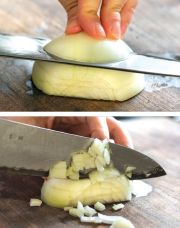
onion dicingOnion Dicing 101
Do you need a refresher in cutting an onion? Stephanie believes there are technically two “right” methods—the “culinary school way” and then the “home kitchen way.” Both are perfectly acceptable. The only difference is your final product might not be as evenly diced.

Professional: Cut off the top of the onion first, trimming the root end but leaving it intact. Then, slice the onion down the middle and peel it. Cut the onion horizontally in layers to the root end. Then come back and cut back vertically in both directions before cutting off the root end. Those first horizontal cuts can be tough for people who aren’t as savvy with a knife or who are not using a sharp knife.

Home Kitchen: A very similar approach but in this case you cut off the top and root end of the onion first, then slice from side to side (so the onion would be in half moons if you separated the pieces), then turn and slice from top to bottom. The pieces won’t be as pretty as the “professional” way, but it’s a lot quicker!


10 Mistakes You Could Be Making In The Kitchen
By Angela Blue

Information from Chef Robert Patton, CEC, CCA, Campus Director for the Culinary Institute of Virginia. Overcooking your vegetables. Unless you are serving them to small children, the vegetables should still have a slight bite to them.

Cooking bacon on the stovetop. Instead, cook it in the oven in a glass baking dish. It saves a ton of mess and allows you to do other things on the range top.
Mistreating your fresh herbs. Trim the root ends a little bit, and then dunk them in a jar with water as you would a bouquet of fresh flowers. For cilantro and parsley, place a damp paper towel over the herbs and store in the refrigerator. For mint, rosemary, thyme, sage and hardier herbs, keep them in their vase out on the counter
at room temperature.

Refrigerating things that don’t like to be cold. Common sense might suggest that keeping things cool in the refrigerator is good for everything—but it’s not. Many items that are often refrigerated don’t need to be, and worse, some things behave badly in there. Potatoes and tomatoes, for example, suffer on the molecular level and lose much of their texture and flavor.

Overcrowding the pot or pan. This doesn’t allow the food to cook properly. Cook in smaller batches or invest in a larger pan. You’ll get a much better result.

Rinsing the noodles. Your pasta wants to wear its sauce like a nice jacket. When you rinse your pasta after cooking it, you are washing away the starch that makes the sauce stick to it. The result? Slippery pasta to which sauce won’t cling.

Not letting food rest. Food needs naps too!

When you take meats and baked dishes out of the oven, they need to sit for a few minutes before serving.

For meats, this prevents the juices from running away from the meat, and for baked dishes like casseroles and lasagna, it helps the liquids be reabsorbed into the food
so you’re not left with a big soupy, slippery mess.

Being afraid of the high heat. Sautéed vegetables, for instance, do better at a higher heat for a shorter period of time.

Tossing your vegetable scraps. Put fennel fronds, carrot ends and other vegetable scraps into a re-sealable plastic bag and keep in the freezer. When it’s full, make vegetable stock.

Not having fun! Don’t be afraid to get out of your comfort zone and experiment.


8 Unique Uses for Ordinary Kitchen Utensils
BY GRACE SILIPIGNI

Among the drawers overflowing with Tupperware containers, bakeware and other miscellaneous kitchen utensils, there are certain culinary devices that can be found in nearly every kitchen, each which can serve a variety of functions. From strainers turned into makeshift steamers to turkey basters serving as pancake makers, we’ve selected eight, common household utensils and offer suggestions on how they can better serve your baking and cooking needs.

Waffle Iron. Waffle irons are the jack of all trades. Not only do they prepare the beloved breakfast item, but can serve as a panini press or quesadilla maker as well. Other sweet treats such as cinnamon buns and brownies can be baked between the two griddles too.

Ice Cream Scoop. This household staple has several uses besides the simple function that its name conveys. Ice cream scoops also happen to measure the perfect amount of batter when preparing muffins, while also serving as the perfect tool for hollowing out the cavities of squash and pumpkins.

Strainer. While strainers are typically used after vegetables, noodles or other foods prepared in a pot of boiling water, we suggest combining the two utensils to create a makeshift steamer. Simply place your strainer, ideally one made from stainless steel, over a pot of boiling water and fill with broccoli, carrots, asparagus or your other favorite vegetable. Then place a lid over the strainer and allow it to steam for several minutes before removing it from the pot.

Tongs. Our alternative suggestion for tongs is somewhat counterintuitive to their purpose, but is certainly helpful. We suggest using the center of the tongs for juicing. Simply place a lime, lemon or other citrusy fruit between the arms and squeeze the open end of the tongs to juice the fruit. This trick is especially useful when preparing large pitchers of lemonade.

Turkey Baster. Turkey basters make their annual debut every Thanksgiving and then are stored away in a drawer for the remainder of the year. It so happens though that turkey basters serve as the perfect pancake maker. Fill the baster with your favorite buttermilk pancake batter and squeeze circles or other fun shapes onto a griddle.
Slotted Spoon. This trick is great for bakers and an easy way to get mess-free egg whites. Over a bowl, simply crack an egg into the slotted spoon to separate the yolk from the whites. Whichever portion of the egg you do not use, refrigerate in an airtight container and save for scrambled eggs or an omelet.

Roller Pin. If you aren’t making sugar cookie cut-outs or a homemade pie crust, the rolling pin may seem obsolete. This device actually serves a wide variety of functions for both cooking and baking. Use the pin as a meat tenderizer to flatten chicken or to crush up graham crackers and candy for baking.

Egg Slicer. This culinary gadget can slice much more than a hard-boiled egg. Try using it to dice up strawberries, avocados and soft cheese, as well as to mince garlic and ginger.


Stock Up Essentials For A Well-Equipped Pantry
Oils (vegetable or canola, extra virgin olive oil, toasted sesame oil): Keep a variety on hand for a little drizzle to finish a dish or to top a salad for added flavor and texture.

Vinegars (apple cider, red wine, rice wine): Each have a distinct flavor profile. A splash of vinegar does wonders to “brighten” up a dish’s
flavor and can be used to replace some of the salt.

Soy sauce: It’s an essential to add a depth of flavor, some umami mouthfeel and also a salty taste.

Worcestershire sauce: Most don’t know that it’s made from anchovies and also offers those umami flavors and a great savory saltiness to dishes.

Sriracha Hot Sauce: It offers a great heat and flavor without having too much vinegar flavor.

Local honey: A little bit of good quality honey instead of sugar not only adds sweetness but also depth of flavor.

Dijon mustard: This adds another layer of flavor, slight heat and also can be used to emulsify or bind a salad dressing together.

Sea salt: Have a nice sea salt on hand, not to use during cooking but to finish a dish and add a
great flavorful burst.

Canned beans (black, cannellini, navy, kidney or garbanzo): Having these on hand can give you a quick go-to meal.

A good quality stock or base: This will add that savory quality and can be handy in a pinch for a quick soup or sauce starter.

Canned tomatoes (paste, diced, sauce/puréed): These are a go-to for a quick sauce when tomatoes are out of peak season.


Lynchburg Community Market

Keeps its Beet Going: The Lynchburg Community Market is bringing the beet back downtown this summer.

“We Got the Beet,” a program offered by the Market in partnership with the Virginia Department of Health, Central Virginia Health District and the Virginia Cooperative Extension, kicked off last year, thanks to a $50,000 grant from the health department. After a successful inaugural run, another $40,000 was granted by the department to keep the beet booming.

“We all have that common goal of contributing to a healthy and educated community,” explained Market Manager Jennifer Kennedy. “It is a really dynamic partnership.”

The program aims to increase health knowledge among underserved populations and expose them to fresh, locally sourced produce. Another goal of “We Got the Beet” is to increase SNAP patronage at the market.

“We live in a very high needs community,” Kennedy said, noting one in four are SNAP eligible. “In these populations we have a particularly vulnerable population … the youth and seniors. They are really underserved inside of that underserved population … we really want to make sure we are offering programming that will be inviting and target those populations as well.”

Programming is free and runs this year from June 9-Aug. 18 on Wednesdays and Saturdays. After a kickoff celebration the first Saturday, the activities will be the same on both days each week, lasting 30 minutes and starting on the half hour at 10 a.m., 10:30 a.m., 11 a.m. and 11:30 a.m.

Each week focuses on a different health message, rotating, week-by-week, between crafts, wellness, and cooking. The adult activities will mirror the children’s activities, scaled slightly to be age-appropriate.

Nakesha Moore

Nakesha Moore, Expanded Food and Nutrition Education Program (EFNEP) Educator, talks to participants about how to make healthier choices, including how to identify the amount of sugar in everyday drinks such as soda, orange juice and whole milk.

“The youth programming was so dynamic last year that one of the improvements that we are having in Year Two is that we are going to have them completely replicate each other,” Kennedy said.

During craft weeks guests will create items they can use to apply the lesson from that session day-to-day. Examples include making a container garden, turning a t-shirt into a reusable bag and decorating a wooden garden stick. Wellness activities range from yoga to exercise training with a local fitness club instructor and even POUND fitness, which utilizes drumming. Cooking weeks help bring exposure to local produce, focusing on an in-season ingredient with a cooking demonstration. At the end, the recipe is shared with attendees.

“We really try to focus on its raw form, so people really appreciate the vegetable for what it really is,” Kennedy explained. The program has a “two bite challenge” hoping to get guests to at the very least try something new. “They get the exposure. … You don’t always have to like it, but the access and exposure aims to broaden your horizons to promote that lifelong learning.”

Some may not realize underserved populations struggle with a lack of access to even the simplest ingredients.

“You have kids come through and you hear a child say, ‘I’ve never had a cherry tomato before, I don’t know if I like cherry tomatoes’ and, all of a sudden, they try it and they like it,” Kennedy said. “Things like that that are so impactful… so many of us take for granted that we know what a cherry tomato tastes like, that we know what fresh broccoli tastes like … that is so important.”

That is why Kennedy feels the program is so important, and why the team strives to build engaging, exciting programming.

“What we wanted to do is not necessarily have something that people can already get everywhere, which is read about nutrition in a book or just have someone talk at you,” she said. “We know that is readily available out there. … We wanted to make this something applicable and something that is relatable so that is why we wanted to bring such dynamic components into it.”

One of the ways “We Got the Beet” resonated was through an original hip-hop song, written and performed by local artist Jiggy M. While the lyrics focus on vitamins, nutrition and health, its catchy rhythm and infectious dance are what draw interest and keep the message playing in children’s minds. The music video—which features the rapper, local schoolchildren and the program’s Beet mascot—has been shared and viewed tens of thousands of times on social media and even a year later Kennedy sees kids, unprompted, breaking out the song’s choreographed moves or repeating verses from it when she visits schools to promote “We Got the Beet.”

The program is structured to incentivize people to keep coming back. Each week guests come home with items to build their chef’s toolkit, such as measuring cups, spatulas or apple slicers, as well as promotional materials. Those who attend two out of the three weeks in each cycle receive a take home “beet box” with items to help them cook the recipe at home. Journals are also provided to help children think through what they have learned and share (via emoji beet faces) what they thought of what they tasted or experienced. Adults are also encouraged to journal at the events so they can take home new cooking and exercise ideas. The program will wrap up with a graduation celebration (Aug. 15 and 18).

Last year, “We Got the Beet” served approximately 400 participants. Most said afterward that they care more about eating healthy and have become more physically active. Of the children surveyed, nearly half said they now choose water over other beverages when thirsty (a ten percent increase from the start of the program) and 90 percent said they like trying new foods (up from 60 percent).

Verna Lamb, whose son Thomas, age 10, participated last summer, appreciated how the program reinforced the healthy eating habits she tries to encourage at home.
“I liked how they initially got the kids to try a vegetable and talked about good health and how to incorporate good eating habits,” she said. “I liked how they made it fun with different activities.”

Thomas agreed that it was “very fun.”

“They had all different kinds of activities there, like a bouncy castle,” he said. Thomas said the programming helped him to try things he might not otherwise. Now, he would encourage other children, “Don’t be afraid to try different foods just because they look bad.”

In the effort to help expand the horizons of Lynchburger’s palates, the market offered a “2-for-1 SNAP dollars” promotion last year (which it hopes to be able to offer again this summer).

“That incentive was putting more healthy foods on the tables of people who desperately need it,” Kennedy said. “Helping families.”

Not only did that mean double the fruits and veggies for many who might not otherwise have them, it also meant more support for area growers. And that is what “We Got the Beet” is all about—a strong healthy community, where Lynchburg Locavores support one another.

“We want to try to help people to live better,” Kennedy said.

“That is a common goal of this great collaboration between the three groups. If we can offer programming that is building a foundation for that, then we are all beyond elated to think that we are helping individuals in our community live just a little bit better.”
Learn more about “We Got the Beet” at lynchburgcommunitymarket.com/wegotthebeet.


Photos COURTESY: CITY OF LYNCHBURG


Contemporary Garden Concepts

Gardens for a Sustainable Environment: Contemporary Concepts

This is part two of a two-part series on garden design. Be sure to check out Susan’s part one from our March/April issue, “Garden Design: Making It Your Own”.

Environmental sustainability matters to millennials. It ranks among their top three most important issues, along with college affordability and health care, according to a recent survey by Virginia21, a millennial advocacy organization. Millennials’ passion for environmental quality is fueling the flames of political advocacy and informing thoughtful personal choices.

This news sparks flashbacks of my own fervor for environmental advocacy at their age when I was employed as Virginia’s first Environmental Impact Statement Coordinator in the early 1970s. Passing the torch to millennials makes my heart sing and gives us all hope for the future of this earth.

Contemporary approaches to gardening reflect the values of environmental champions of all generations. And enhanced awareness and commitment to sustainability translates into garden design and plant material selection that favor sustainability over adherence to historical design norms.

At Home with Nature
What gives us greater joy in spring than a flowering dogwood announcing the end of winter? What better shades us from intense summer sun than a majestic white oak tree? These and a multitude of other native plants are a large part of what we love about living in Central Virginia. And they are the environmentally sustainable choice for our gardens.

I’ve touted native plant guru Dr. Douglas Tallamy and his book, Bringing Nature Home, in several previous issues of Lynchburg Living. Another valuable resource is a new book by Repp Glaettli, Piedmont Native Plants: A Guide for Landscapes and Gardens, reminding us of the aesthetic beauty of local native plants, supporting nurseries in stocking the best varieties, and cultivating deeper understanding of the cultural and natural heritage of native plants in nearby counties of our shared Piedmont region. It also offers practical tips for best growing practices and catalogues native trees, shrubs, vines, grasses, and perennial wildflowers.

First and foremost, contemporary sustainable garden design relies on the right plants for the right locations, accounting for site conditions: size, climate, soil, water, nutrition, and other plant needs. Native plants in the right place require little soil amendment, watering (once established), nutritional supplements, and human pampering. After all, since they’re in their native habitat, they demand no extra fuss.

I fell in love with one native plant at a time and added it to my yard. Then when rose rosette disease claimed dozens of my antique roses and I knew that I could not replant with roses, I chose natives to replace them and never looked back. I was committed to bringing nature home.

Pollinator Power
When I climbed the pasture fence at our farm to retrieve what I’d assumed was a piece of trash that looked suspiciously like a plastic Cheetos bag, I was immediately infatuated with an amazing orange blooming plant covered with monarchs and great spangled frittilaries. Googling it, I discovered it was aptly named butterfly weed, and I couldn’t resist digging it up for my yard. And… voila! I launched my commitment to creating a pollinator garden.

Most of my “starter” native/pollinator plants for my yard and garden came from our farm pastures, woods, and (I confess) even roadside ditches before natives started catching on with local nurseries in response to popular demand. For city folks, stock from country cousins, friends, or nurseries is a better choice than digging from property you don’t own. However, harvesting and transplanting roadside milkweed into a pollinator garden for monarch caterpillar sustenance seems a more noble act than leaving it for inevitable VDOT spraying or mowing.

Natives that attract pollinators, such as Joe Pye weed, coneflower, mountain mint, monarda, and summer phlox, can vigorously populate or happily co-exist with exotic cultivars in lush English-style borders and can vibrantly complete the formal design of a classical Italian garden or a French-style parterre, if that’s your preference and you’re not about to start over with your garden design. They also work well in modern, minimalist gardens; and hybrid designs are just fine.

They’re actually more interesting and contemporary.

Fun garden ideas that have been enjoyed for decades and are gaining increasing popularity are wildflower meadows sporting a mixture of pollinator-attracting flowers and native grasses, as well as woodlands gardens. They typically require a fairly expansive open or wooded area, although “mini-meadows” or tiny wooded areas in city backyards for wildflowers such as native large-flowered trillium can work well too.

The point of pollinator gardens is, of course, to attract and support a wide variety of birds, bees, butterflies, and insects, many of which require specific native plants for nourishment at various stages of their life cycle, with the classic example of milkweed for monarch caterpillars. It’s important for all of us, millennials and older folks, to understand that these host plants and the pollinators they support are critical to the biodiversity necessary for a healthy ecosystem.

Managing Water
A concept that’s turned into a viable alternative garden design and has gained traction in recent years is rain gardens. Rain gardens are basically an effectively engineered way to deal with areas where rain collects or that flood periodically from run-off from impervious surfaces such as buildings, roads and walkways. They are depressions in the landscape that gather water but eventually drain. What they’re NOT is swamp land, ponds, water gardens, or other land that remains wet or under water as a usual thing.

Plants that work in rain gardens can survive periodically standing in water, followed by dry spells. We have a prime example of a well-designed rain garden here in Lynchburg’s downtown Riverfront park. The area is subject to runoff from our city that rises on the bluffs above it. You’ll notice the garden is designed with trenching, sunken beds, and bridges leading to the adjacent performance area.

The garden’s been scientifically engineered with layers of rocks and other devices so water can drain slowly, removing pollutants, and be absorbed back into the earth rather than running directly into the James River. Rain gardens are an environmentally sound method of dealing with city storm water run-off, water conservation, and river water quality. Planted with site-appropriate plants, they are a beautiful, as well as functional, solution to environmental degradation from soil erosion and river pollution.

If the idea of hiring professionals to design a backyard rain garden seems too grand or expensive, but you have issues with rainwater runoff from your roof, driveway, or other impermeable surfaces, you can simplify matters with a Do-It-Yourself version, as I did. My roof drainage problem resulted in a mud hole at my basement door after every heavy or prolonged rain. With steep slopes rising from this door on both sides to downspouts at the corners of the first floor of the house, water inevitably cascaded downhill, taking soil with it, to… guess where! What to do?

First, I hauled in rocks and pavers and hand-built dry stack stone walls and a stepping stone path over permeable garden fabric to the door. (When my husband Tim calls me his “Rockette,” it’s definitely not because I’m a long-legged NYC dancer!) I then angled out terraced slopes behind the walls and added large rocks for soil retention. Next, I affixed one end of 15-20 ft. PVC pipes to each downspout to run the water out from the house, and planted small trees, shrubs, and perennials that could handle periodic flooding. I camouflaged the pipes with rocks and polished the terraces off with mulch. And, miraculously, it worked! I didn’t even know my home-grown concoction was a variation on a garden design with the official name of “rain garden.”

Water gardens, on the other hand, are just that: pools, streams, waterfalls, fountains, and other water features. As we’ve seen from looking at the history of gardens through time, water features with wonderful water plants have been integral to gardens for centuries, and they can be incorporated into indoor or outdoor spaces. They have never faded in popularity, and likely never will.

While sunken gardens offer the option of flooding and deep watering through slow absorption (and are typically more necessary and likely in arid climates), our area is more likely to embrace raised gardens that promote speedy drainage. They also serve the function of providing elderly or mobility-challenged gardeners the ability to enjoy gardening at a comfortable height, thereby meeting physical, medical, psychological, and spiritual needs.

Designs Turn Sideways, Up, and Down
When space is limited, or even if not, sometimes a small, simplified pocket, porch, patio, courtyard, or even alleyway garden is preferred. These tiny gardens can be exquisite, lovely, inviting, and a pleasure to their creators and guests.

Vertical gardens are enjoying a resurgence with a return to inner-city living, smaller home lots, condos, and other close living quarters where garden space is likely to be curtailed or non-existent, as well as in hotels, commercial offices and restaurants. Whenever I see a successful one, I find myself searching for the source of water and soil or other medium for nutrient delivery necessary for plant life. And I typically find a well-engineered structure that serves as a framework to hold individual plants and an irrigation system. I’m intrigued, but this isn’t something I plan to do at home. My engineering skills were pretty much tapped out with my “rain garden” project.

Espaliered (mid-17th century French from Latin) plants are trained to grow flat against a wall. While this age-old method historically was used for fruit trees and ornamental shrubs, its popularity has expanded in modern times to include any plant material, native or exotic, that can be trained in this fashion, such as magnolia, Lady Banks roses, and pyracantha. Lattice and similar framework are traditional supports for espaliered fruit and other types of trees, but permanently installed hooks with wires and other modern engineering options are available to carry higher and heavier loads.

Tower Gardens, made possible by modern technology, are a contemporary idea. One example is the hands-on tower garden project of the Princess Anne Garden Club in Virginia Beach that’s instilling a love of gardening while teaching environmental sustainability to the generation following Millennials (pre-K – 12th grade) in three public schools. The towers are 6’ x 4’ with slots for 28 plants, with herbs, vegetables and flowers grown in each cell, without soil; and each tower sits on a 20-gallon basin of nutrient rich water that supports the plant material. And they’re on wheels for easy movement.

This 21st century growing method is called aeroponic, with the root system aerated through misting with a nutrient-rich spray. It’s a first cousin to hydroponic growing methods that have been around a long time and which use a liquid nutrient solution for root immersion. I got my first glimpse of how efficient and effective this process can be on a behind-the-scenes tour at Disney World about 15 years ago. Thousands upon thousands of plants on high conveyer belts were producing abundantly to feed throngs of visitors. Will aeroponics and hydroponics, already used extensively in China, be the next “big thing” in the U.S. to address both environmental and economic issues in food production and home gardening?

Understated Elegance
In addition to prioritizing environmental concerns, contemporary garden design also reflects artistic and aesthetic values, which currently lean toward asymmetrical, angular, and pared down to essential elements tied together by hardscaping in a unified architectural sensibility. Current U.S. taste tends to draw more heavily on the Japanese Zen tradition than more elaborate and symmetrical layouts.

A “less is more” philosophy guides today’s design.

Hardscaping often creates the “garden bones” in contemporary designs that yews, boxwoods, and other workhorse plants provide in traditional gardens. Natural materials such as stone and slate continue in popularity, and manmade materials, including pavers that offer permeability, have come a long way aesthetically as well as functionally. With low maintenance as a goal, these gardens may have self-watering planters, be all green, or feature repeat patterns of only one plant, such as an interesting native grass. Or they may include several varieties planted in repetition for contrast.

Visual interest is on many different levels even in these sleek designs and may include vertical plantings on privacy or partition walls. A focal point is always necessary, and several focal points can be effective if judiciously placed. Good lighting is essential for a dramatic spotlight on prized features, as well as for safety on pathways and near potential hazards, such as pools and ponds.

As my millennial grandchildren would say about contemporary gardens, “This is not our grandmother’s garden!” This grandmother freely admits sentimental attachment to the design of her old-fashioned country cottage garden with organically shaped English borders overflowing with a lush jumble of hundreds of exotic and native plant species.

Yet, I also respect and am strongly drawn to the elegant, serene beauty of refined minimalist and other Zen-like contemporary concepts. These fit the millennials’ mindset to shed the shackles of traditional concepts of political partisan tribalism or strict precepts of traditional garden design they perceive as inconsistent with their values and priorities.

I get it. After all, I’m already a kindred spirit with millennials in their desire to sustain our environment.


Editor’s Letter May/June 2018

True confessions from a mother, wife and work-from-home magazine editor. Sometimes I pour a can of Manwich into some ground beef, throw some buns on the table and call it a day. (I know. Some of you are throwing your magazine in the trash as we speak. Please keep reading.)

But lately, I’ve set a small goal for myself to try to make more of those quick-and-easy shortcuts “from scratch.” For example, I made my own sloppy joe sauce with fresh veggies instead of relying on my good buddy Manwich. I also was extremely proud of a homemade chicken noodle soup we enjoyed on a freezing night in late March (because it was the winter that would never end). It was nice to slow down and feel accomplished by a culinary creation…instead of settling for what came out of a can.

Seriously—I fished for compliments from my husband for weeks I was so proud of myself: “Remember how awesome that soup was that I made?”

Our goal with this Food Issue is to recharge your confidence in the kitchen as well as your fondness for food. In the Taste department, we’ve compiled dozens of cooking tips from multiple sources.

From time-saving tricks to top kitchen mistakes, we hope you learn something new in “Back to Basics: Helpful Hints for the Home Kitchen.”

The Lynchburg Community Market is working hard to spread awareness about how to prepare healthy food (and other healthy lifestyle habits) in the second year of its “We Got the Beet” program. By focusing on areas of the city that are considered “food deserts,” this initiative has already led to better choices and attitudes among participants. Hear more in our Body feature on page 61.

It’s perfectly okay to let someone else nurture your food-loving spirit. Our much-anticipated Lynchburg Restaurant Week is back for its 7th year with 30 restaurants participating. See all of the menus starting on page 73 and start planning out where you will dine June 23-30.

And if you are on the road this summer and are looking for a new food spot to try, we have highlighted four options for you in four different parts of the state in our Travel feature, “Go Out (of Town) to Eat.”

Now that I’ve finished this Editor’s Letter I can move on to the next item on my agenda for the day: finish building my online shopping cart with Kroger ClickList. And I promise you—no cans of Manwich are allowed!


Shelley Basinger, Managing Editor
Shelley@lynchburgmag.com


America’s Favorite Couple

Step away from the grill this summer and let someone else do the work once in awhile. We recommend these three unique local burgers, all perfectly paired with craft beer.


The Mac Attack
at Beale’s Brewery
510 Grove St., Bedford • www.bealesbeer.com

Two house ground chuck and brisket blend patties topped with American cheese, homemade mac and cheese, and hot sauce. (Add bacon for extra flavor.)

Take your napkin and tuck it into your collar because this burger experience isn’t for the prim and proper. The Mac Attack at Beale’s Brewery combines the classic American cheeseburger with an all-time favorite comfort food—then a rich and complex tangy hot sauce seals the deal.

According to pitmaster Neal Agee, “Everything on this burger is made in house, fresh daily.” Be sure to ask for a fork because you’ll want to scrape up every last bit of this messy creation from your plate.

Wash it down with: A flight of Beale’s beers that are brewed just feet from where you sit. (Pictured: Gold, Silver, Red and Black)


Black & Blue Bacon Jam Burger
at Benjamin’s Restaurant
14900 Forest Rd., Forest • www.cowsandcrabs.com

80/20 Sterling Silver ground chuck topped with blue cheese crumbles, Benton’s Smoky Mountain Tennessee bacon mixed with caramelized onions, brown sugar and local honey, and Arugula.

Sweet, spicy, creamy, smoky, juicy—if it’s possible to pack every savory flavor into one beef experience, Benjamin’s Restaurant accomplished that with their Black & Blue Bacon Jam Burger. “It has a wider spectrum of flavors and unique ingredients than most other burgers,” explained owner Benjamin McGehee.

The bold blue cheese is the perfect complement to a unique “bacon jam” and some spicy Arugula. We would give this burger two thumbs up but we’re too busy stuffing our faces.

Wash it down with: Ben recommends a “big IPA” that can stand up to the burger’s powerful flavor, particularly the Hells Frozen IPA from Apocalypse
Ale Works.


The Hogtown
at Fifth and Federal Station
801 Fifth Street, Lynchburg • www.fifthandfederal.com

8oz. burger cooked to your preference topped with slow cooked pulled pork, house smoked bacon and a savory bacon bourbon jam.

Barbecue… bacon… bourbon… your encounter with a burger doesn’t get much more Southern than this.

The Hogtown is crafted 
by Fifth and Federal’s
Chef Rufus, formerly
of Toy Town Soul
Food in Amherst—this piece of pork lovin’ goodness is a nod to the nearby Madison Heights.

Y’all will not be able to put this one down after the first bite.

Wash it down with: Their house brew, Chaos Federal Reserve—a Scottish ale brewed by Chaos Brewing Company then aged in Smith Bowman bourbon barrels.