Living Out Loud July/August 2018

Vote Today
Visit lynchburgliving.com today to cast your vote in two of our very popular contests!

Nominations are now open for the Best Of Lynchburg Awards—recognizing your favorite businesses, restaurants, destinations and more. Voting ends on September 28. The results will be published in the January/February 2019 issue of Lynchburg Living.

Voting for our Giving Back Awards continues through July 30. Select the nonprofit you think should be recognized for its contributions to the Central Virginia region. The winning nonprofits will be featured in our November/
December issue.

Feedback
From the text to the photography and beyond, the Lynchburg Living team works hard to make sure our story subjects are well represented. We appreciated hearing this positive feedback from our May/June issue’s Artist Profile, Kathy Cudlin:

“I just wanted to tell you how thrilled I am! … The layout is just beautiful, and you all picked exactly the photos I loved the best from the photo shoot, so thank you, thank you! The magazine is always truly gorgeous, anyway, and I am so pleased to be in it.”


Send us an e-mail to shelley@lynchburgmag.com. Correspondents must identify themselves; names may be withheld on request. Lynchburg Living may edit or condense.


The Resurrection of the Virginian

Lynchburg’s first luxury hotel is back on the map, more than 100 years later—with no detail overlooked

Four years ago, George Stanley and Blair Godsey, the developers behind Imperial Tobacco Lofts, Cliff’s Edge Lofts, and other recent Lynchburg building projects, were looking for a new challenge.

Then the Virginian, a former hotel at the corner of Church and Eighth streets, went up for sale.

For 30-some years, the Virginian had served as low-income housing. Before that, it spent 10 years as a dormitory for Liberty University, then Lynchburg Baptist College. For a brief time, in the late 1960s/early ’70s, it was the Stewart Arms hotel. But before that, from 1913 to 1968, it was the Virginian Hotel.

When the Virginian Hotel first opened on April 30, 1913, Woodrow Wilson was president of the United States, a loaf of bread cost six cents, and Lynchburg was amid what The Times Dispatch in Richmond would call its “Great Building Boom.”

At the time, the Virginian was one of several high-profile construction projects underway in the Hill City. The Times Dispatch credited the city’s chamber of commerce with not only seeing the need for a luxury hotel but also with raising the $300,000 needed to build it.

Hundreds of people attended the Virginian’s grand opening. The following morning, the Lynchburg News praised the hotel’s “artistic beauty,” saying it was “completed with every detail,” with a “spacious lobby … finished in tan, with a blue tapestry effect” and a “men’s café,” decorated with mission-oak furniture.

According to the paper, the first guest to sign in was Mr. S.E. Blackford, of Hampton, Virginia.

original facadeA ‘crazy’ idea

By 2014, when Stanley and Godsey first saw the Virginian, it wasn’t much to look at. As Godsey puts it, the hotel was a “very much-depreciated asset,” with leaky plumbing, a leaky roof and other serious issues.

Despite that, Godsey said he and Stanley “were able to see beyond the filth and disrepair.” There also was a hidden gem: the original marble staircase, which had been walled off from public view for more than 30 years. “It was beautiful,” Godsey said.

Initially, the developers thought they might convert the Virginian into high-end apartments, the kind of work they’d been doing for years. They soon realized that wouldn’t work because there was a large amount of space that couldn’t be easily converted into apartments.

So, Godsey floated an idea: “I proposed the idea of ‘How great would it be if it could be redeveloped and brought back as a luxury hotel?’ And everyone, at first, thought I was crazy.”

Intrigue, scandal and the ‘Hot Virgin’

Proposing that the dilapidated building be returned to its former glory wasn’t the first “crazy” thing to happen in the hotel’s history.

In April of 1916, for example, a Kentucky man wrote his hometown newspaper from the Virginian, described by the paper as a “swagger hotel at Lynchburg.” The man, Walter Stadelman, wanted to set the record straight on why he hadn’t been seen around town lately.

“Dear Sir,” he wrote to the editor of the Hopkinsville New Era. “Will you be kind enough to let my Hopkinsville friends know through the columns of your paper that I am living at Lynchburg, Va., and not in prison as a German spy, as reported in your city? I am no pirate or spy but enjoying the pure air and freedom of the mountains of Virginia.”

In 1958, an ax-wielding Virginian bellhop named Clarence Dabney wounded one man and killed another before being arrested. The murder victim, William Owen Grubbs, was attacked at a service station across the street from the Virginian. A Tennessee newspaper said Grubbs’ body was discovered by another bellhop and a hotel guest.

Then there was the “Hot Virgin.” During the Virginian’s first stint as a hotel, light bulbs on the hotel’s rooftop sign—it said “Hotel Virginian” at the time—would suspiciously go out. When they did, the sign would read “Hot Virgin.”

‘Full-speed development’

Stanley and Godsey decided to go for it. After some preliminary design work, they put the building under contract and spent the next year wrangling financing and state and federal historic tax credits. Construction began in 2016 and from that point on, Godsey said, “it was full-speed development.”

Asked about the challenges of resurrecting the Virginian, both Stanley and Godsey laughed.

“It was an incredibly challenging project,” Stanley said, citing, among other things, the creation of Lynchburg’s only rooftop restaurant, the Skyline Grill. “The rooftop addition was structurally very challenging. From a historic-approval point, we were able to get that rooftop addition approved and we were extremely fortunate.”

Stanley and Godsey also negotiated with Hilton Hotels for the Virginian to be part of the Hilton Curio Collection, a global chain of boutique hotels that also includes The Hotel Roanoke. “We realized very quickly, when we decided to do a hotel, that we were going to need, and wanted, an affiliation with one of the big hotel brands,” Godsey said.

“We identified the Curio Collection, a soft-branded, four- or five-star brand by Hilton that allows you to … utilize their reservation system and the Hilton Honors program, but also allows you to develop a unique, independent property.”

While Hilton gives owners creative freedom, opening a boutique hotel isn’t easy. “There’s a level of detail that goes into developing a boutique property,” Godsey said. “There were no grand standards, so it created huge amounts of design complications and challenges.

“Everything in the hotel was custom designed, from the furniture to the beds to the carpet. Trying to figure out how to bring [together] 115 guest rooms, almost 10,000 square feet of banquet space and three restaurants with a common, but unique, design was the most-challenging part.”

Two years and $30,000,000 later, which Stanley said included “acquisition, renovation and the rear parking-deck construction,” it appears they’ve done it.

the virginian‘Completed with every detail’

Like the newspaper’s 1913 description of the hotel, the second coming of the Virginian was “completed with every detail.” Throughout the hotel, there’s a midcentury-meets-Hollywood-Regency vibe, with white marble, crystal chandeliers, satin-brass accents, and Moore & Giles leather furniture. There’s also lots of original artwork, much of it local.

Above the check-in desk is a metal-and-glass piece by Paul Clements, creator of Lynchburg’s LOVE sculpture. In a gallery off of the ballroom are impressionist landscapes and cityscapes by Lynchburg painter Annie Harris Massie.

Local artist Kevin Chadwick was commissioned to do two series of paintings, one of which hangs in the elevator lobby, near the Marigold Café. Chadwick said the owners gave him lots of leeway, asking only for something in the art deco style that incorporated marigold flowers and told a local story.

The end result is four dazzling paintings that feature notable people from Lynchburg’s past: pioneering aviator Chauncey Spencer, folk artist Queena Stovall, architect Amaza Meredith, shoe-factory owner John Craddock, dancer Helen McGehee, poet Anne Spencer, painter Pierre Daura, writer Pearl Buck and surgeon Dr. Rosalie Slaughter.

Chadwick’s subjects are intertwined with marigolds, as requested, along with Italian greyhounds, a favorite breed of the artist’s. Chadwick also incorporated his signature technique, a patchwork of different patterns that is woven through each painting. As he describes it, it represents “peeling back the layers, through the years.”

Lynchburg’s ‘Eloise’

One person who’s anxious to see the resurrected Virginian is Barbara Chavatel. Chavatel grew up at the Virginian Hotel, much like “Eloise,” title character of the popular children’s book series, lived at the Plaza Hotel in New York City. Chavatel lived at the Virginian, where her father was general manager, from 1938 to 1957, from the age of 2 to 21.

As a youngster, Chavatel rode her tricycle down the Virginian’s halls. She met movie stars, who were in town selling war bonds, and Helen Keller. “I remember that very vividly,” Chavatel said of Keller, the blind-and-deaf activist, author and lecturer. “She put her hands on my face and looked at me with her hands. I remember her saying, ‘What a pretty girl.’”

Chavatel was a favorite of the hotel staff, who called her “Miss Barbara” and doted on her. “They were very much a part of my family,” Chavatel said, adding that Lacey, the hotel’s maître d’, was particularly dear. “Lacey was one of my favorites and I think I was one of his favorites.”

When she went to Randolph-Macon Woman’s College, Chavatel said Lacey “told the major cook there that ‘I’m seeing Miss Barbara out to school and I want you to fix her something good to eat.’”

When Chavatel married in 1958, the largely African-American staff gathered to see her off to her wedding. Many attended the wedding as well. Because it was during segregation, however, the usher was flummoxed as to what he should do. Chavatel told him, “Well, you seat them. On my side.”

After her marriage, Chavatel moved away. The decades passed, the Virginian closed and the property fell into disrepair. When she returned to Lynchburg for college reunions, Chavatel said couldn’t bear to drive by her old home.

Now, she’s ready to see the Virginian again. “I have a friend in Lynchburg who’s been sending me articles,” Chavatel, who lives in Richmond, said. “I’m delighted that they’re [redeveloping] it. I certainly commend the owners and everyone who had something to do with it.”

She’s planning to attend the grand opening, which will likely be held in September. The owners are looking forward to seeing her. “We invited her to come up before the grand opening,” Stanley said. “We’ve told her we’d comp a room [for her] anytime she wants to [come]. She’s absolutely invited to stay. Our idea, for the grand opening, is to have her serve as guest of honor.”


Succulents

Bizarre Beauties

WORDS & PHOTOS BY SUSAN TIMMONS

They’re in vogue. The cool kid on the block. Such a hot item that CVS on Langhorne Road featured a vividly blooming batch for sale last week, and they flew out the door.

They’re the Dr. Seuss characters of the plant world. Curious, quirky, even outlandish to eyes attuned to typical Lynchburg flora. Some have symmetrical rosettes or other geometric shapes; others are oddly formed. Some look like foreboding rubbery cartoon creatures from ocean depths or outer space; others are so fuzzy and cute you almost want to cuddle them. They come in every color of the rainbow—subtle to brazen.

Some are edible or have herbal healing properties. One produces tequila, and another is a source of a USDA Schedule I controlled substance.

These plants are called succulents from the Latin word sucus, meaning juice, or sap. Dictionary synonyms for the word succulent are “tender, juicy, moist, fleshy, pulpy, soft, tender…” The common denominator is their capability to store water. Some, such as cacti, are especially adapted to living in arid conditions with poor soil conditions (xerophytes); others, such as bromeliads, can live in moist tropical environments in trees (epiphytes). And some, such as crassula, can even live under water (aquatic).

According to publications by experts, they have a variety of water-saving features, including:
• special metabolism adapted for efficient photosynthesis
• photosynthesis in stems, rather than leaves
• limited number of pores for oxygen and carbon dioxide exchange
• compact, cushiony, columnar, ribbed, or spherical growth patterns to reduce sun exposure
• spiny, waxy, or hairy outer surface areas to reduce water loss
• shallow roots to grab moisture from dew or short showers
• water conservation when external temperatures are high (120+ degrees F)

where they growWhere They Grow

Succulents can adapt to brutal environments. They can live on salty sea coasts and dry lakes, and they can survive concentrated levels of dissolved minerals. High temperatures and low precipitation force them to collect and store water to survive long dry periods—up to many months.

Since succulents conserve water by means other than the fleshy leaves we typically see in plants native to our Piedmont region of Virginia, they are naturally adapted to dry environments all over the world. Various species are found in desert, semi-desert, and flat grassland areas in the Americas, southeastern Europe, Africa, India, Asia, Siberia, Australia, and more.

The rocky, arid coastline of California is one of those habitats where succulents grow naturally. Yet, for many years Californians turned their backs on their native plants and favored English-style lawns and other water-intensive trappings of our U.S. East Coast gardens as high fashion. Fortunately, in recent years, environmentally sensitive California coastline homeowners, as well as hotel and other commercial building managers, have responded to water shortages by “going native” and designing elegant gardens featuring their native water-saving succulent plants.

Another rocky coastline with a fascinating display of succulents is on the Mediterranean Sea. Jardin Exotique (Exotic Gardens) in Monaco boasts one of the largest, most magnificent, and meticulously labeled collections in the world, with several million succulents planted on a cliff overlooking the royal palace and the sea. The initial collection was acquired from around the world by Prince Albert I of Monaco in 1899, and he founded the Jardin Exotique in 1914 to showcase these trophies. Some original specimens are still there.

This is indeed a mecca for succulent aficionados. Though most of the plants in the collection could not normally be grown on the Riviera because of the cold mistral winds from the north, the Jardin Exotique is fortuitously protected by a mountain range, tempered by mild sea breezes, and hydrated by fog.

I’d always been a bit curious about succulents and somewhat amused by their odd and foreign appearance in our lushly vegetated and water-rich Virginia. But I’d never truly warmed up to them until a top-notch guide at the Jardin Exotique inspired more earnest education, quashed my (embarrassingly) provincial aversion to many succulents as simply weird oddballs of the plant world, and converted me into an enthusiast.

Closer to home, the most spectacular collection of succulents I’ve seen in the U.S. is in the world-class Desert Botanical Garden in the Sonoran Desert within the city of Phoenix, Arizona. The focus of this plant museum is to preserve Arizona’s natural desert habitat with research, exhibitions, conservation, and educational programs. Over 50,000 desert plants, including endangered species, inhabit 50 acres.

I’d never felt the allure of succulents pull my heart as well as my head into their world until this past January when visiting this magnificent botanical garden with my husband Tim’s knowledgeable and engaging Scottsdale cousin Donita as our guide. I was not only cured of my ignorance, but also officially seduced!
here in lynchburgHere in Lynchburg

Now that I’m hooked, outdoor succulents grab my attention all over Lynchburg. During the years I worked at Randolph College, I had little appreciation for the flamboyant and commanding May-June white yucca blooms rising above the red brick wall against the backdrop of dark, leafy greens in front of Presser Hall. In retirement, I now honor them as one of the joys of my daily walking regimen.

And I can’t help but marvel at the spectacular stand of prickly pear cactus in front of Betty Bright cleaners near the southeast intersection of Route 221 and the Route 501 Expressway. Betty Bright’s patch of prickly pear blooms sunshine yellow during May and June each year, sets striking red fruit each fall, and delights passersby year after year. Who’d have guessed succulents would grow so successfully in a parking lot along a busy traffic artery in Lynchburg? As one of the hardiest of the cacti, it’s certainly adapted to our summer humidity and winter freezes. And there are other tough succulents along that stretch of road. It’s a veritable succulents road show.

When giving a talk on succulents at the Templeton Senior Center recently, I discovered that my audience was well familiar with numerous yucca, prickly pear, agave, and other conspicuous succulent plants growing outdoors in Lynchburg and our surrounding counties. Have you noticed any?

Although succulents certainly are not yet on Lynchburg gardeners’ “most popular plantings” list, they do show up in traditional Virginia gardens in small doses and happily coexist with neighboring native and other exotic plants. I successfully grew several lovely varieties of sedum, including the ever-popular “autumn joy,” hens and chicks (sempervivums), ice plant, and other succulents whose names I can’t recall, in my own perennial gardens, and they survived our winters.

A bonus of sedum is the beauty of the flowers in late summer and fall and their attractiveness to bees and other pollinators. Once flowers are spent and dry, they add visual interest to the winter garden and offer their seeds to birds.

However, most succulents prefer warm temperatures and are not able to withstand freezing. Due to the water stored in their leaves, freezing will often result in the plant getting mushy leaves and/or dying. So, most succulents around Lynchburg live in pots in homes.

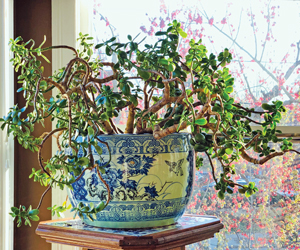
My all-time favorite potted succulent is a decades-old jade plant that has withstood a couple of moves, neglect, and schlepping to church and other places when a specimen’s been needed. It even survived our most recent move with a maladjusted cat who decided its sandy soil was preferable to his kitty litter box for relieving himself. After discovering this assault on my venerable jade, I intervened and nursed it back to health. And it managed to regain its vitality and spread to 40 inches wide. These plants are tough.

I even had large potted bottle/ponytail palm (beaucarnea) for years that lived outdoors in summer and in the dark and cold (but not freezing) garage in winter. This is one of the varieties of succulents that sports a bulbous lower trunk for storing water, and we didn’t water it all winter. In keeping with our family tradition of sharing plants, my son Reid now enjoys it in his sunroom in Mathews County in the winter and on his screened porch in summer.

Until recently, the potted succulents seen most often in Lynchburg were typically passed in families or friend to friend, usually through cuttings. Reid and one of our daughters-in-law, Leisa, are now growing jade plants from cuttings from the mother plant (that’s also been passed around in the family). With the widespread rise in popularity of interesting varieties new to us, succulents are now more frequently purchased through nurseries, florists, and big box and grocery stores (and even pharmacies).

In addition to those already mentioned, popular varieties historically have been kalanchoe, euphorbia, bromeliads, Christmas cactus, aloe vera, agave, and snake plant (sansevieria). In years past, indoor succulent collections typically started with a little aloe vera at the ready for treating burns or a tough snake plant, with other varieties added over time. Today, a wide array of tiny succulents sporting fascinating shapes and showy blooms seem to be everywhere.

crafts and careCare and Crafts

Since most succulents are not cold-hearty, they’re enjoyed as annuals for only one season if planted in the garden. But if planted in pots for outdoor display in summer and moved indoors for protection during winter, they can be enjoyed for years. As potted houseplants, succulents require little maintenance and don’t demand fertilizing or regular repotting.

When planting succulents in the garden, it’s important to remember that they need good drainage, or roots will rot and they will die. Our native compacted red clay doesn’t cut it for most succulents. We must amend the soil to give them a mixture containing sand or gravel or tuck them into stone walls or other places where their roots will not sit in soggy soil.

Most potted succulents need watering only every few weeks or less frequently. You can even take an extended vacation without a plant sitter and they’ll survive. Succulents are the ticket for those of us who choose to wean ourselves away from drama queens, whether in friendships or flowers.

While many succulents require bright light, too much direct sunlight can result in color change. Some green succulents tend to take on red tones (called “blushing”), especially along the edges, if light is intense. Bright light, but not direct sunlight, is best for many, yet some (like snake plant) thrive in low light, so it’s important to learn and follow the individual preferences of each variety.

One of the amazing qualities of succulents is easy propagation. The most common way to propagate is through a cutting, which is simply a several-inch piece of cut stem with leaves. It’s left for a week or so to “cure” and produce a callus, then placed in a growing medium such as sandy soil—and roots most likely will grow. This is the method I use for sharing my jade. Another method is division, which requires uprooting an overgrown clump, easing roots and stems apart, and separating into several plants.

While I confess I’ve only infrequently upped my floral design game by featuring succulents in arrangements, experts confirm that they’re an excellent choice for bridal bouquets, topiaries, vertical gardens, and other uses where you need plant material that won’t quickly wilt. I do know from experience that succulent rosettes can last without a water source for days. If misted or in wet floral foam, they may last for weeks. They are excellent for crafting and can even be attached with glue for decorating packages, holiday ornaments, or party favors.

Rising Stock

Succulents have in recent years captured the imagination of gardeners in Virginia and continue to gain an admiring following. They are versatile and require so little care that it’s no wonder they are such a hit. I lunched recently at Amuse at the Virginia Museum of Fine Arts in Richmond, and tiny potted arrangements of succulents graced all the tables. They charmed us, and we overheard other patrons compliment them, noting how well they work with mid-century modern décor. And how sensible for a restaurant to have live plant material on tables that doesn’t require daily refreshing!

Succulents even have their own fan clubs. The Cactus and Succulent Society of America (CSSA, cssainc.org) founded in 1929, includes over 80 affiliated clubs and thousands of members worldwide. The primary purpose of the society is “to enjoy succulent plants through horticulture, travel and scientific discovery, with a concern for habitat preservation and conservation issues in deserts worldwide.” And closer to home in Washington, D.C. is the National Capital Cactus and Succulents Society (www.washington-dc.cactus-society.org).

Contributing to the increasing popularity of succulents is their unique and intriguing appearance. They can look downright weird. Their shape can be spiraled, spiked, sword, crested, corkscrew, moon, snake-like, wavy, ridged, ribbon, knobby, paddle, plumed, or like a tongue depressor. They can look like snakes, eels, snowflakes, spider webs, pinwheels, a pile of pebbles, or a string of pearls. And that’s not all. They can be covered with protective thorns, prickles, or fluff.

Size can range from minuscule to mammoth. It’s no wonder that standing next to a huge saguaro cactus in Phoenix’s Desert Botanical Gardens, Tim and I felt downright Lilliputian.

Aloe succulents are tagged with names such as partridge breast, gold tooth, blue elf, and hercules. Other succulents boast names like pig’s ear, calico kitten, bear paws, rosary vine, silver torch, and rat tail cactus. With monikers like that, it would be impossible for a curious creature like me not to be fascinated with these amazing plants.


Meet the Gardener

Susan Timmons served in the 1970s as Virginia’s first Environmental Impact Statement Coordinator, then Assistant Administrator and Acting Administrator of Virginia’s Council on the Environment and editor of The State of Virginia’s Environment. During that time she also served on the Board of Directors of the National Association of Environmental Professionals and received the National Wildlife Federation’s Award for Environmental Communications. More recently, she worked in higher education and nonprofit management and, in retirement, she serves as a member of the Speakers Bureau of the Hill City Master Gardeners Association with a series of talks on “Gardens of the World.”


The Great Outdoors

Headlines from the Region’s Parks and Beyond

Kayaking for Kids

New this year at Ivy Creek Park’s Clemmons Lake—children as young as 8 years old can sign up for kayaking or canoeing lessons. The Lynchburg Parks and Rec employees who oversee those lessons are all certified by the American Canoe Association. Once your child knows the ropes, you can take the whole family out for a day on the water! Visit lynchburgparksandrec.com/our-parks/ivy-creek-park to learn more.

Get Some Air!

After a grassroots effort led by skaters and local business owners, the Rotary Centennial Riverfront Skatepark on Ninth Street has reopened to the public. The previous owner, Amazement Square, transferred the deed to the city earlier this year. This 14,000-square-foot complex includes a street course and a bowl for skaters to improve their skills. Hours are subject to weather.

Trailing Off

Looking for a new path to take? Check out the New London Tech Trails in Bedford County, located at the New London Business and Technology Center off Route 460. Runners, hikers and bikers can enjoy 6.5 miles of multi-use trails on more than 500 acres—all created by the Bedford County Parks and Rec team. The system is a great “power hour lunch” for park employees, but it’s open for the public to use too!

A Whole New Level

You may not realize it—but you now live next to “America’s East Coast Mountain Biking Capital.” Virginia’s Blue Ridge is now an official Silver-Level Ride Center™, a designation from the International Mountain Bicycling Association. There are only 15 Silver-Level Ride Centers in the world and one on the East Coast. Lee Wilhelm, Chair of Visit Virginia’s Blue Ridge, calls the designation a “game changer.”

Melodies and Memories

Listen out for some sweet sounds this summer at Riverside Park. In early May, Kids’ Haven and the Junior League of Lynchburg partnered together to install a Weenotes instrument that children can play. It’s dedicated to every child who has lost a loved one, which aligns with the mission of Kids’ Haven. The Junior League helped establish the nonprofit 20 years ago to raise awareness and provide comfort for grieving children in the community.


Let’s Go Glamping!

Connect with Nature… Without Sacrificing Comfort

My husband is an Eagle Scout who spent lots of time backpacking throughout Virginia; thus, he digs camping. I didn’t last a day in Brownies back on my native Long Island and have never actually been camping. Now, while the notion of telling ghost stories around a fire, playing music, roasting hot dogs, and making s’mores appeals to me, the idea of spending the night in sleeping bags and tents does not. No AC, no running water, no bathroom? No thank you!

So the question looms: how can my husband and I enjoy the great outdoors together? Glamping! Glamourous camping combines the best in modern luxuries with rustic settings and views aplenty, and Virginia is home to several properties that each has its own unique (and posh) spin on the glamping concept. Sign me up!

tree houseLook Out from a Treehouse

The Primland Resort in Meadows of Dan is known for its remarkable 12,000 acres of secluded Blue Ridge mountaintop complete with top-rated cuisine and first-class service. Over the past several years, guests have had the chance to take advantage of the resort’s newest accommodations: three luxury treehouses.

Primland vice president Steve Helms says the idea came from one of the resort’s owners who knew Mr. Alain Laurens, famous for his treehouse work in Europe. Laurens, who has built more than 200 treehouses throughout Europe, accepted the invitation to visit the resort and look for a great tree to use as the first treehouse. This project at Primland became Laurens’ first treehouse project in the U.S. He designed and built the Golden Eagle house for Primland in 2011. “It was constructed in France and shipped to Virginia in two containers, and it took only two weeks to reconstruct the treehouse on site,” says Helms.

All three treehouses are located at the end of a ridge point with a view of Kibler Valley 1,500 feet below. According to Helms, the treehouses are “great for couples looking for a peaceful getaway or for celebrating a special occasion. The deck is also a perfect spot for a proposal or writing the next best seller!” Guests stay upwards of 1,300 feet high and enjoy privacy and stargazing in addition to having access to all of the amenities of the greater resort.

Any season is perfect for staying in a treehouse, says Helms. “Spring has more in bloom along with baby fawns, turkey chicks, and wildlife coming out. Summer has lush greenery and cool mountain breezes. Fall has the mountainsides transforming to vibrant red, orange and yellow as the leaves change. And winter allows for clear views and the ability to see the rock outcroppings on the mountainsides.”


Booking Tip:
Bring the kids to Primland, but not to the treehouses, since children are not permitted in these accommodations. Also, the treehouses are closed in January and February.


Channel Your Inner Nomad

Ever since I saw A River Runs Through It, I thought fly-fishing looked like fun (and no, it wasn’t just because I was a teenager and the film featured a young Brad Pitt). What looks like even more fun to me is staying in one of the new, modern yurts at Rose River Farm in Syria, Virginia.

Fly angler and outdoorsman Douglas Dear purchased 20 acres in the Rose River Valley (two hours north of Lynchburg) about 10 years ago and transformed it into Rose River Farm, a nature retreat for lovers of fly-fishing and the great outdoors. Guests stay in one of several yurts, which are circular tents typically made from canvas or wood that perform well in high wind terrains. Yurts originated in Mongolia, but Dear first saw them on a fly-fishing trip to Patagonia. “I liked them, and I kept thinking about them when I came back to the States. I just loved all the space that they offered—there’s no wasted space at all,” he explains.

Dear wanted to offer his guests the opportunity to stay in a yurt. “With our mountain views, they would fit the site really well, but with our climate in Virginia, canvas would get mildew,” he says. He contacted a company in Washington State that fabricated alternative yurt components, and a local contractor assembled them.

Each 1,100-square-foot yurt is made from steel and 2,500 separate pieces of cedar hand cut to fit. They feature full kitchens, Wi-Fi, and high-end club furniture. Fly anglers from around the world come to enjoy the Farm and families can fish on the stocked catch and release pond (or even take private fly-fishing lessons). If you don’t fish, don’t worry—you can still find immense enjoyment at Rose River Farm. Couples and families come to hike Old Rag Mountain, check out the wineries, or just kick back and read a book and relax. “We supply firewood for the fire pits every night, and that just becomes a big family event,” Dear says.


Booking Tip:
Make your reservations several months in advance and up to a year ahead of time for the October and November season.


tiny cabinBook a Tiny Cabin

When people hear that I’ve never been camping, they ask, “Would you stay in a cabin?” Evidently, cabins are the gateway to camping, and I’d be up for a weekend at a cabin for sure. One stellar example is Tim and Cindi Spaulding’s adorable tiny cabin in Big Island.

A few years ago, the Spauldings were hiking in Bedford County and started wondering what land would cost up near the mountains. They stumbled upon an old hiker’s loft that was in rough condition and thought, “Could we make it work?” In order to purchase the 2.5-acre property, they’d have to delay their planned kitchen renovation. “We decided to go with it and have some fun,” explains Tim. The Spauldings and their three young children spent every weekend up at the house, completely renovating the whole thing. “It was really a team effort,” he says.

Because the Spauldings originally purchased the cabin to use as a family getaway, they didn’t spare any expense or overlook any detail. However, it is a “tiny house,” with just 308 square feet of living space. To make it work for their family, “we decided to maximize the space as much as possible,” Spaulding says, so they deliberately designed the home to be bright, airy, and functional for everyday living (such as including a washer/dryer).

The Spaulding’s property is located near the Blue Ridge Parkway—ideal for hikers. The inside features a wood burning stove and a loft with a queen-sized bed; step outside and enjoy al fresco dining at the picnic table or a dip in Battery Creek. A swimming hole in Arnold Valley is just 10 minutes away. With wildlife, greenery, hammocks, and a fire pit right there, Spaulding says, “it’s a great place for a weekend getaway.”


Booking Tip:
The cabin is open year-round, but plan on making a reservation at least three months in advance in order to accommodate your desired date. You can find the Spaulding’s cabin on Airbnb: Airbnb.com/rooms/18385835.


Experience Native American Culture

For the past six years, outdoor enthusiasts have been taking advantage of the canopy tours, paddle boating, and mountain biking at Sandy River Outdoor Adventure and Retreat in Rice. With grounds that highlight a 3-hour tree top adventure (complete with tight ropes, swinging bridges, and zip lines), accommodations ought to fit the scenery. Interested guests can choose to stay in a cottage, one of the rustic log cabins, or one of four luxury tipis on the property, which are the newest additions to Sandy River.

That’s right: a luxury tipi. (It’s not an oxymoron.) Each comes with radiant heated floors, AC, a kitchenette, queen-sized beds, and a full bathroom. They also feature Wi-Fi and televisions with Netflix as well as fire pits, picnic tables, and grills.


Booking Tip:
The tipi fabric does not block daylight, so plan on waking up with the sun. A tipi rental also gives you 20% off on any adventure activities you book during your stay.


Other Glamping Sites In Virginia:

Seasonal glamper cottages at Blue Haven 151 Farm in Roseland

Custom luxury glamp sites by Solid Ground Shelters in Ruckersville

An old watch house and kayak tour with Southeast Expeditions in Chincoteague

Cabooses by Grassy Creek Cabooses in Fancy Gap

Cabins, pods, yurts, tipis and more at Explore Park in Roanoke County


Upfront July/August 2018

Mark Your Calendars July/August

Don’t let the heat keep you on the couch this summer! Check out these active events in the Hill City that will get your blood pumping.

Down Dog at the Water Dog
July 28 & Aug. 25, 11:30 – 12:30 p.m.

A workout doesn’t sound so bad when it’s accompanied by a tasty craft beer! The Water Dog is partnering with Yoga Goodness Studio for these fun, refreshing yoga sessions. One brew of your choice is included with your $12 admission. Love beer but aren’t sure about yoga? This class is perfect for beginners and is offered monthly through the end of the year. Register at yogagoodnesslynchburg.com.

The Great Cardboard Boat Race
Aug. 11, 6:30 – 8:30 p.m.

Put your design and engineering expertise to the test with this fun event for all ages at Miller Park Pool. The challenge is to paddle your vessel to the finish line—but don’t be intimidated by failure. There’s also the Titanic Award for the “Most Dramatic Sinking.” Cost is $10/boat. Register by August 9 at lynchburgparksandrec.org.

Love. Pets. Match. Tennis Tournament
Aug. 31 – Sept. 2

Practice your serve and perfect your backhand—then show off your skills at Oakwood Country Club for a good cause. Proceeds from this weekend-long event will benefit the pets at the Lynchburg Humane Society. For registration and sponsorship information, visit lynchburghumane.org to learn more.

Find more events in our Calendar on page 136!


Local Openings & Closings

Hello! to new bakery truck, Where the Sweet Things Are.

Hello! to a brick and mortar location of Mama Crockett’s Cider Donuts, opening soon on Fifth Street.

Hello! to Eden and Vine, a floral and gift shop on Forest Road.

Goodbye to the Patriotic Peacock boutique/art studio on Main Street.

Hello! to Harry’s Bakery and Catering on Jefferson Street.

Hello! to a new location of Joe Bean’s in Altavista.

Goodbye to T&E Catering’s Campbell Avenue location.
(But hello! to a new location very soon.)

Hello! to Skyline Rooftop Bar, William and Henry Steakhouse, and Marigold Coffee and Wine Bar, all under the roof of the new Virginian Hotel.

Goodbye to Altus Chocolate on Main Street.


The Buzz July/August 2018

Behind the Scenes

After keeping in touch with the staff at the Virginian Hotel for over a year, we were thrilled to finally take a Lynchburg Living team on a tour of the finished project on May 22.
Writer Suzanne Ramsey, photographer Heather Kidd and managing editor Shelley Basinger were escorted through every main room of the hotel by general manager Dennis Marcinik and catering/sales manager Shelley Simpson.

Marcinik and Simpson took their time and made sure to stop and elaborate on different art displays, décor decisions and much more. There were also plenty of side conversations about the building’s history. A big thanks to the Virginian staff for their hospitality!

(Also, we are working on a plan to make sure copies of Lynchburg Living are always on hand for out-of-town visitors at this local destination!)

Read our full feature about the Virginian on page 45.


James River Adventures

Workout, Learn, Play on the Water

Snaking along down the northeastern edge of the Hill City, gleaming turquoise as flecks of gold ripple along its undulating surface in the hot summer sun, the James River cuts the border between Downtown Lynchburg and Amherst County.

Last summer, James River Adventures opened up in Riveredge Park, right across from downtown (150 Rocky Hill Road in Madison Heights), offering the community and its visitors exactly what the name implies: adventures on the James. The operation is a branch of the James River Association (JRA), a Richmond-based organization dedicated to protecting the river through advocacy, education and community conservation.

Open 9 a.m. to 6 p.m. every day but Tuesdays and Wednesdays, James River Adventures offers hourly rentals for canoes, kayaks and paddleboards, as well as half- and full-day paddle excursions (approximately 3-6 hours, respectively) with a kayak or canoe and 3- to 4-hour tubing trips. Guided trips are available for a more enriched experience.

“Our trip is a good snapshot of Central Virginia, of James River floating,” Rob Campbell, JRA Community Conservationist, said. “It is very quintessential of what the river looks like from here to Richmond.”

The shorter trip flows under three bridges, ending just before the abandoned Norfolk/Western Railway crossing. The longer trip continues on for a total of nine miles, ending at a boat ramp off Mount Athos Road. All sorts of wildlife can be seen, including an impressive bald eagle’s nest, “about the size of a VW bus,” according to Campbell.

For the hourly rentals, which are great for testing out a new skill or for a quick evening paddle after work, there’s still plenty to experience right outside James River Adventures’ front door.

“It is a great place to paddle up to Scott’s Mill Dam,” Campbell said. “You’ve got the beautiful cascading water and the nice sandy island to stop up there to enjoy a little picnic or a great place to swim and fish and all that good stuff.”
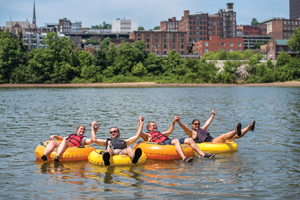
Safety is a top priority. All guests are provided with lifejackets and given basic instruction on how to use their equipment and navigate the waters. Shuttle service is offered not just for customers but also (for a small fee) to paddlers who aren’t able to have cars at both ends of their trips down the river.

Waters are not very rough, so excursions with James River Adventures are great for beginners and families (with certain age/supervision requirements) but even experienced paddlers can appreciate “the beauty and appeal,” Campbell said.

In a society filled with sedentary vices (many of the electronic variety), being active and getting outside is critical. And a workout on the water offers great cardiovascular fitness with low impact on the joints. According to Better Health Channel, physical benefits also include muscle strength targeted in the back, arms, shoulders and chest from paddling and torso and leg strength from rotating and applying pressure through this motion. Standup paddles include the added benefit of balance. That doesn’t even account for the mental benefits.

“The serenity of it, floating down the river without the typical noise distractions,” explained Brooke Newton, JRA Upper James River Educator, “being able to flow along and hear the movement of the water, all the natural sounds … helps enhance how people go on with their personal lives.”

As James River Adventures guides people across the surface, they invite them into a deeper understanding. Education is a key element of what the operation is all about.

“We do hope that when people go out with us we can personify stewardship,” Newton said. “We focus mostly on the positive aspect of what our river is and how awesome and historic the James is for all of us.”

She pointed out that many in the community cling to the idea that the water is “nasty,” while in reality it is booming with a healthy underwater ecosystem.

“That’s part of our mission; to outreach and get people to understand that these local tributaries are vastly important,” Newton said.

“It tells such a better story; it paints a much brighter picture of the James than people ever had,” Campbell added.

Firsthand experience also helps people care more about the environment and spurs them to be more mindful of how they impact it.

tubes james river“If people become connected to the river and they begin to care about it then they want to be a part of that solution,” Newton said.

Throughout the year, James River Adventures takes area middle and high schoolers out on excursions, both to have fun outside the classroom and to have a meaningful educational experience related to what they are learning in class.

“It’s a double-whammy” Campbell said.

The school trips include macro-invertebrate testing and water quality samples, checking the chemical makeup of the river. It all relates to local landscapes, giving students a better appreciation for their community. (Weeklong summer camps were also held in June.)

“We get them to start thinking about things that they do on a daily basis and things that they can do to lessen their impact on water quality,” Newton said. “They are learning about nutrient pollution in textbooks; we try to get them to think for themselves about where this potential pollution is coming from in order for us to come back full circle to see what we can do as individuals to think globally but act locally.”

This deeper educational experience is also incorporated into the guided tours offered by James River Adventures.

The vision is for the organization to flow deep through the community, as vibrant as the waters it seeks to protect, celebrate and enjoy. James River Adventures supports the annual James River Batteau Festival, a historic, weeklong floating adventure that starts in Lynchburg. Campbell and Newton are also partnering with the Lynchburg Outdoor Social Tribe, as well as local businesses, to host outdoor events that connect and support the downtown community (ideas include “Paddles and Pints” and “Paddles and Pizza”). In the long-term, there are hopes to partner with local bike, skate and rock climbing shops to host multi-sport events that include paddling, as well as to offer more educational opportunities (their current offerings help meet statewide Standards of Learning for science but Newton sees more interdisciplinary applications, including for art, history and physical education).

James River Adventures is also a tourism boon for Amherst County as it elevates Riveredge as an attraction.

“Big things are coming from this little park,” Newton said. “We are hoping to open up a whole new realm.”

Book your adventure online or learn more at JamesRiverAdventures.org.