Dare to Prepare

Five Tips from 2 Birds Meal Prep

For 2 Birds Meal Prep owner Ivy Olivier, food and community are inextricably linked. After working in restaurants for more than a decade, she switched to a career as a social worker before ultimately realizing that her passion lies where food and community intersect.

Shortly after launching an Instagram account showcasing her meal prep for her family, Olivier began getting an influx of requests to purchase her meals. She also read a book called Tattoos on the Heart: The Power of Boundless Compassion by Greg Boyle, which is about a café in Los Angeles that hires ex-gang members. These events inspired Olivier to take a leap of faith and start her own meal prep business.

“Between my love for food and my desire to give back to the community, I saw a need that could be filled with 2 Birds Meal Prep,” she says. “I enrolled in culinary school and wrote a business plan! It’s very exciting to transition from my career in social work to owning my own business. I think my background definitely helped prepare me to serve people in our community in a unique way.”

Olivier preps and sells a variety of individual and family meals, many of which are also available as vegan meals. Olivier herself is a vegan and is determined to offer delicious plant-based options. “We don’t want to make food that tastes ‘almost as good’ as the carnivorous version,” she says. “I want to present a happy medium to people—like, here’s how to eat in a way that doesn’t hurt the only earth we have, but it’s also so delicious you’d order it either way!”

After taking a short break, 2 Birds is slated to reopen by May 1st with an even greater emphasis on community outreach. “We have partnered with a local church to be able to do more ministry work and give back to the Lynchburg community in a big way,” Olivier says.

Olivier is also passionate about sharing her meal prep knowledge.

Here are five of her top tips!
1. Start Small
Although a certain amount of enthusiasm is necessary when it comes to meal prep, resist the urge to pre-prepare every meal—doing so will inevitably cause burnout. “Remember, this is something that is supposed to help you, not be a massive, overwhelming burden!” notes Olivier. “If you’re prepping for yourself, maybe start with just one family-sized meal (or double one if you have a large family) so you’ll have leftovers for lunches.”

Olivier adds that preparing single versatile items rather than full meals is also optimal. “Here’s an example: if you roast a chicken on Sunday, you could have shredded chicken to use in enchiladas, make some chicken salad to eat for lunch, and use the bones to make soup,” she says.

3. Shop Selectively
Choosing high-quality foods is an essential part of any healthy and delicious meal prep plan. Olivier recommends shopping at farmers markets when possible. “There are so many benefits to shopping farmers markets: you support local farmers, you know exactly where your food is coming from, and it gives you the opportunity to eat ‘in season,’ which can keep you from getting bored eating the same old thing week to week,” she notes.

Shopping selectively also means staying true to yourself and your preferences. “Do not prep anything for yourself that you don’t like to eat,” says Olivier. “This is a mistake I see so many people making. If you hate kale, don’t force yourself to eat it. There are literally hundreds of other veggies. Eat the ones you like!”

2. Don’t Underestimate Staples
Integrating basic foods into your meal prep plan is ideal in more ways than one. Not only do many staples lend themselves perfectly to advance prep, but they are also budget-friendly. “If you want to prep healthy on a budget, keep it simple,” notes Olivier. “Stick with the staples: apples, carrots, potatoes, a bag of salad, frozen steam veggie bags, canned tuna, pouches of salmon, peanut butter, etc.

You don’t have to reinvent the wheel.”
Beans are Olivier’s personal favorite staple. “Dry beans are my number one favorite versatile ‘cheap’ healthy food,” she says. “They go great in wraps, stews, as a stand-alone item. I make a big pot of rice and beans pretty much every week because they’re so versatile.”

4. Explore Different Cuisines
If you find yourself getting into a meal prep rut, Olivier suggests incorporating foods from other cultures or simply from outside your comfort zone. “I stay motivated by exploring new cuisines often,” she says. “For the home chef, try to make something complicated once a month to remind yourself why you love cooking. Cooking can be a form of self-care, and there is nothing better than surprising yourself with a new flavor combination you haven’t tried yet!”

5. Don’t Get Discouraged
As is the case with any venture, meal prep will have its share of hiccups. Embrace the process and try to view mistakes as opportunities rather than obstacles. “If you try something and it’s gross, don’t be discouraged!” Olivier exclaims. “Every chef will tell you that they have made some questionable concoctions before. It’s just part of the process. The only way any of us got better at this thing was through experience.”


Legendary Eats

Four longtime Lynchburg restaurants that have kept us coming back for almost a century

There’s nothing like enjoying a meal in a place with endless memories of yesteryear—perhaps once frequented by your parents, even your grandparents. The stories told about these historic, and sometimes humble, eateries not only connect us to our local past but they also show how the shared bond of “going out to eat” has prevailed through the generations.

While Lynchburg has a diverse and outstanding selection of locally owned restaurants, we wanted to take some time to focus on the spots that have stood the test of time. These four restaurants, with a combined total of 335 years under their belts, have weathered war, economic depressions and everything in between—but what they all say has been the biggest challenge so far is COVID-19.

The World Famous Stadium Inn
This local hangout spot opened in 1927 when it was converted from a substation into a beer and burger joint. The owner now refers to it as the “greatest little bar in Lynchburg.”

The-World-Famous--Stadium-Inn
Photo by Ashlee Glen

Owner Daryl Burgess purchased the building in 2017 when he saw the restaurant had closed. “I just felt that couldn’t happen,” he said. “It’s a landmark and has such cool history.”

Burgess kept the restaurant closed for two months while he renovated the space into a clean sports bar and grill offering cold beer, low-price eats and TVs.

He threw away old equipment with 50 years of smoke on it including the grill, oven, fryers, photos on the wall and cleaned the windows 27 times until all the smoke was gone.
With all that work under his belt, it’s no secret that The World Famous Stadium Inn is no longer a smoking bar. Under Burgess’ direction last year, they now have a high chair for the first time to accommodate families. They’ve also worked hard to clean up their image in general.

“The servers know everyone and we make sure customers get home,” he explained. “There’s a three-strike rule… It’s now a family-friendly beer joint. The hardest thing I had to do was overcome the character of the place.”

Burgess is also the owner of The Filling Station in Amherst and knows his way around hamburgers, hotdogs and wings, so he incorporated all those items at the Stadium Inn.

During the pandemic, Burgess converted the restaurant into a mini-convenience store for two months selling steaks, hand sanitizer, paper towels and toilet paper.
But ultimately the business still suffered like most others and saw a 75% decrease in sales.

Now, thankfully, with lighter restrictions, Burgess said the restaurant has been filled to its allowed capacity every weekend.

With the growth in mind, he has plans to open an outdoor pavilion soon to provide for more seating. Burgess expects it to be a place for Lynchburg Hillcats fans to hang out after games at City Stadium.

“If you haven’t checked it out, you don’t know what you’re missing,” he said. “Come see us, say hi and you won’t leave unhappy.”

The Dahlia
Photo by Ashlee Glen

The Dahlia
Located on Bedford Avenue, this hidden gem is a little less hidden thanks to the recent boom of its neighborhood, which is now home to Golf Park Coffee and Small Batch Barbecue.

Angel Olds, who believes she is the 17th owner of The Dahlia, said the micro-local restaurant is home to some of the best seafood in town. Olds and her late husband used to own the Blue Marlin Seafood Market next door, so she knows her shrimp, scallops and fish.

When it opened in 1947, the restaurant was originally called The Blue Dahlia after a film noir of the same name. It was a popular local spot but over the years the restaurant received a bad reputation and went downhill, according to Olds.

“It became known as a dive bar. Men would come but wives wouldn’t step foot in the place,” Olds said. “Now it’s the opposite.” The upstairs is a little more upscale, while the downstairs, referred to as “the cellar,” has a more relaxed, English pub–style vibe.

After Olds purchased The Dahlia 11 years ago, she gutted the entire place and has since created a causal, family-friendly pub that focuses on quality food.

Though it’s more well-known now, she said her customers enjoy that the restaurant isn’t a run-of-the-mill chain and newcomers still have to plug the address into their GPS and hunt around for the front door.

“We are kind of secluded, but I’m hoping to get new signage for Bedford Avenue,” Olds said. Out of 74 years, Olds said the restaurant has only been closed for two years.

“It’s an institution. It’s weathered history,” she said. “It’s a very old restaurant that has been reborn several times. It’s still here alive and kicking.”

The Texas Inn
Photo by Ashlee Glen

Texas Inn
You know you’re a local to Lynchburg if you know exactly where to find a “greasy cheesy.” That’s, of course, at The Texas Inn, better known as the T-Room, which operates its flagship downtown and a more recent addition in Cornerstone.

In 1949, the restaurant, once located at 602 Main St., was sold for $10,000 by H.D. White to H.W and T.W. Wright. In the 1970s, it was torn down and relocated to its current location at 422 Main St., which once served as a service station.

The 86-year-old restaurant has seen multiple owners but current owner Dave Saunders remains true to founder I.N. Bullington, a former circus advance man.

Ever since purchasing the iconic restaurant in 2018, Saunders has worked tirelessly to bring the T-Room back to its roots, starting with a six-month search for the original chili recipe.

Today, the T-Room is obviously known for its cheesy western—a hamburger with relish, a fried egg and cheese—and chili, better known as a “bowl.”

Saunders has kept some of the quirkier menu items that no one orders, such as the Denver, an egg and cheese sandwich on a bun topped with relish, or the Funny, a hot dog bun with no wiener topped with relish and chili.

He took cheese sticks off the Cornerstone menu because he felt it didn’t fit the character of the establishment, and the relish is made three times a week instead of just one.

Since its opening in 1935, the T-Room has witnessed The Great Depression, World War II, the Korean War, the Vietnam War and a handful of recessions, but COVID-19 has tested the tavern with its ability to only seat customers at its 15-seat counter.

Saunders placed a picnic table outside but it’s still the only establishment in town that has less than 50% capacity. “People have been really loyal ordering to-go and delivery,” he said. “They really saved our bacon.”

In the end, Saunders said the T-Room is the oldest continuously running restaurant in Lynchburg for a reason. “We serve good food fast and cheap,” he said.

the cav
Photo by Ashlee Glen

The Cavalier
“The Cav” as locals know it might be as hometown as you can get. It’s known for its no-frills and relaxed atmosphere serving up to-die-for burgers and fries.

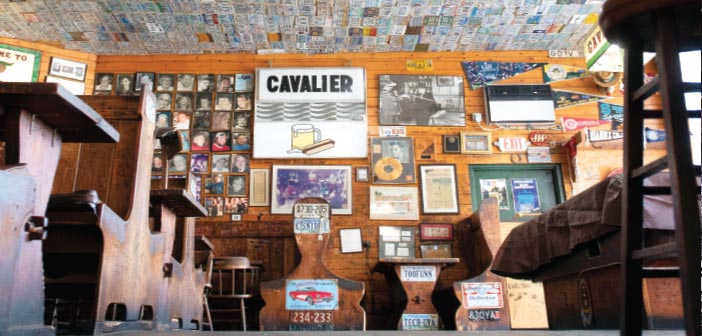
Located right off Rivermont Avenue, down the street from Randolph College, the dive bar is decorated with side-by-side license plates on the ceiling and walls and its wooden booths are covered with carvings of initials and notes from who once sat there.

Opening in 1940 under the name “The Cavalier Store,” the Cav started out as half grocery store, half restaurant where customers could shop and order a beer and hot dog. It was that way until the late 1960s or early 1970s and the wall between the two was torn down.

In 1987 Wells Duffy purchased the bar and continues to operate it to this day. He is responsible for adding in the main bar and the smaller bar near the ATM machine.

Jake Hill, a bar manager at The Cav, said it wasn’t uncommon for 1940s women to come in, buy cigarettes and smoke because their husbands wouldn’t allow them to light up at home. The restaurant is still an icon in the city and known as a bar reliable to always be open.

“It’s a good ‘ol neighborhood restaurant,” Hill said. “Anyone and everyone is welcome. We consider ourselves the Cheers of Lynchburg because everyone knows each other and if you don’t, by the end of your visit you’ll likely have some new friends.”

There is no question that customers keep coming back for the burger, which has been glorified by all walks of life. It pairs perfectly with the seasoned fries and homemade ranch.

In the past 34 years that Duffy has owned The Cav, he’s never experienced anything quite like the pandemic. He’s never had to adjust his hours and the restaurant has always stayed open seven days a week—but that was put on pause last year.

“Even with bad weather, we’re known as a reliable spot that will always stay open,”Hill said. “He’s never had to deal with anything like this.”


Upfront May/June 2021

Mark Your Calendars May/June 2021

Sunset on 7th Concert Series
May 8, June 19, July 17
The Academy Center of the Arts is back and ready to party this summer! The Sunset on 7th Series will be held in the Pacific Life parking lot, featuring the No BS! Brass Band in May, Joslyn & The Sweet Compression in June and The Hackensaw Boys in July. Enjoy the show from your own personal parking space “pod” with up to 10 guests. Learn more at academycenter.org.

Memorial Day 10K
May 31, 8 a.m.
For the past five years, Lynchburg Road Runners Club and Type 1 Diabetes Experience have partnered together for this race that supports local families living with Type 1 and Type 2 diabetes. If a 10K isn’t for you, try the shorter two-mile walk to support the cause. Learn more at runsignup.com.

Steel Magnolias
June 3-27,
various showtimes
Join Truvy, Shelby and the rest of the gossiping gang as Wolfbane Productions brings this Southern classic to life at its Appomattox Wolf Den venue. The hilarious repartee and heartbreaking moments make this a beautiful show you won’t forget. Learn more at wolfbane.org.

Outdoor Summer Job Fair
June 24, 9 a.m. – 1 p.m.
Dust off your resume and save the date for this free job fair at the Forest Public Library, sponsored by the Bedford County Chamber of Commerce. Advance registration is not required.


Discover Your Downtown

Raise a Toast to River Restoration

During the month of May, you can enjoy one of Starr Hill Brewery’s award-winning beers while supporting an impactful nonprofit at the same time.
Starr Hill’s “Love Your River” program is a partnership with the James River Association. Every time someone buys The Love Wheat Beer in May, the brewery will donate $1 to the JRA.

“All great beer starts with great water,” says Brewmaster Robbie O’Cain. “We are encouraging our fans to support river restoration and show their ‘Love’ for the largest river in Virginia. As a brewer and a fisherman, I know how important it is for our community to maintain our waterways and we hope that the craft beer community will support this exciting and important program.”

According to the JRA, more than 2.7 million Virginians rely on the James for their drinking water.


Local Openings & Closings

Hello! to The Ridge, formerly Phase 2. The entertainment venue has new owners after being up for sale since 2019.

Hello! to the Backyard in Forest, featuring multiple food trucks and gathering space.

Hello! to Kaleidoscope Studios on Fifth Street.

Hello! to women’s clothing

store Carter Bates inside River Ridge Mall.

Hello! to Main Street Sports Bar and Grill on Main Street.

Goodbye to Chestnut Hill Hardware, a fixture on Fort Avenue since 1948.

Hello! to Popeyes on Candlers Mountain Road.

Hello! to a new location of Blue Mountain Barn in River Ridge Mall.

Hello! (again) to Gary’s Garden Center, now on Leesville Road.

Hello! to The Chicken Coupe Boutique in Amherst.

Hello! to the second location of Elite Realty on Graves Mill Road.

Hello! to Hearts & Kisses on Leesville Road offering wedding gown and formal dress rentals.

Hello! to Fratelli Italian

Kitchen, now open on the Bluffwalk downtown.

Hello! to Alpaca by Jaca, moving to a new location inside River Ridge Mall.

Hello! to Findings, a unique curated art gallery in the Boonsboro Shopping Center.


Technology Time-Out

The life-changing benefits of unplugging

When I emailed Nick George, executive director of nonprofit The Listening, earlier this year, a line under his email signature grabbed my attention. “I am offline from sundown on Friday to sundown on Saturday, when I observe a ‘tech sabbath’,” it read.

I was intrigued and asked Nick to tell me more.

Nick says he has been taking a 24-hour break from technology for a couple of years after getting the idea from a friend’s email signature as well. During this time frame, Nick says he spends time with family, catches up on errands and will even talk on the phone or FaceTime with his parents—so it’s not completely tech-free, but there’s no absentminded scrolling through social media or responding to emails. “There’s something nostalgically simple about it. I find myself appreciating the weekend more,” says Nick.

According to Alisha Walker Marciano, Ph.D., professor of physiological science at University of Lynchburg, reducing exposure to technology, even for short periods of time, is helpful to prevent what’s known as cognitive overload. “We might be doing work on the computer and have five tabs open and a phone next to us. This requires us to constantly shift our attention, leading to cognitive overload,” she explains. “Having that happen constantly can be problematic because it keeps people from being able to focus on the tasks they are trying to complete. It can make people feel more fatigued.”

All of this connects to our social and emotional health as well. Marciano says that some past research has found if a cell phone was present in a face-to-face conversation, the individuals in that conversation reported feeling less connected to the people they were speaking to.

Social media, in particular, is of specific concern. Constant use of the platforms has been linked to excessive feelings of depression and anxiety. “One study found that people who gave up Facebook for a week actually reported better psychological wellbeing than people who did not,” she says.

If you aren’t glued to your phone, you may be more likely to get outside and enjoy the outdoors—which Marciano explains is linked to tons of benefits: “Exposure to nature, even if it’s just going on a walk in a neighborhood, improves attention, is associated with better mood, lowers stress, and improves short term memory.”

Marciano recognizes that not everyone is going to want to disconnect or be able to disconnect for a full 24 hours, like Nick. But she says there are smaller ways people can reduce distractions:
• Put your phone on “do not disturb” for a little while each day.
• Cut down on the number of notifications you receive from various apps.
• Set boundaries for certain times of the day to stop checking work emails or social media.
• Keep your phone at a distance at bedtime and overnight.

“It doesn’t have to be all or nothing to be beneficial,” she says. “Generally, being more intentional about your use of technology, having a purpose and using it with a purpose will help you reduce how much time you spend online.”

Two years after he started setting some tech boundaries, Nick doesn’t feel restricted but instead views the tech-free time as a gift.

“It’s not intended to be legalistic or bar you from getting work done,” he explains. “But at the same time, if your intention is to take care of your mind and spirit, it’s totally worth it to leave work at work and live your best life on purpose!”


Fun Guide 2021


As soon as school lets out for summer break, the extra time at home—for those who were attending school in person—combined with the absence of constant homework obligations has both parents and kids breathing a sigh of relief and jumping for joy.

But after a few days, without fail, the “I’m bored” comments typically start to surface. We are here to help fill your warm weather months with fun, family-friendly and diverse activities—many of which can be enjoyed in the off-season as well! From historic destinations to breathtaking views, check out these 11 recommendations in our LL Fun Guide.

The-Bower-Center-for-the-ArtsThe Bower Center for the Arts
Join Us for a Summer of Creativity & Fun! Looking for an ARTVENTURE this summer? The Bower Center for the Arts is offering a perfect summer outlet for children and adults to expand their imaginations and artistic talents with a full line up of fun-filled Art Camps and classes beginning in June. No experience is necessary, just a willingness to express your creative spirit!
Visit bowercenter.org for details.


claytor nature centerClayton Nature Center
In 1998, Bedford businessman Boyd Claytor gave his beloved 500-acre Cloverlea Farm to Lynchburg College for the study and appreciation of nature. He envisioned the beauty and wonder of his iconic property to be available to everyone for evermore. Under the steady stewardship of the University of Lynchburg, the Claytor Nature Center is a conservatory of scholarship, the University’s Blue Ridge Mountain campus. But every visitor knows this beautiful sanctuary by their own experience. To many visitors we are a place with premiere breathtaking views of the Peaks of Otter. Others are blessed with lasting memories of joy from their weddings, engagements, celebrations, and holiday gatherings at Cloverlea Farmhouse and Gardens. Photographers and artists render incredible vistas in their media of choice. By day, children and families delight in our natural play area, Otter Space. Hikers and walkers wander over trails, along the Big Otter River, through forests, past ponds and pastures. Local school children engage their minds and senses in experiential outdoor environmental education, nature programs, and summer camps. Birders and other enthusiasts of fauna and flora scan the grasslands and forest for their quarry. By night, community groups of all ages partake of picnics, bonfires, and camping, or cozier overnights in the farmhouse or Eco-Lodge. And the Belk Observatory opens its telescopes to the grandeur of the night skies. Day or night in all seasons, the Claytor Nature Center opens in each of us remembrance of our connection to each other and to the heavens and Earth.
For more information visit www.Lynchburg.edu/claytor.


imagination stationImagination Station
We are keeping little minds growing and creating through art. Masterpieces will be made on different canvases, ceramics, glass, tiles, or wood, while learning to use a variety of mediums. These consist of but are not limited to acrylic, watercolors, oil pastels, gesso, charcoal and much more. Pack a NUT-FREE lunch with a drink and get ready to create.
Visit imaginationstationstudios.com for more information.


James River Association
Find enjoyment and education on the James River at James River Adventures! Lynchburg’s riverfront outfitter is your gateway to the beautiful scenery and solace of our local waterways. Trip opportunities include kayaking, canoeing, paddleboarding, tubing, and – new for 2021 – historic batteau rides!

Additionally, James River Adventures will be running outdoor recreation camps during the months of June and July for 4th – 8th graders. Campers will enjoy both water and land-based activities in a fun and collaborative environment!

The best part? By supporting James River Adventures, you’ll be helping to keep the James clean and healthy by supporting the James River Association, the only non-profit organization solely dedicated to protecting the entire James River and connecting people to it.
Find your adventure at www.jamesriveradventures.org!


james river day schoolJames River Day School
For a summer filled with adventure and learning, kids can join a summer enrichment course at James River Day School. Designed and taught by James River’s incredible teachers, these classes for rising K-8 students are open to the public. Experiential learning drives these engaging summer programs, making the learning hands-on and fun in topics such as Summer STEAM Challenges, LEGO® WeDo, digital photography, nature, basketball, and Crazy 8s math camp, among others. With a wide range of topics from academics to art and on to athletics, James River has summer fun opportunities sure to excite your child.
Visit www.jamesriverdayschool.org/summer to learn more about what is available and to sign up.


lca theater campLCA Theatre Camp
The LCA Theatre Camp will meet for two full weeks from July 5 through July 16. This comprehensive theatre camp is open to students who will be entering the second through the ninth grades. Campers will attend sessions in the areas of makeup, costuming, choreography, musical theatre, improvisation, characterization, acting and theatre. Each child will have the opportunity to take part in a Camp Cabaret or One Act production, where they will memorize lines and demonstrate their skills on the final day of the theatre camp. At the end of camp, various awards will be presented to campers who have distinguished themselves in various areas.
For more information or to register go to payit.nelnet.net/form/UcmOBqFr.
For additional information, email Ray Jones at LcaTheaterDepatment@gmail.com.


lynchburg parks and recreation centerLynchburg Parks & Recreation
The City of Lynchburg Department of Parks and Recreation offers a variety of services and activities to residents and visitors. We maintain 17 parks, which offer organized and open areas for recreation, enjoying a picnic, fishing, canoeing and kayaking, and children’s play. Over 40 miles of our trails wind through Lynchburg and are suited for a variety of activities.
For more information visit lynchburgparksandrec.com.


natural bridge zooNatural Bridge Zoo
Natural Bridge Zoo is the wildest place in the state of Virginia, full of fun and excitement for any age and allows you to get up close and personal with a wide variety of rare and endangered animals. Stare into the eyes of a huge white tiger, feed a giraffe, hug a llama, have a pararkeet land on your hand in parakeet landing. Experience an elephant ride by looking at the world from a different view point while feeling the gait of the elephants walk (offered scheduled days and time).

See a wide variety of beautiful birds, colorful goats, monkeys, deer, mountain lions and many more. Spend a wonderful day at the Natural Bridge Zoo creating lasting memories with the whole family.
Visit naturalbridgezoo.com for more information.


red hillPatrick Henry’s Red Hill
Patrick Henry’s Red Hill is the final home and burial place of Founding Father, American Revolution hero, and five-time Governor of Virginia, Patrick Henry. Visitors can tour Patrick Henry’s reconstructed home, kitchen, and blacksmith shop, as well as his original law office and family gravesite along with other structures. This summer, come walk numerous trails around the property, pack a picnic lunch to eat outside, and enjoy the breathtaking beauty of over 1,000 of Patrick Henry’s original acres.
Red Hill is open year-round but offers special events throughout the warmer months including an Independence Day Celebration, Lantern Tours, Star-Gazing Nights, and Living History Days. Plan your visit to Patrick Henry’s Red Hill, a place he called “the garden spot of the world,” this summer!
Visit redhill.org for more information.


putt puttPutt-Putt Fun Center Lynchburg
Every summer has its own story. We hope you’ll choose to make lasting family memories at Putt-Putt Fun Center™ where cool activities abound for all ages to enjoy!

Feel the Breeze
Jump into the driver’s seat and zoom around our track for a rush of pure adrenaline. We have karts for single riders, as well as karts that can accommodate a parent and child.

Get Wet
A cool splash on a water ride is a great way to beat the summer heat. Battle it out with friends during a whirling, twirling and wet ride on
our bumper boats equipped with water cannons.

Indoor Fun
Escape the heat and challenge friends to a game of laser tag. Guaranteeing nonstop excitement, our laser tag arena is the only two-story arena in Lynchburg. With neon lights and dark colors, our arena is the place to escape sunburn and see who really the ultimate champion is.

Be Cool
Our arcade is the place where “cool” kids hang and parents come to “cool” off. Test your gaming skills with all sorts of arcade games from classic air hockey to our Typhoon Roller Coaster simulator. After you’ve won all the points you can, turn them in at the redemption counter for awesome prizes.

Loop the 18
Our two 18-hole Putt-Putt® Golf courses are the perfect way for the family to stay active, on their feet, and soak in the Vitamin D. You may even get lucky and ace your shot on our skill-based par 2 courses!
Visit PuttPutt.com/Lynchburg to start the fun!


ymcaYMCA
The YMCA of Central Virginia is committed to providing access to life-changing programs to everyone in our community. We offer a variety of inclusive programs, classes, and services. We bring people together to develop strong, positive relationships, healthy habits, and lasting memories. From summer camp to senior activities – we are your mission-driven community-focused non-profit, committed to building a better us. Visit ymcacva.org for more information.


Lynchburg Business Life


The Heritage Meal

Humans have been living in the foothills of the Blue Ridge Mountains for thousands of years, yet most of the stories we know about our local heritage tend to begin in the 18th century when a teenager named John Lynch started a small ferry company, helping travelers from local colonies cross the James River.

But what did life look like before Lynchburg grew into a city?

If you were standing at the top of Lynchburg’s Monument Terrace way back then, what would you see? What would you smell? Who would be there? And, most importantly, what would you eat? This story is an imaginary culinary tour of the place we call home.

Meet the Monacans
Picture multiple rows of corn growing as far as the eye could see in the fertile ground on the banks of the James River over by Percival’s Island, almost like a wide fence. Not the large sweet corn variety we are used to today, but a smaller more grass-like ancestor called maize. Vines of beans may have been climbing up the corn stalks and squash plants were growing on the riverside, protected by the wall of corn.

The long, winding garden did not need a fence. Children armed with pebbles would keep rabbits and squirrels away, and if a hungry deer would be foolish enough to approach the crops, it may not have lived long enough to take a bite. The deadly arrow from one of our area’s first permanent inhabitants, the Monacans, would have killed it instantly.

In 1605 when British explorer Captain John Smith surveyed our region for the first map of Virginia, he identified five Monacan villages in the area between Lynchburg and Natural Bridge. As many as 25,000 members of the Monacan tribe called the area home at that time. Sadly, their numbers were decimated when the British settlers arrived, mostly from disease they brought with them. The lands of the Monacans were taken over during those years as well.

Thanks to the Monacans’ skills in making clay pots and building sophisticated woodstoves, you would be smelling a bubbling stew of squash, corn and beans if you lived in the area back then. A bone from a deer helps make a tasty stock, but the meat is from a freshly caught rabbit. The rest of the deer is hanging in the smokehouse for preservation. The stew will be served with a bread made from acorn flour mixed with a little wood ash from the fire—a natural form of baking soda.

West African Influences
Fast forward to the 1730s and the view has changed dramatically. The Monacan lands in the Lynchburg region have been taken over by European (mostly British) settlers, and there are green rows of tobacco growing as far as the eye can see. Stately plantation homes are earning a reputation for their “Southern Hospitality.”

The food you are smelling is being prepared by the plantation’s cook, typically an enslaved black woman who survived the long journey in chains from West Africa. She is literally bound to the fire as she prepares a sweet potato and peanut soup with corn bread in the plantation kitchen. Kitchens often had a dirt floor and an open-flame hearth—and housed the cook’s living quarters.

The first slaves are said to have been brought to Jamestown by the British from West Africa in 1619, although the industrial-scale slave trade came decades later to support plantation farms. We don’t know exactly when the first enslaved Africans were brought to Lynchburg, but considering there was direct access to Jamestown via the James River, they likely came early in the 17th century.

Chef and food historian Michael Twitty in his book The Cooking Gene explains that, “The American plantation wasn’t exactly the quaint village community you saw described in your history textbook. It was a labor camp system for exiled prisoners of war and victims of kidnapping.”

The African cooks brought both skill and taste to America. Black-eyed peas, okra, peanuts, and sweet potatoes were all new flavors they integrated into the fare of European favorites, essentially giving birth to what we today call Southern cooking.

Our Founding Foodie
Founding father Thomas Jefferson may have been known as the “founding foodie” because of his passion for fine foods and drink, but at his retreat home on the Poplar Forest plantation just outside of Lynchburg, the fare was surprisingly simple. When he famously stated that “Lynchburg is the most interesting place in the state,” he probably was not talking about the culinary scene.

Locally grown vegetables with a side of chicken was often served at 3 p.m. as the main meal of the day at Poplar Forest. And although the kitchen garden was the size of a football field, Jefferson complained in letters that his beloved peas didn’t grow well there and all they had was “spinach and scrubby lettuce,” as he put it.
Martha Jefferson inherited the plantation we know as Poplar Forest from her father, and Thomas himself started visiting Lynchburg after his presidential term had ended in 1809. It was much larger than the site we know today, and Jefferson added even more land over time. At one point this tobacco farm stretched all the way to today’s Jefferson Forest High School, or 5,600 acres to be exact.

Jefferson did not have an ice house at Poplar Forest, so his enslaved cook, Hannah, was not able to make his favorite treat, which was ice cream. However, archeologists have found pieces of what appears to be a serving glass for wine jelly at Poplar Forest, another favorite of Jefferson’s. What is wine jelly, you ask? Well, it’s similar in texture to what we call Jell-O today, but it’s made with fortified wine and milk.

Step back in time and taste some of our Virginia heritage recipes, adapted for our modern palates!


sweet potato soup recipe

APPETIZER
West African Peanut & Sweet Potato Soup
This is a family-friendly yet flavorful soup that’s easy to make. For the best result, look for sweet potatoes with red flesh. The peanutty goodness comes from peanut butter and for optimal flavor, go with either fresh ground or “natural” creamy peanut butter.
SERVINGS: 4 to 6

INGREDIENTS:
2 pounds sweet potatoes, peeled and sliced thin
3 tablespoons peanut butter (creamy)
2 tablespoons unsalted butter
1 medium onion, minced
1 teaspoon brown sugar
3 garlic cloves, minced
1/2 teaspoon ground coriander
1/8 teaspoon cayenne pepper
3 cups chicken broth
2 cups water
1 teaspoon salt (and more to taste)
1/4 teaspoon fresh ground black pepper
Serve with fresh cilantro, chopped and a few drops of olive oil

DIRECTIONS:
In a large saucepan, melt the butter over medium heat. Add the minced onion, brown sugar and salt and cook until the onion is starting to turn brown, about
5-6 minutes. Add the garlic, coriander and cayenne and cook for about 30 seconds.

Add the chicken broth, water, peanut butter and sweet potatoes. Bring to a boil over high heat, then cover and turn to low and let cook for 20 minutes or until the sweet potatoes are soft.

Pour the soup into a food processor and blend slowly and carefully until smooth. Return to the saucepan. Ladle into bowls and serve with cilantro and a splash of olive oil.


braised rabbit recipe

MAIN COURSE
Braised Rabbit with Mushrooms
In addition to being farmers, the Monacans knew how to hunt and live off the land. Deer was the most common menu item, but smaller game such as squirrel and rabbit was also common and easy to trap. If you are new to cooking rabbit, this is an easy way to get started. Much like chicken, rabbit doesn’t have a very strong flavor so the key to a good rabbit recipe is to pair it with other flavorful ingredients, in this case the mushrooms and roasted garlic.

Rabbit is available from the Forest Farmers Market (look for Rainbow’s End Farm) as well as from Fresh Market in Lynchburg. However, if you are not in the mood for rabbit, regular chicken (dark meat) works well as a substitute in this recipe.
SERVINGS: 4

INGREDIENTS:
1 rabbit (3-4 pounds)
2 heads of garlic (don’t worry,
it will not taste garlicky!)
1 pound of mixed mushrooms, sliced
1 cup white wine
3 cups chicken stock (or even better, rabbit stock!)
3 large shallots, diced
1 large parsnip, diced large
(sub for carrots if preferred)
2 tablespoons fresh thyme
2 tablespoons fresh parsley
2+2 tablespoons unsalted butter
2 tablespoons olive oil

DIRECTIONS:
Preheat oven to 375 degrees. Cut up the rabbit and season pieces liberally with salt and pepper. Let sit at room temperature for 30 minutes. Be sure to use all parts of the rabbit in the stew; you can fish out ribs and spine before serving but keeping them in during braising since they add valuable flavor.

Slice the top third off the two garlic heads and drizzle with olive oil.

Wrap heads loosely with aluminum foil and bake for about 45 minutes, or until cloves are soft and brown. Set aside to cool.

Add the oil and 2 tablespoons of the butter to a large Dutch oven or saucepan and brown the rabbit pieces on all sides, a few at a time. Take your time to develop proper browning because this is a key step to build flavor in the dish. Remove the rabbit from the pot.

Sautee the onions until translucent. Add the mushrooms and cook until they have released most of their water, about 5-7 minutes. Add the wine and let cook for 2 minutes while scraping the bottom of the pot. Squeeze the soft roasted garlic cloves into the pot and stir to dissolve.

Add back the rabbit and add thyme, parsnip, water and stock to the pot and simmer for 90 minutes, or until the meat is starting to fall off the bone.

Time to thicken the sauce. Carefully fish out all of the rabbit. In a small bowl, melt 2 tablespoons of butter and mix with 2 tablespoons of all-purpose flour. Add the flour paste to the braising liquid and cook for 3-4 minutes over medium heat until the sauce thickens. Add back the rabbit.

Serve on its own or with a side of rice. Sprinkle some chopped parsley on top for garnish and enjoy!


thomas jefferson wine jello recipe

DESSERT
Thomas Jefferson’s Wine Jell-O
This is a modern adaptation of an old recipe for wine jelly, attributed to Thomas Jefferson. It’s a refreshing dessert with a pungent wine flavor and a small serving goes a long way. Keep in mind that since the fortified wine is not boiled, the alcohol is still there—so eat responsibly! Worth noting: This recipe calls for regular gelatin packets from the grocery store, but Jefferson’s cook actually used the hooves from a calf and boiled them to extract the natural gelatin for this dessert.
SERVES: 4

INGREDIENTS:
1 packet of gelatin
3/4 cup fortified wine (Madeira)
1 cup whole milk
1/4 cup water
1 lemon, juiced and strained
3 tablespoons sugar
1 pinch salt

DIRECTIONS:
Soak the gelatin in the water and let sit for 3 minutes. Add the milk to a bowl with a pouring spout, then whisk the gelatin, sugar and salt into the milk until completely dissolved. Add the lemon juice to the wine and then whisk the wine mixture into the milk mixture.
Pour into individual serving glasses, cover with plastic wrap and refrigerate until firm, about 2-3 hours or overnight. Grate a little lemon zest on top and serve!


SPECIAL THANKS: Thank you to the following for their help with this feature: Vicky Ferguson, Sally Latimer and Jennifer Austin from the Monacan Indian Nation; the Stocker family of Rainbow’s End Farm; Dr. Kelley Fanto Deetz, author of Bound to the Fire: How Virginia’s Enslaved Cooks Helped Invent American Cuisine; and Gail Pond, manager of collections at Thomas Jefferson’s Poplar Forest.


Artist Profile: Heather Sollers Baker May/June 2021

Lynchburg Living Editor Shelley Basinger: Heather, your cookies and other baked goods are certainly eye-catching! When did you first develop a passion for baking?

Heather Sollers: As a child, I used to love making recipes from my mom’s cookbooks and surprising my family. I started off with small snacks, then meals, and, eventually, baked goods. I also remember making chocolate chip cookies every year with my family at Christmastime and everyone sharing cookies they had made after Christmas Eve dinner. This is a tradition I continue with my own family. I have five kids ranging from ages 6 to 20, three girls and two boys.

SB: At what point did your baking turn into more of an artform?
HS: I first tried my hand at making more complicated, artistic cakes for my daughters’ joint birthday party back in 2005. I made a princess castle cake for my then four-year-old and a 3D baby sitting on a cloud for my then one-year-old. After my son was born in 2011, I made my first decorated sugar cookies—a flower cookie pop bouquet for the nurses.

SB: When did you officially start up your business, Creative Confections by Heather?
HS: I actually had a completely different job when we lived in New Jersey. I went to mortuary school and became a funeral director and only baked cakes and cookies on the side. In March of 2014, my husband was transferred and we moved to Lynchburg. Later that same month, I had my daughter and made cookies to thank the wonderful nurses at the Birth Center. A year later, I did the same when I had my son. The nurses quickly spread the word about my cookies and that’s when my business really started. In 2016, I created my LLC, got my business license, and became a state-inspected manufacturer.

heather sollers baker

SB: What types of techniques do you use?
HS: For the most part, I’m self-taught. While there are a number of ways to ice and decorate a cookie,
I use royal icing because it is easy to work with, dries hard, and is extremely versatile. With it, I am able to decorate with the wet-on-wet technique to create various designs, and when the icing is dry, I can layer it, airbrush it, do brush embroidery, hand paint, and use edible markers to add small details. I am always experimenting and learning new techniques.

SB: Do you have any favorites you’ve created?
HS: One of my favorites was a three-tier, ’80s-themed cake that I made for an E.C. Glass reunion a few years ago. I love everything ’80s!
My most memorable cookies would be the “Riverdale” cookies from 2017. They were my first to go viral, shared by Archie Comics and Seventeen Magazine, among others. That was pretty exciting!

SB: Likewise, what are some of the most unique requests you have received?
HS: Every year, usually for Halloween or Christmas, my husband’s cousin comes up with some crazy idea that she wants me to turn into a cookie. We’ve done everything from zombie snowmen to creepy dolls and scary nuns. But, I love the challenge!

SB: You’ve been baking for the Craddock Terry Hotel since 2016. How is that going?
HS: I started off making the red shoe cookies then quickly added many other items. Currently, I make all of the enhancements, custom orders, and the food items in their gift shop. I also bake custom items and treats for Shoemakers and Waterstone, and for the City of Newport News.

SB: What do you love the most about what you do?
HS: I love that I have a unique outlet for my creativity that also contributes to the memories of someone’s special day or event. I love the excitement my customers have when they are ordering and then when they see their cookies for the first time. I also feel very blessed to be a volunteer Sugar Angel for Icing Smiles. Through Icing Smiles, I am able to share my gift by providing dream cakes, celebration cakes, and cookies for families who are impacted by the critical illness of a child. Seeing the excited, appreciative smiles when a child receives their cake or cookies is something that I will always remember.


Blue Ridge Tunnel

19th Century Engineering Feat on Display

“There’s light at the end of the tunnel” is an apt metaphor as the world slowly emerges from the COVID-19 pandemic, but it’s also literally true for visitors to the Blue Ridge Tunnel between Afton and Waynesboro.

The restored Blue Ridge Tunnel opened to the public Nov. 21, 2020 and has been a popular hiking destination ever since, with more than 35,000 visitors by mid-March.
Visitors can see all the way through the dark tunnel to the other end, but need flashlights or headlamps to make their way through the nearly mile-long tunnel.

There are two trails to the tunnel (see sidebar on page 122), but parking is very limited so it’s best to avoid weekends for now.

Maureen Kelley, director of the Nelson County Visitor’s Center, said they are working on expanding parking on both sides, but when they began planning the $5.4 million restoration 20 years ago, they had no idea what a destination the area would become.

blue ridge tunnel

“When this was engineered in the early 2000s, we had only two wineries,” Kelley said. “We knew it was going to be popular, but, wow!”

She added that the opening couldn’t have come at a better time with the pandemic forcing people to spend more time outdoors. Current regulations ask visitors to wear masks if they are closer than six feet to others.

The tunnel itself took eight years to build, from 1850 to 1858, 700 feet beneath Rockfish Gap in the Blue Ridge Mountains, an engineering feat envisioned by Claudius Crozet, a French immigrant who designed the tunnel and was its chief engineer.

While the tunnel is cool—literally an even 50 degrees year-round—the history of the tunnel and the manpower required to create it are the real story. Many say the workers’ toil and loss make the tunnel a sacred place.

The tunnel took about 800 mostly Irish immigrants, who literally left blood and bones inside, eight backbreaking years to build. In an era before dynamite, workers had to pound star drills into solid rock and then fill holes with volatile black powder and fuses. Once the powder detonated, the blast filled the work area with heavy debris.

Cave-ins and unpredictable blasts caused injuries, and at least 14 Irish died in the tunnel. About 190 workers and their family members died from injuries and infectious diseases, such as the 1854 cholera epidemic. Crews on either end toiled to achieve 19 to 20 feet of progress per month.

When the 4,273-foot Blue Ridge Tunnel was completed, it was North America’s longest railroad tunnel and remains the longest constructed with black powder.

Because the tunnel was unable to accommodate larger trains, it was closed in 1944. The Chesapeake and Ohio Railway replaced the 86-year-old Blue Ridge Tunnel with an adjacent tunnel at a slightly lower elevation, which visitors can see is still in daily operation. CSX Transportation donated the Blue Ridge Tunnel to Nelson County in 2007.

That gift launched a regional public-private partnership, the Claudius Crozet Blue Ridge Tunnel Foundation, composed of representatives from Albemarle, Augusta, and Nelson counties and the City of Waynesboro, as well as several local and state agencies.

For nearly 20 years the groups worked to restore the tunnel as a community landmark and recreational and educational resource. One of the biggest hurdles was stopping the flow of water seeping into the tunnel. Visitors are still greeted with a small waterfall flowing down the rock near the eastern entrance.

Crozet had predicted that the Blue Ridge Tunnel would be finished by 1853, but the unexpected hardness of the rock, especially greenstone on the east side, turned out to be an almost unbeatable opponent.

While the Irish workers, many escaping the Irish potato famine, were grateful for their $1-a-day jobs, they stopped work after cave-ins to protest the danger. Crozet hired about 50 local enslaved African Americans, who had laid the track to the tunnel, to help.

Renting out enslaved workers was a common practice at the time, but to protect their investments, the owners made it clear that their workers would not do the blasting. They cleared flooded ditches, repaired grades, helped build culverts, split stone into ballast, spread ballast, and otherwise readied the Blue Ridge Railroad for traffic. Two enslaved men died from a runaway railcar accident on the Blue Ridge Railroad line in April 1854. A third died in a handcar accident the following month, and the enslaved workers were withdrawn from the site.

None of the many hundreds of Irish men and 65 boys employed on the Blue Ridge Railroad could have accomplished their brutal work without the support and labor of wives, daughters, sisters, aunts, and grandmothers. The women gave birth in primitive conditions, swept shanty floors, gathered firewood, drew water from the springs, cooked, and sent their loved ones off every morning, not knowing if they would return.

running the blue ridge tunnel
Meanwhile, local citizens—most from Augusta County—petitioned the Board of Public Works three times in 1857, insisting that the Virginia Central Railroad finish the passage. Upset by criticism of his management, Crozet found employment elsewhere and formally resigned in January 1858.

The Blue Ridge Tunnel opened to traffic three months later on April 13, 1858. Though Crozet was not among the dignitaries who rode the first train through the passage, his professional expertise and visionary leadership were essential to the Blue Ridge Railroad and other lines built across Virginia in the 1840s and 1850s.

After strolling through the tunnel and imagining the death-defying work required to build it, visitors have a variety of nearby options. They can quench their thirst and hunger at numerous local breweries, wineries, distilleries, and restaurants along Routes 151 and 6 in Nelson County or in Waynesboro.

The tunnel is located near the conjunction of the Blue Ridge Parkway and the Shenandoah National Park, with hiking on the nearby Appalachian Trail or at Crabtree Falls.
For a selection of four itineraries with other sights of interest, visit nelsoncounty.com.


Go Deeper
Check out a new documentary, “The Tunnel,” produced by Ellen Casey Wagner and Paul Wagner, which debuted March 17 on American Focus YouTube.


Editor’s Letter May/June 2021

Over the past decade, but more so in the past five years, we have watched my mother-in-law slowly progress through the devastating stages of Alzheimer’s.

While there were plenty of benchmarks that gradually revealed her decline, cooking was one of the top indicators—long-time family recipes that usually didn’t need to be referenced became overwhelming and confusing.

In an effort to preserve her cooking legacy, and other family recipes as well, my sister-in-law compiled some well-known favorites into a cookbook by scanning in original, handwritten recipes. How special it is to flip through and see these weathered, yellowed, sometimes barely legible pieces of paper sharing Southern dishes, including my favorite: the Mayonnaise Cake, a to-die-for chocolate cake that tastes nothing like mayo, by the way.

Not long after receiving this cookbook as a gift, Taste contributor Mikael Blido pitched the idea of “Heritage Recipes” in Central Virginia. My nostalgic soul said absolutely, yes—what a creative concept for our annual Food Issue.

Of course, he proposed to go much further back than my “Family Recipes” cookbook, to the roots of Central Virginia’s ancestors. The amount of time Mikael spent reading history books, interviewing local experts and even experimenting in the kitchen was absolutely incredible. Starting on page 96, learn more about how three groups of people from our region’s history ate back in the day, culminating with Mikael’s modern spin on a 300-year-old meal.

Fast forward to the 20th century, and “going out to eat” became a part of mainstream culture. Tying in with our nod to the past, we wanted to spotlight homegrown restaurants that have been a part of the city’s dining culture the longest. In “Legendary Eats,” we’ll tell you about four spots that have been serving hungry guests for about 335 years combined.

All restaurants, old and new, need our support as we continue to recover from the ongoing pandemic and its restrictions. This year marks the 10th anniversary of our Lynchburg Restaurant Week, a time for local restaurants to showcase their best dishes. We have 13 restaurants on board this time; several just opened their doors this year. Check out their menus starting on page 86 and make it a point to support these small businesses June 12-19.

Whether you are making Great-Great-Grandma’s famed chicken and dumplings or heading to that quaint diner where you remember eating as a kid, I think we can all agree that food—both the preparation and enjoyment of it—is not only a big part of who we are today, but it also connects us to our past.

For my mother-in-law, that past is slipping away, but we find some comfort in knowing that even when her mind is gone, we can still celebrate who she once was with a savory slice of Mayonnaise Cake.

All My Best,
Shelley Basinger, Managing Editor
Shelley@lynchburgmag.com