Cold Weather Crops

Prepping a productive winter garden

Wow, what a summer. If you’re a gardener, your garden this year has been a labor of love. Drought, peppered by random, short-lived downpours and scorching hot days, made this a difficult season.

Soon, our days will grow shorter and cooler, marching slowly toward autumn. Maybe you’re not ready to be done yet. Your green thumb is still a little itchy. Well, I’ve got great news for Virginia growers: gardening doesn’t have to be reserved for the warm months of May through August!

With a little planning, you can grow and harvest fresh veggies all year, and keep your soil healthy for early and easy spring planting.

There are just a few things you need to know before hitting the dirt:
1. When is the first “killing frost”?
2. Which veggies are frost-hardy?
3. When do you need to plant them?

Here in zone 7a, our average first killing frost date is around October 14. This is the date that the frost becomes strong enough to kill tender plants. Generally speaking, you’ll want your fall/winter vegetable garden started well before this date, in August or September. However, gardening hacks such as cold frames and hoop houses can protect those more tender plants through the frost and extend the growing season well into winter. (See sidebar on page 71.)

Since most hobby gardeners stop growing in the fall, it’s not always easy to find garden-ready plants for sale after August.

This means you may have to start from seed. When purchasing veggie seeds for the winter garden, you’ll want to look for the words “hardy” or “frost-tolerant.” These are the varieties especially equipped to handle the cold.

winter garden lettuceSo what exactly can you grow through the colder months?
Some of the most nutrient-packed produce we enjoy thrives with a little frost. Here’s a list:
Brassicas: Veggies in this family such as broccoli, kale, and kohlrabi actually grow better in the fall, and can even survive snow if they’re planted early enough to get established before the really cold weather sets in.

Carrots and their friends (such as radishes & turnips) love a little frost and actually get sweeter, because they naturally produce a surge of sugar to protect themselves from the cold. That means tastier harvests for us!

Peas: This is probably my favorite.

Snow peas and sugar snap peas grow well in the fall garden. Plant new seeds every two weeks for a constant harvest as long as they’ll hold out. Depending on the harshness of our winter, you can plant right through November!

Brussels Sprouts: Like carrots, they actually get sweeter after a frost.

Lettuces and greens: Little leafy guys such as collards, lettuces, mustards, arugula and endive are tender, but given the right conditions they can tolerate the cold and provide a long harvest of healthy veggies. Plant these in cold frames or hoop houses in a sunny location to protect them from the chill, and reseed every few weeks.

Garlic and onions: These can be planted as late as October and November, and love a nice, long growing season. But don’t expect a winter harvest, they’re slow to grow (but worth the wait).

green onions winter gardenThere are some really nice benefits to cold weather gardening. For one, I’m not on my hands and knees in 90 degree weather pulling weeds and plucking cherry tomatoes. But also, there are far fewer pests and diseases to worry about, fewer weeds, and—I hesitate to say this, but—a winter garden requires a bit less work. It also keeps your soil loose and productive so that it’s ready in the spring.

Winter gardening is fun and experimental, because our winters are a little unpredictable. I love trying new things to see what can survive.

How to Extend the Season withCold Frames
A cold frame, defined: A cold frame is a shelter from frost that uses sunlight to maintain warmth and moisture for your veggies. You can spend a lot of money on cold frames, but they don’t have to be fancy or expensive at all.

My method
I use my collection of old windows—which can be found everywhere on the internet for cheap and sometimes free—and whatever I have laying around my yard to construct cold frames.

If you have good sunlight on a particular side of your house, you can even use your wall as the fourth wall for your cold frame. I build a little box, usually out of wood or hay bales, and then I place a window on top of it. I like my window to have a little angle to it in order to capture the most sunlight. You can find plans for cold frames online. The more airtight and sealed, the warmer the temperature will remain inside.

Why they work
Cold frames allow you to harvest longer, and even plant later, in the season. They keep the soil warm and they keep ice off of tender leaves. For most of the list of vegetables I mentioned, you’ll want to get them planted no later than the end of September, especially the tender ones like greens. But if you use a cold frame, you can plant continuously much later into the season.

For example, carrots like a good frost, but they (like most vegetables) can’t survive extreme low temperatures or constant freezing. So after the first fall frost, or once it starts to get consistently cold outside, you can plant your next carrot harvest into cold frames. I succession-plant carrots and greens all winter long in my cold frames. They get a little slower to mature in the cold, but planting every week or two gives me a nice consistent harvest.

Final tip
One thing to remember about cold frames is that on warmer days, you’ll want to crack the top open a bit to allow some air flow and moisture reduction. Then close them overnight and on those bitter cold days.


LiteSheet

Announces New Generation of Popular Disinfecting Cabinet

Alittle over a year after releasing its revolutionary UV-C Disinfecting Cabinet, the Bedford County–based LiteSheet Solutions has come out with a second version that is even more powerful and effective.

LiteSheet is an LED lighting technology company with notable projects completed in New York City’s Woolworth Building and Virginia’s Monitor-Merrimac Tunnel,
among others.

As the COVID-19 pandemic gripped our world last spring, a door opened for LiteSheet to enhance its AC-Direct LED lighting products to include UV-C LED disinfection.

“At the outset of the pandemic, the federal government and Commonwealth of Virginia were making calls to all manufacturers saying, ‘How can you help?’ For the most part, they were looking for fabric manufacturers to produce masks, but I turned to our engineering and manufacturing departments and we developed the UV-C Disinfecting Cabinet,” said Roger Whyte, company president and CEO.

The UV-C Disinfecting Cabinets are manufactured at the company’s Forest facility, which is registered with the Environmental Protection Agency. They are also in full compliance with the Food and Drug Administration as well.

The cabinet uses UV-C LEDs to kill pathogens—including viruses, bacteria, mold and spores—specifically targeting viruses and bacteria that are commonly found in schools, offices and healthcare settings. UV-C wavelengths differ from UV-A and UV-B rays in that they are blocked by the ozone layer so they must be created here on Earth.

However, all three damage cells in a similar way.

“Pathogens are susceptible to UV-C wavelengths,” Whyte explains. “When UV-C strikes a pathogen, it actually permeates the cell of the pathogen, damages its strand of DNA or RNA and kills it.”

Using UV-C as a disinfecting tool has been around for a while and is well researched, Whyte says. But it had traditionally been generated with mercury-vapor lamps, which don’t last long and aren’t easily transported. There are also some environmental concerns if they aren’t disposed of properly.

LiteSheet’s UV-C Disinfecting Cabinet is a much safer option that works similar to a microwave: open up the door, place items inside, shut the door, press start and wait 60 seconds. When the cycle is complete, the items inside have been surface disinfected of common pathogens. There also are safety features on the cabinet, including a digital timer and lock, that ensure the modules will not power on unless the door is securely closed.

In the fall of 2020, LiteSheet’s Gen-1 cabinet was tested by Virginia Tech’s Class 3 Virology lab. Researchers tested the capacity of the SARS-Cov-2 virus to infect cells after spending 15 minutes in the cabinet versus outside the cabinet.

“We found that the level of infectious SARS-Cov-2 on a surface was reduced by 99.97% after 15 minutes in the cabinet,” says Dr. Nisha Duggal, assistant professor in the Department of Biomedical Sciences and Pathobiology.

“The validation from an independent lab is essential,” Whyte adds. “It’s an extra step we took to ensure the cabinet works.”

Now, over a year later, LiteSheet is unveiling the second generation of the UV-C Disinfecting Cabinet that is higher powered and more efficient to kill surface pathogens in under 60 seconds. Shorter cycle times can help facilities disinfect items or equipment even more quickly than before.

“We kill 95 percent of common pathogens in less than a minute now,” Whyte says.

According to Whyte, the cabinets can play a role in overall patient outcomes in hospitals by mitigating the transmission of healthcare-acquired illnesses. They can also be used by schools to disinfect shared items such as tablets and books.

The cabinet is also finding use in other fields as well, such as broadcasting agencies and departments of transportation, he says.

LiteSheet Solutions is now looking at other ways they can expand this technology in the future.

“We’ve been asked to look at quite a few applications, such as air purification; we’re also looking at conveyor system scenarios where items are continuously fed, like at an airport, for example,” he says. “We think the product line will definitely be expanding.”


The Land of the Free

Four-year-old Bruno Niyonsenga-Sarchet took off running when his mother, Danielle Sarchet, brought him to see the rows and rows of American flags on display off Graves Mill Road last year.

For the fourth year in a row, the Rotary Club of Forest is hosting its Field of Honor project.

From Sept. 4-18, one-thousand U.S. flags will cover the lawn in front of Automated Conveyor Systems as a tribute to past and present American heroes—including healthcare workers, first responders, EMTs, firefighters, police officers, active-duty military and veterans.

The opening ceremony is Sept. 5 at 4 p.m. to recognize the 20th anniversary of 9/11. Visitors can walk through the display daily from 11 a.m. – 7 p.m.


Photo by Mike Lewis


The Modern Traditionalists

Mother and Daughter Homes Span Design Spectrum

Lisa Richards and Michele Fredericks both love design. One might say it’s in their genes. Mother and daughter share the same bright blue eyes that light up with mutual passion when discussing a home’s form and function. Their individual styles, however, play out in unique fashion in each of their Boonsboro homes. Lisa is an artist who appreciates traditional architecture, French furniture, and lush gardens. Michele is an architectural designer and gravitates toward what she describes as “warm modern” design.

They invited Lynchburg Living into their homes to talk about their distinct approaches to home design.

modern home decorMichele’s Home: “Making Mid-Century Modern”
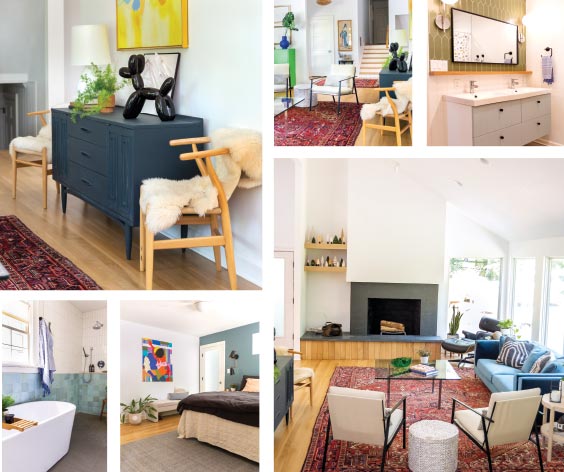
It was not initially the kind of home Michele thought she would buy. As a “never-Split-Level” kind of girl, she was surprised to find herself attracted to the 1958 split four-level home on a large swatch of land just a few miles from her parents’ home. Still, Michele had confidence she could transform the ho-hum house into a light-filled modern retreat for herself, her husband Jonathan, and their two sons.

The one challenge? “We were on a tight budget for all of our renovations, just the two of us quitting our jobs, not having new jobs, and moving from one country to the next,” Michele said.

Before landing back in Lynchburg, Jonathan’s job took them to such far off places as Germany and Hawaii, where they picked up some valuable aesthetic preferences. Topping the list of their renovation desires: opening up the floor plan and the ceiling, overhauling the kitchen and bath spaces, and adding more natural light throughout.

Though Michele designs project schematics for clients every day in her role at the architecture firm Atelier 11, she knew she could use some reinforcements to make faster decisions for her own home. Enter Bryn Namavari, Michele’s friend from grad school and a designer for the company CB2 in California. The two put their heads together to check the boxes the family wanted. Once the floor plan was created, they partnered with contractor John Joyer of Driven Builders and job super Mike Wright to bring their vision to life.

The duo’s decisions paid off. Walking into the home today, what was once a walled apart and dark layout now soars high with vaulted ceilings and warm white walls. Light pours in through large, drape-free windows and skylights in the kitchen. Pendant lights by AllModern glint off the large Quartzite slab from Roanoke Granite atop the kitchen island. IKEA cabinets with custom fronts from Semihandmade further modernize without being stark. Carefully selected pieces from antique shops, former home locations, and Michele’s lineage adorn the home.

“A lot of the Asian influences are things from my grandmother because my grandfather was in the Navy and they lived in Okinawa. So that is her original silk painting [hanging in the entry] from the ’50s in the original frame, so I started with that,” Michele said.

traditional home decorAdjoining the fireplace, with its soapstone hearth and surround from a quarry in Schuyler, VA, are two shelves that host Michele’s one and only true collection, an assortment of wooden trees handmade in the black forest in Germany.

“When I found those—I don’t collect things, but that became an obsession for me because I really like the form of those and how simple they are so now I have a little typology going on,” she explained.

Once the main floor living space renovation plans were complete, Michele turned her attention to the home’s three bathrooms and master bedroom. Tight on money and space, she had to get creative, knocking out hall closets to steal extra space for the bathrooms. In the master bedroom, the problem was too much space, so Michele subtracted some square footage to create a walk-in closet. In the bathrooms, she once again sourced IKEA for vanities with Semihandmade custom fronts. Smaller splurges in the master bath came in the form of an acrylic soaking tub and Cloe Baby Blue tile from Bedrosians Tile surrounding the integrated shower-tub area.

The dust has now settled on the 1.5 years of renovations at the Fredericks’ home and what remains is an airy and eclectic mix of old and new, calming and colorful—exactly as Michele planned it.

“I love an unexpected pop of color,” she said. “I do white walls everywhere because I love color but I don’t love color on the walls. So I want my weird, found, and very bright objects to speak for themselves.”

traditional home decorLisa’s Home: Stylish Symmetry with Gardens Galore
When Lisa and her husband, Jim, decided to finally build their stately brick home in 1995, it had been a long time coming. Lisa, a studio artist whose work ranges from pencil sketching and portraits to oil paintings and watercolors, points to a self-portrait she painted at that time of a 33-year-old version of herself with a certain,
shall we say, “expression” on her face.

“The look I have in that portrait is, ‘If you don’t build me this house soon, I’m selling the property’,” she laughed, recalling that the couple first bought the land and paid it off over six years before they started their new build.

Today the telling self-portrait hangs in Lisa’s art studio inside her quarter-century-old home that has seen a lot of life and expansion over the years. Lisa chose to model her home after the George Wythe house in Colonial Williamsburg, a timeless classic she knew would age beautifully over the years. Michele was just 11 when she and her sister, Laura, picked their bedrooms in the family’s home.

In the time that has passed, Lisa has thoughtfully filled the home with a mixture of antiques, finds from markets in places such as Atlanta, Charlottesville, and France, and an abundance of art. The home’s art collection includes portraits of Michele and her sister as children, “Covid portraits” Lisa painted of her three grandchildren, and a framed still life that was Michele’s first true piece of art at 16, which won an award at the Lynchburg Art Festival. It’s items like these, infused with meaning, that comprise much of what fills the home today.

“I have collected things over the years, over time. Everything has a memory,” Lisa said.

In the living room, for example, six patterned plates hang on the wall, a gift from a close friend who passed away in 1999 from breast cancer. As Lisa carefully collected items over time, her home watched her kids grow up and have children of their own, itself remaining a constant place of gathering for family and friends around the kitchen island.

“I have memories of sitting here sewing Halloween costumes with a day’s notice. And all the family dinners, and making curtains,” Lisa said. “Everything happened here in the kitchen; all of life happened here.”

While the kitchen, with its warm white cabinets, blue toile curtains, double gas range, and hanging copper pans, has not changed much over the years, Lisa did decide to swap out the backsplash and countertops. A slab of granite with beveled edges from Rockfab now adorns that well-loved kitchen island. Off the kitchen, a laundry room was added with creamy cabinets and a place to wash the Richards’ two Yorkies.

traditional home decor and gardensAnother addition off the back of the house came in the form of an oversized sunroom, filled with Parisian-style pieces and offering the feel of a tree house with wall-to-wall windows surrounded by greenery.

“My main goal [with the sun room addition] was to see outside,” Lisa explained. “I wanted everything low, everything subtle, because I’m an avid gardener so our big thing is the gardens and the outdoors.”

Indeed, the yard at the Richards’ house is something to behold. From the large Magnolia tree in the front yard and the newly planted Camellias in the back beds to the quaint potting shed overlooking the lush landscape, it’s little wonder why Lisa’s home was chosen to be on the 2022 Lynchburg Garden Tour. She is self-taught as a gardener, and the grounds of her home are now a designated habitat, which means pesticide-free growing, and also contain several bee houses.

“I’m really into my bees,” Lisa said. “Lynchburg is now a ‘Bee City’ and our Lynchburg Garden Club and Hillside Garden Club are working together to promote this.”

From entry to exit at both Lisa’s and Michele’s homes, each provides a serene space to let daily life with family unfold, filled with equal parts practicality and an effusive creative spark. Like mother. Like daughter.


be inspired


Photos by Daryl Calfee


More than a Club

Lynchburg’s Rotarians uphold rich practice of ‘service over self’

On a cold February evening in downtown Chicago in 1905, four business associates gathered for what would be known as the inaugural Rotary club meeting.

Founder Paul Harris wanted a networking club where businessmen could connect with members of his Chicago community. What was intended as a just a local hub, then named the National Association of Rotary Clubs, quickly sprouted into something much greater—far greater than any charter member imagined.

In just a few short years, Rotary evolved into a national networking and community service force, with hundreds of clubs throughout America. And in 1917, with just under 300 established nationwide, Rotary skidded its way to the small city of Lynchburg, Va.

Rotary International now boasts tens of thousands of clubs worldwide. The Rotary Club of Lynchburg and the Rotary Club of Lynchburg-Morning, Lynchburg’s two distinct clubs, have played a transformative role in the fruition of the community, serving in multiple facets of humanitarian aid, street cleanup, and other city improvement projects.

The Rotary Club of Lynchburg is in its 105th year, and the Rotary Club of Lynchburg-Morning was founded in 1987, just two years before women were permitted as members.
More than simply a club for friends to mingle, both clubs are dedicated to community service. Rotary International’s slogan is “Service above Self.”

The Rotary Club of Lynchburg and the Rotary Club of Lynchburg-Morning are responsible for many local delights, one of them being the Skatepark in downtown Lynchburg, which was funded by both clubs and is now maintained and operated by Lynchburg Parks and Recreation. Peaks View Park’s disc golf course is also a product of the clubs’ efforts, with assistance from district matching for funding projects and grants.

The clubs’ humanitarian aid projects cover a wide range of services, all of which can be described on its website. Recently, the Rotary Club of Lynchburg sponsored a Margaritaville Night at the Hillcats baseball game. A percentage of the proceeds went to Coins for Alzheimer’s Research Trust.

Both clubs have a history of supporting humanitarian aid locally and internationally, such fighting the poliovirus, securing medical equipment access for care facilities in Africa, and raising money to fund the Lynchburg Salvation Army in 1921.

“I love all the clubs in our area,” said Tom Illingworth, an Area Governor, and the Immediate Past President of Rotary Club of Lynchburg. “They do great work in their communities. And having a connection with Rotary can really be beneficial with your career or your personal goals whether it’s within your community or globally.”
Area 5 is home to seven unique Rotary Clubs: Altavista, Amherst, Bedford, Forest, Smith Mountain Lake, Lynchburg, and Lynchburg-Morning.

Both Lynchburg clubs each have more than 40 members and have maintained a strong membership commitment throughout the COVID-19 pandemic. Rotarians from all career backgrounds and age demographics participate.

“It really is uplifting to be a part of this club as well as meet with people each week who are like-minded,” Harrison said.

The Rotary Club of Lynchburg meets the second and fourth Thursday of each month at Oakwood Country Club. The Rotary Club of Lynchburg-Morning meets every Thursday morning at the Virginian Hotel. Weekly club meetings typically feature a meal and guest speaker from the community.

Recently, members from both clubs worked in conjunction to create Rotaract, a branch of Rotary International that provides opportunities for college students and young professionals to take part in serving their community. Rotaract officially was recognized in June 2021.

“We are looking for people who want to serve their community,” Harrison said. “This organization has done so much worldwide and to alleviate human suffering, and that’s the bigger picture. It really is an interesting, well-run organization full of very motivated people. So, anyone who wants to get involved, we are happy to bring you in and put you right to work.”

To get involved, members of the Lynchburg community are welcome to contact membership chair Tracey Dixon at director@lynchburgdailybread.com to inquire about the Rotary Club of Lynchburg, or Bethany Harrison at bethanyrotaryharrison@gmail.com to explore the Rotary Club of Lynchburg-Morning.

For more information about the clubs’ histories, visit lynchburgrotary.org.


Behind the Scenes Sept/Oct 2021

Finishing Touches

Our interview at greenhaus, a new beer garden featured in this issue’s Arts and Culture department, took place in the final week of construction inside the 12th Street building.
Writer Tobi Walsh, owner Sean Bailey and assistant to the regional manager Jordan Miller sat down to chat at the soon-to-be bar as crews installed various lighting, arranged plants and made other improvements to the space. It might be hard to believe, but in less than a week after these photos were taken, greenhaus was photo-ready!

Read more about the unique business that is fully curated by local artists and craftsmen starting on page 44.


Rug Refresh: How to Choose a Rug You Will Love

Rugs are the best of form and function.

As grounding elements, rugs can often set the tone of a room while also serving an important role throughout the home. Whether looking for a soft place to land, protecting wood floors, or covering ugly ones (we’ve all been there), there’s no doubt that the right rug can complete a space.

While replacing all of the rugs in your home at once may not be in the cards, addressing those in the most visible, high-traffic areas is a great place to start. For insights on how to make a choice you will love, we called in expert help from Brittany Sydnor, Lynchburg-based owner of BeFound Collective (befoundcollective.com), an online shop of vintage, hand-woven rugs sourced from all over the world.

Picture It
Before identifying your rug style, it’s important to understand your personal design style. For help with that, Pinterest is a great resource.

“Search by room names and focus less on the rug and more on the overall space. What is it about those rooms that resonate with you? From there, pick it apart and determine the rug style that best supports the space you’re trying to create. You might be surprised to discover that the style of rug you’re attracted to doesn’t align with the aesthetic you’re trying to create. Once you determine the style you love, I recommend sticking with wool or other natural fibers as they tend to wear better over time and are easier to maintain,” Sydnor said.

Easily Influenced
Let’s be real, many of us are influenced by what we see on social media these days. And in the Instagram world in particular, rugs are having a full-blown moment. So what are the trends emerging as a result?

“Vintage and antique Persian and Turkish rugs have always been a timeless choice for the most discerning rug buyers, but in the last several years, a younger audience has emerged and we’re seeing design influencers placing antique Persian rugs in some of the most unexpected spaces,” Sydnor said. “It’s a testament to their versatility and longevity in design.”

Size It Right
Once you set on a style, rug sizing can be the next difficult challenge and with good reason—Sydnor said it’s hands down the most important consideration when selecting a rug.

“In living spaces, aim to have all of your furniture legs resting on the rug or at the very least, the front legs of each piece,” she advised. “For large areas, like living rooms and open concept spaces, we love to use natural fiber rugs (sisal, seagrass, etc.) as a neutral base layered with smaller rugs on top. They can be purchased online in custom sizes (search “custom natural fiber rug”) and are comparatively cost-effective. This approach allows for flexibility with your topper rug and creates layers of texture.

For odd-shaped rooms, custom rugs are certainly an option and most carpet stores can take a broadloom carpet (typically thought of as wall-to-wall) and create an area rug, tailored to your space.

It’s also worth noting that many hand-woven rugs, particularly old Persian and Turkish pieces, are sized outside of modern standards (4’x6′, 5’x8′, etc.).
We recently helped a client place a 7’x16′ antique Persian Bidjar gallery runner in a long, narrow home library. We would have never found this size outside of looking for vintage or going custom.”

rug investmentMaking a Beautiful Investment
As any homeowner can attest, rugs don’t often come cheap. However, for something you walk over all day, the price is often worth the investment. Sydnor said she has a “buy what you love and you’ll always make room for it” mantra that extends to rugs, particularly vintage and antique pieces.

“Because no two are the same, if you love it, snag it. There will never be another just like it. That said, it’s important to balance love with space realities. Collecting smaller rugs is a solid approach because even if you aren’t in your forever home, they can easily transition from dwelling to dwelling.

For instance, something in the 3’x5′ range will work as a doormat, at the side of a bed, in front of a kitchen sink, and so on.”

Keep It Clean
For basic cleaning and care, Sydnor said, first start by using the floor setting on your vacuum and avoiding the fringe, which is one of the most vulnerable areas of a hand-woven rug. On occasion, take your rugs outside for a sun bath–the UV rays act as a natural disinfectant and will help kill off odors and bacteria.

“We recommend professional cleaning as needed and at least once every year or two, depending on the amount of traffic your rug receives,” she said. “It’s also important to keep the perimeter of the rug (fringe and binding) secure so that you don’t lose any of that precious weave. Lastly, do not—I repeat, do not—tape your antique rugs to the floor. The residue from the tape will be nearly impossible to remove later and impacts the stability of the foundation. We recommend thin, felt wool pads under all rugs.”


By Johanna Calfee | PHOTOS BY DARYL CALFEE


Artist Profile: Sonny Harlow Sept/Oct 2021

Decorative Artist

If you don’t recognize the name Sonny Harlow, you’ll recognize his work, whether it’s murals downtown or in homes across Boonsboro. For nearly four decades, this burly painter has focused on stenciling and hand-painting to create a unique look that not a lot of people can do—or want to do, according to him.

We caught up with Harlow after a recent kidney transplant, and though he’s promised his doctor to rest, he can’t wait to be able to paint once again.

Tobi Walsh: Sonny, how did you get started?
Sonny Harlow: I’ve been painting for 38 years. I was always scribbling on something as a kid. There was just always something in me. [When I moved to Lynchburg] I needed to find a way to earn money and I picked up some projects [in Boonsboro]. Then it was just word of mouth.

TW: How would you describe your artistic style?
SH: I’m self-taught. There was a high school teacher who showed me a lot, but I think I have my own style. I just have a lot of patience.

TW: You’ve worked on so many projects around Lynchburg. Which one has been your favorite?
SH: St. Paul’s Episcopal Church. They were renovating the church and there were no pews—nothing inside. They were trying to restore it to what it looked like back then. They had photos of the original stenciling on the ceiling and I had to recreate it.

TW: Whoa. That had to be time consuming.
SH: Yeah, it was one of my favorites. While we were in there painting, an organist would come in and practice. It sounded awesome. I still have goosebumps thinking about it. A church out in Lexington approached me about working on a similar project for them, but I had just started dialysis and wasn’t able to make the drive.

TW: Yes! You recently received a new kidney via transplant. That’s incredible.
SH: My doctor told me it would probably take a long time to find a donor so I had buckled down, but it took a lot quicker than I thought. I couldn’t do the Lexington job, but I did hand-cut the stencils for them. I was so humbled that they trusted me to do that.

TW: It seems like you have a thing for churches.
SH: (chuckles) I also worked on a mural for Tree of Life Church in their sanctuary.

TW: Any other projects that come to mind?
SH: When Amazement Square first opened, they asked me to come in and do a lot of hand-painting for some of the exhibits. I remember climbing into this tiny tunnel and doing some painting and drawing worms and bugs. I could barely fit. I worked on a few of the traveling exhibits they had at one point. There was one about ancient Egypt. They also wanted to start showing movies in the park [by Amazement Square] so I did a mural for that as well. I also helped out on a project at Point of Honor.

They were trying to recreate a specific wallpaper. So I did it by hand so part of the wall is wallpaper, the other is just a painting.

TW: Do you think hand-stenciling is a lost art form?
SH: I mean, a lot of my stencils I cut by hand. It’s not something you can go and pick out at Michaels. You need a lot of patience.

I remember a mechanic worked on my truck and said, “I couldn’t imagine painting all day.” And I said, “I can’t imagine fiddling with a wrench all day.” Not everyone wants to do it. But I like it. I like being able to take my time.

TW: And it allows you to create some really cool effects, too.
SH: I worked on a house where they wanted a certain area to look a certain way. So I took a sponge and a rag, let it dry, and then wrinkled it out to make the wall look almost like marble. I guess they sold the house, and the new owners mistook the painting for wallpaper. They tried to take it down and realized it was paint!


Photos by Ashlee Glen

GET IN TOUCH
Email Sonny at sonnyharlow6073@gmail.com


Living Out Loud Sept/Oct 2021

Readers Taking Action
We are always thrilled to hear how our magazine is improving the community. Thank you to reader June Najjum for sending us this note about our March/April issue: “I wanted to thank Kaye Moomaw for writing the article about ‘Planting for Birds and Bees’ in the March issue. I turned my garden into a certified pollinator habitat. I don’t live in Lynchburg but I live in nearby Bedford County. I’m proud of my sign in the front yard. I happened to pick up your magazine at an antique shop in Lynchburg while I was shopping with a friend.

You never know what kind of positive impact your magazine makes out there!”

Slight Change
Perceptive readers may notice a small difference in our Art department, which is now called Arts and Culture. We wanted to open up this section of the magazine to include not only local art forms—visual art, theater, dance etc.—but also in-depth articles about the ways of life and customs of different groups of people in our region.

Have an Arts and Culture story idea? Contact information for the editor is below.

LRW Recap
A huge thanks to everyone who came out to support our 10th annual Lynchburg Restaurant Week June 12-19. We had 13 restaurants participate this year, with many owners telling us they were impressed with the crowds.

On Facebook, Burt Taylor, owner of Stoney Badger, said: “We were slammed tonight because of it.” Also on Facebook, Tim Overstreet told us he had lunch at Trio during Lynchburg Restaurant Week: “First time there, very pleased. Will go back!”

A portion of our sponsorship proceeds was donated to Meals on Wheels of Greater Lynchburg. They tell us they have seen a surge in demand since the pandemic began. If you want to help out, visit their website to learn more about donating or volunteering: mealsonwheelslynchburg.org.

We Want To hear From You!
Send us an e-mail to shelley@lynchburgmag.com. Correspondents must identify themselves; names may be withheld on request. Lynchburg Living may edit or condense.


Camp Trapezium

Adding another unique brewery experience to Central Virginia

There is a new future for a historic landmark in Amherst.

Camp Trapezium, the western outpost of Trapezium Brewing Company in Petersburg, opened up in the renovated Amherst Milling Co. in June, offering small-batch craft beers, brick oven pizzas, wings and salads.

Amherst Milling Co., a mill and farming supply store built in 1890, ceased operations in 2017 and was purchased the following year by the Petersburg-based Waukeshaw Development. The company renovated the mill, farmhouse and land into a haven for family-friendly fun, craft beer and an immersive experience drawing much praise and appreciation from the local community.

“One of the most fun parts about getting [Camp Trapezium] open [was] the number of people who drove past every day for months, well before we were open, and just wanted to pop their heads in and take a look,” said Rachel Jesten, hospitality manager. “Everyone tells us the same thing. They say, ‘Boy, I used to buy my grain here for years. This was our local farm shop… they used to sell everything here.’”

Camp Trapezium’s beer menu currently features award-winning ales brought in from the Petersburg location, but the ultimate goal is for the brewery to also become a producer of its own beers that will incorporate ingredients grown on their farm. According to Jesten, head brewmaster James Frazer’s idea is to use the local flora to influence the fermentation process.

“[Camp Trapezium] is almost the even artsier cousin of [Trapezium Brewing Company],” Jesten said. “So, we are doing a lot of wild fermentation, mixed-culture ales. Basically, anything James Frazer wants to try… This is really a cool playground for that.”

In addition to the brewery and restaurant, the 76-acre property is open for guests to walk around and explore. Featuring a farmhouse that has been renovated into an AirBnb with eight suites, a permaculture farm, live animals roaming around and a water wheel that Waukeshaw hopes to make operational for hydroelectric power production within the next few years, Camp Trapezium is as much a historic site as an eatery.

“We want [Camp Trapezium] to be a really immersive experience,” Jesten said. “We love the idea of people coming down to the area and not just making a day trip out of it but making
a weekend.”


By Christian Weaner | Photos courtesy of Trapezium Brewing Co.

Camp Trapezium
140 Union Hill Rd., Amherst
(434) 381-2635
www.trapeziumbrewing.com/amherst