Carving a Dream

How this Altavista Resident Built a Life Using Age-Old Art Techniques

Most Americans delve into an industry, work on average 40 hours each week for 40 years, then retire on 40 percent of their income. But master engraver Tim George of Altavista chiseled against that mold by mastering and selling a unique artform.

Every well-designed engraving you see in this story was done by hand. No fancy machinery like air utensils, high-end microscopes, or expensive engraving pens. Only tools made from small carbide steel drill blanks, countless hours of chisel practice and refinement, and a passion to master this ageless art. 

The art of engraving is as old as time, but very few still practice the traditional hands-only techniques. Engraving is the art of carving initials, patterns, and picture art into an object’s metal components. 

The industry rose to prominence in the 15th, 16th, and 17th centuries, and evolved further as time passed. Today, popular metal objects signatured with engravements include handguns and rifles, knives, and a wide variety of jewelry.
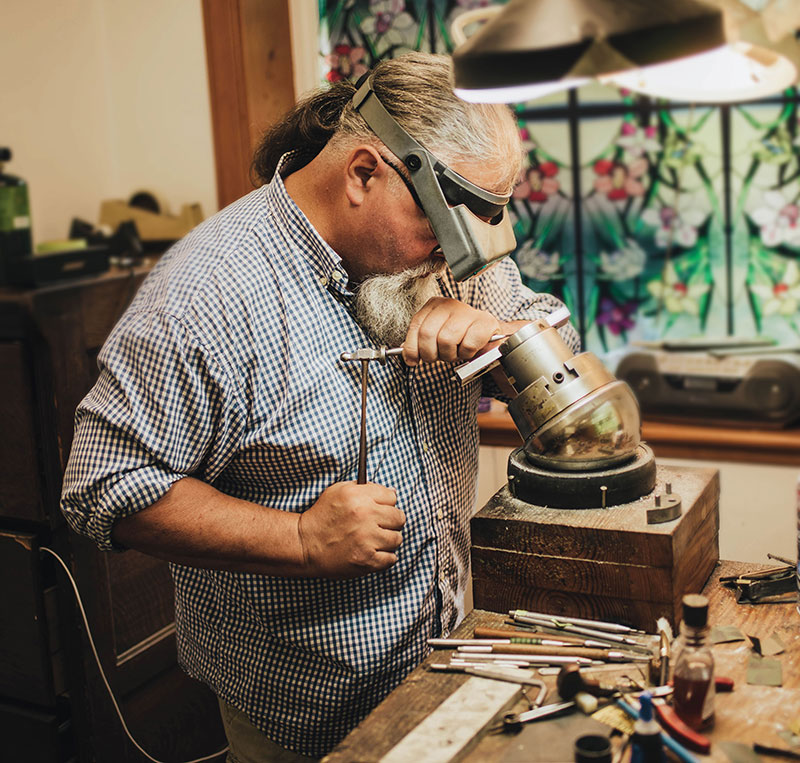
tim george

“What we do is so cool, and I just love it,” George said. “You’re in contact with the metal in a different way. This is closer to the way it was done thousands of years ago, going on back to cavemen carving images on the wall.” 

According to the Firearms Engravers Guild of America (FEGA), where he is a member, George is one of 50 certified master engravers in the country.

For decades, jewelry, knife, and gun companies have commissioned George to engrave his illustrations and designs into exclusive and limited-edition products. George also extends his services to private clients, who pay upwards of tens of thousands for just one project. 

Popular features of his art include 24 karat yellow gold, 18 karat green gold, and even rose gold, in addition to multi-dimensional layering and flush.

George has been commissioned by Ruger, Colt, and even William Henry, a jewelry company that sold one of George’s masterpieces for $57,000. His work has also been featured in magazines and other publications with national circulations, like Garden & Gun.

 “Now that I’m older, I often reflect back on my career and wonder sometimes how the heck I made it,” George said.

“I was lucky in that I loved my job and really enjoyed creating something every day out of nothing. I also had, and still have, the ability to critique my work and be proud of it, but also to notice little things to improve on.

Most commissions begin with a sketch. Once approved, it may take George anywhere between a couple weeks to a year to complete one project, depending on size, features, and workload.

George’s love for art began with his grandparents.
His grandmother on his mother’s side was a painter, and his grandfather on his dad’s side was a craftsman. Both of his daughters are also entrenched in the visual arts, one being a photographer, and the other an art teacher. 

“I do think that art runs in people’s families,” George said. “This is the only thing I have ever done for a living, aside from being a ski mechanic. I like to have a flexible schedule.”

With art holding a special place in his soul, George looked for any opportunities to leverage this passion for a living. In 1981, George apprenticed under master engraver Ken Hurst, a former master for Colt Firearms. As Hurst’s company grew, George became his general manager and even trained new engravers. By 1987, large projects came to an end, so he and two other engravers formed their own company, Old Dominion Engravers, based out of Lynchburg. In 1990, as his knowledge and skill improved, George left the company to go solo—and he has never looked back.

“I still shake my head when I think back over my past,” he said. “I never thought about it much in my early days. I just wanted to learn as much as I could as fast as I could. I was trained to be a production engraver when I first started and was paid piecemeal, so I learned to be fast. Most of the better engravers that I know are fast and efficient, so that always helped.”

George works from the basement of his home. There’s nothing fancy about his 8-by-16-foot “office”—just a couple tables and tools scattered around the room. Several scratch marks blemish the floor, worn down by his chair. 

Through it all, George is thankful for health, as his craft can become physically demanding.

 “I never thought about it then, but I think about it now: I’ve never broken a bone. …If you’re cutting, you need to be moving your whole body,” he said. 

George has coated his art onto some of the nation’s most expensive collectible guns, knives, and jewelry. People often ask him if he ever experiences apprehension while handling delicate, expensive weaponry. His answer is always the same: never. 

Aside from engraving, George enjoys fishing, cigars and bourbon, and participating in the public square. He is on the Altavista town council.

“I loved growing up in Lynchburg,” he said. “I lived there for more than 30 years. I moved to Altavista about 22 years ago for family reasons and fell in love with this small town immediately. I love our parks, the YMCA, and the beautiful Staunton River that runs right through our town.”

George showcases much of his work through Instagram, where he shares photos of current projects and even videos of him at work. 

“There are very few of ‘us’ that still basically use the hammer and chisel method in the US,” he said. “I know lots of engravers that I admire that use the new modern method—air-assisted tools in conjunction with microscopes. They do incredible work. I guess I just like the way I learned the best. I like antiques and feel pleasure doing what I do the old-fashioned way.”

For more information, visit George’s Instagram profile @timgeorgeengraving. To learn more about his portfolio, visit his website www.timgeorgeengraving.com.


Stewards of Ivy Cliff

One Family’s Journey to Preserve History

We want to figure out who the enslaved were,” Sophie Taylor resolutely said. Clad in duck boots and flannel, she leaned across the granite kitchen countertop—the newest element in her home by about a century—as she poured over census records, family trees, and local history books.

That journey—one that began in March of 2021 when she and her husband, Mike, purchased the Ivy Cliff estate—really began much longer ago, in 1772.

Ivy Cliff was built by Revolutionary War hero Captain Henry Brown, who completed three terms in the Continental Army and served under Colonel Charles Lynch. It’s estimated that the Brown family acquired the Ivy Cliff tract of land—3,400 acres in total—in 1755, with the brick Federal style home being built and completed by the late 18th century.

The 4,900-square-foot home features sweeping 10-foot ceilings, original long plank wood floors, and ten fireplaces in total. Historical records show that the home originally had more rooms than what stand today, but all that remains of them is a swath of exterior wall that stretches from the east side of the home.

Photos by Ashlee Glenn

Captain Brown and his wife had six children together, all of whom were raised at Ivy Cliff, and the property remained in the Brown family until the 1920s.

Ivy Cliff, which at one time was referred to as Otter Hills plantation, was a booming tobacco farm.

“We found a census from September 1860 that shows 29 enslaved men and women on the property at the time,” Taylor said. “Thirteen men and sixteen women. Though it’s certainly possible that more than that were living here under a different owner’s name. We found evidence that there were six different enslaved dwellings on the property at one time.”

One of those dwellings is still standing today, downhill and largely out of view from the main house. 

The enslaved cabin is a “dogtrot” style cabin, which means that it’s essentially two separate cabins connected by a breezeway. The west side of the cabin was completed in 1810, with the east side of the cabin following shortly after in 1830.

Photo by Ashlee Glenn

“There are four separate rooms in the cabin, but we’re not sure if four different families lived in this one cabin, or if the rooms were separated by males and females,” Taylor explained.

When the Taylor family purchased the property in 2021—a pandemic move from Florida—they knew that there was a rich history behind the property, which had been meticulously preserved by previous owners. But the surprise came from how much the community became invested in its history.

“There are so many people in this town who love history,” Taylor recounted. “They saved everything and gave it back.”

Since they arrived at Ivy Cliff, neighbors have been “returning” pieces of property history that had been salvaged over the years. From the original louvered shutters, which a neighbor salvaged when a previous owner remodeled, to Independent State of the Congo coins circa 1888, which were dug up on the property, neighbors and history buffs alike have flocked to Ivy Cliff to return memorabilia and help piece the history together.

Part of connecting those dots was ensuring that the history remained preserved.

In 2022, the Taylors made great strides in ensuring the entirety of their property—now 17.3 acres of the original 3,400—became a historical site. They worked with Preservation Virginia, a nonprofit organization that sustains Virginia’s historic places through leadership in advocacy, education, revitalization, and stewardship, to have the slave dwelling added to the “Virginia’s Most Endangered Historic Places” list.

Photos by Ashlee Glenn

In Virginia, extant dwellings of enslaved people are rare and often overlooked. Constantly subject to time, elements, and lack of resources of the property owners, many have fallen into ruin or vanished from history altogether.

“Having this Preservation Virginia designation helps us advocate for resources and grant funding,” Taylor explained.

In addition to the Virginia’s Most Endangered Historic Places list, the Taylors applied for the Threatened Sites Program with the Virginia Department of Historic Resources, which offers emergency funding for archaeological sites endangered by erosion or other factors like impending development or vandalism.

That grant, in particular, connected the Taylors with local engineering and surveying firm, Hurt & Proffitt.

“We had Hurt & Proffitt out with their archaeology team completing a site survey of the hillside with the extant cabin searching for likely locations of the other slave dwellings,” Taylor explained. “They are still studying the thousands of artifacts found at their lab at Historic Sandusky.”

Shovel tests and test unit excavations were completed by the Hurt & Proffitt team, which runs the only engineering student lab in the state.

Photos by Ashlee Glenn

Every artifact found around the slave dwelling as well as the surrounding land where other dwellings may have stood were bagged in acid-free bags for storage and identification.

“The most significant findings were the ones that couldn’t be bagged,” said Jess Gantzert, Hurt & Proffitt’s laboratory director. “We found quartz cornerstones, which were religiously significant [to the enslaved] as well as a number of Hoodoo markings on the enslaved cabin.”

Photos by Ashlee Glenn

In addition to the cornerstones and markings, the Hurt & Proffitt team was able to collect nails, bricks, bottle glass, pottery, and window glass, all of which will help them begin painting the picture of the everyday lives of the enslaved living on the property.

“We have the technology now to identify what type of liquid bottles used to hold,” Gantzert explained.

“So we will be able to determine if they held medicine, drinks, or liquids that were significant to their
Hoodoo culture.”

While processing and identification is still ongoing, the Taylors and the Hurt & Proffitt team are hopeful that the history of the enslaved people on the property will start to be told.

“We are able to use archaeology to find and tell the stories of the people who weren’t considered people,” Gantzert said.

“Our plans include a complete renovation of the cabin with the intention of sharing it with local school groups as a means of learning local Virginia history,” Taylor furthered. “Due to the historical importance of the cabin, we want to ensure that any renovation is completed with special care, which is why we are seeking the assistance from historical architects, archaeologists, contractors, and stone masons.”

Under the Taylors’ care and stewardship, the story of Ivy Cliff continues to unfold with the hopes of one day identifying the names of those who were enslaved on the property and reconstructing their stories.  

If you’re a Lynchburg native, are familiar with Ivy Cliff’s history, and have information that may help,
reach out to the 501(c)(3) that the Taylors established at https://ivycliff.wixsite.com/ivycliff.


The Summer Soul Came to Lynchburg

How Robert “DJ Mad Lad” Goins Shaped Lynchburg’s Culture

Local DJ and all-around renaissance man Robert “DJ Mad Lad” Goins’ influence on Lynchburg’s rich and complex cultural and musical identities simply cannot be overstated. At the tender age of 15, he saw that Lynchburg’s African American population lacked representation on the radio and set out with tenacity, curiosity, and ingenuity to address the problem. Goins’ fateful tale of the summer of 1966 is a testament to an individual’s capacity to enact positive change and transform a community.

In the early 1960s, Lynchburg’s radio station offerings did not come close to reflecting the vibrant diversity of the music being made or the artists making that music. In particular, soul music by Black artists had no avenue for reaching a broad local audience; access was limited to those who could afford to buy soul records.

“Growing up in Lynchburg in the ’60s, there was no soul station,” Goins recalled. “I didn’t know the difference between the different genres of music. Songs like Whole Lot of Shakin’ Going On; Ahab,
the Arab; Does Your Chewing Gum Lose Its Flavour;
and Peggy Sue were all that I knew about in the first, second, and third grades. I didn’t know anything about Black artists because the stations
weren’t really playing those artists. Nobody played any soul music during the day. You might occasionally hear The Supremes or Chubby Checker, but those occurrences were few and far between.”

Little did Goins know that a trip to Chicago in the summer of 1966 would open up a new world of music not only for him, but also for the Lynchburg community at large.

“I didn’t know that there was such a thing as a Black radio station until 1966, when I spent the summer with my cousin in Chicago,” he said. “I heard this Black radio station and I said, ‘Wow, this is slick! I wish I could have some kind of way to get this kind of music out to everybody!’”

Photo by Ashlee Glenn

It didn’t take long for Goins—who was only 15 at the time—to begin turning that wish into reality. His first step was learning how to build a transmitter.

“I came across this popular electronics book called Radio-TV Experimenter, and they had this circuit board transmitter—a short-wave code transmitter—and I just started building it,” he noted. “All it did was make Morse Code noise on the air on the short-wave band. I just kept on messing with it and adjusting it and making it fall on a band where people could listen to it.” 

The next step in the process was figuring out how to get music onto the radio.

“After some trial and error and a couple of blown circuit boards, I found a way to put music on the radio,” said Goins. “It was a daily experiment until I got something that worked, and it took me the summer of 1966 to figure it out. I finally got a circuit, hooked my record player and microphone up to it, and I was on the air! I could get a couple of blocks with it.”

Along the way, Goins—who did not yet realize that he was creating an illegal radio station—consulted with two of his teachers, neither of whom were aware of their student’s project.

“I had a couple of teachers—my electronics shop teacher and my physics teacher—who told me about crystals, which are the things that put the radio waves on the air,” he stated. “They didn’t know what they were helping me do! They thought I was just really interested in the topic.”

Photos by Ashlee Glenn

Once Goins figured out how to get music on the air, he realized that he needed access to additional music if he wanted to start his own station. Fortunately, he had plenty of friends who were happy to share their records in exchange for guest spots on Goins’ new station, which he named WKKD (KKD stood for Krispy Kreme Donuts).

“I didn’t have too much music at the time,” Goins recalled. “Records were 76¢ back then, and that was most of my lunch money. And that was only for a two-and-a-half-minute song, so what do you do for the rest of the time? I kind of depended on my friends who bought records all \the time. If you had a record collection, you could come be on the air!”

Still unaware that his station was illegal, Goins advertised with gusto.

“I put it out there that I was putting a soul radio station on the air and nobody believed it because the only time we heard soul music was when WLAC out in Nashville came through Lynchburg around 10:00 at night,” he said. “That was my bedtime! I put up posters and flyers all over the school telling people to tune in to 630 on their radio dials to hear all kinds of soul music starting at 3:00 p.m.”

Despite any initial skepticism, WKKD quickly gained a lot of traffic—literally and figuratively. A myriad of listeners consistently drove downtown and lined the streets within WKKD’s limited range
to listen to artists like James Brown, Aretha Franklin, Marvin Gaye, Etta James, Otis Redding, and many more.

“Everyone seemed to like what I was doing,” Goins stated. “They would drive in range of the station, and that range was very, very limited. I lived at 1502 Pierce Street. On a good day, when it was nice and sunny, I might reach all the way past 5th Street and the Rivermont Bridge—that’s all the range it had. At 3:00, there was a huge migration of cars that parked on the side of the road so they could hear some music. Cars would line up on 12th Street and Pierce Street so they could get in range of the station. People would even dance on the side of the road!”

As WKKD’s popularity continued to skyrocket, one of Goins’ friends—who worked at a legitimate radio station—warned him that he could get into hot water.

“I didn’t know anything about radio regulations, FCC licenses, or any of that stuff,” noted Goins. “I just kept hearing from a friend of mine, ‘Yo man, you’re going to get into trouble! You might go to jail!’ And I said, ‘Go to jail for what? I’m just playing around with the radio here!’”

Ultimately, Goins did not get into legal trouble, but he was forced to shut WKKD down after about a year and a half on the air. By this point, however, Goins had already established himself as a central figure in the Lynchburg music scene and quickly embarked on the next chapter of his ongoing illustrious career—all before graduating from high school.

Photo by Ashlee Glenn

“There was a radio station called WDMS that played easy listening music on AM and FM all day, and they weren’t able to get advertisers,” Goins recalled. “Sponsors were calling them wanting to know where my station was so they could advertise on it. That did it. The guy [at WDMS] said, ‘We’ve got to do something about this,’ and they gave the FM—which became WJJS—to us. I didn’t know it was going to become as popular as it did—if I had known, I would have bought it! I was in eleventh grade at the time.” 

WJJS went on to become the number one radio station in Lynchburg.

These days, Goins continues to DJ a wide variety of events in and around Lynchburg and can be heard on “The Groove” WGVY, an Oldies station on 102.3 FM, weekdays at 3 p.m. With his gregarious nature, boundless curiosity, and respect for all genres of music, he also continues to lead the charge in fostering connection and innovation through music.

“I play all different genres of music with the same level of enthusiasm,” he said.
“I’m also the kind of person where, after about 15 to 20 minutes, you’re my best friend and I’m your best friend! That’s just the way I am.”  


2023 Top Lawyer Winners

What makes a great lawyer? While impeccable communication skills and high intelligence are a part of the equation, truly great lawyers also earn a respect that follows them out of the courtroom and into the community.

Top Lawyers of Greater Lynchburg is the result of a comprehensive peer-to-peer survey, facilitated by DataJoe Research Company.

Read on to see who lawyers themselves recommend in 23 specialties.


Summary.  To create the list, Lynchburg Living contracted DataJoe Research to facilitate an online peer-voting process and Internet research process.  DataJoe Research is a software and research company specializing in data collection and verification, and conducts various nominations across the United States on behalf of publishers.  To create the list, DataJoe Research facilitated an online peer-voting process. We paired this with an Internet research process to identify success characteristics. DataJoe checked and confirmed that each published winner had, at time of review, a current, active license status with the appropriate state regulatory board. If we were not able to find evidence of a lawyer’s current, active registration with the state regulatory board, that lawyer was excluded from the list.  In addition, we checked available public sources to identify lawyers disciplined for an infraction by the state regulatory board. These entities were excluded from the list.  Finally, DataJoe presented the tallied result to Lynchburg Living for its final review and adjustments.  

Final note.  We recognize that there are many good lawyers who are not shown in this representative list. This is only a sampling of the huge array of talented professionals within the region. Inclusion in the list is based on the opinions of responding lawyers in the region. We take time and energy to ensure fair voting, although we understand that the results of this survey nomination and Internet research campaign are not an objective metric. We certainly do not discount the fact that many, many good and effective lawyers may not appear on the list.

Disclaimers. DataJoe uses best practices and exercises great care in assembling content for this list.  DataJoe does not warrant that the data contained within the list are complete or accurate. DataJoe does not assume, and hereby disclaims, any liability to any person for any loss or damage caused by errors or omissions herein whether such errors or omissions
result from negligence, accident, or any other cause. All rights reserved.
No commercial use of the information in this list may be made without
written permission from DataJoe.

Questions?  For research/methodology questions, contact the research team at surveys@datajoe.com.


The Next Generation of Virginia Wine

Hazy Mountain Vineyards & Brewery Levels Up the Local Wine Experience

Driving up a meandering mountain slope just off of the Nelson 151, you’re not quite sure what you’ll find when you reach the top. But then, three-quarters of the way up, you pass through an imposing iron gate and the first glimpse of stucco, stone, and terracotta come into view and you wonder if you’ve somehow been transported from the foothills of the Blue Ridge Mountains to a remote French oasis.

That feeling of tranquility continues as you crest the mountaintop, with 180-degree sweeping views of the valley below.

If first impressions are any indication (spoiler: they are), you know your time at Hazy Mountain Vineyards & Brewery will be one for the memory books—and one you’ll want to repeat again and again.

Hazy Mountain Vineyards & Brewery opened in June of 2021—quietly at first, to allow the team to ease into their space. Perhaps what they didn’t realize though is that the “if you build it, they will come” adage would be true.

Photos courtesy of Hazy Mountain Vineyards & Brewery

The Hazy Mountain estate is sprawling, with 35-acres under vine, an expansive tasting room, and an adjacent event space for events and weddings. The tasting room interior mirrors its rustic yet elegant exterior. Stone archways give way to sweeping pine ceilings and two bars run parallel to one another so there’s plenty of room to sample their classic varietals before committing to a bottle and some food, which can be enjoyed on one of the two floors inside of the tasting room, or out on their stone veranda.

On any given day, the Hazy Mountain grounds are full of locals and tourists alike who either chose Hazy Mountain as their one-stop destination, or who have added it as a stop along their 151 tour. Regardless of their intention, they tend to happily stay a little longer than planned as they soak up the surroundings and dive into Hazy Mountain’s unparalleled wine.

Photos courtesy of Hazy Mountain Vineyards & Brewery

When choosing a wine to enjoy, no choice is the wrong one. While their chardonnay—fermented in French oak with a strong, toasted edge and creamy center—is their bread and butter, they aim to stick to classic varietals that everyone can rely on and enjoy.

“Where some wineries are more experimental with their varietals, we aim to stick to the classics and level up a next generation of Virginia wine,” said Michael Gagliardi, Wine Club and Events Coordinator for Hazy Mountain.

Hazy Mountain has eight white and eight red wines currently on rotation in their tasting room, ranging from familiar classics like chardonnay and cabernet sauvignon to varietals you don’t typically find at Virginia wineries, like chenin blanc.

Luke Trainum, Wine Maker. Photos courtesy of Hazy Mountain Vineyards & Brewery

“We planted six acres of nebbiolo in 2021,” said Luke Trainum, one of the two Hazy Mountain wine makers on staff. “It has a long growing season and can be a challenge to grow in this area, but it’s a wine we are looking forward to introducing.”

While the varietals themselves aren’t experimental, what you’ll find at Hazy Mountain is experimentation with the classics. The terrain is unique in that the south facing slopes range in elevation from 800 feet to 1,140 feet at the mountain’s crest, with the soil type varying just as much as the elevation.

“The site is unique for the area because of the rocky slopes, air flow, and temperature oscillations,” said Trainum. “It’s totally different compared to a vineyard that’s just 30 minutes away.”

Photos courtesy of Hazy Mountain Vineyards & Brewery

It’s that unique terrain and the seven different subsoils that are found on the property that allow the Hazy Mountain team to grow classic Bordeaux-style wines and other unique varietals, like their blaufränkisch rosé, which is vibrantly colored, floral, and dry.

“No one else is growing varietals like that,” said Trainum, speaking of the blaufränkisch grape, which is traditionally grown in Central Europe and can be demanding in terms of where it will grow.

In addition to the 35-acres under vine at the Hazy Mountain estate, the team also manages a secondary production vineyard in Swoope, Virginia, which brings their growing capacity up to 90 total acres.

Their production vineyard in Swoope is just under an hour away from the tasting room and boasts a completely different climate and terrain, allowing them to grow varietals that wouldn’t otherwise survive on the rocky surface of Hazy Mountain.

Photos courtesy of Hazy Mountain Vineyards & Brewery

“You don’t know your site that well unless you know fruit from other sites,” said Trainum.

It’s this level of intentionality—of truly understanding terroir, or regional, wine—that makes Hazy Mountain’s offering stand out.

“It’s wine that truly expresses itself,” summarized Trainum.

Wine isn’t all there is to the Hazy Mountain story—though the story could certainly end there and it would be a happy one, full of warm days on the veranda sipping chilled rosé. In addition to their 16 varietals, Hazy Mountain also offers six classic beers that are brewed on-site. Rather than overly hoppy IPAs or heavy beers with high ABV percentages, you’ll find classic pilsners, ales, and lagers that will feel refreshing at the end (or at the start) of your day.

Photos courtesy of Hazy Mountain Vineyards & Brewery

All beers on tap are European-style, which are all about balance. There’s a hefeweizen, a Bavarian-style wheat beer that is slightly malty but unbelievably refreshing. There’s also a pilsner that’s brewed with German and Czech hops that’s easy to drink and pairs well with just about anything, especially a slice of pizza, which Hazy Mountain also serves.

The tasting room offers a full menu of expertly crafted pizzas, from a classic cheese to a mouthwatering prosciutto and fig. If you’re in the mood for a quick snack while you take in the view,
Bavarian pretzels, charcuterie boards, and beloved regional favorite Nightingale ice cream sandwiches also line their “Light Bites” menu. 

Hazy Mountain Vineyards & Brewery, unassuming at first as you make your way toward the estate, is an experience unlike any other in our area. You’re carried away, even if just for a brief moment, to the French countryside, where decades-old vines line rocky mountainsides and a history of bold and balanced wine beckons you to pull up a chair, wine glass in-hand, and simply sit and enjoy the peaceful view for a while.  


A Tale of Two Educators

How Kathleen Olinger and Anthony Andrews are increasing early childhood education in the Hill City

Two new early child care centers are on the horizon in Lynchburg. One opened this past fall and another will open its doors this August, and both have unique ideas for filling the childcare needs for the city.

Earlier this fall, Kathleen Olinger, along with three other Montessorians, started Hill City Montessori School located  at 1301 Rivermont Ave. at the terrace level of Gospel  Community Church.

Olinger said the school offers mutual respect and collaboration between students and adults through guidance, empathy, and preparation of the environment. 

“Four of us who had worked in Montessori communities for 10 years came together to build a local school that we believed in,” she said. “So, we’ve taken all the lovely things that we’ve learned, and we’re putting it into the heart and soul of this whole city.”

Montessori education prepares students for a life of purpose from birth to adulthood. The mission of the school is to cultivate a diverse, inclusive, Montessori community through family partnerships and the preparation of the whole child. They believe in responsive education that supports not only students, but their families as well. 

“As Dr. Montessori has said, ‘establishing lasting peace is the work of education,’” Olinger said. “Through high-quality, comprehensive, and science-based education, we are able to offer appropriate and effective early childhood education—and beyond—that we believe can truly solve so many issues in our local community, and society as a whole.”

Olinger said the further she went to school for education, the more she realized traditional education was not what she wanted to pursue with teaching.

After enrolling her child in a Montessori school, she said she started to fall in love with its style and mission.

Olinger eventually became the head of school and executive director of a Montessori school and has training in Montessori leadership. 

Montessori schools focus on a child-led, comprehensive, whole education for students, Olinger said.

“It’s all about preparing for life beyond school. It’s all about preparing the human—the whole child,” she said. 

Montessori education goes beyond just academics. It’s about providing emotional, social, and basic, everyday life skills. Students don’t sit at desks, do lots of worksheets, or use much plastic. Olinger said the classrooms are cozy and students learn to use everyday items, preparing them for independence.

 “I have an extreme desire to make Montessori accessible to the average family and not just elitist,” she said. “I want to make it a program that actually gives back to the community.”

Olinger is also a certified Positive Discipline Educator and offers courses at a sliding scale for families and adults to also gain the tools and community needed to become equipped to interact in a way that offers mutual respect and collaboration and fosters healthy relationships. 

“Such skills will have a positive impact on not only the children they may have in their households or in their classrooms, but also with adults they meet as well,” she said.

Hill City Montessori School offers additional education opportunities and book clubs that are open to the greater community, often at no cost, that are specific to potty training, independence, inclusivity, and more. 

“We believe in equipping our students, adults, and fellow humans of Lynchburg, so that we can learn from one another, collaborate, and work together to create a more beautiful, healthy, and responsive community,” she said.

Olinger said there has been research to prove that students who attend Montessori schools for early childhood education do significantly better with their social and emotional skills later in life.

“So that foundation is irreplaceable,” she said.

The school offers spots for kids from birth to sixth grade.

With less than 30 subsidy providers in Lynchburg, Olinger said school leaders are also part of the community that believes in offering high-quality education in a way that is accessible and inclusive. 

The child care subsidy program through the state of Virginia subsidizes the cost of child care for qualifying families and allows them to choose education that feels right to them without the cost eliminating their opportunity.

Olinger said the biggest focus is responsive education.

“We want to be evolving and checking in with ourselves and being aware of who we are and making sure that we’re making mission-focused decisions,” she said. “We’re going to put ourselves in the heart of Lynchburg and serve the families as best as we possibly can.”

Later this year, Anthony Andrews will be opening a new preschool near Lynchburg General Hospital at 1915 Thomson Dr. called Teachable Moments Preschool.

The new school will make room for about 70 new students from six weeks to five years old.

Andrews said he has been holding onto this dream for a while—since 2006 in fact.

Andrews said Sackett Wood, president of Moore & Giles, has been an instrumental person who believed in Andrews from the beginning when he decided he had a dream of opening a preschool one day.

“Sackett asked me what my passion was and what I wanted to do with my life, and I told him that I wanted to start a preschool,” Andrews said. “He was the very first person not only to give me advice on the business side of things, but he financially invested in me as a person.”

It all started about 16 years ago with a three-month-old baby girl who died of sudden infant death syndrome (SIDS) and Andrews, a firefighter with the Lynchburg Fire Department, responded to the call. The baby was at a daycare center held at someone’s home.

When he and his wife Stephanie had their daughter, Alaya, they decided to learn more about child care and how they could prevent such a tragic situation from happening to their own baby.

“One thing led to another and we looked for quality child care, and we couldn’t find any that we really enjoyed,” Andrews explained. “It wasn’t until two years later that we found Centra’s child care center and my love for child care started blossoming from there. Everything that my daughter was learning at school, I wanted to add to or supplement that at home.”

From there, Andrews started getting more involved in child care, learning about brain development, and learning how children learn and grow.

Andrews now serves on the Lynchburg School Board, was a teacher for six years at Elizabeth’s Early Learning Center, and was the assistant director of Peakland Preschool for two years.

His upcoming Teachable Moments Preschool will begin taking potential students for a waitlist, and enrollment will begin late spring of 2023. He said onboarding for teachers will also begin around the same time.

“They don’t really tend to get enough credit,” Andrews said of preschool teachers. “We’re still in that whole mindset of ‘we’re babysitting service,’ but we’re not. We’re definitely a validated profession that’s taking care of kids and just trying to help them transition to elementary school.”

Once the 6,400-square-foot preschool opens in August, Andrews said it will meet the needs of parents who are essential workers as well as filling in a crucial hole of the child care desert in that area of the city.

“The other need is the need to fulfill an underprivileged demographic that sometimes gets swept under the rug,” he said. “If a kid comes from Diamond Hill or College Hill, sometimes there’s a stigma that they don’t deserve high quality child care, and that is false.”

He said he wants to fulfill a need of having a true, diverse student population made up of all types of students from different backgrounds.

Unique approaches to meeting needs in the community include being located on a public bus line, matching two percent of student’s tuition each year to go toward a 529 college plan, and wellness checks at the clinic, which allow kids to get ahead of RSV, common colds and seasonal allergies. 

 “We want to help identify some things that may be on the horizon when it comes down to illnesses and injuries for children and for staff but also give parents an opportunity to prevent those things from happening,” Andrews said.

Even though the preschool is private, Andrews hopes to create a nonprofit arm of the organization to tap into funding to help enrich the curriculum, books, and materials, and allow for field trips.

“I’m super excited about all the things that we have to offer now in our little world,” he said. “I’m so excited for what we have to offer Lynchburg.”  

Photos by Ashlee Glen