Preserving Garden Goodness

How to Dry Herbs & Vegetables Without a Dehydrator

Drying herbs and vegetables is a fantastic way to preserve your garden’s bounty or leftover farmer’s market produce for use year-round. While a food dehydrator can speed up the process, you don’t need special equipment to successfully dry your produce. Many herbs and vegetables can be air-dried or dried in the oven with minimal effort. Here’s how to do it, plus tips to ensure the best results.

Herbs & Vegetables That Can Be Dried Without a Dehydrator

Herbs
• Basil
• Oregano
• Thyme
• Rosemary
• Sage
• Mint
• Parsley
• Dill
• Chives
• Marjoram

Vegetables
• Tomatoes (for making sun-dried tomatoes in the oven)
• Peppers (hot or sweet)
• Onions
• Garlic
• Mushrooms
• Kale
• Spinach
• Carrots (grated or sliced thin)
• Zucchini (sliced or shredded)

Air-Drying Method
Air-drying is ideal for herbs and certain vegetables that don’t have a high moisture content. This method works best in a dry, warm, and well-ventilated area.

Steps for Air-Drying Herbs
1. Harvest herbs in the morning after the dew has evaporated but before the heat of the day.
2. Gently shake off any dirt or rinse lightly and pat dry with a towel.
3. Gather small bunches (about five to ten stems) and tie them together with twine or a rubber band.
4. Hang the bunches upside down in a warm, dark, and well-ventilated space, like a pantry or a covered porch.
5. Depending on humidity levels, herbs will dry in 1-2 weeks. They are ready when they crumble easily.
6. Remove the leaves from the stems and store them in airtight containers away from direct sunlight.

Steps for Air-Drying Vegetables
• Thinly slice low-moisture vegetables like peppers and onions.
• Lay them out on a clean, breathable surface like a mesh rack or parchment paper in a dry, warm area.
• Turn them every few days to ensure even drying.
• Once brittle, store them in airtight containers.

Oven-Drying Method
For vegetables and moisture-rich herbs, oven drying is a more reliable option.

Steps for Oven-Drying Herbs & Vegetables
1. Preheat your oven to the lowest setting (typically 150-200°F).
2. Arrange herbs or vegetable slices in a single layer on a baking sheet lined with parchment paper.
3. Leave the oven door slightly open to allow moisture to escape (you can prop it open with a wooden spoon).
4. Check herbs after 1-2 hours; they should crumble easily.
5. Vegetables may take 4-6 hours depending on thickness. Flip them halfway through drying.
6. Once fully dry, cool completely before storing in airtight containers.

Tips for Successful Drying
• Choose the best produce: Only dry fresh, unblemished herbs and vegetables for the best flavor and storage quality.
• Avoid damp conditions: Humidity can slow drying and promote mold.

Ensure a dry environment for air-drying.
• Store properly: Keep dried herbs and vegetables in airtight containers in a cool, dark place to retain freshness.
• Label your jars: Include the drying date to track freshness. Most dried herbs last up to a year, while dried vegetables can last even longer.
• Test for dryness: If a vegetable bends instead of breaking, it needs more drying time.


How Her Garden Has Grown

Unearthing the Nuanced Strata of Anne Spencer’s Life, Home, and Garden

By: Emily Mook | Photos by: Ashlee Glen

A museum is a paradoxical thing: a permanent fixture that seeks to preserve the ephemeral, a stationary monument to that which once buzzed with momentum, a tangible rendering of such lofty intangibles as hopes, dreams, fears, love, and perhaps even radical change.

These paradoxes are especially pronounced when a museum was once someone’s home, as is the case with the Anne Spencer House and Garden Museum. The eclectic beauty and thoughtful sophistication of Anne Spencer’s home and the profound tranquility and majestic splendor of her garden make an indelible impression and lend themselves pliantly to an oft-told narrative of Spencer’s life: she was an introspective creative who found respite—and helped others find respite—from the turmoil of their times in the carefully curated comforts of the home and garden she and her beloved husband, Edward, built and inhabited together. This narrative is not untrue, but it is also not close to complete. Spencer contained multitudes and made waves that continue to create ripples in and far beyond Lynchburg, and she frequently did so outside the walls and trellises of her Pierce Street abode.

Spencer’s granddaughter Shaun Spencer-Hester has served as Executive Director and Curator of ASHGM since June 2010 and has made it her mission to not only maintain and educate others about the physical spaces that her grandmother held so dear, but also to uncover and make known the complex, nonphysical layers of Spencer’s life and legacy. As more and more layers are revealed, may we come to a truer understanding of the seeds of change that Spencer and her colleagues sowed and strive to cultivate the resulting crops with care.

Spencer-Hester emphasizes to Museum visitors the kineticism of the luminaries who visited Spencer and of Spencer herself.

“When people come to visit the Museum, I try to reiterate the importance of the people who came there,” said Spencer-Hester. “They came to visit Anne Spencer, but those footsteps didn’t stay there—they went out into the community.”

Among those luminaries were James Weldon Johnson, W.E.B. Du Bois, Langston Hughes, George Washington Carver, Zora Neale Hurston, Countee Cullen, Marian Anderson, Thurgood Marshall, and Dr. Martin Luther King, Jr.

The accomplishments of these and other visitors are abundant, vast, and well-known on a global scale, but many of them achieved things right here in Lynchburg that may get overlooked. It is important to note that although Spencer ended up forging personal connections of varying degrees with some of these visitors, she did not simply offer her home as a place of rest and retreat for friends; rather, she wanted to facilitate change in and beyond Lynchburg by hosting those whose work she believed in and with whom she felt collaboration would be possible and fruitful.

“The people who visited Anne were here doing big things—they weren’t just walking around downtown going to the barbershop or buying groceries,” Spencer-Hester noted. “You have to realize that, at that time, it was a different town. African Americans had to be careful about where they went around town. These people were coming to pursue whatever interests they had with Anne and connecting with other like-minded people in the area. George Washington Carver came and they talked about plants and seeds and flowers. W.E.B. Du Bois came and they talked about justice and equality, as did many of the people who came to visit. And then there were writers like James Weldon Johnson, who was compiling The Book of American Negro Poetry, who came to talk about writing and activism.”

Johnson’s collaborations with Spencer were particularly noteworthy.

“When James Weldon Johnson came to that house, he came as a guest—someone my grandparents knew only as a field secretary of the NAACP from New York City,” stated Spencer-Hester. “He and Anne met with 22 other community members and established the Lynchburg chapter of the NAACP right there in that living room. He helped bring justice to Lynchburg by joining forces with Anne and other activists in the community.”

Langston Hughes and W.E.B. Du Bois also made their mark on a local level. According to Spencer-Hester, Hughes spoke at the University of Lynchburg [then Lynchburg College] in the 1940s and “Du Bois lectured at Virginia Seminary and conducted studies on African American culture and history in this area.”

Spencer herself didn’t shy away from speaking out either.

“Anne wasn’t just this little lady sitting in her garden on Pierce Street who wanted to be left alone,” Spencer-Hester said. “She was involved and active. She was boycotting public transportation and fighting for the integration of teachers for the school system. She was doing things here in Lynchburg that I don’t think she really gets credit for. Maybe she was a quiet mover about it, but she was definitely in the meetings. She confronted Carter Glass!”

Glass was a white newspaper publisher and politician from Lynchburg who advocated for segregation. According to Spencer-Hester, the confrontation occurred when Glass and Spencer both attended a public meeting in Lynchburg about education and the hiring of Black teachers.

“Carter Glass attended this meeting—which consisted mostly of African American attendees—and he got up to speak,” remarked Spencer-Hester. “He kept speaking and speaking, and my grandmother got up and told him to be quiet and sit down to give someone else a chance to talk. It was bold for a Black woman to do that!”

Indeed, Spencer’s boldness in the spheres of community and collaboration, of letting wild things grow and of cultivating positive change as a collective, is reflected in her home and garden—both during her life and after her death. For starters, both spaces resulted from a beautiful partnership between Spencer and Edward.

“The home and garden were definitely extensions of not just Anne, but also of her family,” Spencer-Hester noted. “Edward and Anne were both instrumental in making these spaces into places where people could feel comfortable and have open discussions. I don’t think people think of Edward as an artist, but he was definitely a creative. He utilized elements of math and science to construct, and Anne brought the arts, the colors, and the patterns. Together, they had a vision of what their home and garden could be.”

Additionally, the garden was just as much a hub of activity as it was a place of quiet contemplation for Spencer during her lifetime.

“The garden is often described as this place of leisure and a place of retreat for Anne, but they also partied in that garden!” exclaimed Spencer-Hester. “They had a party for Langston Hughes that was in the house but extended into the garden. There’s an article in one of the African American newspapers that says they had 350 people there! It’s a beautiful green space that they created, but that doesn’t mean that they just used it to talk about flowers and sip on mint juleps. They were having big discussions, celebrating weddings, and hosting children’s groups like the Jack and Jill Club.”

After Spencer’s death in 1975, this spirit of collaboration continued to define her home and garden. Spencer-Hester fondly recalls a memory of her father, Chauncey Spencer, going through photos of his parents’ garden and the resulting community restoration project that helped shape the garden into the resplendent space it is today.

“When I was younger, my father was going through photographs at home and asked my sister Kyle and me to help him pick out photographs of the garden,” Spencer-Hester said. “In 1983 he started asking around town about restoring the garden. By this point, the house had been made a historic landmark, and my father started really directing his attention toward the garden. He talked to us a lot about the garden and what it meant to him and how special it was. He ended up meeting with Jane Baber White, who later told me about the meeting. She said she immediately fell in love with the garden. The collection of small black and white photographs on display at the Old City Cemetery are the photographs my father gave to Jane.”

White was a landscape designer and a member of the Hillside Garden Club.

After meeting with Chauncey, she met with Lynchburg Garden Club member and fellow landscape designer Mina Walker Wood, and together they approached the Hillside Garden Club to inquire about taking on the major task of restoring the Anne Spencer Garden.

The Hillside Garden Club agreed, and thus the restoration began.

“Folks raised funds and donated trees and flowers and E.C. Glass students helped lay down brick,” recalled Spencer-Hester. “It was truly a community project, and not just a restoration project—people learned about Anne Spencer.”

Even the plants themselves that once populated and still populate the Spencers’ garden tell a tale of gathering and collective growth.

“Anne had quite a collection of roses, and we still have many of her original roses, as well as many of her plants and trees and shrubs,” Spencer-Hester remarked. “She also grew native flowers. She and Edward would drive the Virginia highways and dig up Virginia native flowers—don’t do that today; it’s illegal!—and bring them home and plant them in the garden. They had what we consider today an early pollinator garden, and there’s still evidence of that. She also loved and grew nasturtiums and wrote about them. She had a lot of lilies as well. I’m doing research in her archives at UVA, and there’s a huge collection on her garden. I’m going to meet with the [Hillside] Garden Club at some point about planting some new plantings in the garden from this research of her magazines and of catalogs she checked off and ordered from. This garden is a living thing. It’s something you have to preserve and continuously restore.”

Anne Spencer’s legacy, too, is a living and evolving thing, and Spencer-Hester’s incredible dedication to researching and disseminating all aspects of her grandmother’s life has allowed that legacy to bloom so very brilliantly. There is a lot of love in that stewardship, and there’s also a lesson: when it comes to your elders, do a little digging. You never know what you may unearth about them, about yourself, and about the garden we’re all growing, together.
“I didn’t know a lot of these things about my grandmother,” said Spencer-Hester.

“She was really something. I’m amazed and very proud. There’s a lot you don’t know about your elders until you’re older—or maybe not even when you’re older! It depends upon whether or not you’re interested. I tell people to ask their grandparents and parents and uncles and aunties simple questions while you can: ‘Where were you born?’ ‘What were your parents like?’ Even if it doesn’t seem important to ask these questions, it is. It’s amazing how all of our stories are intertwined.”



Garden Fresh Foods

Herby Recipes that are Full of Flavor

Written & Photographed By: Laura Miner

The first signs of spring are beginning to show, and at my house, that means my little herb garden will be coming back to life soon.
And after a long, dreary winter, it’s a very welcome sight!

There’s really nothing that brightens and livens a dish like fresh herbs. If you take simple ingredients, cook them just right, and make sure to include plenty of fresh herbs, you may be surprised at how much flavor can be packed in every bite.

In the kitchen, I love to be inspired by the fresh flavors and bright scents of the new season. These recipes are quick to make, full of bright flavors, and they’re perfect for any spring meal!

So grab your favorite herbs from the garden or grocery store, and watch what they can do!

Garlic New York Strip Steak with Viral Quinoa Salad

Serves: 4

This mouthwatering NY Strip Steak is infused with bold, citrusy flavors from a zesty herb marinade, seared to juicy, tender perfection, and paired with the quinoa salad.

Every bite of these dishes delivers! It’s a wonderful pairing of savory steak goodness and fresh, vibrant vegetables and quinoa. The herbs come through on all fronts! It’s simple yet impressive, and absolutely perfect for a restaurant-quality experience right at home!

You might remember this quinoa salad from the way it went absolutely viral last year. But what makes a simple quinoa salad go viral? I think it’s the way all the ingredients work together so beautifully! The quinoa is tossed with crisp cucumbers, bell peppers, onions, chickpeas, and a light dressing, then finished with a medley of fresh herbs.

What I love most about this recipe is that when you make the marinade, you use half to marinate the steak and half doubles as the bright, tangy dressing for the salad. Hello, time saver!

Ingredients:
2 NY Strip steaks, about 1 inch thick
4-5 cloves sliced garlic
1 tsp olive or avocado oil
1 tbsp butter

Marinade/Dressing Ingredients:
1/3 cup extra virgin olive oil
3 tbsp red wine vinegar
2 tbsp lemon juice
3-4 cloves minced garlic
1 tsp minced fresh thyme
1 tsp minced fresh oregano
1 tbsp minced fresh chives
1/4 tsp red pepper flakes (optional)
1/4 tsp salt & pepper

Salad Ingredients:
2 cups quinoa (cooked and cooled)
1 cup chickpeas
2 tbsp minced red onion
2/3 cup diced bell pepper
1 cup diced cucumber
(1/2 large cucumber)
2 tbsp minced fresh mint
2 tbsp minced fresh cilantro

Instructions:
1. Make the marinade/salad dressing by whisking all the ingredients together. You will use half for a steak marinade and half for the salad dressing.
2. Pat the steaks dry and place in a bag or wide rimmed dish. Pour half of the marinade on top, turning to coat. Set the rest of the marinade/dressing aside to use in the salad later. Cover the steaks and set in the refrigerator for at least one hour, up to overnight.
3. Meanwhile, make the quinoa salad. Add half of the salad dressing/marinade to a medium bowl. Add the minced red onion to the marinade and allow it to sit while you prep the rest of the salad ingredients. This will take some of the bite out of the raw onion.
4. Dice the bell pepper and cucumber and mince the mint and cilantro.
5. Add the cucumber, chickpeas, bell pepper, and quinoa to the bowl. Toss to coat. Season to taste with salt and pepper and stir in the mint and cilantro. Keep the salad covered and refrigerated until you’re ready to serve it.
6. Next, cook the steaks. Preheat your oven to 400°F. Heat a large, oven-safe skillet over medium-high heat.
7. To sear the steaks, heat the oil in the pan, then place the steak in the skillet and allow them to cook for about
3 minutes per side without moving them. Add the sliced garlic to the pan and top each steak with half of the butter.
8. Transfer the skillet to the oven to finish cooking for 3-5 minutes for medium rare (135-140F). Remove the skillet from the oven and check the internal temperature of the steaks.
9. Season with a sprinkle of salt and pepper and serve with a generous helping of the quinoa salad.

Herby Spring Vegetable Frittata

Serves: 4

This herb-loaded, veggie-packed frittata is giving all the weekend brunch vibes!

But because frittatas are incredibly simple to make using just one skillet, it’s a simple way to make any morning a whole lot more flavorful.

Mushrooms and thyme give the frittata a deep, earthy flavor, while the chives and dill freshen and brighten every bite. Asparagus adds extra texture and savory Parmesan cheese balances it all out. Even my mushroom-despising kids gobbled up every bite! Serve it up with smashed avocado, crispy potatoes, and toast.

Ingredients:
8 large eggs
1 cup sliced mushrooms (about 4 oz.)
1 cup asparagus, cut into 1-inch pieces
1/3 cup milk
1 tbsp minced fresh chives
1 tbsp minced fresh dill
1 tsp minced fresh thyme
4 tbsp shredded parmesan cheese,
plus more for serving
2 tbsp olive oil, divided
1/2 tsp salt
1/2 tsp black pepper

Instructions:
1. Preheat your oven to 375°F.
2. Meanwhile, prepare the vegetables and herbs. Slice the mushrooms, trim and cut the asparagus into 1-inch pieces, and mince the herbs.
3. Heat 1 Tablespoon of olive oil in a 9-inch, oven-safe skillet over medium heat. Add the mushrooms and cook for about 3 minutes, stirring occasionally. Add the asparagus pieces and cook for another 2-3 minutes until slightly tender.
4. While the vegetables cook, whisk the eggs, milk, salt, and pepper together in a large bowl. Stir in the herbs and Parmesan cheese.
5. Reduce the heat to low and spread the vegetables evenly across the skillet. Drizzle the remaining oil over the vegetables. Pour the egg mixture into the pan.
6. Allow the eggs to cook, gently pulling the mixture from the sides toward the center of the pan, allowing the eggs to fill in the space, about 2-3 minutes.
7. Once the egg mixture slows at filling in the edges, transfer the skillet to the oven.
8. Bake for 8-10 minutes, until the eggs are fluffy and completely set in the center.
9. Remove the skillet from the oven. Carefully slide the frittata out of the pan and allow it to cool slightly. Season with a little more salt and pepper and sprinkle with extra parmesan cheese. Slice into 4-6 pieces and serve.

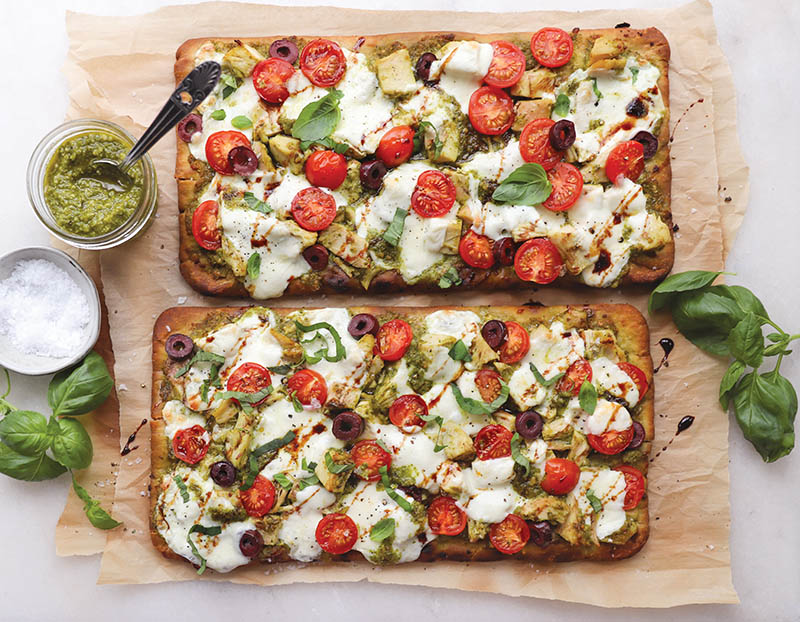
Oven Baked Italian Pesto Chicken Flatbread

Serves: 4-6

Enjoy this flavor-packed flatbread recipe as a shared snack during happy hour, a game-day treat with friends, or as an easy weeknight meal.
The crispy flatbread is topped with homemade pesto, chicken, tomatoes, fresh mozzarella cheese, and olives, and finished with balsamic glaze and more fresh basil. The homemade pesto really brings the flatbread to the next level!

To save time, repurpose leftover chicken or use store-bought rotisserie chicken.

This meal comes together in a snap! Best of all, you can cook in the oven or on the grill, but either way, it’s guaranteed to disappear in minutes!

Pesto Ingredients:
2 bunches of fresh basil, large stems removed (about 2 packed cups)
1/3 cup pine nuts
1/2 cup extra virgin olive oil
1/4 cup grated Parmesan cheese
2 cloves garlic

Flatbread Ingredients:
2 flatbreads (or substitute naan)
1 1/2 cups cherry or grape tomatoes, halved
8 oz. fresh mozzarella
1/4 cup sliced olives
1/2 – 2/3 cup pesto
1 tsp olive oil
2 cups of cooked, cooled chicken
1 tbsp balsamic glaze
Fresh basil, for serving

Instructions:
1. Make the pesto. Add the garlic, basil, pine nuts, and Parmesan to a food processor. Pulse for 30 seconds until broken down into a finer mixture. Turn the food processor on low and slowly drizzle in the oil. Blend just until smooth. Season to taste with salt and pepper.
2. Preheat the oven to 400°F. Slice the tomatoes and olives in half. Cut the cooked chicken into bite-sized pieces. Set them aside.
3. Brush the bread on both sides with the oil. Set it directly on the oven grates or on the grill for 2-3 minutes. Remove from the oven and set on a baking sheet.
4. Spread 1/4 – 1/3 cup of pesto evenly over each flatbread. Arrange the chicken, halved tomatoes, and olives on top. Spread the shredded or sliced cheese on top.
5. Bake in the oven or carefully transfer to a well-oiled grill and cook until the cheese is melted and bubbly, about 7-9 minutes.
6. Sprinkle with salt, pepper, and fresh basil, and drizzle with the balsamic glaze. Cut into individual pieces and serve right away while still hot.

Notes:
• Optional: Toast the pine nuts in a medium-hot skillet for 3-4 minutes, just until fragrant, before making the pesto! It will bring out more of the nutty flavor.
• Add fresh baby spinach and/or thinly sliced red onion to the flatbreads for extra flavor!
• Be careful not to over blend the pesto. It should be smooth, but still have a bit of texture to the consistency.
• You can freeze any leftover pesto for later! Spoon the pesto into a cube tray, freeze for 3-4 hours, then pop out the cubes and transfer to an airtight container or bag. Freeze for 3-4 months, per USDA.


Wick and Pour

A Candle Shop That Lights Up Community and Connection

By: Emeri Glen | Photos by: Ashlee Glen

Wick and Pour, a new candle bar in downtown Lynchburg, is adorned not by flashy pops of color, or distracting murals on the walls, but by the joy and warmth that grows from conversation around a simple table. The owner, Chantel West-White, well knows the value of intergenerational community and the beauty of forged relationships.

A middle school nurse during the weekdays, West-White began dabbling in candle-making as something to do during the Covid-19 pandemic. As she grew in her hobby, more and more women joined her around her home craft table.

“It just became a place for everyone to talk, to laugh, or to cry,” she said. And thus, was planted the seed for Wick and Pour.

West-White wanted to create a more dedicated space for her newfound passion, but on a larger scale. While the location that she found on Ninth Street in downtown Lynchburg was a tad smaller than what she had originally envisioned, it turned out to be the perfect space for the type of conversations that West-White was seeking to cultivate.

“There are people from all races, all ages, [and] all backgrounds who come together at the table and they make candles. You will see a seventy-year-old woman talking to a twenty-year-old woman, talking about raising a family” she said.

Wick and Pour contains a communal crafting table, similar to the one that she started with. The shop’s lack of separate worktables is meant to encourage community building and story swapping, with the express goal of de-othering neighbors.

Of this, West-White said, “The table is doing exactly what I wanted it to: showing people we are more alike than we are different.”

The shop, which is currently open Fridays through Sundays, utilizes only eco-friendly materials.

The fragrances are diverse—West-White associates colors with these, further adding to the allure of her shop—and she picks up inspiration for them (some of which include “Library” and “Coffee Shop”) on her travels across the country. They are clean-burning, without cancer-causing ingredients, and glitter is an option.

West-White’s business now also boasts a fragrance bar, where patrons can create their own signature perfumes. In addition, the venue hosts special events
for holidays such as “Galentines,” “Friendsgiving”, and Mardis Gras, as well as fun pop culture events like “Taylor Swift sing-a-along.”

West-White found support and community during the uncertainty of the pandemic in the experience and voices of those women who created with her. She continues to find support through the help of her loved ones.

“I know I wouldn’t have been able to do this without my family,” she said.

Ultimately, apart from creating a space that nurtures and tends relational growth, West-White says that, “When they (patrons) walk away, I hope they find a little bit of peace in a world of chaos.”

To book a session at Wick and Pour or to learn more about what the shop offers, visit wickpourcandlebar.com.


Landscaping Upgrades That Add Comfort (and Value)

A well-designed outdoor space does more than just enhance curb appeal—it adds real value to your home and creates a retreat where you can truly relax. Whether you’re preparing to sell or simply want to make your backyard a more inviting oasis, strategic landscaping upgrades can make a big impact.

1. Invest in Hardscaping for Long-Term Impact
Adding pathways, patios, or retaining walls creates structure in your yard and boosts property value.

Well-designed hardscaping defines outdoor spaces, and improves accessibility. Stone walkways, paver patios, and fire pits are some of the best long-term investments.

For added comfort, consider incorporating built-in benches, an outdoor rug, or a pergola to create a welcoming, shaded retreat.

2. Upgrade Your Lawn (or Replace It Entirely)
A lush lawn is appealing, but it requires significant upkeep. If you’re tired of the maintenance, consider alternatives.

Drought-tolerant landscaping or native ground covers can reduce water consumption and maintenance while still looking beautiful.

For those committed to traditional grass, aerate and overseed in the fall to keep your lawn soft and resilient—perfect for barefoot summer days.

A tranquil outdoor scene featuring a woman relaxing on a sofa under a pergola adorned with string lights. The warm glow of the lights and the lush greenery surrounding the area create a cozy and inviting atmosphere. The setting sun adds a soft, ambient light, perfect for unwinding in the garden.

3. Create Functional Outdoor Living Spaces
Your backyard should feel like an extension of your home. A patio with a pergola or an outdoor kitchen adds value and usability.

Think about your lifestyle—whether it’s grilling, hosting gatherings, or simply unwinding, tailor the space accordingly. Cozy additions like cushioned seating, an outdoor daybed, or a hammock can turn your backyard into a personal retreat.

4. Prioritize Smart Drainage Solutions
Poor drainage can lead to erosion, foundation issues, and soggy unusable areas. French drains, rain gardens, and permeable pavers can help redirect excess water while keeping your yard functional.

If you experience standing water or erosion, addressing drainage should be your first landscaping upgrade before moving on to aesthetics and comfort-enhancing features.

5. Incorporate Low-Maintenance Plantings
Choose plants that thrive in your region with minimal upkeep. Native plants are the best choice for homeowners who want a beautiful yard without constant maintenance—not to mention they are the best choice for our environment.

Perennials, drought-tolerant shrubs, and ornamental grasses can create a lush look without requiring frequent watering or pruning. Group plants with similar water needs together to make irrigation more efficient and allow for a more hands-off approach.

6. Install Outdoor Lighting for Safety and Ambiance
Strategic lighting enhances both curb appeal and security while making your outdoor space feel more inviting.

Pathway lighting, uplighting for trees, and LED accents around patios or decks can make outdoor spaces feel warm and cozy.

Soft, warm lighting instantly creates an intimate atmosphere—ideal for evening gatherings or quiet nights under the stars.

7. Add Trees for Shade and Comfort
Trees provide natural cooling, privacy, and long-term property value. A well-placed tree can reduce cooling costs by shading your home in summer.

Fast-growing shade trees like maples or oaks offer long-term benefits, while smaller ornamental trees can add beauty and create a peaceful retreat. For extra coziness, hang a hammock or string lights between trees to create a serene lounging spot.

Urban backyard

8. Define Borders and Edging for a Polished Look
Installing clean edging around garden beds and walkways creates a tidy, intentional appearance. Steel, stone, or brick edging not only enhances curb appeal but also helps keep mulch and plants contained.

This small upgrade makes maintenance easier and ensures your yard always looks well-kept, making it a more relaxing space to enjoy.

9. Set Up an Irrigation System for Effortless Maintenance
Watering your yard manually can be time-consuming and inefficient. A drip irrigation system or smart sprinkler system ensures plants get the right amount of water without waste.

Newer smart irrigation systems can be controlled from your phone, adjusting automatically based on weather conditions—giving you more time to relax and enjoy your outdoor space.

10. Add a Fire Feature for Year-Round Enjoyment
A fire pit or outdoor fireplace extends the usability of your yard into cooler months. Fire features create a cozy focal point and encourage outdoor gatherings even in colder weather.

Choose a wood-burning fire pit for a rustic feel or a gas-powered option for convenience. Surround it with plush outdoor seating, throw blankets, and lanterns to create the ultimate outdoor lounge area.

Landscaping isn’t just about aesthetics—it’s about creating functional, comfortable spaces that add long-term value to your home. Whether it’s improving drainage, incorporating native plants, or installing hardscaping elements, these upgrades can make your outdoor space more enjoyable, efficient, and valuable. Start with small, strategic changes and build from there—your future self (and your home’s resale value) will thank you.


Functional & Flexible

How to Adapt Your Spaces Rather than Simply Maximize Them

By: Megan Williams

Picture this: You have a beautiful guest room in your home. It has plush bedding, ample natural light from two second story windows, enough closet space for your guests to tuck in for a while should they choose to extend their stay. You’ve meticulously crafted this room to be a home-away-from-home for your friends and family. It’s perfect.

But then: Your job shifts to remote work (a reality many of us were familiar with just five years ago). You don’t have a quiet office space in your home. The living room won’t do, because that’s also your toddler’s playroom; the dining room chairs will cause sciatica on your otherwise healthy back and limbs if you sit in them for too long; and your primary bedroom is already packed to the gills. You peer into your spacious guest bedroom. You take in its spaciousness, its crisp linens, its intentional lack of modern technology and shudder: Do I really have to turn this into an office?

All is not lost and, as it turns out, sometimes you can have the best of both worlds.

More families are spending time at home. With 14% of U.S. workers—about 22 million people—now working remotely (Pew Research Center), many households are rethinking how to make their spaces work for both personal and professional life.

The Guest Room/Office Combo
“We like to opt for pieces that are flexible, such as furniture that can be reconfigured—think murphy bed, sofa bed, daybed, chairs that turn into twin beds, and so on,” explained Ashley Hilbish, co-owner and principal designer for Greer Design Co. “If you’re customizing a desk, have your cabinet maker work in drawers to hide printers and keyboards, and consider built-in shelving for visual interest and for storage space for your pesky paperwork that won’t pique your guests’ interest when they’re staying.”

Hilbish also suggests investing in side tables that can double as desks, if space is a concern, or opting for slim office chairs that are both beautiful and functional.

“We also like to go for an overall neutral color scheme that offers pops of color to create a serene space for your guests but an inspiring space for work,” she added.

The Living Room/Playroom Dynamic Duo
“First and foremost, it’s key to invest in lifestyle fabrics,” advised Hilbish, whose company focuses on combining the team’s expertise in window coverings, styling, and soft goods with comprehensive design services. “Those are the fabrics that offer stain resistant factors either naturally or due to a coating that has been applied. Those could look like performance velvets, leathers, or items with washable slipcovers. Lifestyle fabrics are available in almost every collection of furniture, without having to pay a huge, upgraded fee.”

Hilbish advises, when in doubt, ask for a sample and give it a “red popsicle test” to determine if it’s up to the challenge of rigorous use from rambunctious kids.

“Melt a popsicle in a Tupperware, submerge the fabric sample, and see how easy it is to wash off,” she suggested.

Depending on the age of your children, it’s also important to consider furniture with soft or rounded edges to help reduce the number of accidents.

But what to do with all the toys?

“To help keep your spaces aesthetically pleasing, we suggest plenty of storage for toys such as textured baskets or bins with lids, and built-ins with cabinets that are low enough for easy access,” she said. “Washable rugs also offer a sense of convenience for parents in a space where there will be food and drink—on the other end, a high-quality run will clean beautifully when done professionally and is designed to stand the test of time.”

Hilbish also advises against washable rugs over 5’ x 7’, as they tend to be frustrating to put in the wash and dry.

Photo Courtesy Greer Design Co.

Photo Courtesy Greer Design Co.

Creating Defined Zones in an Open-Concept Space
If you have an open flow to your home, with your kitchen, dining area, and living spaces all intertwining with one another, there is still plenty of opportunity to create functional and flexible spaces that will adapt with your lifestyle needs.

First and foremost, arrange your furniture to create distinct areas, or “rooms” within your larger space.

“One mistake we see often is the phenomenon of ‘perimeter people’ where everything is pushed against the wall,” Hilbish said. “Pulling your furniture off to float and grounding it with a rug in an open concept is key! We never suggest having any furniture touch the wall, it should always have some breathing room of at least a couple of inches.”

When it comes to “grounding” furniture with a rug, Hilbish and her team advise a minimum of an 8’ x 10’ rug for a standard 7’ or 8’ sofa.

“Lighting can play another key element in defining areas and we suggest mixing and matching the varieties to highlight specific zones—pendants, chandeliers, scones, floor and table lamps, and so on. We’re personally not ‘big light people’ and you can always find our design projects with layered lighting,” she said. “You can even use window coverings to help make one space feel more or less dressy than the next, such as adding draperies in the dining area and shades in the living room for a nice mix and match.”

With a little creativity, your home can evolve with your lifestyle—offering function, flexibility, and a design you love.


Pro Tips for a Successful Home Upgrade

Advice Straight from the Experts

Upgrading your home doesn’t always mean knocking down walls or embarking on expensive renovations. Sometimes, small, strategic changes can have the biggest impact. To help homeowners make the most of their spaces, we spoke with local interior designer Britney Good, owner and principal designer at Britney Good Interiors, to get expert advice on easy, budget-friendly ways to refresh a home without a full remodel.

Simple and Affordable Ways to Make a Home Feel Stylish and Updated
If your home is feeling outdated but a major renovation isn’t in the budget, consider these quick and effective updates: Rearrange the Furniture: Sometimes, a fresh perspective is all you need. “Try a new space plan that still allows for optimal traffic flow while offering a new layout,” said Good. Simply moving pieces around can transform how a room feels.

Add Something Leafy: Plants breathe life into a room. Choose a bold or uniquely shaped pot to add character and dimension.

Upgrade Your Lighting: “New light fixtures can make a big difference in the overall look and feel of a room,” Good explained. For an easy update without hiring an electrician, swap out a lamp to create a new ambiance.

Swap Out Throw Pillows and Blankets: Incorporate fresh colors, textures, and patterns to instantly revitalize a space.

“Adding a woven basket for storage creates a functional yet stylish touch,” Good suggested.

Introduce Artwork: Whether it’s framed prints, canvas paintings, or wallpaper accents, wall decor adds personality and depth.

Good recommends making a statement with chunky, detailed frames or even wallpapering the ceiling to draw the eye upward.

Declutter and Organize: “One of the best ways to make a home feel intentionally designed is to declutter,” advised Good. Find creative storage solutions to organize essentials and maintain a curated, polished look.

Small Design Changes That Make a Big Impact
Sometimes, a single change can completely shift a home’s aesthetic. Two of the most effective transformations? Paint and rugs.

Refresh with Paint: “Colors have the ability to affect a person’s mood and productivity,” Good explained. Choosing the right hue can set the tone of a room, whether you want to create a calming retreat or an energizing space.

Invest in a Good Rug: “Pattern is key,” Good advised.

Like paint, a well-chosen rug influences a room’s overall theme. She recommends selecting a colorway that complements existing furnishings while balancing comfort and practicality. Soft textures work well in living spaces, while low-pile rugs allow for easy movement in dining areas.

Avoiding Common Design Mistakes
One of the biggest mistakes homeowners make is overlooking the importance of furniture scale. “Many people work with an interior designer for construction materials but not furnishings, which can lead to choosing furniture that is too large for a space,” said Good. Oversized pieces can make even a spacious room feel cramped.

To avoid this, Good suggests: Working with a Designer for Space Planning: Designers can help ensure proper furniture placement and scale.

Measuring Before Buying: Always check dimensions before purchasing new pieces. Allow at least 36 inches of walkway space to maintain an open flow.
Choosing Appropriately Scaled Furniture: For smaller rooms, opt for lighter, streamlined pieces rather than bulky ones.

Considering Multi-Functional Pieces: Items like sofas with hidden storage or expandable dining tables maximize function without cluttering the space.

Balancing Personal Style with Broad Appeal
If you’re considering selling your home, you may need to strike a balance between personal expression and broad market appeal. Good recommends:
Highlighting Key Features: Ensure elements like built-ins, natural light, and architectural details are well-lit and clutter-free.

Adding Subtle Personality: While it’s best to remove overly personal decor, small touches—such as wallpaper, decorative hardware, or unique mirrors—can still reflect your style while appealing to buyers.

Scandinavian interior design living room 3d render with beige colored furniture and wooden elements

Budget-Friendly Staging Tips for Showings
Staging can make a huge difference when selling a home, but it doesn’t have to be expensive. Good suggests focusing on key areas: Main Living Spaces: Add rugs and light furniture in living and dining areas to define the space.

Bedrooms: If a room is empty, a styled air mattress can help potential buyers visualize its use.

Kitchen Islands: Simple additions like stools can make the kitchen feel more inviting and functional.

Final Takeaway
Upgrading your home doesn’t have to mean tearing down walls or spending a fortune. By making strategic updates—whether it’s rearranging furniture, refreshing lighting, or incorporating well-scaled furnishings—you can create a space that feels fresh, stylish, and functional. And if you’re considering selling, thoughtful staging and a balance between personal style and market-friendly design can help make a lasting impression on buyers.