Forging Excellence

Ironclad Coffee Brings Innovation and Community Spirit to the Hill City

By: Emeri Glen | Photos By: Ashlee Glen

A series of happy clicks greet patrons as they walk into a green-filled room. The source of the clicking? Two Vestaboards above a bar featuring rotating jokes that flip every couple of minutes. Behind the bar, baristas wear crisp, black shirts and welcoming smiles as they ask coffee-seekers about their day, skillfully making espresso and other colorfully-named drinks. Excellence pervades Ryan and Kelly O’Rourke’s Ironclad Coffee.

The inspiration for the O’Rourke’s first Ironclad location in their hometown of Richmond began to take root when they lived for a time in Galway, Ireland.

“We started out with a hobby roaster…and I could see my husband Ryan was really getting into it,” Kelly said.

She explained that, when it came time to come back to the U.S., Ryan considered becoming a barber for a time but couldn’t pursue the idea due to an old football injury. And so, the O’Rourkes decided to lean into what they had already found a small amount of success in: Roasting beans.

This dynamic duo started small, roasting their own beans—purchased from farms that benefit their communities, were sustainable, and were dedicated to treating their workers well—and selling to local coffee shops, but found that the feedback regarding quality was inconsistent. Determined to showcase the best that their beans had to offer, the O’Rourkes upgraded their roastery to a café. Seven years later, two coffee shop locations in Richmond were followed by Lynchburg’s new addition, which has decidedly made its mark on the Candler’s Mountain area.

The carefully curated atmosphere of the cafe is classy, with gold accents, jazz playing in the background, and a grand piano sitting in the center of the space. The O’Rourkes’ business has come a long way from its beginnings in Ireland, but they still pay homage to their roots. In fact, you can find traces of these ties in one of their drinks, the Connemara Cappuccino.

The drink is smoked on the counter using real peat shipped from Ireland.

“It’s very nostalgic, because [peat] is what we burned in our little house,” Kelly said.

In addition to the Connemara, the café boasts a pomegranate and lime espresso tonic and browned butter chocolate chip cookie milk latte. Their bakery has a diverse menu, including consistent classics and more experimental items, all of which you can watch being made over the open bar.

Kelly noted that this layout choice was a departure from their other locations, saying “It’s incredibly rare to go into a shop and have everything being made from scratch.

We wanted to make sure that people knew that this is what was happening.”

Part of the O’Rourkes’ dedication to excellence is their desire to partner with the Lynchburg community. They use Homestead Creamery milk (which is very low in lactose) and desire to continue to foster an environment that makes all ages feel welcome and special. During “Tiny Tuesdays,” kids five and under receive a little packet with craft supplies, a “Babyccino” (steamed milk), and a muffin with the purchase of mom or dad’s drink. They also plan to have live jazz events in the future.

To learn more about the O’Rourkes and their Lynchburg location, visit ironcladcoffee.com.


Grinnin’ Bear Tavern

A Local’s Dream and A Community’s Treasure

By: Jeremy Angione | Photos By: Ashlee Glen

After years in a mix of careers in entertainment and manufacturing, local Chris Seigla decided to serve his community by opening a restaurant. Formerly Spring House Dining and Reception Hall, Seigla bought the Richmond Highway building in October and turned it into the Grinnin’ Bear Tavern.

After years of passing the building while helping with his family’s food truck, Butts Up BBQ. Seigla’s curiosity compelled him to check the place out.
After bringing his wife in to see it, he suggested they buy the building.

“Have you lost your damn mind?” she asked.

After his wife explained all the risks and considerations in owning a restaurant, Seigla decided he was still up for the challenge. The true reality check for Seigla was the amount of “red tape” involved in food service.

“That was the biggest hit for me; the amount of stuff that we had to go through just to be able to cook a hamburger and sell it to somebody,” Seigla said.

Despite the challenges, Seigla remained excited for the opportunity, describing himself as an “eternal optimist.” In preparation for their grand opening, Seigla posted a six-minute video on Facebook, introducing himself, Grinnin’ Bear, and his vision for its impact in the community. According to Seigla, the video was viewed more than 100,000 times.

Because of the unexpected exposure, Seigla says that “everything got thrown into fast forward.” Grinnin’ Bear Tavern held a grand opening March 8. In what became the saving grace for the day, Seigla and his staff approached neighbors of the business to ask for permission to have their patrons park along the road in front of their houses, if necessary.

It was necessary.

“Our grand opening was terrifying. You’ve got to be ready for 10,000 people, but you’ve also got to be ready for 100 people to show up,” Seigla said.

Despite the spacious rooms, large deck, and all the preparation Grinnin’ Bear’s team could muster, the day still proved a challenge.

“We got our butts whipped,” Seigla joked.

Fortunately, according to Seigla, patrons who did not want to bear the crowded venue during the grand opening were understanding and pledged to return another time.

“The support and encouragement that we got from the people around here and the community in general—it’s been unbelievable. I thought it would take a year to get to the point where people knew who we were, knew what we were about, and knew my face. It happened in two months,” Seigla said.

With lessons learned since opening day, Seigla and the Grinnin’ Bear are already planning events, new menus, and infrastructure updates. Chief among those updates are refreshing the decor, installing a proper HVAC system, and expanding parking to take advantage of the 5 acres of land the Grinnin’ Bear Tavern sits on.

Seigla believes the back room and deck will be key in making the tavern a full-fledged event space, with the ability to host several events simultaneously, thanks to retractable partitions throughout the large room.

According to Seigla, the Grinnin’ Bear event space has already been booked 22 times this year. As a former wedding DJ, Seigla is confident that he can show his patrons a good time.

“If I can give them a good meal and a cold beer, then I think this thing could be something really special,” Seigla said.

As a born and raised local, Seigla wants the Grinnin’ Bear to be a boon for the community and all his neighbors whenever possible. The Grinnin’ Bear staff will often bring the fire department, and even one of their elderly neighbors, food, to make sure they are taken care of.

According to Seigla, he wants to do everything from sponsoring little league teams to donating to the local Humane Society.

“We want to be a service to this community. I want to be something to people. I want these people to know, I live 2 miles up the road.

This is where I’ve been my whole life. I want people to know that we want to be a part of this for reasons other than just making money,” Seigla explained.
In accordance with their values of community, Grinnin’ Bear Tavern’s menu is full of what many would consider “comfort food.” What sets it apart, according to Seigla, is the true homemade nature of many of their dishes and their affordability.

With his mom and stepdad helping in the kitchen, Seigla is enthusiastic about the love and quality ingredients that go into Grinnin’ Bear’s simple menu. The tavern’s menu is what you might imagine a bar menu would look like, with items such as a BLT (Seigla’s favorite), mozzarella sticks, or a Philly cheesesteak. Seigla also made a point to highlight their foot-long hotdog that he says you can’t really find anywhere.

What elevates those classic food items is the commitment to making things in house. From housemade condiments to thoughtfully sourced meats, a Grinnin’ Bear Tavern meal provides guests with a generous, plate-filling portion at dive bar prices.

Every Sunday, Grinnin’ Bear offers a breakfast and lunch buffet that Seigla believes will be a staple in the community once it gains traction. According to Seigla, the Sunday buffet was a tradition at Spring House that he’d like to continue in the community.

“The stuff that we’re doing is food that you can’t just go buy anywhere. Rather than trying to do a bunch of stuff right now, let’s do 10 dishes and let’s do ’em really good,” Seigla said.

Seigla also plans to bring the tavern’s menu on the road by converting Butts Up BBQ to a Grinnin’ Bear food truck in October.

Aside from the large and varied spaces, and unique menu, the thing that makes Grinnin’ Bear Tavern the place to visit is Seigla himself.

“I’m the grinnin’ bear. I’ve got these dents on my face ’cause all I do is smile, man,” Seigla exclaimed.

Seigla recalls his time working at Paradise Lake getting paid to wear a Yogi Bear costume. Coincidentally, Seigla is also a Chicago Bears fan. Although Seigla says the name is just one he’s always liked.

“This world’s got enough problems. If for an hour of your day or week, you can come in here and you’re not worried about that stuff, that just swells my heart up,” Seigla said.

Currently, the Grinnin’ Bear Tavern is only open on Fridays, Saturdays, and Sundays. However, the Tavern will sometimes open for special sporting events, such as March Madness.


150 Years of Impact

The Miller Home for Girls’ Legacy of Empowerment and Transformation

By: Olivia Carter | Photos By: Ashlee Glen

For 150 years, the Miller Home for Girls has provided a safe place for young women in need, guiding them toward stability, self-sufficiency, and a brighter future.

Executive Director Stacy Garrett, who has led the organization for two decades, passionately upholds the mission that has remained steadfast since the home’s founding in 1875: to care for girls and help them build a positive path forward.

“Miller Home opened its doors in 1875 and has been taking care of girls who needed a safe place to live, redirect their path, and become smart, intelligent, well-rounded individuals who can go back into our community after the age of 18,” Garrett said. “That has always been our mission.”

Above: When first established, the Miller Home was known as the Lynchburg Female Orphan Asylum. At that time the home could care for approximately 100 girls at once and it was located in a four story building on a working farm. The Asylum was located on Memorial Avenue where E. C. Glass High School and The Plaza are today. Photo courtesy of Lynchburg Museum System.

Above: When first established, the Miller Home was known as the Lynchburg Female Orphan Asylum. At that time the home could care for approximately 100 girls at once and it was located in a four story building on a working farm. The Asylum was located on Memorial Avenue where E. C. Glass High School and The Plaza are today. Photo courtesy of Lynchburg Museum System.

Originally established as the Lynchburg Female Orphan Asylum, the home primarily served orphaned girls. Back then, a guardian, family member, or parent could drop off a girl and she would remain at the home until she married or finished school. In the 1950s, the institution was renamed the Miller Home of Lynchburg and the term “orphan” was phased out as societal needs and the structure of child welfare evolved.

Today, girls come to the Miller Home in various ways.

Many are placed by a guardian or through the Department of Social Services due to changing home circumstances, truancy, or court orders. The home serves as an alternative to detention centers, offering preventive care rather than treatment.

Miller Home

“We’re not a treatment facility; we are a preventive care facility,” Garrett said. “We aim to smooth out a bumpy road and build a network of professionals to help these young women transition back home, move into foster care, or age out and become independent members of the community.”

Dr. Selinna Creasy, volunteer while in college, full-time staff member, and Board of Directors member, said as a volunteer, she witnessed firsthand the organization’s profound impact on the community.

“Inspired by the dedication of the staff and the lives being transformed, I transitioned into a full-time staff role, contributing to the mission that I deeply believe in, ‘Changing Lives, One Girl at a Time.’ Over the years, my commitment to Miller Home grew stronger, eventually leading me to serve on the Board,” Creasy said. “As the current vice president of Miller Home for Girls, this progression has been incredibly fulfilling, allowing me to support and advocate for a place that continues providing hope and strength to so many. It’s a privilege to be part of such a legacy and I look forward to seeing what the future holds for Miller Home.”

The Miller Home focuses on three key areas to support the girls in their care: academics, mental health, and life skills.

“We work to ensure our girls are engaged in school, attending every day, and striving for academic success,” Garrett said. “We also connect them with professional counseling services to help them develop problem-solving and coping skills, particularly if mental health is a factor in their placement.”

The Miller Home also helps girls develop essential life skills.

“We teach them how to keep their rooms clean, cook meals, do their laundry—basic skills they need to be self-sufficient,” Garrett said. “By combining these three aspects, we help them build a strong foundation for the future.”

Unlike some institutions, the Miller Home does not offer in-house counseling. Instead, they partner with outside professionals to ensure an unbiased perspective on each girl’s progress.

“Having a third-party professional involved means we’re not the only ones making the call, especially when it comes to mental health,” Garrett said.

The Miller Home has never relied on state, federal, or city funding to sustain its operations. Instead, it has thrived for 150 years thanks to unwavering
community support.

“The reason our doors are still open is because of our community,” Garrett said. “Through donations, volunteering, and in-kind gifts, our supporters ensure we can continue our work. But it’s getting harder. With economic uncertainties, people are more cautious about giving, yet the needs of our girls remain.”

Local organizations, civic groups, and businesses have played an instrumental role in keeping the home running. St. John’s Episcopal Church, Park View Community Mission, Food for Thought, the Lynchburg Hillcats, and Liberty University have all contributed through fundraising, pantry donations, and volunteer efforts.

Phil Vassar, a country music artist, has partnered with the home since 2008.

“We are incredibly grateful for the Greater Lynchburg Community Foundation’s grants, which have helped us purchase necessary items,” Garrett said. “And our community always steps up, whether it’s Dave and Chris Henderson at Water Dog supporting our fundraising events or Starr Hill Brewery organizing an Angel Tree for us. The generosity is overwhelming.”

The Miller Home has an ability to tailor individualized service plans for each girl. As one of only three programs in Virginia licensed by the Department of Social Services under minimum standards, the Miller Home develops monthly goals and structured plans based on each girl’s specific needs.

“We don’t take a ‘one-size-fits-all’ approach,” Garrett said. “Each girl has her own plan, reviewed on a monthly basis. Because we have a small number of residents, usually eight to ten girls, we can work with them closely and ensure they are making progress.”
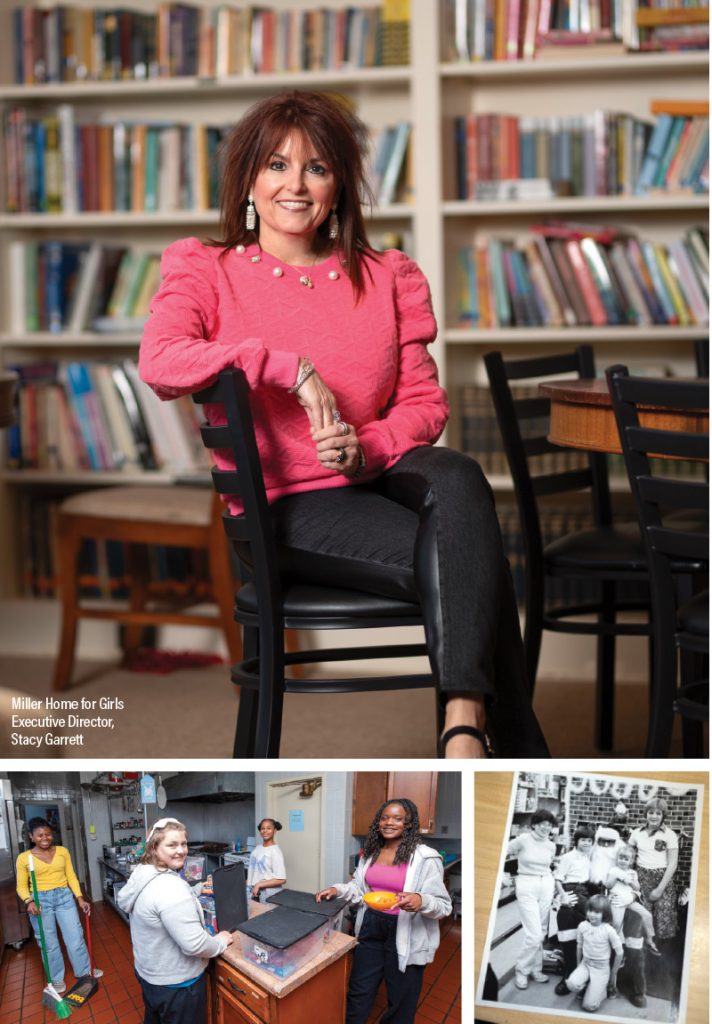
She said it’s this hands-on approach that is one of the reasons the Miller Home continues to thrive and make a lasting impact.

Justine, who was a resident from middle school until her first semester of college, then becoming an intern and a full-time staff member with Miller Home, said the impact that the organization had on her life as a resident inspired her to want to come back and complete an internship.

“During my internship a full-time position opened and I decided to take it and become a Child Care Worker,” she said. “Miller Home has had such an impact on my life that I wanted to come back, stay involved, and keep Miller Home in my life.”

Over the decades, the challenges faced by the girls at the Miller Home have evolved.

“In the past, our girls had to sew their clothes and work on farms. Now, we’re dealing with issues like technology, social media, vaping, and the aftermath of COVID-19,” Garrett said. “But our mission remains the same, which is to provide a stable, nurturing environment that prepares them for a successful future.”
One of the most significant measures of success is the transformation that takes place in the lives of the girls.

“Success for us isn’t about numbers, it’s about the quality of the time we spend with these girls,” Garrett said. “It’s seeing a girl make the honor roll for the first time, getting a job, opening a bank account, or applying to college.”

The consequences of not having a place like the Miller Home are stark. Without its support, many of these young women could face homelessness, fall into gang-related activities, or continue cycles of instability, Garrett said. Instead, they are given the chance to break generational patterns and build a better future.
“We’ve had girls who are the first in their families to go to college,” Garrett said. “They learn to trust people outside their immediate family, gain self-worth, and see possibilities they never imagined.”

Kayla, current intern for Miller Home, said her time at the nonprofit has been one of the greatest blessings of her college journey.

“I’ve witnessed firsthand the profound impact Miller Home has on the lives of the girls it serves, and the incredible difference made when dedicated individuals, like the Miller Home staff, step up to care for them every day,” she said. “Miller Home is not just a building or a temporary place for the girls to stay, it’s a true home, where they can find safety, support, and a sense of belonging.”

Every single day, the staff gives 100 percent to these girls, Garrett said.

“We make sure they are fed, safe, clothed, and supported,” she said.

“That’s the heart of what we do. I definitely think our community is proud of it and I appreciate them riding along with us and we need their support to keep us here for another 150 years.”


A Taste of the Big City

Elevated Mexican Fare at Uno Mas

By: Anna Eileen White | Photos By: Ashlee Glen

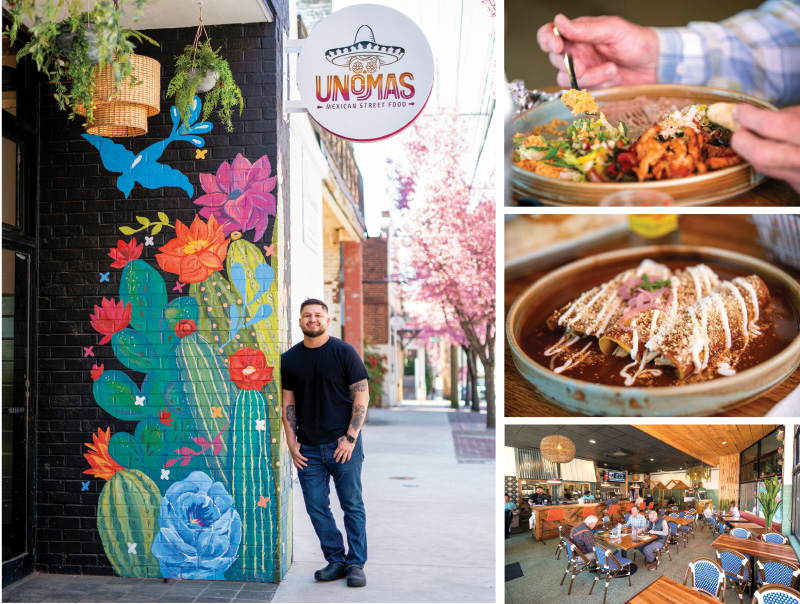
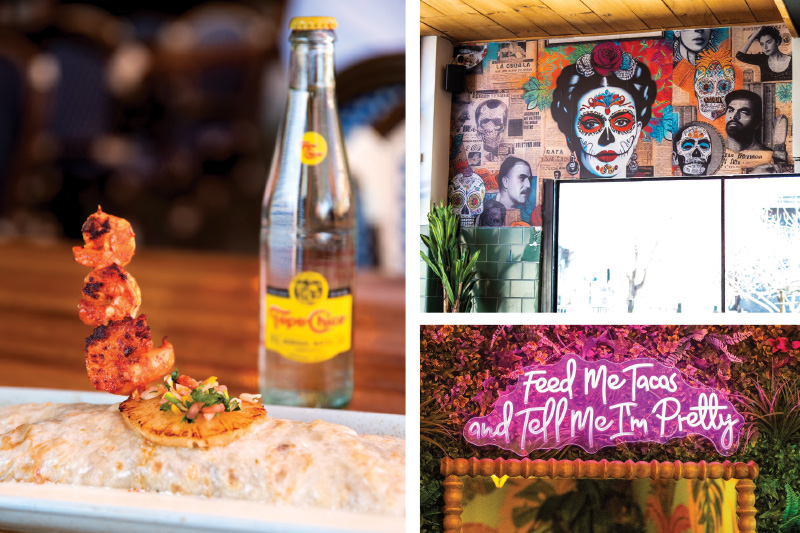
Neon signage and greenery floating overhead usher visitors into 5th Street’s latest culinary spot. It’s almost as bright inside as outside. Walls of windows illuminate cactus-green subway tiles and conversation buzzes beneath the electric pulse of a well-curated playlist.

This is Uno Mas, and if the experience lives up to its name, visitors will be tempted to stick around for “one more.”

Upon entering, a mustard-yellow bus with a rust-speckled fender doubles as a hostess stand —this is chef and owner Alan Gutierrez’s favorite design element. He said they cut the bus in half allowing servers to walk and stand behind the dashboard. License plates and road signs reading “Uno Mas,” “Tacos BLVD,” and “Tequila Way” are affixed around the antique VW badge.

Where to sit is the first choice: pick a table or booth in the main dining room and admire colorful homages to Mexico’s Day of the Dead, find a seat at the bar, slip into the secluded side room and dine under a blue haze away from the crowd, or feast al fresco on the patio. Any location will more than complement the extensive menu of Lynchburg’s self-proclaimed “home of street tacos.”

“Everybody loves tacos,” said Gutierrez, who has been cooking for most of his life.

His menu features 10+ tacos served on house-made corn or flour tortillas with endless customizations. Choices include two styles applied to any taco—Gringo and Street. Choose Gringo and receive a taco topped with lettuce, tomatoes, crema, and cheese. Choose Street and enjoy the bright addition of cilantro, onions, and lime. Among protein choices like melt-in-your-mouth lengua (tongue) for the adventurous and tender carne asada, visitors can find a standard favorite and stick with it, or never eat the same taco twice by swapping salsa verde for a creamy avocado salsa and vice versa.

Everything at Uno Mas is made in-house, the result of skills Gutierrez has built over his 29 years.

“Since I was little, I would always cook for my brothers, my mom, my dad, and I wanted to be a chef,” he said. Born and raised in Mexico, he grew up watching his mom navigate the food industry there. He said she rarely measures, and her culinary methods are subconscious and natural, “I definitely got that from her.”

When his parents opened El Camino on Lakeside Drive, it was another opportunity for Gutierrez to explore the food industry and eventually become part-owner.
“Little by little, I started liking the restaurant business,” he explained.

Though busy splitting his time between construction in the mornings and El Camino in the afternoons and evenings, Gutierrez didn’t have any doubts when
512 5th Street came available. His dad first saw the listing.

“He showed me a picture, and as soon as he told me, I called the number,” he said. After multiple unanswered calls, Gutierrez’s persistence paid off.

“[The agent] showed me the place, that same day or the day after, and I told him I wanted it, and then we jumped on it the day after that.”

Now the location is Gutierrez’s canvas, and his preferred mediums are the sights, sounds, and flavors of the big city. He says the details are inspired by his travels, where he pays close attention to “the colors, the decorations, the food, how they present things, the drinks.” He’s taken “a little bit of everything” from favorite locations including Acapulco, Guadalajara, Jalisco, California, and Puerto Rico. “Everywhere I would go, either Mexico or bigger cities, I would look at things and get ideas,” he explained.

Despite the main dining room’s joyful allure, the patio is irresistible on a 75-degree spring evening. Sheltered on two sides by buildings, but open to 5th Street, traffic hums and occasionally roars by—an organic addition to Gutierrez’s big-city bent. Several of 5th Street’s iconic cherry trees mark a chiffony margin between the roadway and patio. On one side, life as usual; on the other, good food, good drinks, good atmosphere, and good music, according to Gutierrez.

“[People] always have a good time,” he explained. “They kind of just come and hang out, and they bring their friends, and those friends bring more friends. It’s kind of just like a cool hang-out place.”

Open since February 3rd, Gutierrez says they never truly announced they were open and didn’t do any paid advertising. Instead, they used social media and let news spread word-of-mouth.

“We just turned the lights on and opened the doors and people just started coming in,” he shared. “We’ve been getting really good feedback. I knew it was going to be successful.

I just didn’t think it was going to be this quick.”

Top-ordered food items so far include tacos, Burrito Cocino, and Maria Bonita. Gutierrez says the top-ordered drinks are margaritas and palomas. He is already envisioning a second location in the near future. “If you want to try new Mexican food that’s not at any other restaurants around,” he explained, “this is the perfect place.”

Gutierrez says it’s not just the food—he’s worked hard to create an atmosphere that visitors won’t find elsewhere. The way diners stick around, soaking up the many sensory delights, confirms that he’s concocted something magnetic.

A toddler finds his groove dancing atop the patio’s flagstone pavers and his parents join the fun in between polishing off a few more bites. Conversation keeps pace with the playlist even as daylight dwindles. “I think people just love to be here,” said Gutierrez.

Whether looking to enjoy one more drink or one more round of steak nachos, Uno Mas is meant for lingering, and visitors will surely leave with one more colorful moment in time under their belts than they began with.


2025 LL Fun Guide

As summer settles in, there’s no better time to explore the rich history and vibrant arts scene that define our region.

From captivating theater performances to immersive historical sites, Lynchburg offers a unique blend of culture and storytelling that brings the past to life. Whether you’re rediscovering familiar landmarks or venturing to new experiences, this guide is your perfect companion for an unforgettable summer filled with adventure.


Service through Sustenance & Skills

Park View Community Mission’s Comprehensive Fight Against Food Insecurity

By: Emily Mook | Photos By: Ashlee Glen

For many of us, food can be both fun and frustrating. When it comes to our culinary experiences, our emotions may range from excitement about trying a new recipe or restaurant to ennui over planning and preparation. We consider notions of form, function, and perhaps even presentation, and we may forget what a privilege it is to think about food in such certain terms and to contend with things like indecision and overwhelm rather than hunger and food insecurity.

Merriam-Webster defines food insecurity as “the fact or an instance of being unable to consistently access or afford adequate food,” and according to the 2024 USDA Food Security Report (the latest data available), a staggering 13.5 percent of U.S. households experienced food insecurity in 2023. Lynchburg’s statistics mirror that figure very closely; according to Park View Community Mission’s Food for Families Director Heather Gibson, the latest Feeding America’s “Map the Meal Gap” data indicates that 13.6 percent of Lynchburg’s citizens are food insecure. That data also indicates that surrounding counties aren’t too far behind: Appomattox is at 12.1 percent, Amherst is at 11.8 percent, Campbell County is at 11.2 percent, and Bedford is at 10.7 percent. As these numbers continue to climb globally, nationally, and locally, food-distributing nonprofits are experiencing more demand than ever before and thus need more attention and community support than ever before. Lynchburg is home to several such organizations, including the outstanding and uniquely comprehensive 501(c)(3) Park View Community Mission.

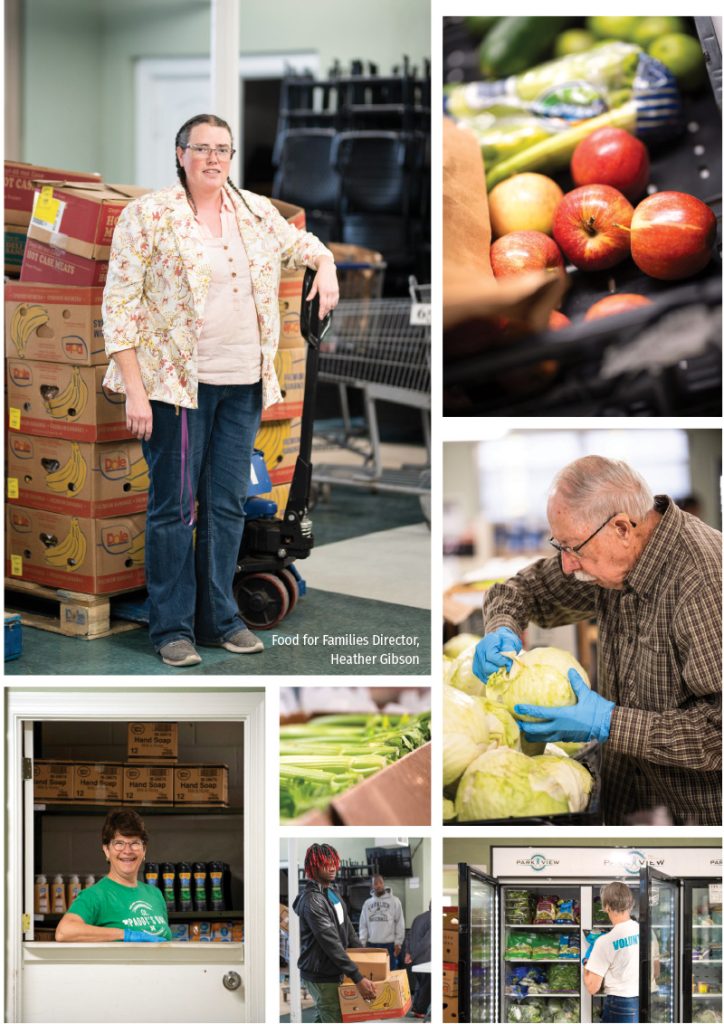
Located at the corner of Memorial Avenue and Wadsworth Street, Park View Community Mission began as a weekly Wednesday night dinner service in 1996. It was spearheaded by the late Fred Fauber and the late Larry Brooks and initially run by members of the now-disbanded congregation of Park View United Methodist Church. Those weekly dinners continue today as the Park View Café, providing at least 100 meals each Wednesday from 4:30 to 5:30 p.m. A carryout setup—introduced after the onset of the COVID-19 pandemic—allows neighbors to dine in or take their meals to go. Volunteers (and Park View staff, as needed) conduct all steps of the process.

“Typically, we have various groups cook and serve the food,” Gibson noted. “Volunteers can come and help set up, serve, and take down at the end of the dinner. If they want to cook, they can reach out to the director of the Café and she can schedule a time for them to cook. If we don’t have enough volunteers, then the staff pitches in. Due to the bad weather in February, we had a group cancel, so I cooked chili for 100.”

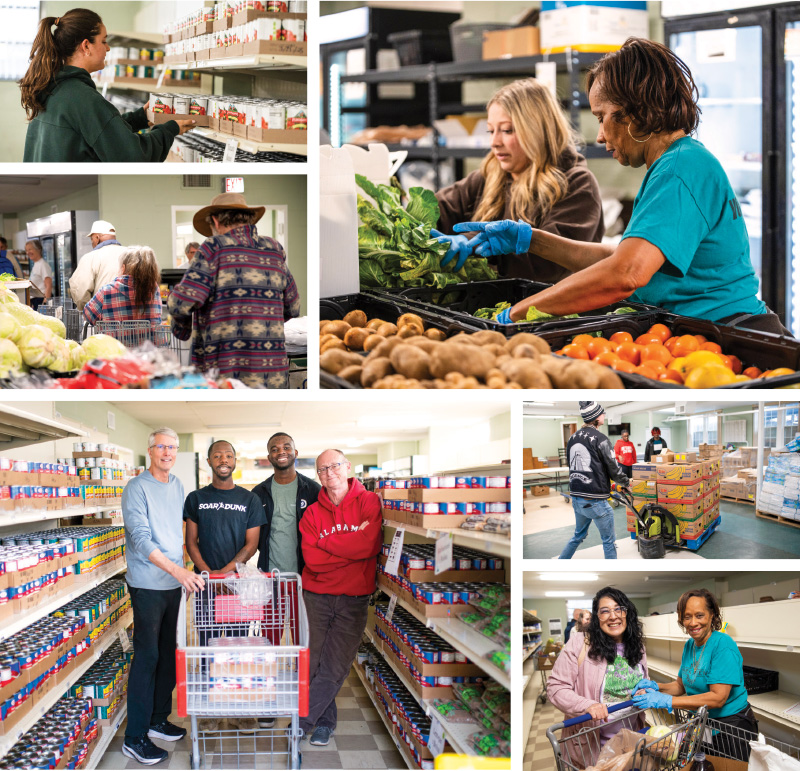
After 20 years of providing weekly meals, Park View added a service that would ultimately become the cornerstone of their organization: a food pantry called Food for Families. Since its creation in 2006, Food for Families has grown into Lynchburg’s largest food pantry and into the largest client-choice pantry in the state west of Richmond.

The pantry is open from 9:30 a.m. to 2:00 p.m. on Thursdays and Saturdays, and emergency food bags are available to anyone who needs them on the days the pantry isn’t open.

“We began serving groceries to about 40 families per week, and we now serve over 400 families each week,” said Gibson. “In 2024, Food for Families served 16,479 families from Lynchburg, Amherst, Appomattox, and Bedford and Campbell Counties. We receive USDA food from the Blue Ridge Area Food Bank; this food is given free to anyone living in Virginia whose yearly income is below 250% over the poverty line. We also receive weekly donations from Walmart, Kroger, Panera, Little Caesars Pizza, Flowers Foods, Tree of Life Midtown, and Starbucks. Along with these donations, we receive donations from food drives done by churches and businesses along with donations from individuals. We can always use non-perishable donations.”

Park View also welcomes non-perishable donations for its Food for Thought initiative, which provides food during the weekends to Lynchburg students in need. Launched in 2018, this initiative provides elementary school students with bags including two breakfasts, two lunches, and three dinners and middle and high school students with access to food pantries.

“Students are identified by the guidance counselors of the schools, and parents sign a permission slip to allow their children to receive food,” Gibson stated. “Each school decides how to distribute the bags at the end of the day on Fridays. Some do it in the hallways and some in the last class of the day. Foods given out include ravioli, tuna, chicken noodle soup, cups of mac & cheese, individual cereal cups, shelf-stable milk, and snacks. Food for Thought provided 38,865 weekend meal bags last year.”

Food insecurity is a complex issue that extends beyond food scarcity, and thus the fight against it necessitates holistic education and support.

Park View’s remaining initiatives—the Clothing Connection, the Community Resource Center, and the Life Skills Institute—allow the organization to address and mitigate other roadblocks to food security.

The Clothing Connection provides free clothing, the Community Resource Center provides eviction and utility assistance and matches neighbors with other organizations as needed, and the Life Skills Institute imparts practical life and career skills.

“Our Life Skills Institute provides job readiness training through the ‘Vital Skills with Jeff from CVCC’ series,” remarked Gibson. “It teaches the necessary soft skills for retention, interviews, making career goals, and networking. LSI has classes on financial wellness and computer skills, as well as a series of cooking classes through the VA Extension Office. We also provide clothing for job interviews and to start your new job.”

In addition to offering these six invaluable initiatives, Park View is dedicated to raising community awareness about food insecurity and about how to join in the fight against it.

“We have an educational component to make people in the community aware of food insecurity,” Gibson said. “The directors of the programs are always willing to discuss Park View with civic groups, college classes, and churches. We also have the Teal Bag Initiative that has a food drive and educational components. We will give any organization a presentation and will provide teal reusable shopping bags with lists of needed items. We then arrange a pickup time for the bags.”

As demand for these comprehensive services continues to rise, Park View is hoping to find a larger physical space to meet that demand.

“With the increase in neighbors, we have outgrown our physical space,” noted Gibson. “Our neighbors have to wait outside until their numbers are called before they can come inside. We are looking at options to be able to serve more families in our community.”

Community awareness and support are critical in ensuring that Park View Community Mission can continue to serve our most vulnerable neighbors. As we consider our feelings about and relationships with food, may we also consider the feelings and needs of those whose relationships with food are less secure.

“Individuals can help in the fight against food insecurity by donating to local food pantries in both time and money,” Gibson stated. “It takes quite a few people to help stock the pantry and then help our neighbors grocery shop during distributions. The most rewarding thing about my job is knowing I am helping to feed our neighbors, but the most challenging thing is making sure I have enough food to go around.”