Nature Therapy

A mindful guide to walking and hiking your way into spring renewal

There is something about early spring in Lynchburg that feels like permission.

Permission to begin again. Permission to go slower. Permission to breathe a little deeper after months of gray skies and indoor routines.

While gym memberships and structured workouts certainly have their place, one of the most accessible—and restorative—forms of wellness is already woven through our city: walking. Not the distracted, earbuds-in, email-checking kind. But intentional walking. Mindful walking. What some call “nature therapy.”

In a season defined by renewal, our local trails offer more than scenic backdrops.

They offer space to reset your nervous system, quiet mental noise, and reconnect with your body in a way that feels gentle and grounding.

Percival’s Island Natural Area
For gentle grounding and river calm

Tucked between the James River and downtown Lynchburg, Percival’s Island feels like a pause button. The flat path stretches just over a mile one way, making it ideal for beginners, families, or anyone easing back into movement after winter.

From a wellness perspective, this is the place to start if you’re feeling overwhelmed.

The river does something remarkable to the body. Studies show that proximity to water—sometimes called “blue space”—can lower cortisol levels and reduce stress. As you walk the island loop, notice the sound of water moving against rocks, the rhythmic hum of the pedestrian bridge, and the way sunlight reflects off the surface.

Try this mindful practice: Walk the first five minutes without your phone. Notice five things you can see, four you can hear, three you can feel (the breeze, the ground beneath your shoes), two you can smell, and one thing you’re grateful for. This simple grounding exercise pulls you out of mental clutter and into the present moment.

Because the terrain is level, Percival’s Island is also a wonderful place to focus on posture.

Let your shoulders soften. Unclench your jaw.

Allow your arms to swing naturally. Even 20 to 30 minutes of this kind of intentional walking can shift your mood and energy for the rest of the day.

Blackwater Creek Trail
For rhythmic movement and stress release

If Percival’s Island is the exhale, Blackwater Creek Trail is the steady heartbeat.

Winding through wooded areas, open stretches, and alongside the creek itself, this trail system offers both paved and natural-surface paths.

The variety makes it ideal for those who want a slightly more immersive experience without committing to a strenuous hike.

Spring along Blackwater Creek feels especially alive. Wildflowers dot the edges of the trail.

The trees bud in layers of green. The creek moves steadily, a reminder that forward motion doesn’t have to be frantic to be meaningful.

From a wellness standpoint, longer, uninterrupted stretches of walking help regulate the nervous system. When you settle into a consistent pace—breathing in for four steps, out for four steps—you create a rhythm that calms the body and clears mental fog.

Try this stress-release technique: As you walk, imagine that each exhale releases something you’ve been holding onto—an unresolved email, a lingering frustration, a worry about the week ahead. With each inhale, picture drawing in fresh energy, like the new growth around you.

Blackwater Creek is also a wonderful trail for walking conversations. Research shows that side-by-side movement often makes deeper conversations easier. If you’ve been meaning to catch up with a friend or have a heart-to-heart with your spouse, consider swapping a coffee date for a trail walk.

There’s something about moving forward together that makes hard topics feel lighter.

Peaks View Park
For perspective and renewal

For those craving a bit more elevation—and perhaps a symbolic fresh start—Peaks View Park delivers.

With wooded trails that gently climb and open spaces that offer sweeping views, this park invites you to look outward as much as inward. Even modest elevation gains increase heart rate and circulation, which can boost endorphins and improve mental clarity.

Spring hikes here feel like a metaphor for the season: the effort of the climb rewarded by a wider perspective.

When you reach a higher vantage point, pause. Take in the view. Notice how small the meandering creek looks from above. It’s a subtle but powerful reminder that many of our stressors shrink when we step back from them.

Try this renewal ritual: At the top of a hill or overlook, set a quiet intention for the season ahead.

It doesn’t need to be grand. It might be “more patience,” “more time outside,” or “less rushing.” Let the intention anchor itself to the place. Each time you return to Peaks View, you’ll reconnect with that commitment.

Because some sections are more rugged, Peaks View is also an opportunity to practice presence. Uneven terrain requires attention. And attention, in itself, is therapeutic.

The Science (and Simplicity) of Nature Therapy

You don’t have to call it forest bathing or nature therapy for it to work. The science behind outdoor movement is compelling: exposure to natural light regulates circadian rhythms, green spaces reduce anxiety, and moderate walking improves cardiovascular health and cognitive function.

But perhaps the deeper benefit is harder to measure.

In a culture that celebrates productivity and speed, walking—especially slow, mindful walking—can feel countercultural. It asks nothing of you except that you show up.

No metrics. No competition. No performance.

Just breath and step. Step and breath.

And in a city like Lynchburg, where trails thread through neighborhoods, along waterways, and into wooded parks, that kind of therapy is available without a membership fee or appointment.

A Gentle Invitation

As the days grow longer and dogwoods begin to bloom, consider building a simple ritual into your week: one intentional walk.
Leave the headphones behind. Notice what’s changing—buds where branches were bare, birdsong where winter was quiet, the way the air feels different against your skin.

Spring renewal doesn’t always require dramatic resolutions. Sometimes it begins with something as small as lacing up your shoes and stepping onto a familiar path with fresh awareness.

Nature, after all, has been practicing renewal long before we ever thought to call it wellness.



Keep This On Hand: A no-bake classic for when guests pop by

There’s a certain kind of hospitality that doesn’t require a dinner party or a perfectly set table. It’s the midweek knock at the door. A neighbor returning a borrowed tool.

A friend who “just happened to be in the area.” The early-spring afternoons when the light lingers a little longer and you find yourself inviting someone in without much notice.

For moments like that, it helps to have one recipe memorized.

Preacher cookies—those chocolatey, oat-filled, no-bake drops—earned their name for good reason. Legend has it they were quick enough to whip up if the preacher stopped by unexpectedly. No oven to preheat. No dough to chill. Just a saucepan, a wooden spoon, and about 10 minutes at the stove.

In a season when we’re opening windows, tidying porches (see The Front Porch Effect on page 31), and welcoming people back into our homes, they feel especially fitting.

Classic Preacher Cookies

No-Bake Chocolate Oatmeal Drops

Ingredients
1/2 cup butter
2 cups sugar
1/2 cup milk
1/4 cup unsweetened cocoa powder
1/2 cup peanut butter
1 tsp vanilla extract
3 cups quick oats
Pinch of salt

Instructions
1. Line a baking sheet with parchment paper and set aside.
2. In a medium saucepan over medium heat, combine the butter, sugar, milk, and cocoa powder.
3. Bring the mixture to a full rolling boil and boil for exactly 1 minute, stirring occasionally. (Editor’s Note: Timing matters here: too short and they won’t set, too long and they’ll crumble.)
4. Remove from heat and immediately stir in the peanut butter, vanilla, and salt until smooth.
5. Fold in the oats until fully coated.
6. Drop spoonfuls onto the prepared parchment and let sit at room temperature for 20–30 minutes, until set.

Makes about 2 dozen cookies.

NO FUSS = Big Plus
They’re not fancy. They won’t win a decorating contest.

But they’re dependable—the kind of recipe that lives on a handwritten card in a kitchen drawer.

And sometimes, that’s exactly what a home needs.


From Pierce Street to Point of Honor

A Theater Rooted in Place

By: Charlotte Farley / Photos Courtesy: Enstation Theatre Company

By the time I finally clicked on Endstation Theatre Company’s website, I felt that particular brand of guilt reserved for English majors like myself. After all, I’ve lived in this area for over twenty years. I’ve taught literature, worked with local arts agencies, and waxed poetic about “place.” And yet somehow I had missed that Lynchburg has had its own professional theater company for nearly two decades.

Sitting across from Producing Artistic Director Patrick Earl, though, my guilt turned into curiosity. Endstation isn’t trying to compete with touring blockbusters or turn out jukebox musicals. Instead, it’s doing something more rooted in this region and the people who call it home.

A Lynchburg Original

Endstation was incorporated in 2006, starting life as a small company at Sweet Briar College mounting original works, intimate Shakespeare, and adapted classics. From the beginning, its focus was to “advance the cultural history and landscape of this region,” language Earl calls “very poetic and awesome,” but also quite practical.

Underneath the lofty phrasing is a simple guiding principle he repeats to his company: serve the audience you actually have. For Endstation, that means the neighborhoods, histories, and unresolved stories of the greater Lynchburg area. “We are telling a people’s story,” he says, and he means “people” in the most local sense: the families who’ve walked Pierce Street for generations, the students bused in from area high schools, the patrons who might not see themselves on stage anywhere else.

Over the years, the company has produced more than a dozen original plays, many commissioned or developed through its playwright pipeline. Whirlwind, for instance, explored the life of Dr. Robert Walter “Whirlwind” Johnson, the first Black physician permitted to practice at Lynchburg General Hospital and a tennis coach who mentored Arthur Ashe and Althea Gibson on a court in his side yard on Pierce Street.

That attention to place isn’t metaphorical: Endstation has staged performances inside historic homes, at Point of Honor, and even in the basin of a long-closed public pool while tracing the buried history of segregated swimming in Riverside Park. There’s something sacred about telling a story in the very space where it unfolded, as if proximity itself deepens the act of remembering.

Twenty Years of Evolution

Of course, no arts organization moves through twenty years unchanged. After its early seasons at Sweet Briar, Endstation experimented with larger productions and more commercially recognizable shows, the sort many regional companies rely on to stay solvent.

On July 1, 2024, Endstation officially came under the umbrella of Randolph College while retaining its own distinct nonprofit identity. As the college’s professional theater, it enjoys a stable home base, a campus full of students, and local connections.

Fringe, Fields, and Memories

The Central Virginia Fringe Festival—launched just last year—is another extension of that impulse. “We have so many talented folks, so many talented companies,” Earl says. “We need something to celebrate that. So we said, ‘You know what, let’s start a Fringe Festival.’”

The premise is simple but generous: Endstation provides a venue and modest tech support, and invites theater companies, community groups, and individual performers to show what they’ve been making. In its inaugural year, 14 companies (including Endstation) presented nearly 20 performances over the course of the week, spread across spaces at Randolph like Smith Hall Theater and another campus performance hall.

This summer’s festival will again run Saturday to Saturday in mid-June, opening with a concert and “Fringe Feast” and closing with the world premiere of Earl’s new play, Good Birth, alongside the launch of the summer Shakespeare production.

Beginning in fall 2026, Endstation will also take over the Old City Cemetery’s candlelit tour, partnering with staff to create a theatrical experience that weaves history, performance, and memory in one of Lynchburg’s most significant landmarks. If theater at its best is an act of collective remembering, there may be few settings more suited to that than a location where names are literally carved into stone.

Shakespeare on the Hill, Free for All

If you’ve never made it to Shakespeare at the Point, you’re not alone. But the series, now heading into its third summer, may be the clearest expression of Endstation’s commitment to accessibility.

What began as a small-scale experiment at Point of Honor has grown into a cornerstone of the season. Tickets for Endstation productions top out at $35 for special events (galas excluded), with many offerings around $15 (and less for students).Through the “Serving the Audience Initiative,” Endstation has made a portion of its outdoor Shakespeare performances free to the public in recent years, with a long-term goal of making the entire run free.

“We are working to make professional theater accessible to everyone,” Earl says. That includes scholarships for their Embark Youth Theatre Conservatory, where at least 15 of 40–50 spots each year are full or partial tuition scholarships, and Theater Day at Randolph, when high school students come to campus for workshops in technical theater, stage combat, and Shakespeare.

This summer’s production, The Merry Wives of Lynchburg, adapts The Merry Wives of Windsor, keeping the language largely intact while setting it here at home. It’s a playful nod to place that still takes the text seriously, much like the company itself.

What’s Next

“If I could choose, I’d want our legacy to be that we created essentially a staged history of our community, a dramatic, historical canon for the area,” he adds. “After being around 20 years and doing 14 original shows—that’s a lot for any theater company—and that doesn’t even account for the dozens of original plays from our Playwrights Initiative.

For Earl, the heart of Endstation’s work is empathy. “Theater is uniquely suited to helping audiences experience how someone else sees the world. That is, in its essence, what theater really is,” he says.

“I want Endstation to be the end station for theater. Every community deserves somewhere they can go and hear their story, and hear their story done well, and see live performance at the best possible level without having to drive to New York or to their nearest large city—at a high level, at a professional level, and a dependable level.”

As Endstation enters its third decade, it faces the same challenge every arts organization does: persuading people to show up in person. Earl is realistic about the competition. “Every platform, screen, and phone is rival for attention, but it’s something more than that,” he says. “People go into their phones trying to find happiness and humanity. But you know where it is: humanity is going to watch humans.”

That humanity lives here: on a hillside at Point of Honor as the sun goes down, in a darkened hall at Randolph, inside a reclaimed pool basin at Riverside Park.

It’s in the moment when a familiar street name, a long‑ignored plaque, or an old family story suddenly stands up, steps into the light, and, for a moment, seems to be speaking directly to you.


Fabric at the Forefront

The Linnen Shoppe Celebrates Small Batch Designs

By: Jeremy Angione | Photos By: Ashlee Glen

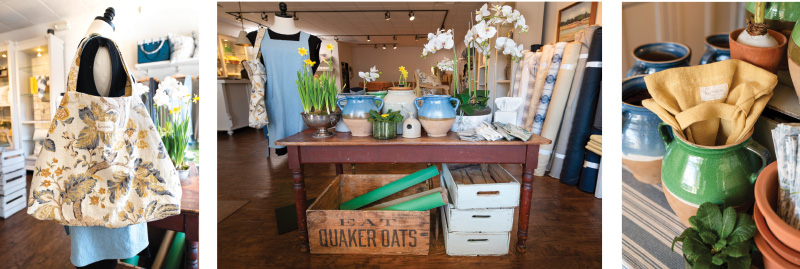
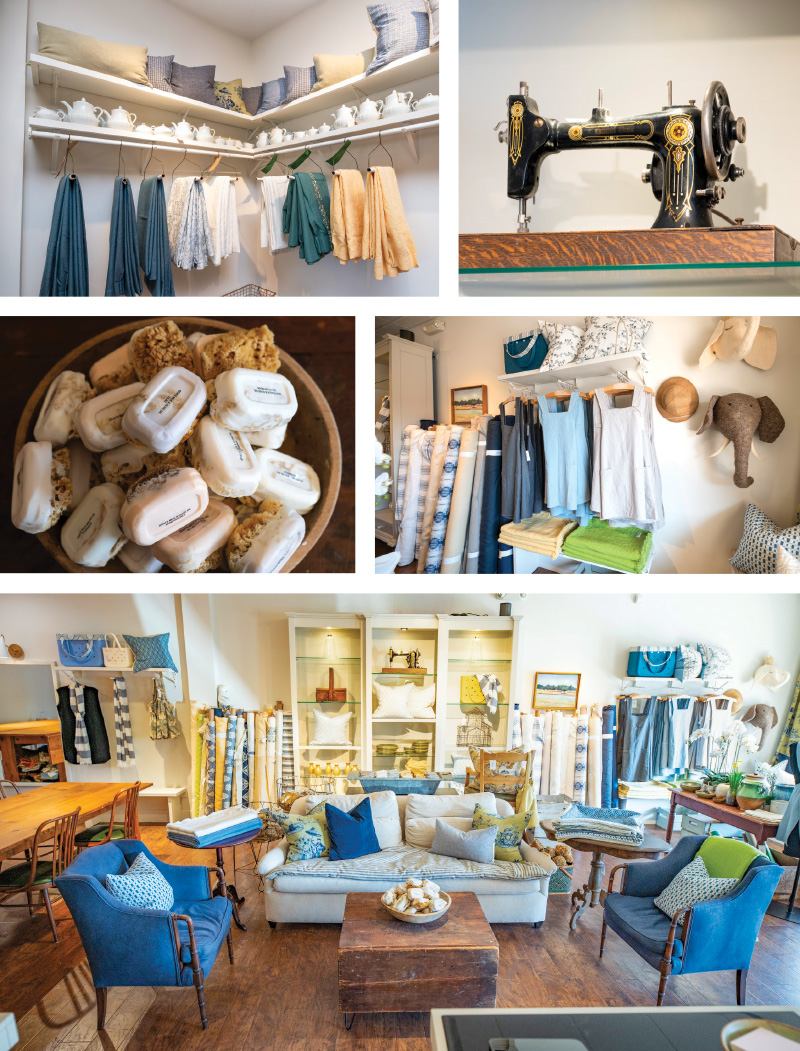
Rebekah Moody opened the Linnen Shoppe in October 2025, giving Lynchburg and Boonesboro shoppers a curated, boutique fabric experience. The Linnen Shoppe sells clothing and a variety of everyday items such as pillow covers, dish towels, and blankets, all hand made by Moody.

“We have seen a good reception from the community,” Moody said.

The Linnen Shoppe was not Moody’s first fabric business venture. She previously owned a business called Southern Provisions Company on Langhorne Road, that operated as a full design house with a whole team helping her.

Southern Provision Company was sold during COVID and Moody moved to Southport, North Carolina to open the first Linnen Shoppe.

“It did really well there, and we loved it, but my family was still here in Lynchburg, and I was commuting back and forth between Southport and Lynchburg,” Moody recalled.

She brought the business back to Lynchburg with “much simpler offerings”. Moody’s business model and team have also been simplified since the Southern Provision days.

“Linnen Shoppe is just my husband and me. I make a small category of home goods, and I make a lot of it,” Moody said.

Moody affectionately refers to Linnen Shoppe’s offerings as “small batch”. While she may not carry the inventory of a larger retailer, her items have distinct purposes and are thoughtfully crafted and added based on the season and customer feedback.

Despite the Linnen Shoppe’s various iterations, Moody says simply that “fabric has always been the goal.”

Although the Linnen Shoppe does not offer custom pieces, because of her involvement in every piece sold, coupled with her fabric sourcing methods, her inventory still has a custom, or one-of-a-kind quality.

A cornerstone of the Linnen Shoppe’s structure is its commitment to sustainability.

The fabrics Moody uses are acquired from large fabric liquidators. She sources raw fabric that would otherwise be considered “industry waste” for a variety of reasons.

“The industry throws away thousands and thousands of yards of fabric a year. There’s nothing wrong with this fabric,” Moody insisted.

Because of the variety of fabrics Moody can acquire, she is able to consistently create “one-of-a-kind” products.

According to Moody, her fabric sourcing methods allow her to pass on her savings to the customer, who might otherwise pay much more for the same fabric, combined with her artisanal approach to crafting these items.

“We’re really approachable with price,” Moody said.


Another unique aspect of the Linnen Shoppe is its seasonal operation. While the store is open Monday through Friday with reasonable hours, when all inventory is exhausted, the Linnen Shoppe closes for weeks at a time for Moody to create a new collection.

“That allows me the opportunity as a creative to be able to create uninterrupted,” Moody explained.

Moody conceptualizes, designs, and creates new fabric collections based on the seasons or time of the year. This approach gives the Linnen Shoppe an endless appeal as she sources and utilizes fabrics that allow for unlimited variety for its products.

“If you like it, buy it, because it won’t be here again. Certainly, there is a process of educating people on what we do, because it’s very unique to retail,” Moody said.

The different pigments and designs of unused fabrics from large manufacturers allows Moody to visualize her future collections based on what colors she feels embody that season. The variety of colors in the Linnen Shoppe at any given time create what Moody playfully calls a “candy shop of fabric” in her store.
The Linnen Shoppe is currently offering its Spring collection.

According to Moody, the store will close July 1 through Labor Day to design and produce the Linnen Shoppe’s Fall collection.

“One of the things that we’ve found in retail is that pop-ups can be really successful,” Moody said.

She explained that this seasonal approach creates a sense of urgency, excitement, and motivation for her customers to see what’s new and get it before it’s gone.
According to Moody, the Linnen Shoppe’s best seller is the Everyday Dish Towel.

Moody’s ability to create entire, unique collections is attributed to her years of experience in sewing and fabrics.

“I am completely self-taught.

I started sewing when I was six years old. Sewing is a lost art, so to find people who can sew for production is really hard to do,” Moody explained.

Moody recalled that she’d taken a hiatus from sewing, but returned to it when she needed curtains for her new home and the options she saw in stores weren’t to her liking.

While having a few friends over, they noticed the curtains she’d made in her foyer. They asked if they could buy the curtains which spurred her decision to use her sewing skills to go into business.

“That’s where it all started. In the foyer of my house,” Moody remembered.

Moody would like to use the Linnen Shoppe as a space to embrace community engagement with crafting. She has and wants to continue to hold classes that would teach artistic skills like floral arrangements, knitting, painting, and more.

“I think there’s a real need in the community for connection,” Moody insisted.


Curated, Not Cluttered

How to strike the balance between styled layers and lived-in comfort—without tipping into chaos here’s a fine line between a home that feels thoughtfully layered and one that feels…busy.

We’ve all walked into both. One feels collected over time, rich with story and texture. The other feels like every surface was filled simply because it could be. The difference isn’t necessarily how much is in the room—it’s how intentionally it’s arranged.

If you love books stacked on side tables, ceramics collected from travels, framed photos, woven baskets, vintage finds, and a healthy mix of new and old, but you worry about crossing into clutter, this guide is for you.

Here’s how to create a home that feels curated, not crowded.

Start with Breathing Room

Before adding anything, step back.

Every well-styled space begins with negative space—the empty areas that allow your eye to rest. Think of it as visual oxygen. Without it, even beautiful objects begin to compete.

As a general rule: not every wall needs art, not every shelf needs to be filled, and not every tabletop needs décor. If you’re styling built-ins, leave a few shelves partially empty. If you’re working with a gallery wall, allow for consistent spacing between frames.

Editing is often more powerful than adding.

©PHOTOS BY DARYL CALFEE

©PHOTO BY DARYL CALFEE

Create Visual Anchors

Clutter often happens when a room lacks a focal point. When everything is competing for attention, nothing stands out.

Choose one or two anchor elements per room:
• A statement light fixture
• A large piece of art
• A bold rug
• A beautifully styled mantel
• A sculptural chair

Once your anchor is established, let the surrounding décor support it rather than rival it. Smaller objects should feel like supporting characters, not co-stars.

Think in Layers, Not Piles

Layering creates depth; piling creates chaos.

The difference? Intention and variation.

Instead of lining up objects of similar height and size, vary scale and shape.

Pair something tall with something low. Combine smooth ceramics with woven textures. Place art behind a lamp or slightly overlap framed pieces on a shelf.
A simple formula to try on coffee tables
or consoles:
1. Something vertical (a vase, candlestick,
or lamp)
2. Something organic (greenery, a bowl of fruit, a branch)
3. Something personal (a book, photo, or collected object)

Three elements often feel balanced without feeling busy.

Photo by Daryl Calfee

©PHOTO BY DARYL CALFEE

Corral the Small Stuff

Small objects are usually what push a room from curated to cluttered.

The fix? Containment.

Use trays, bowls, baskets, or decorative boxes to group smaller items. Instead of five separate candles scattered across a surface, place two or three on a tray. Instead of loose mail on the counter, use a woven basket. Instead of remotes floating on a coffee table, use a lidded box.

When small items are visually grouped, they read as a single design moment rather than visual noise.

Stick to a Cohesive Color Story

Even eclectic homes benefit from a defined palette.

This doesn’t mean everything must match. But choosing a general color direction—warm neutrals, moody jewel tones, soft coastal hues—helps diverse pieces feel connected.

If you’re unsure, look at what you already own. What colors repeat? What tones do you naturally gravitate toward?

Then, when adding something new, ask: Does this complement what’s already here?

When color feels cohesive, layering feels intentional.

Mix Eras—But With Restraint

A home filled entirely with brand-new pieces can feel flat. A home filled entirely with vintage can feel heavy. The magic is in the mix.

Pair an antique wooden chest with a modern lamp. Style heirloom china inside streamlined cabinetry. Hang contemporary art above a traditional console.

The key is balance. If everything is ornate, it becomes overwhelming. If everything is minimal, it lacks warmth. Let contrasting elements enhance one another.

Leave Room for Function

Sometimes what feels like clutter is simply poor function.

Decor should never interfere with daily life. If you’re constantly moving objects to use a surface, that surface is over-styled.

Coffee tables should still hold coffee. Nightstands should still hold a book and a glass of water. Kitchen counters should allow space for meal prep.
When décor supports the way you live—rather than complicates it—your home feels calmer instantly.

Rotate, Don’t Accumulate

You don’t have to display everything at once.

One of the simplest tricks professional stylists use is rotation. Store seasonal pieces or extra décor in labeled bins and swap them throughout the year.
Shelves feel refreshed, and you avoid the slow build-up of excess.

This also allows sentimental objects to shine when they’re displayed—rather than disappearing into visual overload.

Make It Personal (But Edit Thoughtfully)

A curated home tells a story.

Photographs, children’s art, travel souvenirs, inherited pieces—these are the elements that make a house yours. The goal isn’t to remove personality in the name of minimalism. It’s to showcase it well.

Choose your favorite pieces. Frame the art instead of taping it to the fridge.

Give that inherited bowl a place of honor rather than tucking it behind other items. Display collections together instead of scattering them throughout the house.

When personal items are presented intentionally, they feel meaningful—not messy.

Do the “Squint Test”

When you feel unsure, try this: stand in the doorway and squint.

What do you notice first? Does your eye know where to land? Or does it bounce around the room?

If everything feels loud, remove one or two things and reassess. Often, subtracting just 10 percent of a room’s décor dramatically shifts how it feels.

Remember: Curated Doesn’t Mean Perfect

The most beautiful homes aren’t museum displays. They feel lived in.

Books are dog-eared. Throws are slightly rumpled. A stack of mail sits on the desk—contained, but present.

Striking the balance between styled and sincere takes practice. It requires stepping back, editing bravely, and choosing pieces that truly resonate rather than simply fill space.

A curated home isn’t about having less. It’s about choosing well.

And when each object has room to breathe, your home doesn’t just look better—it feels better.


A Home That Doesn’t Perform

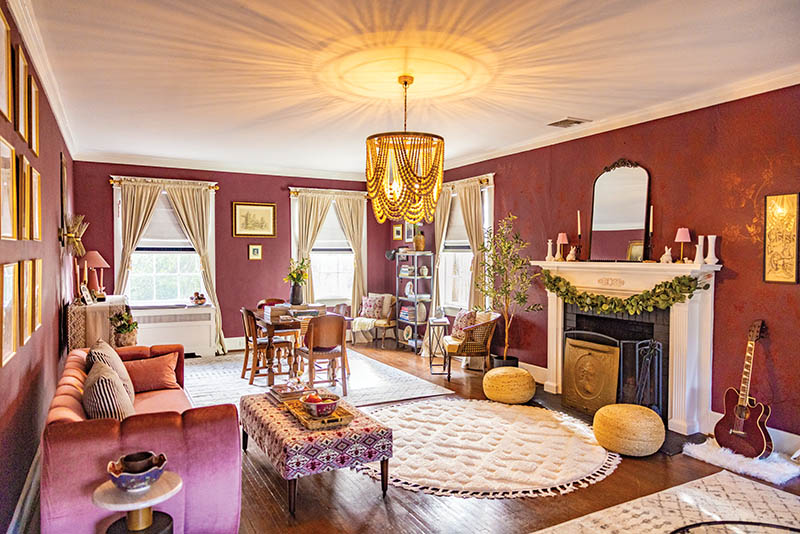
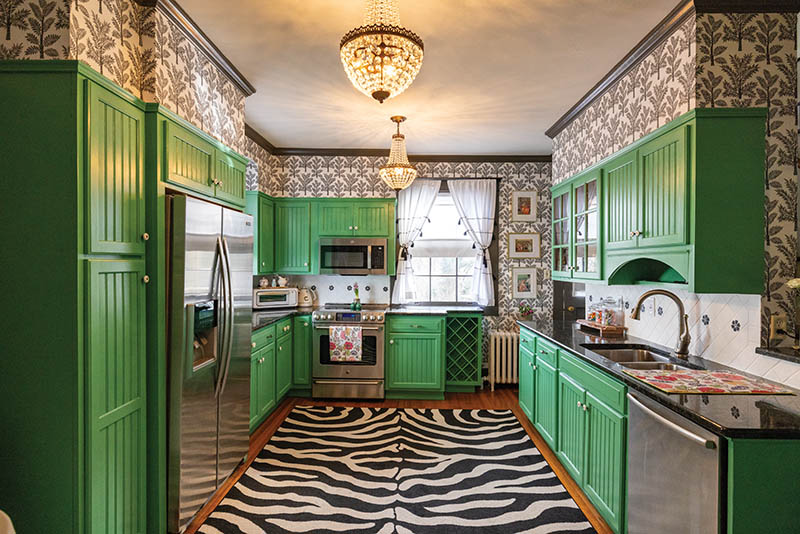
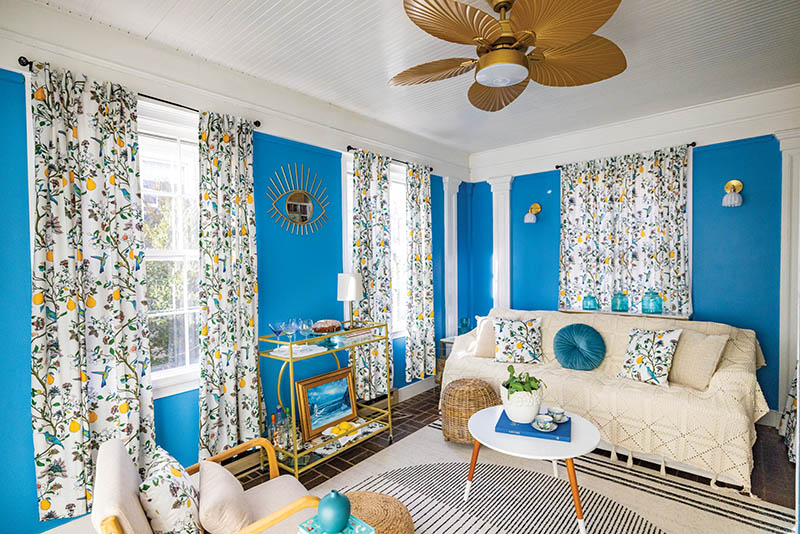
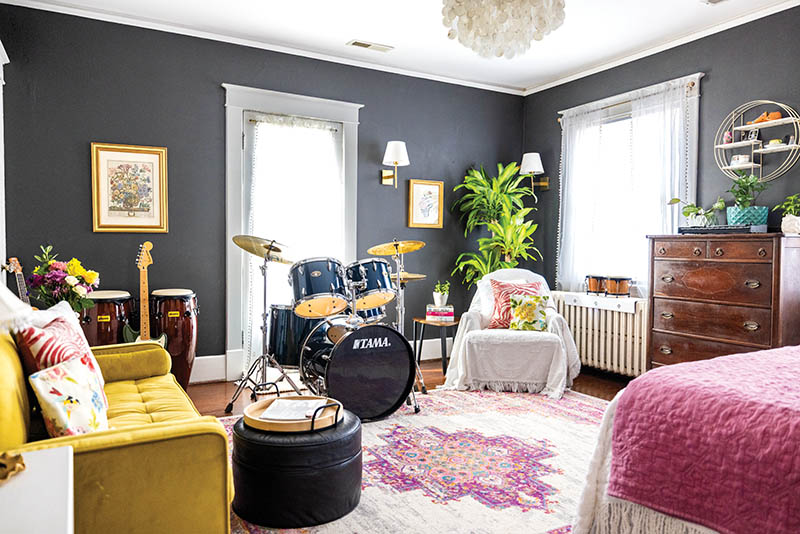
In her 1924 Colonial Revival, Mia Mangold has created a space shaped by history, humor, and intention

By: Megan Williams | Photos By: Andria Fontenot

Life changes exponentially when you stop performing and stop caring who’s watching,” Mia Mangold said, standing in the dining room of her 1924 Colonial Revival home—a space layered with collected furniture, hand-upholstered pillows, and just enough evidence of daily life to make it clear no one here is trying to impress anyone.

Mangold laughed, almost as if to soften the weight of the statement. “It took me a long time to actually mean that,” she added.

It’s not a catchphrase she uses lightly. It’s an earned mantra—one shaped over decades of movement, reinvention, and saying yes to experiences that most people only daydream about, then learning when to stop performing altogether.

Mangold bought her Lynchburg home in 2019 after renovating a string of historic houses across the Hill City. The story of those homes—and the life she built around them—is literally displayed on the walls.

Decorative plates from Oxide Pottery line her living room built-ins, each illustrating a house she has owned, loved, and renovated in Lynchburg. She gestures toward them as if they’re old friends rather than milestones (though, to the outsider looking in, they are both).

“I’ve owned seven houses in Lynchburg, plus one in St. Pete [Florida], one in Austin [Texas], and one in New Jersey—so 10 total,” she said. “My first house in New Jersey was built around 1865, and it’s where Walt Whitman used to stay in the summer. There was a natural spring—I picture him sitting down there writing poetry.

It sounds cheesy, but as a kid I was an old soul, weird kid. New Jersey has so many old Victorians.”

To hear her describe her journey—from “old soul, weird kid” who grew up on the New Jersey–Philadelphia line to home renovator in Lynchburg—is to realize that Mangold’s life has never followed a straight line.

It’s shaped by an innate curiosity, a desire to see the world, and a penchant for never saying no to a good time.

“I basically grew up in Philadelphia,” she said. “I lived 15 minutes away in New Jersey, near the Ben Franklin Bridge. Then I left for a while—lived in a car with my friends and went cross-country, ended up in San Francisco. I came back when I was 21 because my grandma got really sick. We thought she was going to pass, but she lived four more years and couldn’t be alone. I spent days with her; my mom slept there at night. I worked while getting my photography degree—I was a photo lab tech—and I worked at the Camden County Library in periodicals. I even worked at Staples, which was fun.”

By 24, Mangold had saved up enough money to buy her first home. It was then, staring down the beams of a 19th century Victorian, that her gumption grew even more.

“I didn’t have YouTube tutorials. I had old home and garden handyman books that taught me how to change a faucet or fix something,” she remembered, nodding to the corner bookshelf where her handyman books still reside. “My uncle worked at a lumber yard—he helped me with trim and molding.”

At the same time that she was teaching herself how to renovate her New Jersey home, she was also working at the historic Trocadero Theatre in Philadelphia’s Chinatown, where she worked until she turned 30. While she loved working as a concert promotor and then later a booking agent, the early load-ins and late-night shows eventually became too much. The housing market in New Jersey was booming and Mangold took a chance and sold her house.

“The housing market got high—when balloon loans were everywhere and rates were low—and I sold my house for three times what I paid,” she said. “Then I flew to Spain and didn’t come back for two years. I lived in Turkey, spent a lot of time in Greece, went to Australia, Asia… India for a while because it was affordable and I could stay longer. I was saving money because I knew I’d have to come back eventually and I wanted to buy another house.”

And she did.

After flying to Austin, Texas, for a wedding, Mangold planted roots once again—working at the legendary Red 7 venue, popular for hosting rock, punk, and metal shows. She also purchased a condo, which she sold a few years later for enough money to buy her first 5,000-square-foot home in Rivermont—with enough money left over for renovations.

“I saw a house online—I think it was on Madison—and I was like, ‘Where is this place?’ I thought: Is this magical fairyland? I could buy two old houses for what I could sell my one house for. So I made a list of 10 houses, found a local realtor, and she showed me all of them. I chose the Rivermont house—the big white house—it had an apartment in the back and had been a rooming house. It was fun to renovate. I was still tiptoeing into color because I was accommodating guests. I rented downstairs as an Airbnb. I didn’t want an all-white Airbnb with the same horse picture everyone has. I wanted it to feel interesting—bright, funky—something you don’t live in every day.”

From there flowed a series of home purchases and renovations—some of which she held onto for a time as short-term rentals, and others she lived in or sold. All the while, Mangold was rolling up her sleeves, doing the work herself, and evolving her style even further.

“On Arlington [Street], I was taking out a vanity and the plumbing was corroded—it broke off and sprayed everywhere. I’m soaked, running into the basement, crawl space… water pouring everywhere—hardwood floors exposed,” she remembered, noting that the journey has been far from picture perfect, and that’s exactly how she’d prefer it. “Or when I moved here [to this house] the plumbing started leaking so I had to go in and fix it, patch the wall, put up a new ceiling… a week later, water’s dripping out of the vent. That stuff happens.”

Mangold doesn’t shy away from the uncomfortable. Rather, those messy moments are what make her story all the more interesting and all the more relatable. A small woman in stature, her lived experiences have made her a force of will and determination.

And it’s an interesting juxtaposition—the know-how to fix plumbing and patch the wall alongside of the person who can effortlessly style a room all while wearing vintage Doc Martens that have been meticulously preserved since the ‘80s.

Mangold’s life has never followed a straight line, and she has no interest in pretending it should have. The houses, the travel, the work—even the setbacks—have all been part of the same ongoing experiment: figuring out what feels honest, useful, and worth keeping.

In her Lynchburg home, there’s no performance—only layers of intention, curiosity, and care. It’s a place where old windows are left intact, mistakes are patched and repatched, and nothing is precious unless it’s personal.

For Mangold, that’s the point. Not perfection, not polish, just a life and a home that reflects exactly who she is, right now.