Tips for Purchasing Second-Hand Art

How to Spot Authentic Pieces and Navigate Online Listings

Art possesses an ineffable quality that resonates with individuals on a deeply personal level. Whether you’re an art enthusiast seeking to adorn your walls with captivating pieces or a collector in pursuit of unique finds, the world of second-hand art offers a treasure trove of possibilities. Exploring thrift stores, antique shops, and online platforms like Facebook Marketplace can unearth hidden gems at affordable prices. However, distinguishing between an original masterpiece and a reproduction requires a keen eye and some know-how. Here are essential tips for discerning authenticity, evaluating online listings, and discovering second-hand art in various locations:

Identifying Authenticity: Original vs. Reproduction

When shopping online for artwork—either via Facebook Marketplace, Etsy, eBay, or even looking at upcoming local estate sale listings ahead of the sale—one of the first questions that will come to mind is, “Is this a good deal?” One of the first steps in answering that question—though the answer is often entirely subjective, as art is always a good deal if it means something to you—is determining if the piece is original or simply a reproduction. And, it’s often even more nuanced than that. But, to determine if a piece is an original, look for:

  • Artist’s Signature: Look for the artist’s signature, which should be consistent with known signatures or documented styles. Beware of printed signatures or signatures that seem out of place.
  • Brush Strokes and Texture: Original artworks often display brushwork depth and unique texture, while prints or reproductions may lack these details, appearing flat or uniform.
  • Materials and Aging: Inspect the materials used, such as canvas, paper, or paint. Authentic pieces may show signs of aging, like cracks or discoloration, which reproductions won’t replicate accurately.

Oftentimes, artists completed numbered reproductions of their original work, which can also be quite valuable. However, it takes a discerning eye and a little bit of research to determine if the piece you’re looking at is an example of one.

  • Artist Background: Familiarize yourself with the artist’s style, techniques, and history. Research their portfolio or consult reliable sources to authenticate their works.
  • Provenance and Documentation: Request provenance or documentation confirming the artwork’s authenticity, such as certificates of authenticity, receipts, or previous ownership records.

If the artist is relatively unknown or is even a local artist, the above inspection techniques of looking at the signature, brush strokes, and materials used will still inform you of whether or not it’s an original. There are also a number of questions you can ask the original poster or certain details you can look for, such as:

1. Detailed Descriptions and Images:

  • Clear Photos: Look for listings with high-resolution images showcasing the artwork’s details, including close-ups of signatures, textures, and any imperfections.
  • Comprehensive Descriptions: Seek listings that provide detailed information about the artist, dimensions, materials, and condition of the piece.

2. Seller Reputation and Communication:

  • Seller Reviews and Ratings: Check the seller’s ratings and reviews on Facebook Marketplace or other platforms. Positive feedback often indicates a trustworthy seller.
  • Inquire and Verify: Don’t hesitate to ask the seller for additional information, such as authenticity documents or more images. A reputable seller will readily address your queries.

Shopping Locations for Second-Hand Art

However, there is absolutely nothing better than finding a diamond in the rough at a local yard sale or spotting the artwork of your dreams at a local thrift store. Spend a weekend hopping around to local shops and see what type of artwork you can find for your home.

1. Thrift Stores and Goodwill:

  • Diverse Selection: Thrift stores often boast a wide array of art pieces, from paintings to sculptures, at affordable prices. Visit regularly as new items frequently arrive.

2. Antique Stores and Estate Sales:

  • Quality and Rarity: Antique shops and estate sales may feature higher-quality or rarer pieces. Be prepared for potentially higher prices but also for unique finds.

3. Online Auctions and Classifieds:

  • Variety and Convenience: Platforms like eBay, Etsy, or local classifieds provide access to a broad range of art pieces from different eras and styles, offering convenience and diverse options.

Seasoned thrifters and second-hand shoppers will tell you that consistency always pays off when second-hand shopping. Get to know the turn around days for your local thrift stores—when new merchandise often comes in. You’ll soon learn the best days of the week and times of the day to shop.

Purchasing second-hand art is an exciting endeavor that allows you to uncover exceptional pieces while adding character and depth to your space. However, exercising caution, conducting thorough research, and honing your observational skills are crucial when determining authenticity and evaluating listings. Exploring various shopping locations, both physical and online, expands your chances of stumbling upon remarkable treasures waiting to adorn your walls.

Remember, the joy of finding a genuine masterpiece in a second-hand store or online platform not only enriches your collection but also speaks to the serendipity and allure of the art world. 


Lynchburg’s “Happy Pollock”

Julian Raven, Opens Gallery and Studio on Wards Road

When artist Julian Raven shares his story, he paints a picture as vivid and lively as the stunning works he displays in his new gallery on Wards Road.

Raven’s journey from a young English boy living in Spain with a penchant and talent for art to an internationally celebrated artist with a vast and versatile catalog of work has been full of peaks, valleys, and serendipitous moments. He seems to recall every step of his journey with gratitude for bringing him to where he is today.

Raven’s earliest memory of loving art occurred when he was about eight years old and living in Spain.

“I can remember sitting with my father on a veranda in a villa in southern Spain, where I grew up,” he recalled. “It was a sunny day, and I did a colored pencil drawing of some beautiful bougainvillea that was wrapped around a white-washed wall. It was a clear picture of my inclination towards the visual arts.”

When his family moved to Portugal when he was a bit older, Raven attended tiny international English-speaking schools and continued pursuing his passion for art. He won several art contests, but because the arts were not prioritized in these schools, Raven was not fully supported in his pursuit—that is, until the day his math teacher found him sketching in the school’s library.

“My math teacher saw me doodling in the library at the English International College and set a crushed can of Coke in front of me to sketch,” said Raven. “After I was done sketching, he basically took me by the hand and walked me over to meet David Bodlak, an artist and teacher in the art department.”

Bodlak mentored and championed Raven when the latter was in his mid-teens and continues to be a source of great inspiration to him to this day.

Photos by Ashlee Glen

“He was a wonderful mentor,” Raven stated. “His enthusiasm and encouraging spirit were incredible. In an art class where you have all different skill levels, he would go from student to student and always find something redeemable about each person’s work. He has had a tremendous impact on me.”

Raven graduated high school at the age of 16 and took a year off to focus on his art. He then went on to study at the prestigious Chelsea College of Arts in London.

During his time at the College, Raven experienced a series of highs and lows. Although he “was in heaven because the facilities were huge,” he was struggling greatly with his father’s death, which happened when Raven was only 10, and with the political climate that surrounded him. He notes that he lost his faith in God and often felt hopeless and lost during this time.

Raven ended up leaving the College and going back to Spain, where he began to work in the bar business. Then, in early 1992, Raven’s life changed dramatically as he sat alone on a mountain.

“I came to faith in God in Spain, alone and sitting on a mountain, contemplating nature,” he recalled.
“That experience changed my life and led me down a spiritual journey where I began to pursue missionary work.”

This missionary work brought him to America. He originally planned to do missionary work in California for six months and then move to Mexico as a missionary, but he ended up moving to Elmira, New York, in 1996 instead. There, he met his wife, Gloria, and they started their own business: Raven’s Custom Creations. As Raven used his artistic skills to create custom-painted and decorative furniture, his passion for art was invigorated.

Photos by Ashlee Glen

In addition to thriving artistically, Raven was spiritually and personally fulfilled. He and Gloria had three children, and he opened his own gallery in Elmira in 2007. Then the 2008 financial crisis occurred.

Forced to close the gallery, Raven and his family moved back to Spain for a year and a half. Ultimately, they moved back to Elmira and Raven opened a new gallery.

After entertaining the idea of RVing out west, Raven and Gloria decided to move to Lynchburg, where all three of their children still study at Liberty University. Raven knew that he wanted to open a gallery here; the challenge was finding the right spot for it. Julian Raven Artist, LLC, found a home at 2121 Wards Road and officially opened on March 25.

“I could have gotten a warehouse and been off the beaten path,” he said. “I looked at those options but decided that if I wanted to get up and running, I needed to be in an area with more movement. It’s sort of an unlikely setting for an art studio because I’m stuck between a Wendy’s and a McDonald’s, but it’s also sort of fitting because I’m a contrarian by nature. It just had what I saw as the bones to be something great.”

Raven and his son spent six weeks completely renovating the building, which houses not only Raven’s work, but also what he calls his “Renaissance Creative Palette” of services: painting parties, art classes, portrait painting and photography, and more. There is a screen-printing room downstairs and a brand-new photo studio, for which a ribbon cutting ceremony was held on June 15.

Raven says that his painting parties are a “real way to connect with people,” and adds that “seeing people who have never painted before create works of art is remarkable.” According to Raven, one gentleman came in a couple of times to paint, and after Raven shared the man’s second painting on Instagram, it sold for $100.

When it comes to Raven’s own work, he is a multimedia artist and photographer.

“I have a lot of very broad experience because my artistic hunger has made me curious to discover and try new things,” he noted. “I like to be constantly challenged. I always seem to find difficult things to do!”

That said, Raven specializes in abstract expressionism, which he says allows him “to share his inner-world experience and joy.” He recalls that an attendee of one of his shows referred to him as a “happy Pollock,” a moniker that he happily embraced.

There is no telling where Raven’s journey will take him next, but one thing is certain: he will continue to see the beauty in all things and to share his interpretations of that beauty with others.

“Beauty, for me, is so arresting,” he stated. “When I see true beauty—nature, people—I want
to capture it and share it with others.
We live in some pretty serious times right now. I want people to feel lighter after leaving my gallery.”  

To learn more about Julian Raven, his gallery and studio, and his art, check out his website (julianraven.com) and Facebook page.


Reinvigorated Retreats

Renowned Artist Residency Program Virginia Center for the Creative Arts Continues to Innovate after 50 Years of Success

Photo courtesy of Paige Critcher

Art, in its many forms, tends to be perceived as a product rather than a process. When you see a painting in a gallery or a book on a shelf, you are presented with a polished result of a great deal of time and effort expended by that particular creator. At Virginia Center for the Creative Arts, however, the creative process—in all its unrefined and hard-won glory—is given the spotlight. For just over 50 years, VCCA has provided artists of multiple disciplines with the time, space, and amenities to fully immerse themselves in their work without specific expectations. Considering the organization’s recent and upcoming developments, its next 50 years are sure to be even more remarkable.

VCCA’s story began in the late 1960s when two Virginia-based authors, Elizabeth Coles Langhorne and Nancy Hale, agreed that Virginia should have its own artist residency program. The program started as a couple of homes and a farm in Charlottesville, and the first artists were welcomed in 1971. In 1978, the program moved to Amherst thanks largely to the efforts of William Smart, an English professor at Sweet Briar College. To this day, VCCA resides on the picturesque 410-acre Mt. San Angelo estate across the highway from Sweet Briar.

Photo courtesy of Paige Critcher

VCCA, whose alumni include Beth Macy—author of Dopesick, which has now been turned into a Hulu miniseries—and Charlottesville-based author Jocelyn Nicole Johnson, offers fellowships for writers, visual artists, and composers at all stages in their artistic careers. Applications are accepted three times per year and are peer-reviewed by other artists within the same discipline.

“The most important part of the application is a work sample,” said Kim Doty, VCCA’s Director of Communications. “The panel carefully considers the quality and promise of the work before making their recommendations, and we try to schedule as many people as we can. We have three four-month residency seasons: winter, summer, and fall. Historically, summer tends to be a little more competitive due to many people being on an academic schedule. Within each scheduling period, people come for various lengths of time. We really want to make sure that people can come for a length of time that works with their lives.”

Photo courtesy of Paige Critcher

Since its inception, VCCA has remained committed to providing fellows with a balanced environment that allows them to focus on their work while also forging meaningful connections.

“We’re trying to make sure that we’re cultivating a welcoming, supportive, and nurturing atmosphere where artists of all kinds can come and be themselves and get the support they need to move their work forward,” Doty noted. “Our missions of time, space, and a sense of community have been very constant.”

Photo courtesy of Paige Critcher

On a basic level, that sense of community derives from artists’ shared awareness of daily life’s abiding ability to thwart the creative process.

“Few people acknowledge the amount of effort and time that goes into creating art,” Doty remarked. “Our day-to-day lives don’t make it easy to carve out that time and space. VCCA and other art residency programs are places where you can be among other artists—the people who understand the struggle personally.”

Photo courtesy of Paige Critcher

Opportunities for deeper connections are also plentiful at VCCA. For instance, after residents enjoy dinner together, writers in the group will often host optional and informal readings of their work around the fireplace.

“There are these chances for people to come together and start a collaboration, form a friendship, or simply gain new understandings about how to solve a creative problem,” said Doty. “A writer can have a conversation with a painter and, even though their work may seem to involve totally disparate processes, there’s just something about a different creative approach that can change the way you think about something.”

Photo courtesy of Paige Critcher

Of course, solitude is also an essential part of the creative process. Each resident enjoys a private bedroom and bathroom, and plentiful studio spaces are available for use.

Fellows also receive three meals per day provided by renowned catering service Meriwether Godsey.

“We used to try to manage an in-house kitchen staff, but that was sort of an ongoing struggle,” Doty noted. “Then we partnered with Meriwether Godsey, and they are just fantastic. The residents rave about the food and feel like they’re getting healthy, nourishing, and delicious meals every day. Food that is good and lovingly prepared really makes a difference.”

Photo courtesy of Paige Critcher

In addition to improved dining services, several updates and serendipitous occurrences have helped VCCA become the celebrated residency program it is today.

In 2004, a foundation in Denver, Colorado, sent out a flyer indicating that it was looking to give away a lovely property called Le Moulin à Nef in the village of Auvillar, France. As luck would have it, Sheila Gulley Pleasants, VCCA’s Director of Artist Services, is fluent in French. VCCA acquired the property and started a residency program in France. Once artists have had a residency in Virginia, they are eligible to apply to the program in France, which hosts four artists at a time. Additional international programs have since been established in Germany and Austria.

Photo courtesy of Paige Critcher

In 2020, a once-in-a-lifetime gift helped VCCA realize its long-standing dream of purchasing the Mt. San Angelo estate.

“When we learned that Sweet Briar would be willing to entertain our offer to buy the property, a longtime board member of ours [Cynthia Tremblay] was ready to help,” Doty recalled. “She owned this Georgia O’Keeffe painting, entitled Blue Sand, and when she learned that there was a buyer interested in purchasing it, she very generously donated the painting to VCCA so that we could sell it and use the money to help purchase the property. It feels very poetic that the gift of this painting will ensure that we have this home for artists.”

Photo courtesy of Paige Critcher

Although VCCA was saddened to halt the program for 15 months due to the pandemic, the organization completed several significant renovations during that time: the Studio Barn and other public rooms were upgraded and refurnished, each bedroom received its own private bath, all bedrooms and studios received independently controlled HVAC units, and the 1930s pool that had fallen into disrepair was restored. The organization also hopes to improve ADA accessibility in the near future.

Additionally, and even more importantly, VCCA recently hired its first outreach manager and established its 50th Anniversary Fund, which is specifically designated to give 50 artists of color who are new to VCCA a free two-week residency.

“We’ve always had diversity in terms of artistic disciplines, ages, and phases of people’s careers,” remarked Doty. “Now, we’re working hard to make sure that the demographics of the artists who are coming more closely reflect those of the U.S. population.”

Photo courtesy of Paige Critcher

VCCA currently has a pay-as-you-can model in which the organization’s Annual Fund covers at least 50% of the cost of all artist residences and an endowment provides more than $150,000 annually in financial aid. A variety of fully funded fellowships, which are endowed by individual donors or sponsored by grants or foundations, are also available. Ultimately, VCCA hopes to eliminate all fees for artists.

As VCCA continues to innovate and improve its residency program, its primary mission of facilitating and honoring the creative process without agenda will undoubtedly remain unchanged.

“It’s a very unpretentious and welcoming place, and there are no expectations or obligations,” Doty said. “We want people to be able to come and just pursue what they want to pursue. We’re trusting them to come and hopefully take their work to unexpected places.”


The Magic of Art and Illusion

This summer, Ellee Evans, an artist who is from Lynchburg but currently living in Atlanta, set out to alter perception and bend reality. With paintbrush in-hand, she stood in the middle of Art Alley in downtown Lynchburg for four hours expertly mixing color and creating contrast. But rather than painting something stationary, Evans relied on a patient model to act as her canvas.

Artist Ellee Evans painting model Kiersten May

“I have a deep desire for making things magical just from illusion,” Evans explained. “I think it started from my scenic painting training my senior year of college. I learned how to make backdrops for plays look three dimensional and it inspired me to do the reverse with body paint. I want to turn the 3D image we see in life into a 2D illusion. It’s magical and so incredibly fulfilling once I step back and see the final product.”

Using Mehron, a water-based body paint, Evans was able to ensure that a thin layer of breathable, weightless paint could be applied to the skin and clothes to act as the base before applying contour and details. But before Evans ever puts brush to body, she first puts pen to paper.

“Prepping for a paint session starts with a drawing. I draw out a rough sketch using the dimension of the model, and then I play around with color palettes and designs,” she said. “Then, when I have a vision, I will share it with the client or friend that I am painting. I wash and cleanse all of my brushes and palettes, and then I pack up my back with all of my essentials and meet with the client to create the magic!”

For Evans, painting a person versus a canvas is about the connection and the process. Evans enjoys being able to talk to someone while she paints and allows herself to get inspired in the moment to add more details to her living painting while she works. But Evans also recognizes that there can be something deeper at play when you spend that much time working closely with another person.

“It’s body positivity,” she said. “I love making someone feel like a beautiful piece of artwork—even though every human already is one, we just often are hard on ourselves and don’t see it! I have a lot of self-image issues and whenever I paint myself, I feel so valuable and special and important. It means the world to me to be able to share that feeling with other humans.”

Evans has been passionate and curious about this type of live, body art since she was a child. Her mom would read Purple, Green and Yellow by Robert Munsch to her, which recounts a story of a marker-obsessed girl who runs out of paper and begins drawing on herself instead.

“Throughout high school, I would use sharpies and eye liner to draw tattoos on myself,” Evans remembered. “Eventually, I started playing around with makeup and cosplays. I would want to buy a costume, but then something would just click in me, and I would just say, ‘I could just paint it on me, right?’ It all started trickling off into more and more creative ways to use paint and play with illusions.”

Although Evans moved away from Lynchburg a little over a year ago, she still enjoys returning for art projects or to see how much the city has changed.

“This last time coming back to Lynchburg, I found myself taking so many photos downtown,” she recounted. “The art scene has made a huge difference in the downtown atmosphere. It makes me feel welcome and appreciated as an artist. Like, ‘Hello, we welcome art here.’”

Evans plans to return to Lynchburg often, and is available for commissions via her website or on Instagram.

Photos by Enrique with Kanded Photo


Have Paint, Will Travel

Raleigh artist, Chris Jones, finds beauty and inspiration in the Hill City

In the early 19th century, French painter Pierre-Henri de Valenciennes wrote a treatise entitled Reflections and Advice to a Student on Painting, Particularly on Landscape where he encouraged fellow artists to paint “en plein air”, or to paint landscapes while in the landscape. The act of immersing oneself in the elements, and painting the lines, light, and contrast exactly as they were rather than exactly as memory served, became the backbone of French landscape painting transforming from minor genre to primary art form as the 19th century progressed.

Today, artists around the globe still choose to paint en plein air—opting for mobile canvases and ever-changing environments as a way to keep their perspectives fresh and inspired. Chris Jones, a Raleigh-based artist, is one of them.

A renaissance man of sorts, Jones has always been a creator.

Chris Jones paints en plein air on Grace Street. Photo by Ashlee Glen.

“When I was 8 or 9 years old, there was a guy on TV named Jon Gnagy [host of the TV series You Are an Artist and Learn to Draw],” he explained. “He would draw something and show how a shadow might follow the contour of the land. It was all black and white TV back then, but he was drawing with charcoal so it didn’t matter. I ordered his book, which was on sale, and I devoured it. I drew everything in it and learned a lot about composition and perspective.”

Jones continued to pursue art through adolescence and into high school, when he became interested in photography, architecture, and design. After graduating high school, he began pursuing a degree in architecture and design from NC State University’s College of Design while supplying photography to local ad agencies.

“When I got to College, though, I realized it was design and art that I wanted, rather than architecture,” he remembered. “The closest art school was in Chapel Hill, so I took a semester there. It was a young program at the time, so I went on to look at Baltimore College of Art and California Institute of Art. Somewhere along the way, I got sidetracked a bit.”

At the time, Jones was a drummer in a band—a passion that started when he was six years old and still continues to this day.

“I ended up recording two albums with a band named Glass Moon at Electric Lady Studios and then toured for two years,” he said. “We had recorded in the West Village of New York, and I loved the city, so I ended up moving to New York after the tour was over. I left design school and decided to pursue photography full-time instead.”

Within six months in New York, Jones was getting work as a location photographer—and that work continued for the next 25 or so years.

“When I wasn’t traveling on assignment, I would hang out with artists and friends, and I would draw or paint on and off throughout those years. After my wife and I raised our children, we retired and moved to the west coast. I moved back to Raleigh in 2019, and when COVID hit, I put my camera down, picked up a paintbrush again, and started painting everyday. Now I have a stack of paintings that I don’t know what to do with,” he laughed.

Photo by Ashlee Glen

In a journey that may seem all too familiar to artists—one where passions are pursued and given the space to transform—Jones’s creative life has been a whimsical dance between music, photography, and painting. Each medium has offered a unique chance to view life in just a slightly different way.

“When COVID hit, there was this existential fear that we all had of, ‘What can I touch? Am I going to die? How many years do I have left to do what I’m doing?’” he explained. “I had already done photography and I had played drums all my life. I wanted to do painting and fine art. That was the third leg of my desires as a child, and COVID allowed me to explore it because I was at home.”

Now, Jones has been painting almost daily for over two years. He leverages his early love for architecture and design, and explores composition, light, shadows, and intensity of colors in architectural spaces in and around his home base of Raleigh.

Photo by Ashlee Glen

“Raleigh is a very happening place that’s growing very fast,” he said. “Part of my job as an artist is to document that. I like drawing and painting buildings. Because of the architectural influence I had as a kid, I love seeing how Raleigh is growing and trying to paint that.”

But Jones’s exploration of architectural beauty and growing cities doesn’t stop in Raleigh. Jones recently traveled to Lynchburg and found inspiration.

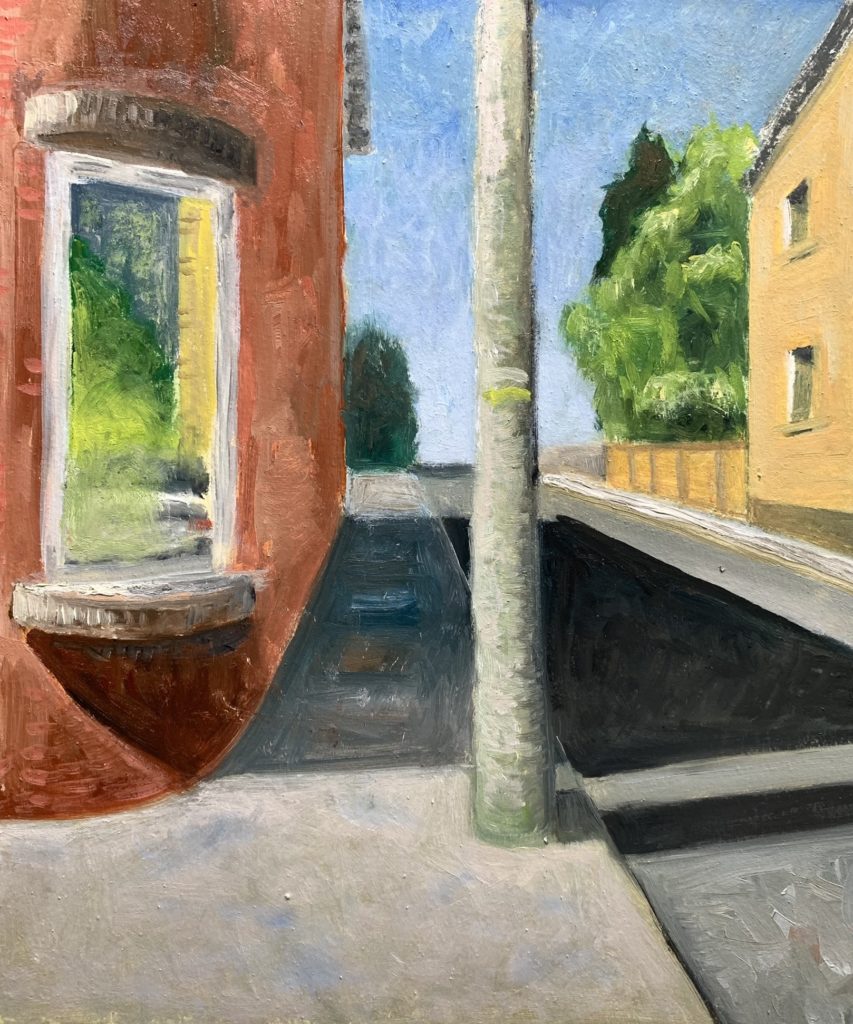
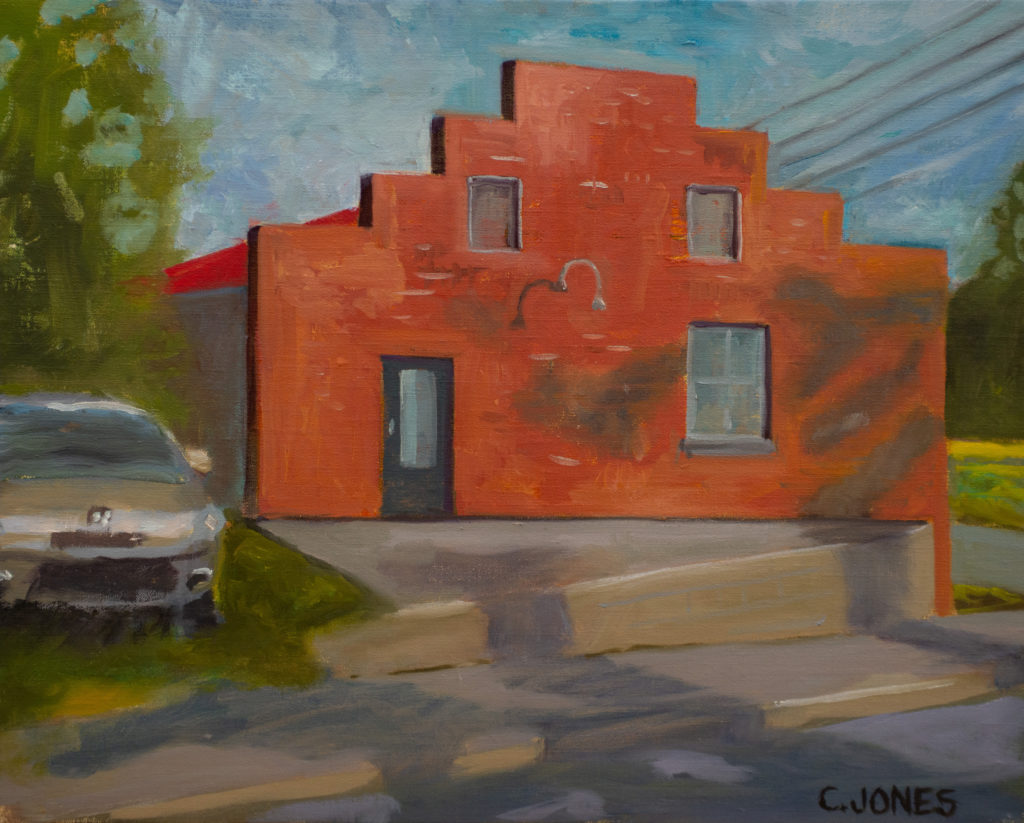
“When I drove to Lynchburg, I drove down Grace Street by mistake,” Jones explained. “As I drove down Grace Street, I immediately saw two scenes that begged to be painted—the first was the historic Fire Station No. 2 building and the second was a gorgeous brick building where you could see where the facade had been at one point. When I have that instant strike, it says to me, ‘Let’s see if I can paint it.’ The same happened on Church Street. I could have easily painted there for two weeks.”

Engine Company Number 2- 24×24 oil on panel
Church Street- 11×14 oil on paper
Old Facade on Grove Street- 16×20 oil on panel

With his canvas and paint tools in tow, Jones stopped and painted the two Grace Street buildings en plein air.

“I was struck by [the Fire Station No. 2 building] because of the way the light hit it, plus it was beautifully designed in the first place,” Jones recounted. “I had this fantastic feeling of having been there in the day when it was being used, and seeing fire trucks come out of the door.”

Jones spent an afternoon getting the architectural lines and sunlight reflecting off the fire station just right before returning back home to Raleigh, but not before Lynchburg had a chance to leave an impression on him.

“Lynchburg is going through a renaissance of sorts, it seems,” he said. “I loved to see all of the hip looking youngsters walking around. If I didn’t love living in Raleigh, I’d be hard pressed not to want to move to Lynchburg.”

To see more of Chris Jones’s art, visit his portfolio at www.chrisjonespaints.com and find him on Instagram at @chrisjonespaints. He is currently accepting commissions, and his Lynchburg paintings are available for purchase.


“It’s Like Living in an Art Project”

A Lynchburg Midcentury Time Capsule Meets Its Perfect Match

Is it possible that sometimes a house chooses its owners?

Much like a rare antique sitting boxed up for decades in an attic, or a valuable painting relegated to the back rack at a thrift store, it waits for just the right old soul who will lift it up with a sense of reverence and say, “There you are.” It seems an impossible idea given the recent real estate market, but when you hear the kismet story of Hannah Poucher and Grant Kittrell, it may lead you to wonder if maybe, just maybe, their house chose them.

Photos Courtesy of Daryl Calfee

The Discovery
“We knew the second we looked through the windows that we wanted to live here forever,” Hannah, now 32, said of their love-at-first-home-sighting experience.

It was August 2019, and she and Grant, now 30, were making plans for a wedding and their future together, when something akin to Zillow lightning struck. A little listing with just five vague pictures popped up—a circa 1954 midcentury modern in the middle of Lynchburg. Within the hour, the couple found themselves peering through the windows, unable to believe their own eyes. It was meant for them, they knew it, but they needed to move fast.

“We weren’t pre-qualified, we had never looked at any houses before, we had to Google after we saw this place—’how to get a mortgage’—we didn’t know anything!” Hannah, a military recruiter for Liberty University, said. “But we knew if we didn’t jump at this, we wouldn’t get another shot at something like this in town.”
A bidding war ensued, but the home seemed to intuitively know who it wanted as its next caretaker. The couple closed in November 2019 and made a defining decision in honor of their new-old home.

“We wanted to live in the space for at least a year before doing anything radical,” Hannah explained. “We wanted to understand what it was like to be here as people within a space where it was designed to work like this. So, we decided no big changes for the first year.”

An Intentional Interior
It turns out, there was much the home wanted to teach them. Grant and Hannah took pleasure in learning about its history and thoughtful layout, taking note of each delightful detail, like how the abundant natural light shifted across the open-beamed ceiling throughout the day.

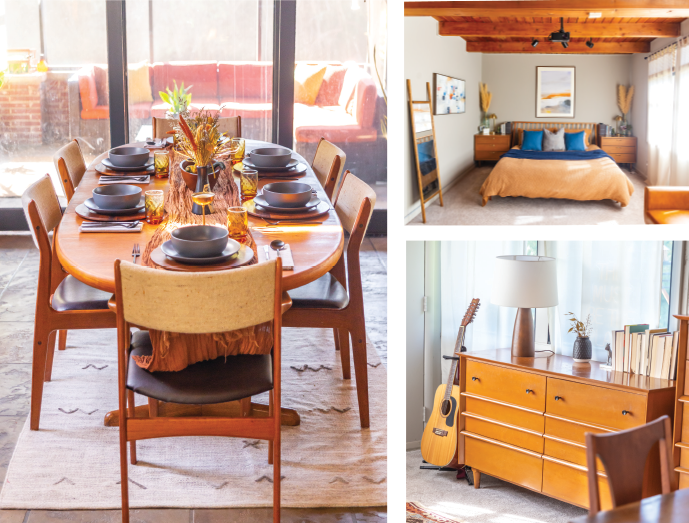
“We both, perhaps in different ways, came to this space with appreciation for art and design,” Grant, a writer, illustrator, and musician who works at Randolph College, said. “The midcentury modern style is very intentional and leans in the direction of sculptural, so there’s not a day that we don’t look around and say, ‘Hey look at that! Isn’t that really amazing?’ So, we are living in this space that we see as a piece of art, and really it is.”

Photos Courtesy of Daryl Calfee

Within that first learning year, they came to understand the unique reason for the way things were designed. Like the greater abundance of windows on one side of the house to allow for passive solar heat. Or the fact that the floors, which look like stone, are in fact stamped concrete designed to hold thermal mass, making what should be a cold underfooting somehow warm and earthy.

The biggest discovery, however, came in the form of a large manila folder filled with the home’s blueprints, original building materials, past pictures, and a booklet of original paint colors from The Frank Lloyd Wright Sierra Sunset Collection.

“When we found that folder, with the Frank Lloyd Wright paint palette, we realized that there was incredible intention behind it,” Hannah said. “So, for example, this color isn’t black, this is the Midnight color from that collection that is part of a larger palette. It was already here. We only painted the kitchen cabinets.”

Furnishings with Soul
While their commitment not to change the home’s interior held strong after moving in, it did need some furnishings. Some true-to-the-era furnishings.

They dove in with both feet and hands.

“Pretty quickly, Hannah became a master of the Facebook Marketplace,” Grant laughed. “She would stay up late at night looking for furniture. So as soon as I got off work, we would take off and go to places we had never seen before, out in the countryside, and pick up an old piece of furniture that someone maybe didn’t really know what they had.”

The hunt for pieces soon evolved into restoration of those finds as needed. Grant and Hannah became quick students of the specific approach to refinishing midcentury pieces.

“We aren’t talking about just sanding and staining, you’re talking about burning through wood veneer if you mess it up and how things aren’t stained, they are toned and sealed and lacquered,” Hannah said.

Photos Courtesy of Daryl Calfee

“I think the more work we put into a piece, the more we favor it.”

Her current favorite piece? A hutch from Lane Furniture, whose factory was once headquartered in Altavista. They discovered the piece in Rustburg, and it is now situated proudly in the area that opens from the kitchen into the dining area.

“We got it on Facebook Marketplace and the seller’s mother had bought it originally from Lane. So it’s a Virginia piece and the time period is right,” she recalled.

What you won’t find a lot of on the home’s ever-evolving furniture front are many new items.

Not because they are purists, Hannah explained, but because of what’s available on Marketplace, what’s within their budget, and what they can restore back to life now and perhaps replace later.

“I can probably count on one hand the number of new things that are in this house,” she said. “And while sustainability might not be the first thing we think about, it’s definitely a driving force. I think in terms of a level of purism, that’s what we are working towards.

It feels like such a perfect space, and we want to honor it with things from that time period.”

Photos Courtesy of Daryl Calfee

An Apartment Evolution
Of course, as with most self-imposed rules, there is almost always an exception. For Hannah and Grant’s “no changing the house for a year” rule, that exception came in the form of an efficiency apartment just across the home’s attached breezeway, where they cut their teeth on the basics of home renovation.

“We focused a lot of our initial energy there because it was a smaller space; we weren’t as overwhelmed and we figured we could learn in there and not have to live in it if we made any mistakes,” Hannah said.

While the essential layout existed when the couple bought it, the apartment needed some finishing work. They took to painting the kitchen cabinets the same green as the main home’s kitchen, updated the floors with a light luxury vinyl tile they laid themselves, and furnished the small bedroom, kitchen, and bath with interesting finds, such as a 1965 Sears Roebuck & Co. bar sourced in Roanoke and a white 1930s stove from Farmville. While not decade-specific to the home, Grant said, “when you bring something this old from the 30s, you’re bringing a long history into this space and the possibilities of whatever life it lived before.”

The renovations came with inherent lessons for the couple, and they reflect now that it better prepared them for future renovation jobs still ahead, like their dream of expanding the home’s main kitchen.

“We have learned to work with each other a little better and be patient with each other in different ways we didn’t know at that point,” Grant said. “Coming home each day and laying flooring every day…we learned a lot!”

From the Inside Out
Much is to be made of the home’s interior, and for good reason, but the property’s grounds are stunning in their own right. In fact, it is the marriage of the two, one spilling by design into the other, that creates a zen-like cohesion with nature from nearly every vantage point.

Photos Courtesy of Daryl Calfee

“We both love and appreciate a lush, green space and this has a lot of bamboo, a big maple, and some really intentional plant life,” Hannah said. “So when you’re looking out these windows, the lines are blurred between outside and inside.

It feels like a really natural space and really a sacred space almost.”

The pair have worked diligently to make conscious updates to the home’s exterior, including retrimming the formerly gray windows to a crisp black, something akin to adding eyeliner to an already lovely face. They cut back layers of bamboo and, as a reward, have witnessed more wildlife at play, from a family of foxes to finches taking up residence in one of the many birdhouses Grant made to a shy resident doe the couple affectionately calls “Jean.”

Most warmer nights of the year, you will find Hannah and Grant on their back patio area, nestled in wicker egg chairs, beverage in hand, dreaming into the future about their vision for the space. Their ultimate hope is to continue to collaborate with their cherished home in order to share it with others—an ever-welcoming, one-of-a-kind retreat.

“Mixing the inside and outside is always a goal,” Grant said. “Having a nature trail on the property is a dream, or hosting yoga or meditation classes here, maybe along with some creative writing workshops.

I would also love to make this place more sustainable, perhaps with solar power.”

It is little wonder that whatever the pair chooses to do next will be with great planning and purpose for the home that somehow, some way, chose them. Three years into their adventure, they still wake every morning with a wide-eyed sense of awe for their surroundings.

“I think, ‘How is this even a possibility? How could this even possibly be our home?’” Hannah smiled. “There is a lingering sense of wonder and excitement every day that we are in this space.”

Photos Courtesy of Daryl Calfee

Follow Along
Want to follow along with the home’s furnishing adventures and projects?

Check out Hannah and Grant’s Instagram page dedicated to the home @clerestorymod. “Clerestory” is the word for windows that are above normal ceiling height
and project into the roofline, which their home boasts in abundance.


Finding Your Home’s Art Style

Curating art for your home is a big investment, and a lifelong journey. The first step in that journey is finding an art style that resonates with you. That art style will ultimately set the stage for the artists that you gravitate toward, the mediums that you prefer, and the overall tone that each room in your home will have.

But how do you determine which art style you love when there are so many talented artists out there? It starts with spending time with art before ever making the first purchase.

The Different Types of Art Styles
Walk into any art gallery or art museum and you’ll see myriad art styles. An expert would be able to immediately note the nuances in brush strokes, the relevancy of the time period, or the backstory of the art that makes it so powerful. But for those of us who simply want to curate an aesthetically pleasing and uniquely styled home, here are the primary art styles you can focus on.

Home Featured in Lynchburg Living September/October 2021. Photo by Daryl Calfee

Abstract Art
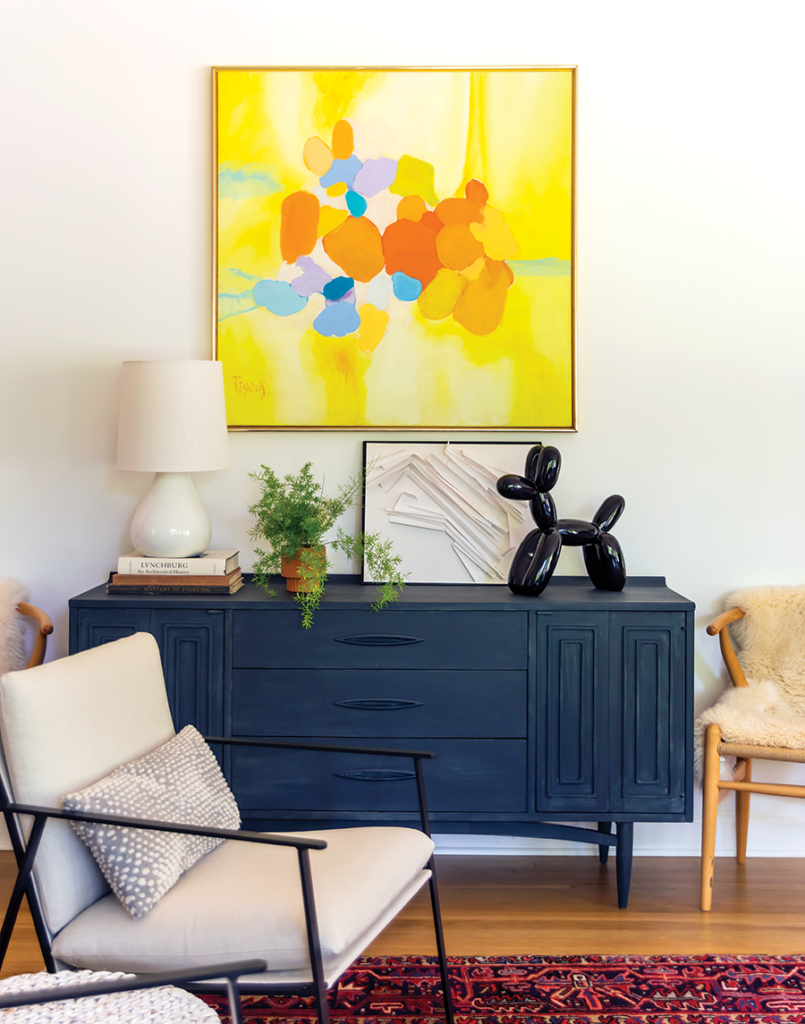
Abstract art is an art style in which an artist uses shapes, colors, and textures to create an image that’s not based on reality. Abstract art can take the form of a painting, sculpture, photography, design, or any other art form that doesn’t accurately represent a subject or object.

One of the most unique aspects of abstract art is that it’s always open to interpretation. A viewer doesn’t always immediately know what the piece is about—it is abstract after all—but over time, certain emotional or intellectual qualities can be seen in the piece that can make it uniquely special to the viewer.

Contemporary Art
In short, contemporary art is art that’s made today by living artists. Because of that broad sweeping definition, it’s an art style that is ever-evolving and often reflects the complex issues that shape our diverse and rapidly changing world.

While the art world is still debating what eras technically define the contemporary art style, most can agree that the starting point is the late 1960s or early 1970s.

Within the contemporary art style, more niche movements can be found. Pop art, photo realism, conceptualism, minimalism, and street art are all styles that can be explored if you want your home’s art style to make a statement.

Fine Art
Fine art is artwork that has been created for the sole purpose of being appreciated for its beauty and intellectual or emotional influence, rather than its function. Of course, with art being so subjective, what distinguishes something as “fine art” can be left to the interpretation of the viewer.

Within the fine art style, painting, sculpture, and photography can all be explored for your home. And while there are countless fine artists across different mediums and centuries, a few examples of visual fine artists are Rembrandt, Matisse, Van Gogh, Monet, and Degas.

Home Featured in Lynchburg Living January/February 2020. Photo by Heather Kidd

Determining Your Home’s Art Style
Your goal is to create a stylish and cohesive home, so it’s important to choose not only an art style that resonates with you, but also to find an art style that accents your existing home furnishings.

When you walk into an art gallery or store, have the space you’re hoping to find art for in mind. Maybe even have a photo or two on your phone to use as a reference. Know what the dimensions of the wall are, and the existing color palette of the wall paint, furnishings, and rugs.

From there, slowly walk through the art selections and pay careful attention to the art that evokes an immediate reaction. The old adage “I’ll know it when I see it” has never been more true when it comes to choosing art for your home. If you see a piece of art and it creates a feeling of excitement or positive emotion, it may be something you can work with.

This feeling of excitement and emotion may even help you eliminate the art styles that aren’t quite for you, making your future art shopping trips even easier.
After you’ve narrowed your selections down to the pieces that resonate with you, pull out your handy reference photos and measurements and consider how the piece will work within your existing space. Consider how the colors will play with each other, or how much wall space the piece may occupy. Consider the frame that it’s currently in—if it’s framed at all—and whether the style suits your tastes or if you’ll have to budget for a reframe.

It’s important at this stage to avoid talking yourself into an art purchase. Remember, art is a big investment in and of itself, so if you have to completely rework the rest of your space to accommodate your new purchase, it may not be worth it.

Your art style is a way to express your personality within your home. And just like with any other personal style, opinions can change over time. Allow yourself to continuously explore art of all styles by supporting local art galleries and artists. Learn the colors that strike an emotion, or the details that draw you in. Over time, your home’s art style will become even more honed and beautiful.