Muralist Andrew Williams has always been an artist. Born in West Palm Beach, Florida, Williams’ mother was a proponent of his connection with the arts from an early age.
“I had great access to art stores,” Williams remembered. “My mom would buy charcoal pencil sets and paper—I still have my first drawing pad. It started with charcoal drawings, and then I got into drawing Disney characters. From there, I transitioned to watercolor.”
That transition to watercolor was the first time Williams experimented with color—an experiment that led to his future as the muralist he is today. In 2016, Williams was contracted by The Draper Mercantile and Trading Company in Draper, Virginia, for a large-scale mural.
“I was good friends with the folks at Draper Mercantile and I had gifted the owner a watercolor of the building,” he said. “She offered to have me take a stab at the wall outside, which already had a mural on it, but it was faded. It’s a 160-foot wall and was the first mural I ever did.”
Photos Courtesy of Andrew Williams
The Draper Mercantile mural took three months for Williams to complete. The process began with sketches with pen and pencil on paper and then, once approved by the owner, the design transitioned onto the wall surface.
“While I was working on that mural, I was contacted by someone from Wytheville to do a 90-foot mural,” Williams said. “And it just kind of snowballed from there.”
In 2018, Williams’ muralist work brought him to Lynchburg when he was commissioned to paint a mural of Donkey Kong at The Water Dog. Then, just a few years later, The Water Dog team commissioned Williams to paint a large-scale sign for the entrance of Oktoberfest in downtown Lynchburg.
Photos Courtesy of Andrew Williams
“Dave [one of the owners of The Water Dog] wanted Donkey Kong, so that was pretty straight forward,” he explained. “But, as for the Oktoberfest sign, that was an incorporation of the logo mixed with German characters and beer. Dave pushed the envelope for me with the Oktoberfest sign because it opened up a different path to travel down and seeing the opportunities that can come with that. I’m excited to see the evolution of public art, and that’s what I’m trying to focus on for these next few years. I’m excited to see what’s next after murals for public art—what balances between a mural, a sculpture, etc. I’m excited to continue to explore the beautification of public events.”
Williams’ work keeps him traveling all over Virginia—hopping from one commission to the next. As of this writing, Williams has just finished a memorial for a WWII veteran and is currently working on a three-dimensional mural in Roanoke.
“I’m at the point in my career where I can find a wall that’s begging to be beautified,” Williams said. “I see a vision, and then I cold call it and pitch it. I’m not afraid to tackle any sort of project that someone may have. The more unique and the more crazy a project is, the more I want to do it. I’m not scared to push the envelope on some of these projects.”
A New World from the Old World
What the Revitalization of the Tutelo Language Will Mean for the Monacan Indian Nation
“A language is not just words. It’s a culture, a tradition, a unification of a community, a whole history that creates what a community is. It’s all embodied in a language.” – Noam Chomsky
Throughout its history, the Monacan Indian Nation has demonstrated astounding resilience in the face of obstacles orchestrated by those who wish to eradicate its identity. The Monacan community has not only overcome these obstacles, but has also utilized them as opportunities to reclaim and strengthen its identity time and again. To say the least, the journey has been arduous and the victories hard-won, but the Monacan people have continued to reclaim and revitalize the aspects of their identity that have been taken from them.
One such aspect is the Monacan language, Tutelo, which is in the process of being recreated, restored, and cataloged. The importance of language to a community’s identity cannot be overstated; when a community’s language dies, that community must then use the words—which, as Chomsky said, are never just words—of others to refer to itself. The Monacans’ reclamation of Tutelo is monumental, a fact made even clearer as one learns about the journey that led to this reclamation.
Hundreds of artifacts line the walls of the Monacan Indian Nation Ancestral Museum, from items found on Monacan land to those lovingly passed down through generations. The Museum is open Tuesday through Saturday from 10 a.m.-3 p.m. and on Sunday by appointment, and the entry fee is $5. Photos by Ashlee Glen.
The Monacan Indian Nation is headquartered on Bear Mountain in Amherst County, and its citizens are descended from Eastern Siouan groups from Virginia and North Carolina. The Nation’s efforts to attain state and federal recognition—which it did in 1989 and 2018, respectively—demonstrate the Monacans’ longstanding strength and ability to turn obstacles into opportunities.
In fact, the earliest documentation of Monacan presence in Virginia—documentation that was ultimately integral in the Nation’s achievement of federal recognition—details the capture of a Monacan man.
“The history of our people dates back to 1608 as far as physical, handwritten proof of us being here in the state of Virginia goes,” said Lou Branham, Director of the Monacan Indian Nation Ancestral Museum. “It goes back to a personal journal kept by Captain John Smith. He ran across a Monacan named Amoroleck, took him captive, and questioned him about the Powhatan Confederacy. This document was very important when it came to the Bureau of Indian Affairs and us getting federal recognition.”
In the 1920s, Dr. Walter Plecker enacted what Branham calls a “paper genocide” of Virginia-based Native Americans by eliminating the option to identify oneself as an indigenous person when responding to the census. Plecker, along with the Anglo-Saxon Clubs of America, persuaded the Virginia General Assembly to pass the Racial Integrity Act of 1924, which stated that it was illegal for whites and non-whites to marry, and which recognized only two racial classifications: “white” and “colored.”
“Plecker was in a position of power—he was the head of Vital Records and Statistics for 32 years—and he believed in eugenics,” Branham noted. “He thought that you were either white or you were colored; to him, no Native Americans existed.”
The Monacan Indian Nation’s original territory would have been the majority of the Piedmont area and parts of the Blue Ridge, even stretching down into modern-day northern North Carolina. Today, that footprint is much smaller. However, the land that the Ancestral Museum sits on is sacred to the Monacan Indian Nation and is now protected and preserved as a historical site. Photos by Ashlee Glen.
As a result, Monacan people who moved away—often to marry whom they wanted and to generally escape the rampant racism in the area—would frequently be unable to locate family members upon their return.
The United States Supreme Court overturned the Racial Integrity Act in 1967, thus allowing Native Americans in Virginia to marry whom they chose and to change their birth certificates—for a fee, until 1997—to accurately convey their identities.
“When we went for state recognition, we had to mail off our birth certificates,” recalled Branham. “If we hadn’t gone for state recognition, we never would have known that that documentation had been changed.”
Branham chooses to see Plecker’s contemptible actions as a catalyst in the Monacan Nation’s journey to fully reclaim its identity.
Lou Branham, Director of the Monacan Indian Nation Ancestral Museum. Photos by Ashlee Glen.
“I’m a firm believer that in our walk in life, we have ups and downs and many side roads that are taken,” she stated. “Plecker was just a part of the plan that happened to happen to the Monacan people.”
Branham’s father, Ronnie, started the Monacan tribe as an entity along with his first cousin and founder of the Monacan Indian Nation Ancestral Museum, Phyllis Hicks. Ronnie Branham was the first elected chief of the Nation, and Hicks was an ordained minister who pastored the church that resides on the Monacans’ seven-and-a-half acres of land alongside the tribal schoolhouse (once used as both a school and a community meeting space) and the museum.
Photos by Ashlee Glen.
“This land is the heart and soul of our community,” said Branham. “If you take this away, it’s almost like ripping a heart away from a body. The history of generations and generations of our family—of kids playing in the creeks and running through the woods, of people going to the church and the school and attending functions—is here. Here I promote no negative energy. Everything here is positive for me because this has always been a positive and peaceful place in my life.”
As the Monacan Nation’s recent federal recognition continues to open doors to various government programs—including a community health services program that will be open to Native Americans from any tribe and to community members who are Medicaid and Medicare recipients—the restoration of the Tutelo language has come to the forefront.
The process was initiated by the late George Whitewolf, who was a Monacan medicine man, in 2000. According to Branham, Whitewolf spent a great deal of time with the Lakota tribe and shared their language, Lakhota, with the Monacan tribe upon his return. These interactions prompted further research of Lakhota and other Siouan languages, and the Monacan people ultimately discovered that they spoke Tutelo.
The near-extinction of Tutelo resulted largely from colonization. Additionally, the last native speaker passed away around the year 2000.
“A lot of it had to do with colonization and eugenics,” Branham noted. “The United States’ political ideology of things is that they wanted to colonize Native Americans and make them conform to non-Native ways.”
Photos by Ashlee Glen
A group of historians and linguists, led by indigenous historian and language activist Dr. Marvin Richardson of the Haliwa-Saponi Tribe, is working with Living Tongues Institute for Endangered Languages to create a Tutelo-Saponi Monacan Living Dictionary. This online dictionary is accessible to the general public and continues to grow at a steady pace.
“We’ve got to recreate words and grammar,” stated Branham. “We’re currently working on creating words and phrases, but it’s hard to do the verbs right now. We actually have about 700 entry words so far, but by the end of 2023, we hope to have 3,000.”
For Branham, the revitalization of Tutelo is important on both a personal and a wide-scale level.
“When I was little, I remember my grandmother using certain words and phrases, and my father would say, ‘You can’t teach her that,’” she recalled. “My great-grandmother said, ‘If we spoke our language, we could risk having our homes burnt down.’ I think it’s a shame that you have to live in fear just because you have different cultural beliefs and speak a different language.”
As Branham continues to build bridges with community organizations to raise awareness of and garner support for the Monacan Indian Nation, she is excited to see the bridge between the Nation’s past and future become fortified by Tutelo’s return.
“It’s going to open up a new world from the old world,” she said. “It’s our old, traditional language, but to so many it’s going to be something that’s brand new.”
Artist Profile: Mitchell Bryant
Photos courtesy of Mitchell Bryant
Lynchburg Living Editor Megan Williams: You’ve been seriously pursuing photography since you were in the 10th grade; were you initially interested in adventure and landscape photography?
Mitchell Bryant: The outdoors was often the subject of a lot of those early photographs as I didn’t know what I was doing. I could practice by myself and learn with no real boundaries. I’d grab my camera, go for a walk behind our house, and shoot through a roll of film. Now, my love for the outdoors is a much more holistic endeavor. I love being in nature. My camera has become a faithful hiking/backpacking partner throughout the years and one that I lean on to retell the stories in vivid detail.
MW: Who or what has most inspired you, or driven you forward in your growth as a photographer?
MB: In the early parts of my career I religiously followed Jeremy Cowart. He had such a creative and innovative approach to image-making, while maintaining such a lovely balance of technical prowess and experimental creativity. I learned a lot from his images and continue to follow his work closely today.
One of my favorites to keep up with is painter and traditional artist Mark Maggiori. His method of reproducing massive landscapes with impeccable detail and visceral color leaves me scratching my head often saying, “How?!”
Another no-brainer follow is Chris Burkard.
Photos courtesy of Mitchell Bryant
MW: How do you approach your outdoor/adventure/travel photography? Do you set out with a specific vision in mind, or do you tend to capture moments that are more spontaneous or real-time?
MB: If I’m traveling to a new place, I’m like a kid seeing the world for the first time. Almost everything is image-worthy. I want to remember it all, and some of it might be considered art. When I return to a place, experience or environment that I love, I’m much more particular and premeditated. There are certain aspects of that adventure or that story that I want my viewers to experience and “remember” even if it’s something they’ve never experienced. That often involves wide context imagery, action/journey of some kind, and, of course, my layered, textured, patterned, artful landscapes.
MW: In your opinion, what makes a good photograph?
MB: Technically speaking there are rules, a prescription of aesthetics that you can follow, like many art forms, that are the “compositional elements of a great, technically sound photograph”. Those elements come together to create a well-structured, beautiful, pleasing image.
Great photography is found at the intersection of innovation, expertise, courage, and creativity—knowing everything you “should do” and daring to abandon that appropriately. My favorite images (and most art for that matter) transport us to another time and place where presence—the power of here and now—is visceral and transformative.
MW: Looking back at your work, what are some of your favorite photographs that you’ve shot? What makes them special to you?
MB: I’m big on Type 2 fun (look it up). Any images that help me recall a certain moment, adventure, or experience of course have a special place in my book. My wife can tell you I’m constantly scrolling through my phone looking through old photographs and laughing, or sighing, or saying, “Oh man look at this, wow that was 2015?!” It is absolutely one of my favorite things. My friends and family probably get tired of me taking over the TV so I can Airplay an image and tell them about what was going on again and again.
Also in terms of favorites or images that are special to me—anytime someone seeks out my work for a large print in their home or workspace—that is the ultimate compliment.
MW: Do you have any photos or styles that you want to explore? Where do you see your photography going from here in terms of subject and style?
MB: This is fun for me to think about. In the future I want to involve my family more. Photography can tend to be a solo venture. I want my boys in particular to find a love and appreciation for this world and a love and respect for all of nature’s beauty and the people within it. If I could bottle the reactions my boys have, their wonder and imagination running rampant, and pour that all over my images, I’d be doing just fine.
The work I want to focus on involves being outside more and more. There is a lot left to be explored in that regard.
I’m also working on having more of my images printed/installed on a massive scale, whether that be in retail spaces, custom residential builds, or hospitality projects.
Artist Profile: Jill Jensen
Finds Creativity in the Routine
Jill Jensen knows a thing or two about methodical problem-solving. With an educational background in material science and chemistry, Jensen spent the early years of her career as an engineer.
“Part of what I’ve learned in science training is that you don’t quit,” Jensen explained. “If the first thing doesn’t work, you come up with a solution and you keep going.”
When Jensen left her engineering role to start her family, she applied that same diligence to her other passion: printmaking.
“There is a rhythm [with printmaking] that comes into play,” she said. “Printmaking is process-oriented and there are multiple steps to get from the idea or image in your head to the final piece of work.
I like the process of methodically going through the steps of coming up with ideas. I draw the ideas out on tracing paper, so I can turn the paper over and transfer the image to a block. Then, I carve the plate.”
When Jensen creates her original designs, they are only contour drawings with no details, which allows her a bit of creative freedom to add elements as she works. As Jensen explores the possibilities of each design, she incorporates color pencil sketches within the print or will add embroidery or machine stitching to add even more texture and visual interest.
Photos By Ashlee Glen
Jensen’s printmaking has evolved over time to incorporate additional media largely because of her daily and weekly commitment to creating something every day.
“I have both a daily art practice and a weekly art practice,” she explained. “I make sure that I do some sort of artwork every day, usually a drawing in a sketchbook. I made the rule for myself that I can’t go to bed until I put something in a sketchbook—it may be pen and ink, pen and ink plus watercolor—but something has to be done every day. And then I have my weekly practice. I have the rule that between Sunday and midnight Saturday of that week that I must do a miniature art quilt. It can be related to something that happened that week—like a holiday or something—or an experiment in mixing colors or carving a new printing plate. It changes size each year, but it is the same size for the entire year. On the backside of each miniature quilt, I journal about what happened that week. Each one has a weekly number and then the date that I did it.”
Jensen has been committed to her weekly practice for 22 years, only missing her midnight deadline twice.
“If you stop, you lose momentum,” she said. “Knowing myself, I realize how important it is for me to make something, no matter how small it is. To keep the ball rolling.”
Jensen will be participating in a solo art exhibition at The Lynchburg Art Club for the entire month of January. Her work is available for purchase via jilljensenart.com, and she is currently accepting commissions.
Carving a Dream
How this Altavista Resident Built a Life Using Age-Old Art Techniques
Most Americans delve into an industry, work on average 40 hours each week for 40 years, then retire on 40 percent of their income. But master engraver Tim George of Altavista chiseled against that mold by mastering and selling a unique artform.
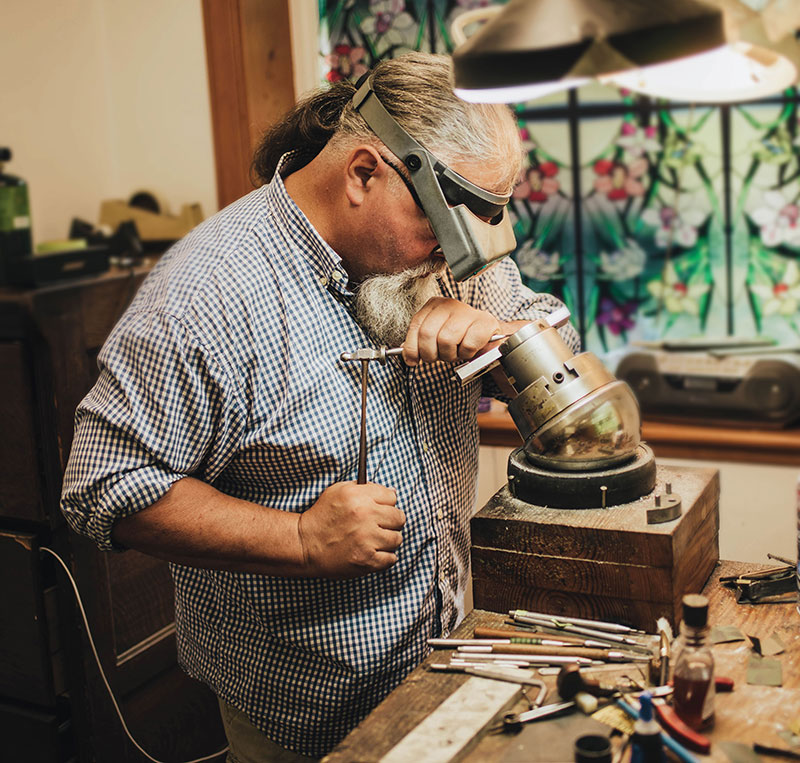
Every well-designed engraving you see in this story was done by hand. No fancy machinery like air utensils, high-end microscopes, or expensive engraving pens. Only tools made from small carbide steel drill blanks, countless hours of chisel practice and refinement, and a passion to master this ageless art.
The art of engraving is as old as time, but very few still practice the traditional hands-only techniques. Engraving is the art of carving initials, patterns, and picture art into an object’s metal components.
The industry rose to prominence in the 15th, 16th, and 17th centuries, and evolved further as time passed. Today, popular metal objects signatured with engravements include handguns and rifles, knives, and a wide variety of jewelry.
“What we do is so cool, and I just love it,” George said. “You’re in contact with the metal in a different way. This is closer to the way it was done thousands of years ago, going on back to cavemen carving images on the wall.”
According to the Firearms Engravers Guild of America (FEGA), where he is a member, George is one of 50 certified master engravers in the country.
For decades, jewelry, knife, and gun companies have commissioned George to engrave his illustrations and designs into exclusive and limited-edition products. George also extends his services to private clients, who pay upwards of tens of thousands for just one project.
Popular features of his art include 24 karat yellow gold, 18 karat green gold, and even rose gold, in addition to multi-dimensional layering and flush.
George has been commissioned by Ruger, Colt, and even William Henry, a jewelry company that sold one of George’s masterpieces for $57,000. His work has also been featured in magazines and other publications with national circulations, like Garden & Gun.
“Now that I’m older, I often reflect back on my career and wonder sometimes how the heck I made it,” George said.
“I was lucky in that I loved my job and really enjoyed creating something every day out of nothing. I also had, and still have, the ability to critique my work and be proud of it, but also to notice little things to improve on.
Most commissions begin with a sketch. Once approved, it may take George anywhere between a couple weeks to a year to complete one project, depending on size, features, and workload.
George’s love for art began with his grandparents. His grandmother on his mother’s side was a painter, and his grandfather on his dad’s side was a craftsman. Both of his daughters are also entrenched in the visual arts, one being a photographer, and the other an art teacher.
“I do think that art runs in people’s families,” George said. “This is the only thing I have ever done for a living, aside from being a ski mechanic. I like to have a flexible schedule.”
With art holding a special place in his soul, George looked for any opportunities to leverage this passion for a living. In 1981, George apprenticed under master engraver Ken Hurst, a former master for Colt Firearms. As Hurst’s company grew, George became his general manager and even trained new engravers. By 1987, large projects came to an end, so he and two other engravers formed their own company, Old Dominion Engravers, based out of Lynchburg. In 1990, as his knowledge and skill improved, George left the company to go solo—and he has never looked back.
“I still shake my head when I think back over my past,” he said. “I never thought about it much in my early days. I just wanted to learn as much as I could as fast as I could. I was trained to be a production engraver when I first started and was paid piecemeal, so I learned to be fast. Most of the better engravers that I know are fast and efficient, so that always helped.”
George works from the basement of his home. There’s nothing fancy about his 8-by-16-foot “office”—just a couple tables and tools scattered around the room. Several scratch marks blemish the floor, worn down by his chair.
Through it all, George is thankful for health, as his craft can become physically demanding.
“I never thought about it then, but I think about it now: I’ve never broken a bone. …If you’re cutting, you need to be moving your whole body,” he said.
George has coated his art onto some of the nation’s most expensive collectible guns, knives, and jewelry. People often ask him if he ever experiences apprehension while handling delicate, expensive weaponry. His answer is always the same: never.
Aside from engraving, George enjoys fishing, cigars and bourbon, and participating in the public square. He is on the Altavista town council.
“I loved growing up in Lynchburg,” he said. “I lived there for more than 30 years. I moved to Altavista about 22 years ago for family reasons and fell in love with this small town immediately. I love our parks, the YMCA, and the beautiful Staunton River that runs right through our town.”
George showcases much of his work through Instagram, where he shares photos of current projects and even videos of him at work.
“There are very few of ‘us’ that still basically use the hammer and chisel method in the US,” he said. “I know lots of engravers that I admire that use the new modern method—air-assisted tools in conjunction with microscopes. They do incredible work. I guess I just like the way I learned the best. I like antiques and feel pleasure doing what I do the old-fashioned way.”
For more information, visit George’s Instagram profile @timgeorgeengraving. To learn more about his portfolio, visit his website www.timgeorgeengraving.com.
Artist Profile: Hanna Burnside
Legacy Keeper Artist Hannah Burnside Is Keeping a 700-Year-Old History Alive
PHOTOS BY ASHLEE GLEN
In August, tattoo artist Hannah Burnside woke up in Jerusalem. After long layovers, even longer flights, and hassles through airport security, she walked through the streets of the Christian Quarter and found herself in front of a solid metal door. On the door, no other markings were clear besides a phone number written in permanent marker.
“I called the number and this dude just rolled up in an old Harley,” Burnside, a Savannah native who has been living in Lynchburg since college, recounted. “His leather jacket had ‘Holy Land Bikers’’ on the back, which is a Christian biker club in Jerusalem.”
Stepping off of the bike was Wassim Razzouk, a 27th generation tattoo artist and the current owner of Razzouk Tattoo.
PHOTOS BY ASHLEE GLEN
For the week following that phone call from the crowded streets of the Holy City, Burnside worked alongside the Razzouk family, learning their tattoo styles and, more importantly, the legacy that they represent.
“The Razzouk family immigrated from Egypt 700 years ago and followed a similar path to Jerusalem that folks take on pilgrimages to the Holy Land,” Burnside explained. “To commemorate their pilgrimage, people would get a tattoo of a particular saint or something that represented the pilgrimage. If they returned, say a year later, they would get the date tattooed underneath the original tattoo. So, some people would have dates stretching down their arm that marked their annual pilgrimages.”
Wooden carved stamps were used as stencils for the tattoos—stamps that are still used some 700 years later at Razzouk Tattoo.
PHOTOS BY ASHLEE GLEN
“There are some stamps at the shop that they believe are older than that,” Burnside said. “But they just can’t date them back that far.”
During her apprenticeship at Razzouk Tattoo, Burnside immersed herself into the culture and worked tirelessly alongside the Razzouk family as they helped people memorialize a significant journey.
“One day, we had a group of 20 or 30 Armenian pilgrims come by the shop and ask for cross tattoos to mark their journey,” she said. “It was really cool seeing all of these groups who have different takes on religion, but whether they were Christian, Jewish, or any other religion, Jerusalem marks the Holy Land for all of them. Knowing that they all didn’t believe the exact same thing, but still gathered for the same goal, was really beautiful.”
Despite the language barriers—folks travel from all over the world to get tattooed at Razzouk—Burnside noted that she still found such deep bonds with the people she was able to tattoo.
PHOTOS BY ASHLEE GLEN
“They have full trust in you even though you can’t understand each other,” she explained. “That’s a really powerful thing and a really amazing experience to have.”
That level of trust is something that Burnside has worked to cultivate since she began tattooing in 2020. A tattoo apprentice at Caspian Tattoo in Lynchburg, Burnside puts a big emphasis behind comfort and trust with the people she tattoos.
“I understand that a lot of people come into the shop with body image issues, or not loving a certain part of themselves and I just want our time together to be a time of complete ease and confidence,” she said.
PHOTOS BY ASHLEE GLEN
After returning home from her Razzouk Tattoo apprenticeship, Burnside is now an official Razzouk ambassador, which means she is in possession of some of the antique tattoo stamps and has expressed approval to tattoo those designs in Lynchburg. As one of only nine current ambassadors—all of whom are situated around the globe—this is an incredible privilege and honor.
“I even had the opportunity to design my own stamp before I left,” Burnside explained. “So now my stamp sits in the shop at Razzouk and they will tattoo my stamp for folks all over the world. And I can tattoo it here in Lynchburg, as well.”
Burnside shared a Ram Dass quote that she felt was particularly poignant in commemorating her journey to Jerusalem—her own pilgrimage in a way. “The quote is, ‘We are all walking each other home.’ I can’t think of a better way to describe what this experience has been like, or what these tattoos mean, than that.”
Artist Profile: Bosco Bae
Grief Work AND the Art of Intention
Potter Bosco Bae blends emotion and clay
Imagine having the opportunity to grab ahold of your grief—to shape it, swipe it away, and turn it into something durable and beautiful. Potter Bosco Bae’s most recent series, called Grief Work, is exploring the different forms that grief and healing can take.
“A lot of my work nowadays is trying to capture grief and work through the myriad of emotions involved with love and loss. The work can get pretty dark, but I try to remain true to the idea that there is meaning and beauty within struggle, within hardships, and imperfection,” Bae explained.
Potter Bosco Bae
While the acceptance and celebration of imperfection is something that Bae, a Ph.D. and professor of Religion at University of Lynchburg, has been exploring artistically for years, the expression of that has shifted since the passing of his brother last year. Bae takes inspiration from the moon jar, which is a Korean form in ceramics and traditionally combines two symmetrical bowls to create one large vessel. While the two bowls individually are perfect, they come together to create an asymmetrical, imperfect union. Traditional moon jars feature a white glaze and a very thin base, which make the vessel look like it’s floating—like a moon. “It’s minimalistic yet sophisticated in its evocation of a calm and serene ideal,” said Bae.
But he takes the form a step further.
“The moon jar, in its traditional form, is romantic, normative, ideal. My work aims to be a bit more descriptive, flawed, messy—to allow suffering to speak and find expression,” he said. “How does a form retain, embody, or convey lament?”
One of the first pieces that Bae created in his Grief Work series began with the moon jar form. Using his hands, Bae tore a hole through one side of the vessel to exemplify a piece of him that is now gone.
“After that part of the vessel was ripped out, I went to the other side and started taking pieces out to patch the hole.
When that patch was mended, of course, another hole emerged on the other side. I then started digging into the bottom and scraping out any clay I could use to patch up the side that was given up to mend the first hole” Bae said. “So, in this particular piece, you’ll see where I’ve scraped from the bottom.”
In another piece from the Grief Work series, Bae began with a moon jar, cut it apart, and reassembled it.
“After deconstructing the piece and breaking it down, there was an active attempt to try and put the pieces back together—to go back and recreate what it was before breaking down—kind of like drawing somebody from memory,” he explained. “But during that process it changed and it was clear that the reconstruction wasn’t going to be the same. The vessel was transformed into something else with only traces, shadows, or memories of what it was before.”
Metaphorically, the piece showed just how different a person can be after grief, trauma, or hardship.
“All the pieces in this series begin with the moon jar form, thrown as a singular piece, as opposed to combining two.
The piece is then altered, stressed, and it endures—sometimes it doesn’t—and accepts the distortions, rips, and unanticipated irregularities that emerge from the process. I think a lot of the uncertainties and unintended consequences from the intentional moves and gestures I put into the piece make it interesting, perhaps, even difficult, or uncomfortable to look at,” Bae said. “Grieving is an uncomfortable process in which bracketed realities can intersect and break into the forefront of our consciousness at any given moment. Grappling with difficult truths is a process of reconciling with a dissonance that jars against tacit presuppositions about ideals and expectations, whether we acknowledge them or not. Sometimes, words are insufficient and talking about it isn’t always the best way to express ourselves. Being intentional through nonverbal forms of expression can be just as, if not more, relevant in the healing process.”
This level of intention—of dissecting an emotion or experience—is what encapsulates Bae as an artist. Whether he is throwing teapots or mugs with perfect, ergonomic form, or exploring just how beautifully imperfect a piece can be, Bae reverently approaches each piece and accepts it exactly the way it is.
Nina Simone once said, “It’s an artist’s duty to reflect the times,” which is a charge that Bae has fervently accepted. While his most recent body of work reflects his current experience of grief and healing, the journey isn’t over and his art will surely evolve again.
One thing is certain, however—it will be beautiful.
To connect with Bosco Bae, find him on Instagram at @potsbosco.
Photos by Ashlee Glenn
Art, But Make It Punk
Lynchburg’s Punk Rock Flea Market Creates a Beautiful Community
Walking into Three Roads Brewing on a Sunday at 3 p.m. is like walking into a family reunion. Everyone is catching up, the beer is flowing, music is playing. You hear, “Market day, baby!” muffled in the background amidst the chatter and clinking of glasses, and you realize that this isn’t a family reunion at all (or is it?). It’s an art market.
Kaleb Gay is the man behind the curtain of this joyous, and sometimes chaotic, scene.
“You want people to stop and wonder what is happening, and then realize that it’s good,” Gay said, almost with a renegade glimmer in his eye.
And stop and wonder is what people do. The LoveLYH Flea Market is Lynchburg’s very own punk rock flea market. From Seattle to Philadelphia punk rock flea markets have been popping up in cities across the country for years, so it was only a matter of time before one came to Lynchburg as well.
While Gay is the current maestro of the weekly market—home to artists, makers, crafters, musicians, and folks hoping to make some cash from their unwanted clothes and housewares in true flea market fashion—Katy Wetzel is the one who brought the concept of a punk rock flea market to Lynchburg.
“I’m originally from just outside of Philadelphia, and I came to Lynchburg to attend Randolph [College]. I had the opportunity to go to a punk rock flea market in Philly, which is a twice-annual thing,” Wetzel explained. “There are punk rock flea markets all over the country and it’s an opportunity for people to just sell stuff if they’re cleaning out their garage, but it’s also a space for makers and artists.”
After Wetzel moved to Lynchburg and got connected with her own network of artists and makers, she knew that Lynchburg had the type of creative community to support a flea market of its own. Dave Ellis, owner of Dish in downtown Lynchburg, offered up the patio and parking lot of Rendezvous, his former restaurant on Main Street across from Dish, as a free spot to host the market.
“Dave is someone who is supportive of all sorts of different cultural happenings in Lynchburg,” Wetzel said. “He’s always all about supporting folks. I wouldn’t have initiated the flea market if I didn’t have the space, and Dave was able to provide that.”
With the venue nailed down, Wetzel knew she needed a partner to help organize and promote the flea market.
“Kaleb was the first person who came to my mind. He’s a maker at heart and an artist,” Wetzel said. “I couldn’t imagine a better person to talk to about starting something like this.”
Photos by Ashlee Glenn
So, in 2019, the first Lynchburg punk rock flea market was born. Vendors set up tables and tents in an empty parking lot, selling handmade zines, artwork, and clothes. Fast forward three years, and the flea market has grown by leaps and bounds.
Now the flea market has found its home at Three Roads Brewing, where Gay is also a bartender. Having a larger indoor/outdoor space has allowed the flea market to open itself up even further to makers, artists, and musicians.
“It was another opportunity from another wonderful friend,” Gay explained, speaking of former Three Roads manager Molly Fusco, who offered up the Three Roads space in August of 2020.
It’s that sort of mentality—folks stepping up and helping out—that truly encapsulates what makes the LoveLYH Flea Market so special. Wetzel’s and Gay’s vision for the market has always been to keep it as accessible as possible, which is why there are zero fees or costs to have a table or booth space on Sundays. Artists don’t need to sign up or commit to coming long term, they simply need to have something that they want to sell and show up.
“I want people to understand that it’s a free place to set up. You don’t have to be an established arts and crafts person. I’ll probably take a Sunday soon and sell my excess garden tomatoes,” Wetzel said of the free-flowing structure of the market. “It’s a space for all, and it’s so cool that there is no charge for a table or anyone cutting into people’s sales for anything.”
“I see people coming here sometimes who are out of work right now, or struggling financially, and they have an opportunity to sell their stuff and make some income,” Gay furthered. “There’s something to someone showing up and seeing that, ‘You know what, someone just liked my stuff enough to buy it.’ and then they keep doing it and coming back each week.”
That feeling of pride—and of bravery to show up and put yourself out there in the first place—is palpable every Sunday at the market. Rain or shine, folks are able to display their work and make life-changing connections with others.
“The market has been a miracle for me,” said Kat Newcomb, who makes and sells jewelry made with precious and semiprecious stones. “I moved to Lynchburg right before everything shut down [for COVID], so I didn’t know anybody and I hadn’t been anywhere. Kaleb kept telling me that he had started this market, and that I needed to come for a visit, so I showed up, and it quickly became something that I looked forward to every week… . This was my haven every Sunday. I started to meet people. I’ve met so many people who are now my support system. I credit Kaleb and I credit the market for that.”
Newcomb also brings her 8-year-old son with her to the market on Sundays, which has done wonders for his confidence as well.
“He has started doing the singer/songwriter showcase on Sundays,” she said. “Everyone has been so encouraging of him. The round of applause that he received the first time he performed just encouraged him to keep going. He’s getting into music because he has gotten so much encouragement from folks at the market. He’s been so brave, and it’s been a journey for him as well.”
When you experience the LoveLYH Flea Market, you get a sense that maybe it’s not about the art at all—it’s about the connections that you can make. The flea market is an opportunity to meet folks from all walks of life, and share a conversation and a beer with them. The art just happens to be the icebreaker to those conversations.
“We’re a social gathering exploring the limits of community,” Gay said. “It’s a bit more corybantic than your standard or structured market. It leaves a nice amount of wiggle room for expression—and that’s what we all could use a bit more of.”
Folks looking to sell their wares, or simply shop at the LoveLYH Flea Market, can visit Three Roads Brewing on Court Street every Sunday from 3 p.m. to 6 p.m. Follow @lyhpunkrockfleamarket on Instagram for updates.
Little Town, Big Talent
Little Town Players Continues to Shine a Spotlight on Bedford with Topnotch Productions
Beloved community theatre nonprofit Little Town Players has been making a big impact in Bedford—and beyond—for nearly 50 years, and it will undoubtedly continue to do so in the future. With its rich and decorated history, generous and talented volunteers, and commitment to presenting dynamic and high-quality productions, LTP is a triumphant testament to the power of close-knit communities.
“Bedford is thought of as a tight-knit community, and Little Town Players is very much a tight-knit community as well,” says LTP Board President Lisa Butler.
Little Town Players’ story began in 1975 with a group of enthusiastic thespians, many of whom were members of St. John’s Episcopal Church in Bedford.
PHOTOS COURTESY OF LITTLE TOWN PLAYERS
“At that time, there had not been any local theatre in Bedford for at least two decades,” Butler notes. “Roy and Karen Thorpe led a production of Our Town at St. John’s. Karen directed the play, and the majority of the cast was comprised of the church congregation. The show was a great success, so LTP officially began in 1976 with its first season of shows.”
Shortly thereafter, Little Town Players gained 501(c)(3) status and brought on its first Board of Directors. The Board originally had seven members, and now it has nine. The organization also found its permanent home at a former movie house.
“Somebody at the church found out that there was an old movie house that was not being utilized on the campus of the Elks National Home,” Butler recalls. “LTP has had a home in that space, which is called the Fred Harper Theatre, ever since. We have a great working relationship with The Elks: A Noble Senior Living Community.”
PHOTOS COURTESY OF LITTLE TOWN PLAYERS
In 1983, a historic honor solidified Little Town Players’ status as a top-tier theatre organization: then-President Ronald Reagan awarded LTP a Volunteer Action Award for the Arts and Humanities. The Volunteer Action Awards were designed to honor outstanding volunteer achievements. In 1982, more than 2,000 groups were nominated nationally for 20 awards in 10 categories.
“In addition to having fantastic volunteers, I think that LTP was chosen for the award because of our ability to make the most of our fairly limited resources,” Butler says. “For instance, if we needed a stove for a production, we would get a cardboard box that a stove came in from a local electric company and paint it to look like the real thing. We’ve certainly come a long way!”
The Fred Harper Theatre specifically has come a long way thanks to many improvements over the years.
PHOTOS COURTESY OF LITTLE TOWN PLAYERS
“We took the booth area from the former movie house and turned it into a booth for our sound and light controls,” notes Butler. “We’re working on getting all of our lights switched over to LED lighting, we’ve recovered our seats, and we’ve added lights above the stage. We’ve also built dressing rooms, installed heating and air conditioning, added bathrooms downstairs for the cast, and enclosed the lobby. We are able to use the space rent-free, so we do whatever we can to help the Elks continue to remain vibrant. It’s an ideal partnership.”
Since it was founded, Little Town Players has presented a wide variety of productions including Driving Miss Daisy, The Sound of Music, Fiddler on the Roof, Cat on a Hot Tin Roof, A Christmas Story: The Musical, Steel Magnolias, A Streetcar Named Desire, My Fair Lady, The Secret Garden: A Musical, and many more. Butler’s personal favorites are The Wizard of Oz, in which she portrayed Dorothy, and Always… Patsy Cline, in which she portrayed the titular character. See the sidebar for LTP’s upcoming lineup of productions.
Although LTP presents shows with apparent ease, a great deal of behind-the-scenes work goes into each production.
PHOTOS COURTESY OF LITTLE TOWN PLAYERS
“We have a play-reading committee that consists of six to 10 people,” Butler says. “Each person brings suggestions of productions within three different categories: musicals, comedies, and dramas. We typically start out with 60 to 70 possibilities. The committee starts discussing pros and cons of each of the shows: the feasibility of building certain sets, whether or not patrons are likely to enjoy the production, how difficult the production would be to cast, etc. Once the committee limits the choices and votes on a slate, they present it to the Board for approval. The whole process generally takes five to six months.”
The members of that committee, Board members, actors, and a myriad of others involved in each production are volunteers. Directors, music directors, and choreographers receive small stipends.
“Without volunteers, LTP simply would not exist,” Butler remarks. “We are very lucky to have so many wonderful volunteers. Anyone can get involved by checking out our website and filling out our volunteer form. We can always use stage managers, light and sound workers, costumers, set designers, builders, painters, ushers, box office assistants, play-reading committee members, and more.”
According to Butler, LTP has a dual primary mission.
PHOTOS COURTESY OF LITTLE TOWN PLAYERS
“Our mission is to both entertain and educate our audiences through theatre,” she says. “You may not think you’ll be entertained by a production that is laden with facts or educated by a comedy, but we aim to make those things happen. My mission as Board President is to ensure that all that is done within our theatre is done to uphold and support LTP’s mission and to ensure that LTP is around for generations to come.”
Little Town Players offers an annual scholarship to encourage involvement among young people in its and other organizations’ theatre programs.
PHOTOS COURTESY OF LITTLE TOWN PLAYERS
“For over 20 years, we’ve offered a $1,000 scholarship each year to a Bedford County graduating high school senior,” notes Butler. “Preference is given to graduating seniors who have been involved with Little Town Players, but it is not a requirement. The student needs to be very involved with theatre, but they do not need to be pursuing a theatre degree.”
There is no doubt that community is the cornerstone of Little Town Players. Butler, who met her husband through the organization and was involved in LTP’s production of Little Women: The Musical with her husband and two of her children, believes that anyone who gets involved with LTP will find a home away from home.
PHOTOS COURTESY OF LITTLE TOWN PLAYERS
“Little Town Players is truly like a family,” she says.
“For us, community theatre is all about getting together and having fun while making beautiful art that is representative of our community.”
UPCOMING LITTLE TOWN PLAYERS SEASON Shows are presented on Fridays and Saturdays at 7:30 p.m. and Sundays at 2:00 p.m.
The Mousetrap Sept. 9-18, 2022
Blithe Spirit Nov. 4-13, 2022
12 Angry Men Feb. 24-March 5, 2023
Little Shop of Horrors May 12-21, 2023
Art Across the Ages
Lynchburg Art Club & Gallery Continues to Preserve—and Make—Local Art History
As I toured the Lynchburg Art Club & Gallery’s headquarters on Rivermont Avenue, I was struck by the balance between tradition and innovation and by a sense of nostalgia alongside a sense of excitement about what the future of art could look like in Lynchburg. Founded in 1895 and still going strong today, the Lynchburg Art Club is both a steward of Lynchburg’s rich visual arts history and a leading player in building its future.
LAC’s permanent collection, which currently consists of over 90 paintings, features the work of LAC members past and present and serves as an account of Lynchburg’s visual arts history. “We have the responsibility of restoring, preserving, and protecting that incredible body of work,” says Jennifer Staton, Manager of the Lynchburg Art Club. “The way I see it, we are the ones who get to tell the stories of the brilliant and forward-thinking founders who, really just as the Civil War was ending, recognized that it is the arts that bring communities together. Lynchburg truly was so far ahead of its time and an arts and culture mecca of sorts then.”
The oldest pieces in the permanent collection are those created by the founders: Bernhart Gutmann, Louise Jordan Smith, and Georgia Morgan. Gutmann was the first supervisor of art in the Lynchburg Public Schools, Smith was once head of the art department at Randolph-Macon Women’s College (now Randolph College), and Morgan was once chair of the art department at Lynchburg College (now University of Lynchburg).
“The permanent collection is used as a teaching tool for our members and the community to study, appreciate, and learn from these accomplished pieces of original art from our talented members,” says Kelly Mattox, President of LAC. “To be featured in the collection, a work has to be an original piece of art, it has to have been done by a member of the club, and it has to be in good to excellent condition. We also need the artist bio, any accolades they accomplished in their medium and artistic career, and information about the donor if they have a connection to the artist.”
The permanent collection is one of many things that found a permanent home when LAC purchased the 1011 Rivermont Avenue building and became incorporated in 1961. “We finally had a permanent home for monthly exhibits, lectures, large classroom space, special events, dinners, receptions, and First Fridays openings for the community to enjoy,” Mattox notes. “It became a destination to experience the arts in Lynchburg.”
Monthly exhibits are organized by an exhibition committee. This committee creates an annual calendar that highlights a wide variety of styles and mediums and features the work of a diverse group of artists. Exhibits often have overarching themes; for instance, a STEAM-themed show happening this September will highlight Lynchburg’s long history as an engineering and design hub.
LAC’s classes and workshops are selected by the volunteer education committee, which is led by Carolyn Prince. This committee chooses the classes, instructors, and formats based on feedback and requests from LAC members and from the general public. Both member artists and guest artists are invited to teach. “One class that has a very loyal following is Ron Boehmer’s ‘Theory and Practice of Drawing and Painting,’” Staton notes. “The class sees new students join each eight weeks or so but there is definitely a core group. I love to be in my office on Tuesday mornings when they are meeting. Ron is incredibly gifted and has created a great atmosphere where everyone is so encouraging of each other, and the works that his students produce are just spectacular.”
Additionally, the club’s event calendar, which can be found on LAC’s website, is always full of exciting options. On May 14, LAC will hold an event called “Plein air painting of a landscape with roses in oil” at Old City Cemetery. The roses will be in full bloom, and artist Julia Lesnichy will demonstrate the technique of painting these delicate flowers. On June 6, Georgia Morgan Civic Art Show winner David Eakin will be conducting a special gouache workshop. A date for the 49th autumn Lynchburg Art Festival at E.C. Glass High School will be announced in June.
For more than 20 years, the Lynchburg Art Festival has funded four scholarships for rising high school seniors from Lynchburg who major in the arts for their four academic college years. LAC also works with Beacon of Hope to help students in need. “As part of our outreach mission to the community, we have partnered with Beacon of Hope for their ‘Art for Achievement’ fundraiser for a few years,” says Mattox. “Lynchburg Art Club members paint over 100 paintings to be auctioned at their gala event. It is such a rewarding experience to generate the funds that will assist students in need with their future education.”
Mattox, who moved to Lynchburg from Richmond, believes that Lynchburg is a can’t-miss art destination for several reasons. “I was so impressed with the large number of artists who are so incredibly talented in Central Virginia and who were so helpful to me when I arrived,” she says. “I think Lynchburg stands out in Central Virginia because it has colleges that have degrees in visual arts programs and their own collections: The Maier Museum of Art at Randolph College, the Daura Museum of Art at University of Lynchburg, and Sweet Briar College’s Art Gallery.”
LAC has also helped make the Rivermont area a hub of creativity. “Along with Point of Honor, Lynchburg Art Club serves as the arts and culture anchor to this area of town,” says Staton. “LAC has shown that lower Rivermont is a safe and beautiful area that is worthy of preservation. We are excited to be the visual arts center of this up-and-coming pedestrian and biker-friendly area of town.”
Lynchburg Art Club & Gallery is undoubtedly an integral part of Lynchburg’s art culture and history. Its staff’s dedication to growing and evolving while also honoring and preserving the past points to another century—at least—of esteemed service.
“We are one of the oldest nonprofit volunteered membership art clubs in America,” notes Mattox. “This history is so valuable. Of course, we always need to change with the times and add more diversity of classes, develop more outreach programs and partnerships, welcome new members, and embrace all social media outlets. We encourage everyone to visit and celebrate our past and experience our future.”