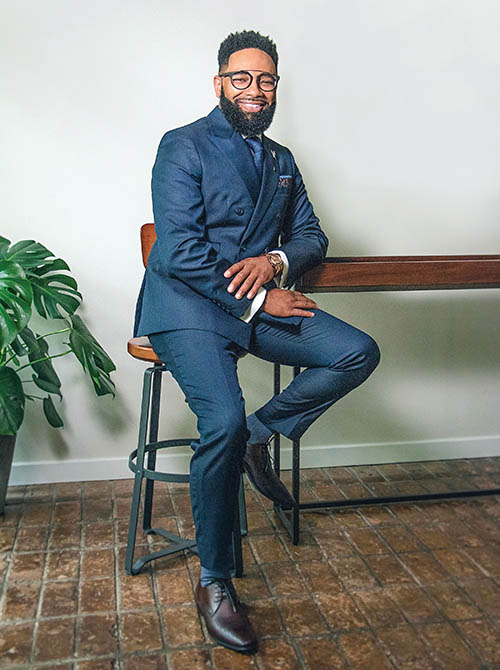
Artist Profile: Delmus Phelps

Delmus Phelps’ Contagious Joy in Flowers: The Art of Offering Healing Through Paintings

By: Emeri Glen | Photos by: Ashlee Glen

Settled next to a small garden and near the nesting spot of a neighboring doe, Delmus Phelps’ red studio sits neatly. It’s filled with natural light from its several windows and, covering the wall opposite the entrance, still moments captured on canvas. One of these pieces recreates Phelps’ son looking out over a valley, trying to discern which path to take following his graduation from high school. Another is of a colorful giraffe playfully sticking its tongue out. But most of these poignant pieces are flowers.

Somewhere between 2007 and 2008, Phelps was walking along a street with his son when he chanced to see a marvel through a storefront window.

“I saw the painting, from the street, through the gallery, all the way in the back… That [the positioning of the painting] was done on purpose,” he recalled.

Phelps had glimpsed an unusually large, detailed painting of three blooms. Despite his son’s chuckles, Phelps left his walk to go search through the gallery for the piece. After winding through the maze of paintings to the end of the gallery, he finally was able to properly appreciate what he’d seen from the street, and thus Phelps, immediately falling in love with this style of artistry, began to paint flowers.

artist profile Delmus PhelpsPhelps, born in Germany, raised in the United States, and well-traveled, has experienced a wide range of what this life has to offer. He is acquainted with both great joy and heavy grief, and seeks to represent these experiences in his art. Phelps’ family deemed him “the artist” amongst their bunch when he was young, and he has been painting impressive pieces for decades.

Following another stint in Germany, where he was stationed with the Airforce, Phelps’ returned to the United States with his growing family in tow and began to hone his passion. His oil on canvas pieces include familiar locations around Lynchburg, landscape, still life, and everyday objects, but his main focus is on flowers and their beauty.

Phelps spoke of a study conducted by California University where individuals were gifted flowers.

“Their face typically lights up,” he said. “People are really happy when they see flowers. … And I’ve asked customers who’ve bought my paintings, ‘Well, what was your main reason?’”

These customers’ reasons were primarily in keeping with the results found by the study; flowers bring joy, and Phelps paints them well.

Some of the themes that permeate Phelps’ work are that of healing and not worrying oneself over circumstances that aren’t within one’s control.

The yellow swallowtail butterfly serves as a spiritual reminder to Phelps that everything will be ok, and he mentions that it makes appearances in many of his paintings. Encompassing these themes is the common, meaningful need for beauty in the form of art. Phelps spoke about how his customers recognized the grief in his paintings, and this shared meaning helped them to find commonality in beauty and understanding.

“I guess the main thing is… You need art in your life, and it’s healing, especially flowers,” he said.

Phelps continues to offer healing in the form of his empathy and painted blooms. To read more about his story, visit his website www.delmusphelps.com.


A Feather in His Cap

Greg Starbuck’s Remarkable Experience as a Historical Headwear Hobbyist

By: Emily Mook | Photos By: Ashlee Glen

If you know—or at least know of—Greg Starbuck, you likely already know that he wears many hats. If you don’t, however, he would simply like for you to know that he makes them. Starbuck has been creating authentically reproduced 19th century headwear, specifically Civil War kepis, for more than 40 years, and his experience doing so is like something out of a Hollywood movie—or, as it were, something in multiple Hollywood movies.

Starbuck’s early interest in American history paired with his early exposure to sewing made him ideally tailored for his eventual—and highly fruitful—hobby as a kepi creator.

“I grew up with a mother who was into quilting, so I grew up surrounded by sewing machines and fabric,” he remarked. “It was not an unfamiliar domain for me.”

Starbuck made his first cap at the tender age of 13, but the hobby really took hold during his time working at a historic Civil War site in Georgia in the 1980s.

Greg Starbuck“A big part of our programming involved people dressing up in uniforms,” he recalled. “Back in those days, you couldn’t just go online and order historical gear, so some of my colleagues and I would get together and sew things ourselves.”

Starbuck soon realized that he had a particular affinity for creating kepis.

“As time went on, I gravitated toward Civil War headgear because the pieces are distinctive and attractive—and small!” he said. “Making the headgear also entails working with fabric and leather, and I like working in both of those disciplines.”

According to Starbuck, the kepi is “ubiquitously associated with the Civil War,” but it actually originated in France. America adopted its style for the Civil War, and many other countries—including Japan, Mexico, and Germany—also adopted its style in the 19th century. With its easily identifiable shape and style, the kepi is undoubtedly an iconic historical artefact.

Starbuck’s ability to honor the kepi’s rich history while innovating and improving his creative process makes him a master in his field.

“The techniques, materials, and equipment I use have all evolved over time,” he said.

“Even though I’ve been doing this for more than 40 years, I’m still always learning.

It’s fun to discover new things. I may have done something a certain way for 20 years and then learn a new approach that’s easier and also produces better results. I’ve gotten more economical and streamlined over the years.

It’s natural to evolve and improve when you do the same thing for this long!”

Of course, innovation sometimes entails an enhanced aptitude for authentically replicating techniques of the past, as is the case with the fabrics Starbuck uses for his kepis.

“In the early days, I would just go to the fabric store and buy fabric, but now there are a lot of places that specialize in producing fabrics exactly the way they were produced in the 19th century,” he remarked. “They will weave the fabrics on looms and dye the fabrics with vegetable dyes rather than modern dyes.

The materials now are much more exciting to work with because they replicate what was used back then so well.”

From start to finish, Starbuck’s kepi-creating process runs like a well-oiled machine.

“I keep a pile of fabric and leather on hand,” he stated. “When I need to make something, I simply pick the right pattern out—I have 30 to 40 patterns—trace it, cut it out, assemble the basic framework by machine, and then hand-sew the rest. I then hand-sew the leather components like the visor and sweatband. I also have a supply of buttons on hand because each cap has a button on either side. I’ve literally accumulated thousands of buttons over the years! There’s also some ironing involved.”

As luck would have it, Starbuck took on another hobby in and beyond the 1980s that would ultimately help catapult his kepi-making hobby to A-list Hollywood heights: acting as a TV and film background extra.

“The 1990s and 2000s were a sort of golden age of historical movies, and I got to work on several of them as a background extra,” he recalled. “They [movie crews] typically use the same 40 people and just dress them up differently for different scenes. Being an extra got me slightly into the Hollywood network.”

Among the films Starbuck has appeared in are Ironclads, The Broken Chain, Tecumseh: The Last Warrior, Forces of Nature, The General’s Daughter, The Hunley, and the hugely successful and acclaimed The Patriot. He can be seen playing a squeezebox in a bar scene in The Hunley and playing a fife in the Charleston British headquarters scene in The Patriot.

Greg Starbuck

Starbuck’s first major motion picture costuming experience was as a props assistant on Gettysburg in 1993. He cites his first big costuming break as 2003’s Gods and Generals, saying that “the costume designer for that film was a history friend of mine, and he called me to see if I could create the headwear.” He designed and produced more than 80 pieces of principle headwear for all lead actors in the film including Stephen Lang, Jeff Daniels, C. Thomas Howell, and Bruce Boxleitner.

2003 proved to be a banner year for Starbuck; his next project was the blockbuster smash Cold Mountain. He both designed and handcrafted Civil War headgear for Jude Law and other actors and served as an advisor to the costume department.

Since 2003, Starbuck has worked on over a dozen film and TV projects, most notably 2012’s multi-Oscar winning, Steven Spielberg-helmed Lincoln.

“I did four caps for Spielberg’s Lincoln,” noted Starbuck. “They said they needed one of the caps by a certain date, but then they contacted me and said they needed it sooner for rehearsals in Baltimore because Spielberg wanted everyone to rehearse in full costume. I told them that even if I finished it that day and shipped it the following day, it wouldn’t make it in time, but they said, ‘No problem; we’ll send someone to pick it up.’ So, someone came and picked it up and drove it to Baltimore.”

Regardless of the size, scale, and commercial success of—and personalities involved in—Starbuck’s many projects, he says that every experience has been his favorite.

Greg Starbuck

“The energy, enthusiasm, and adrenaline rush on a movie set is unparalleled,” he remarked. “Each project is different, and those differences keep things fun and interesting!”

Similarly, whether Starbuck is making a kepi for a major celebrity, a museum exhibit, a living history or reenactment event, or a noncelebrity history enthusiast, he approaches each project with curiosity, enthusiasm, and a profound regard for both the client and the craft.

“I think the most rewarding thing is seeing someone really happy with what I’ve made for them,” he stated. “It’s great to see someone in their 60s acting like a kid at Christmas! It’s also great to see what you’ve made up on screen on a famous A-lister.

Of course, it’s not just about producing something—the process is also a form of relaxation therapy for me. It’s something I truly enjoy doing.”

No matter what his next move—or movie—may be, Starbuck tips his hat to the legacy he has built thus far.

“If I stopped tomorrow,” he said, “all of my dreams would have been realized.”


19th Annual Gift Guide 2024

Not sure where to start with that holiday shopping list? You’ve come to the right place!

Our annual Holiday Gift Guide is an overview of unique gift ideas, all found from local businesses. So you’ll not only feel good about what’s under the tree, but you’ll also know your purchase helped support the local economy.


From Pulpit to Plate

Irvin Reynolds’ ‘Preacher’s Pick’ Food Reviews

By: Olivia Carter / Photos By: Ashlee Glen

Lynchburg native Irvin Reynolds has always had a deep connection to his community. From growing up in the Richland Hills subdivision, delivering newspapers and working at the local Winn Dixie, to embarking on a career in food service and ministry, Reynolds’ life has taken many turns.
Now, after nearly 40 years away, he’s back in Lynchburg with a new mission—finding the best dishes in town ranging from hot dogs and burgers to barbeque and pizza.

Reynolds left home after high school to pursue higher education and a career in retail grocery and food manufacturing. He worked for companies like Winn Dixie and CPC International, managing stores and overseeing food production, all while learning the ins and outs of the food industry. His expertise ranged from butchery to crafting grocery store “meal solutions,” a precursor to the modern-day ready-made meals we find in today’s grocery aisles.

While in Charlotte, where he lived for 28 years, Reynolds also became involved in ministry, eventually serving as a discipleship pastor at a large church. His wife, Donna, also became heavily involved in food service at the church—feeding more than 600 people at a time.

But after years of service, the couple felt the pull to return home to Lynchburg, especially with their grandchildren now living in the area.
The Reynolds moved back in 2023, settling near their family. Shortly after, an unexpected opportunity arose. A small church in Evington—Bethel Baptist—needed a pastor and Reynolds agreed to serve, returning to his roots in ministry.

But it’s not just ministry that has captured Reynolds’ attention since his return to Lynchburg. Last August, while browsing the “Living in Lynchburg” Facebook page, Reynolds noticed a local debate about the best place to get a hot dog. Inspired by his own love for the classic American treat, Reynolds decided to start a fun new project—“Preacher’s Pick.”

Each week, Reynolds would visit a different restaurant around Lynchburg to sample their hot dogs. He would share his thoughts on Facebook, accompanied by photos of the hot dogs and a bit of commentary on the experience. His posts quickly gained traction, sparking lively discussions among locals about their favorite spots.

“I grew up with the Weenie Stand and Texas Inn, so I know a good hot dog when I see one,” Reynolds said. “It’s been great to reconnect with the food scene here and it’s a fun way to explore Lynchburg again.”

Reynolds’ “Preacher’s Pick” has become a charming addition to the local online community, offering residents a fresh perspective on old favorites—such as the humble hot dog. Through his light-hearted reviews and thoughtful engagement, Reynolds is creating a new sense of camaraderie among Lynchburg’s food lovers.

“I have to say, there’s something special about the Weenie Stand,” he said.

“It’s nostalgic and it always hits the spot.”

His approach to reviewing local food spots is all about detailed descriptions and community engagement. By asking locals for their favorite spots, he gives them a chance to voice their preferences, and the response has helped drive the direction of his reviews.

He said his process involves visiting the top-nominated places, ordering a consistent meal—in the case of the hot dog: a hot dog with chili, slaw, and onions—and providing thorough descriptions of every aspect: the bun, meat, chili, slaw, condiments, and even the price.

The detailed nature of his reviews, inspired by what he learned from Food Network shows, stood out to the community. Rather than simply stating that the food was good, he explained why it was good, noting the quality of the chili and whether it was meaty or whether the slaw was homemade or store-bought.

Initially, Reynolds posted his reviews in the Lynchburg Recommendation group, but after his posts—especially on fried chicken—gained popularity, Kipp Teague, the administrator of Living in Lynchburg, suggested he share his reviews there instead.

He said that oftentimes, his posts will drive attention to small, often overlooked, local restaurants.

What began in August of last year has snowballed into a local sensation.

“People started paying attention, especially when I reviewed fried chicken,” Reynolds said. “That one really got people talking.”

He said he has adapted his method based on feedback. For example, while hot dog and fried chicken reviews were a hit, taco reviews didn’t receive the same enthusiasm, partially because tacos didn’t photograph well and there were diverse expectations about what makes a good taco. Ultimately, he said his aim isn’t to act as a food critic but to promote local businesses and share personal experiences that resonate with the community.

“One of the biggest challenges is to keep the reviews positive, even when there are some aspects of a dining experience that aren’t great,” Reynolds said. “My intent is to promote local businesses.”

In just a year, he has reviewed everything from fried chicken and barbecue to cheeseburgers, tacos, and ice cream.

His selections are crowd-sourced as much as they are driven by his own curiosity.

He admits that he doesn’t feel like he’ll run out of places to review anytime soon.

“I’ve been surprised by the variety we have,” he said. “Lynchburg does have diversity in food styles, though some people don’t think so.”

With his latest endeavor focusing on mac and cheese, Reynolds said he has learned a lot about Lynchburg’s food scene—most notably, how slow it is to embrace change.

“Lynchburg is cost-conscious.

People get excited about new restaurants, but then it goes back to, ‘Well, how much does it cost?’” he said. “People here talk about the IHOP coming, and the next thing you know, everybody’s hyped up.

But two days later, they’re saying, ‘That place is expensive.’”

Reynolds has used the Preacher’s Pick platform to introduce the community to some hidden gems. One being Jed’s, a small barbecue food truck in Madison Heights. After his review, the place saw a surge in business.

“When I went back, the guy working said, ‘I know who you are. After your review, we got slammed, and we’ve been slammed ever since.’ It’s moments like that that make it all worth it,” he said.

Despite his success, Reynolds keeps it humble. He’s just a local preacher, enjoying good food with his wife, Donna, and sharing the experience with the community. He’s not worried about burnout or losing momentum. For him, there’s always a new dish or restaurant around the corner waiting for his Preacher’s Pick stamp of approval.

“People will tell someone, ‘Did you see what he said? Let’s go there tonight,’”

he said. “That’s what it’s all about, bringing people together over good food.”


The Enchanting World of Lillian Merritt

Fine Art Photography and Ethereal Self Portraiture

By: Emeri Glen | Photos by: Ashlee Glen

Lillian Merritt works in avenues of redemption, but this may not be evident upon first glancing at her work. Filled with beautifully rich tones, breathtaking scenery, and packed with ample opportunity for different interpretations, Merritt’s fine art photography exists to create shared meaning.

Merritt grew up in the small military town of Eden, Oklahoma, with an older sister, two scientifically inclined parents, and a love for the arts. At the surprisingly young age of two, Merritt was already learning ballet at a studio, and it was at this establishment that she was first exposed to photography at the age of eleven.

For Merritt, photography just clicked.

“I was just like, this is it. This is what I [want to] do long-term,” she said.

Merritt began to explore the different avenues of photography and eventually landed on self-portraiture with a twist; she added the component of fine art-style post-editing to create something ethereal.

“I instantly fell into this other-worldly, fanciful style,” she remembered. “I’d never seen it anywhere before.”

Encouraged by her ballet studio’s photographer and an online teacher (who Merritt has since met and worked with), Merritt began to flourish in her newfound venture.

In an almost eerie way, Merritt’s pieces often have subtle connections to her childhood. One piece, “Jadis,” is based off of the popular Chronicles of Narnia book series. The picture portrays a white dress-clad Merritt trapped and suspended behind a fractured pane of ice. The whole piece is a chilling blue, much like the environment of The Lion, the Witch, and the Wardrobe. Merritt excitedly reminisced about how she grew up listening to her mother read the books in the series.

“The books are amazing. … Edmund is my favorite,” she said. “There is a special place in my heart for people who are like the black sheep, the people who need extra love and saving.”

Merritt and her family have lived in the Lynchburg area since 2015, and it was around this time that she truly began to invest in her natural talent.

By 2017, Merritt had gained the opportunity to send her art to a gallery in The Louvre. While she wasn’t able to travel with her art that year, she has since visited France, England, several states in the U.S. (her favorite is Montana), and several other countries. On each trip, she’s made sure to add to her photo reserves.

Merritt’s artistic process begins with coming up with a theme, envisioning what she wants to communicate through her art, packing up her tripod, camera, and any props that she may need, and setting off for her shoot location. After the shoot, which typically takes thirty minutes or so, Merritt heads back to her studio and resizes her photos to fit her standard template. Then comes the fun part, where Merritt plays with light and magic in the colors and landscape of her photos.

When she’s not creating with her camera and laptop, working her day job, seeking out new shoot locations, or choreographing for a production, Merritt is planning her next steps. Her love for “black sheep” and the Edmunds of the world has played a part in her vision for redeeming things very near and dear to her heart: Old abandoned homes.

“I’ve always loved the surrealness about abandoned properties,” she said. “I’ve always wanted to restore them. They need—they deserve—a second chance at life.”

Merritt hopes to start a nonprofit in the near future where she redeems these old homes (she’s already purchased her first and is ecstatic) and creates an environment for other artists to thrive and grow in. Its name? “Restory.”

To contact or learn more about Merritt and the stories that she tells through her work, visit her website (www.strengthofatlantis.com) or
Instagram account (@strengthofatlantis).


Angry Music for Happy People

A Day in Pompeii Is Changing the Perception of Female-Fronted Metal Music

By: Olivia Carter  |  Photos by: Ashlee Glen

Angry music for happy people.” This is how members of local band A Day in Pompeii describe their music.

The heavy rock and metal band describe their sound as a mix of intense, emotional music aimed to uplift and energize listeners. While the band has a wealth of original material, they also perform covers to engage audiences and draw them in. 

The band formed last year and today includes Anna Tracy, Candy Phelps, Jonathan May, and Brian Honeycutt.

For Tracy and Phelps, who are sisters, music has always been a family affair.

“Candy and I have always been in music together. It’s a family kind of thing,” Tracy said.

Phelps, the bassist and vocalist for A Day in Pompeii, has always felt a deep connection to music.

“I’ve always felt drawn to be involved in music in one way or another for as long as I can remember,” she said.

Creating, performing, writing, and recording music is not just an activity—it’s a part of her identity.

“It’s part of who we are,” she said.

May, the guitarist and harsh vocalist for the band, said he became involved after he asked Tracy to sing on one of the songs in the band he was playing for at the time.

The collaboration went well, and an idea formed.

“We should start a band,” he suggested, and the rest, as they say, is history.

The origin of the band’s name, A Day in Pompeii, stems from a question at May’s workplace: If you could go anywhere in history without affecting the timeline or fearing death, where would you go?

May’s answer was, “the last day in Pompeii.” He pitched this idea as a band name, and Tracy immediately saw its appeal.

“If I read that, I’m going to click on it. It says metal, it says rock, it’s heavy, and it’s catchy,” Tracy said.

Despite their demanding schedules, the band remains committed to producing high-quality music.

“It’s a challenge to do it when you have a full-time job and a family, but we get it done. We have a high standard of what we want to sound like,” Tracy said.

The band meets weekly to rehearse, working on songs individually at home, and coming together to perfect their sound which blends heavy and melodic elements.

“We meet once a week, rehearse, and practice. We work on our songs individually at home, and when we come together, it’s like a group project where everyone does their part,” she said.

Tracy, who has a background in rock, acapella, and gospel music, brings a fresh dynamic to the band.

“I’ve never been in a band where I was singing with a male voice. The harsh vocals from John are new and exciting for me,” she said.

Despite the male-dominated genre, she believes there is a place for women in metal.

The genre already has plenty of women in it, Tracy said.

“These women have been around for like two decades. So it’s not new. As for A Day in Pompeii, I guess the uniqueness for us is we really like to have the harmonies in the layers of female vocals against harsh vocals and you’ll get that from us,” she said. “If you hear our songs, you recognize it as us because you have those beautiful harmonies on top of the melody, which is all female. And then you have harsh vocals coming in with John.”

There have been preconceived notions about female-fronted bands in the hard rock and metal genres, Phelps said, and she finds it perplexing that some people view female-fronted bands as deliberately going against the grain.

“Hard rock and metal were never meant to be just male voices or just female voices,” she said.

The genre, she believes, is for everyone and their music should be appreciated for its authenticity rather than judged by outdated stereotypes.

The band said it has had a difficult time getting booked at local venues.

“It’s really challenging for an original metal band with female singers to get in these venues,” Tracy said. “Venue owners need to take a risk and give us the opportunity. Lynchburg wants metal and they will show up if given the chance.”

Most live music events take place in restaurants or businesses that double as music spaces, Phelps said.

“[Venues] think people only want to hear music they’ve heard a million times before,” she said.

The band has a vision for the future of Lynchburg’s music scene. They hope to see more original bands like theirs on stage and to be a part of a thriving local music community.

“We want to play our town and have the support of local fans. We believe Lynchburg has a lot of talented musicians and we want to be a part of that scene,” Tracy said.

A Day in Pompeii is determined to bring heavy metal back to Lynchburg and to change preconceived notions about female-fronted metal bands.

“We want to play our town and have the support of local fans. We believe Lynchburg has a lot of talented musicians and we want to be a part of that scene,” Tracy said.

When asked about the band’s sound, Phelps said she finds it challenging to compare themselves to other bands.

“We all have different influences. We sound like A Day in Pompeii,” she said confidently.

The band’s music is rooted in their local experiences and reflects their own lives.

“The songs we write are an expression of people who live where you live,” Phelps said.

She said the music resonates with the struggles, joys, and experiences of their community.

 “Give it a chance because you might find something that connects with you,” she said.

A goal for A Day in Pompeii is to create a deep connection with their audience.

“We don’t just write songs; we build soundscapes. We want listeners to feel what we feel when we play,” May said.

The band strives to evoke a range of emotions, from headbanging excitement to goosebumps-inducing epic moments.

May said the band is a prime example of creativity and taking a risk.

“Don’t be afraid to shoot your shot,” he said. “Don’t be afraid to break through the stereotypes because that’s what we’re doing.”  


Artist Profile: Keith Thomas

The True Hill City Story of Keith Thomas From Church Showman to Media Success

By: Jeremy Angione  |  Photos Courtesy: Keith Thomas

The trajectory of success for Lynchburg local Keith Thomas is characterized by his willingness to learn, improvise, and teach. Before his various professional milestones, Thomas was profoundly shaped by the Lynchburg community and his upbringing in the church.

“You can’t be from Central Virginia and not be touched by religion in some way,” Thomas said. “I really appreciate how this community embraced a very youthful, naive, foolish Keith Thomas.”

At a young age, Thomas got his first taste of production thanks to Phil Spinner, a video producer for Lynchburg City Hall.

“He started a youth program way back then that taught knucklehead kids like me how to write, record, produce, shoot, and stage-manage productions,” Thomas said.

©Keith Thomas
Keith Thomas

From there, Thomas’ resume expanded exponentially. As an adult, he started working at a cable access station in Danville. Thomas then took a job at a NBC affiliate in Danville.

“That’s where things started to grow for me as a professional,” Thomas said.

Aside from television production, Thomas was and remains an avid musician. He attributes much of his passion and understanding of music to his early life in church.

“What I appreciated about the Black Gospel church experience was that it taught me how to hear,” Thomas said. 

The nuances of Gospel music afforded Thomas a universal understanding of the emotions that go into and that are conveyed by music. 

“It made me sensitive to the human condition,” he said. “It’s the same way I make my content today.”

Thomas’ music career started to blossom as he played gigs around Virginia, networking himself as a reliable “everyman” the whole way.

“I was starting to get connected with the ‘who’s-who’ of the music scene in Virginia,”
he recalled.

Although Thomas did not have a college degree at the time, he took marketing jobs at Radford University and Virginia Tech where he created their promotional material. Thomas says his work at those universities “raised his visibility.”

Despite his lack of technical know-how with certain tools on set, his wealth of experience in various media productions meant that he “understood the gear intuitively.” His various freelance jobs and willingness to fill any role on a set meant that Thomas was often at the top of the list for many producers looking for an experienced hand. An important opportunity presented itself when Thomas’ field producer fell sick while filming an episode of E! True Hollywood Stories about Missy Elliott.

On set filming HGTV's 
A Very Brady Renovation
On set filming HGTV’s A Very Brady Renovation

“If you don’t work as a crew, you don’t get paid. We wanted to get paid,” Thomas said.

He already had a connection with Missy Elliott’s mother which gave him the confidence to step up and produce the episode himself. The episode was so well produced that Thomas was offered a permanent field producing job.

In 2013, Thomas moved to Atlanta to produce several reality television shows including Say Yes to the Dress: Atlanta. Reality television gave Thomas a unique skill set in TV production.

“Couple that with my technical ability which most producers didn’t have, I sort of became a commodity. You could literally put me anywhere on a set and I could do it,” Thomas said.

After thoroughly establishing himself in the television industry, Thomas returned to Lynchburg two years ago. Needing a haircut, Thomas’ brother recommended a barber. Jordan Preston met Thomas, cut his hair, and the two discussed their careers and ambitions. 

Preston owned Music is Forever, a production studio on Jefferson Street in Downtown Lynchburg. Thomas came on board and helped to elevate the studio to grant artists more resources and a
wider appeal.

“We are a global organization, but we are locally minded,” Thomas said.

From his early church days, to his various production jobs, passion drives everything that Thomas produces.

“Whether it’s music, or whether it’s some visual thing that I create onscreen, my sole responsibility on this earth is to make you feel,” he said. “Feel what? It’s up to you.”


Watch for Wonder

Torbee’s Refreshing Approach to Children’s Television Programming

By: Emily Mook  |  Photos by: Ashlee Glen

When Tori Buckley Garris sat down to watch a children’s show with her then two-year-old son in 2020, she had no idea that inspiration would strike—and that this inspiration would lead her to not only create her own children’s show, but also lead her on a journey back to herself. At that time, Garris had a corporate job and was working from home due to the COVID-19 pandemic, but for much of her life up to that point, she had passionately pursued and made a name for herself through acting. She had thought that her acting days were behind her, but she suddenly found herself pulled back into that sphere with a new sense of purpose and direction.

“My son and I were watching a children’s show together,” Garris recalls. “It was kind of educational—more entertaining—and looking at it through my professional acting lens, it occurred to me that I could do something like this and it could be much less annoying! That was where the idea started.”

Garris’s acting journey began when she was very young.

“I’ve been acting as long as I can remember,” she says. “When I was in first grade, my music teacher said to my parents, ‘You have got to get that girl into acting. She has no stage fright, and it is so hard to come across someone with no stage fright!’”

Garris’s first public performance as a child was in a production of Joseph and the Amazing Technicolor Dreamcoat at a theater in Chicago, her hometown. She booked her first professional gig when she was 15 and consistently acted professionally from age 19 on.

After taking acting intensives in both Chicago and New York City over the subsequent years, Garris began to weigh the pros and cons of moving to either New York City or Los Angeles to pursue acting even more rigorously. Amidst her pondering, however, a different and more pressing thread of thought emerged.

“The more I thought about it [moving], the more I realized that I kept saying I was pursuing my acting career because that’s what the Lord had called me to do—because it’s what I was supposed to do—but I kept getting offered roles that went against my morals,” she remarks. “They were roles that I would not have been proud to play. If I kept saying I was doing this for the Lord, then why on Earth did I keep getting offered these roles? It was like God said to my spirit, ‘Because you say you’re doing this for me, but you’re actually doing this for you.’ So I literally stopped and said, ‘I don’t know how to do this any other way, so I’m just going to go and do something else.’”

Garris and her husband, Zac, ultimately moved to Central Virginia to be closer to family and friends and had a son, and Garris embarked on a corporate career.

Fast forward, then, to that fateful day when Garris saw a new path emerge in front of her—a path that would allow her to both rediscover her passion for acting and tap into her passion for being a mother. 

“I found that I still had that itch to be an actress,” she notes. “It’s what lights my soul on fire!”

That spark of inspiration ignited quickly into a plan, and thus was Torbee born. It didn’t take Garris long to form a vision and mobilize a team to bring that vision to life. In addition to her acting chops, Garris had some light editing experience and friends with a variety of creative talents who were willing to help.

Central to Torbee’s creation and continued success are two of Garris’s friends in particular: husband and wife Zach and Bryanna Boyd, who serve as the show’s director of photography and executive producer, respectively. Garris shot episodes of Torbee on her iPhone starting in 2021 before taking a break after the birth of her daughter, and when she began working with the Boyds at the beginning of 2023, a whole new world of possibilities emerged.

Garris remarks that the Boyds “immediately understood my vision, bought into the vision, and helped me refine what we were looking to build.”

The Torbee team also includes a graphic designer, songwriter, marketing specialist, and several musicians, colorists, and editors. The team frequently films episodes at Atelier Studio & Gathering Space and outdoors at HumanKind.

Garris’s vision for Torbee is centered around helping families “slow things down in a fast-paced world” and place “wonder at the center of everything.” She cites Mr. Rogers as a “huge source of inspiration because he was known for talking about how children need wonder.”

“In today’s society, we’re so obsessed with information, and we continually put wonder to the side—especially for kids,” she adds.

Garris hopes that Torbee can facilitate wonder by serving as a bridge between screen time and either play time or thoughtful discussion. As such, Torbee covers myriad topics that encourage off-screen engagement, and the videos are conveniently color-coded to indicate which topics are being covered: purple for imagination and creativity; blue for math concepts like numbers, counting, and shapes; green for nature and exploring; yellow for language and story time; and red for emotions and safety.

As a busy mom herself, Garris prioritizes sharing simple activities that use common household materials and showing the process from start to finish.

“I’ll often go to Instagram for inspiration and ideas for simple crafts to do with my kids, but usually life gets so busy that I’ll like and save all these videos and reels and will then never go back to them,” she says. “With Torbee, we want to show the whole process: an idea that we are actively putting into practice. We also just want to create so much content that parents can choose an activity that they already have the materials for.”

In addition to an upcoming series focused on puppet-making and puppetry, major projects with two partner organizations are in the works.

The Torbee team will be working with CASA (Court-Appointed Special Advocates) of Central Virginia on an episode entitled “Things To Know By Heart,” which will focus on helping parents and caregivers equip their children with knowledge they need to know in case of an emergency—namely first and last names of parents/caregivers, phone number, and address—and on helping children understand what makes an adult a “safe grownup.” A free downloadable and printable PDF resource will accompany the episode.

“CASA is a voice for the most vulnerable children,” states Garris. “We are not experts
on trauma, so we want to be able to lean on and promote and recommend organizations like CASA.”

The Torbee team will also be working with Freedom 4/24, an organization that aims to end exploitation of children and human trafficking, to produce episodes centering around personal safety and boundaries for six- to eight-year-olds.

“We want to empower kids to be able to say things like ‘My body is my own,’ ‘I don’t want you to hug or touch me,’ and ‘No is a complete sentence,’” she says. “We’re not ready to produce those episodes yet, but we’re going to be working with Freedom 4/24 and a couple of licensed therapists to create content that is age-appropriate and is focused on being empowering. That’s a really important mission for us.”

When it comes to contemplating Torbee’s future, Garris exhibits the same sense of wonder—of letting things unfold with an open mind, curiosity, and optimism—that typifies Torbee’s content. Beyond hoping to branch out into other languages and to do a traveling live show, she is open to a multitude of possibilities.

“We don’t have one specific vision of where the show could go, but we would love to continue to be a bigger and better resource for parents, caregivers, and kids,” she remarks. “We would just love for Torbee to be a beloved children’s show.”

For more information about Torbee and to find out where to watch episodes, visit torbee.tv.


Artist Profile: Sallie Sydnor

Lynchburg Local Embraces Artistic Lifestyle  through designing two-story home mural and more

By Christian Shields  |  Photos by Ashlee Glen

Whether it’s painting, home renovation, gardening, or designing a two-story mural for her house, Lynchburg resident Sallie Sydnor consistently looks for ways to improve her craft as well as strengthen her relationship with her fellow artists. 

From a young age, Sydnor has had a passion for the arts. The daughter of a church minister, she remembers spending her Sunday mornings drawing on the church bulletins during her father’s messages. She later attended Eckerd College in Saint Petersburg, Florida, with the goal of one day becoming an art teacher. After spending several years as a special education teacher, she left that career to stay home with her children. Once they grew up, she returned to her artistic pursuits.

Although oil painting is her style of choice, she recently completed a two-story mural at her home, which she and her husband Walker moved into last May. Sydnor said that she got the idea for the mural after shopping for wallpaper and realizing the incredible cost to cover her entire stairwell. Instead, she purchased a stencil kit and some wall paint and set to work.

Not only did this method allow her to save money on wallpaper, but it also allowed her to customize the decoration to her own liking. Featuring picturesque imagery of nature, the mural transports the viewer to a wooded forest occupied by birds and deer. Sydnor described the mural as a “colonial and early American inspired grisaille,” which follows a monochrome coloring style.

“I have an affinity for anything creative,” she said. “I’m afraid I live a very creative life, for better or for worse. I’m always thinking up projects and getting myself into things like that mural. I thought about it the whole time we were doing the [other home renovations], I was thinking ‘How am I going to do that? And when am I going to do that?’”

The project, which took a couple weeks from start to finish, also required scaffolding to go up inside the house for a week so Sydnor could reach the higher points on the wall, adding an additional challenge to navigating the house.

Describing the project as an “adventure,” Sydnor humorously remarked that she has “more guts than talent” regarding her artistic ability. She completed the project with help from her daughter, Brantley.

Since moving to her current house last spring, Sydnor has completed a number of major renovations to the home, including adding additional rooms. With the completion of the mural earlier this year, she does not currently have plans for another project of such magnitude. Instead, she plans to spend her time working on her oil paintings.

Sydnor credits a large portion of her expertise to the numerous art workshops that she has attended both locally and in the surrounding states. She currently has trips planned to Philadelphia, Pennsylvania, as well as the Nimrod Hall Artist Retreat later this year. These trips allow her to not only fellowship with like-minded artists, but also help provide inspiration for future art projects.

“Any creative person will say that you never stop learning and you never stop acquiring inspiration from all spheres of life,” she said. “The more you can get out there and experience life, the more inspired you are.”

“Maybe there are artists who enjoy a solely introspective life, but I can’t imagine that,” Sydnor added. “It’s too much fun to do this with other people. It’s also very encouraging. Creative people feed off each other, encourage each other, boost each other. It’s all good.”

In addition to these workshops, Sydnor also participates in the local art community through her membership in the Lynchburg Art Club as well as participating in the Lynchburg Art Festival each year. Although she does not create her paintings primarily for profit, her works can often be found at local businesses such as Findings Art Gallery in Boonsboro as well as on www.artworkarchive.com.  


A River Runs Through It

The Transportive Power of the James River Batteau Festival

By Emily Mook | Photos Courtesy of Holt Messerly & Faye Smith

There are no right or wrong answers to the question, “What makes Lynchburg Lynchburg?” but the annual James River Batteau Festival (JRBF) is undoubtedly a compelling and comprehensive candidate. It is integral to Lynchburg’s history and culture, it bridges Lynchburg’s past and present in both tangible and intangible ways, and it inspires enthusiastic participation in many and an impressive level of dedication in some. Since the inaugural JRBF in 1986, this annual living history reenactment has evolved to allow for advancements and increased community involvement while also staying true to its roots. This effort to strike a balance between tradition and innovation is much like a batteau’s journey down the James River: a delicate dance that requires collaboration, patience, diligence, fortitude, passion, and adaptability. This year’s Festival, which will run from June 15 through June 22, promises to be another dynamic celebration of Lynchburg’s history and of the river that runs through it.

The James River was the site of the first permanent English colony at Jamestown in 1607 and is recognized by Congress as the founding river of the United States. Incidentally, the James is also the founding river of Lynchburg.

“Lynchburg started as a depot for storing goods to be shipped on the batteaux and later the canal down to the markets in Richmond,” explains Robert Campbell, Upper James Senior Manager of the James River Association and longtime JRBF participant. “Over the years a settlement grew up on the hillside above the James where John Lynch ran his ferry across to the north bank on the Amherst County side. This little spot would eventually become Lynchburg, and it all had to do with geography and its position by the river.”

JRBF’s 120-mile, eight-day journey from Lynchburg to Richmond is full of visible reminders of the James River’s rich history.

“There are aqueducts spread down the River which are beautiful examples of stonework from the early 1800s and which carried the canals over the creeks and rivers entering the James,” notes Ralph Smith, Owner of High Peak Sportswear and former Festival Chairman (a position he held for 15 years). “There are also multiple sluices, which are places where the batteaumen—many of whom were slaves—cleared the rocks in particularly shallow places in the River. Many of these sluices are still functional today and are the only way to get a batteau around a ledge or shallow.”

It is important to recognize that many African American men—both enslaved and free—operated the batteaux that made Lynchburg the large city that it is today.

“In January 1854, Frank Padget, a slave and head boatman, lost his life in the process of saving others after the canal boat Clinton’s tow rope broke in the flooded James River at Balcony Falls,”
says Diane Easley, Archivist for the VA Canals and Navigations Society. “Lynchburg resident Sydnor Royall was on the Clinton and successfully swam to shore. Sam Evans, another African American boatman, rescued the rescue party the day after Frank Padget drowned. We need to appreciate the work these men did and learn more about their lives.”

Batteaux are 45 to 50 feet long, six to eight feet wide, flat-bottomed boats made of white oak. They are stored in lakes and ponds and kept submerged underwater to preserve the wood. Campbell, Smith, and Easley have all led or been part of batteau building crews. 

Building and operating batteaux are no simple feats, but dedicated crews happily take on these arduous tasks for JRBF year after year.

“Maneuvering a boat that large and heavy using the same methods that would have been used in the 1700s is truly a unique skill in this world that only a few have mastered,” Campbell remarks. “Wooden poles are used to give the boat momentum and on the other side of that to help slow the boat down. Large sweeps at each end of the boat are used to maneuver the vessel as it shoots through rapids. Batteaux cannot take too many big hits on rocks, so the whole idea is to navigate through a rapid—however long, narrow, curvy or shallow it may be—without having the batteau strike a rock. It is extremely challenging, but for those of us who like a challenge, it is a truly amazing thing to take part of.”

Luckily, when hiccups inevitably occur during the Festival, many hands are on deck to assist.

“More times than I can count, batteaux have gotten hung up on the rocks of this rapid [Goosby Falls] and required sometimes 40 people to be in the water to free the boat,” Smith says. “It’s a great sense of community and nobody needs to be asked to help.”

Although traveling by batteau makes for the most authentic Festival experience, “a trip down the James is great no matter what boat you’re in,” as Campbell says. Those looking for a more laid-back experience may choose to travel by canoe or kayak and to join for a day or two rather than the full eight days. After launching near Percival’s Island, the batteaux and accompanying boats travel to a new camp each day, located respectively in Stapleton, Bent Creek, Wingina, Howardsville, Scottsville, Slate River, Cartersville, and Maidens Landing.

JRBF’s singular sense of community is further bolstered by shared meals and stories and impromptu concerts at the camps and on the River.

Photo courtesy of Faye Smith

“One of the hidden gems of the festival is the fantastic, authentic music that usually comes out while a couple batteaux are hiding in a creek on the side of the James River underneath a 250-year-old aqueduct that has better acoustics than a lot of famous music halls,” notes Campbell. “Those are some of the magical moments that happen while we’re on the River that can never be planned, but end up being as perfect and unique as they are elusive and irreplaceable.”

Of course, in order to provide a framework for these serendipitous moments, the Festival itself must be meticulously planned. Longtime leaders and innovators are looking to the next generation to take the helm. Easley works closely with Dr. William E. Trout III, the Founder of the VA Canals and Navigations Society and one of the founders of the Festival, and she observes that “as we are coming up on the 40th anniversary of the JRBF, we need to recruit younger people for it to continue another 40 years.”

Fortunately, this necessary passing of the torch is already well underway. Smith’s two sons are both longtime participants in the Festival, and his eldest son is the co-founder of the James River Batteau Company.

Photo courtesy of Faye Smith

“My son Will, along with his close friend Will Cash, started the James River Batteau Company in 2022,” Smith remarks. “They give tours out of Scottsville on batteaux.  The business is doing very well, and they were booked for most of last summer. I always dreamed of finding a way to make a living being a batteauman but thought it was impossible. But now my son and his friend are actually making it happen, which is tremendously exciting and gratifying for me.”

JRBF’s success is a direct reflection of the people who plan, run, and participate in it with care—perhaps confirming that what ultimately makes Lynchburg Lynchburg is the people.

“The people who gather to run the river every year are some of the most amazing people that you’ll ever meet,” Campbell says. “There are people from all walks of life. We all put our lives aside for a week to run these big boats down the River with our friends and family and experience living history. We are all in it together while we’re out there. We look out for each other, help each other off of rocks, and help repair each other’s boats, and we laugh and have a good time while we’re doing it!”