Jill Jensen knows a thing or two about methodical problem-solving. With an educational background in material science and chemistry, Jensen spent the early years of her career as an engineer.
“Part of what I’ve learned in science training is that you don’t quit,” Jensen explained. “If the first thing doesn’t work, you come up with a solution and you keep going.”
When Jensen left her engineering role to start her family, she applied that same diligence to her other passion: printmaking.
“There is a rhythm [with printmaking] that comes into play,” she said. “Printmaking is process-oriented and there are multiple steps to get from the idea or image in your head to the final piece of work.
I like the process of methodically going through the steps of coming up with ideas. I draw the ideas out on tracing paper, so I can turn the paper over and transfer the image to a block. Then, I carve the plate.”
When Jensen creates her original designs, they are only contour drawings with no details, which allows her a bit of creative freedom to add elements as she works. As Jensen explores the possibilities of each design, she incorporates color pencil sketches within the print or will add embroidery or machine stitching to add even more texture and visual interest.
Photos By Ashlee Glen
Jensen’s printmaking has evolved over time to incorporate additional media largely because of her daily and weekly commitment to creating something every day.
“I have both a daily art practice and a weekly art practice,” she explained. “I make sure that I do some sort of artwork every day, usually a drawing in a sketchbook. I made the rule for myself that I can’t go to bed until I put something in a sketchbook—it may be pen and ink, pen and ink plus watercolor—but something has to be done every day. And then I have my weekly practice. I have the rule that between Sunday and midnight Saturday of that week that I must do a miniature art quilt. It can be related to something that happened that week—like a holiday or something—or an experiment in mixing colors or carving a new printing plate. It changes size each year, but it is the same size for the entire year. On the backside of each miniature quilt, I journal about what happened that week. Each one has a weekly number and then the date that I did it.”
Jensen has been committed to her weekly practice for 22 years, only missing her midnight deadline twice.
“If you stop, you lose momentum,” she said. “Knowing myself, I realize how important it is for me to make something, no matter how small it is. To keep the ball rolling.”
Jensen will be participating in a solo art exhibition at The Lynchburg Art Club for the entire month of January. Her work is available for purchase via jilljensenart.com, and she is currently accepting commissions.
Carving a Dream
How this Altavista Resident Built a Life Using Age-Old Art Techniques
Most Americans delve into an industry, work on average 40 hours each week for 40 years, then retire on 40 percent of their income. But master engraver Tim George of Altavista chiseled against that mold by mastering and selling a unique artform.
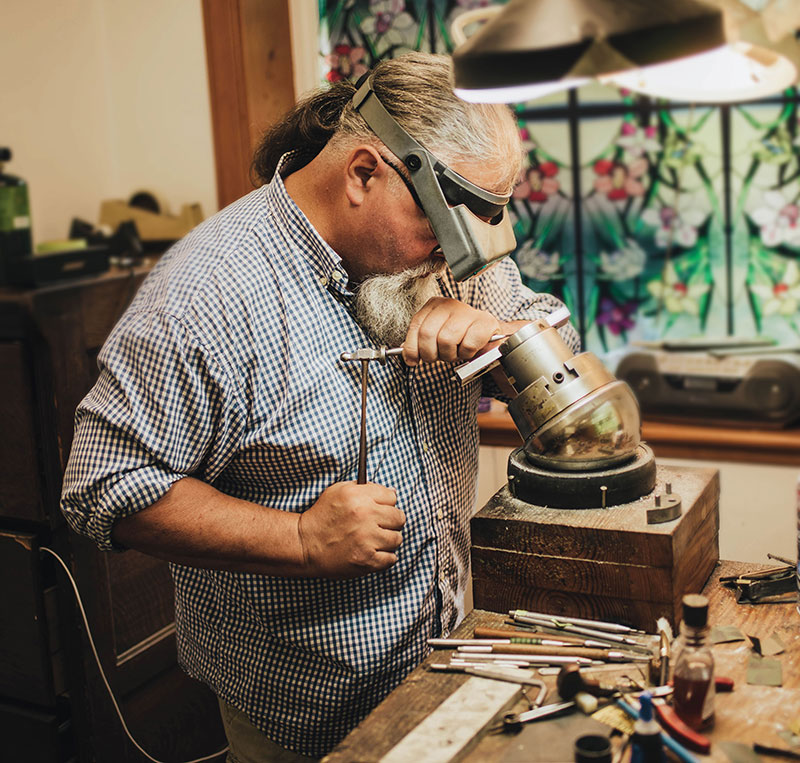
Every well-designed engraving you see in this story was done by hand. No fancy machinery like air utensils, high-end microscopes, or expensive engraving pens. Only tools made from small carbide steel drill blanks, countless hours of chisel practice and refinement, and a passion to master this ageless art.
The art of engraving is as old as time, but very few still practice the traditional hands-only techniques. Engraving is the art of carving initials, patterns, and picture art into an object’s metal components.
The industry rose to prominence in the 15th, 16th, and 17th centuries, and evolved further as time passed. Today, popular metal objects signatured with engravements include handguns and rifles, knives, and a wide variety of jewelry.
“What we do is so cool, and I just love it,” George said. “You’re in contact with the metal in a different way. This is closer to the way it was done thousands of years ago, going on back to cavemen carving images on the wall.”
According to the Firearms Engravers Guild of America (FEGA), where he is a member, George is one of 50 certified master engravers in the country.
For decades, jewelry, knife, and gun companies have commissioned George to engrave his illustrations and designs into exclusive and limited-edition products. George also extends his services to private clients, who pay upwards of tens of thousands for just one project.
Popular features of his art include 24 karat yellow gold, 18 karat green gold, and even rose gold, in addition to multi-dimensional layering and flush.
George has been commissioned by Ruger, Colt, and even William Henry, a jewelry company that sold one of George’s masterpieces for $57,000. His work has also been featured in magazines and other publications with national circulations, like Garden & Gun.
“Now that I’m older, I often reflect back on my career and wonder sometimes how the heck I made it,” George said.
“I was lucky in that I loved my job and really enjoyed creating something every day out of nothing. I also had, and still have, the ability to critique my work and be proud of it, but also to notice little things to improve on.
Most commissions begin with a sketch. Once approved, it may take George anywhere between a couple weeks to a year to complete one project, depending on size, features, and workload.
George’s love for art began with his grandparents. His grandmother on his mother’s side was a painter, and his grandfather on his dad’s side was a craftsman. Both of his daughters are also entrenched in the visual arts, one being a photographer, and the other an art teacher.
“I do think that art runs in people’s families,” George said. “This is the only thing I have ever done for a living, aside from being a ski mechanic. I like to have a flexible schedule.”
With art holding a special place in his soul, George looked for any opportunities to leverage this passion for a living. In 1981, George apprenticed under master engraver Ken Hurst, a former master for Colt Firearms. As Hurst’s company grew, George became his general manager and even trained new engravers. By 1987, large projects came to an end, so he and two other engravers formed their own company, Old Dominion Engravers, based out of Lynchburg. In 1990, as his knowledge and skill improved, George left the company to go solo—and he has never looked back.
“I still shake my head when I think back over my past,” he said. “I never thought about it much in my early days. I just wanted to learn as much as I could as fast as I could. I was trained to be a production engraver when I first started and was paid piecemeal, so I learned to be fast. Most of the better engravers that I know are fast and efficient, so that always helped.”
George works from the basement of his home. There’s nothing fancy about his 8-by-16-foot “office”—just a couple tables and tools scattered around the room. Several scratch marks blemish the floor, worn down by his chair.
Through it all, George is thankful for health, as his craft can become physically demanding.
“I never thought about it then, but I think about it now: I’ve never broken a bone. …If you’re cutting, you need to be moving your whole body,” he said.
George has coated his art onto some of the nation’s most expensive collectible guns, knives, and jewelry. People often ask him if he ever experiences apprehension while handling delicate, expensive weaponry. His answer is always the same: never.
Aside from engraving, George enjoys fishing, cigars and bourbon, and participating in the public square. He is on the Altavista town council.
“I loved growing up in Lynchburg,” he said. “I lived there for more than 30 years. I moved to Altavista about 22 years ago for family reasons and fell in love with this small town immediately. I love our parks, the YMCA, and the beautiful Staunton River that runs right through our town.”
George showcases much of his work through Instagram, where he shares photos of current projects and even videos of him at work.
“There are very few of ‘us’ that still basically use the hammer and chisel method in the US,” he said. “I know lots of engravers that I admire that use the new modern method—air-assisted tools in conjunction with microscopes. They do incredible work. I guess I just like the way I learned the best. I like antiques and feel pleasure doing what I do the old-fashioned way.”
For more information, visit George’s Instagram profile @timgeorgeengraving. To learn more about his portfolio, visit his website www.timgeorgeengraving.com.
Reinvigorated Retreats
Renowned Artist Residency Program Virginia Center for the Creative Arts Continues to Innovate after 50 Years of Success
Photo courtesy of Paige Critcher
Art, in its many forms, tends to be perceived as a product rather than a process. When you see a painting in a gallery or a book on a shelf, you are presented with a polished result of a great deal of time and effort expended by that particular creator. At Virginia Center for the Creative Arts, however, the creative process—in all its unrefined and hard-won glory—is given the spotlight. For just over 50 years, VCCA has provided artists of multiple disciplines with the time, space, and amenities to fully immerse themselves in their work without specific expectations. Considering the organization’s recent and upcoming developments, its next 50 years are sure to be even more remarkable.
VCCA’s story began in the late 1960s when two Virginia-based authors, Elizabeth Coles Langhorne and Nancy Hale, agreed that Virginia should have its own artist residency program. The program started as a couple of homes and a farm in Charlottesville, and the first artists were welcomed in 1971. In 1978, the program moved to Amherst thanks largely to the efforts of William Smart, an English professor at Sweet Briar College. To this day, VCCA resides on the picturesque 410-acre Mt. San Angelo estate across the highway from Sweet Briar.
Photo courtesy of Paige Critcher
VCCA, whose alumni include Beth Macy—author of Dopesick, which has now been turned into a Hulu miniseries—and Charlottesville-based author Jocelyn Nicole Johnson, offers fellowships for writers, visual artists, and composers at all stages in their artistic careers. Applications are accepted three times per year and are peer-reviewed by other artists within the same discipline.
“The most important part of the application is a work sample,” said Kim Doty, VCCA’s Director of Communications. “The panel carefully considers the quality and promise of the work before making their recommendations, and we try to schedule as many people as we can. We have three four-month residency seasons: winter, summer, and fall. Historically, summer tends to be a little more competitive due to many people being on an academic schedule. Within each scheduling period, people come for various lengths of time. We really want to make sure that people can come for a length of time that works with their lives.”
Photo courtesy of Paige Critcher
Since its inception, VCCA has remained committed to providing fellows with a balanced environment that allows them to focus on their work while also forging meaningful connections.
“We’re trying to make sure that we’re cultivating a welcoming, supportive, and nurturing atmosphere where artists of all kinds can come and be themselves and get the support they need to move their work forward,” Doty noted. “Our missions of time, space, and a sense of community have been very constant.”
Photo courtesy of Paige Critcher
On a basic level, that sense of community derives from artists’ shared awareness of daily life’s abiding ability to thwart the creative process.
“Few people acknowledge the amount of effort and time that goes into creating art,” Doty remarked. “Our day-to-day lives don’t make it easy to carve out that time and space. VCCA and other art residency programs are places where you can be among other artists—the people who understand the struggle personally.”
Photo courtesy of Paige Critcher
Opportunities for deeper connections are also plentiful at VCCA. For instance, after residents enjoy dinner together, writers in the group will often host optional and informal readings of their work around the fireplace.
“There are these chances for people to come together and start a collaboration, form a friendship, or simply gain new understandings about how to solve a creative problem,” said Doty. “A writer can have a conversation with a painter and, even though their work may seem to involve totally disparate processes, there’s just something about a different creative approach that can change the way you think about something.”
Photo courtesy of Paige Critcher
Of course, solitude is also an essential part of the creative process. Each resident enjoys a private bedroom and bathroom, and plentiful studio spaces are available for use.
Fellows also receive three meals per day provided by renowned catering service Meriwether Godsey.
“We used to try to manage an in-house kitchen staff, but that was sort of an ongoing struggle,” Doty noted. “Then we partnered with Meriwether Godsey, and they are just fantastic. The residents rave about the food and feel like they’re getting healthy, nourishing, and delicious meals every day. Food that is good and lovingly prepared really makes a difference.”
Photo courtesy of Paige Critcher
In addition to improved dining services, several updates and serendipitous occurrences have helped VCCA become the celebrated residency program it is today.
In 2004, a foundation in Denver, Colorado, sent out a flyer indicating that it was looking to give away a lovely property called Le Moulin à Nef in the village of Auvillar, France. As luck would have it, Sheila Gulley Pleasants, VCCA’s Director of Artist Services, is fluent in French. VCCA acquired the property and started a residency program in France. Once artists have had a residency in Virginia, they are eligible to apply to the program in France, which hosts four artists at a time. Additional international programs have since been established in Germany and Austria.
Photo courtesy of Paige Critcher
In 2020, a once-in-a-lifetime gift helped VCCA realize its long-standing dream of purchasing the Mt. San Angelo estate.
“When we learned that Sweet Briar would be willing to entertain our offer to buy the property, a longtime board member of ours [Cynthia Tremblay] was ready to help,” Doty recalled. “She owned this Georgia O’Keeffe painting, entitled Blue Sand, and when she learned that there was a buyer interested in purchasing it, she very generously donated the painting to VCCA so that we could sell it and use the money to help purchase the property. It feels very poetic that the gift of this painting will ensure that we have this home for artists.”
Photo courtesy of Paige Critcher
Although VCCA was saddened to halt the program for 15 months due to the pandemic, the organization completed several significant renovations during that time: the Studio Barn and other public rooms were upgraded and refurnished, each bedroom received its own private bath, all bedrooms and studios received independently controlled HVAC units, and the 1930s pool that had fallen into disrepair was restored. The organization also hopes to improve ADA accessibility in the near future.
Additionally, and even more importantly, VCCA recently hired its first outreach manager and established its 50th Anniversary Fund, which is specifically designated to give 50 artists of color who are new to VCCA a free two-week residency.
“We’ve always had diversity in terms of artistic disciplines, ages, and phases of people’s careers,” remarked Doty. “Now, we’re working hard to make sure that the demographics of the artists who are coming more closely reflect those of the U.S. population.”
Photo courtesy of Paige Critcher
VCCA currently has a pay-as-you-can model in which the organization’s Annual Fund covers at least 50% of the cost of all artist residences and an endowment provides more than $150,000 annually in financial aid. A variety of fully funded fellowships, which are endowed by individual donors or sponsored by grants or foundations, are also available. Ultimately, VCCA hopes to eliminate all fees for artists.
As VCCA continues to innovate and improve its residency program, its primary mission of facilitating and honoring the creative process without agenda will undoubtedly remain unchanged.
“It’s a very unpretentious and welcoming place, and there are no expectations or obligations,” Doty said. “We want people to be able to come and just pursue what they want to pursue. We’re trusting them to come and hopefully take their work to unexpected places.”
Artist Profile: Hanna Burnside
Legacy Keeper Artist Hannah Burnside Is Keeping a 700-Year-Old History Alive
PHOTOS BY ASHLEE GLEN
In August, tattoo artist Hannah Burnside woke up in Jerusalem. After long layovers, even longer flights, and hassles through airport security, she walked through the streets of the Christian Quarter and found herself in front of a solid metal door. On the door, no other markings were clear besides a phone number written in permanent marker.
“I called the number and this dude just rolled up in an old Harley,” Burnside, a Savannah native who has been living in Lynchburg since college, recounted. “His leather jacket had ‘Holy Land Bikers’’ on the back, which is a Christian biker club in Jerusalem.”
Stepping off of the bike was Wassim Razzouk, a 27th generation tattoo artist and the current owner of Razzouk Tattoo.
PHOTOS BY ASHLEE GLEN
For the week following that phone call from the crowded streets of the Holy City, Burnside worked alongside the Razzouk family, learning their tattoo styles and, more importantly, the legacy that they represent.
“The Razzouk family immigrated from Egypt 700 years ago and followed a similar path to Jerusalem that folks take on pilgrimages to the Holy Land,” Burnside explained. “To commemorate their pilgrimage, people would get a tattoo of a particular saint or something that represented the pilgrimage. If they returned, say a year later, they would get the date tattooed underneath the original tattoo. So, some people would have dates stretching down their arm that marked their annual pilgrimages.”
Wooden carved stamps were used as stencils for the tattoos—stamps that are still used some 700 years later at Razzouk Tattoo.
PHOTOS BY ASHLEE GLEN
“There are some stamps at the shop that they believe are older than that,” Burnside said. “But they just can’t date them back that far.”
During her apprenticeship at Razzouk Tattoo, Burnside immersed herself into the culture and worked tirelessly alongside the Razzouk family as they helped people memorialize a significant journey.
“One day, we had a group of 20 or 30 Armenian pilgrims come by the shop and ask for cross tattoos to mark their journey,” she said. “It was really cool seeing all of these groups who have different takes on religion, but whether they were Christian, Jewish, or any other religion, Jerusalem marks the Holy Land for all of them. Knowing that they all didn’t believe the exact same thing, but still gathered for the same goal, was really beautiful.”
Despite the language barriers—folks travel from all over the world to get tattooed at Razzouk—Burnside noted that she still found such deep bonds with the people she was able to tattoo.
PHOTOS BY ASHLEE GLEN
“They have full trust in you even though you can’t understand each other,” she explained. “That’s a really powerful thing and a really amazing experience to have.”
That level of trust is something that Burnside has worked to cultivate since she began tattooing in 2020. A tattoo apprentice at Caspian Tattoo in Lynchburg, Burnside puts a big emphasis behind comfort and trust with the people she tattoos.
“I understand that a lot of people come into the shop with body image issues, or not loving a certain part of themselves and I just want our time together to be a time of complete ease and confidence,” she said.
PHOTOS BY ASHLEE GLEN
After returning home from her Razzouk Tattoo apprenticeship, Burnside is now an official Razzouk ambassador, which means she is in possession of some of the antique tattoo stamps and has expressed approval to tattoo those designs in Lynchburg. As one of only nine current ambassadors—all of whom are situated around the globe—this is an incredible privilege and honor.
“I even had the opportunity to design my own stamp before I left,” Burnside explained. “So now my stamp sits in the shop at Razzouk and they will tattoo my stamp for folks all over the world. And I can tattoo it here in Lynchburg, as well.”
Burnside shared a Ram Dass quote that she felt was particularly poignant in commemorating her journey to Jerusalem—her own pilgrimage in a way. “The quote is, ‘We are all walking each other home.’ I can’t think of a better way to describe what this experience has been like, or what these tattoos mean, than that.”
The Magic of Art and Illusion
This summer, Ellee Evans, an artist who is from Lynchburg but currently living in Atlanta, set out to alter perception and bend reality. With paintbrush in-hand, she stood in the middle of Art Alley in downtown Lynchburg for four hours expertly mixing color and creating contrast. But rather than painting something stationary, Evans relied on a patient model to act as her canvas.
Artist Ellee Evans painting model Kiersten May
“I have a deep desire for making things magical just from illusion,” Evans explained. “I think it started from my scenic painting training my senior year of college. I learned how to make backdrops for plays look three dimensional and it inspired me to do the reverse with body paint. I want to turn the 3D image we see in life into a 2D illusion. It’s magical and so incredibly fulfilling once I step back and see the final product.”
Using Mehron, a water-based body paint, Evans was able to ensure that a thin layer of breathable, weightless paint could be applied to the skin and clothes to act as the base before applying contour and details. But before Evans ever puts brush to body, she first puts pen to paper.
“Prepping for a paint session starts with a drawing. I draw out a rough sketch using the dimension of the model, and then I play around with color palettes and designs,” she said. “Then, when I have a vision, I will share it with the client or friend that I am painting. I wash and cleanse all of my brushes and palettes, and then I pack up my back with all of my essentials and meet with the client to create the magic!”
For Evans, painting a person versus a canvas is about the connection and the process. Evans enjoys being able to talk to someone while she paints and allows herself to get inspired in the moment to add more details to her living painting while she works. But Evans also recognizes that there can be something deeper at play when you spend that much time working closely with another person.
“It’s body positivity,” she said. “I love making someone feel like a beautiful piece of artwork—even though every human already is one, we just often are hard on ourselves and don’t see it! I have a lot of self-image issues and whenever I paint myself, I feel so valuable and special and important. It means the world to me to be able to share that feeling with other humans.” Evans has been passionate and curious about this type of live, body art since she was a child. Her mom would read Purple, Green and Yellow by Robert Munsch to her, which recounts a story of a marker-obsessed girl who runs out of paper and begins drawing on herself instead.
“Throughout high school, I would use sharpies and eye liner to draw tattoos on myself,” Evans remembered. “Eventually, I started playing around with makeup and cosplays. I would want to buy a costume, but then something would just click in me, and I would just say, ‘I could just paint it on me, right?’ It all started trickling off into more and more creative ways to use paint and play with illusions.”
Although Evans moved away from Lynchburg a little over a year ago, she still enjoys returning for art projects or to see how much the city has changed.
“This last time coming back to Lynchburg, I found myself taking so many photos downtown,” she recounted. “The art scene has made a huge difference in the downtown atmosphere. It makes me feel welcome and appreciated as an artist. Like, ‘Hello, we welcome art here.’”
Evans plans to return to Lynchburg often, and is available for commissions via her website or on Instagram.
Photos by Enrique with Kanded Photo
Sara Ernst Spreads Joy and Life Lessons from One Coast to the Next
Local artist Sara Ernst is a renaissance woman in every sense of the term. A photographer, published author, illustrator, and musician, Ernst has been creating in one way or another since she was 15 years old.
“Photography came first!” she said. “I started doing wedding photography when I was just 15 years old. Children and families have always been my passion, though, and I’ve been beyond blessed to be an award-winning children’s photographer here in the area for over 20 years! I’ve watched the newborns grow and graduate before my eyes and my lens…such a humbling experience. I’ve even had the honor of one of my photographs being in the 2020 May edition of British Vogue!”
Ernst’s love of children and families created a natural segue for her to hone her creativity even further and captivate an audience that she already enjoyed working with. Founding her business Wild Pickle Press, Ernst creates stories and songs that help the youngest readers navigate life.
“Adults can sometimes have a very linear way of looking at things…thinking of songs or books as simply ‘catchy’, ‘silly’, ‘boring’, etc.,” she said. “Children are eager to soak up whatever is provided to them, and new things tend to spark new interests.”
Ernst’s work breathes life into that curiosity—fostering a sense of awe for the natural world and answering the inevitable ‘whys’ that often come from children when they’re discovering something new.
“For example, when a child learns what an ootheca is through my music, they are so eager to tell me about one they found the next time they see me. They have even brought them to concerts to show me! Wondering what an ootheca is? Go listen to my song!” she laughed. “I have worked with children in some way, shape, or form since I was literally a child myself, so interacting with them comes very naturally to me. I also know that music is a powerful learning tool and children need as much positive music as we can give them. Knowing that I’m giving them something good through my words is rewarding.”
Ernst wrote her first book, Dragons Really Do Love Tea in 2017. With no intention to ever sell copies outside of the supportive friend or family member, Ernst found herself at local bookstore Givens Books, who expressed interest in selling it. Now, she has published four books, all of which are available at Givens and on Amazon.
“My fourth book is the one I consider the most crucial,” she explained. “It started with my song Shout No, which I wrote to help teach children as young as two what a tricky situation might look like—whether from a stranger, friend, or, sadly, family member. It helps teach them how they can react, what trust means, and the importance of listening to their feelings. I really wanted something for visual learners and early readers as well, though, so I created a book from the song called Shout NO! A Child’s Rhyme About Tricky People…And What To Do. This book is now in Germany, Japan, France, the United Kingdom, Canada, and across the United States.”
This fourth and important children’s book is being used in foster programs and is accessible via Little Free Libraries and school libraries. In 2021, it won both the Purple Dragonfly Book Award and The Story Monsters Approved Book Award, and is available to read for free on the Wild Pickle Press website. The song is also free to download via the website.
“I just want this crucial message spread to children,” Ernst furthered. “If hearing the song or reading the book saves a child from a potentially dangerous situation, it’s all worth it!”
“This book has armed my kids with knowledge and confidence,” one parent said.
Ernst’s work has received even more recognition in recent months—this time, for a jingle she wrote for the California Strawberries Commission.
From April to May of this year, the California Strawberries Commission opened a contest for artists across the country to submit a written and recorded 45-second jingle for the group to adopt for future marketing and outreach efforts.
“The contest was promoted on Instagram, and it happened to show up in my feed,” she explained. “When I read about the specific things the jingle needed for the entry, I immediately felt inspired, grabbed my ukulele, wrote the jingle in about an hour, and submitted it that day. I didn’t overthink it; I just wrote what I felt immediately about it. I genuinely had fun writing it and felt happy when I played it. Those were two things I knew couldn’t be changed even if I didn’t win!”
Out of countless submissions, Ernst’s melodic jingle was selected as the winner.
“Anytime someone sees something or hears something in my work that they love, it’s truly rewarding,” Ernst said. “Winning [the contest]meant that someone (really, a bunch of someones) other than myself found joy in it…and that’s a wonderful feeling! While I couldn’t say for certain exactly how or where California Strawberries will use the jingle, it is the first jingle to represent their company and they can use it however they see fit…whether it’s through television, radio, social media, in-person events, etc. If you hear it somewhere, let me know!”
Whether Ernst is writing books, helping kids navigate tricky situations with easy to memorize songs, or creating award-winning jingles, her message is always consistent: It’s about finding joy, feeling love, and having fun.
“I want kids to remember that no one has the right to try to make them do something that is wrong or makes them feel uncomfortable. That they are strong, brave, kind, and smart. That nature is a whole world of creatures and life just waiting for them to explore. That there is no one quite like them. And that feelings are like friends trying to tell them something for a reason.”
Parents and young readers looking to connect with Ernst can find her on her website, www.wildpicklepress.com, or on Facebook and Instagram @wildpicklepress.
Have Paint, Will Travel
Raleigh artist, Chris Jones, finds beauty and inspiration in the Hill City
In the early 19th century, French painter Pierre-Henri de Valenciennes wrote a treatise entitled Reflections and Advice to a Student on Painting, Particularly on Landscape where he encouraged fellow artists to paint “en plein air”, or to paint landscapes while in the landscape. The act of immersing oneself in the elements, and painting the lines, light, and contrast exactly as they were rather than exactly as memory served, became the backbone of French landscape painting transforming from minor genre to primary art form as the 19th century progressed.
Today, artists around the globe still choose to paint en plein air—opting for mobile canvases and ever-changing environments as a way to keep their perspectives fresh and inspired. Chris Jones, a Raleigh-based artist, is one of them.
A renaissance man of sorts, Jones has always been a creator.
Chris Jones paints en plein air on Grace Street. Photo by Ashlee Glen.
“When I was 8 or 9 years old, there was a guy on TV named Jon Gnagy [host of the TV series You Are an Artist and Learn to Draw],” he explained. “He would draw something and show how a shadow might follow the contour of the land. It was all black and white TV back then, but he was drawing with charcoal so it didn’t matter. I ordered his book, which was on sale, and I devoured it. I drew everything in it and learned a lot about composition and perspective.”
Jones continued to pursue art through adolescence and into high school, when he became interested in photography, architecture, and design. After graduating high school, he began pursuing a degree in architecture and design from NC State University’s College of Design while supplying photography to local ad agencies.
“When I got to College, though, I realized it was design and art that I wanted, rather than architecture,” he remembered. “The closest art school was in Chapel Hill, so I took a semester there. It was a young program at the time, so I went on to look at Baltimore College of Art and California Institute of Art. Somewhere along the way, I got sidetracked a bit.”
At the time, Jones was a drummer in a band—a passion that started when he was six years old and still continues to this day.
“I ended up recording two albums with a band named Glass Moon at Electric Lady Studios and then toured for two years,” he said. “We had recorded in the West Village of New York, and I loved the city, so I ended up moving to New York after the tour was over. I left design school and decided to pursue photography full-time instead.”
Within six months in New York, Jones was getting work as a location photographer—and that work continued for the next 25 or so years.
“When I wasn’t traveling on assignment, I would hang out with artists and friends, and I would draw or paint on and off throughout those years. After my wife and I raised our children, we retired and moved to the west coast. I moved back to Raleigh in 2019, and when COVID hit, I put my camera down, picked up a paintbrush again, and started painting everyday. Now I have a stack of paintings that I don’t know what to do with,” he laughed.
Photo by Ashlee Glen
In a journey that may seem all too familiar to artists—one where passions are pursued and given the space to transform—Jones’s creative life has been a whimsical dance between music, photography, and painting. Each medium has offered a unique chance to view life in just a slightly different way.
“When COVID hit, there was this existential fear that we all had of, ‘What can I touch? Am I going to die? How many years do I have left to do what I’m doing?’” he explained. “I had already done photography and I had played drums all my life. I wanted to do painting and fine art. That was the third leg of my desires as a child, and COVID allowed me to explore it because I was at home.”
Now, Jones has been painting almost daily for over two years. He leverages his early love for architecture and design, and explores composition, light, shadows, and intensity of colors in architectural spaces in and around his home base of Raleigh.
Photo by Ashlee Glen
“Raleigh is a very happening place that’s growing very fast,” he said. “Part of my job as an artist is to document that. I like drawing and painting buildings. Because of the architectural influence I had as a kid, I love seeing how Raleigh is growing and trying to paint that.”
But Jones’s exploration of architectural beauty and growing cities doesn’t stop in Raleigh. Jones recently traveled to Lynchburg and found inspiration.
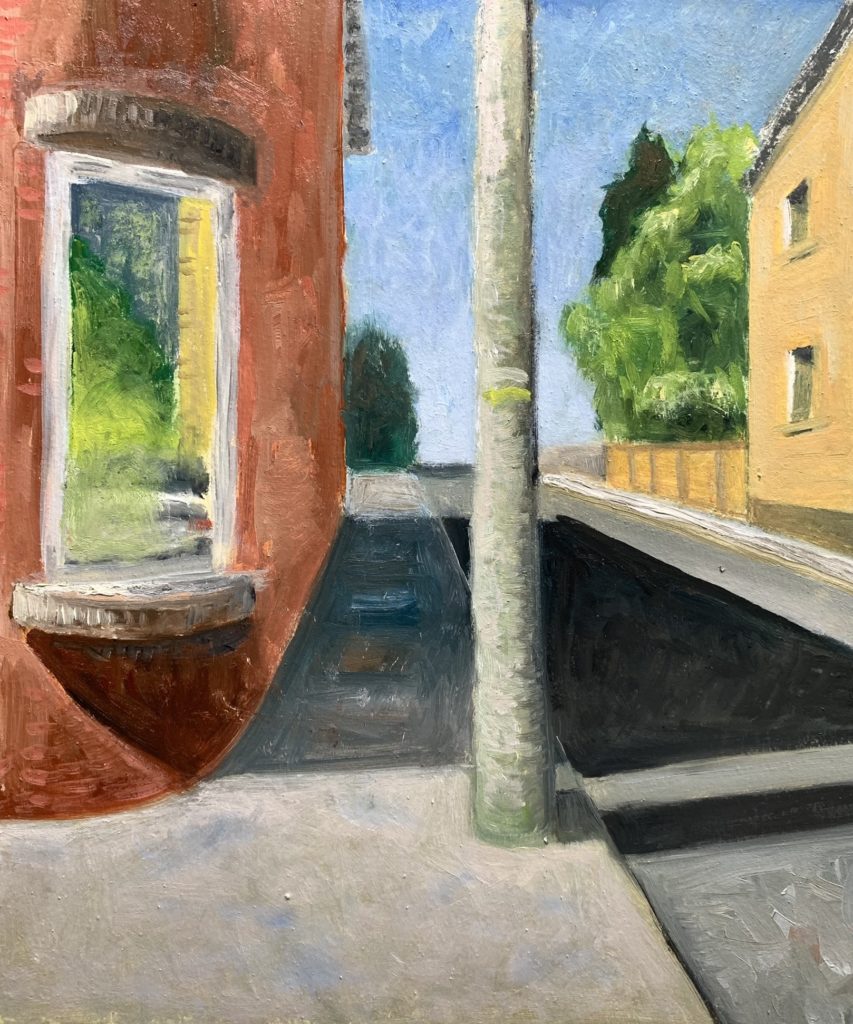
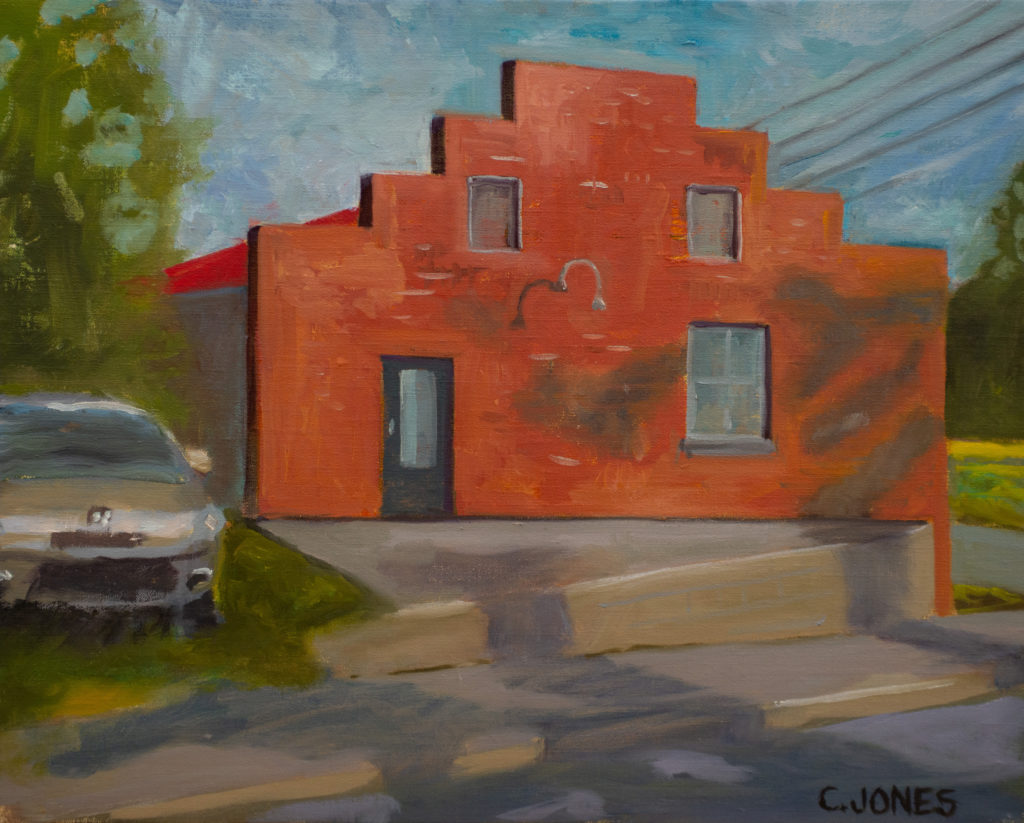
“When I drove to Lynchburg, I drove down Grace Street by mistake,” Jones explained. “As I drove down Grace Street, I immediately saw two scenes that begged to be painted—the first was the historic Fire Station No. 2 building and the second was a gorgeous brick building where you could see where the facade had been at one point. When I have that instant strike, it says to me, ‘Let’s see if I can paint it.’ The same happened on Church Street. I could have easily painted there for two weeks.”
Engine Company Number 2- 24×24 oil on panelChurch Street- 11×14 oil on paperOld Facade on Grove Street- 16×20 oil on panel
With his canvas and paint tools in tow, Jones stopped and painted the two Grace Street buildings en plein air.
“I was struck by [the Fire Station No. 2 building] because of the way the light hit it, plus it was beautifully designed in the first place,” Jones recounted. “I had this fantastic feeling of having been there in the day when it was being used, and seeing fire trucks come out of the door.”
Jones spent an afternoon getting the architectural lines and sunlight reflecting off the fire station just right before returning back home to Raleigh, but not before Lynchburg had a chance to leave an impression on him.
“Lynchburg is going through a renaissance of sorts, it seems,” he said. “I loved to see all of the hip looking youngsters walking around. If I didn’t love living in Raleigh, I’d be hard pressed not to want to move to Lynchburg.”
To see more of Chris Jones’s art, visit his portfolio at www.chrisjonespaints.com and find him on Instagram at @chrisjonespaints. He is currently accepting commissions, and his Lynchburg paintings are available for purchase.
“It’s Like Living in an Art Project”
A Lynchburg Midcentury Time Capsule Meets Its Perfect Match
Is it possible that sometimes a house chooses its owners?
Much like a rare antique sitting boxed up for decades in an attic, or a valuable painting relegated to the back rack at a thrift store, it waits for just the right old soul who will lift it up with a sense of reverence and say, “There you are.” It seems an impossible idea given the recent real estate market, but when you hear the kismet story of Hannah Poucher and Grant Kittrell, it may lead you to wonder if maybe, just maybe, their house chose them.
Photos Courtesy of Daryl Calfee
The Discovery “We knew the second we looked through the windows that we wanted to live here forever,” Hannah, now 32, said of their love-at-first-home-sighting experience.
It was August 2019, and she and Grant, now 30, were making plans for a wedding and their future together, when something akin to Zillow lightning struck. A little listing with just five vague pictures popped up—a circa 1954 midcentury modern in the middle of Lynchburg. Within the hour, the couple found themselves peering through the windows, unable to believe their own eyes. It was meant for them, they knew it, but they needed to move fast.
“We weren’t pre-qualified, we had never looked at any houses before, we had to Google after we saw this place—’how to get a mortgage’—we didn’t know anything!” Hannah, a military recruiter for Liberty University, said. “But we knew if we didn’t jump at this, we wouldn’t get another shot at something like this in town.” A bidding war ensued, but the home seemed to intuitively know who it wanted as its next caretaker. The couple closed in November 2019 and made a defining decision in honor of their new-old home.
“We wanted to live in the space for at least a year before doing anything radical,” Hannah explained. “We wanted to understand what it was like to be here as people within a space where it was designed to work like this. So, we decided no big changes for the first year.”
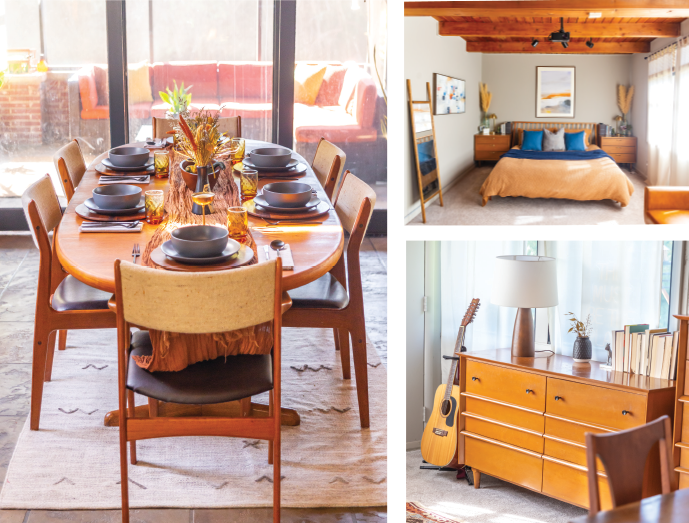
An Intentional Interior It turns out, there was much the home wanted to teach them. Grant and Hannah took pleasure in learning about its history and thoughtful layout, taking note of each delightful detail, like how the abundant natural light shifted across the open-beamed ceiling throughout the day.
“We both, perhaps in different ways, came to this space with appreciation for art and design,” Grant, a writer, illustrator, and musician who works at Randolph College, said. “The midcentury modern style is very intentional and leans in the direction of sculptural, so there’s not a day that we don’t look around and say, ‘Hey look at that! Isn’t that really amazing?’ So, we are living in this space that we see as a piece of art, and really it is.”
Photos Courtesy of Daryl Calfee
Within that first learning year, they came to understand the unique reason for the way things were designed. Like the greater abundance of windows on one side of the house to allow for passive solar heat. Or the fact that the floors, which look like stone, are in fact stamped concrete designed to hold thermal mass, making what should be a cold underfooting somehow warm and earthy.
The biggest discovery, however, came in the form of a large manila folder filled with the home’s blueprints, original building materials, past pictures, and a booklet of original paint colors from The Frank Lloyd Wright Sierra Sunset Collection.
“When we found that folder, with the Frank Lloyd Wright paint palette, we realized that there was incredible intention behind it,” Hannah said. “So, for example, this color isn’t black, this is the Midnight color from that collection that is part of a larger palette. It was already here. We only painted the kitchen cabinets.”
Furnishings with Soul While their commitment not to change the home’s interior held strong after moving in, it did need some furnishings. Some true-to-the-era furnishings.
They dove in with both feet and hands.
“Pretty quickly, Hannah became a master of the Facebook Marketplace,” Grant laughed. “She would stay up late at night looking for furniture. So as soon as I got off work, we would take off and go to places we had never seen before, out in the countryside, and pick up an old piece of furniture that someone maybe didn’t really know what they had.”
The hunt for pieces soon evolved into restoration of those finds as needed. Grant and Hannah became quick students of the specific approach to refinishing midcentury pieces.
“We aren’t talking about just sanding and staining, you’re talking about burning through wood veneer if you mess it up and how things aren’t stained, they are toned and sealed and lacquered,” Hannah said.
Photos Courtesy of Daryl Calfee
“I think the more work we put into a piece, the more we favor it.”
Her current favorite piece? A hutch from Lane Furniture, whose factory was once headquartered in Altavista. They discovered the piece in Rustburg, and it is now situated proudly in the area that opens from the kitchen into the dining area.
“We got it on Facebook Marketplace and the seller’s mother had bought it originally from Lane. So it’s a Virginia piece and the time period is right,” she recalled.
What you won’t find a lot of on the home’s ever-evolving furniture front are many new items.
Not because they are purists, Hannah explained, but because of what’s available on Marketplace, what’s within their budget, and what they can restore back to life now and perhaps replace later.
“I can probably count on one hand the number of new things that are in this house,” she said. “And while sustainability might not be the first thing we think about, it’s definitely a driving force. I think in terms of a level of purism, that’s what we are working towards.
It feels like such a perfect space, and we want to honor it with things from that time period.”
Photos Courtesy of Daryl Calfee
An Apartment Evolution Of course, as with most self-imposed rules, there is almost always an exception. For Hannah and Grant’s “no changing the house for a year” rule, that exception came in the form of an efficiency apartment just across the home’s attached breezeway, where they cut their teeth on the basics of home renovation.
“We focused a lot of our initial energy there because it was a smaller space; we weren’t as overwhelmed and we figured we could learn in there and not have to live in it if we made any mistakes,” Hannah said.
While the essential layout existed when the couple bought it, the apartment needed some finishing work. They took to painting the kitchen cabinets the same green as the main home’s kitchen, updated the floors with a light luxury vinyl tile they laid themselves, and furnished the small bedroom, kitchen, and bath with interesting finds, such as a 1965 Sears Roebuck & Co. bar sourced in Roanoke and a white 1930s stove from Farmville. While not decade-specific to the home, Grant said, “when you bring something this old from the 30s, you’re bringing a long history into this space and the possibilities of whatever life it lived before.”
The renovations came with inherent lessons for the couple, and they reflect now that it better prepared them for future renovation jobs still ahead, like their dream of expanding the home’s main kitchen.
“We have learned to work with each other a little better and be patient with each other in different ways we didn’t know at that point,” Grant said. “Coming home each day and laying flooring every day…we learned a lot!”
From the Inside Out Much is to be made of the home’s interior, and for good reason, but the property’s grounds are stunning in their own right. In fact, it is the marriage of the two, one spilling by design into the other, that creates a zen-like cohesion with nature from nearly every vantage point.
Photos Courtesy of Daryl Calfee
“We both love and appreciate a lush, green space and this has a lot of bamboo, a big maple, and some really intentional plant life,” Hannah said. “So when you’re looking out these windows, the lines are blurred between outside and inside.
It feels like a really natural space and really a sacred space almost.”
The pair have worked diligently to make conscious updates to the home’s exterior, including retrimming the formerly gray windows to a crisp black, something akin to adding eyeliner to an already lovely face. They cut back layers of bamboo and, as a reward, have witnessed more wildlife at play, from a family of foxes to finches taking up residence in one of the many birdhouses Grant made to a shy resident doe the couple affectionately calls “Jean.”
Most warmer nights of the year, you will find Hannah and Grant on their back patio area, nestled in wicker egg chairs, beverage in hand, dreaming into the future about their vision for the space. Their ultimate hope is to continue to collaborate with their cherished home in order to share it with others—an ever-welcoming, one-of-a-kind retreat.
“Mixing the inside and outside is always a goal,” Grant said. “Having a nature trail on the property is a dream, or hosting yoga or meditation classes here, maybe along with some creative writing workshops.
I would also love to make this place more sustainable, perhaps with solar power.”
It is little wonder that whatever the pair chooses to do next will be with great planning and purpose for the home that somehow, some way, chose them. Three years into their adventure, they still wake every morning with a wide-eyed sense of awe for their surroundings.
“I think, ‘How is this even a possibility? How could this even possibly be our home?’” Hannah smiled. “There is a lingering sense of wonder and excitement every day that we are in this space.”
Photos Courtesy of Daryl Calfee
Follow Along Want to follow along with the home’s furnishing adventures and projects?
Check out Hannah and Grant’s Instagram page dedicated to the home @clerestorymod. “Clerestory” is the word for windows that are above normal ceiling height and project into the roofline, which their home boasts in abundance.
Hill City Ink
What’s better than art that stays with you wherever you go?
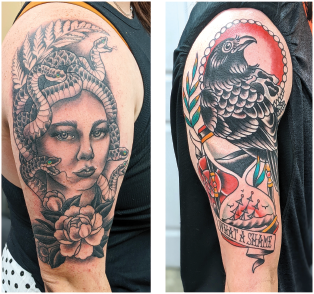
Tattoos have been around for thousands upon thousands of years—since around 8000 B.C.! To pay tribute to an ancient art form that is still widely loved today, we talked with a handful of Lynchburg’s tattoo artists to hear what they have to say about their favorite tattoo styles and why you should consider one or more of those styles for your next (or first!) tattoo.
Will Hunter, Owner of Hill City Tattoo
Artist: Will Hunter, Owner of Hill City Tattoo STUDIO: Hill City Tattoo Favorite Style: Neo-traditional/new school style What Will has to say about this style: “I enjoy doing tattoos in a neo-traditional/new school style. The thick lines and bright colors are just fun. As old school artists say, ‘Bold will hold!’” To make an appointment: (434) 237-5037
Jonathan Schultz, Caspian Tattoo
Artist: Jonathan Schultz STUDIO: Caspian Tattoo Favorite Style: Neo-traditional What Jonathan has to say about this style: “I prefer Neo-Traditional designs because they are bright and bold with high contrast. They age well and are fun to look at. If you can tell what it is from across the room, then you can tell what it is for the rest of your life.” To view Jonathan’s portfolio: Instagram: @jonnschultz To make an appointment:JsTattooer@gmail.com
Hannah Burnside, Caspian Tattoo
Artist: Hannah Burnside STUDIO: Caspian Tattoo Favorite Style: Black and gray illustrative What Hannah has to say about this style: “I love having creativity with the design and doing all the little details. I gravitate toward bold outlines and high contrast. I enjoy tattooing botanicals and traditional inspired designs in this style.” To make an appointment: (434) 237-1900
Andrew Montgomery, Caspian Tattoo
Artist: Andrew Montgomery STUDIO: Caspian Tattoo What Andrew has to say about tattooing: “Tattooing is a unique art form that allows an individual to be marked for a lifetime. Choosing one style from an artform that’s as ancient as humanity is difficult. What I enjoy about tattooing is the bond that can be created between an artist and client when creating a permanent piece of art.” To make an appointment: (434) 237-1900
Artist Profile: Bosco Bae
Grief Work AND the Art of Intention
Potter Bosco Bae blends emotion and clay
Imagine having the opportunity to grab ahold of your grief—to shape it, swipe it away, and turn it into something durable and beautiful. Potter Bosco Bae’s most recent series, called Grief Work, is exploring the different forms that grief and healing can take.
“A lot of my work nowadays is trying to capture grief and work through the myriad of emotions involved with love and loss. The work can get pretty dark, but I try to remain true to the idea that there is meaning and beauty within struggle, within hardships, and imperfection,” Bae explained.
Potter Bosco Bae
While the acceptance and celebration of imperfection is something that Bae, a Ph.D. and professor of Religion at University of Lynchburg, has been exploring artistically for years, the expression of that has shifted since the passing of his brother last year. Bae takes inspiration from the moon jar, which is a Korean form in ceramics and traditionally combines two symmetrical bowls to create one large vessel. While the two bowls individually are perfect, they come together to create an asymmetrical, imperfect union. Traditional moon jars feature a white glaze and a very thin base, which make the vessel look like it’s floating—like a moon. “It’s minimalistic yet sophisticated in its evocation of a calm and serene ideal,” said Bae.
But he takes the form a step further.
“The moon jar, in its traditional form, is romantic, normative, ideal. My work aims to be a bit more descriptive, flawed, messy—to allow suffering to speak and find expression,” he said. “How does a form retain, embody, or convey lament?”
One of the first pieces that Bae created in his Grief Work series began with the moon jar form. Using his hands, Bae tore a hole through one side of the vessel to exemplify a piece of him that is now gone.
“After that part of the vessel was ripped out, I went to the other side and started taking pieces out to patch the hole.
When that patch was mended, of course, another hole emerged on the other side. I then started digging into the bottom and scraping out any clay I could use to patch up the side that was given up to mend the first hole” Bae said. “So, in this particular piece, you’ll see where I’ve scraped from the bottom.”
In another piece from the Grief Work series, Bae began with a moon jar, cut it apart, and reassembled it.
“After deconstructing the piece and breaking it down, there was an active attempt to try and put the pieces back together—to go back and recreate what it was before breaking down—kind of like drawing somebody from memory,” he explained. “But during that process it changed and it was clear that the reconstruction wasn’t going to be the same. The vessel was transformed into something else with only traces, shadows, or memories of what it was before.”
Metaphorically, the piece showed just how different a person can be after grief, trauma, or hardship.
“All the pieces in this series begin with the moon jar form, thrown as a singular piece, as opposed to combining two.
The piece is then altered, stressed, and it endures—sometimes it doesn’t—and accepts the distortions, rips, and unanticipated irregularities that emerge from the process. I think a lot of the uncertainties and unintended consequences from the intentional moves and gestures I put into the piece make it interesting, perhaps, even difficult, or uncomfortable to look at,” Bae said. “Grieving is an uncomfortable process in which bracketed realities can intersect and break into the forefront of our consciousness at any given moment. Grappling with difficult truths is a process of reconciling with a dissonance that jars against tacit presuppositions about ideals and expectations, whether we acknowledge them or not. Sometimes, words are insufficient and talking about it isn’t always the best way to express ourselves. Being intentional through nonverbal forms of expression can be just as, if not more, relevant in the healing process.”
This level of intention—of dissecting an emotion or experience—is what encapsulates Bae as an artist. Whether he is throwing teapots or mugs with perfect, ergonomic form, or exploring just how beautifully imperfect a piece can be, Bae reverently approaches each piece and accepts it exactly the way it is.
Nina Simone once said, “It’s an artist’s duty to reflect the times,” which is a charge that Bae has fervently accepted. While his most recent body of work reflects his current experience of grief and healing, the journey isn’t over and his art will surely evolve again.
One thing is certain, however—it will be beautiful.
To connect with Bosco Bae, find him on Instagram at @potsbosco.



 Evans plans to return to Lynchburg often, and is available for commissions via