Lynchburg’s past is full of inspirational figures, but those who have shaped the minds of young and old alike have always been our teachers.
With the help of the Lynchburg Museum System, we took a look at three of those impactful educators who lived, worked and taught here in our city and were the ones to pave the way during a time when it may not have been as celebrated as it is now.
Amelia Perry Pride (1857-1932) Not only was Pride an African-American elementary school teacher and principal for 30 years, she was also well known for her larger contributions to the Lynchburg community.
Pride attended Hampton Institute, now Hampton University, and returned to Lynchburg to begin her teaching career, where she was one of the first Black teachers in Lynchburg City Schools. She later became principal of Polk Street Elementary School.
In 1897, Pride established the former Dorchester Home on Pierce Street or what some called the “Old Folks Home for impoverished former slave women.” According to a city historical marker, it provided shelter, fuel, clothing and food for its residents until their deaths.
The marker also states that, “Following Hampton Institute’s principle of uplifting her race through self-help, Pride was a passionate advocate of African American and Virginia Indian education.”
Pride provided scholarships for many young women seeking higher education and established sewing and cooking schools for women and men entering vocational fields. Her namesake lives on at the Amelia Pride Center on the grounds of Dunbar Middle School, which houses several alternative and adult programs.
Edward Christian Glass (1852-1931) Glass was Lynchburg’s long-time public school superintendent and namesake of E.C. Glass High School on Memorial Avenue.
According to Museum Director Ted Delaney, Glass’s most monumental contribution to our community was that he ensured that public education in Lynchburg was viable at a time when many citizens opposed the idea of taxpayer-funded, government-run schools.
Glass became superintendent of Lynchburg’s public school system in 1879 at the young age of 26 and served for nearly 53 years, according to a city historical marker. He established and for 18 years oversaw a summer teachers’ institute that trained thousands of teachers from Virginia and beyond.
Glass co-owned and co-edited the Virginia School Journal, which for years was the official organ of the state’s Department of Public Instruction and the Educational Association of Virginia. Glass was president of this association and twice served on the State Board of Education.
According to the marker, Glass wrote several textbooks, including Glass’s Speller. Lynchburg High School was renamed in his honor in 1920, and a new E. C. Glass High School opened in 1953.
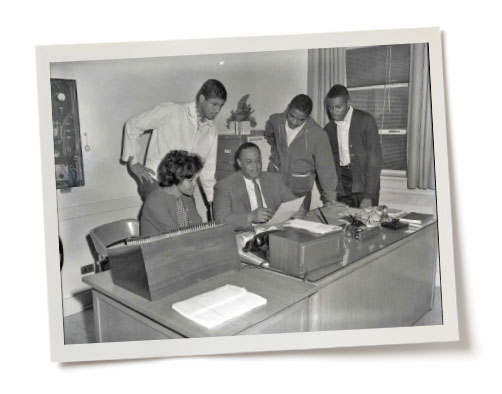
Clarence W. (or “C.W.”) Seay (1900-1982) Seay was an African-American, long-serving principal of Dunbar High School from 1938 to 1968. At the time, Dunbar was Lynchburg’s secondary school for African Americans. According to Delaney, he was the last principal before integration and a beloved advocate for his students and faculty.
Seay believed in the connection between school and community. According to a historical marker in the city, he shaped Dunbar High School into a school of academic excellence, holding that a “successful school and its community are inseparable.”
According to the Lynchburg Museum, Seay spoke out against injustices within the education system and encouraged Black schools to hire Black educators, administration, and personnel, and to seek Black leaders for the School Board.
He later became the first high school principal elected to the presidency of the Association of Colleges and Secondary Schools. After his retirement in 1968, Seay taught at Lynchburg College, now University of Lynchburg, and held the position of Assistant Professor of Education. He was the first and only African American to be employed by the school at the time.
He later served two terms as Lynchburg’s first Black city council member since the 1880s and the first Black vice mayor.
Legendary Eats
Four longtime Lynchburg restaurants that have kept us coming back for almost a century
There’s nothing like enjoying a meal in a place with endless memories of yesteryear—perhaps once frequented by your parents, even your grandparents. The stories told about these historic, and sometimes humble, eateries not only connect us to our local past but they also show how the shared bond of “going out to eat” has prevailed through the generations.
While Lynchburg has a diverse and outstanding selection of locally owned restaurants, we wanted to take some time to focus on the spots that have stood the test of time. These four restaurants, with a combined total of 335 years under their belts, have weathered war, economic depressions and everything in between—but what they all say has been the biggest challenge so far is COVID-19.
The World Famous Stadium Inn This local hangout spot opened in 1927 when it was converted from a substation into a beer and burger joint. The owner now refers to it as the “greatest little bar in Lynchburg.”
Photo by Ashlee Glen
Owner Daryl Burgess purchased the building in 2017 when he saw the restaurant had closed. “I just felt that couldn’t happen,” he said. “It’s a landmark and has such cool history.”
Burgess kept the restaurant closed for two months while he renovated the space into a clean sports bar and grill offering cold beer, low-price eats and TVs.
He threw away old equipment with 50 years of smoke on it including the grill, oven, fryers, photos on the wall and cleaned the windows 27 times until all the smoke was gone. With all that work under his belt, it’s no secret that The World Famous Stadium Inn is no longer a smoking bar. Under Burgess’ direction last year, they now have a high chair for the first time to accommodate families. They’ve also worked hard to clean up their image in general.
“The servers know everyone and we make sure customers get home,” he explained. “There’s a three-strike rule… It’s now a family-friendly beer joint. The hardest thing I had to do was overcome the character of the place.”
Burgess is also the owner of The Filling Station in Amherst and knows his way around hamburgers, hotdogs and wings, so he incorporated all those items at the Stadium Inn.
During the pandemic, Burgess converted the restaurant into a mini-convenience store for two months selling steaks, hand sanitizer, paper towels and toilet paper. But ultimately the business still suffered like most others and saw a 75% decrease in sales.
Now, thankfully, with lighter restrictions, Burgess said the restaurant has been filled to its allowed capacity every weekend.
With the growth in mind, he has plans to open an outdoor pavilion soon to provide for more seating. Burgess expects it to be a place for Lynchburg Hillcats fans to hang out after games at City Stadium.
“If you haven’t checked it out, you don’t know what you’re missing,” he said. “Come see us, say hi and you won’t leave unhappy.”
Photo by Ashlee Glen
The Dahlia Located on Bedford Avenue, this hidden gem is a little less hidden thanks to the recent boom of its neighborhood, which is now home to Golf Park Coffee and Small Batch Barbecue.
Angel Olds, who believes she is the 17th owner of The Dahlia, said the micro-local restaurant is home to some of the best seafood in town. Olds and her late husband used to own the Blue Marlin Seafood Market next door, so she knows her shrimp, scallops and fish.
When it opened in 1947, the restaurant was originally called The Blue Dahlia after a film noir of the same name. It was a popular local spot but over the years the restaurant received a bad reputation and went downhill, according to Olds.
“It became known as a dive bar. Men would come but wives wouldn’t step foot in the place,” Olds said. “Now it’s the opposite.” The upstairs is a little more upscale, while the downstairs, referred to as “the cellar,” has a more relaxed, English pub–style vibe.
After Olds purchased The Dahlia 11 years ago, she gutted the entire place and has since created a causal, family-friendly pub that focuses on quality food.
Though it’s more well-known now, she said her customers enjoy that the restaurant isn’t a run-of-the-mill chain and newcomers still have to plug the address into their GPS and hunt around for the front door.
“We are kind of secluded, but I’m hoping to get new signage for Bedford Avenue,” Olds said. Out of 74 years, Olds said the restaurant has only been closed for two years.
“It’s an institution. It’s weathered history,” she said. “It’s a very old restaurant that has been reborn several times. It’s still here alive and kicking.”
Photo by Ashlee Glen
Texas Inn You know you’re a local to Lynchburg if you know exactly where to find a “greasy cheesy.” That’s, of course, at The Texas Inn, better known as the T-Room, which operates its flagship downtown and a more recent addition in Cornerstone.
In 1949, the restaurant, once located at 602 Main St., was sold for $10,000 by H.D. White to H.W and T.W. Wright. In the 1970s, it was torn down and relocated to its current location at 422 Main St., which once served as a service station.
The 86-year-old restaurant has seen multiple owners but current owner Dave Saunders remains true to founder I.N. Bullington, a former circus advance man.
Ever since purchasing the iconic restaurant in 2018, Saunders has worked tirelessly to bring the T-Room back to its roots, starting with a six-month search for the original chili recipe.
Today, the T-Room is obviously known for its cheesy western—a hamburger with relish, a fried egg and cheese—and chili, better known as a “bowl.”
Saunders has kept some of the quirkier menu items that no one orders, such as the Denver, an egg and cheese sandwich on a bun topped with relish, or the Funny, a hot dog bun with no wiener topped with relish and chili.
He took cheese sticks off the Cornerstone menu because he felt it didn’t fit the character of the establishment, and the relish is made three times a week instead of just one.
Since its opening in 1935, the T-Room has witnessed The Great Depression, World War II, the Korean War, the Vietnam War and a handful of recessions, but COVID-19 has tested the tavern with its ability to only seat customers at its 15-seat counter.
Saunders placed a picnic table outside but it’s still the only establishment in town that has less than 50% capacity. “People have been really loyal ordering to-go and delivery,” he said. “They really saved our bacon.”
In the end, Saunders said the T-Room is the oldest continuously running restaurant in Lynchburg for a reason. “We serve good food fast and cheap,” he said.
Photo by Ashlee Glen
The Cavalier “The Cav” as locals know it might be as hometown as you can get. It’s known for its no-frills and relaxed atmosphere serving up to-die-for burgers and fries.
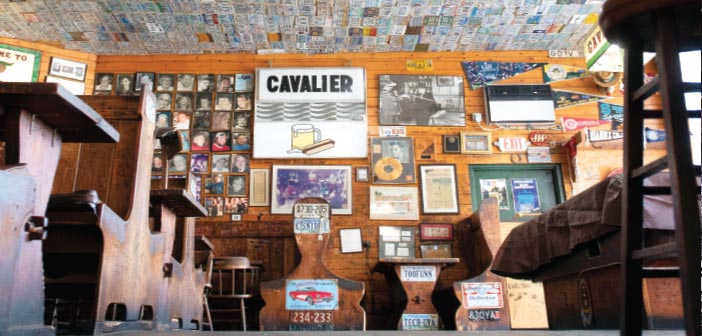
Located right off Rivermont Avenue, down the street from Randolph College, the dive bar is decorated with side-by-side license plates on the ceiling and walls and its wooden booths are covered with carvings of initials and notes from who once sat there.
Opening in 1940 under the name “The Cavalier Store,” the Cav started out as half grocery store, half restaurant where customers could shop and order a beer and hot dog. It was that way until the late 1960s or early 1970s and the wall between the two was torn down.
In 1987 Wells Duffy purchased the bar and continues to operate it to this day. He is responsible for adding in the main bar and the smaller bar near the ATM machine.
Jake Hill, a bar manager at The Cav, said it wasn’t uncommon for 1940s women to come in, buy cigarettes and smoke because their husbands wouldn’t allow them to light up at home. The restaurant is still an icon in the city and known as a bar reliable to always be open.
“It’s a good ‘ol neighborhood restaurant,” Hill said. “Anyone and everyone is welcome. We consider ourselves the Cheers of Lynchburg because everyone knows each other and if you don’t, by the end of your visit you’ll likely have some new friends.”
There is no question that customers keep coming back for the burger, which has been glorified by all walks of life. It pairs perfectly with the seasoned fries and homemade ranch.
In the past 34 years that Duffy has owned The Cav, he’s never experienced anything quite like the pandemic. He’s never had to adjust his hours and the restaurant has always stayed open seven days a week—but that was put on pause last year.
“Even with bad weather, we’re known as a reliable spot that will always stay open,”Hill said. “He’s never had to deal with anything like this.”
Remembering the Patterson Six
How the 1960 Sit-in Was a Catalyst for Civil Rights in Lynchburg
Sixty years ago, six college students sat down together for a cup of coffee at the lunch counter at Patterson’s Drug Store in downtown Lynchburg. But because two of those students were Black, all six were arrested and charged with trespassing.
Their Dec. 14, 1960 arrest and subsequent conviction, which included a sentence of 30 days in jail, sparked a number of other sit-ins, forcing residents to grapple with the ugly inequality in their segregated city.
“Oh my God, that was a wonderful day,” recalls the Rev. Virgil Wood, then pastor at Diamond Hill Baptist Church who helped plan the sit-in. “I remember it like it was yesterday. It’s indelibly imprinted in your spirit.”
Now 88 and a resident of a Houston suburb, Wood said the sit-in “was an originating moment in some ways” and was significant because of the institutions involved.
Barbara Thomas, 21, and Kenneth Green, 28, were students at the all-Black Virginia Theological Seminary, while Mary Edith Bentley, 20, and Rebecca Owen, 20, were students at Randolph-Macon Woman’s College. James E. Hunter, 19, and George Terrill Brumback, 20, were students at Lynchburg College.
Photo courtesy of News and Advance
“It was just an obvious moral issue; (segregation) was wrong,” said Hunter, the only one of the six interviewed for this story. Two have died, one is ill, one can’t be found, and the other declined an interview.
Hunter, who will turn 80 in December, has not talked about the sit-in much over the years, but summed up the action this way: “Two things I would emphasize are that nonviolence can work, and things can change.”
Hunter, who had a career in social work and lives in Maine, acknowledges that racism remains a problem, but says things have improved vastly. He had seen signs of segregation, including separate drinking fountains, as a child. “You saw that kind of thing all over the place,” said Hunter, who grew up in Indianapolis. “It irked you.”
The decision to become involved in civil rights was a no-brainer for Hunter. He said a group of students had been meeting at Diamond Hill for a few weeks and realized they needed to take action. They chose Patterson’s Drug Store because of its prominence on Main Street and hoped to convince drug store owner William S. Patterson to get on the right side of history.
Instead, Patterson called the police and had the students arrested for trespassing. A patrol wagon took the students to jail. Hunter said a Black businessman posted his bail that evening.
Rebecca Owen called her good friend Alice Hilseweck (now Ball), who got word to R-MWC President William Quillian. Quillian arranged for bail for his students.
The very next day, Ball participated in a sit-in at Peoples Drug Store. “We didn’t want to go home for Christmas vacation and leave (the people of) Lynchburg thinking there were just six bad guys in the town,” Ball, now 81, said in a phone interview from her home in Atlanta.
Ball joined four other R-MWC students and Miriam Thomas Gaines, a Black student from Campbell County High School, at Peoples. Miriam’s sister, Barbara Thomas, had been arrested the day before.
“I’ve been doing a lot of thinking about it,” Ball said. “This is an issue now and has never not been an issue.” Her book club in Atlanta is reading The Race Beat, about how the media covered racial issues from 1958 to 1960, which makes her realize “the things that I as a white woman don’t have to wake up thinking about.
“I believe some of the material that’s being written now is beginning to get white people to wake up,” Ball said, adding she is hopeful because white Episcopal parishes in her area are talking about white privilege.
Ball’s life reflected her early beliefs. Her work to help battered women, foster children, and young girls earned her national recognition. She has also worked as a mediator and trainer for an alternative dispute resolution center in Atlanta.
For Miriam Gaines, now 77 and a resident of Forest, her decision to join the Peoples sit-in was prompted by the racism she experienced as a child. Until very recently, she has been reluctant to talk about it. When she was asked to tell children about the sit-in at Pleasant Valley Church earlier this year, however, she couldn’t resist. She shared the notes from her talk.
Gaines said her father worked three jobs to support his nine children. He owned a store and a barbershop and was a porter carrying mail and packages at a railroad station. Her mother stayed at home and periodically did day jobs cleaning the homes of whites.
Photo courtesy of News and Advance
“One of the things that bothered me was how the white men, women, and children would call my mother, Sallie… even though she was much older than they were,” Gaines said. Her mother had to use the back door to those white houses. On vacations with her family, Gaines learned that Blacks couldn’t stay in hotels or motels, eat at restaurants, or use restrooms that were for whites only, much less attend the same schools or live in the same neighborhoods.
Photo courtesy of News and Advance“We had a white school one block from our house,” she said. “We had to pass that school and attend a Black school about 10 blocks away. We used to walk to school. As we passed the white school I can remember being teased and being called the “N”-word as we walked by… .
“Finally, unrest developed in the Black community and we felt that we had enough living as secondhand citizens,” she said. When the movement came to Lynchburg, Gaines was 18. She tagged along with her sister Barbara.
Barbara, who died in 2004, was one of those arrested at Patterson’s Drug Store, but Gaines joined the next day’s Peoples sit-in without hesitation. “The four white girls ordered Cokes; I was ignored. When the drinks came, one of the girls slid her drink to me. I sipped it. Immediately, the manager told us to get out. He said this is the end, good-bye, and showed us the door.”
Alice Ball was the one who slid her drink to Gaines. She grew up in Texas with parents who were part Choctaw and taught her to treat all people fairly. “It was the air to breathe and the water to drink at my house,” she said.
In Lynchburg, the attempts at integration were resisted forcefully by many whites, including one woman who lived on Rivermont Avenue. She invited the R-MWC students to tea to try to coax them to reveal who at the college put them up to participating in the sit-ins, Ball said. The students let her know it was all their doing.
The day after the Patterson sit-in, the two R-MWC students were brought before the Judiciary Committee where they learned they would not be expelled, but received “stern” disapproval from the College administration for breaking the law, according to a story in the fall 2010 Randolph College Bulletin. They had to promise not to be involved in more protests.
The College lost several large financial supporters and three R-MWC trustees resigned publicly after Dr. Quillian refused to let the Board handle the decision. “It was a difficult time,” he said in the 2010 Bulletin article. “The lines were pretty well drawn in our community. I was devoted to all of our students, and I was torn as to how best to deal with a situation like this. I respected them and I shared their concerns, but I wasn’t sure this was the best way under the circumstances to try and bring change when others were trying to bring change in a different way.”
When the students returned to campus in January 1961, they faced a packed court hearing where they were found guilty and received the maximum sentence, 30 days in jail. They appealed the verdict, but later decided to drop the appeal, and on Feb. 6, people were shocked as the six students were led away in handcuffs.
Photo courtesy of News and Advance
Jim Hunter joked that they got out after 20 days for good behavior but weren’t sure what that meant. Unlike the R-MWC students who said they read and studied, Hunter said he and Terrill Brumback mostly played poker with their cellmates.
While in jail, Hunter, who smoked, had been sent cartons of cigarettes as a way to show appreciation for his participation in the sit-in. Cigarettes were the currency of poker. “I wasn’t a great player so that made me a popular player,” he said.
Hunter added, however, that he did manage to read Dostoevsky’s Crime and Punishment, while behind bars.
Ball said the students’ jail time served its purpose. “They decided Lynchburg would never confront what was going on unless their own college students were in jail,” she said.
About the same time as the sit-ins, a group of Blacks were preparing to start the court case that would desegregate E.C. Glass High School. Owen Cardwell, who became one of the first two Black students to attend the school on Dec. 29, 1962, said he has thought a lot about the events that got his attention as an eighth-grader in 1960.
“The key thing that stands out for me was there was a two-fold strategy: public accommodation and public education,” Cardwell said.
Caldwell believes the sit-ins in Greensboro, North Carolina from February to July 1960—which were a pivotal part of the national civil rights movement—brought greater awareness to the Blacks in Lynchburg. “In a real sense, the Patterson sit-in launched the Civil Rights Movement here in Lynchburg,” he said.