If aliens had landed and embedded a tribe of intergalactic species into one room… .” No, that’s not the start of a zany joke; rather, it’s how one story in the January 2004 issue of Lynchburg Living began. In the article, Cutting Edge, Curious, Contemporary, writer Craig Shaffer reviewed a sculpture installation exhibiting at the time at Riverviews Artspace. We’d like to adopt that title—Cutting Edge, Curious, Contemporary—as the autobiographical title to this trip down memory lane. Twenty years of magazines. Twenty years of curiosity, of exploring the cutting edge, the contemporary, and the celebratory. Twenty years of putting ink to paper to catalog all that our beautiful region has to offer. If you’ve been with us since day one, this is just as much your celebration as it is ours. If you’re new to these pages, welcome. We hope you’ll stick with us for the next 20.
50 Reasons to Love Summer in Central Virginia
Summertime in the south-is there anything better? We’ve corralled the best ways to beat the heat, soak up the long days, and enjoy local summer bounty so you never have to spend a single moment wondering what to do this summer.
Room at the Table
Amelia Perry Pride’s Steadfast Quest for Equity in—and Beyond—Home Economics
By: Emily Mook | Photos by Ashlee Glen
“I would rather wear out working among all classes of my race than to rust out seeing so much to be done.” – Amelia Perry Pride (in a letter to Orra Langhorne, 1899)
Although she was one of Lynchburg’s most groundbreaking, altruistic, and inspiring citizens, Amelia Perry Pride is not as well-known as she should be.
“During her time, everybody knew her, and yet today, I feel like nobody knows her,” said Ted Delaney, Director of the Lynchburg Museum System.
Photograph of the Polk Street Elementary School, 908 Polk Street, Lynchburg, Virginia, in 1911. Principal Amelia Perry Pride (1857–1932) is pictured standing on the right holding a hat in her left hand. This was Pride’s last class before retiring after 30 years as an educator in the local public school system. Photo courtesy of Lynchburg Museum System.
Perhaps this is partially the case because Pride, a free biracial woman born in Lynchburg in 1857, did not seem to be concerned with her own prominence. A monumentally generous and seemingly tireless philanthropist, Pride focused her energies on bettering the lives of others—particularly people of color who were less fortunate than she—rather than on widely broadcasting her own name and achievements. Additionally, Pride was more concerned with practical matters of equity and equality than with outright innovation. It also cannot go without saying that the accomplishments of people of color are routinely and unjustly undervalued.
Whatever the reasons may be for Pride’s relative lack of present-day recognition, her story is unquestionably worth knowing and celebrating. Among her most remarkable endeavors are her founding and running of the Theresa Pierce Cooking School, which ultimately became the basis for the public home economics curriculum for Lynchburg City Schools.
Born to biracial parents and orphaned by the age of 16, Pride demonstrated early abilities to take care of, motivate, and challenge herself. After attending local schools as a child, she continued her education at the highly esteemed Hampton Normal and Agricultural Institute (known today as Hampton University) and graduated in 1879 from the teachers’ education program. Upon her graduation, Hampton immediately hired Pride to teach a group of Native American girls through its missionary program. Over the next decade, she taught at various Lynchburg public schools, including Polk Street Colored School, Old Payne School, and Jackson Street School, and she went on to serve as the principal of Polk Street School from 1890 to 1911. She was one of the first Black women employed by the Lynchburg School system. Pride also established The Dorchester Home (a retirement home for elderly Black women) in 1897, the McKenzie Sewing School (a free sewing school for Black children) in 1898, and the Theresa Pierce Cooking School (a free cooking school for Black girls) in 1903.
The Theresa Pierce Cooking School was held in a house owned by Pride and her husband, Claiborne Gladman Pride, and located on Madison Street across from the couple’s home. Its name evinces a common practice of that time period.
“[A white couple named] Wallace and Stella Pierce donated money to Amelia Pride to start the school in memory of their deceased daughter, Theresa,” Delaney noted. “At Hampton Institute, each student was sponsored by someone, and students were expected to write their sponsors letters. Sponsors were typically white people in the North trying to help Black people in the South. Amelia Pride herself was expected to write letters to her sponsors to update them on what she was working on. She had this model of how you were supposed to do things: Get sponsors to underwrite your projects and keep in touch with them. It was very natural and normal for her to make contact with Wallace Pierce, get him to underwrite the school, and name the school after his daughter.”
In fact, Pride was generally extremely adept and resourceful when it came to using her identity as an affluent biracial individual to enact positive change.
This copy is inscribed on the inside front cover in blue ink “Sister C’s book”. Per correspondence from the donors, this was Caroline C. Smith (1877-1959) who was “informally adopted by the Prides when she was 9 years old”.
“Another thing she was very skilled at was, through her connections to the white community, getting white people to donate to her causes and being able to walk that line,” stated Delaney. “She was in a socioeconomic class where she could socialize with white people and gain their support while at the same time—because she was considered ‘colored’ or ‘Negro’ by the society of that time—she had full reign to work, lead, and start initiatives in Black communities. She used her position—which was very much on the line of race—to navigate both worlds.”
Although there are no rosters or other data sources indicating the number or ages of students who attended the cooking school, Delaney believes that students likely ranged in age from about eight years old (old enough to follow a basic recipe) to 15-20 years old (old enough to get work on their own). That said, he also thinks that Pride would have been unlikely to turn adults in need of basic cooking instruction away.
“It wouldn’t surprise me at all if she had some adults in the classes,” he said. “She was so equal opportunity. Whoever was in need, she was going to help.”
According to Delaney, Pride’s granddaughter Miriam Pride Kyle said her grandmother was committed to helping families learn how to grow and prepare nutritious foods. An avid gardener herself, Pride insisted on adding a garden to the grounds of Polk Street School to facilitate this learning and took matters into her own hands when her request was initially denied.
“The school board denied her request to plow a plot of land behind Polk Street School,” Kyle recalled in 1981. “She got a horse and plow and proceeded to do it herself. It was reported immediately and a man was sent out to do it. She taught gardening to pupils and canning to their parents.”
Pride’s focus on imparting essential skills also applied to her curriculum for the Theresa Pierce Cooking School.
“As far as I’m aware, there was nothing particularly revolutionary about her cooking and she didn’t have a signature dish,” said Delaney. “At that time, she was really worried that there were young people—and even older people—who maybe had been enslaved, were now on their own, and had never been taught things as basic as boiling water. She really focused on the core principles of cooking and being able to feed yourself. Reading her letters and articles that she sent to [Hampton Institute periodical] The Southern Workman, I think that in everything—cooking, sewing, The Dorchester Home—she was really about imparting those fundamental life skills that many of us take for granted and assume that everyone knows or has the opportunity to learn at home with family.”
The Theresa Pierce Cooking School was transferred to Virginia Theological Seminary and College (known today as the Virginia University of Lynchburg) during the 1916-1917 school year. An excerpt from the College’s 1920-1921 catalog (seen to the left) outlines Pierce’s (likely somewhat modified) curriculum.
In 1949, 17 years after Pride’s death, Lynchburg City Schools created a new home economics building at Dunbar High School and named it the Amelia Pride Center in Pride’s honor.
“The oral history is that her cooking school and curriculum were generally integrated into the public schools here for Black students,” Delaney noted.
Today, the Amelia Pride Center is part of the Paul Laurence Dunbar Middle School for Innovation campus, and it houses continuing education and alternative secondary education programs. Pride’s steadfast legacy lives on, and her name is one we should all feel proud to know.
“She was in command at all times!” Kyle said of Pride in 1981. “It was often said of her: ‘When Mrs. Amelia Perry Pride walks down the street, the street has been walked down.’ I’m sure she could have persuaded the rattles off a snake if she had to in order to help someone.”
“She strikes me as one of the hardest-working, most productive people who lived in Lynchburg,” stated Delaney. “Starting schools, starting an old folks’ home, and taking on the many other initiatives that she took on were not easy tasks by any means. These are major accomplishments, and they require not only your own hard work and investment, but also the ability to mobilize other people and to get other people to follow your vision and support you. It’s really amazing to see how much she accomplished and to think about the forces she was able to marshal to support her work. She was an incredible woman in this community.”
The Summer Soul Came to Lynchburg
How Robert “DJ Mad Lad” Goins Shaped Lynchburg’s Culture
Local DJ and all-around renaissance man Robert “DJ Mad Lad” Goins’ influence on Lynchburg’s rich and complex cultural and musical identities simply cannot be overstated. At the tender age of 15, he saw that Lynchburg’s African American population lacked representation on the radio and set out with tenacity, curiosity, and ingenuity to address the problem. Goins’ fateful tale of the summer of 1966 is a testament to an individual’s capacity to enact positive change and transform a community.
In the early 1960s, Lynchburg’s radio station offerings did not come close to reflecting the vibrant diversity of the music being made or the artists making that music. In particular, soul music by Black artists had no avenue for reaching a broad local audience; access was limited to those who could afford to buy soul records.
“Growing up in Lynchburg in the ’60s, there was no soul station,” Goins recalled. “I didn’t know the difference between the different genres of music. Songs like Whole Lot of Shakin’ Going On; Ahab, the Arab; Does Your Chewing Gum Lose Its Flavour; and Peggy Sue were all that I knew about in the first, second, and third grades. I didn’t know anything about Black artists because the stations weren’t really playing those artists. Nobody played any soul music during the day. You might occasionally hear The Supremes or Chubby Checker, but those occurrences were few and far between.”
Little did Goins know that a trip to Chicago in the summer of 1966 would open up a new world of music not only for him, but also for the Lynchburg community at large.
“I didn’t know that there was such a thing as a Black radio station until 1966, when I spent the summer with my cousin in Chicago,” he said. “I heard this Black radio station and I said, ‘Wow, this is slick! I wish I could have some kind of way to get this kind of music out to everybody!’”
Photo by Ashlee Glenn
It didn’t take long for Goins—who was only 15 at the time—to begin turning that wish into reality. His first step was learning how to build a transmitter.
“I came across this popular electronics book called Radio-TV Experimenter, and they had this circuit board transmitter—a short-wave code transmitter—and I just started building it,” he noted. “All it did was make Morse Code noise on the air on the short-wave band. I just kept on messing with it and adjusting it and making it fall on a band where people could listen to it.”
The next step in the process was figuring out how to get music onto the radio.
“After some trial and error and a couple of blown circuit boards, I found a way to put music on the radio,” said Goins. “It was a daily experiment until I got something that worked, and it took me the summer of 1966 to figure it out. I finally got a circuit, hooked my record player and microphone up to it, and I was on the air! I could get a couple of blocks with it.”
Along the way, Goins—who did not yet realize that he was creating an illegal radio station—consulted with two of his teachers, neither of whom were aware of their student’s project.
“I had a couple of teachers—my electronics shop teacher and my physics teacher—who told me about crystals, which are the things that put the radio waves on the air,” he stated. “They didn’t know what they were helping me do! They thought I was just really interested in the topic.”
Photos by Ashlee Glenn
Once Goins figured out how to get music on the air, he realized that he needed access to additional music if he wanted to start his own station. Fortunately, he had plenty of friends who were happy to share their records in exchange for guest spots on Goins’ new station, which he named WKKD (KKD stood for Krispy Kreme Donuts).
“I didn’t have too much music at the time,” Goins recalled. “Records were 76¢ back then, and that was most of my lunch money. And that was only for a two-and-a-half-minute song, so what do you do for the rest of the time? I kind of depended on my friends who bought records all \the time. If you had a record collection, you could come be on the air!”
Still unaware that his station was illegal, Goins advertised with gusto.
“I put it out there that I was putting a soul radio station on the air and nobody believed it because the only time we heard soul music was when WLAC out in Nashville came through Lynchburg around 10:00 at night,” he said. “That was my bedtime! I put up posters and flyers all over the school telling people to tune in to 630 on their radio dials to hear all kinds of soul music starting at 3:00 p.m.”
Despite any initial skepticism, WKKD quickly gained a lot of traffic—literally and figuratively. A myriad of listeners consistently drove downtown and lined the streets within WKKD’s limited range to listen to artists like James Brown, Aretha Franklin, Marvin Gaye, Etta James, Otis Redding, and many more.
“Everyone seemed to like what I was doing,” Goins stated. “They would drive in range of the station, and that range was very, very limited. I lived at 1502 Pierce Street. On a good day, when it was nice and sunny, I might reach all the way past 5th Street and the Rivermont Bridge—that’s all the range it had. At 3:00, there was a huge migration of cars that parked on the side of the road so they could hear some music. Cars would line up on 12th Street and Pierce Street so they could get in range of the station. People would even dance on the side of the road!”
As WKKD’s popularity continued to skyrocket, one of Goins’ friends—who worked at a legitimate radio station—warned him that he could get into hot water.
“I didn’t know anything about radio regulations, FCC licenses, or any of that stuff,” noted Goins. “I just kept hearing from a friend of mine, ‘Yo man, you’re going to get into trouble! You might go to jail!’ And I said, ‘Go to jail for what? I’m just playing around with the radio here!’”
Ultimately, Goins did not get into legal trouble, but he was forced to shut WKKD down after about a year and a half on the air. By this point, however, Goins had already established himself as a central figure in the Lynchburg music scene and quickly embarked on the next chapter of his ongoing illustrious career—all before graduating from high school.
Photo by Ashlee Glenn
“There was a radio station called WDMS that played easy listening music on AM and FM all day, and they weren’t able to get advertisers,” Goins recalled. “Sponsors were calling them wanting to know where my station was so they could advertise on it. That did it. The guy [at WDMS] said, ‘We’ve got to do something about this,’ and they gave the FM—which became WJJS—to us. I didn’t know it was going to become as popular as it did—if I had known, I would have bought it! I was in eleventh grade at the time.”
WJJS went on to become the number one radio station in Lynchburg.
These days, Goins continues to DJ a wide variety of events in and around Lynchburg and can be heard on “The Groove” WGVY, an Oldies station on 102.3 FM, weekdays at 3 p.m. With his gregarious nature, boundless curiosity, and respect for all genres of music, he also continues to lead the charge in fostering connection and innovation through music.
“I play all different genres of music with the same level of enthusiasm,” he said. “I’m also the kind of person where, after about 15 to 20 minutes, you’re my best friend and I’m your best friend! That’s just the way I am.”
A 120-Year Legacy
The Academy Center of the Arts Continues to Hone their Mission
Photos Courtesy of The Academy Center of the Arts
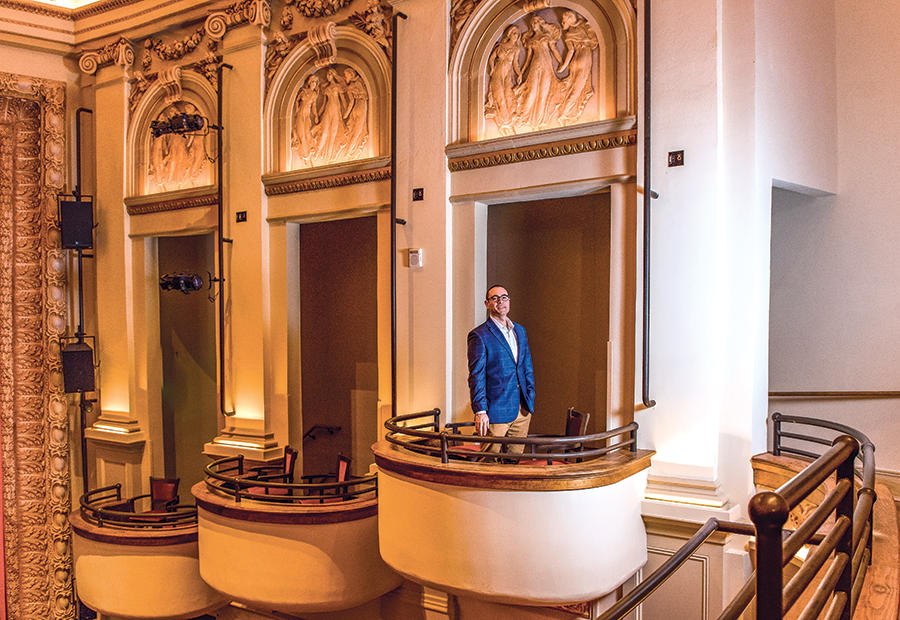
In its nearly 120-year history, the Academy Center of the Arts has seen highs and lows.
It was once a prominent, glamorous theater that brought in traveling shows, musicals, and performers.
At its lowest point, it was shuttered for six decades before restoration groups fought and fundraised for years to finally renovate the historic landmark back to its former glory.
Dr. Bill Kershner, volunteer archivist at the Academy, said there have been several stages in the life of the theater lasting longer than a century.
The golden age of the Academy began in 1905 and lasted until about 1915, he said.
The Academy opened in February of 1905 and had first and second class touring companies who would come to the Academy after their Broadway shows.
Photos Courtesy of The Academy Center of the Arts
“Lynchburg was an important stop because these touring companies didn’t want to travel without making any money every day. They didn’t want to play for, say, a week in Washington D.C. and then a week in Atlanta, and then lose a couple of days traveling. So they would book these things together,” Kershner said. “So Lynchburg was on that circuit. We had the same shows that everybody read about during this period.”
The Academy also offered cheaper events that were popular with different groups in the community.
“So the Academy always served several different parts of the community,” Kershner said. “It wasn’t just the wealthy folks.”
Aside from the touring companies, the Academy also held concerts and recitals, some of them by internationally famous acts. They even tried wrestling in 1914, and Kershner says he is still wrapping his head around how that was pulled off.
Parts of the Academy burned down on April 20, 1911, and the interior was destroyed. No one knows what caused the fire, but the best guess was it was caused by the furnace, Kershner said.
It was rebuilt and reopened in December of 1912 and the interior was even grander than the original—and it was that version that became the prototype for the restorations in 2015. The next period of the Academy brought in silent films, though the building wasn’t fitted for that type of venue until a third stage was built in 1928 for talking movies.
“For about two years, it does first run films and the Academy is once again on the forefront of entertainment in Lynchburg—but that only lasts a few years, because in 1930 the Paramount, designed as a movie theater, opens across the street, and after that they’re really a second-run theater,” he said.
Most people who remember the Academy from this time will remember viewing the serial films shown on Saturdays.
The theater showed some movies that were about a year or two old, ran serials, and held the occasional vaudeville show until it ultimately closed in 1958 and remained shut for 60 years until it reopened in 2018.
For the first 10 years of its closure, it fell into disrepair until the announcement that the 5th Street bridge would be built right through it in the late 1960s
A group of citizens rallied to secure a historical landmark status in 1969 and got the bridge rerouted, Kershner said, and although that group had hoped to restore it, raising money was difficult, so it continued to sit for another 15 years until the early 1980s when it was bought by Liberty University who had the idea to restore it.
That never happened though.
In the 1990s it was sold to the Friends of the Academy for the low price of about $10, Kershner said, and in 1996 it merged with the Fine Arts Center.
“That’s when the Fine Arts Center was torn down and they raised the money for the Warehouse Theater and the building next door, which became the art galleries,” he said.
It wasn’t for another 20 years when other spaces were being renewed downtown that people saw possibilities for the Academy to be a part of that renovation work. “People saw that downtown was coming back to life,” Kershner said.
Photos Courtesy of The Academy Center of the Arts
In 2015 they began seriously raising money and were successful, which was around the time that CEO Geoff Kershner—Bill Kershner’s son—took over.
“So that was pretty gratifying to us that it was while Geoff was executive director that it actually happened,” he said.
By December 2018, the historic theater was back open after a $30 million restoration project.
Nearly 50 years after community members were able to begin fundraising efforts for the Academy and save it from demolition, the beloved historic space was able to live on with the same mission it’s had all along of serving citizens from all backgrounds.
That inclusivity is an important piece of Chief Programming Officer Michelline Hall’s job, who said the mission of the new Academy is to have arts be accessible for all people in the community.
“A part of that is having camps and classes that people can attend and participate in and then another piece is providing financial support for people who can’t afford it,” she said.
New to the Academy that was not a part of its original function is the art galleries and educational classes that the community now has an opportunity to be a part of.
It recently has begun offering Academy in Motion, a mobile arts program that seeks to impact members of the Lynchburg community by providing arts access to groups and individuals with barriers that would otherwise prevent exposure to the arts on their physical campus.
Hall said the bus goes to the YMCA, adult day care centers, and schools to bring programming straight to participants.
She said it also has a partnership with the Virginia Cooperative Extension on an initiative called Plates and Paints, which is a food and nutrition program. The program works with people digitally to make a healthy plate of food in a way that is diverse in color just like a paint palette would be.
The Academy is also open for school field trips and offers students to take a class, see a performance or the art galleries, or learn the history of the building.
Photos Courtesy of The Academy Center of the Arts
“That’s the programmatic aspect of being intentional about how often we’re creating those moments where we’re able to tie in that educational and cultural component because a lot of these kids, just by expanding their horizons, you never know what they may decide they can do,” Hall said.
Hall said the Academy is going to invest in the best acts and artists that it can bring in, but wants to make sure that it’s bringing everyone to the table to enjoy it.
“I don’t know how many doors were opened just from people seeing something or experiencing something or hearing someone that inspired them and allowed them to go down a certain path,” Hall said. “I’m not anticipating that kids that come in here to all become amazing visual artists, but maybe they feel like they can do something else in their lives that they thought they wouldn’t be able to do.”
That’s a beautiful thing about the arts. The arts are cross-cultural, Hall said, and reach across all demographics.
“Good music touches everyone,” she said. “It doesn’t have a zip code, it doesn’t have a salary cap or limit. There are certain things about the arts that just unify all of us together.
And we’re trying to constantly be the catalyst for that.”
Calling All Good Dogs
Centra Looks to Rebuild Pet Therapy Program
Joyce Bailey wandered into the world of pet therapy quite by accident close to 20 years ago, when she took her young Bichon Frise, Amie, to a trainer.
“The trainer said, ‘You know, she would make a good therapy dog’ and told me the tester was coming into town in the next couple of weeks,” Joyce recalls. “Well, she passed with flying colors!”
Before long, Amie was a familiar face (or should we say, snout) in hospital rooms, nursing homes, and classrooms in the Lynchburg area. Bailey later added another Bichon Frise, Cece, to the family about seven years later, who quickly followed in the footsteps of her big sister.
Bailey rotated her therapy visits between the two dogs until Amy passed away four years ago. Now, Cece remains as one of the “old school” therapy dogs you’ll find roaming the halls of Centra Health’s two hospitals.
“It just pleases me so much to bring Cece in and see somebody smile and have a nurse say, ‘That’s the first time we’ve seen a smile from that patient.’ That warms my heart,” Bailey said.
Photography by Ashlee Glen
According to Therapy Dogs International, therapy dogs are simply defined as dogs with outstanding temperaments. They tolerate other animals well, love children, and enjoy meeting new people.
Therapy dogs can often be confused with service dogs or emotional support animals, but therapy dogs do not provide a specific service for people with special emotional or physical needs. As further explained by the American Kennel Club, the purpose of therapy dogs is to lend comfort and affection to people in a facility or setting such as a hospital.
“There are sensory benefits. When you touch a dog, it’s warm and soft. Also, I think there is something about a dog’s eyes. When they look you in the face with those eyes and they are so accepting,” said Bailey.
While you may be thinking “my sweet pooch could be a therapy dog,” many organizations, such as Centra, require that therapy dogs be certified by a reputable organization such as Therapy Dogs International, which is who Bailey used to gain her dogs’ certifications.
“It’s not so much about being a trick dog but they have to walk on a leash without pulling, they have to sit when you tell them to sit, and stay when you tell them to stay,” she explained. “What I thought would be the hardest for my dogs was to leave them with someone they don’t know then leave the room for three minutes and not have them panic.”
Photography by Ashlee Glen
Sylvia Beamer, director of volunteer services at Centra, explained that proof of certification is just the first step in the vetting process for their therapy dog program, which was officially formed in 2015. Dogs also have to go through Canine Good Citizen training from the American Kennel Club.
“We interview the handler as well as the pet to make sure both are a good fit for the organization and patient population. We onboard them just like any other volunteer and have an orientation. Then we will shadow the pet and make sure the pet is doing well and truly fits the therapy mode that we need,” Beamer explained. “After they are shadowed by another experienced handler, they are able to go out on their own.”
Unfortunately, there hasn’t been much paperwork to sift through or shadowing to oversee recently. According to Beamer, there are only two or three therapy dogs on Centra’s list right now. Ideally, they would have 20 to work with in both hospitals.
“During COVID we had pets that aged out of the program or handlers who were in bad health,” she said, adding that the pandemic likely affected certification testing schedules. “Now we are truly looking for more therapy animals and are trying to build our program back up.”
It’s worth the effort because the benefits for patients are clear. Beamer notes that in a hospital setting, oftentimes patients have a furry friend at home that they miss.
Photography by Ashlee Glen
“Or it could be someone who doesn’t have any visitors because their family lives elsewhere. Or simply just someone that the nurses have identified is going through some depression. The nurses are great about making sure the therapy dogs are offered to the right rooms,” she said.
In one case, Bailey and Cece weren’t exactly welcome—at least not at first.
“I stopped by an open door and this patient said, ‘oh no, don’t bring that dog in here.’ I stood at the door and said that’s fine, I hope you feel better. I walked on and pretty soon the patient yelled out to me…. ‘you can come in with the dog.’ So I came in,” Bailey recalls. “A little bit later she said to me, ‘I think I would like to pet that dog.’ She petted her. Then after I left, she got out of her chair, walked into the hallway and called after me… ‘tell me what kind of dog that is, I think I might want to get one of those!’”
Therapy dogs have a knack for turning skeptical individuals into “dog people.” Just ask Beamer.
“To be honest I have always had a fear of dogs, until we had pet therapy. I had a couple of bad circumstances in the past,” she explained. “Not only have I witnessed what pet therapy does to calm a patient, they also have such a calming effect on me.”
She says the visits from dogs like Cece are also great for hospital staff, who work long hours in a high stress environment. They also encourage handlers to take the therapy dogs through waiting rooms.
“For a family who is waiting for news, that’s a stressful time. There is no simple surgery. When those pets go through the waiting room, that just brings the family some relief,” said Beamer.
Photography by Ashlee Glen
If you are considering seeing if your pooch has what it takes to be a therapy dog, here are a couple requirements for certification, as listed on the website for the Alliance of Therapy Dogs, another well-known and reputable therapy dog organization: ∙ Dogs must be at least one year old. ∙ All breeds are accepted. ∙ Dogs must be current on all vaccines required by local laws, have a negative fecal test every 12 months and be clean and well-groomed for each visit.
The testing process depends on which therapy dog organization you are working with. Each organization has its own set of standards and checklists. It’s recommended that you work with a program that is recognized by the American Kennel Club (see sidebar).
And if your dog does pass the certification test, just a warning—you may end up on the receiving end of the therapy, too.
“There were days when I would pull into the hospital parking lot and think… I don’t know if I have the energy to do this. But when I left I felt 100 times better than when I went in,” said Bailey. “The hospital is a great leveler. You walk into a room and you don’t know whether you are talking to a CEO of a company or someone who lives under a bridge. Everybody is the same. I just felt exhilarated after talking to everybody and seeing my dog make everyone so happy.”
The nickname “Hill City” dates back to the mid-1800s, Lynchburg Museum Director Ted Delaney said, but the idea of our seven hills is more unknown.
He believes it probably originated around Lynchburg’s sesquicentennial in 1936.
“My guess is that at that point it was probably pretty well accepted that we’re the city of seven hills and we’ve got seven distinct hills,” he said. (Technically, there are eight—but we will get to that in a moment.)
You could say that it’s unique for Lynchburg neighborhoods to be named in this way, but as Delaney explains, it’s actually pretty common for cities to advertise that they have seven hills.
“That was the custom or tradition of Rome and people were trying to kind of piggyback on that,” Delaney said. “And a lot of places claim that but I think what might set Lynchburg apart is that a lot of our neighborhoods still carry the hill name and the hill is still part of the name in the neighborhood.”
This is why Delaney believes each hill should be uniquely preserved.
“It’s unique to Lynchburg because there is no other city that has a Garland Hill, Daniel’s Hill, a College Hill, etc,” he said. “So just from the perspective of being unique and trying to be authentic to your place, I think it has a lot of value.”
On the following pages, Delaney helps us share the early history of each hill.
College Hill Est. 1815
The largest of the hills, College Hill was originally known as “White House Hill” before military school Lynchburg College was built (no relation to what is now the University of Lynchburg). The general boundaries of College Hill are the Expressway, Kemper Street Railroad Station, and Old City Cemetery. It adjoins Federal and Diamond hills.
College Hill is home to Anne Spencer House and Garden Museum, the John Warwick Daniel statue on Park Avenue, the home of Confederate General Robert Rodes and the brickyard of Christopher Lynch, son of town founder John Lynch.
Even though this is the largest of the city’s hills, you don’t often hear this area referred to by its official name. Delaney said it’s expected that would happen over time.
“Because it’s so well documented of what it used to be and what I would hope is that there’s some way that it is preserved, whether that’s in a historic marker or maybe there’s a place that keeps the name,” he said.
Court House Hill Est. 1813
After Lynchburg’s courthouse was completed in 1813, it was discovered that the building was not within the town’s limits. In 1814 the town boundaries were extended, and the name “Court House Hill” came into use. This is considered the “extra” eighth hill in Lynchburg.
“Most historians don’t include it in the standard seven. Because it includes John Lynch’s original 1786 town, and because it has had so few residences compared to the others, many people don’t consider it a true neighborhood,” Delaney said.
According to the Lynchburg Museum, when John Lynch chartered the town of Lynchburg in 1786, its 45 acres included Commerce, Main, and Church streets, bounded on the east by Twelfth Street and the west by Fifth Street. With the entire town on a hill sloping down to the James River, the area was sometimes called “Lynchburg Hill.”
This hill had many homes built in the early 1800s, with the John Warwick Daniel house completed in 1826 and the Carter Glass home on Clay Street in 1827.
In 1855, the second Lynchburg Court House was built on the site of the original with a view down Ninth Street to the river where Lynch’s Ferry stood. In the late 1970s, the second courthouse became the home of the Lynchburg Museum.
Court House Hill is also home to a number of churches originally built on what became Church Street.
The Lynchburg Museum website states that by the mid-20th century, the churches had all moved to other areas of the city. After 1880, large churches were built on Court and Clay streets.
In the 20th century, the Academy of Music opened, as did a new post office and several schools. As a memorial to the World War I dead, Monument Terrace was completed in 1925.
Daniel’s Hill Est. 1870
Bounded by the James River, Blackwater Creek, and H Street, the hill is named for the Daniel family.
This hill is home to Point of Honor, which Dr. George Cabell had purchased in 1805. His land included much of what is now Daniel’s Hill, plus the river islands and the flood plain where U.S. Pipe Foundry is now located.
Daniel’s Hill was a very industrial and commercial neighborhood with factories all around, Delaney said.
“A lot of people who worked in those factories lived in the neighborhood, but they didn’t live on Cabell Street,” he said. “They lived in smaller, more working-class, affordable housing that was on the side streets.”
He said it’s important for people to look more broadly at what makes a neighborhood instead of just recognizing the famous white people who lived on the main streets.
“We have to look at the supporting side streets and all the other supporting structures in the neighborhood,” he said, adding we should be thinking about where enslaved people lived in these older neighborhoods. Sometimes it was in quarters that were behind a house.
Diamond Hill Est. 1820s
Diamond Hill lies to the south and west of Downtown Lynchburg and has steep terrain and ravines. The naming of Diamond Hill is still a mystery, according to the Lynchburg Museum, but theories include that the hill was named for wealthy residents, triangular-shaped lots, or sparkling minerals in the soil.
Two hospitals once stood along Grace Street including Marshall Lodge Memorial Hospital, which opened in 1886 and closed in 1971. In 1931 the Guggenheimer family home became Guggenheimer Memorial Hospital. >>
Photos courtesy of the Lynchburg Museum
Federal Hill Est. 1819
The smallest of the city’s seven hills, Federal Hill is bounded by steep hills near Twelfth Street and valleys near Eighth and Madison streets.
According to the Lynchburg Museum website, Federal Hill was originally outside of the town’s limits and was considered Lynchburg’s first suburb.
While the Federal Hill name shows up by 1839, its origin is not known. When the nation was first founded, leaders such as George Washington and John Adams were known as “Federalists.” The name may be related to their political party.
Delaney says there is a spot in Federal Hill where there used to be a whole row of enslaved housing for people who worked in factories.
Photos courtesy of the Lynchburg Museum
Franklin Hill Est. 1820s
Franklin Hill is one of the most clearly defined hills in Lynchburg, bounded by the Lynchburg Expressway to the west, Main Street to the north, Florida Avenue on the east, and Fishing Creek along the south.
It is believed the hill was named after Benjamin Franklin, the Lynchburg Museum states.
The most well-known landmark in the neighborhood is Presbyterian Cemetery, founded in 1823.
Delaney said there might just be about one in 1,000 people who have ever heard of this hill because many would consider themselves residents of White Rock Hill.
“So the fact that it’s on paper and someone says it’s an original hill may not really have any value or meaning if the people today don’t think of it that way,” he said. “Think of the hills very broadly and not just as a couple of beautiful houses and famous people. But think of the whole history of what were some of the other activities that were happening in the neighborhood.”
Photos courtesy of the Lynchburg Museum
Garland Hill Est. 1845
Originally, Garland Hill was the farm of William Lynch, Sr., the son of Lynchburg founder John Lynch. Blackwater Creek forms the boundary for much of the neighborhood along with a portion of Fifth Street and the valley near Old City Cemetery.
The oldest home still in its original location in the city is at 619 First Street in Garland Hill. The “Lynch House” was built by the Lynch family in 1787. According to the Lynchburg Museum, William Lynch, Jr., left the land to his cousin Celine Dupuy, who sold off block-size lots beginning in 1845. By the mid-19th century, there were so many members of the Garland family living in the neighborhood that the hill became known as Garland Hill.
Part of this Hill also bleeds into Tinbridge Hill, which is an example, Delaney said, of how the definition of the hills and its boundaries has changed over time.
“I think there’s a lot of really arbitrary nature in the definition of the hills and how their boundaries were defined and who named them,” he said. “There are a whole bunch of people who live in that area who call themselves Tinbridge Hill, but someone decided a long time ago it was Garland Hill. So we just have to think about whether the boundary is legitimate, accurate and meaningful.”
Photos courtesy of the Lynchburg Museum
White Rock Hill Est. 1870
This hill is located east of Franklin Hill and is bounded by Florida Avenue, the James River and Fishing Creek. White Rock Hill was named for the outcropping of white quartz rocks along the bluff of the James River that was a well-known local landmark, the Lynchburg Museum states.
A portion of the hill was incorporated into the city in 1870. The steep hillsides of this neighborhood prevented development, and the area was not fully annexed into the city until 1908.
The seven-acre White Rock Cemetery was established in 1882 for African Americans and was used by many local Black churches for more than a century. The Lynchburg Museum states that approximately 4,000 people are estimated to be buried there, one of whom is believed to be Ota Benga, a member of the Batwa or Mbuti tribe of the Congo.
While knowing the history of our city’s original hills is important, Delaney says we should also remember to look to the current residents of these hills and ask them how they would define their neighborhood.
“It’s an opportunity to learn more about your place, where you live and the community in your neighborhood,” he said. “On one hand I know the city’s got to change so we want to strike a balance of remembering history and preserving memories but also making space for your city to grow and evolve.”
What About the Other Hills? There are four additional hills, or well-known neighborhoods, in Lynchburg: Cotton Hill, Tinbridge Hill, Chestnut Hill, Fort Hill. Learn more about these hills at www.lynchburgmuseum.org/more-hills.
The Troops Rally
Lynchburg’s Longest Weekly Consecutive Event Shows Support for Veterans, Active Military and Their Families
Vietnam War veteran Steve Bozeman didn’t realize what he had gotten himself into on Nov. 30, 2001 as he organized a peaceful gathering in downtown Lynchburg. Little did he know, that event would have massive influence on the greater Lynchburg veteran community and surrounding areas in the years to come.
Following the tragic events of 9/11, President George W. Bush deployed troops to Afghanistan. The world watched as the United States plunged into conflict with radical terrorist groups the Taliban and Al-Qaeda.
Photos by Ashlee Glen
Meanwhile in Lynchburg, a protest opposing the war occurred on the steps of Monument Terrace in downtown Lynchburg, an iconic city location. In response to this protest, 80 veterans and patriots, led by Bozeman and several others, gathered on the other side of the street to peacefully counter the demonstration and show support for the war efforts in Afghanistan. At that point, there were no American casualties in what would become a near two-decade feud.
Following the counter-protest, World War II veteran James Hazelwood asked Bozeman, “Is everyone coming back next Friday to have a second rally?”
Photos by Ashlee Glen
“Well, I didn’t plan on it myself,” Bozeman replied. It just so happened that the following week, Dec. 7, was the anniversary of Pearl Harbor, the infamous Japanese air strike in 1941 that claimed nearly 2,400 American lives. Upon this realization, Bozeman agreed: “Hell, yeah I’ll come back!”
Several others gathered at Monument Terrace on Dec. 7, 2001, to commemorate the lives lost at Pearl Harbor and to again show support for American troops in Afghanistan.
“Then we came back the third week, and people just showed up, and the momentum built up from there,” Bozeman said.
Photos by Ashlee Glen
Since that first Nov. 30 gathering, the weekly Friday meeting known as the “Troops Rally” has taken place every consecutive Friday, totaling more than 1,040 weeks. Veterans, families of veterans, and members of the city and surrounding areas congregate to remember the sacrifices and celebrate American heroes.
“You can’t walk away from the Troops Rally without having inspiration in patriotism that’s displayed there every Friday,” Bozeman said. “To me, this is very fulfilling. My heart swells with all the things that we have done for two decades now. And it’s only starting.”
The weekly gatherings are as unique as their meeting place: Monument Terrace. This iconic downtown Lynchburg location honors the lives lost throughout America’s darkest conflicts, beginning from the Civil War.
The landmark has 132 steps and is decorated with several markers and monuments. Even since being renovated in 2002 and fully renovated in 2004, the Troops Rally has found ways to remain near the monument every Friday. There is even a designated “veterans’ room” 100 feet away from Monument Terrace that houses pictures, plaques, and posters, as well as other memorabilia.
Photos by Ashlee Glen
“There’s always an obstacle,” Bozeman said. “Marines have a saying, ‘improvise, overcome, and adapt,’ so we’ve figured out how to get through all of that.”
Meetings always end with the singing of the National Anthem, followed by announcements and the toll of the bell eight times at one o’clock—signaling “ending the watch.”
The group has campaigned for different local veterans’ efforts, including holding fundraisers for Richmond’s Hunter Holmes McGuire Hospital and supporting the National Center for Healthy Veterans Valor Farm in Altavista.
“The mission statement has always been ‘support our troops’‚” Bozeman said. “We do that, and we also support each other. The word has gotten out there that this is going on every Friday. The media has helped get the word out.”
Photos by Ashlee Glen
Between 50-80 participants, mostly Vietnam War veterans, attend the weekly gatherings on average. But thanks to heavy media coverage over the years, hundreds and even upwards of 1,000 have shown up depending on the occasion. On Sept. 10, the eve of the 20th anniversary of 9/11, the entire street was blocked off for the event.
The impact of these simple Troops Rallies can be felt throughout the Lynchburg community. Many nonprofits that specialize in veterans’ issues have found roots in the community because of the activism and attention brought about by the Troops Rally. One of these initiatives is the Lynchburg Area Veterans Council, a publicly supported 501c3 that for seven years has helped veterans avoid homelessness.
Photos by Ashlee Glen
The Lynchburg Area Veterans Council, which started in the American Legion building on Greenview Drive, has received grants from Pacific Life and the Greater Lynchburg Community Foundation. It also organized and executed two veterans’ parades, the first ever in Lynchburg since 1938.
“If we didn’t have the weekly Monument Terrace Troops Rallies going on for 20 years, I don’t think there would be a Lynchburg Area Veterans Council,” said Tom Current, a retired army Colonel in Special Forces, and the president of the Lynchburg Area Veterans Council.
Eighteen months ago, the Lynchburg Area Veterans Council purchased the birthplace and childhood home of Desmond T. Doss, a Lynchburg resident and a Medal of Honor recipient who saved 75 people during World War II. The Garfield Avenue property is being used to house previously homeless veterans. The City of Lynchburg even adopted a proclamation making Oct. 12 Desmond T. Doss Day in Lynchburg.
Photos by Ashlee Glen
The National Center for Healthy Veterans at Valor Farm, a nonprofit that helps veterans avoid suicide and reintegrate into society, recognized the tremendous veteran support in Lynchburg and the surrounding area.
“Veterans share this bond, and I’ve tried to figure out what that is, and I think I have the answer,” Current said. “Veterans served different capacities, and we all put the mission ahead of our own desires. We put ourselves second. That takes character. That’s what binds all these different veterans, different ages, different services….”
Photos by Ashlee Glen
“There are a lot of good Americans who have character and understand what it means to have a heart of a servant,” he added. “And that’s why I have hope.”
Bozeman, who has attended over 1,000 meetings, said that the purpose of the Troops Rallies has always been and will always be about supporting troops, veterans, and their families. He doesn’t see the weekly gatherings ending anytime soon.
“Everyone feels connected. Everyone is glad about what is going on in Lynchburg,” Bozeman said. “The future is unknown. We still have troops all around the world. So, I don’t see these Troops Rallies going away.”
Shoes With A Mission
Liberty alumnus tells story through new book about life in war-torn Congo.
Even after running through the Congolese jungle barefoot, Liberty alumnus Emmanuel Ntibonera says he still spends most of his days not wearing shoes.
“I think part of me is sick of shoes after seeing them piled up in my home for so long,” he laughed. “Every inch has boxes of shoes. It got to be too much. I don’t even want to wear them anymore.”
Ntibonera has spent the last several years collecting more than 70,000 pairs of shoes for the people of Congo, a mission he details in his book Congo Sole, which came out in October. The book tells the story of Ntibonera and his family as they escaped war-torn Congo and came to the United States.
“The biggest takeaway I want people to get from the book is that there is hope,” Ntibonera said.
“Though we may fall, you can get back up. There is nothing you can’t overcome. I look back at everything that I’ve been through, and see? I’m still standing because I have hope in the Lord.”
Humbled Beginnings
Born in Congo as the oldest of nine siblings, Ntibonera said he and his family had a fairly normal life before the war.
The Ntiboneras lived in a seven-bedroom house, which was part of a larger compound his dad owned and rented out. While they lacked American comforts such as running water or taking the bus to school, the Ntiboneras were surrounded by a loving community where everyone looked out for each other.
But that all changed in 1996 when Africa launched into war as Rwanda invaded what is now the modern-day Republic of Congo, which led to violence and genocide across the country.
At the time Ntibonera was eight years old.
“War broke out as me and my family sat down for dinner,” Ntibonera explained during his Liberty University Convocation appearance last November where he shared his testimony. “Chaos, people running. You could hear gunshots in every direction and every corner of the country.”
In that moment, Ntibonera said he and his family prayed for peace as they sat in the darkness. Over the radio, they learned that rebel forces had taken over their city.
As a large family, the Ntiboneras began to make a plan to leave the city alongside their extended family knowing that there was danger ahead as they trekked throughout the jungle. Ntibonera said his family kept saying, “Keep moving forward.”
“As my bare feet carried me, one step at a time, my eyes and ears absorbed horrors I’ll never forget,” Ntibonera describes in his book. “Limp bodies, painted with dry blood, were laid out on the side of the road. Women’s screams, muffled by rows of vacant houses, turned my stomach, even though I was too young to fully understand what was happening.”
Suddenly, his family members were refugees in their own country, but Ntibonera said his father vowed that they would not die in Congo. Eventually, the family fled to Kenya. There they filled a tiny apartment and waited for a door to open so they could come to the U.S. In 2009, it did, and the family found themselves settling in Greensboro, N.C.
“We suddenly had to adapt to a new place and culture,” Ntibonera explained. “The Lutheran Church helped us get to America and they were able to set us up with a social worker for the first six months of our time in Greensboro, but then we were on our own.”
As Ntibonera became more settled in America, he decided he wanted to pursue an education and found himself applying to Liberty University—only an hour and a half up the road from their new home.
“It was hard being away from my family,” Ntibonera said. “We had this bond. We had been through so much together and we had been together my whole life.”
But Ntibonera said God was preparing a place for him at Liberty, and he didn’t know it at the time, but it involved 20,000 pairs of shoes.
Finding sole in tragedy
Ntibonera said he soaked up life as a student at Liberty, where he heard from speakers from all over the world during their twice weekly Convocation.
But the person who stood out from the stage the most was Senior Vice President for Spiritual Development David Nasser. Like Ntibonera, Nasser himself was a refugee after fleeing Iran as a child.
“Here was a man who was a refugee who was speaking to thousands of people,” Ntibonera said. “It made me feel like he could do anything.”
As Ntibonera sat in Convocation each week, he also heard about humanitarian trips Liberty students would take to serve people all over the world.
“I remember they were talking about students going to Rwanda and I thought, ‘Why can’t they go to Congo too? It’s right there’,” he said. “I told my siblings that someday, someone was going to talk about the Congo from that stage.”
At the same time, Ntibonera said God was stirring something in his heart that it was time to remember where he came from and give back to his people who were still hurting halfway across the world. As he went through his closet, it came to him: shoes.
“I remember thinking, ‘Why do I have so many pairs of shoes?’,” he said. “At one time, I didn’t have any and I was praying out to God for a pair.”
Ntibonera said that many children in his country did not have shoes growing up, which put them at risk for disease, sometimes even fatal ones. Sending shoes to Congo could potentially save lives, he thought.
Ntibonera began collecting shoes on his own, filling any space he could with shoes. But soon he was overwhelmed and realized that if he was going to accomplish his goal, he needed help. He decided
to turn to Nasser to see if there was anything Liberty could do.
He emailed Nasser for a meeting and within a few hours of talking, Nasser set a plan in motion: they would host a campus-wide shoe drive with the help of NBA player Steph Curry and his wife, Ayesha, during Convocation.
“God ordained that meeting,” Ntibonera said.
Liberty’s Vice President of Spiritual Development Josh Rutledge said after their initial meeting with Emmanuel, it wasn’t his story that stuck out.
“A lot of young people, especially students, have remarkable stories,” he said. “But Emmanuel’s story was tied in with a dream and a personal plan of action, and not only that, it was a plan he was pursuing regardless of whether anyone else got on board with it or not. That’s always going to stand out. When someone says, ‘Look, here’s what I feel called to do, and here’s the steps I’ve taken to make it a reality. Would you like to join?’ That’s Emmanuel. He’s not out looking for permission to do something. He’s out extending invitations to join him in something he’s already doing.”
Then in March 2017, Ntibonera’s declaration came true. During the Curry’s March 2017 Convocation visit, Nasser invited Ntibonera to share his story from the Convocation stage.
“I remember before Convocation sitting in the green room with Steph wondering how I got here,” Ntibonera said. “Part of me just wanted to sit back and take it all in from the audience and just see what God was doing.”
More than 20,000 shoes were donated by not only the Currys and sponsors such as Nike and Under Armour, but by the Liberty student body.
“I think our students are often the ones leading the way at LU when it comes to service and ministry,” Rutledge said. “We’re always much more interested in joining with what they’re already doing than trying to invent something new. Emmanuel’s mission had a very practical call to action. ‘Do you have a nice pair of tennis shoes lying around that you’d be willing to donate?’ That was it.”
Since then, Ntibonera said that he has raised more than 70,000 shoes for the people in the Congo and has traveled to the country to deliver them more than three times.
“There is still so much work that needs to be done there,” he said, noting that sales from his book, Congo Sole, will go toward building a community center in the country where individuals can seek medical care, counseling, and start businesses.
“My people have been through so much,” he said. “There is so much trauma and hurt. A pair of shoes is a start but can only last so long. I want to be able to support them long-term.”
Ntibonera, who now lives in Nashville, said Lynchburg played a huge part in his story and helping him grow into the person he is now.
“Lynchburg was my temporary home, but in a way, it will always be home,” he said. “Liberty impacted my life in so many ways. It was incredible to see students and people from the community come behind me and say, ‘Yes, we want to help’.”