Summertime in the south-is there anything better? We’ve corralled the best ways to beat the heat, soak up the long days, and enjoy local summer bounty so you never have to spend a single moment wondering what to do this summer.
Room at the Table
Amelia Perry Pride’s Steadfast Quest for Equity in—and Beyond—Home Economics
By: Emily Mook | Photos by Ashlee Glen
“I would rather wear out working among all classes of my race than to rust out seeing so much to be done.” – Amelia Perry Pride (in a letter to Orra Langhorne, 1899)
Although she was one of Lynchburg’s most groundbreaking, altruistic, and inspiring citizens, Amelia Perry Pride is not as well-known as she should be.
“During her time, everybody knew her, and yet today, I feel like nobody knows her,” said Ted Delaney, Director of the Lynchburg Museum System.
Photograph of the Polk Street Elementary School, 908 Polk Street, Lynchburg, Virginia, in 1911. Principal Amelia Perry Pride (1857–1932) is pictured standing on the right holding a hat in her left hand. This was Pride’s last class before retiring after 30 years as an educator in the local public school system. Photo courtesy of Lynchburg Museum System.
Perhaps this is partially the case because Pride, a free biracial woman born in Lynchburg in 1857, did not seem to be concerned with her own prominence. A monumentally generous and seemingly tireless philanthropist, Pride focused her energies on bettering the lives of others—particularly people of color who were less fortunate than she—rather than on widely broadcasting her own name and achievements. Additionally, Pride was more concerned with practical matters of equity and equality than with outright innovation. It also cannot go without saying that the accomplishments of people of color are routinely and unjustly undervalued.
Whatever the reasons may be for Pride’s relative lack of present-day recognition, her story is unquestionably worth knowing and celebrating. Among her most remarkable endeavors are her founding and running of the Theresa Pierce Cooking School, which ultimately became the basis for the public home economics curriculum for Lynchburg City Schools.
Born to biracial parents and orphaned by the age of 16, Pride demonstrated early abilities to take care of, motivate, and challenge herself. After attending local schools as a child, she continued her education at the highly esteemed Hampton Normal and Agricultural Institute (known today as Hampton University) and graduated in 1879 from the teachers’ education program. Upon her graduation, Hampton immediately hired Pride to teach a group of Native American girls through its missionary program. Over the next decade, she taught at various Lynchburg public schools, including Polk Street Colored School, Old Payne School, and Jackson Street School, and she went on to serve as the principal of Polk Street School from 1890 to 1911. She was one of the first Black women employed by the Lynchburg School system. Pride also established The Dorchester Home (a retirement home for elderly Black women) in 1897, the McKenzie Sewing School (a free sewing school for Black children) in 1898, and the Theresa Pierce Cooking School (a free cooking school for Black girls) in 1903.
The Theresa Pierce Cooking School was held in a house owned by Pride and her husband, Claiborne Gladman Pride, and located on Madison Street across from the couple’s home. Its name evinces a common practice of that time period.
“[A white couple named] Wallace and Stella Pierce donated money to Amelia Pride to start the school in memory of their deceased daughter, Theresa,” Delaney noted. “At Hampton Institute, each student was sponsored by someone, and students were expected to write their sponsors letters. Sponsors were typically white people in the North trying to help Black people in the South. Amelia Pride herself was expected to write letters to her sponsors to update them on what she was working on. She had this model of how you were supposed to do things: Get sponsors to underwrite your projects and keep in touch with them. It was very natural and normal for her to make contact with Wallace Pierce, get him to underwrite the school, and name the school after his daughter.”
In fact, Pride was generally extremely adept and resourceful when it came to using her identity as an affluent biracial individual to enact positive change.
This copy is inscribed on the inside front cover in blue ink “Sister C’s book”. Per correspondence from the donors, this was Caroline C. Smith (1877-1959) who was “informally adopted by the Prides when she was 9 years old”.
“Another thing she was very skilled at was, through her connections to the white community, getting white people to donate to her causes and being able to walk that line,” stated Delaney. “She was in a socioeconomic class where she could socialize with white people and gain their support while at the same time—because she was considered ‘colored’ or ‘Negro’ by the society of that time—she had full reign to work, lead, and start initiatives in Black communities. She used her position—which was very much on the line of race—to navigate both worlds.”
Although there are no rosters or other data sources indicating the number or ages of students who attended the cooking school, Delaney believes that students likely ranged in age from about eight years old (old enough to follow a basic recipe) to 15-20 years old (old enough to get work on their own). That said, he also thinks that Pride would have been unlikely to turn adults in need of basic cooking instruction away.
“It wouldn’t surprise me at all if she had some adults in the classes,” he said. “She was so equal opportunity. Whoever was in need, she was going to help.”
According to Delaney, Pride’s granddaughter Miriam Pride Kyle said her grandmother was committed to helping families learn how to grow and prepare nutritious foods. An avid gardener herself, Pride insisted on adding a garden to the grounds of Polk Street School to facilitate this learning and took matters into her own hands when her request was initially denied.
“The school board denied her request to plow a plot of land behind Polk Street School,” Kyle recalled in 1981. “She got a horse and plow and proceeded to do it herself. It was reported immediately and a man was sent out to do it. She taught gardening to pupils and canning to their parents.”
Pride’s focus on imparting essential skills also applied to her curriculum for the Theresa Pierce Cooking School.
“As far as I’m aware, there was nothing particularly revolutionary about her cooking and she didn’t have a signature dish,” said Delaney. “At that time, she was really worried that there were young people—and even older people—who maybe had been enslaved, were now on their own, and had never been taught things as basic as boiling water. She really focused on the core principles of cooking and being able to feed yourself. Reading her letters and articles that she sent to [Hampton Institute periodical] The Southern Workman, I think that in everything—cooking, sewing, The Dorchester Home—she was really about imparting those fundamental life skills that many of us take for granted and assume that everyone knows or has the opportunity to learn at home with family.”
The Theresa Pierce Cooking School was transferred to Virginia Theological Seminary and College (known today as the Virginia University of Lynchburg) during the 1916-1917 school year. An excerpt from the College’s 1920-1921 catalog (seen to the left) outlines Pierce’s (likely somewhat modified) curriculum.
In 1949, 17 years after Pride’s death, Lynchburg City Schools created a new home economics building at Dunbar High School and named it the Amelia Pride Center in Pride’s honor.
“The oral history is that her cooking school and curriculum were generally integrated into the public schools here for Black students,” Delaney noted.
Today, the Amelia Pride Center is part of the Paul Laurence Dunbar Middle School for Innovation campus, and it houses continuing education and alternative secondary education programs. Pride’s steadfast legacy lives on, and her name is one we should all feel proud to know.
“She was in command at all times!” Kyle said of Pride in 1981. “It was often said of her: ‘When Mrs. Amelia Perry Pride walks down the street, the street has been walked down.’ I’m sure she could have persuaded the rattles off a snake if she had to in order to help someone.”
“She strikes me as one of the hardest-working, most productive people who lived in Lynchburg,” stated Delaney. “Starting schools, starting an old folks’ home, and taking on the many other initiatives that she took on were not easy tasks by any means. These are major accomplishments, and they require not only your own hard work and investment, but also the ability to mobilize other people and to get other people to follow your vision and support you. It’s really amazing to see how much she accomplished and to think about the forces she was able to marshal to support her work. She was an incredible woman in this community.”
“You Must be a Friend!”
A cozy cafe inspired by a beloved children’s book
Deep within a whimsical bookstore, and among the pages of an old children’s book, lives a stuffed bear named Corduroy. The little Corduroy bear was the inspiration for Lynchburg’s latest cafe, of the same name, nestled in the back of Givens Books and Little Dickens.
Longtime patrons will remember the Drowsy Poet in that space. After the owners of the Drowsy Poet retired, Givens approached Jordan and Holly Nickerson—owners of Rookie’s and Bacon St. Bagels—to fill the space.
“The idea was initially for another Bacon St. Bagels. I didn’t think Bacon St. made sense for the space,” Creative Director Holly Nickerson said.
Photos by Ashlee Glen
Before Corduroy the bear, friend and manager at Bacon St. Bagels Court Smith served as the initial inspiration for Corduroy Coffee + Kitchen.
“I got involved with these guys at Bacon St. The coffee scene has always been something that I’ve really dreamed about. I got into coffee when I was in college,” Smith said.
Smith’s love for coffee and his aptitude for leadership helped to define what would eventually become Corduroy. Not only was Smith made general manager of the cafe, but he was also brought on as part owner.
“We really want to invest in our people. We want to leave them better than we found them. That was why, when this opportunity presented itself, my first thought was for Court,” Corduroy Regional Lead Jordan Hawkins said.
Photos by Ashlee Glen
Hawkins acts as the creative force behind the kitchen aspect of Corduroy. With an offering of familiar and unique dishes, Hawkins feels Corduroy’s menu sets them apart from most cafes in the area.
Although Rookie’s and Bacon St. have proven to be successful, Hawkins felt that their concepts called for a more limited menu.
“What was exciting about Corduroy was the opportunity to have a little more creative freedom to do what we wanted to do with the menu,” Hawkins said.
Photos by Ashlee Glen
Before the coffee and food were implemented, Holly designed the cafe with the existing space in mind.
“There’s this added element of everything that Givens and Little Dickens contributes to this space,” Holly said.
Corduroy recently added a unique snack menu for afternoons and evenings and hopes to add wine soon as well.
The design is purposeful and evocative. Deep greens and stark whites adorn the space, and the added lighting keeps the space vibrant without interrupting the cozy atmosphere of the book shop. The seating is soft corduroy, and even the wood paneling at the front counter evokes the gentle ridges of the fabric.
“There’s a lot of DIY stuff on this project,” Holly said.
“I’ve loved working on the space and making it look like a fresh cafe in Lynchburg.”
Having just opened in November of 2022, the Corduroy team is excited to expand and serve the community they already have established.
At A Glance:
Corduroy Coffee + Kitchen Located in Givens Books & Little Dickens 2236 Lakeside Drive, Lynchburg VA 24501 (434) 385-5027 • corduroycoffeekitchen.com
Hill City Eats
Downtown Lynchburg Association highlights downtown restaurants & recipes
In November 2022, Downtown Lynchburg Association released a surprise for the Lynchburg community: A cookbook, meticulously created with love that features 35 of downtown Lynchburg’s beloved restaurants.
Titled Hill City Eats, the cookbook features recipes from participating downtown locations with the hopes of inspiring readers to whip up a few of their favorites, but to also give readers a moment of appreciation for the hard work and dedication that restaurants put behind those favorites.
“This book is a symbol of progress, born out of a deep appreciation and love for our city,” said Ashley Kershner, Executive Director of Downtown Lynchburg Association. “And most importantly, it is a celebration of the small businesses that are at its heart. Today, with over forty restaurants, many of which have opened in the last ten years, it is safe to say that we have become a culinary destination—a diverse restaurant scene that has breathed new life into this city.”
The cookbook highlights the places, food, and restaurateurs that make Lynchburg the culinary designation that it is—from new favorites like Bacon St. Bagels and Fratelli Kitchen & Wine Bar to local icons such as Dish and Hot & Cold Cafe.
Folks looking to purchase a copy of Hill City Eats—which at this time will only be available in limited quantities—can do so on the Downtown Lynchburg Association website or at select distribution locations, which are also listed online. downtownlynchburg.com/hill-city-eats
The Summer Soul Came to Lynchburg
How Robert “DJ Mad Lad” Goins Shaped Lynchburg’s Culture
Local DJ and all-around renaissance man Robert “DJ Mad Lad” Goins’ influence on Lynchburg’s rich and complex cultural and musical identities simply cannot be overstated. At the tender age of 15, he saw that Lynchburg’s African American population lacked representation on the radio and set out with tenacity, curiosity, and ingenuity to address the problem. Goins’ fateful tale of the summer of 1966 is a testament to an individual’s capacity to enact positive change and transform a community.
In the early 1960s, Lynchburg’s radio station offerings did not come close to reflecting the vibrant diversity of the music being made or the artists making that music. In particular, soul music by Black artists had no avenue for reaching a broad local audience; access was limited to those who could afford to buy soul records.
“Growing up in Lynchburg in the ’60s, there was no soul station,” Goins recalled. “I didn’t know the difference between the different genres of music. Songs like Whole Lot of Shakin’ Going On; Ahab, the Arab; Does Your Chewing Gum Lose Its Flavour; and Peggy Sue were all that I knew about in the first, second, and third grades. I didn’t know anything about Black artists because the stations weren’t really playing those artists. Nobody played any soul music during the day. You might occasionally hear The Supremes or Chubby Checker, but those occurrences were few and far between.”
Little did Goins know that a trip to Chicago in the summer of 1966 would open up a new world of music not only for him, but also for the Lynchburg community at large.
“I didn’t know that there was such a thing as a Black radio station until 1966, when I spent the summer with my cousin in Chicago,” he said. “I heard this Black radio station and I said, ‘Wow, this is slick! I wish I could have some kind of way to get this kind of music out to everybody!’”
Photo by Ashlee Glenn
It didn’t take long for Goins—who was only 15 at the time—to begin turning that wish into reality. His first step was learning how to build a transmitter.
“I came across this popular electronics book called Radio-TV Experimenter, and they had this circuit board transmitter—a short-wave code transmitter—and I just started building it,” he noted. “All it did was make Morse Code noise on the air on the short-wave band. I just kept on messing with it and adjusting it and making it fall on a band where people could listen to it.”
The next step in the process was figuring out how to get music onto the radio.
“After some trial and error and a couple of blown circuit boards, I found a way to put music on the radio,” said Goins. “It was a daily experiment until I got something that worked, and it took me the summer of 1966 to figure it out. I finally got a circuit, hooked my record player and microphone up to it, and I was on the air! I could get a couple of blocks with it.”
Along the way, Goins—who did not yet realize that he was creating an illegal radio station—consulted with two of his teachers, neither of whom were aware of their student’s project.
“I had a couple of teachers—my electronics shop teacher and my physics teacher—who told me about crystals, which are the things that put the radio waves on the air,” he stated. “They didn’t know what they were helping me do! They thought I was just really interested in the topic.”
Photos by Ashlee Glenn
Once Goins figured out how to get music on the air, he realized that he needed access to additional music if he wanted to start his own station. Fortunately, he had plenty of friends who were happy to share their records in exchange for guest spots on Goins’ new station, which he named WKKD (KKD stood for Krispy Kreme Donuts).
“I didn’t have too much music at the time,” Goins recalled. “Records were 76¢ back then, and that was most of my lunch money. And that was only for a two-and-a-half-minute song, so what do you do for the rest of the time? I kind of depended on my friends who bought records all \the time. If you had a record collection, you could come be on the air!”
Still unaware that his station was illegal, Goins advertised with gusto.
“I put it out there that I was putting a soul radio station on the air and nobody believed it because the only time we heard soul music was when WLAC out in Nashville came through Lynchburg around 10:00 at night,” he said. “That was my bedtime! I put up posters and flyers all over the school telling people to tune in to 630 on their radio dials to hear all kinds of soul music starting at 3:00 p.m.”
Despite any initial skepticism, WKKD quickly gained a lot of traffic—literally and figuratively. A myriad of listeners consistently drove downtown and lined the streets within WKKD’s limited range to listen to artists like James Brown, Aretha Franklin, Marvin Gaye, Etta James, Otis Redding, and many more.
“Everyone seemed to like what I was doing,” Goins stated. “They would drive in range of the station, and that range was very, very limited. I lived at 1502 Pierce Street. On a good day, when it was nice and sunny, I might reach all the way past 5th Street and the Rivermont Bridge—that’s all the range it had. At 3:00, there was a huge migration of cars that parked on the side of the road so they could hear some music. Cars would line up on 12th Street and Pierce Street so they could get in range of the station. People would even dance on the side of the road!”
As WKKD’s popularity continued to skyrocket, one of Goins’ friends—who worked at a legitimate radio station—warned him that he could get into hot water.
“I didn’t know anything about radio regulations, FCC licenses, or any of that stuff,” noted Goins. “I just kept hearing from a friend of mine, ‘Yo man, you’re going to get into trouble! You might go to jail!’ And I said, ‘Go to jail for what? I’m just playing around with the radio here!’”
Ultimately, Goins did not get into legal trouble, but he was forced to shut WKKD down after about a year and a half on the air. By this point, however, Goins had already established himself as a central figure in the Lynchburg music scene and quickly embarked on the next chapter of his ongoing illustrious career—all before graduating from high school.
Photo by Ashlee Glenn
“There was a radio station called WDMS that played easy listening music on AM and FM all day, and they weren’t able to get advertisers,” Goins recalled. “Sponsors were calling them wanting to know where my station was so they could advertise on it. That did it. The guy [at WDMS] said, ‘We’ve got to do something about this,’ and they gave the FM—which became WJJS—to us. I didn’t know it was going to become as popular as it did—if I had known, I would have bought it! I was in eleventh grade at the time.”
WJJS went on to become the number one radio station in Lynchburg.
These days, Goins continues to DJ a wide variety of events in and around Lynchburg and can be heard on “The Groove” WGVY, an Oldies station on 102.3 FM, weekdays at 3 p.m. With his gregarious nature, boundless curiosity, and respect for all genres of music, he also continues to lead the charge in fostering connection and innovation through music.
“I play all different genres of music with the same level of enthusiasm,” he said. “I’m also the kind of person where, after about 15 to 20 minutes, you’re my best friend and I’m your best friend! That’s just the way I am.”
Upfront November/December 2022
Behind the Scenes The team behind the cover
To see our cover, you would think you had stepped into the middle of a holiday party. While the team did enjoy a festive serving of charcuterie after the shoot was over, the cover was actually shot in our office studio using a creative combination of bamboo flooring, coolers, and ladders.
Helping make the shot absolutely perfect was Vista Graphics Creative Director David Uhrin as photographer and Art Director Chris Meligonis, Office Manager Tracy Thompson and Web Content Manager Kelsey Thomas as our hand models. The greens were clipped from backyards in the middle of a tropical storm—not the most festive of weather, but definitely a memory to keep!
Read more on pairing wines and cheeses on page 125.
Mark Your Calendars
November 12 Thomas Jefferson Wine Festival It’s the favorite event of wine and history lovers alike! Join Poplar Forest on November 12 for their annual Thomas Jefferson Wine Festival. Sample from Virginia’s regional wines, enjoy live performances by local musicians, graze on foods by local vendors, and shop the artisan market for one-of-a-kind finds. Tour the president’s private retreat at a reduced rate throughout the day. Visit poplarforest.org for info.
November 24 Lynchburg Turkey Trot Join the 34th annual Lynchburg Turkey Trot, presented by Scott Insurance, on Thanksgiving Day! This beloved tradition is a great way to support local nonprofit organization, HumanKind, plus it’ll get your appetite ready to indulge in a hearty meal. Participate in-person on Thanksgiving Day or register to run virtually from anywhere you choose! Registration information can be found at humankind.org.
December 10 Christmas in Sedalia Christmas in Sedalia is an annual event that offers holiday shoppers an opportunity to purchase unique hand-crafted gifts for everyone on their list. The Sedalia Center and neighboring Mountain Run Farm partner to showcase the best of the region’s creative community. This is an indoor event and is free to the public. Santa always makes a surprise visit to take selfies with kids of all ages! Light lunch items will be available for purchase along with hot cocoa, and fresh-baked Christmas cookies to enhance your festive shopping experience. Visit sedaliacenter.org for more info.
December 13 Glenn Miller Orchestra The world-famous Glenn Miller Orchestra will perform on the Historic Academy Theatre stage on December 13, 2022. Enjoy the 18-member ensemble as it plays many of the original Miller arrangements. Additionally, it will also play some more modern selections arranged and performed in the Miller style and sound. For tickets and event information, visit academycenter.org.
November 26 & December 3, 10, and 17 Mistletoe Market Visit the Lynchburg Community Market for its annual Mistletoe Market! Take in the sights, sounds, and scents of the holidays with artisan vendors, handmade crafts, fresh greenery, and local produce. Horse drawn carriage rides through the city will take place on December 10 and 17.
Local Openings & Closings
Hello! to The Aloha Hut Hello! to Kline’s Dairy Bar Hello! to Goosehead Insurance Goodbye to Champion Brewing on Main Street Hello! to First Watch, The Daytime Cafe
Living Out Loud November/December 2022
Shout Outs Our recent story on KAYA Health’s art service project—The Art of Healing, found in our Sept/Oct issue—is gathering supporters for KAYA Health’s cause! Read what Dr. Andrew Anderson, owner of KAYA Health, had to say: “Thank you to Lynchburg Living magazine for the kind article and for bringing awareness to our little project. I just got a call from a Girl Scout troop yesterday asking to donate to our walls and purpose. I love seeing the kindness of others and sharing in the blessing that it is!”
Top Teachers Lynchburg Living is recognizing and honoring the amazing, inspiring educators in our area with the Lynchburg Living Top Teachers Awards. Submit your entries on lynchburgliving.com for your favorite current and local teacher who, if chosen, will be honored in our upcoming March/April 2023 issue of Lynchburg Living magazine. Nominations are open until November 30th.
Email us at megan@lynchburgmag.com. Correspondents must identify themselves; names may be withheld on request. Lynchburg Living may edit or condense.
To Hellgate & Back
LU Professor Brings Unique Ultramarathon into its 20th Year
When the clock strikes midnight on the second Saturday of December each year, there is no sign of bedtime for a group of runners at Camp Bethel in Fincastle. In fact, physical rest will only come approximately 18 hours later. Because the only way these athletes are getting back to where they started is via 66.6 miles of darkness, woods, steep elevation gains, and possibly—depending on the season—extreme winter weather conditions.
But this is the Hellgate 100K—and the race roster is full yet again.
“I think Hellgate is appealing to people because it’s such a difficult race,” said Dr. David Horton, race director. “People are attracted to tough things, to unique things.”
Horton, a professor of health sciences at Liberty University for more than 40 years, has a lot in common with the men and women who come out each year to attempt Hellgate, the race he founded in 2002.
Photo by Keith Knipling
Despite his impressive athletic resume, the 72-year-old didn’t start running until he was an adult, attempting his first ultramarathon (a race longer than a 50K) in 1979, not long after he started teaching at LU. After that accomplishment, he was hooked—it was the first of about 30 marathons and 160 ultramarathons he would log in the coming decades. Horton also ran across the United States twice.
“Volkswagens are suited for mileage but not for drag racing. I’m suited for longer distance runs,” Horton said with a laugh. “I found the further I went, the better I did.”
Alongside this newfound passion, Horton felt called to bring more ultramarathon opportunities to others. He founded the Mountain Masochist Trail Run 50 Miler (Montebello) in 1983, the Holiday Lake 50K (Appomattox) in 1996, and the Promise Land 50K (Bedford) in 2000.
Photo by Keith Knipling
Through the years, he directed these races, and dozens of others, but over time has passed each one on to someone else to lead—all except Promise Land and Hellgate, his two favorites.
Hellgate has had the same course since it was created 20 years ago. While it’s a 100K, the exact distance down the Glenwood Horse Trail ended up, ironically, being 66.6 miles.
Photo by Keith Knipling
According to Horton, Hellgate seems to have the largest and strongest following in the ultrarunning world.
“Runners from 30 or more states come and run it,” he said of the approximately 150 participants who take part each year.
John Anderson, a 47-year-old father and veterinarian in Crozet, will mark his tenth Hellgate experience this December. He is hoping for his ninth top-10 finish.
“Hellgate is like a test at the end of each year—a life test,” said Anderson, who started running marathons once he turned 30. “Not only are you in shape to tackle this race, which is so hard, but also are you in a mental space where you can handle the race?”
Photo by Keith Knipling
Each runner has to train and prepare for 13,000 feet of elevation gain during the Hellgate course; that’s about 2.5 miles of hills. Much of the terrain is covered with leaves and very uneven.
As is typical in the Virginia mountains, the weather is a mixed bag from year to year.
“We have anywhere from nice weather in the 70s to 10 degrees with a foot of snow. But we have never canceled a race,” Horton explained. “Two years ago, it rained for 10 hours during the race. We called that race Watergate, instead of Hellgate.
Photo by Jay Proffitt
There was also Snowgate one year.” There is also the dreaded Hellgate Eyes—a condition where your cornea literally freezes, causing blurred vision. About five or six athletes deal with this each year, Horton says.
The 12:01 a.m. start time means the first seven hours of the race are practically pitch black, with handheld flashlights or headlamps helping to guide the way.
Along the trail, Horton and his team set up nine aid stations that are manned by dedicated volunteers. These stations provide help to runners if they need it and also make sure they stay on course, especially during the nighttime hours.
All of the darkness is a prelude to Anderson’s favorite part of the race: “And then, the sun comes up. It’s like a rebirth, but right when things are getting tough,” he said.
Photo by Keith Knipling
In a way, the Hellgate race—with its demand for physical and mental fortitude— mirrors the life of its founder and director, who has been the subject of two movies, Extraordinary and The Runner.
After several knee injuries and surgeries left him unable to pound the pavement (or trail), Horton had to hang up his marathon days about a decade ago. But he didn’t take that as a reason to stop competing and quickly transitioned to distance biking.
This past summer, Horton completed a bike race from Portland, OR, to San Diego and finished it in just over 13 days. He has also biked across the United States twice.
Photo by Jay Proffitt
“Did I want to switch to biking? Nope. I wish I were still running,” said Horton. “But you always look for different challenges. And since I teach at LU, I want to be an example to my students.”
Horton holds himself to a very high standard—and is equally as tough on the athletes that choose his races. This is one reason why Anderson keeps coming back year after year.
“David has been there for several 100-mile races that I have done, and when things are tough, and he knows they are tough, he doesn’t coddle you, or give you false bravado—he will say a comment or two that makes you realize that this is your race and what you choose to do with it is your decision,” said Anderson.
Photo by Jay Proffitt
Last year, the fastest Hellgate runner completed the race in just over 10 hours. The average time is around 16 hours. There is an 18-hour time cap.
Horton is proud to say that 90 percent of the people who start the Hellgate race finish it within that time frame.
“It’s not about who wins, it’s about challenging yourself to do something you aren’t sure you can do,” he said.
Photo by Jay Proffitt
As for his personal finish line, Horton has no plans of slowing down anytime soon. Retirement isn’t on the table just yet, and the Hellgate and Promise Land races will continue “indefinitely,” much to the delight of ultramarathon runners like Anderson.
“Virginia arguably has the best ultrarunning community on the East Coast, and I would argue, the nation. It’s a tight knit group, and this is OUR race,” Anderson said. “Everyone respects Hellgate and takes some pride in it.”
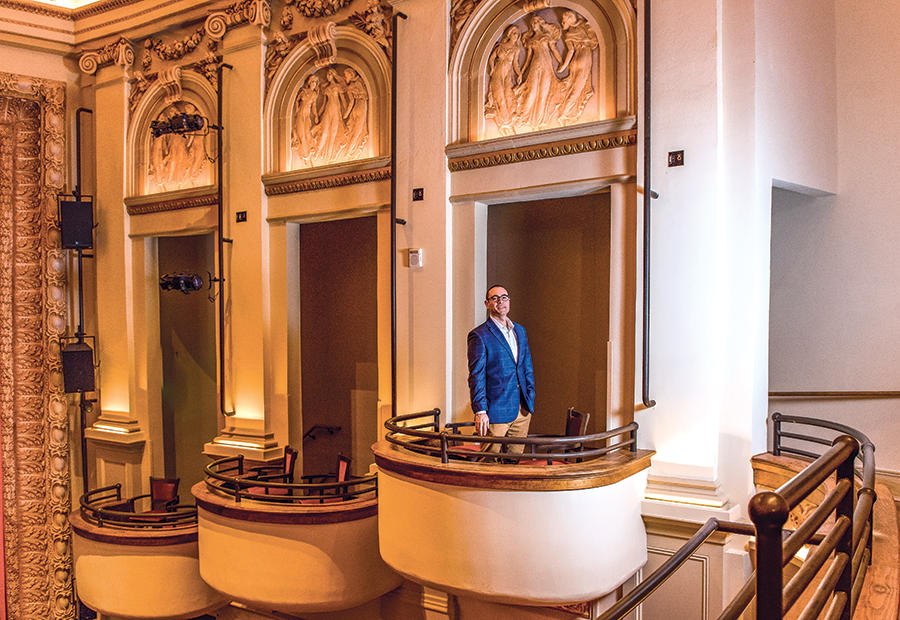
A 120-Year Legacy
The Academy Center of the Arts Continues to Hone their Mission
Photos Courtesy of The Academy Center of the Arts
In its nearly 120-year history, the Academy Center of the Arts has seen highs and lows.
It was once a prominent, glamorous theater that brought in traveling shows, musicals, and performers.
At its lowest point, it was shuttered for six decades before restoration groups fought and fundraised for years to finally renovate the historic landmark back to its former glory.
Dr. Bill Kershner, volunteer archivist at the Academy, said there have been several stages in the life of the theater lasting longer than a century.
The golden age of the Academy began in 1905 and lasted until about 1915, he said.
The Academy opened in February of 1905 and had first and second class touring companies who would come to the Academy after their Broadway shows.
Photos Courtesy of The Academy Center of the Arts
“Lynchburg was an important stop because these touring companies didn’t want to travel without making any money every day. They didn’t want to play for, say, a week in Washington D.C. and then a week in Atlanta, and then lose a couple of days traveling. So they would book these things together,” Kershner said. “So Lynchburg was on that circuit. We had the same shows that everybody read about during this period.”
The Academy also offered cheaper events that were popular with different groups in the community.
“So the Academy always served several different parts of the community,” Kershner said. “It wasn’t just the wealthy folks.”
Aside from the touring companies, the Academy also held concerts and recitals, some of them by internationally famous acts. They even tried wrestling in 1914, and Kershner says he is still wrapping his head around how that was pulled off.
Parts of the Academy burned down on April 20, 1911, and the interior was destroyed. No one knows what caused the fire, but the best guess was it was caused by the furnace, Kershner said.
It was rebuilt and reopened in December of 1912 and the interior was even grander than the original—and it was that version that became the prototype for the restorations in 2015. The next period of the Academy brought in silent films, though the building wasn’t fitted for that type of venue until a third stage was built in 1928 for talking movies.
“For about two years, it does first run films and the Academy is once again on the forefront of entertainment in Lynchburg—but that only lasts a few years, because in 1930 the Paramount, designed as a movie theater, opens across the street, and after that they’re really a second-run theater,” he said.
Most people who remember the Academy from this time will remember viewing the serial films shown on Saturdays.
The theater showed some movies that were about a year or two old, ran serials, and held the occasional vaudeville show until it ultimately closed in 1958 and remained shut for 60 years until it reopened in 2018.
For the first 10 years of its closure, it fell into disrepair until the announcement that the 5th Street bridge would be built right through it in the late 1960s
A group of citizens rallied to secure a historical landmark status in 1969 and got the bridge rerouted, Kershner said, and although that group had hoped to restore it, raising money was difficult, so it continued to sit for another 15 years until the early 1980s when it was bought by Liberty University who had the idea to restore it.
That never happened though.
In the 1990s it was sold to the Friends of the Academy for the low price of about $10, Kershner said, and in 1996 it merged with the Fine Arts Center.
“That’s when the Fine Arts Center was torn down and they raised the money for the Warehouse Theater and the building next door, which became the art galleries,” he said.
It wasn’t for another 20 years when other spaces were being renewed downtown that people saw possibilities for the Academy to be a part of that renovation work. “People saw that downtown was coming back to life,” Kershner said.
Photos Courtesy of The Academy Center of the Arts
In 2015 they began seriously raising money and were successful, which was around the time that CEO Geoff Kershner—Bill Kershner’s son—took over.
“So that was pretty gratifying to us that it was while Geoff was executive director that it actually happened,” he said.
By December 2018, the historic theater was back open after a $30 million restoration project.
Nearly 50 years after community members were able to begin fundraising efforts for the Academy and save it from demolition, the beloved historic space was able to live on with the same mission it’s had all along of serving citizens from all backgrounds.
That inclusivity is an important piece of Chief Programming Officer Michelline Hall’s job, who said the mission of the new Academy is to have arts be accessible for all people in the community.
“A part of that is having camps and classes that people can attend and participate in and then another piece is providing financial support for people who can’t afford it,” she said.
New to the Academy that was not a part of its original function is the art galleries and educational classes that the community now has an opportunity to be a part of.
It recently has begun offering Academy in Motion, a mobile arts program that seeks to impact members of the Lynchburg community by providing arts access to groups and individuals with barriers that would otherwise prevent exposure to the arts on their physical campus.
Hall said the bus goes to the YMCA, adult day care centers, and schools to bring programming straight to participants.
She said it also has a partnership with the Virginia Cooperative Extension on an initiative called Plates and Paints, which is a food and nutrition program. The program works with people digitally to make a healthy plate of food in a way that is diverse in color just like a paint palette would be.
The Academy is also open for school field trips and offers students to take a class, see a performance or the art galleries, or learn the history of the building.
Photos Courtesy of The Academy Center of the Arts
“That’s the programmatic aspect of being intentional about how often we’re creating those moments where we’re able to tie in that educational and cultural component because a lot of these kids, just by expanding their horizons, you never know what they may decide they can do,” Hall said.
Hall said the Academy is going to invest in the best acts and artists that it can bring in, but wants to make sure that it’s bringing everyone to the table to enjoy it.
“I don’t know how many doors were opened just from people seeing something or experiencing something or hearing someone that inspired them and allowed them to go down a certain path,” Hall said. “I’m not anticipating that kids that come in here to all become amazing visual artists, but maybe they feel like they can do something else in their lives that they thought they wouldn’t be able to do.”
That’s a beautiful thing about the arts. The arts are cross-cultural, Hall said, and reach across all demographics.
“Good music touches everyone,” she said. “It doesn’t have a zip code, it doesn’t have a salary cap or limit. There are certain things about the arts that just unify all of us together.
And we’re trying to constantly be the catalyst for that.”
2022 Lynchburg Dental Guide
Lynchburg’s Resource to Local Dental Care
Not sure where to go for your oral health or dental treatments? Look no further than the experts referenced in our Area Dental Guide. From braces for your kids to the dental professionals you want in your corner when there’s an issue, we have you covered.