Couple takes to Facebook after finding old items during a reno
Shanna and Toby Davies were in the middle of a renovation at their home on Stafford Street near University of Lynchburg when they started making some unique discoveries in the walls—a paring knife, stockings, old newspapers and receipts, a photo of a silent film actress, several medicine bottles and a mysterious love letter.
They took to the popular “Living in Lynchburg” Facebook page to get answers back in January.
“I enjoy genealogy and between home ownership and census forms, we discovered that the author was about 17 when she wrote this,” Shanna Davies said in the post. “Either we found a rough draft or she never sent the letter. We couldn’t find any lyrics matching the song/poem on the bottom.”
The letter was dated Oct. 14, 1924 and was addressed to a man named Tom.
“My dear Tom,
As it seems that you have forgotten me altogether. I guess you have forgot I was ever living. But I have never forgot you of never will as long as I live. I think of you night and day. But if you are tired of me I have nothing more to say. I guess I will close by asking you to always remember me as a true and faithful pal of your heart.
As ever yours,
Hazel Roberts.
Remember me when this you see
And take it to your heart
Let not the love of other girls
Cause you and I to part
Are you angry with me darling?
Are you sorry that we met?
Have you learned to love another?
Has she taught you to forget
Answer
I’m not angry with you darling
I’m not sorry that we met
I’ve never learned to love another
And I never will forget
Thanks to help from users on the Facebook page, the Davies now know the song was released by two different artists two years later in 1926—The Blue Ridge Highballers and Earnest Van Stoneman accompanied by Katie Kline, Fiddler Joe, and Henry Whitter.
The song was called “Are You Angry With Me Darling?”
Or sometimes “Are You Angry?”
Shanna Davies wonders if since The Blue Ridge Highballers were from Danville, perhaps Roberts played a role in helping to write the song.
She looked up the ownership history of the home and found that after the Campbell County annexation in 1926, the first owner was CT Roberts.
Through Family Search, an ancestry website, Shanna Davies found the family who lived in Lynchburg and matched them to her street.
“So from census forms, I could see how many kids they had and their names and I saw Hazel listed as one of them,” he said. “So I was fairly confident that I had the right family.”
Those on the Living in Lynchburg page were helpful in looking up those records as well, she said, which she thought was cool. Some shared pictures of Roberts’ headstones, other people shared the lyrics of the song and somebody shared the first artist who had released it.
“It’s cool that people have taken the same interest that we have,” Toby Davies said. “I find that with Facebook you can build a community of friends pretty quick if you have similar interests.”
Shanna Davies said other people pointed out Facebook groups that were dedicated to finding old photos at Goodwill, finding their ancestors and as a group, try to track down living relatives.
“Sometimes I feel so distant to history because it didn’t happen where I was or it wasn’t people I knew but when you find a scrap of paper in your house that somebody scribbled on almost 100 years ago, it makes it feel a little bit more personal,” she said.
Toby Davies has a theory as to how all these items have made their way into the holes and walls of the 1920 four-square craftsman house, pointing primarily to a busy packrat who once inhabited the space.
“The way these houses are built, there’s really no sections,” he said. “Everything’s kind of connected if you can get through the little cracks and crevices. Modern houses are built very compartmentalized where you can’t get from one space to another without burrowing a hole if you’re an animal.”
In the end, Hazel Roberts never ended up with the man she wrote that letter to. According to Shanna Davies and the genealogy research she conducted, she actually ended up with a man named Christopher Columbus Gunter.
Finding the letter has excited the couple and they say they look forward to future discoveries within their house.
“I’m anxious to be able to look in more parts of the house and find more things. Part of what I look forward to when I do a renovation here is, ‘What am I going to find?’ and I was not let down this time,” Toby Davies said.
Legendary Educators
Lynchburg’s past is full of inspirational figures, but those who have shaped the minds of young and old alike have always been our teachers.
With the help of the Lynchburg Museum System, we took a look at three of those impactful educators who lived, worked and taught here in our city and were the ones to pave the way during a time when it may not have been as celebrated as it is now.
Amelia Perry Pride (1857-1932) Not only was Pride an African-American elementary school teacher and principal for 30 years, she was also well known for her larger contributions to the Lynchburg community.
Pride attended Hampton Institute, now Hampton University, and returned to Lynchburg to begin her teaching career, where she was one of the first Black teachers in Lynchburg City Schools. She later became principal of Polk Street Elementary School.
In 1897, Pride established the former Dorchester Home on Pierce Street or what some called the “Old Folks Home for impoverished former slave women.” According to a city historical marker, it provided shelter, fuel, clothing and food for its residents until their deaths.
The marker also states that, “Following Hampton Institute’s principle of uplifting her race through self-help, Pride was a passionate advocate of African American and Virginia Indian education.”
Pride provided scholarships for many young women seeking higher education and established sewing and cooking schools for women and men entering vocational fields. Her namesake lives on at the Amelia Pride Center on the grounds of Dunbar Middle School, which houses several alternative and adult programs.
Edward Christian Glass (1852-1931) Glass was Lynchburg’s long-time public school superintendent and namesake of E.C. Glass High School on Memorial Avenue.
According to Museum Director Ted Delaney, Glass’s most monumental contribution to our community was that he ensured that public education in Lynchburg was viable at a time when many citizens opposed the idea of taxpayer-funded, government-run schools.
Glass became superintendent of Lynchburg’s public school system in 1879 at the young age of 26 and served for nearly 53 years, according to a city historical marker. He established and for 18 years oversaw a summer teachers’ institute that trained thousands of teachers from Virginia and beyond.
Glass co-owned and co-edited the Virginia School Journal, which for years was the official organ of the state’s Department of Public Instruction and the Educational Association of Virginia. Glass was president of this association and twice served on the State Board of Education.
According to the marker, Glass wrote several textbooks, including Glass’s Speller. Lynchburg High School was renamed in his honor in 1920, and a new E. C. Glass High School opened in 1953.
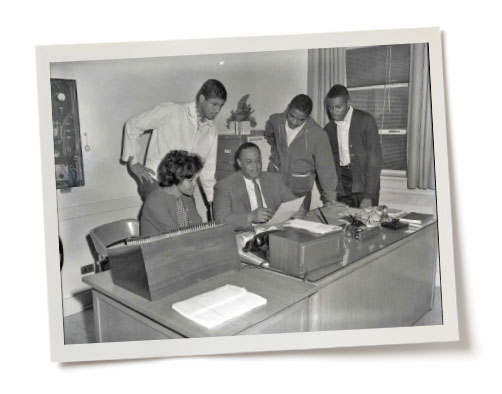
Clarence W. (or “C.W.”) Seay (1900-1982) Seay was an African-American, long-serving principal of Dunbar High School from 1938 to 1968. At the time, Dunbar was Lynchburg’s secondary school for African Americans. According to Delaney, he was the last principal before integration and a beloved advocate for his students and faculty.
Seay believed in the connection between school and community. According to a historical marker in the city, he shaped Dunbar High School into a school of academic excellence, holding that a “successful school and its community are inseparable.”
According to the Lynchburg Museum, Seay spoke out against injustices within the education system and encouraged Black schools to hire Black educators, administration, and personnel, and to seek Black leaders for the School Board.
He later became the first high school principal elected to the presidency of the Association of Colleges and Secondary Schools. After his retirement in 1968, Seay taught at Lynchburg College, now University of Lynchburg, and held the position of Assistant Professor of Education. He was the first and only African American to be employed by the school at the time.
He later served two terms as Lynchburg’s first Black city council member since the 1880s and the first Black vice mayor.
Hills of History
A Tour of Lynchburg’s Original Neighborhoods.
The nickname “Hill City” dates back to the mid-1800s, Lynchburg Museum Director Ted Delaney said, but the idea of our seven hills is more unknown.
He believes it probably originated around Lynchburg’s sesquicentennial in 1936.
“My guess is that at that point it was probably pretty well accepted that we’re the city of seven hills and we’ve got seven distinct hills,” he said. (Technically, there are eight—but we will get to that in a moment.)
You could say that it’s unique for Lynchburg neighborhoods to be named in this way, but as Delaney explains, it’s actually pretty common for cities to advertise that they have seven hills.
“That was the custom or tradition of Rome and people were trying to kind of piggyback on that,” Delaney said. “And a lot of places claim that but I think what might set Lynchburg apart is that a lot of our neighborhoods still carry the hill name and the hill is still part of the name in the neighborhood.”
This is why Delaney believes each hill should be uniquely preserved.
“It’s unique to Lynchburg because there is no other city that has a Garland Hill, Daniel’s Hill, a College Hill, etc,” he said. “So just from the perspective of being unique and trying to be authentic to your place, I think it has a lot of value.”
On the following pages, Delaney helps us share the early history of each hill.
College Hill Est. 1815
The largest of the hills, College Hill was originally known as “White House Hill” before military school Lynchburg College was built (no relation to what is now the University of Lynchburg). The general boundaries of College Hill are the Expressway, Kemper Street Railroad Station, and Old City Cemetery. It adjoins Federal and Diamond hills.
College Hill is home to Anne Spencer House and Garden Museum, the John Warwick Daniel statue on Park Avenue, the home of Confederate General Robert Rodes and the brickyard of Christopher Lynch, son of town founder John Lynch.
Even though this is the largest of the city’s hills, you don’t often hear this area referred to by its official name. Delaney said it’s expected that would happen over time.
“Because it’s so well documented of what it used to be and what I would hope is that there’s some way that it is preserved, whether that’s in a historic marker or maybe there’s a place that keeps the name,” he said.
Court House Hill Est. 1813
After Lynchburg’s courthouse was completed in 1813, it was discovered that the building was not within the town’s limits. In 1814 the town boundaries were extended, and the name “Court House Hill” came into use. This is considered the “extra” eighth hill in Lynchburg.
“Most historians don’t include it in the standard seven. Because it includes John Lynch’s original 1786 town, and because it has had so few residences compared to the others, many people don’t consider it a true neighborhood,” Delaney said.
According to the Lynchburg Museum, when John Lynch chartered the town of Lynchburg in 1786, its 45 acres included Commerce, Main, and Church streets, bounded on the east by Twelfth Street and the west by Fifth Street. With the entire town on a hill sloping down to the James River, the area was sometimes called “Lynchburg Hill.”
This hill had many homes built in the early 1800s, with the John Warwick Daniel house completed in 1826 and the Carter Glass home on Clay Street in 1827.
In 1855, the second Lynchburg Court House was built on the site of the original with a view down Ninth Street to the river where Lynch’s Ferry stood. In the late 1970s, the second courthouse became the home of the Lynchburg Museum.
Court House Hill is also home to a number of churches originally built on what became Church Street.
The Lynchburg Museum website states that by the mid-20th century, the churches had all moved to other areas of the city. After 1880, large churches were built on Court and Clay streets.
In the 20th century, the Academy of Music opened, as did a new post office and several schools. As a memorial to the World War I dead, Monument Terrace was completed in 1925.
Daniel’s Hill Est. 1870
Bounded by the James River, Blackwater Creek, and H Street, the hill is named for the Daniel family.
This hill is home to Point of Honor, which Dr. George Cabell had purchased in 1805. His land included much of what is now Daniel’s Hill, plus the river islands and the flood plain where U.S. Pipe Foundry is now located.
Daniel’s Hill was a very industrial and commercial neighborhood with factories all around, Delaney said.
“A lot of people who worked in those factories lived in the neighborhood, but they didn’t live on Cabell Street,” he said. “They lived in smaller, more working-class, affordable housing that was on the side streets.”
He said it’s important for people to look more broadly at what makes a neighborhood instead of just recognizing the famous white people who lived on the main streets.
“We have to look at the supporting side streets and all the other supporting structures in the neighborhood,” he said, adding we should be thinking about where enslaved people lived in these older neighborhoods. Sometimes it was in quarters that were behind a house.
Diamond Hill Est. 1820s
Diamond Hill lies to the south and west of Downtown Lynchburg and has steep terrain and ravines. The naming of Diamond Hill is still a mystery, according to the Lynchburg Museum, but theories include that the hill was named for wealthy residents, triangular-shaped lots, or sparkling minerals in the soil.
Two hospitals once stood along Grace Street including Marshall Lodge Memorial Hospital, which opened in 1886 and closed in 1971. In 1931 the Guggenheimer family home became Guggenheimer Memorial Hospital. >>
Photos courtesy of the Lynchburg Museum
Federal Hill Est. 1819
The smallest of the city’s seven hills, Federal Hill is bounded by steep hills near Twelfth Street and valleys near Eighth and Madison streets.
According to the Lynchburg Museum website, Federal Hill was originally outside of the town’s limits and was considered Lynchburg’s first suburb.
While the Federal Hill name shows up by 1839, its origin is not known. When the nation was first founded, leaders such as George Washington and John Adams were known as “Federalists.” The name may be related to their political party.
Delaney says there is a spot in Federal Hill where there used to be a whole row of enslaved housing for people who worked in factories.
Photos courtesy of the Lynchburg Museum
Franklin Hill Est. 1820s
Franklin Hill is one of the most clearly defined hills in Lynchburg, bounded by the Lynchburg Expressway to the west, Main Street to the north, Florida Avenue on the east, and Fishing Creek along the south.
It is believed the hill was named after Benjamin Franklin, the Lynchburg Museum states.
The most well-known landmark in the neighborhood is Presbyterian Cemetery, founded in 1823.
Delaney said there might just be about one in 1,000 people who have ever heard of this hill because many would consider themselves residents of White Rock Hill.
“So the fact that it’s on paper and someone says it’s an original hill may not really have any value or meaning if the people today don’t think of it that way,” he said. “Think of the hills very broadly and not just as a couple of beautiful houses and famous people. But think of the whole history of what were some of the other activities that were happening in the neighborhood.”
Photos courtesy of the Lynchburg Museum
Garland Hill Est. 1845
Originally, Garland Hill was the farm of William Lynch, Sr., the son of Lynchburg founder John Lynch. Blackwater Creek forms the boundary for much of the neighborhood along with a portion of Fifth Street and the valley near Old City Cemetery.
The oldest home still in its original location in the city is at 619 First Street in Garland Hill. The “Lynch House” was built by the Lynch family in 1787. According to the Lynchburg Museum, William Lynch, Jr., left the land to his cousin Celine Dupuy, who sold off block-size lots beginning in 1845. By the mid-19th century, there were so many members of the Garland family living in the neighborhood that the hill became known as Garland Hill.
Part of this Hill also bleeds into Tinbridge Hill, which is an example, Delaney said, of how the definition of the hills and its boundaries has changed over time.
“I think there’s a lot of really arbitrary nature in the definition of the hills and how their boundaries were defined and who named them,” he said. “There are a whole bunch of people who live in that area who call themselves Tinbridge Hill, but someone decided a long time ago it was Garland Hill. So we just have to think about whether the boundary is legitimate, accurate and meaningful.”
Photos courtesy of the Lynchburg Museum
White Rock Hill Est. 1870
This hill is located east of Franklin Hill and is bounded by Florida Avenue, the James River and Fishing Creek. White Rock Hill was named for the outcropping of white quartz rocks along the bluff of the James River that was a well-known local landmark, the Lynchburg Museum states.
A portion of the hill was incorporated into the city in 1870. The steep hillsides of this neighborhood prevented development, and the area was not fully annexed into the city until 1908.
The seven-acre White Rock Cemetery was established in 1882 for African Americans and was used by many local Black churches for more than a century. The Lynchburg Museum states that approximately 4,000 people are estimated to be buried there, one of whom is believed to be Ota Benga, a member of the Batwa or Mbuti tribe of the Congo.
While knowing the history of our city’s original hills is important, Delaney says we should also remember to look to the current residents of these hills and ask them how they would define their neighborhood.
“It’s an opportunity to learn more about your place, where you live and the community in your neighborhood,” he said. “On one hand I know the city’s got to change so we want to strike a balance of remembering history and preserving memories but also making space for your city to grow and evolve.”
What About the Other Hills? There are four additional hills, or well-known neighborhoods, in Lynchburg: Cotton Hill, Tinbridge Hill, Chestnut Hill, Fort Hill. Learn more about these hills at www.lynchburgmuseum.org/more-hills.
The Troops Rally
Lynchburg’s Longest Weekly Consecutive Event Shows Support for Veterans, Active Military and Their Families
Vietnam War veteran Steve Bozeman didn’t realize what he had gotten himself into on Nov. 30, 2001 as he organized a peaceful gathering in downtown Lynchburg. Little did he know, that event would have massive influence on the greater Lynchburg veteran community and surrounding areas in the years to come.
Following the tragic events of 9/11, President George W. Bush deployed troops to Afghanistan. The world watched as the United States plunged into conflict with radical terrorist groups the Taliban and Al-Qaeda.
Photos by Ashlee Glen
Meanwhile in Lynchburg, a protest opposing the war occurred on the steps of Monument Terrace in downtown Lynchburg, an iconic city location. In response to this protest, 80 veterans and patriots, led by Bozeman and several others, gathered on the other side of the street to peacefully counter the demonstration and show support for the war efforts in Afghanistan. At that point, there were no American casualties in what would become a near two-decade feud.
Following the counter-protest, World War II veteran James Hazelwood asked Bozeman, “Is everyone coming back next Friday to have a second rally?”
Photos by Ashlee Glen
“Well, I didn’t plan on it myself,” Bozeman replied. It just so happened that the following week, Dec. 7, was the anniversary of Pearl Harbor, the infamous Japanese air strike in 1941 that claimed nearly 2,400 American lives. Upon this realization, Bozeman agreed: “Hell, yeah I’ll come back!”
Several others gathered at Monument Terrace on Dec. 7, 2001, to commemorate the lives lost at Pearl Harbor and to again show support for American troops in Afghanistan.
“Then we came back the third week, and people just showed up, and the momentum built up from there,” Bozeman said.
Photos by Ashlee Glen
Since that first Nov. 30 gathering, the weekly Friday meeting known as the “Troops Rally” has taken place every consecutive Friday, totaling more than 1,040 weeks. Veterans, families of veterans, and members of the city and surrounding areas congregate to remember the sacrifices and celebrate American heroes.
“You can’t walk away from the Troops Rally without having inspiration in patriotism that’s displayed there every Friday,” Bozeman said. “To me, this is very fulfilling. My heart swells with all the things that we have done for two decades now. And it’s only starting.”
The weekly gatherings are as unique as their meeting place: Monument Terrace. This iconic downtown Lynchburg location honors the lives lost throughout America’s darkest conflicts, beginning from the Civil War.
The landmark has 132 steps and is decorated with several markers and monuments. Even since being renovated in 2002 and fully renovated in 2004, the Troops Rally has found ways to remain near the monument every Friday. There is even a designated “veterans’ room” 100 feet away from Monument Terrace that houses pictures, plaques, and posters, as well as other memorabilia.
Photos by Ashlee Glen
“There’s always an obstacle,” Bozeman said. “Marines have a saying, ‘improvise, overcome, and adapt,’ so we’ve figured out how to get through all of that.”
Meetings always end with the singing of the National Anthem, followed by announcements and the toll of the bell eight times at one o’clock—signaling “ending the watch.”
The group has campaigned for different local veterans’ efforts, including holding fundraisers for Richmond’s Hunter Holmes McGuire Hospital and supporting the National Center for Healthy Veterans Valor Farm in Altavista.
“The mission statement has always been ‘support our troops’‚” Bozeman said. “We do that, and we also support each other. The word has gotten out there that this is going on every Friday. The media has helped get the word out.”
Photos by Ashlee Glen
Between 50-80 participants, mostly Vietnam War veterans, attend the weekly gatherings on average. But thanks to heavy media coverage over the years, hundreds and even upwards of 1,000 have shown up depending on the occasion. On Sept. 10, the eve of the 20th anniversary of 9/11, the entire street was blocked off for the event.
The impact of these simple Troops Rallies can be felt throughout the Lynchburg community. Many nonprofits that specialize in veterans’ issues have found roots in the community because of the activism and attention brought about by the Troops Rally. One of these initiatives is the Lynchburg Area Veterans Council, a publicly supported 501c3 that for seven years has helped veterans avoid homelessness.
Photos by Ashlee Glen
The Lynchburg Area Veterans Council, which started in the American Legion building on Greenview Drive, has received grants from Pacific Life and the Greater Lynchburg Community Foundation. It also organized and executed two veterans’ parades, the first ever in Lynchburg since 1938.
“If we didn’t have the weekly Monument Terrace Troops Rallies going on for 20 years, I don’t think there would be a Lynchburg Area Veterans Council,” said Tom Current, a retired army Colonel in Special Forces, and the president of the Lynchburg Area Veterans Council.
Eighteen months ago, the Lynchburg Area Veterans Council purchased the birthplace and childhood home of Desmond T. Doss, a Lynchburg resident and a Medal of Honor recipient who saved 75 people during World War II. The Garfield Avenue property is being used to house previously homeless veterans. The City of Lynchburg even adopted a proclamation making Oct. 12 Desmond T. Doss Day in Lynchburg.
Photos by Ashlee Glen
The National Center for Healthy Veterans at Valor Farm, a nonprofit that helps veterans avoid suicide and reintegrate into society, recognized the tremendous veteran support in Lynchburg and the surrounding area.
“Veterans share this bond, and I’ve tried to figure out what that is, and I think I have the answer,” Current said. “Veterans served different capacities, and we all put the mission ahead of our own desires. We put ourselves second. That takes character. That’s what binds all these different veterans, different ages, different services….”
Photos by Ashlee Glen
“There are a lot of good Americans who have character and understand what it means to have a heart of a servant,” he added. “And that’s why I have hope.”
Bozeman, who has attended over 1,000 meetings, said that the purpose of the Troops Rallies has always been and will always be about supporting troops, veterans, and their families. He doesn’t see the weekly gatherings ending anytime soon.
“Everyone feels connected. Everyone is glad about what is going on in Lynchburg,” Bozeman said. “The future is unknown. We still have troops all around the world. So, I don’t see these Troops Rallies going away.”
A Historic Hidden Gem
A team of neighbors adopts the Timberlake Tavern with the hope of bringing it back to its former glory
Take a right past the Koffee Kup restaurant on busy Timberlake Road and weave about one mile through the Timber Lake neighborhood, and you’ll find the cozy Timberlake Tavern, an event center offering three Airbnb rentals.
New owners Etta Legner, DD Gillett, and DD’s husband Tom closed on the 1.2-acre property in October 2020 and have worked consistently since then to repair the tavern by adding a new roof, gutters, fresh landscaping, bathroom updates, as well as giving attention to other cosmetic issues.
Legner and the Gilletts are all retired homeowners living in the Timber Lake neighborhood and say they have a passion not only for the tavern but also the history of the lake.
“In the ’30s and ’40s this was a much sought-after site for entertainment in this area,” DD Gillett said.
“Our hope is that Timberlake Tavern will once again become a popular choice for events of simple elegance where lasting memories are made.”
The event space can host weddings, receptions, holiday gatherings, corporate retreats, reunions, birthdays and memorial celebrations in the downstairs area, wrap-around porch and outdoor space. The upstairs has been renovated into three separate Airbnb rentals.
The tavern was built in 1929 by Edley Craighill and Fred Showalter, the same men who built Timber Lake in 1926. They wanted the tavern to be a community center for lake residents, who used it as a place for dining, music and celebrations until the 1950s.
Upstairs, groups such as the Girl Scouts used 12 rooms—six rooms on the front of the tavern and six on the back—for accommodations while they visited the area and learned to swim, boat and fish in the summers.
The tavern has served as a worship center and a first home for Timberlake United Methodist Church, a meeting place for clubs and service groups, and was even a private home for a number of years. It was modernized as an event center with apartments in the early 2000s.
But the 1929 building has hardly changed and guests can still admire its symmetrical charm featuring original hardwood floors, a central staircase leading to a charming library, oak mantles and flooring, wood beam ceilings and dual fireplaces, which Gillett says adds to the overall aesthetic.
The property also includes a waterfront dock enabling guests to use the water to swim, kayak, boat or sunbathe.
“It’s such a happy special place,” Gillett said. “It’s just a fun, fun place.”
It’s a small venue, Legner added, but that’s the way they want it to be.
If they get creative and guests don’t use the dance floor, they can allow for 112 inside and a total of 135 on the premises for a sit-down event.
“But we don’t really want to do that though,” Gillett said of making the space too crowded. “We are hands-on owners and we think that’s a real perk, that we’re very personal about meeting with clients and meeting their needs. We try to be adaptable and versatile and flexible in what we do because we like people, we want this to be a people place.”
The Gilletts and Legner are always on site during an event.
“It’s a 1929 building, and anything could happen so we need to be here,” Gillett said. “This is like our house, it’s just like another one of our homes and if something’s going to happen we need to know about it. Plus we might meet some really cool people we want to know for the rest of our lives.”
Between the three Airbnbs and event hosting, the tavern has stayed busy every single weekend since the beginning of April, Legner said.
“We like what we’re doing, we want it to be like this,” Legner said, but added that moving forward: “My plan is to do less physical labor.”
For now, Legner and the Gilletts do everything—everything except catering.
“If you want someone to make you more than a Pop Tart, get someone else. I’m not your girl,” Gillett joked.
But they make the beds, do the laundry, scrub the toilets and mow the lawn. At least for now.
“We’re doing everything because we want to do it ourselves first,” Legner said. “We don’t want other people to help us before we know what we’re doing.
We want to do it ourselves so we’ll really know how long it takes to do this. So then when we get people to help us, we’ll be aware, rather than not knowing how long it will take to do the laundry.”
She said their goal is to be flexible and easy to be around but at the same time offer clients a professional event.
“I think that we have managed that,” she said. “That was one of our goals and we have accomplished that.”
Legner and Gillett have since renovated the apartments into three Airbnb rentals called the Sunshine Suite, the Showalter Suite and the Birdhouse Suite.
Gillet said there was a hidden section of the tavern on the third floor, which is only visible from the back of the building and was formerly used as the maid’s quarters in the 1930s.
“It was just a dark, dingy, dreamy place,” Gillett said.
Gillett, along with Legner, the decorator of all the rentals, decided to convert that space into the third, cozy Airbnb.
“It’s the most popular Airbnb spot now,” Gillett said.
Each suite is charming and cozy with a coffee bar, fresh flowers and chocolates, and since not much has been altered from the original tavern, it makes guests feel like they are staying at a summer cottage in Cape Cod.
Guests have access to a deck overlooking the lake on the second floor where they can lounge, relax and read.
“Airbnb was a new stroke for both of us so I’m extremely proud of the fact that Etta and I have worked as hard as we have to the point that the Timberlake Tavern Airbnb has a five-star rating,” said Gillett.
They are only about a year into their new endeavor and free weekends are sparse. But this team wouldn’t have it any other way as they see this hidden landmark into the future.
“It’s been a labor of love,” Legner said.
Photos by Ashlee Glen
A Fresh Start
Area farmers markets emerge from the pandemic stronger than ever before
There’s something about a stroll through your local farmers market that turns grocery shopping from a rushed task into a meaningful experience—the simple wooden tables, rows of fresh products, and smiling faces of local makers and producers form a gathering spot that has been a mainstay in our area for generations, serving to not only nourish our bodies but also nurture a sense of community.
Even though farmers markets thrived better during 2020 than other businesses, because of their loyal followers and also being able to serve outdoors, they are just as enthusiastically celebrating the end of pandemic restrictions and are pulling out all the stops—from live music to night festivals. They are also seeing a wider range of customers and larger vendor base than ever before.
Dorothy McIntyre, market manager at the Forest Farmer’s Market, said she is seeing more vendors using the market as an avenue to showcase their creativities and as a way to introduce themselves into the community.
It’s no longer just a place for people to sell homemade muffins but also French-inspired pastries like macarons. Farmers markets are the incubator for these small businesses.
“You have the mom and pops that are coming in that are trying to create and bring something new and valuable to the area, but then you get these people that are relocating and are finding the farmers market and they feel like this is a good atmosphere to try out to see if this is something that would be interesting to the area,” she said.
Each week McIntyre says she sees more young people and a more diverse crowd come to the market to buy groceries and just to hang out at the park behind the Forest Library where the market is located.
“They’re asking questions about the food and how it’s been grown and where it’s been grown. Things like that are still happening,” she said. “It’s still very active in that people want to know where their food is coming from. I’ve been approached more this season by more African American or Haitian American potential vendors that have phenomenal products and are starting to see the market as not just the white person’s market.”
The Forest Farmer’s Market began in 2011 with 11 vendors. It now averages 38 to 42 vendors a week. By the end of September last year, total sales from all vendors were $500,000, McIntyre said.
“There’s been growth of the diversification to where it’s not just meat and produce and eggs, it’s spices, it’s pasta. The diversity of products has grown exponentially from 2011,” she said.
She said there are constantly new people coming in and experiencing local markets, whether it’s Lynchburg, Bedford or Forest, and they’re enjoying the atmosphere, the community and are supporting local businesses.
“They’re more mainstream now and it’s just part of people’s lifestyle now,” McIntyre said. “I know a couple people that their highlight for the week is coming to the market on Saturday because they know that they’ll get to see people, get good food, and they enjoy the people watching that you get to experience at a farmers market.”
The market has added new features on Saturday morning such as live music and offering booths for community programs and nonprofits to set up at.
“More of the community is seeing the market as a way to get their information out to the public,” she said. “There are tables and benches for people to come and the atmosphere is relaxed. People see friends, it’s pet-friendly, they’re getting their breakfast there and hanging out. They seem to want to be out in the public and enjoying the community space that a farmers market provides.”
Farmers markets also saw a big win from Virginia’s General Assembly this year when it deemed markets as essential in the event of a crisis, similar to how a grocery store is treated.
“If non-essentials are shut down, farmer’s markets can stay open and have a presence in the community,” McIntyre said.
Ricky Kowalewski, market manager of the Lynchburg Community Market, said this season, compared to last year, is already leaps and bounds better.
“I think last year this time [of year] we just moved everything back outside but we had barricades up,” he said. “We’ve still got all of our producers outside spaced out but we don’t have to control the traffic flow anymore.”
The market also recently just brought music back which is held every Saturday through the end of October.
He said he’s excited to have those typical Saturday mornings back that everyone knows and loves.
For example, Easy Does It Farm, one of the pork producers, will be out under the pavilion on Main Street at 7:30 a.m. cooking up sausages and setting out samples for customers meandering at the market.
“That really just kind of adds to the ambience of some of the market so we’re really excited,” he said. “We’re just really excited to be able to have a somewhat normal market experience and when you go to the Lynchburg Community Market on a Saturday morning, you’re ready to see a crowd about 7:30 once the sun comes up.”
The market is open Tuesday through Saturday but the weekday crowds are mostly lunch-driven and visited by tourists.
“We’ve got people from all over downtown that come and hang out at Ms. Barbs or they get something from the bakery,” he said. “Being open during the week is great. There’s not a whole lot of public markets around the country that are open five days a week. We were open during an ice storm a few months ago and the bakery had donuts ready to go. I think that just speaks a lot about Lynchburg as a whole.”
The market has started a Tuesday evening market for producers only and a Lynchburg Night Market, which will take place once a month the last Saturday of June, July, August and September and will host breweries, food trucks, vendors and live music.
Erika McFadden, market manager for the Bedford Farmers Market, which is held each Friday and second Saturday, said she was pleasantly surprised with the turnout from patrons over the last year during the pandemic.
“Our challenges were having to spread out vendors, and the masks and all that good stuff and do some additions that cost a little bit of money,” McFadden said. “But patron-wise, people in Bedford really showed up and supported the market, even though there was a pandemic in place. So our numbers weren’t hurting, we did a great job last year.”
The Bedford market is open from late April to October and is located at 220 W. Washington St. under a large pavilion.
McFadden said in past years the market sees between 17 to 21 vendors each week but this season she had 45 applications.
“We’ll have a really good turnout throughout the summer and it’s been nice to see more people want to come out and I think that’s what we’re seeing with the post-COVID vaccines as people are feeling a little bit safer,” she said. “More vendors feel like they can come out to the market so I’ve had a lot of phone calls from local producers and artisans.”
She thinks the people who show up to the market are looking to support local farms and to buy fresh produce.
“They buy their groceries here and that’s how they do their grocery shopping,” she said. “In June we have this huge influx of customers because that’s what they want, they want their fresh tomatoes, they want their fresh herbs and try different produce that’s coming through like eggplants and things like that.”
She said what makes Bedford so special is its family-friendly atmosphere where everyone can feel welcome.
“Everybody helps everybody else out,” she said. “We are one big family under the pavilion and people feel that. This is a great place to visit on a Friday or Saturday morning. It’s a nice place to be.”
Legendary Eats
Four longtime Lynchburg restaurants that have kept us coming back for almost a century
There’s nothing like enjoying a meal in a place with endless memories of yesteryear—perhaps once frequented by your parents, even your grandparents. The stories told about these historic, and sometimes humble, eateries not only connect us to our local past but they also show how the shared bond of “going out to eat” has prevailed through the generations.
While Lynchburg has a diverse and outstanding selection of locally owned restaurants, we wanted to take some time to focus on the spots that have stood the test of time. These four restaurants, with a combined total of 335 years under their belts, have weathered war, economic depressions and everything in between—but what they all say has been the biggest challenge so far is COVID-19.
The World Famous Stadium Inn This local hangout spot opened in 1927 when it was converted from a substation into a beer and burger joint. The owner now refers to it as the “greatest little bar in Lynchburg.”
Photo by Ashlee Glen
Owner Daryl Burgess purchased the building in 2017 when he saw the restaurant had closed. “I just felt that couldn’t happen,” he said. “It’s a landmark and has such cool history.”
Burgess kept the restaurant closed for two months while he renovated the space into a clean sports bar and grill offering cold beer, low-price eats and TVs.
He threw away old equipment with 50 years of smoke on it including the grill, oven, fryers, photos on the wall and cleaned the windows 27 times until all the smoke was gone. With all that work under his belt, it’s no secret that The World Famous Stadium Inn is no longer a smoking bar. Under Burgess’ direction last year, they now have a high chair for the first time to accommodate families. They’ve also worked hard to clean up their image in general.
“The servers know everyone and we make sure customers get home,” he explained. “There’s a three-strike rule… It’s now a family-friendly beer joint. The hardest thing I had to do was overcome the character of the place.”
Burgess is also the owner of The Filling Station in Amherst and knows his way around hamburgers, hotdogs and wings, so he incorporated all those items at the Stadium Inn.
During the pandemic, Burgess converted the restaurant into a mini-convenience store for two months selling steaks, hand sanitizer, paper towels and toilet paper. But ultimately the business still suffered like most others and saw a 75% decrease in sales.
Now, thankfully, with lighter restrictions, Burgess said the restaurant has been filled to its allowed capacity every weekend.
With the growth in mind, he has plans to open an outdoor pavilion soon to provide for more seating. Burgess expects it to be a place for Lynchburg Hillcats fans to hang out after games at City Stadium.
“If you haven’t checked it out, you don’t know what you’re missing,” he said. “Come see us, say hi and you won’t leave unhappy.”
Photo by Ashlee Glen
The Dahlia Located on Bedford Avenue, this hidden gem is a little less hidden thanks to the recent boom of its neighborhood, which is now home to Golf Park Coffee and Small Batch Barbecue.
Angel Olds, who believes she is the 17th owner of The Dahlia, said the micro-local restaurant is home to some of the best seafood in town. Olds and her late husband used to own the Blue Marlin Seafood Market next door, so she knows her shrimp, scallops and fish.
When it opened in 1947, the restaurant was originally called The Blue Dahlia after a film noir of the same name. It was a popular local spot but over the years the restaurant received a bad reputation and went downhill, according to Olds.
“It became known as a dive bar. Men would come but wives wouldn’t step foot in the place,” Olds said. “Now it’s the opposite.” The upstairs is a little more upscale, while the downstairs, referred to as “the cellar,” has a more relaxed, English pub–style vibe.
After Olds purchased The Dahlia 11 years ago, she gutted the entire place and has since created a causal, family-friendly pub that focuses on quality food.
Though it’s more well-known now, she said her customers enjoy that the restaurant isn’t a run-of-the-mill chain and newcomers still have to plug the address into their GPS and hunt around for the front door.
“We are kind of secluded, but I’m hoping to get new signage for Bedford Avenue,” Olds said. Out of 74 years, Olds said the restaurant has only been closed for two years.
“It’s an institution. It’s weathered history,” she said. “It’s a very old restaurant that has been reborn several times. It’s still here alive and kicking.”
Photo by Ashlee Glen
Texas Inn You know you’re a local to Lynchburg if you know exactly where to find a “greasy cheesy.” That’s, of course, at The Texas Inn, better known as the T-Room, which operates its flagship downtown and a more recent addition in Cornerstone.
In 1949, the restaurant, once located at 602 Main St., was sold for $10,000 by H.D. White to H.W and T.W. Wright. In the 1970s, it was torn down and relocated to its current location at 422 Main St., which once served as a service station.
The 86-year-old restaurant has seen multiple owners but current owner Dave Saunders remains true to founder I.N. Bullington, a former circus advance man.
Ever since purchasing the iconic restaurant in 2018, Saunders has worked tirelessly to bring the T-Room back to its roots, starting with a six-month search for the original chili recipe.
Today, the T-Room is obviously known for its cheesy western—a hamburger with relish, a fried egg and cheese—and chili, better known as a “bowl.”
Saunders has kept some of the quirkier menu items that no one orders, such as the Denver, an egg and cheese sandwich on a bun topped with relish, or the Funny, a hot dog bun with no wiener topped with relish and chili.
He took cheese sticks off the Cornerstone menu because he felt it didn’t fit the character of the establishment, and the relish is made three times a week instead of just one.
Since its opening in 1935, the T-Room has witnessed The Great Depression, World War II, the Korean War, the Vietnam War and a handful of recessions, but COVID-19 has tested the tavern with its ability to only seat customers at its 15-seat counter.
Saunders placed a picnic table outside but it’s still the only establishment in town that has less than 50% capacity. “People have been really loyal ordering to-go and delivery,” he said. “They really saved our bacon.”
In the end, Saunders said the T-Room is the oldest continuously running restaurant in Lynchburg for a reason. “We serve good food fast and cheap,” he said.
Photo by Ashlee Glen
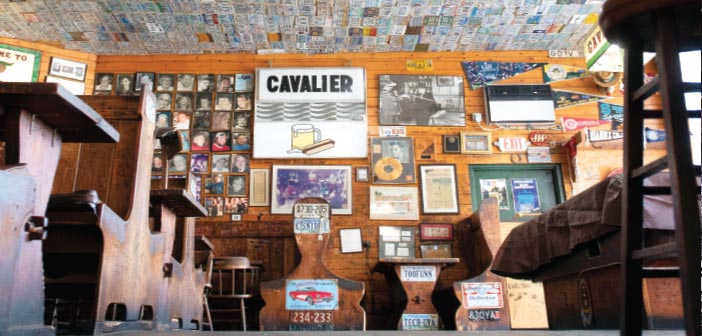
The Cavalier “The Cav” as locals know it might be as hometown as you can get. It’s known for its no-frills and relaxed atmosphere serving up to-die-for burgers and fries.
Located right off Rivermont Avenue, down the street from Randolph College, the dive bar is decorated with side-by-side license plates on the ceiling and walls and its wooden booths are covered with carvings of initials and notes from who once sat there.
Opening in 1940 under the name “The Cavalier Store,” the Cav started out as half grocery store, half restaurant where customers could shop and order a beer and hot dog. It was that way until the late 1960s or early 1970s and the wall between the two was torn down.
In 1987 Wells Duffy purchased the bar and continues to operate it to this day. He is responsible for adding in the main bar and the smaller bar near the ATM machine.
Jake Hill, a bar manager at The Cav, said it wasn’t uncommon for 1940s women to come in, buy cigarettes and smoke because their husbands wouldn’t allow them to light up at home. The restaurant is still an icon in the city and known as a bar reliable to always be open.
“It’s a good ‘ol neighborhood restaurant,” Hill said. “Anyone and everyone is welcome. We consider ourselves the Cheers of Lynchburg because everyone knows each other and if you don’t, by the end of your visit you’ll likely have some new friends.”
There is no question that customers keep coming back for the burger, which has been glorified by all walks of life. It pairs perfectly with the seasoned fries and homemade ranch.
In the past 34 years that Duffy has owned The Cav, he’s never experienced anything quite like the pandemic. He’s never had to adjust his hours and the restaurant has always stayed open seven days a week—but that was put on pause last year.
“Even with bad weather, we’re known as a reliable spot that will always stay open,”Hill said. “He’s never had to deal with anything like this.”
Prepped for Pandemic
Historic Garden Week set for April 17-24 with Lynchburg event on April 20
For only the second time in its history, Virginia’s Historic Garden Week was cancelled last year when COVID-19 came calling.
This year, however, the show will go on after months of careful planning. “We knew doing Historic Garden Week in the way we’ve done in the last 87 years was not going to work in 2021,” said Karen Cauthen Ellsworth, director of Historic Garden Week and editor of the guidebook.
Presented by the Garden Club of Virginia, Historic Garden Week will offer 30 tours organized and hosted by 48 member clubs during the week of April 17-24. The nation’s only statewide house and garden tour has contributed an estimated $518 million to state and regional economies in the last 50 years.
A photo from the Lynchburg archives titled, “1924 Ladies.” Location unknown.
While some clubs are still hoping they may be able to provide indoor house tours, each club is ready to make this year’s tour entirely outdoors. They’ve lowered ticket prices, created timed ticketing, and are requiring masks.
Ellsworth expects enthusiasm for the tours to remain high. “Gardens have given people a lot solace in this upside-down, topsy-turvy world,” she said.
The only other time the weeklong festivities were cancelled was during World War II, Ellsworth said, noting that funds were sent to London to help restore gardens damaged in bombing raids.
The Garden Club of Virginia has since extended its mission and goodwill to other friends in need, Ellsworth said. After Hurricane Hugo, a donation was made to replant trees in Charleston, South Carolina. After Hurricane Katrina, money was sent to the New Orleans Botanical Garden to rebuild its greenhouses.
The roots of Historic Garden Week date to 1927, when a flower show organized by the Garden Club of Virginia raised an impressive $7,000 to save some of the trees planted by Thomas Jefferson on the lawn at Monticello.
Today, tour proceeds primarily fund the restoration of Virginia’s historic gardens and, since 1996, to provide graduate level research fellowships. In celebration of the Garden Club of Virginia’s 2020 centennial, funds were also pledged to support Virginia State Parks.
Annual Meeting of Garden Club of Virginia in Lynchburg on May 18, 1926.
During the past year, funds were distributed to Poplar Forest for restoration of the roundabout driveway and the creation and restoration of Reveley Garden at William & Mary.
The formal tours began in 1929, benefitting gardens at Monticello, Beatrix Farrand’s Green Springs Garden, Bacon’s Castle, Lewis Ginter Botanical Garden, and the State Arboretum in Winchester, among many others.
The Garden Club of Virginia’s horticultural programming and flower shows inspire one of Historic Garden Week’s greatest attractions, the world-class floral arrangements by club members featured on tours. An estimated 2,300 will be created for Historic Garden Week this spring.
Another plan upended by COVID-19 was a Garden Club of Virginia centennial celebration with renowned floral arranger Paula Pryke of London. The organization is working on having her do a virtual event this year. “We’re definitely trying to find the silver lining in all of this,” Ellsworth said.
Since 1920, the Garden Club of Virginia has grown from eight founding clubs to 48 clubs with more than 3,300 members. The efforts of these volunteers, along with the generosity of nearly 150 private homeowners across the commonwealth, make Historic Garden Week possible.
The Lynchburg Garden Club was founded in 1923 and started participating in Historic Garden Day in 1932. In 1953, the Hillside Garden Club was founded and the two joined together to support Historic Garden Week.
Normally, garden tours include tours of the four to five houses on the tour, but because the pandemic may force an outdoor-only focus this year, the group decided to capitalize on the change by emphasizing sustainable lawns and gardens. “We’re trying to educate people about what they can do in a small space to help our environment and our state,” said Jeanna Chapman, co-chair of Lynchburg’s Historic Garden Week.
Garden of John and Jill Fees, one of the homes on Lynchburg’s 2021 Garden Day tour. Photos by Amanda Smithson.
Homeowners at the four houses on the tour are getting certified through Blue Ridge Conservation, a partnership between the Lynchburg and Hillside Garden Clubs started in 2019 to make Central Virginia more pollinator-friendly. A demonstration on how to plant a pollinator garden will be held at Irvington Springs Farm on Irvington Springs Road.
Several precautions are being taken to keep visitors safe. Tickets will be for sale for $25 online at VAGardenWeek.org, rather than for pickup, and will be offered as either morning (10 a.m. to 1 p.m.) or afternoon (2 to 5 p.m.) tours to allow for social distancing. There will be no day-of ticket sales.
Lynchburg has always been supportive of Historic Garden Week, Chapman said, noting that sponsors help defray the costs. The Bank of the James, for example, contributes $5,000 annually.
An added benefit of this year’s ticket will be the inclusion of local restoration sites. In Lynchburg, for example, visitors will also have free admission to Poplar Forest, Point of Honor, the Anne Spencer Garden, Old City Cemetery, the Miller-Claytor House, and the gardens at Sweet Briar College. “Lynchburg is special in the state in that there are several restorations sites,” Ellsworth said.
Tickets include admission to the following four private properties in Lynchburg:
1221 Fox Hill Road, John and Jill Fees, owners
This English Country estate, completed in 2013, combines stately architecture and the function of a working farm.
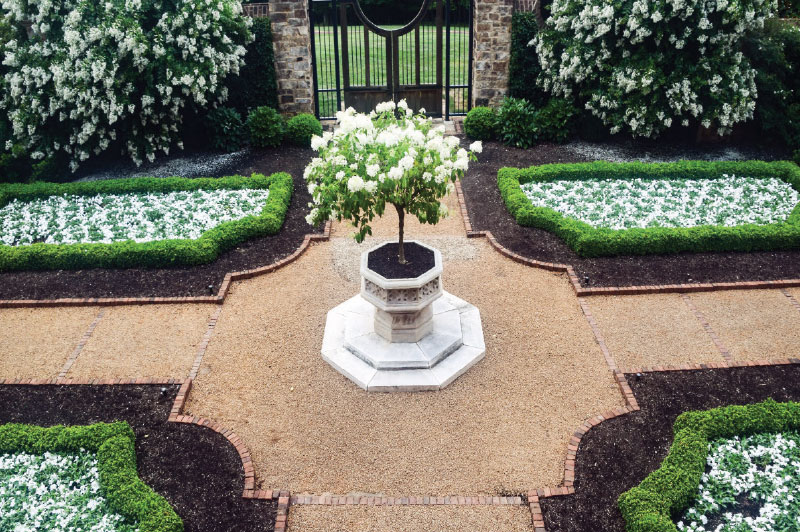
A recently added folly, an ornamental building, is nestled on the left as visitors enter. Farther along the bricked driveway are manicured lawns, a commanding stone forecourt, and a view of the residence. The gardens are filled with fruit trees, evergreens, and numerous native species. The family keeps bees and chickens, a large greenhouse, and maintains kitchen, vegetable, and floral cutting gardens.
1116 Running Cedar Way, Drs. Tim and Sarah Hellewell, owners
Built in 1983, this Federal Revival gem is a traditional Virginia Piedmont home, featuring Flemish bond brickwork, a Doric-columned entrance porch, and arched windows. The homeowners are committed to sustainability and biodiversity. The lawn has been pesticide- and herbicide-free for more than a decade, and the owners continue to reduce areas of manicured lawn to support pollinators and wildlife. Thirty-three solar panels on the rear roof provide all the power the property needs from March to October, while a fenced compost pile enriches the soil that sustains the vegetables growing on the back porch. Garden beds include a mix of old and new varieties of ornamentals and native species.
4113 Peakland Place, Dr. James E. and Elizabeth Foster, owners
Located in the heart of Boonsboro, this recently renovated Colonial Revival home was built during the early twentieth century suburban expansion of Lynchburg. The exterior is brick, painted in soft white. The neutral façade, weathered gray slate roof, and bluestone terraces counterbalance vivid greens and vibrant plant selections that provide year-round color.
A commanding front lawn framed by pyramidal evergreens and low boxwood contrasts with the casual entertaining spaces behind the house, including hidden nooks, a fairy garden, stone terraces, and a Williamsburg-style potting shed. A cascade of seasonal blooms begins with camellias and is followed by azaleas, peonies, magnolia, and hydrangeas.
4108 Peakland Place, Dr. Samuel and Mary Omotoye, owners
This charming English Country manor–style residence was built in 1928 in the midst of Virginia’s English Revival architectural and landscape movement. To emphasize a rural setting, previous owners added a circular drive and a walled cottage garden to provide a transition to the multiple side and rear gardens original to the property. The front beds have undergone a recent transformation with the addition of numerous American boxwoods. Colorful perennials, such as poppies, delphiniums, and irises, soften the brick exterior. In the rear gardens a terrace, fashioned with salvaged flagstones from downtown Lynchburg sidewalks, juxtaposes the natural earth tones of the brick and stone house with the lush green extending to the rear of the property.
Shoes With A Mission
Liberty alumnus tells story through new book about life in war-torn Congo.
Even after running through the Congolese jungle barefoot, Liberty alumnus Emmanuel Ntibonera says he still spends most of his days not wearing shoes.
“I think part of me is sick of shoes after seeing them piled up in my home for so long,” he laughed. “Every inch has boxes of shoes. It got to be too much. I don’t even want to wear them anymore.”
Ntibonera has spent the last several years collecting more than 70,000 pairs of shoes for the people of Congo, a mission he details in his book Congo Sole, which came out in October. The book tells the story of Ntibonera and his family as they escaped war-torn Congo and came to the United States.
“The biggest takeaway I want people to get from the book is that there is hope,” Ntibonera said.
“Though we may fall, you can get back up. There is nothing you can’t overcome. I look back at everything that I’ve been through, and see? I’m still standing because I have hope in the Lord.”
Humbled Beginnings
Born in Congo as the oldest of nine siblings, Ntibonera said he and his family had a fairly normal life before the war.
The Ntiboneras lived in a seven-bedroom house, which was part of a larger compound his dad owned and rented out. While they lacked American comforts such as running water or taking the bus to school, the Ntiboneras were surrounded by a loving community where everyone looked out for each other.
But that all changed in 1996 when Africa launched into war as Rwanda invaded what is now the modern-day Republic of Congo, which led to violence and genocide across the country.
At the time Ntibonera was eight years old.
“War broke out as me and my family sat down for dinner,” Ntibonera explained during his Liberty University Convocation appearance last November where he shared his testimony. “Chaos, people running. You could hear gunshots in every direction and every corner of the country.”
In that moment, Ntibonera said he and his family prayed for peace as they sat in the darkness. Over the radio, they learned that rebel forces had taken over their city.
As a large family, the Ntiboneras began to make a plan to leave the city alongside their extended family knowing that there was danger ahead as they trekked throughout the jungle. Ntibonera said his family kept saying, “Keep moving forward.”
“As my bare feet carried me, one step at a time, my eyes and ears absorbed horrors I’ll never forget,” Ntibonera describes in his book. “Limp bodies, painted with dry blood, were laid out on the side of the road. Women’s screams, muffled by rows of vacant houses, turned my stomach, even though I was too young to fully understand what was happening.”
Suddenly, his family members were refugees in their own country, but Ntibonera said his father vowed that they would not die in Congo. Eventually, the family fled to Kenya. There they filled a tiny apartment and waited for a door to open so they could come to the U.S. In 2009, it did, and the family found themselves settling in Greensboro, N.C.
“We suddenly had to adapt to a new place and culture,” Ntibonera explained. “The Lutheran Church helped us get to America and they were able to set us up with a social worker for the first six months of our time in Greensboro, but then we were on our own.”
As Ntibonera became more settled in America, he decided he wanted to pursue an education and found himself applying to Liberty University—only an hour and a half up the road from their new home.
“It was hard being away from my family,” Ntibonera said. “We had this bond. We had been through so much together and we had been together my whole life.”
But Ntibonera said God was preparing a place for him at Liberty, and he didn’t know it at the time, but it involved 20,000 pairs of shoes.
Finding sole in tragedy
Ntibonera said he soaked up life as a student at Liberty, where he heard from speakers from all over the world during their twice weekly Convocation.
But the person who stood out from the stage the most was Senior Vice President for Spiritual Development David Nasser. Like Ntibonera, Nasser himself was a refugee after fleeing Iran as a child.
“Here was a man who was a refugee who was speaking to thousands of people,” Ntibonera said. “It made me feel like he could do anything.”
As Ntibonera sat in Convocation each week, he also heard about humanitarian trips Liberty students would take to serve people all over the world.
“I remember they were talking about students going to Rwanda and I thought, ‘Why can’t they go to Congo too? It’s right there’,” he said. “I told my siblings that someday, someone was going to talk about the Congo from that stage.”
At the same time, Ntibonera said God was stirring something in his heart that it was time to remember where he came from and give back to his people who were still hurting halfway across the world. As he went through his closet, it came to him: shoes.
“I remember thinking, ‘Why do I have so many pairs of shoes?’,” he said. “At one time, I didn’t have any and I was praying out to God for a pair.”
Ntibonera said that many children in his country did not have shoes growing up, which put them at risk for disease, sometimes even fatal ones. Sending shoes to Congo could potentially save lives, he thought.
Ntibonera began collecting shoes on his own, filling any space he could with shoes. But soon he was overwhelmed and realized that if he was going to accomplish his goal, he needed help. He decided
to turn to Nasser to see if there was anything Liberty could do.
He emailed Nasser for a meeting and within a few hours of talking, Nasser set a plan in motion: they would host a campus-wide shoe drive with the help of NBA player Steph Curry and his wife, Ayesha, during Convocation.
“God ordained that meeting,” Ntibonera said.
Liberty’s Vice President of Spiritual Development Josh Rutledge said after their initial meeting with Emmanuel, it wasn’t his story that stuck out.
“A lot of young people, especially students, have remarkable stories,” he said. “But Emmanuel’s story was tied in with a dream and a personal plan of action, and not only that, it was a plan he was pursuing regardless of whether anyone else got on board with it or not. That’s always going to stand out. When someone says, ‘Look, here’s what I feel called to do, and here’s the steps I’ve taken to make it a reality. Would you like to join?’ That’s Emmanuel. He’s not out looking for permission to do something. He’s out extending invitations to join him in something he’s already doing.”
Then in March 2017, Ntibonera’s declaration came true. During the Curry’s March 2017 Convocation visit, Nasser invited Ntibonera to share his story from the Convocation stage.
“I remember before Convocation sitting in the green room with Steph wondering how I got here,” Ntibonera said. “Part of me just wanted to sit back and take it all in from the audience and just see what God was doing.”
More than 20,000 shoes were donated by not only the Currys and sponsors such as Nike and Under Armour, but by the Liberty student body.
“I think our students are often the ones leading the way at LU when it comes to service and ministry,” Rutledge said. “We’re always much more interested in joining with what they’re already doing than trying to invent something new. Emmanuel’s mission had a very practical call to action. ‘Do you have a nice pair of tennis shoes lying around that you’d be willing to donate?’ That was it.”
Since then, Ntibonera said that he has raised more than 70,000 shoes for the people in the Congo and has traveled to the country to deliver them more than three times.
“There is still so much work that needs to be done there,” he said, noting that sales from his book, Congo Sole, will go toward building a community center in the country where individuals can seek medical care, counseling, and start businesses.
“My people have been through so much,” he said. “There is so much trauma and hurt. A pair of shoes is a start but can only last so long. I want to be able to support them long-term.”
Ntibonera, who now lives in Nashville, said Lynchburg played a huge part in his story and helping him grow into the person he is now.
“Lynchburg was my temporary home, but in a way, it will always be home,” he said. “Liberty impacted my life in so many ways. It was incredible to see students and people from the community come behind me and say, ‘Yes, we want to help’.”
Remembering the Patterson Six
How the 1960 Sit-in Was a Catalyst for Civil Rights in Lynchburg
Sixty years ago, six college students sat down together for a cup of coffee at the lunch counter at Patterson’s Drug Store in downtown Lynchburg. But because two of those students were Black, all six were arrested and charged with trespassing.
Their Dec. 14, 1960 arrest and subsequent conviction, which included a sentence of 30 days in jail, sparked a number of other sit-ins, forcing residents to grapple with the ugly inequality in their segregated city.
“Oh my God, that was a wonderful day,” recalls the Rev. Virgil Wood, then pastor at Diamond Hill Baptist Church who helped plan the sit-in. “I remember it like it was yesterday. It’s indelibly imprinted in your spirit.”
Now 88 and a resident of a Houston suburb, Wood said the sit-in “was an originating moment in some ways” and was significant because of the institutions involved.
Barbara Thomas, 21, and Kenneth Green, 28, were students at the all-Black Virginia Theological Seminary, while Mary Edith Bentley, 20, and Rebecca Owen, 20, were students at Randolph-Macon Woman’s College. James E. Hunter, 19, and George Terrill Brumback, 20, were students at Lynchburg College.
Photo courtesy of News and Advance
“It was just an obvious moral issue; (segregation) was wrong,” said Hunter, the only one of the six interviewed for this story. Two have died, one is ill, one can’t be found, and the other declined an interview.
Hunter, who will turn 80 in December, has not talked about the sit-in much over the years, but summed up the action this way: “Two things I would emphasize are that nonviolence can work, and things can change.”
Hunter, who had a career in social work and lives in Maine, acknowledges that racism remains a problem, but says things have improved vastly. He had seen signs of segregation, including separate drinking fountains, as a child. “You saw that kind of thing all over the place,” said Hunter, who grew up in Indianapolis. “It irked you.”
The decision to become involved in civil rights was a no-brainer for Hunter. He said a group of students had been meeting at Diamond Hill for a few weeks and realized they needed to take action. They chose Patterson’s Drug Store because of its prominence on Main Street and hoped to convince drug store owner William S. Patterson to get on the right side of history.
Instead, Patterson called the police and had the students arrested for trespassing. A patrol wagon took the students to jail. Hunter said a Black businessman posted his bail that evening.
Rebecca Owen called her good friend Alice Hilseweck (now Ball), who got word to R-MWC President William Quillian. Quillian arranged for bail for his students.
The very next day, Ball participated in a sit-in at Peoples Drug Store. “We didn’t want to go home for Christmas vacation and leave (the people of) Lynchburg thinking there were just six bad guys in the town,” Ball, now 81, said in a phone interview from her home in Atlanta.
Ball joined four other R-MWC students and Miriam Thomas Gaines, a Black student from Campbell County High School, at Peoples. Miriam’s sister, Barbara Thomas, had been arrested the day before.
“I’ve been doing a lot of thinking about it,” Ball said. “This is an issue now and has never not been an issue.” Her book club in Atlanta is reading The Race Beat, about how the media covered racial issues from 1958 to 1960, which makes her realize “the things that I as a white woman don’t have to wake up thinking about.
“I believe some of the material that’s being written now is beginning to get white people to wake up,” Ball said, adding she is hopeful because white Episcopal parishes in her area are talking about white privilege.
Ball’s life reflected her early beliefs. Her work to help battered women, foster children, and young girls earned her national recognition. She has also worked as a mediator and trainer for an alternative dispute resolution center in Atlanta.
For Miriam Gaines, now 77 and a resident of Forest, her decision to join the Peoples sit-in was prompted by the racism she experienced as a child. Until very recently, she has been reluctant to talk about it. When she was asked to tell children about the sit-in at Pleasant Valley Church earlier this year, however, she couldn’t resist. She shared the notes from her talk.
Gaines said her father worked three jobs to support his nine children. He owned a store and a barbershop and was a porter carrying mail and packages at a railroad station. Her mother stayed at home and periodically did day jobs cleaning the homes of whites.
Photo courtesy of News and Advance
“One of the things that bothered me was how the white men, women, and children would call my mother, Sallie… even though she was much older than they were,” Gaines said. Her mother had to use the back door to those white houses. On vacations with her family, Gaines learned that Blacks couldn’t stay in hotels or motels, eat at restaurants, or use restrooms that were for whites only, much less attend the same schools or live in the same neighborhoods.
Photo courtesy of News and Advance“We had a white school one block from our house,” she said. “We had to pass that school and attend a Black school about 10 blocks away. We used to walk to school. As we passed the white school I can remember being teased and being called the “N”-word as we walked by… .
“Finally, unrest developed in the Black community and we felt that we had enough living as secondhand citizens,” she said. When the movement came to Lynchburg, Gaines was 18. She tagged along with her sister Barbara.
Barbara, who died in 2004, was one of those arrested at Patterson’s Drug Store, but Gaines joined the next day’s Peoples sit-in without hesitation. “The four white girls ordered Cokes; I was ignored. When the drinks came, one of the girls slid her drink to me. I sipped it. Immediately, the manager told us to get out. He said this is the end, good-bye, and showed us the door.”
Alice Ball was the one who slid her drink to Gaines. She grew up in Texas with parents who were part Choctaw and taught her to treat all people fairly. “It was the air to breathe and the water to drink at my house,” she said.
In Lynchburg, the attempts at integration were resisted forcefully by many whites, including one woman who lived on Rivermont Avenue. She invited the R-MWC students to tea to try to coax them to reveal who at the college put them up to participating in the sit-ins, Ball said. The students let her know it was all their doing.
The day after the Patterson sit-in, the two R-MWC students were brought before the Judiciary Committee where they learned they would not be expelled, but received “stern” disapproval from the College administration for breaking the law, according to a story in the fall 2010 Randolph College Bulletin. They had to promise not to be involved in more protests.
The College lost several large financial supporters and three R-MWC trustees resigned publicly after Dr. Quillian refused to let the Board handle the decision. “It was a difficult time,” he said in the 2010 Bulletin article. “The lines were pretty well drawn in our community. I was devoted to all of our students, and I was torn as to how best to deal with a situation like this. I respected them and I shared their concerns, but I wasn’t sure this was the best way under the circumstances to try and bring change when others were trying to bring change in a different way.”
When the students returned to campus in January 1961, they faced a packed court hearing where they were found guilty and received the maximum sentence, 30 days in jail. They appealed the verdict, but later decided to drop the appeal, and on Feb. 6, people were shocked as the six students were led away in handcuffs.
Photo courtesy of News and Advance
Jim Hunter joked that they got out after 20 days for good behavior but weren’t sure what that meant. Unlike the R-MWC students who said they read and studied, Hunter said he and Terrill Brumback mostly played poker with their cellmates.
While in jail, Hunter, who smoked, had been sent cartons of cigarettes as a way to show appreciation for his participation in the sit-in. Cigarettes were the currency of poker. “I wasn’t a great player so that made me a popular player,” he said.
Hunter added, however, that he did manage to read Dostoevsky’s Crime and Punishment, while behind bars.
Ball said the students’ jail time served its purpose. “They decided Lynchburg would never confront what was going on unless their own college students were in jail,” she said.
About the same time as the sit-ins, a group of Blacks were preparing to start the court case that would desegregate E.C. Glass High School. Owen Cardwell, who became one of the first two Black students to attend the school on Dec. 29, 1962, said he has thought a lot about the events that got his attention as an eighth-grader in 1960.
“The key thing that stands out for me was there was a two-fold strategy: public accommodation and public education,” Cardwell said.
Caldwell believes the sit-ins in Greensboro, North Carolina from February to July 1960—which were a pivotal part of the national civil rights movement—brought greater awareness to the Blacks in Lynchburg. “In a real sense, the Patterson sit-in launched the Civil Rights Movement here in Lynchburg,” he said.