The Relics of War

As the 75th anniversary of D-Day approaches, artifacts shed light on June 6, 1944

John Long ran a bit late to an interview about the D-Day artifacts he curates because he got a last-minute invitation to lunch with a World War II veteran.

Those are invitations you never turn down. While his lunch partner, Bobbie Johnson, served in the Pacific, Johnson knew a lot of the Bedford Boys—the 19 young men who died on D-Day on France’s shore. They represent the highest per-capita loss in the June 6, 1944 landing, which prompted the building of the National D-Day Memorial in this small Virginia town. In 1944, Bedford’s population was about 3,200. Another four soldiers from Bedford died later in the Normandy campaign. Still others were killed or wounded during the war. “Bedford lost so many men,” Johnson said.

A native of Bedford, Johnson was a crew member on B-29s, the top bombers of the day. He flew on reconnaissance missions and helped bring back B-29s as the war wound down. Johnson’s flight helmet and oxygen mask are among the thousands of artifacts that Long has cataloged and stored in the cramped basement of the National D-Day Memorial Foundation’s administration building. Johnson, who turns 93 in April, says it’s important to study history. “Lest we forget, we may have to repeat it,” he said. He has also donated books and other memorabilia to the memorial.

Long, director of education for the memorial, searched through what seems like chaos to find an artifact to share. He readily selected a box with a few possessions of Jimmy Foster, a veteran from Waynesboro, who died shortly after landing on Omaha Beach. His watch stopped at 8:25, and Long surmises that was the time of his death.

Time is now winding down for those who survived. Indeed, all of the surviving Bedford Boys have passed. As the number of living World War II veterans dwindles, the race to preserve individual stories is intensifying. Long feels the pressure every day as he wades through piles of donations to the D-Day Memorial.

“With the World War II generation passing on, we are getting things from kids, grandkids, and even great-grandkids,” he noted. One recent single donation included 200 items that must now be crammed into boxes in a space that is already overflowing.

The long-range goal is a large education facility/museum to display these relics. In the short-term, the D-Day Foundation is opening a Quonset hut this spring to display a few items. It will replace the old Army tents that have been used at the memorial for education programs for local students and visitors.

Long said they cannot accept all donations, but if an item is related to D-Day, they are keen to have it. Other unusual or rare items from World War II are also welcome, but what they want most are items with stories.

The next artifact he pulls out is a Gold Star banner, given to grieving parents to hang in their homes. This banner belonged to the family of Daniel Paul Womack, who grew up on Walnut Street in Lynchburg. Like the Bedford Boys, Womack was a member of the National Guard’s 29th Division, 116th Infantry Regiment, though he was in Company B, while the Bedford Boys were in Company A. Womack, too, was killed in the landing, and his remains were buried in the Normandy American Cemetery. A French family adopted his grave, a common practice in France, and put flowers on it every June 6.

As construction of the memorial was underway, this family contacted Bob Slaughter, the late D-Day veteran from Roanoke who was largely responsible for the creation of the memorial in Bedford. The French family was able to connect with Womack’s family, and they traveled from France for the dedication of the memorial on June 4, 2001, which was presided over by President George W. Bush.

Although the Bedford Boys are the reason the memorial is in Bedford, there are relatively few artifacts from those 19 men. Among the most poignant is a pocket-sized New Testament belonging to John Schenk. The bible, which was a gift from his mother, was found on a beach in France. Schenk’s wife, Ivylynn, later donated the bible, along with the last letter she wrote—but never mailed—to her husband. The morning after she wrote it, the dreaded telegram arrived.

That telegram was delivered too many times throughout the nation after D-Day, but the losses in Bedford were disproportionately staggering. The Hoback family lost not one, but two sons, on June 6, 1944. Slaughter was determined that the nation understand the extreme sacrifice from this one community. Before he died in 2012, he also contributed one of the rarest items in the collection.

His “Order of the Day,” the official document from President Dwight D. Eisenhower, outlined the D-Day landing to the troops going in. “You are about to embark upon the Great Crusade, toward which we have striven these many months,” the order begins. “The eyes of the world are upon you. The hopes and prayers of liberty-loving people everywhere march with you.”

Slaughter had 75 of his fellow soldiers sign his Order of the Day, which was folded and taped from much handling. Of those 75, 11 died within an hour of landing and another 11 died after D-Day. “This was his most cherished memento of the war,” Long said. It is currently being restored in Richmond.

Long pulls out another box, this one containing a medic’s armband that belonged to Robert Ware, a Lynchburg physician who died on a beach before he could help anyone.

Artifacts have been donated from around the nation. One display box features two sea bags decorated by Jack Edward Rowe of Rhode Island. Rowe was a member of the Coast Guard who decorated the bag that he stored his portable typewriter and diary in. His last entry was 12:50 a.m. on June 6, 1944.

The archives also include commemorative items, such as the 1960s-vintage D-Day board game requiring players to figure out how to take the Normandy beaches. Each big anniversary, in 1984, 1994, and 2004, also created new mementos. One of the more unusual ones in the archive is a bottle of Calvados, a French apple brandy. The bottle was given to Earl Draper, a paratrooper from Texas who was among the 70-somethings who parachuted into France a second time in 1994 to celebrate the 50th anniversary of D-Day. Draper was injured in that jump and had to be hospitalized for a couple of days in Sainte-Mere Eglise. The town gave him the 1944 vintage Calvados, which has a whole pear inside, with etchings on the bottle to thank him for his service.

The vast majority of items in the archives are photographs, many with no names and no way to identify the subjects. There are also a few weapons, including an M-1 carbine found on a beach, restored, and later donated, but with no history attached. Of the more exciting items donated early on were some hand grenades, still live, which required a visit from a bomb squad.

Long, a longtime history buff who has been overseeing the archives for three and a half years, said they do everything they can to preserve items to archival standards, but some items will inevitably fade with time.

It’s more important that their stories live on.


Person of Interest: Lauryn Lynch January/February 2019

AGE: 8
Lauryn Lynch, a Bedford County resident and Liberty Christian Academy student, was crowned Little Miss of America on Nov. 24. We asked her a few questions about her newfound fame!

Lauryn, congratulations! As Little Miss of America, what types of things do you get to do in the coming year? I will travel and make appearances on behalf of American Pageants. Little Miss of America also serves as an ambassador for Special Olympics, hosting an inclusion event. I also get to go watch Miss America in Atlantic City with my sister queens in September!

When did you first start competing in pageants? I entered my local fair pageant when I was 6 and won! I was the very first Tiny Miss Bedford County Fair.

What do you like about pageants? I enjoy being on stage and talking to the judges. American Pageants is different from other pageants. Most of your score is based on your grades, community service, and activities. I work hard to get good grades and stay involved, so my mom figured I should try it.

Who are your role models—and why? I look up to my sister queens.

They’re all older than me and are really great role models who’ve accomplished a lot. It’s fun to be the little sister.

How does it feel to have so much national attention? It’s fun. It was cool to see my picture on the pageant’s website and social media. I hope other little girls will know they can do it too!

What do you have planned next? My next goals are to totally rock 3rd grade and have a great year as Little Miss of America!


A Reprieve for Lynchburg’s Only Lake

College Lake will return to full pond but plans for a wetland remain the ultimate goal

Laura Henry-Stone envisions the day when the area between the University of Lynchburg and Faculty Drive will be a thriving wetland—with plants filtering runoff, waterfowl dabbling in Blackwater Creek, and community members walking across boardwalks to enjoy a healthy ecosystem.

The wetland would take the place of College Lake, which was drained in August after a heavy rainstorm sent water over its dam. In late October, the city temporarily refilled the lake pending the construction of a new bridge and removal of the dam. The city says refilling the lake will reduce the debris clogs at the dam’s emergency outfall and slow the sediment that is currently being washed into the downstream reaches of Blackwater Creek and the James River.

Henry-Stone, a professor of environmental studies at the University of Lynchburg and the university’s liaison with the city, acknowledges that it will take several years and a lot of money for her vision for College Lake to become a reality.

When parts of Lynchburg received a whopping 5 inches of rain on Aug. 2, the surge carried water over College Lake dam and Lakeside Drive, raising Blackwater Creek 10 to 12 feet above its normal flow. In all, an area of 22 square miles drains into the lake.

The flood left behind a mess, destroying trees and infrastructure along the Blackwater Creek Trail system and dumping a polluted plume into the James River, which flows into the Chesapeake Bay, a body of water the state is under mandate to help clean up.

Another mess was created when the city decided to drain College Lake two days later, in just three hours, fearful that the dam would not hold. The city acted under a state of emergency to drain the lake without having to consider environmental impacts. That killed countless fish and other critters that once called the lake home, as well as those downstream.

The city acted out of concern for homeowners who lived below the dam, but officials acknowledge it would have been far preferable to have taken action in a non-emergency time frame.

The damage from the August storm would have been far less if, for example, College Lake dam had already been removed and a stable wetland been in place. City assessors estimated damage from the Aug. 2 storm at $18 million, including $10 million in damage to the dam and $5.6 million in damage to parks and trails. City officials counted 324 downed trees in the streambed. Piles of silt landed on the Blackwater Creek Athletic Area field and elsewhere, and three pedestrian bridges were destroyed.

The city and university have been in discussion for years about how best to manage the lake. In 2008, the state changed the regulations governing dams, said Tim Mitchell, director of water resources for the City of Lynchburg, and the city was told the dam had to be strengthened or removed. While the city and university were searching for options, the city was given a conditional permit to operate the dam until March 30, 2020.

Even before the dam became a safety concern, Tom Shahady, a professor of environmental science at the University of Lynchburg, had urged the city to promote smarter development that didn’t create such huge runoff and sediment loading in city streams and College Lake. “When you build irresponsibly, you get these problems,” Shahady said.

Early History

College Lake was created in 1935 when the City of Lynchburg dammed Blackwater Creek to build U.S. 460, now Lakeside Drive. The city owned the dam, and Lynchburg College (now the University of Lynchburg) owned the lake, but a city park gave everyone some access to the city’s only lake, providing students and residents a place to swim, boat, fish, and ice skate in then-colder winters.

In Full Circle; Memories of Lynchburg College and Beyond, the memoir of former Lynchburg College President M. Carey Brewer, he writes about his son Rob’s memories of College Lake. “At this writing, Rob’s fondest memories are those of ice skating on College Lake as a fourteen-year-old on those rare occasions when the ice was thick enough. He recalls the joy of skating to the far end and back with abandon. Every member of the family enjoyed skating on the lake from time to time, but there was the ever-present fear that the ice might break with tragic consequences.”

Almost no one has skated on the lake for decades because the ice has not been thick enough to support a person’s weight, said Julius Sigler, former dean of Lynchburg College, who first came there as a student in 1958. Any attempt to skate now would have tragic consequences. Sigler also noted that the city park was hard to get to because of the heavy truck traffic whizzing by on U.S. 460.

A bigger problem lurked beneath the surface, however. By the 1950s, raw sewage was flowing into the lake on a regular basis, Sigler said. While locals still fished in the lake, no one dared swim in it.

Once the city built its combined sewer overflow system in the late ’60s and early ’70s, the sewage problem improved though bacteria counts continued to spike in the lake after it rained, said Sigler, who is also a longtime member of the Robert E. Lee Soil and Water Conservation District.

Throughout this time, professors, including the late Ruskin Freer, were already using the lake area as a laboratory to study everything from insects to plants to bacteria levels from the sewage. As development began creating a sediment buildup, students started measuring the decreasing depth of the lake.

By the 1970s, development was beginning to create bigger sediment problems and more stormwater runoff. Rain hitting buildings, parking lots, and roads has no place to go but downhill fast. The flush of water carves the banks, putting even more sediment into streams and rivers.

In the 1990s, the College built a cabin-like structure and dock on the lake at Beaver Point, where students had dances, picnics, and get-togethers. As development accelerated, the lake began catching and storing enormous amounts of sediment and pollutants from Wards and Timberlake roads, and the lake filled in at Beaver Point, leaving the dock high and dry. Students pretty much stopped using it in the early 2000s, but the lake remained an outdoor laboratory for science students.

“The lake was a gigantic stormwater pond,” said Shahady, who has studied College Lake for 16 years. He predicted the lake would eventually fill in unless measures were taken to stop the flow of sediment. College President Kenneth Garren lobbied for federal funding, but Congress failed to help.

Nevertheless, Shahady found sizeable populations of bass and other fish still thriving in recent years. They died when the lake was drained, and so did Garren and Shahady’s dream of preserving it.

Turning College Lake Into a Wetland

In the coming years, the city will remove the dam and replace it with a four-lane bridge over Blackwater Creek, Mitchell said. In the meantime, refilling the lake will keep debris from clogging a temporary grate and will decrease the flow of sediment from the lakebed into Blackwater Creek, which has remained a muddy brown all the way to the James River. But the long-term goal for the area is turning it into a wetland.

A number of structures, as well as natural plantings, will be required to make this happen. Even then, Sigler worries that it won’t look the way it should. “My concern is how do you make it look like a reasonably wild stream,” he said.

A wetland is a land area saturated with water, either permanently or seasonally, with aquatic plants adapted to this unique soil. Wetlands are critical to healthy ecosystems, but, according to the U.S. Geological Survey, throughout the U.S. we have destroyed or degraded 50 percent of wetlands with development, engineering projects, agriculture, and fossil fuel development.

Still, wetlands shelter more than one-third of the country’s threatened and endangered species, according to the Environmental Protection Agency. Without wetlands, a huge number of songbirds, waterfowl, shellfish, and mammals wouldn’t exist. If trees are the lungs of the planet, then wetlands are its kidneys, removing pollutants including nitrates, phosphorus, and heavy metals. Clean and plentiful drinking water depends on healthy wetlands.

Wetlands also provide people with many ways to enjoy nature, including bird watching, biking, and hiking, activities that could easily occur in the College Lake area. While a number of people will mourn the loss of College Lake when it is permanently drained, there are many benefits to restoring this area to a functioning wetland.

Both Tim Mitchell and Laura Henry-Stone remain optimistic that this can happen. Henry-Stone said the city and university are exploring funding options, including nutrient trading credits that could be received for reducing the nitrogen and phosphorous levels in the James River, and ultimately, the Chesapeake Bay.

Henry-Stone will keep the community up-to-date on the project through a blog on the university’s website at redchairblogs.com.


Grassroots Local Market

Grocery Co-op Opens Downtown

By Drew Menard | Photos by Heather Kidd

While Grassroots Local Market is a co-op, dedicated to adding value to the community beyond the product on its shelves, as far as shoppers are concerned it operates like a “regular” grocery store.

“The bottom line is this is a grocery store,” said Kate Jenkins, GLM Outreach Coordinator. “No one is going to choose your groceries for you or just give you a box of food where you don’t know what you are getting.”

The grocery store opened to the public on September 1; it has produce, milk, frozen entrees, and grab-and-go options, including self-serve coffee, soup, and sandwiches.

“We are going to see what the community reacts to and we are going to build on that,” GLM General Manager Zack Sheppard said.

Common misunderstandings about co-ops are that they are always for members only—which is not true—and that one has to work there or provide some sort of labor for the store in order to shop there—also false.

“Co-ops are really just a reflection of the community that owns them,” Sheppard explained.

How Co-ops Really Work

Each co-op is unique to the community it’s in, but generally they operate under seven basic principles that include concern for the community, open, voluntary membership, and democratic member control. Membership is open to anyone (for a one-time, $200 payment or a payment plan of $50 up front and five monthly installments of $30) and is refundable.

“Once you purchase a membership you become a co-owner of the grocery store,” Jenkins said. “You are purchasing one equal stock and that gives you one equal vote.”

So, rather than a national retail chain making decisions about what is best for your local grocery store, you, as a member-owner, get a say.

“It’s a way for community members to take action and be involved,” Jenkins said. “But they don’t have to contribute a large amount of time and money or resources to be a key member. … A co-op essentially serves as a gathering place for those (member-owner) community members. The goal behind the membership is to have an equal yet very diverse representation of the community that we serve.”

Co-ops run as a pure democracy—one vote per member. While individuals may purchase multiple memberships, that does not buy a weighted vote or more power; it’s functionally a donation. Multiple people within one household may purchase a membership, and with it the right to vote, individually. And members don’t weigh in on every trivial matter of the store, such as what brands of beans are stocked. Members certainly can offer feedback, but business decisions are handled by the general manager, who is hired and held accountable by an elected board of directors. Any member is eligible to run for the board, currently seven members (up to 11 may be elected) who serve voluntarily with term limits.

“Equality and equity are founding principles of a co-op,” Sheppard said.

How Grassroots Adds Community Value

Grassroots supports local farmers and food producers, providing shelf space for their products.

“It really brings access to market for farmers,” Jenkins said. “I come from a long line of farmers. Farmers markets are great but the maker or the grower has to stop what they are doing, load up their goods, travel to a farmers market. [The store] provides them the ability to source their goods in another location and keep a roof over their heads.”

The co-op does support, and has the support of, area farmers markets, including the Lynchburg Community Market. Grassroots aims to build up, not undercut, the downtown local economy.

“The goal is to source as many items locally as possible,” Jenkins said. For the items that are imported, “it will be done in a mindful way.”

An advantage of co-ops is not just that they are customized to their community—focused on bringing as much local product to the shelves as is feasible—but that they are invested in it as well.

“We are a for-profit enterprise,” Jenkins clarified. “At the end of the day, we are a grocery store that is a for-profit business. The difference with cooperatives versus publicly traded companies and different types of enterprises is that surplus at the end of the year is either invested back into the store or equitably allocated back to the membership in the form of a patronage rebate. It incentivizes a member to shop here versus somewhere else.”

But profits are also going to go toward education. Grassroots is committed to bringing fresh, healthy food downtown and, likewise, the co-op is on a mission to bring knowledge on sustainable business practices, fair trade, where our food comes from, and healthy eating and cooking to help foster a culture of more mindful shoppers.

“It really is about sourcing local food, making it available for local people and then keeping the money local,” Jenkins said, noting the co-op’s commitment to supporting other local businesses. That way, she continued, Grassroots can help Lynchburg “build up our community for a stronger generation.”

How It Came To Be

Local shakers David Poole and Dan Hague, both current board members, co-own the building at 1300 Main Street, where Grassroots is housed. A survey from Virginia Tech noted that downtown Lynchburg is the largest urban food desert in the commonwealth. Combined with feedback from locals expressing a desire for a downtown grocer, they knew the space could fill a need.

“We wanted to see a grocery downtown,” Hague said, “but could not attract a commercial enterprise that was interested in doing it. We looked at the survey results for downtown. The No. 1 requested service was always a grocery store.”

The only viable option became a cooperative venture.

“A co-op is a way for a community to further its wants and needs in a sensible fashion,” Poole said. “It’s a load-sharing, risk-sharing, cost-sharing—it’s a way to get what a community wants. The sustainability and the aspects of good food fit in so well with that. They are not necessarily easy ones to sell in the standard world of commerce. It brings all those things together quite well.”

“We figured if the community wants a grocery store then maybe they would like to do it themselves,” Hague added.

A steering committee was formed and began spreading the idea among local groups and individuals. In 2016 they started selling memberships and raised more than $175,000 through those efforts in about a year and a half.

“It was really a leap of faith for those early adopters to get on board with the co-op,” Poole said.

Last November, the Lynchburg Economic Development Authority awarded Grassroots a $180,000 loan, which was vital in getting construction underway.

“It is really about the rebirth of downtown and the understanding of the economic vitality of downtown,” Poole said. “[Lynchburg] acknowledged the heart of the community and this idea that you need to focus on the livability of a community. You have a re-interest in downtown and what it brings in terms of history and culture and focus on the community.”

And a cooperative grocery store fits right in with the downtown culture that is carving out its individual identity.

“Co-ops are very adaptable to their environment,” Poole said. “The co-op that we opened may be very different in a couple years to even what we could imagine because of the community and the ownership.”

For Sheppard, co-ops are more than a fun experiment in community governance. He’s worked with co-ops for the past seven years, starting in Ohio and then Massachusetts, because he sees them as a way to inject goodwill into a local economy.

“On an ideological level,” he said, “I personally think conventional big business models cause a lot of harm in the world for the sake of short-term gains. I see the cooperative model as a solution to that problem.”

“It has to be a win-win,” Poole added. “The corporate philosophy of ‘win at all costs’ does not work when you are trying to revitalize a downtown and bring heart and soul back to a community. That is where a co-op can shine.”


James River Adventures

Workout, Learn, Play on the Water

Snaking along down the northeastern edge of the Hill City, gleaming turquoise as flecks of gold ripple along its undulating surface in the hot summer sun, the James River cuts the border between Downtown Lynchburg and Amherst County.

Last summer, James River Adventures opened up in Riveredge Park, right across from downtown (150 Rocky Hill Road in Madison Heights), offering the community and its visitors exactly what the name implies: adventures on the James. The operation is a branch of the James River Association (JRA), a Richmond-based organization dedicated to protecting the river through advocacy, education and community conservation.

Open 9 a.m. to 6 p.m. every day but Tuesdays and Wednesdays, James River Adventures offers hourly rentals for canoes, kayaks and paddleboards, as well as half- and full-day paddle excursions (approximately 3-6 hours, respectively) with a kayak or canoe and 3- to 4-hour tubing trips. Guided trips are available for a more enriched experience.

“Our trip is a good snapshot of Central Virginia, of James River floating,” Rob Campbell, JRA Community Conservationist, said. “It is very quintessential of what the river looks like from here to Richmond.”

The shorter trip flows under three bridges, ending just before the abandoned Norfolk/Western Railway crossing. The longer trip continues on for a total of nine miles, ending at a boat ramp off Mount Athos Road. All sorts of wildlife can be seen, including an impressive bald eagle’s nest, “about the size of a VW bus,” according to Campbell.

For the hourly rentals, which are great for testing out a new skill or for a quick evening paddle after work, there’s still plenty to experience right outside James River Adventures’ front door.

“It is a great place to paddle up to Scott’s Mill Dam,” Campbell said. “You’ve got the beautiful cascading water and the nice sandy island to stop up there to enjoy a little picnic or a great place to swim and fish and all that good stuff.”
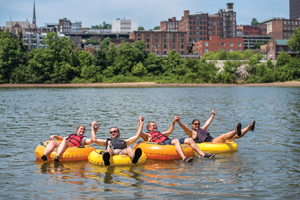
Safety is a top priority. All guests are provided with lifejackets and given basic instruction on how to use their equipment and navigate the waters. Shuttle service is offered not just for customers but also (for a small fee) to paddlers who aren’t able to have cars at both ends of their trips down the river.

Waters are not very rough, so excursions with James River Adventures are great for beginners and families (with certain age/supervision requirements) but even experienced paddlers can appreciate “the beauty and appeal,” Campbell said.

In a society filled with sedentary vices (many of the electronic variety), being active and getting outside is critical. And a workout on the water offers great cardiovascular fitness with low impact on the joints. According to Better Health Channel, physical benefits also include muscle strength targeted in the back, arms, shoulders and chest from paddling and torso and leg strength from rotating and applying pressure through this motion. Standup paddles include the added benefit of balance. That doesn’t even account for the mental benefits.

“The serenity of it, floating down the river without the typical noise distractions,” explained Brooke Newton, JRA Upper James River Educator, “being able to flow along and hear the movement of the water, all the natural sounds … helps enhance how people go on with their personal lives.”

As James River Adventures guides people across the surface, they invite them into a deeper understanding. Education is a key element of what the operation is all about.

“We do hope that when people go out with us we can personify stewardship,” Newton said. “We focus mostly on the positive aspect of what our river is and how awesome and historic the James is for all of us.”

She pointed out that many in the community cling to the idea that the water is “nasty,” while in reality it is booming with a healthy underwater ecosystem.

“That’s part of our mission; to outreach and get people to understand that these local tributaries are vastly important,” Newton said.

“It tells such a better story; it paints a much brighter picture of the James than people ever had,” Campbell added.

Firsthand experience also helps people care more about the environment and spurs them to be more mindful of how they impact it.

tubes james river“If people become connected to the river and they begin to care about it then they want to be a part of that solution,” Newton said.

Throughout the year, James River Adventures takes area middle and high schoolers out on excursions, both to have fun outside the classroom and to have a meaningful educational experience related to what they are learning in class.

“It’s a double-whammy” Campbell said.

The school trips include macro-invertebrate testing and water quality samples, checking the chemical makeup of the river. It all relates to local landscapes, giving students a better appreciation for their community. (Weeklong summer camps were also held in June.)

“We get them to start thinking about things that they do on a daily basis and things that they can do to lessen their impact on water quality,” Newton said. “They are learning about nutrient pollution in textbooks; we try to get them to think for themselves about where this potential pollution is coming from in order for us to come back full circle to see what we can do as individuals to think globally but act locally.”

This deeper educational experience is also incorporated into the guided tours offered by James River Adventures.

The vision is for the organization to flow deep through the community, as vibrant as the waters it seeks to protect, celebrate and enjoy. James River Adventures supports the annual James River Batteau Festival, a historic, weeklong floating adventure that starts in Lynchburg. Campbell and Newton are also partnering with the Lynchburg Outdoor Social Tribe, as well as local businesses, to host outdoor events that connect and support the downtown community (ideas include “Paddles and Pints” and “Paddles and Pizza”). In the long-term, there are hopes to partner with local bike, skate and rock climbing shops to host multi-sport events that include paddling, as well as to offer more educational opportunities (their current offerings help meet statewide Standards of Learning for science but Newton sees more interdisciplinary applications, including for art, history and physical education).

James River Adventures is also a tourism boon for Amherst County as it elevates Riveredge as an attraction.

“Big things are coming from this little park,” Newton said. “We are hoping to open up a whole new realm.”

Book your adventure online or learn more at JamesRiverAdventures.org.


Lynchburg, Virginia Overview

Lynchburg, Virginia may surprise you with its history! From The National D Day memorial, to the Appomattox Courthouse, Lynchburg is in the center of it all.


Erik The Travel Guy
Published on Jun 22, 2009

Erik Hastings is Erik The Travel Guy! He is on a mission to help you get out and explore the world! Airlines, cruises, trains and unbelievable destinations big and small await you EVERYDAY. Please share this video with your friends, subscribe to my YouTube Channel and be inspired by watching more videos on my website www.erikthetravelguy.com


360: Memorial Steps in Lynchburg, VA

One of the iconic sites of downtown Lynchburg, Virginia is the Memorial Steps – built after World War I to honor those who had served. Over the years, the city has made additions to commemorate later wars. Lynchburg Museum curator Laura Wilson takes us up all 140 steps.


C-SPAN: Published on Feb 16, 2018


Gone But Not Forgotten

Local Garden Club Takes CHILD Gravesites Under Its Wing

In October 2017, members of Garden by the James Garden Club were volunteering at Lynchburg’s Presbyterian Cemetery. In particular, the local garden club had been working to beautify the cemetery’s “cradle graves,” called as much because they often resemble a crib or a bed. Popular in the 1800s, cradle graves were not exclusively used for children’s burials, but perhaps that’s where their use is the most poignant.

Garden by the James, a relatively new garden club in Lynchburg, has a strong commitment to community service. “Garden, home and community is what our goal is,” community service project coordinator Lisa Edmunds said. “We do a lot of gardening, a little bit of home, and every year we choose a community project to do.”

Early last year, Edmunds said, the club surveyed five local organizations “about what their needs were and what we could do for them. The one that ended up tugging at our hearts the most was Presbyterian Cemetery.”

They contacted Wanda Carpenter, executive director of the nearly 200-year-old cemetery, who had some ideas about how the club could help. “The first thing we did out there was the 10 babies [from] the one family,” Edmunds said, referring to the 10 children of tin-ware dealer Robert Waldron and his wife, Susan.

Waldron childrenThe Waldron children are buried side by side, in 10 identical graves. Although information is scant, it’s likely they died between the mid-1860s and 1880. Adding to the mystery, there are no names or dates on the graves, only a single obelisk dedicated to “Our Children” and engraved with Isaiah 40:11: “He shall gather the lambs with his arm and carry them in his bosom.”

Garden club members cleaned up the gravesite, weeding and adding fresh dirt and weed preventer. They planted phlox, candy tuft and violas. They mulched and then started wondering what else they might do for the cemetery.

One day, Edmunds said, Carpenter called to see if the club was interested in doing work on another gravesite, one with an equally sad story: five girls killed in a fire at Lynchburg’s Presbyterian Orphanage. “Absolutely,” Edmunds told her. “We want to really lock arms with you and do what we can to help out.”

This sad story began at about 4 a.m. on Oct. 26, 1909, when fire broke out in a girls’ dormitory at the Presbyterian Orphanage, now part of the HumanKind complex on Linden Avenue. Five girls, ages about 5 through 10, were killed. Stories about the tragedy appeared in newspapers as far away as Kansas, under dramatic headlines such as “Babes Die in Flames.”

The Baltimore Sun reported that “Mrs. Priest,” the orphanage cook, was the first to detect the fire after being awakened “by the roar of the flames.” In one eternal sentence, the reporter described the scene: “When [Mrs. Priest] saw that it was … impossible to get the children out by the stairway, the entire basement and first floor at that time being enveloped, and that it would be but a few minutes before the whole building would fall, she rushed to the third story and brought 15 children down to the second floor, leading them to the veranda roof, where they were taken down a ladder, several of them dropping into the outstretched arms of the older boys of the institution.”

The five girls who died that morning were Ruby and Lucile Moorefield, sisters from Lynchburg; Mamie Reynolds of Bath County; Marie Hickman of Campbell County; and Mary Poole of McDowell County, W. Va. The Louisville, Ky., Courier-Journal reported that Ruby Moorefield had been rescued but, upon learning that her younger sister, Lucile, was still trapped inside ran back into the inferno and “lost her life.”

The girls were buried at Presbyterian Cemetery in five white caskets. A single tombstone, bearing all five names, sits at the head of the plot. Edmunds described the plot she first saw as “a sad little spot, very root-y and weedy, with some grass and some dirt. It just wasn’t very happy.” She said club members envisioned something different: a well-defined resting place, bordered with cobblestones and planted with daffodils and periwinkle.

“That’s what we did,” Edmunds said.

“We got the trench dug and picked a stone that we felt would look really nice with the headstone. … We raked, pulled weeds and did whatever we could. We laid the stone, set them the next day, and then [we] planted 100 daffodil bulbs.”

In early spring, the work continued with the group planting periwinkle, a traditional cemetery groundcover. “Hopefully, next year, we’ll have daffodil blooms coming up around these green and purple flowers,” Edmunds said, adding that future plans might extend beyond the gravesites to the cemetery’s entrance on Robins Road.

She hopes other garden clubs will get involved, too. “Everybody has gotten excited about this partnership,” Edmunds said. “We want to continue this relationship and I hope it will grow bigger than us.”

Carpenter is grateful for the help and welcomes the other clubs as well. “The cemetery is honored that Garden by the James has chosen the cemetery as one
of their community projects,” she said. “We are very thankful to Lisa and her team for all of their hard work. Many gravesites are no longer visited, as family lines have died out. For Garden by the James to adopt some these graves and help us preserve their stories is a gift to the entire community.”

What Garden by the James didn’t know before scheduling their workday last fall—“the almost goosebump-y part of the whole story,” Edmunds said—was that they would be at the cemetery on Oct. 26, 2017, the 108th anniversary of the fire.

“I looked up a story on this whole thing and when I read the story, I realized that we were actually going to be there on the anniversary of their deaths,” Edmunds said. “It was not planned. We had no idea when the fire happened. To go back [to the club] and say, ‘Oh, my goodness, the first day we’re starting this is 108 years from the day when they died,’ that was kind of a really neat coincidence.”


Person of Interest: Luis Quijano March/April 2018

AGE: 19 | TITLE: Liberty University
senior fashion design student

You are in the middle of some research that almost sounds a little impossible! How did you become interested in the concept of growing your own clothes?
I originally needed a topic for my public speaking competitions with LU’s Forensics Team and had encountered a Ted Talk by Suzanne Lee called, “How to grow your own clothes.” Then, I decided to use the topic of bacterial cellulose (vegan leather) as my research focus in the Honors program. Through this experience of learning how to grow my own vegan leather, Sacha Laurin, owner of Kombucha Couture, guided me through the various proportions and I was able to begin to grow it. I started applying for research grants. Now, I have completed my Honor’s thesis, while I continue to learn about the process.

How does the process work?
You need water, sugar, green tea, kombucha tea and a container. Boil the water so it no longer contains chlorine or fluoride or use distilled water. Add the sugar, and mix it into the water letting it dissolve. Next, steep the green tea for approximately 10 to 15 minutes, letting the combination cool to room temperature within your container. After the batch is at room temperature, you would insert the kombucha tea, allowing the mixture to grow three to four weeks. Around that time, you will see a thick layer on the surface of the liquid that would then be dried into your vegan leather.

The fabric is described as “sustainable.” What did you learn about the fashion industry that made you want to study this?
Unbeknown to most, the fashion industry is among the most polluting industries in the world, second only to oil. The industry perpetuates an enormous amount of waste environmentally, chemically, and textile-based. The process of growing bacterial cellulose removes most of the steps needed in today’s industry—from growing the resources, making the fibers, converting fibers to thread, and using threads to create the final fabric.

You even spent some time in Australia, right?
I was awarded the Provost’s Award for Research Excellence grant through Liberty University and that allowed me to go to Brisbane, Australia from May to August 2017. I partnered with the Queensland University of Technology and the State Library of Queensland to explore alternative sugars for the growing process of bacterial cellulose (tea leather).

What’s next for you in your journey?
Currently, I am working on designing a collection of sustainable garments for LU’s annual FACS fashion show in April. After I graduate with my B.S. in Fashion Design in May, I will be continuing research with bacterial cellulose, and hopefully begin pursuing my Ph.D. at the Queensland University of Technology in Australia. I am a Fulbright semifinalist for Australia to pursue research in bacterial cellulose. Semifinalists will be notified about finalist notifications in March and April.


Read All About It

A glimpse of local culture as seen  through headlines over the past 125 years

Long before 24-hour news and the internet, newspapers and word of mouth were how people got their news. Recently, Lynchburg Living visited Jones Memorial Library, a local history and genealogy library with newspapers on microfilm back to 1795.

Here are some of the local news stories we found there, looking back every 25 years, from 1993 to 1893: >>

1993
On Feb. 2, The News & Advance reported that the Tour DuPont bike race would be “pedaling through Lynchburg in May.” The 11-day race would attract more than 100 cyclists from around the world.
The biggest news in local sports on Feb. 4 was that E.C. Glass High School’s star linebacker Cornell Brown had signed with the Virginia Tech Hokies. In fact, all of the stories on page B-6 that day had to with high school football signing day.

Brown told reporters, “I just really liked the players up there. That’s just the place that suits me the most and that’s where I think I’ll fit in.”

Then, there was this interesting tidbit: “Brown said he wasn’t bothered by the rumors that Tech coach Frank Beamer may only have a year left if the team doesn’t perform better.” Most people know how that went. Beamer went on to coach at Tech until 2015, a span that included a shot at the national championship and about two dozen bowl games.

Other sports stories that day included, “Hokies mop up on this year’s top Lynchburg-area recruits,” and a story about Liberty University’s freshman football recruiting class being the best it had ever seen.

The same day, on the bottom-right corner of the front page, was a story about the Rev. Jerry Falwell: “Falwell considers his role in revival of Moral Majority.” With the election of President Bill Clinton, after a more than a decade of Republicans in the White House, Falwell was thinking about re-launching the conservative political group he founded in 1979.

In the end, it wasn’t until 2004 that Falwell revived the group and renamed it the Moral Majority Coalition.

And showing that not much changes with the passage of time, two of the three letters to the editor that day were about gun control. The third letter, written by local nurse Doris Weiss, was in support building a women’s war memorial at Arlington National Cemetery. The memorial was dedicated in 1997.

1968
The first baby born in Lynchburg that year was Lisa Carol Stegt, daughter of a couple identified as Mr. and Mrs. Jacob Stegt Jr. The Daily Advance reported on Jan. 1 that Lisa “made her grand entrance at 3:28 a.m. at Virginia Baptist Hospital.”

The sports page on Jan. 10 included a story about the Dunbar High School boys’ basketball team. The Poets would be facing “a tough band of Albert Harris cagers” that Friday night in Martinsville.

Five of the team’s starters had graduated the previous spring, giving Coach Harry Waters what the paper described as “little hope that his young Poets would even enjoy a break-even season.” Despite that dismal prediction, Dunbar went on to end the regular season with a 17-1 record and the Western District championship.

On Jan. 18, 1968, The Daily Advance reported that Pfc. David Harker was missing-in-action in Vietnam. In the end, Harker, a Brookville High School graduate, had been captured by the North Vietnamese. He spent three years as a prisoner of war in what he later told the newspaper were “the worst conditions you can imagine.” He still lives in Central Virginia.

Also reported on Jan. 18, four men were “accosted by the game warden” for spotlighting deer in Amherst County. State Game Warden Robert Chenault was dispatched to High Peak Orchard Road, where he reportedly saw a man standing on the roadside with a rifle.

“I asked him what he was doing there with the rifle,” Chenault said. “He told me he thought he saw a rabbit. They said they were out looking for mistletoe.”

The judge didn’t believe the story, fined each man $150 and confiscated their guns.

1943
On Jan. 4, The Daily Advance reported that Sen. Carter Glass had turned 85. He was celebrating the event by “quietly receiving a few friends at his home, Montview Farm.” While some telegrams had been received by the senator, “the usual flood of telegrams was missing because of the wartime restriction of telegraphic communications.”

Montview Farm is located on what is now Liberty University. At LU, it’s commonly referred to as “The Mansion.”

On Jan. 13, under the headline “In the Courts,” The Daily Advance told the story of three local women sentenced for crimes related to prostitution. The house where the crimes occurred was at 1008 Fourth Street, in what was then a well-known red-light district.

Nancy Schoefield, found guilty of “operating a house of ill fame,” was “sentenced to a total of 15 months in jail.” Betty Lou Howell and Louise Collins, described as “inmates of the same house,” pleaded guilty and were sentenced to six months each.

Eleven years later, at the house next door—1006 Fourth Street—a well-known madam named Mamie Feimster and another woman named Tina Thompson were shot and killed by Lythia Brown Buckwalter. The sensational case was widely covered in The Lynchburg News.

1918
On Jan. 2, an article in The News said that all “alien enemies” living in Lynchburg and the surrounding area had to register with the police department. This included non-naturalized Germans living in the U.S. and was later expanded to include female U.S. citizens married to these “enemy aliens.”

The order came down from the U.S. Attorney General’s Office. The News estimated there were about 50 “alien enemies” in the area who would “be required to carry a registration card with them and will not be allowed to leave Lynchburg without a permit.”

Another article that day told readers that two daring characters—“The Human Spider” and “The Human Fly”—climbed up the Krise Building. The Krise Building is still located at the corner of Main and Ninth streets and houses, among other things, Bowen Jewelry Company.

According to the story, “The ‘Spider’ went all the way to the top of the building and the crowd below greeted his climbing over the eaves with cheering. The ‘Fly’ went only to the sixth floor.”
“The Human Spider” was North Carolina native W.C. “Bill” Strother, known nationwide for his climbing stunts.

On Jan. 3, The News reported under the headline, “One Divorce in Eight” that there were “more than 60 divorces out of 483 marriage licenses” granted in Lynchburg’s corporation and circuit courts over the previous year.

The newspaper also thought it important to let readers know that six Randolph-Macon Woman’s College students had not returned to campus after the winter break, preferring to get married instead. This was reported on Jan. 5, under an all-caps headline: “SIX GET HUSBANDS WHILE ON HOLIDAY.”

1893
The Daily Virginian reported on Jan. 3 that “theatre-goers have a dramatic treat in store for them at the Opera House” with the performance of “The Silver King.” The melodramatic play, written in 1882, was described as the “grand drama of a lifetime.”

Lynchburg’s Opera House was completed in 1879 and was located “on the east corner of Main and Eleventh streets,” according to “Lynchburg: An Architectural History,” by S. Allen Chambers.

It was built by what Chambers describes as “two public-spirited and wealthy tobacconists” named Hancock and Moorman at a cost of $55,000—about $1.3 million today. One of the things written about the Opera House was that its interior was “richly decorated with stucco and composition ornaments” and “painted with gilt.”

In the same column as the story about the Opera House, under the headline, “Fire in West Lynchburg,” is one paragraph about a storehouse that was “totally destroyed by fire.” It was located “near the Zink Works” and owned by a man named R.J. Hudson.

On Jan. 7, a column in The News—the city’s other newspaper, a competitor of Daily Virginian—reported local news and gossip “caught on the streets, at the depot and in the hotel lobbies.”

Among other things, “all water wheels on the river front were blocked with ice yesterday morning, and the machinery at the Glamorgan Works, J.P. Pettyjohn’s, Adams & Woodson’s, and other enterprises in that vicinity refused to move.

“The river froze almost from bank to bank, Blackwater creek was a sheet of ice, and all in all it was an Arctic day. Sleigh riding and coasting were the principal employments of the day.”

And at the home of longtime school superintendent E.C. Glass on Madison Street, Mrs. A.W. Carter, Glass’s mother-in-law, was reportedly seriously ill. Carter—full name Mary Isbell Carter—was unfortunately not long for this world and died two days later on Jan. 9, 1893.