Calling all foodies! As you likely already know, Lynchburg’s restaurant game is strong.
The eateries featured in this issue, those participating in Lynchburg Restaurant Week, and a myriad of others boast delectable dishes and drinks that are undoubtedly worth a venture out. That said, the Lynchburg area also has plenty of offerings for discerning foodies that can be prepared and enjoyed in the comfort of your own home. Read on for details about five of our favorites!
Blackwater Bitters Co. Bitters
Blackwater Bitters Co., owned by Christy Christmas and Katie Elliott, is dedicated to producing high-quality and handcrafted bitters for foodies who want to add some zest to their drinks and food. Their small-batch production process often involves use of a tincture-based method, in which each agent is extracted individually, steeped from one to four weeks, and then combined. Products include cedar, orange, mocha, lavender, aromatic, celery, and rosemary bitters, and purchases can be made online or at select retailers in Lynchburg. For more information or to order online, visit blackwaterbitters.com.
T.C. Trotters Moose Mix for Bloody Marys
After T.C. Trotters Restaurant & Bar closed its doors, the company continued to produce its famous Moose Mix for Bloody Marys and sell it online and at various retailers. Then, near the end of 2020, owner Paul Webster opened a storefront on Commerce Street where the mix is made and where customers can sample the mix at a tasting bar. Each bottle is handmade and hand-poured, and the mix is bold, hearty, and just the right amount of spicy. It also doesn’t get watered down no matter how long you nurse it, and it tastes great with vodka or on its own. For more information or to order online, visit tctrotters.com.
Gunnoe Sausage Co. Country Sausage
Gunnoe Sausage Co. has been making fresh country sausage in Goode, Virginia since 1965. According to owner Craig Gunnoe, the formulations and flavor profiles haven’t changed, and the Gunnoe family recipe, which spans four generations, continues to impress. Country sausage varieties include sage, mild, and hot. Gunnoe products can be found in Virginia grocery stores and in stores throughout the mid-Atlantic. For more information, visit gunnoesausage.com.
Scratch Pasta Co. Pasta
Scratch Pasta Co. was created in 2017 by Chef Stephanie Fees, who is passionate about sharing her love of high-quality pasta with others. The pasta combines simple, fresh, and carefully-sourced ingredients with hand-made textures that are ideally suited for sauce. From spinach fusilli to spicy garlic mohawks to squid ink campanelle, Scratch Co. offers unique and flavorful options for every palate. You can purchase Scratch Pasta Co. products at the Lynchburg Community Market and online. For more information or to order online, visit scratchpastaco.com.
Stone Spice Company Spices
Stone Spice Company offers unique handcrafted, small-batch dry rubs and seasonings. Owner Josh Stone is dedicated to using the highest-quality spices to produce his original recipes, and he uses organic products as often as possible. Offerings include several varieties of the sweet and salty “BBQT,” including “Kickin’ BBQT,” “Screamin’ BBQT,” and “Buzzin’ BBQT,” along with “Sketti Sprinkle,” “Everything Sprinkle,” “Hot Toddy,” and more. Stone Spice products are available for purchase online and at many retailers throughout Virginia. For more information or to order online, visit stonespicecompany.com.
Behind the Scenes: Teamwork Makes the Dream Work
Don’t let the name fool you: Lynchburg Living Idea Houses may be driven by ideas, but they are built, decorated, and documented thanks to the collective actions of talented and dedicated individuals. The 2022 Lynchburg Living Smith Mountain Lake Idea House—a bright and family-friendly lakehouse—is no exception.
For instance, Woody Watts, President of Watts Creative Studios, took the photos of the house and the photos for the Idea House Partner Profiles, and Kasey Bruffy, Marketing and Production Assistant at Watts Creative Studios, assisted on the shoots and snapped these behind-the-scenes shots.
Lynchburg Art Club & Gallery Continues to Preserve—and Make—Local Art History
As I toured the Lynchburg Art Club & Gallery’s headquarters on Rivermont Avenue, I was struck by the balance between tradition and innovation and by a sense of nostalgia alongside a sense of excitement about what the future of art could look like in Lynchburg. Founded in 1895 and still going strong today, the Lynchburg Art Club is both a steward of Lynchburg’s rich visual arts history and a leading player in building its future.
LAC’s permanent collection, which currently consists of over 90 paintings, features the work of LAC members past and present and serves as an account of Lynchburg’s visual arts history. “We have the responsibility of restoring, preserving, and protecting that incredible body of work,” says Jennifer Staton, Manager of the Lynchburg Art Club. “The way I see it, we are the ones who get to tell the stories of the brilliant and forward-thinking founders who, really just as the Civil War was ending, recognized that it is the arts that bring communities together. Lynchburg truly was so far ahead of its time and an arts and culture mecca of sorts then.”
The oldest pieces in the permanent collection are those created by the founders: Bernhart Gutmann, Louise Jordan Smith, and Georgia Morgan. Gutmann was the first supervisor of art in the Lynchburg Public Schools, Smith was once head of the art department at Randolph-Macon Women’s College (now Randolph College), and Morgan was once chair of the art department at Lynchburg College (now University of Lynchburg).
“The permanent collection is used as a teaching tool for our members and the community to study, appreciate, and learn from these accomplished pieces of original art from our talented members,” says Kelly Mattox, President of LAC. “To be featured in the collection, a work has to be an original piece of art, it has to have been done by a member of the club, and it has to be in good to excellent condition. We also need the artist bio, any accolades they accomplished in their medium and artistic career, and information about the donor if they have a connection to the artist.”
The permanent collection is one of many things that found a permanent home when LAC purchased the 1011 Rivermont Avenue building and became incorporated in 1961. “We finally had a permanent home for monthly exhibits, lectures, large classroom space, special events, dinners, receptions, and First Fridays openings for the community to enjoy,” Mattox notes. “It became a destination to experience the arts in Lynchburg.”
Monthly exhibits are organized by an exhibition committee. This committee creates an annual calendar that highlights a wide variety of styles and mediums and features the work of a diverse group of artists. Exhibits often have overarching themes; for instance, a STEAM-themed show happening this September will highlight Lynchburg’s long history as an engineering and design hub.
LAC’s classes and workshops are selected by the volunteer education committee, which is led by Carolyn Prince. This committee chooses the classes, instructors, and formats based on feedback and requests from LAC members and from the general public. Both member artists and guest artists are invited to teach. “One class that has a very loyal following is Ron Boehmer’s ‘Theory and Practice of Drawing and Painting,’” Staton notes. “The class sees new students join each eight weeks or so but there is definitely a core group. I love to be in my office on Tuesday mornings when they are meeting. Ron is incredibly gifted and has created a great atmosphere where everyone is so encouraging of each other, and the works that his students produce are just spectacular.”
Additionally, the club’s event calendar, which can be found on LAC’s website, is always full of exciting options. On May 14, LAC will hold an event called “Plein air painting of a landscape with roses in oil” at Old City Cemetery. The roses will be in full bloom, and artist Julia Lesnichy will demonstrate the technique of painting these delicate flowers. On June 6, Georgia Morgan Civic Art Show winner David Eakin will be conducting a special gouache workshop. A date for the 49th autumn Lynchburg Art Festival at E.C. Glass High School will be announced in June.
For more than 20 years, the Lynchburg Art Festival has funded four scholarships for rising high school seniors from Lynchburg who major in the arts for their four academic college years. LAC also works with Beacon of Hope to help students in need. “As part of our outreach mission to the community, we have partnered with Beacon of Hope for their ‘Art for Achievement’ fundraiser for a few years,” says Mattox. “Lynchburg Art Club members paint over 100 paintings to be auctioned at their gala event. It is such a rewarding experience to generate the funds that will assist students in need with their future education.”
Mattox, who moved to Lynchburg from Richmond, believes that Lynchburg is a can’t-miss art destination for several reasons. “I was so impressed with the large number of artists who are so incredibly talented in Central Virginia and who were so helpful to me when I arrived,” she says. “I think Lynchburg stands out in Central Virginia because it has colleges that have degrees in visual arts programs and their own collections: The Maier Museum of Art at Randolph College, the Daura Museum of Art at University of Lynchburg, and Sweet Briar College’s Art Gallery.”
LAC has also helped make the Rivermont area a hub of creativity. “Along with Point of Honor, Lynchburg Art Club serves as the arts and culture anchor to this area of town,” says Staton. “LAC has shown that lower Rivermont is a safe and beautiful area that is worthy of preservation. We are excited to be the visual arts center of this up-and-coming pedestrian and biker-friendly area of town.”
Lynchburg Art Club & Gallery is undoubtedly an integral part of Lynchburg’s art culture and history. Its staff’s dedication to growing and evolving while also honoring and preserving the past points to another century—at least—of esteemed service.
“We are one of the oldest nonprofit volunteered membership art clubs in America,” notes Mattox. “This history is so valuable. Of course, we always need to change with the times and add more diversity of classes, develop more outreach programs and partnerships, welcome new members, and embrace all social media outlets. We encourage everyone to visit and celebrate our past and experience our future.”
By Emily Mook | Photos By Ashley Glen
Mizumi Japanese Bistro & Moon Tea of Lynchburg
In early January, the city’s newest Asian eatery opened on the newly revamped Main Street in downtown Lynchburg. Located under one roof is Japanese fusion restaurant Mizumi Japanese Bistro and local boba tea staple Moon Tea of Lynchburg, which debuted as a food truck in July 2021.
“As Moon Tea got famous, we needed a local location or building,” Manager David Kang said. “So, we decided to combine the two restaurants together.”
According Kang, they purchased the Main Street property in October 2021 and renovated the building over a two-month span. When deciding what to name the restaurant that would accompany Moon Tea, he says they were inspired by the nearby waterfall in Hollins Mill Park.
“‘Mizumi,’ in Japanese it means ‘waterfall’,” Kang said.
The restaurant is across the street from the Lynchburg Community Market and in walking distance from the city’s business hub, making it poised to benefit from the recent completion of the Main Street Renewal Project.
Since the grand opening on Jan. 8, Kang said Mizumi and Moon Tea have enjoyed a consistent stream of 300 to 400 customers each day. The busyness picked up even more when students from local universities returned to Lynchburg to start their spring semesters.
Many customers enjoy the 30-plus flavors of bubble and fruit teas Moon Tea offers, while others are drawn to the go-to Japanese cuisine—hibachi and ramen, among other dishes—served by Mizumi. What keeps them coming back is not only the clean, bright atmosphere of the restaurant, but also the quality and freshness of the fare.
“I know the other places do it well too, but I can say that [our] taste is different, our freshness is different,” Kang said. “Also, for bubble teas, we have our own recipes.”
What’s the secret? According to Kang, nearly every tea and food item on the menu—everything from Thai tea to teriyaki sauce—is made fresh daily from Mizumi and Moon Tea’s unique recipes.
“Every day we boil fresh milk teas, unsweet teas, unsweet milk teas and we make our own green teas and everything,” Kang said. “So, we don’t buy it from other places, we just make it our own.”
At a Glance: Mizumi & Moon Tea 1125 Main Street, Lynchburg mizumiva.com Hours: Monday – Sunday 11:30 a.m. to 9:30 p.m.
Photos Courtesy of Downtown Lynchburg Association
Legendary Educators
Lynchburg’s past is full of inspirational figures, but those who have shaped the minds of young and old alike have always been our teachers.
With the help of the Lynchburg Museum System, we took a look at three of those impactful educators who lived, worked and taught here in our city and were the ones to pave the way during a time when it may not have been as celebrated as it is now.
Amelia Perry Pride (1857-1932) Not only was Pride an African-American elementary school teacher and principal for 30 years, she was also well known for her larger contributions to the Lynchburg community.
Pride attended Hampton Institute, now Hampton University, and returned to Lynchburg to begin her teaching career, where she was one of the first Black teachers in Lynchburg City Schools. She later became principal of Polk Street Elementary School.
In 1897, Pride established the former Dorchester Home on Pierce Street or what some called the “Old Folks Home for impoverished former slave women.” According to a city historical marker, it provided shelter, fuel, clothing and food for its residents until their deaths.
The marker also states that, “Following Hampton Institute’s principle of uplifting her race through self-help, Pride was a passionate advocate of African American and Virginia Indian education.”
Pride provided scholarships for many young women seeking higher education and established sewing and cooking schools for women and men entering vocational fields. Her namesake lives on at the Amelia Pride Center on the grounds of Dunbar Middle School, which houses several alternative and adult programs.
Edward Christian Glass (1852-1931) Glass was Lynchburg’s long-time public school superintendent and namesake of E.C. Glass High School on Memorial Avenue.
According to Museum Director Ted Delaney, Glass’s most monumental contribution to our community was that he ensured that public education in Lynchburg was viable at a time when many citizens opposed the idea of taxpayer-funded, government-run schools.
Glass became superintendent of Lynchburg’s public school system in 1879 at the young age of 26 and served for nearly 53 years, according to a city historical marker. He established and for 18 years oversaw a summer teachers’ institute that trained thousands of teachers from Virginia and beyond.
Glass co-owned and co-edited the Virginia School Journal, which for years was the official organ of the state’s Department of Public Instruction and the Educational Association of Virginia. Glass was president of this association and twice served on the State Board of Education.
According to the marker, Glass wrote several textbooks, including Glass’s Speller. Lynchburg High School was renamed in his honor in 1920, and a new E. C. Glass High School opened in 1953.
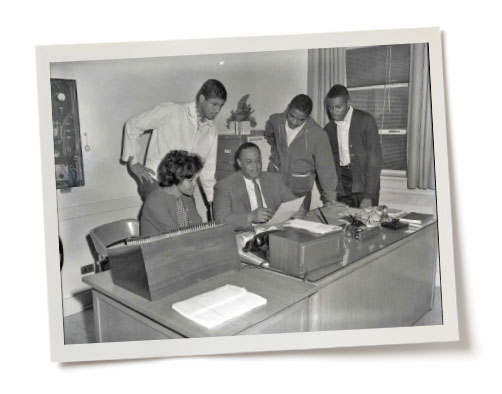
Clarence W. (or “C.W.”) Seay (1900-1982) Seay was an African-American, long-serving principal of Dunbar High School from 1938 to 1968. At the time, Dunbar was Lynchburg’s secondary school for African Americans. According to Delaney, he was the last principal before integration and a beloved advocate for his students and faculty.
Seay believed in the connection between school and community. According to a historical marker in the city, he shaped Dunbar High School into a school of academic excellence, holding that a “successful school and its community are inseparable.”
According to the Lynchburg Museum, Seay spoke out against injustices within the education system and encouraged Black schools to hire Black educators, administration, and personnel, and to seek Black leaders for the School Board.
He later became the first high school principal elected to the presidency of the Association of Colleges and Secondary Schools. After his retirement in 1968, Seay taught at Lynchburg College, now University of Lynchburg, and held the position of Assistant Professor of Education. He was the first and only African American to be employed by the school at the time.
He later served two terms as Lynchburg’s first Black city council member since the 1880s and the first Black vice mayor.
Living with the Waltons
A Dedicated Fan of Earl Hamner Classic Creates a Unique Nelson County Destination
Forty-nine years ago a television classic was launched when the first episode of The Waltons appeared on CBS. The Depression to WWII-era series harkened to a simpler time, though a harder life.
If one word could describe The Waltons, it’s wholesome. Families could comfortably watch the show without worries about R-rated content.
And if one person could be called the show’s No. 1 fan, it’s Carol Johnson, who opened John & Olivia’s Bed & Breakfast in Nelson County in 2019 and named it after the parents on The Waltons.
PHOTOS BY ASHLEE GLEN
The house is a replica of the Hollywood set of The Waltons. “Downstairs looks almost exactly like it,” Johnson says proudly as visitors take a tour. Upstairs, however, she had to reconfigure the set to accommodate the five bedrooms for her bed and breakfast.
Johnson has meticulously decorated the house to match the set. “I’ve gotten things from all over the United States,” she said.
She exudes enthusiasm for everything about The Waltons and has memorized countless facts about both the fictional characters and the real-life ones they were based on.
She said her whole life changed in 2012 while binge-watching The Waltons. A commercial encouraged fans to travel to Los Angeles for the 40th anniversary of the show.
PHOTOS BY ASHLEE GLEN
A native of Ukiah, California, Johnson had never lived anywhere else. She spent 30 years working as a bookkeeper for an orthopedic surgeon, while her husband ran a logging company.
She decided to attend the reunion, where she met the cast and became a major groupie, flying around the country to watch various cast members in theater productions, including Michael Learned, who played Olivia, and Richard Thomas, who was John-Boy.
PHOTOS BY ASHLEE GLEN
In 2014, she helped support the filming of a documentary on Earl Hamner, the writer and TV producer from Schuyler, Virginia, who based The Waltons on his novel, Spencer’s Mountain, which in turn was fashioned after his own childhood. Hamner also provided voice-over narration for The Waltons.
A prolific writer, Hamner also created Falcon Crest, another long-running TV series. He wrote six novels, three nonfiction works, and a number of episodes for TV shows including The Twilight Zone, Gentle Ben, and Nanny and the Professor.
Johnson struck up a friendship with Hamner and visited him in Los Angeles just a month before his death at age 92 on March 24, 2016.
PHOTOS BY ASHLEE GLEN
In 2017, as the 45th anniversary rolled around, Johnson flew to Virginia and volunteered at the Walton’s Mountain Museum, and 15 original cast members showed up at Hamner’s birthplace.
Johnson was among the fans interviewed by The Nelson County Times, and when Hamner’s Schuyler home went up for sale the same year, a reporter gave her a call to ask her about it. She said she would buy it, and she did, beginning what would become her collection of Hamner-related properties.
Visitors can now tour the 1915 Hamner house, which is also full of early 20th-century furnishings including a few original pieces.
PHOTOS BY ASHLEE GLEN
Hamner actually had seven siblings, but the TV series combined two of the boys into one character. “Hollywood didn’t want to pay for the eighth child,” Johnson said.
Hamner was the oldest of the real-life siblings. Hamner’s family moved to Schuyler, where the economy was based on soapstone mining by New Alberene Stone.
When the Great Depression hit, the mines closed, and Hamner’s father could only find work as a machinist at the DuPont factory in Waynesboro, about 30 miles away. Because the roads were so bad, Earl Sr. lived at a boarding house in Waynesboro during the week, only traveling home on the weekend.
The commute required a six-mile walk to the bus and his return walk on a snowy Christmas Eve in 1933 provided the inspiration for Hamner’s 1970 novel, The Homecoming, which became a TV Christmas special.
PHOTOS BY ASHLEE GLEN
Johnson’s bed and breakfast attracts fans from all over the U.S. to stay in a room that replicates the one TV parents John and Olivia slept in. Or they can choose the grandparents’ bedroom, the girls’ room, the boys’ room, or the “Writer’s Room.” Some guests are moved to tears by the experience. “People come crying in and out,” Johnson said.
One visiting couple offered to donate money for elaborate Christmas decorations, but Johnson told them what she really needed was help decorating. The couple came from Washington, D.C. last year to help and will be bringing five couples with them in November to decorate for this Christmas.
Now 55, Johnson moved to Schuyler full-time in March to attend to her Hamner projects, but she still travels back and forth across the continent to visit her family. She also bought another building just up the road, an old school house built in 1917 that will take major renovations.
She has a handful of folks working with her to keep the operations going. “It takes a village to run this village,” she said.
Giving tours and hosting fans in both houses obviously brings Johnson great joy, but she says she’s not the only one: “It makes people happy.”
Even if you’re not a fan of The Waltons, a visit to Schuyler is a trip back in time, and the history of the small town is told through the life of Hamner and The Waltons at the Walton’s Mountain Museum, right across the road from John & Olivia’s Bed & Breakfast.
PHOTOS BY ASHLEE GLEN
The museum, which is the old school building from where Hamner graduated in 1940, is not affiliated with Johnson’s properties, but you can hardly pass up the chance to visit all three.
The museum is owned by the nonprofit Schuyler Community Center on Walton’s Mountain, which also provides a place for residents to hold programs, take their children to play, and create community spirit, said Alison Morgan, a volunteer at the museum.
The museum boasts five replicas of the TV sets of The Waltons as well as a recipe room for the Baldwin sisters’ still. A 30-minute documentary on Hamner loops for visitors, who can also buy items at “Ike Godsey’s Store.”
The Walton’s Mountain Museum is open daily from May to October and weekends only in March, April, and November, and is closed Easter Sunday. Admission is $10 for those 13 and older.
Johnson offers tours of the Hamner House daily from 10 a.m. to 5 p.m. except for Easter, Thanksgiving, and Christmas. Admission is $10 for those 7 and older, and $15 to add John & Olivia’s Bed & Breakfast to the tour.
Camp Trapezium
Adding another unique brewery experience to Central Virginia
There is a new future for a historic landmark in Amherst.
Camp Trapezium, the western outpost of Trapezium Brewing Company in Petersburg, opened up in the renovated Amherst Milling Co. in June, offering small-batch craft beers, brick oven pizzas, wings and salads.
Amherst Milling Co., a mill and farming supply store built in 1890, ceased operations in 2017 and was purchased the following year by the Petersburg-based Waukeshaw Development. The company renovated the mill, farmhouse and land into a haven for family-friendly fun, craft beer and an immersive experience drawing much praise and appreciation from the local community.
“One of the most fun parts about getting [Camp Trapezium] open [was] the number of people who drove past every day for months, well before we were open, and just wanted to pop their heads in and take a look,” said Rachel Jesten, hospitality manager. “Everyone tells us the same thing. They say, ‘Boy, I used to buy my grain here for years. This was our local farm shop… they used to sell everything here.’”
Camp Trapezium’s beer menu currently features award-winning ales brought in from the Petersburg location, but the ultimate goal is for the brewery to also become a producer of its own beers that will incorporate ingredients grown on their farm. According to Jesten, head brewmaster James Frazer’s idea is to use the local flora to influence the fermentation process.
“[Camp Trapezium] is almost the even artsier cousin of [Trapezium Brewing Company],” Jesten said. “So, we are doing a lot of wild fermentation, mixed-culture ales. Basically, anything James Frazer wants to try… This is really a cool playground for that.”
In addition to the brewery and restaurant, the 76-acre property is open for guests to walk around and explore. Featuring a farmhouse that has been renovated into an AirBnb with eight suites, a permaculture farm, live animals roaming around and a water wheel that Waukeshaw hopes to make operational for hydroelectric power production within the next few years, Camp Trapezium is as much a historic site as an eatery.
“We want [Camp Trapezium] to be a really immersive experience,” Jesten said. “We love the idea of people coming down to the area and not just making a day trip out of it but making a weekend.”
By Christian Weaner | Photos courtesy of Trapezium Brewing Co.
Four longtime Lynchburg restaurants that have kept us coming back for almost a century
There’s nothing like enjoying a meal in a place with endless memories of yesteryear—perhaps once frequented by your parents, even your grandparents. The stories told about these historic, and sometimes humble, eateries not only connect us to our local past but they also show how the shared bond of “going out to eat” has prevailed through the generations.
While Lynchburg has a diverse and outstanding selection of locally owned restaurants, we wanted to take some time to focus on the spots that have stood the test of time. These four restaurants, with a combined total of 335 years under their belts, have weathered war, economic depressions and everything in between—but what they all say has been the biggest challenge so far is COVID-19.
The World Famous Stadium Inn This local hangout spot opened in 1927 when it was converted from a substation into a beer and burger joint. The owner now refers to it as the “greatest little bar in Lynchburg.”
Photo by Ashlee Glen
Owner Daryl Burgess purchased the building in 2017 when he saw the restaurant had closed. “I just felt that couldn’t happen,” he said. “It’s a landmark and has such cool history.”
Burgess kept the restaurant closed for two months while he renovated the space into a clean sports bar and grill offering cold beer, low-price eats and TVs.
He threw away old equipment with 50 years of smoke on it including the grill, oven, fryers, photos on the wall and cleaned the windows 27 times until all the smoke was gone. With all that work under his belt, it’s no secret that The World Famous Stadium Inn is no longer a smoking bar. Under Burgess’ direction last year, they now have a high chair for the first time to accommodate families. They’ve also worked hard to clean up their image in general.
“The servers know everyone and we make sure customers get home,” he explained. “There’s a three-strike rule… It’s now a family-friendly beer joint. The hardest thing I had to do was overcome the character of the place.”
Burgess is also the owner of The Filling Station in Amherst and knows his way around hamburgers, hotdogs and wings, so he incorporated all those items at the Stadium Inn.
During the pandemic, Burgess converted the restaurant into a mini-convenience store for two months selling steaks, hand sanitizer, paper towels and toilet paper. But ultimately the business still suffered like most others and saw a 75% decrease in sales.
Now, thankfully, with lighter restrictions, Burgess said the restaurant has been filled to its allowed capacity every weekend.
With the growth in mind, he has plans to open an outdoor pavilion soon to provide for more seating. Burgess expects it to be a place for Lynchburg Hillcats fans to hang out after games at City Stadium.
“If you haven’t checked it out, you don’t know what you’re missing,” he said. “Come see us, say hi and you won’t leave unhappy.”
Photo by Ashlee Glen
The Dahlia Located on Bedford Avenue, this hidden gem is a little less hidden thanks to the recent boom of its neighborhood, which is now home to Golf Park Coffee and Small Batch Barbecue.
Angel Olds, who believes she is the 17th owner of The Dahlia, said the micro-local restaurant is home to some of the best seafood in town. Olds and her late husband used to own the Blue Marlin Seafood Market next door, so she knows her shrimp, scallops and fish.
When it opened in 1947, the restaurant was originally called The Blue Dahlia after a film noir of the same name. It was a popular local spot but over the years the restaurant received a bad reputation and went downhill, according to Olds.
“It became known as a dive bar. Men would come but wives wouldn’t step foot in the place,” Olds said. “Now it’s the opposite.” The upstairs is a little more upscale, while the downstairs, referred to as “the cellar,” has a more relaxed, English pub–style vibe.
After Olds purchased The Dahlia 11 years ago, she gutted the entire place and has since created a causal, family-friendly pub that focuses on quality food.
Though it’s more well-known now, she said her customers enjoy that the restaurant isn’t a run-of-the-mill chain and newcomers still have to plug the address into their GPS and hunt around for the front door.
“We are kind of secluded, but I’m hoping to get new signage for Bedford Avenue,” Olds said. Out of 74 years, Olds said the restaurant has only been closed for two years.
“It’s an institution. It’s weathered history,” she said. “It’s a very old restaurant that has been reborn several times. It’s still here alive and kicking.”
Photo by Ashlee Glen
Texas Inn You know you’re a local to Lynchburg if you know exactly where to find a “greasy cheesy.” That’s, of course, at The Texas Inn, better known as the T-Room, which operates its flagship downtown and a more recent addition in Cornerstone.
In 1949, the restaurant, once located at 602 Main St., was sold for $10,000 by H.D. White to H.W and T.W. Wright. In the 1970s, it was torn down and relocated to its current location at 422 Main St., which once served as a service station.
The 86-year-old restaurant has seen multiple owners but current owner Dave Saunders remains true to founder I.N. Bullington, a former circus advance man.
Ever since purchasing the iconic restaurant in 2018, Saunders has worked tirelessly to bring the T-Room back to its roots, starting with a six-month search for the original chili recipe.
Today, the T-Room is obviously known for its cheesy western—a hamburger with relish, a fried egg and cheese—and chili, better known as a “bowl.”
Saunders has kept some of the quirkier menu items that no one orders, such as the Denver, an egg and cheese sandwich on a bun topped with relish, or the Funny, a hot dog bun with no wiener topped with relish and chili.
He took cheese sticks off the Cornerstone menu because he felt it didn’t fit the character of the establishment, and the relish is made three times a week instead of just one.
Since its opening in 1935, the T-Room has witnessed The Great Depression, World War II, the Korean War, the Vietnam War and a handful of recessions, but COVID-19 has tested the tavern with its ability to only seat customers at its 15-seat counter.
Saunders placed a picnic table outside but it’s still the only establishment in town that has less than 50% capacity. “People have been really loyal ordering to-go and delivery,” he said. “They really saved our bacon.”
In the end, Saunders said the T-Room is the oldest continuously running restaurant in Lynchburg for a reason. “We serve good food fast and cheap,” he said.
Photo by Ashlee Glen
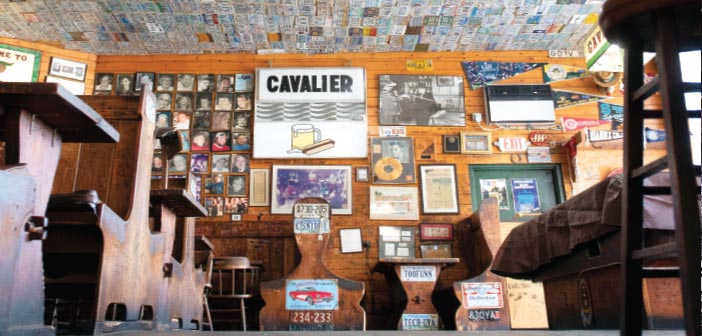
The Cavalier “The Cav” as locals know it might be as hometown as you can get. It’s known for its no-frills and relaxed atmosphere serving up to-die-for burgers and fries.
Located right off Rivermont Avenue, down the street from Randolph College, the dive bar is decorated with side-by-side license plates on the ceiling and walls and its wooden booths are covered with carvings of initials and notes from who once sat there.
Opening in 1940 under the name “The Cavalier Store,” the Cav started out as half grocery store, half restaurant where customers could shop and order a beer and hot dog. It was that way until the late 1960s or early 1970s and the wall between the two was torn down.
In 1987 Wells Duffy purchased the bar and continues to operate it to this day. He is responsible for adding in the main bar and the smaller bar near the ATM machine.
Jake Hill, a bar manager at The Cav, said it wasn’t uncommon for 1940s women to come in, buy cigarettes and smoke because their husbands wouldn’t allow them to light up at home. The restaurant is still an icon in the city and known as a bar reliable to always be open.
“It’s a good ‘ol neighborhood restaurant,” Hill said. “Anyone and everyone is welcome. We consider ourselves the Cheers of Lynchburg because everyone knows each other and if you don’t, by the end of your visit you’ll likely have some new friends.”
There is no question that customers keep coming back for the burger, which has been glorified by all walks of life. It pairs perfectly with the seasoned fries and homemade ranch.
In the past 34 years that Duffy has owned The Cav, he’s never experienced anything quite like the pandemic. He’s never had to adjust his hours and the restaurant has always stayed open seven days a week—but that was put on pause last year.
“Even with bad weather, we’re known as a reliable spot that will always stay open,”Hill said. “He’s never had to deal with anything like this.”
Lynchburg is for Bloody Mary Lovers
The iconic T.C. Trotter’s has a new home for its must-have, multi-use Moose Mix
When Lonnie Hoade and Paul Webster received a call from Virginia ABC last October, the owners of T.C. Trotterʼs Moose Mix for Bloody Marys were equal parts thrilled and intimidated. “We suddenly had an order for 18,000 bottles to be delivered by the first week in December,” Lonnie explained of the very tight timeline.
But when you’ve invested so many years into a product, a little hard work doesn’t scare you off. Many who have lived in Lynchburg over the past few decades have watched the evolution of Moose Mix—from its local restaurant roots to its current location on Commerce Street, which serves as a manufacturing center and tasting room.
Lonnie and Paul’s tried-and-true Bloody Mary recipe, now recognizable across the country, was born at T.C. Trotterʼs Restaurant where Paul was the bar manager.
Casually known as “Trotterʼs,” the restaurant was located in what’s now Rivermont Pizza on Rivermont Avenue for three decades.
“[Our Bloody Mary] became very popular and was served in that glass,” Paul said, pointing to the stemmed and slightly fluted glass on the tasting room counter. “It was five dollars a glass and came with two shots of vodka. We just had cases and cases of those glasses because on weekends, we would serve so many of them.”
“When we first started to notice the demand for it [outside the restaurant], it was around 2004,” Lonnie explains. “Lynchburg College students would call us and want some so we were delivering it around the state. It wasn’t even shelf stable at that point.”
Photo by ASHLEE GLEN
Back then, everyone knew it as “Trotterʼs Bloody Mary Mix”—but eventually they decided on a name change that combined autonomy from the restaurant with a bit of personality.
“We licensed it as Moose Mix because he makes it,” Lonnie said, referring to Paul and his nickname. They started bottling it for sale in 2007.
That same year, the owner of T.C. Trotterʼs decided to close the restaurant, but Lonnie and Paul didn’t let Paul’s famed Bloody Mary mix die out. Back then, and still today, each bottle is prepared by hand, every step of the way.
“From the labor to the packaging and then we put it on pallets and deliver it ourselves,” Paul explains. Each batch of Moose Mix takes about 2.5 hours from start to finish. The bottles are capped at high heat so there are no preservatives.
Now, the demand for their product reaches as far as New York, Florida, and California, with plenty of customers in between.
What makes the mix so popular, Lonnie and Paul believe, is its homegrown taste.
“When we are at festivals, people say, ‘This tastes fresh.’ Some brands can taste manufactured,” Paul says. “It is very flavorful. It has spice as in flavorful spice, not burn-your-mouth spice.”
Lonnie also believes their mix “holds up” better than other brands, making your classic Bloody Mary taste good down to the last drop: “We don’t add any water so it doesn’t water down. The end of the your drink, it’s just as good as the beginning.”
Photo by ASHLEE GLEN
In 2016, Lonnie and Paul took what they learned from their experience at T.C. Trotter’s and opened Moose’s Café in Boonsboro. There, they continued making and selling their Moose Mix but also let it inspire some culinary creations as well—from the “Moose Island” dressing they used on their popular Reuben (a homemade Thousand Island with Moose Mix in place of ketchup) to a Gazpacho made with fresh local vegetables.
“We’ve done chili with it. We’ve done spaghetti sauce. People have told us about ribs that they have done,” Lonnie explains. “There are so many possibilities aside from the Bloody Mary.”
In fact, marketing their Moose Mix as more than just a base for a Bloody Mary has been an important step in their business model.
“At festivals, invariably, people would come to our booth and say ‘what is this’ and we would say ‘Bloody Mary mix’ and one of them would go ‘yeah!’ and the other would go, ‘ew, no.’ But we would let that person taste the shrimp we grilled in it. It would give us another avenue to reach people and find new customers,” says Paul.
In 2020, they made the decision to close Moose’s Café so they could focus even more on their Moose Mix.
Because when you are this husband-and-wife team, you like to be busy—even if it means bottling 18,000 bottles of Moose Mix by hand in less than two months. A deadline they met, by the way.
Photo by ASHLEE GLEN
Now, they are able to enjoy a much slower pace as they maintain their case count at the ABC distribution center in Richmond. They’ve also had Absolute Vodka show some interest in doing a new promotion in 2021.
So slower, but not too slow, they hope. Lonnie and Paul are looking forward to the start of spring and warmer weather that will bring increased foot traffic outside of their Commerce Street location. “That’s why we are excited to be here. We get the impression it will be like a festival once it’s warm. We want to have tasting trays outside,” Paul says.
As Lonnie and Paul can attest through their journey, it doesn’t take much to bring people together in Lynchburg.
But a good cocktail never hurts.
“People can criticize it, but I’ve lived in a lot of places and this city is so great,” says Lonnie. “There is a connection here, something wonderful.”
Remembering the Patterson Six
How the 1960 Sit-in Was a Catalyst for Civil Rights in Lynchburg
Sixty years ago, six college students sat down together for a cup of coffee at the lunch counter at Patterson’s Drug Store in downtown Lynchburg. But because two of those students were Black, all six were arrested and charged with trespassing.
Their Dec. 14, 1960 arrest and subsequent conviction, which included a sentence of 30 days in jail, sparked a number of other sit-ins, forcing residents to grapple with the ugly inequality in their segregated city.
“Oh my God, that was a wonderful day,” recalls the Rev. Virgil Wood, then pastor at Diamond Hill Baptist Church who helped plan the sit-in. “I remember it like it was yesterday. It’s indelibly imprinted in your spirit.”
Now 88 and a resident of a Houston suburb, Wood said the sit-in “was an originating moment in some ways” and was significant because of the institutions involved.
Barbara Thomas, 21, and Kenneth Green, 28, were students at the all-Black Virginia Theological Seminary, while Mary Edith Bentley, 20, and Rebecca Owen, 20, were students at Randolph-Macon Woman’s College. James E. Hunter, 19, and George Terrill Brumback, 20, were students at Lynchburg College.
Photo courtesy of News and Advance
“It was just an obvious moral issue; (segregation) was wrong,” said Hunter, the only one of the six interviewed for this story. Two have died, one is ill, one can’t be found, and the other declined an interview.
Hunter, who will turn 80 in December, has not talked about the sit-in much over the years, but summed up the action this way: “Two things I would emphasize are that nonviolence can work, and things can change.”
Hunter, who had a career in social work and lives in Maine, acknowledges that racism remains a problem, but says things have improved vastly. He had seen signs of segregation, including separate drinking fountains, as a child. “You saw that kind of thing all over the place,” said Hunter, who grew up in Indianapolis. “It irked you.”
The decision to become involved in civil rights was a no-brainer for Hunter. He said a group of students had been meeting at Diamond Hill for a few weeks and realized they needed to take action. They chose Patterson’s Drug Store because of its prominence on Main Street and hoped to convince drug store owner William S. Patterson to get on the right side of history.
Instead, Patterson called the police and had the students arrested for trespassing. A patrol wagon took the students to jail. Hunter said a Black businessman posted his bail that evening.
Rebecca Owen called her good friend Alice Hilseweck (now Ball), who got word to R-MWC President William Quillian. Quillian arranged for bail for his students.
The very next day, Ball participated in a sit-in at Peoples Drug Store. “We didn’t want to go home for Christmas vacation and leave (the people of) Lynchburg thinking there were just six bad guys in the town,” Ball, now 81, said in a phone interview from her home in Atlanta.
Ball joined four other R-MWC students and Miriam Thomas Gaines, a Black student from Campbell County High School, at Peoples. Miriam’s sister, Barbara Thomas, had been arrested the day before.
“I’ve been doing a lot of thinking about it,” Ball said. “This is an issue now and has never not been an issue.” Her book club in Atlanta is reading The Race Beat, about how the media covered racial issues from 1958 to 1960, which makes her realize “the things that I as a white woman don’t have to wake up thinking about.
“I believe some of the material that’s being written now is beginning to get white people to wake up,” Ball said, adding she is hopeful because white Episcopal parishes in her area are talking about white privilege.
Ball’s life reflected her early beliefs. Her work to help battered women, foster children, and young girls earned her national recognition. She has also worked as a mediator and trainer for an alternative dispute resolution center in Atlanta.
For Miriam Gaines, now 77 and a resident of Forest, her decision to join the Peoples sit-in was prompted by the racism she experienced as a child. Until very recently, she has been reluctant to talk about it. When she was asked to tell children about the sit-in at Pleasant Valley Church earlier this year, however, she couldn’t resist. She shared the notes from her talk.
Gaines said her father worked three jobs to support his nine children. He owned a store and a barbershop and was a porter carrying mail and packages at a railroad station. Her mother stayed at home and periodically did day jobs cleaning the homes of whites.
Photo courtesy of News and Advance
“One of the things that bothered me was how the white men, women, and children would call my mother, Sallie… even though she was much older than they were,” Gaines said. Her mother had to use the back door to those white houses. On vacations with her family, Gaines learned that Blacks couldn’t stay in hotels or motels, eat at restaurants, or use restrooms that were for whites only, much less attend the same schools or live in the same neighborhoods.
Photo courtesy of News and Advance“We had a white school one block from our house,” she said. “We had to pass that school and attend a Black school about 10 blocks away. We used to walk to school. As we passed the white school I can remember being teased and being called the “N”-word as we walked by… .
“Finally, unrest developed in the Black community and we felt that we had enough living as secondhand citizens,” she said. When the movement came to Lynchburg, Gaines was 18. She tagged along with her sister Barbara.
Barbara, who died in 2004, was one of those arrested at Patterson’s Drug Store, but Gaines joined the next day’s Peoples sit-in without hesitation. “The four white girls ordered Cokes; I was ignored. When the drinks came, one of the girls slid her drink to me. I sipped it. Immediately, the manager told us to get out. He said this is the end, good-bye, and showed us the door.”
Alice Ball was the one who slid her drink to Gaines. She grew up in Texas with parents who were part Choctaw and taught her to treat all people fairly. “It was the air to breathe and the water to drink at my house,” she said.
In Lynchburg, the attempts at integration were resisted forcefully by many whites, including one woman who lived on Rivermont Avenue. She invited the R-MWC students to tea to try to coax them to reveal who at the college put them up to participating in the sit-ins, Ball said. The students let her know it was all their doing.
The day after the Patterson sit-in, the two R-MWC students were brought before the Judiciary Committee where they learned they would not be expelled, but received “stern” disapproval from the College administration for breaking the law, according to a story in the fall 2010 Randolph College Bulletin. They had to promise not to be involved in more protests.
The College lost several large financial supporters and three R-MWC trustees resigned publicly after Dr. Quillian refused to let the Board handle the decision. “It was a difficult time,” he said in the 2010 Bulletin article. “The lines were pretty well drawn in our community. I was devoted to all of our students, and I was torn as to how best to deal with a situation like this. I respected them and I shared their concerns, but I wasn’t sure this was the best way under the circumstances to try and bring change when others were trying to bring change in a different way.”
When the students returned to campus in January 1961, they faced a packed court hearing where they were found guilty and received the maximum sentence, 30 days in jail. They appealed the verdict, but later decided to drop the appeal, and on Feb. 6, people were shocked as the six students were led away in handcuffs.
Photo courtesy of News and Advance
Jim Hunter joked that they got out after 20 days for good behavior but weren’t sure what that meant. Unlike the R-MWC students who said they read and studied, Hunter said he and Terrill Brumback mostly played poker with their cellmates.
While in jail, Hunter, who smoked, had been sent cartons of cigarettes as a way to show appreciation for his participation in the sit-in. Cigarettes were the currency of poker. “I wasn’t a great player so that made me a popular player,” he said.
Hunter added, however, that he did manage to read Dostoevsky’s Crime and Punishment, while behind bars.
Ball said the students’ jail time served its purpose. “They decided Lynchburg would never confront what was going on unless their own college students were in jail,” she said.
About the same time as the sit-ins, a group of Blacks were preparing to start the court case that would desegregate E.C. Glass High School. Owen Cardwell, who became one of the first two Black students to attend the school on Dec. 29, 1962, said he has thought a lot about the events that got his attention as an eighth-grader in 1960.
“The key thing that stands out for me was there was a two-fold strategy: public accommodation and public education,” Cardwell said.
Caldwell believes the sit-ins in Greensboro, North Carolina from February to July 1960—which were a pivotal part of the national civil rights movement—brought greater awareness to the Blacks in Lynchburg. “In a real sense, the Patterson sit-in launched the Civil Rights Movement here in Lynchburg,” he said.