Up for Adventure in Culpeper

Main Street renaissance, Blue Ridge charm are a gateway to great food, wine, shopping and outdoor fun

By: Leona Baker / Photos courtesy of Visit Culpeper, West Park Gardens or by Lisa Davenport

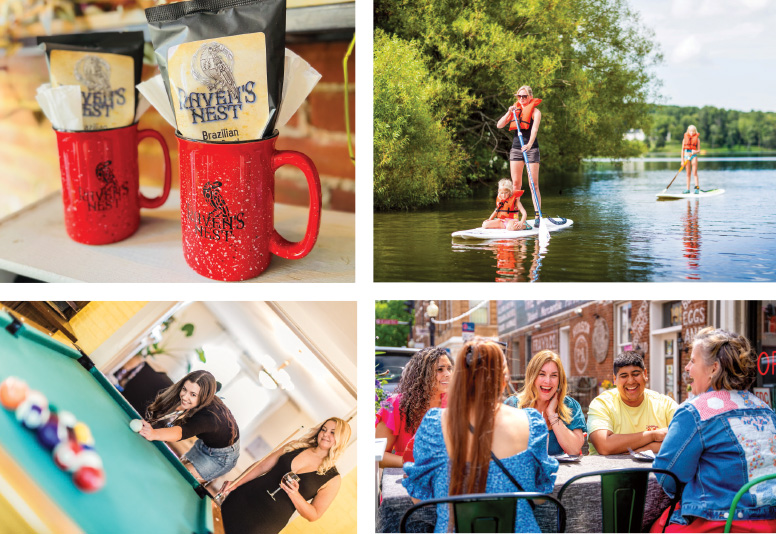
Tucked into the main living room, cattycorner to the pool table and a retro Pac-Man table game at West Park Gardens—a 1920s era home turned short-term rental for overnight stays and special events in Culpeper, Virginia—is a colorful, chalkboard-style display inscribed with ideas for where to “Eat,” “Drink”
and “Play” during your visit.

Based on my recent two-night girls’ getaway with a friend to this historic town on the edge of the Shenandoah Valley, which included jaunts to nearby wineries, restaurants, shops and more, you are going to want to do at least a little of all the above and then some if you plan a visit of your own.

Part of the Virginia Main Street revitalization program, downtown Culpeper has experienced a much-deserved renaissance that showcases its quintessential VA vibes, unique crossroads location, role in American history and gorgeous natural surroundings along with boutique retail, dining, special events and nightlife.

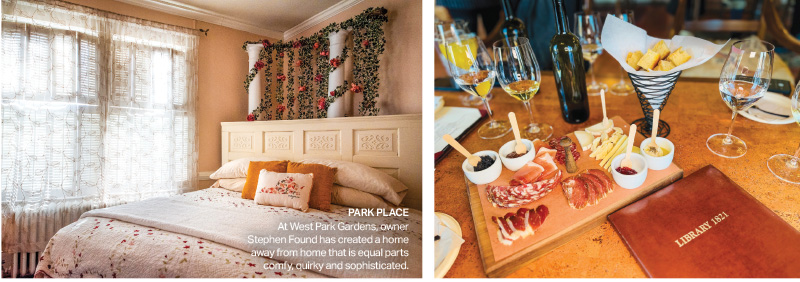
I might have been perfectly content to spend my whole visit at West Park Gardens, where owner Stephen Found has created a home away from home that is equal parts comfy, quirky and sophisticated. From its three spacious second floor guest rooms to the home’s stunning secret backyard garden—where the renovated Garden Cottage with its own kitchen, loft bedroom and private balcony is also available for overnight stays—this is easy Southern living at its best.

West Park’s first-floor common rooms beg you to sit and stay a while, play a game, read a book, or just admire the eclectic assortment of art, antiques and charming tchotchkes. There’s a welcoming dining area for breakfast bites and coffee, a period butler’s pantry and, just beyond a throwback beaded curtain, an enclosed sunroom with golden yellow walls, old-fashioned diner stools along one wall, plants aplenty and even a dartboard.

Once we did venture out the front door and down the sidewalk, we found lots to do and see nearby, including in the downtown area, which is a quick five- to 10-minute walk from West Park Gardens or just a few minutes’ drive.

Culpeper also happens to be geographically situated smack in the middle of a circle of destination towns and attractions that make great day trips—from Lake Anna and Luray Caverns to Harrisonburg and Charlottesville.

World-class hiking, Blue Ridge Mountain scenery and some of Virginia best wineries are also on their doorstep. Here are a few ideas for adventure in and around Culpeper.

Start with Bites and Brews

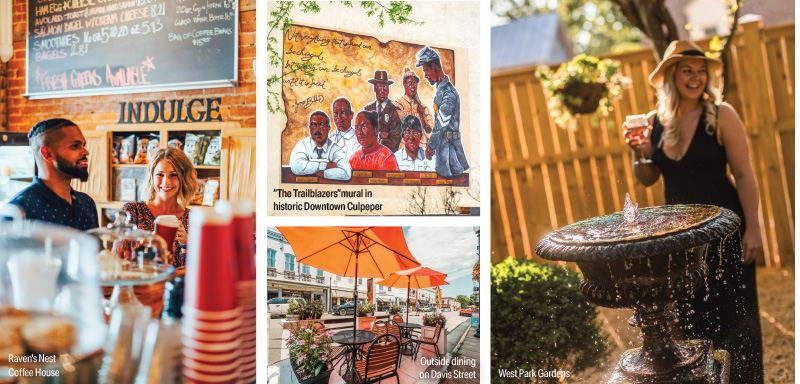
Our quest for caffeination was percolating from the moment we spotted bags of a local roast bearing a black bird logo on the kitchen counter at West Park Gardens. So, we flew right down to the Raven’s Nest on Davis Street in downtown Culpeper.

A “community living room and coffee house,” it’s everything you want in a cozy coffee shop, plus they serve specialty adult libations like a Garden Gimlet or Barista Sour along with wine, beer, cider and a menu of sandwiches, bagels, avo toast, pastries and more.

If you’ve got baked goods on the brain, you’re going to want to rise and shine for Knakal’s Bakery, because people queue up on the regular to savor the glazed donuts, polka rolls, cakes, cookies, yeast biscuits and apple bread at one of Culpeper’s oldest family-run businesses, in operation since 1935. Just note they are closed on Sunday and Monday.

We had a delightful dinner at Grass Rootes, a farm-to-table restaurant housed in a historic industrial building whose brick walls with hand-painted signage, exposed beams, wooden floors, fireplaces and barred basement door speak to its storied past as a tobacco warehouse, stables, tin shop, Civil War jail and hardware store.

Today, Grass Roote’s guests are greeted by a huge, stylized portrait of Anthony Bourdain and a wall-sized quote from Prince’s “Purple Rain” before they enjoy well-crafted classics like Pan-Seared Salmon with creamy orzo, Crispy Duck Breast with red wine risotto, Spaghetti and Meatballs or Bone-in Pork Chops with garlic whipped potatoes. They also serve brunch and creative cocktails and feature live music in “The Burrow,” AKA basement: ghost stories optional.

Other Culpeper food and drink options: Beer Hound Brewery, Burnt Ends BBQ, La Chiapaneca, Flavor on Main, Far Gohn Brewing Company, Grill 309, HFR Contemporary Kitchen & Bar, It’s About Thyme, Pinto Thai Culpeper and Shawn’s Craft BBQ.

Get on a Roll for Good Wine

It’s a crime to drink and drive. But it would also be a crime not to visit at least a couple of the many wonderful Central Virginia wineries within easy driving distance of Culpeper. Good thing we’ve uncorked a perfect solution that is stylish, fun and safe to boot.

I highly recommend booking with Central Virginia Wine Tours, based in Orange and owned by Stephen Sanford, who may also be your personable and patient driver. Select a Cadillac Escalade, shuttle or a limousine bus, grab your significant other, friends, family and fellow wine lovers and leave the driving to the pros.

You can choose one of their preplanned tours or design your own. Brewery tours are also available. We decided to keep it simple by visiting two of the region’s most celebrated wineries for sips, snacks and what turned out to be a truly unforgettable meal.

Perhaps the most recognizable name in Virginia wine for good reason, Barboursville Vineyards is steeped in tradition, its location on a historic vineyard estate on the slopes of the Southwest Mountains a combination of Old-World elegance and modern refinement.

We nestled into a long wooden bench in Barboursville’s Library 1812 Tasting Room for six-wine flights, a small plate of Pappardelle Bolognese from their Trattoria-inspired menu and a lovely charcuterie board. These paired perfectly with our selections from the wine menu, which showcases Barboursville’s wide variety of wines including the Cabernet Francs and Bordeaux-style red blends for which they are well known, such as their signature Octagon.

At the sleek and inviting Early Mountain Vineyards, we were treated to selections from their Virginia Table small plates menu—from Kaluga Caviar gaufrettes with crème fraîche, chive and potato to Grilled Bison Ribeye with shallot confit and rosemary demi-glace to Chocolate Cremeux with pickled cranberry and anise.

This luxurious feast of shareables was a complete culinary experience paired with the sommelier’s picks, beginning with their Brut Sparkling NV and featuring reds such as their RISE blend of Merlot, Cabernet Franc, Petit Verdot and Tannat. Established in 2012, Early Mountain has quickly made a name for itself as a leader in the industry, known for its dry wines and focus on low-intervention winemaking embracing Virginia’s terroir.

Where to wander for even more wine: Barboursville and Early Mountain are less than 35 miles from Culpeper.

Some other suggested wineries nearby are DuCard Vineyards, Lake Anna Winery, Mountain Run Winery, Narmada Winery, Old House Vineyards and Prince Michel Vineyard & Winery.

Hit the Shops or Head Outdoors

Get Retail Therapy Downtown. Check out Le Monkey House for edgy and irreverent gifts, our favorite being the cheeky “Where The F*** Is Culpeper?” swag; The Cameleer for handcrafted home decor, pottery and textiles from more than 80 countries around the world; Fulton Found for “curated goods for the rugged spirit”; or Green Roost for ethically sourced, curated apparel, home goods and more.

Hike, Bike, Paddle, Backpack.

Culpeper is a short drive from the Thornton River Gap entrance to Skyline Drive and Shenandoah National Park, making it a great starting point for exploring legendary trails and scenic views. Don’t miss Old Rag and Mary’s Rock. There’s also great camping, glamping, kayaking and more at Rappahannock River Campground and paddling and fishing at Lake Culpeper.

Even More Outdoorsy Stuff.

Explore Virginia’s newest state park, Culpeper Battlefields State Park; camp, zipline or climb at Verdun Adventure Bound; charter a fly-fishing trip with Middle River Outfitters; hunt for culinary delicacies with Virginia Truffle Hunting; hike or take a tour of Virginia Bison Company at Cibola Farms; or get a view from the skies with Skyline Heli Helicopter Tours.

Cinema and Civil War History.

Culpeper was a crossroads for Union and Confederate forces, playing a key role in Civil War events. Learn more at various historic sites in the area or tour the Museum of Culpeper History. The town also happens to be home to the U.S. Library of Congress collection of historic films, and the nearby Packard Campus Theater hosts screenings of films from the silent era to modern day.

Throw In Some Throwback Fun.

For some family-friendly or rainy-day to-do’s, it’s game on at Throwbacks Arcade downtown, which boasts more than 70 classic arcade cabinets and pinballs.

Saddle up for the 4th Annual Culpeper Rodeo on August 30, check out State Climb indoor rock-climbing gym or Puzzle Room Live, an interactive, fully immersive escape room.

Visit stayculpeper.com to book a room or the Garden Cottage at West Park Gardens. Follow @westparkgardens on Instagram.

West Park Gardens is one of a variety of overnight rentals, B&Bs, boutique hotels, camping and glamping options in or near Culpeper. You can find others as well as more great ideas for things to see and do including seasonal special events at visitculpeper.com.

See also culpeperdowntown.com.


Artist Profile: JoAnne Becker

Making a Difference

A local artist uses her skillset to create beautiful works and foster Lynchburg’s growing art scene

By: Christian Shields | Photos By: Ashlee Glen

Tucked away on the third floor of the Bailey Spencer Hardware building on Lynchburg’s main street, the Studio 3 Art Gallery provides patrons with a wide range of artistic expertise, all courtesy of owner JoAnne Becker.

From woodworking to abstract paintings, portrait photography, family history books, and more, Becker has a self-described “compulsion to create things.” This desire to create beauty causes her to try her hand at many different art disciplines with a high level of success. This often leads to unique combinations of photography intertwined in other art forms, such as her custom cigar boxes.

“It’s a good day when I create something interesting,” she said with a smile.

Becker originally moved to Lynchburg from Maine eight years ago. During a conversation with Bailey Spencer owner Michael Pearl five years later, she was offered the chance to rent the third-floor studio space and she jumped at the opportunity.

While Becker places high value on her creations and takes pride in her work, she refuses to hoard these treasures or over price them for her own personal gain. She instead keeps her prices reasonable and also features low cost items to ensure everyone who walks into her studio can take something home if they choose.
“Really the impetus for this is I love what I do, and I want to share that with people,” she said. “It makes people feel good to have their portraits done.
I get satisfaction taking photographs, but it’s also really rewarding to see them go somewhere where people will enjoy them. Whether I give them away or sell them, it’s the same feeling.

It’s not about the money, it’s about sharing what I do.”

This heart for the community extends beyond Becker’s approach for selling her own products. On Saturdays, she hosts a maker’s market in which local artists of any age can set up a table in her gallery to sell their wares. Rather than seeing other artists as competition, she sees them as fellow craftsmen.

“Art is very personal, so it’s hard for some artists to put their work out there for everyone to see, it definitely was for me,” she said. “I am grateful to be able to help young artists at Studio 3 and watch them gain the confidence and fortitude they need for success.”

This summer, Becker will hold her first solo art show, “Beauty of the Unexpected,” at the Up Front Gallery at the Academy Center of the Arts, with an opening night on June 6 from 5 to 8 p.m. The show will run through July 26.

Explore JoAnne’s paintings and photography at joannebecker.com and connect with Studio 3 Art Gallery on Instagram at @studio3lynchburg.

You can find JoAnne’s custom cigar boxes online at creativecigarboxes.com.


A Weekend at Caesars Virginia

A New Chapter for Danville

Photos by: Ashlee Glen

Imagine stepping into a world of bright lights and anticipation, where the thrill of the roulette wheel competes with the high-energy sounds of slot machines. Every step you take brings you closer to the electric buzz of excitement—a buzz that encapsulates the new heart of Danville, where Caesars Virginia reigns as a beacon of both luxury and possibility.

For those unfamiliar with the region, Danville has long been known for its industrial past, primarily tied to tobacco and textiles. Yet in recent years, the city has reinvented itself. Once a hub of manufacturing, Danville has begun to flourish as a small city of innovation, bringing in new businesses, restaurants, and attractions. The arrival of Caesars Virginia, located on the site of a historic textile mill, is both a testament to this transformation and a catalyst for even more development.

The Building: Merging History & Modernity

Caesars Virginia’s location—just off the Dan River—has been carefully chosen to reflect both the city’s industrial heritage and its bright future. The casino sits on the same grounds that once housed a textile mill, with the iconic smokestacks still standing tall as a symbol of the city’s past. This historical integration is particularly meaningful in Danville, where old factories are being repurposed into trendy restaurants, breweries, and offices. Caesars preserving these smokestacks during construction was part of a broader effort to honor the city’s roots while building for its future.

Inside, the property radiates modern luxury. The Caesars name brings with it a promise of world-class amenities, and the resort does not disappoint. With 320 hotel rooms, including 28 suites, the space offers a welcoming atmosphere for all visitors. Whether you’re a high-roller or someone just looking to unwind, the accommodations are designed for comfort and luxury. The hotel’s grand aesthetic extends to the casino floor itself, where 1,500 slot machines and numerous table games create a buzz of activity. The venue also features a World Series of Poker room and a state-of-the-art sportsbook, making it an exciting destination for both seasoned gamblers and those looking for a little thrill.

A New Experience for the Region

The allure of Caesars Virginia isn’t just in the gaming. The resort has a strong emphasis on providing a full experience for visitors, with something for everyone—whether you’re a foodie, a spa enthusiast, or someone looking for a relaxing weekend. The highlight for many is Ramsay’s Kitchen, by multi-Michelin-starred chef and television personality Gordon Ramsay—the first of its kind in Virginia—where diners can indulge in world-class dishes. Additionally, there’s Dan Dan Noodle Bar, where guests can enjoy Pan-Asian inspired dishes such as sushi or stir fry; Starbucks; and a variety of local eateries like those found at the 500 Block—managed by local restaurateur Steve Parry and local property developer Rick Barker—offering everything from pizza to BBQ.

For those looking to relax and unwind, the spa and pool areas provide serene retreats, while The Pantheon, a 2,500-seat entertainment venue with 30,000 square feet of showroom space, promises a variety of entertainment options. Scheduled to host headliners such as Wynonna Judd and ZZ Top, The Pantheon is poised to become one of the area’s premier venues for major acts. Visitors can expect performances ranging from country and rock to stand-up comedy, further establishing the casino as a vibrant cultural hub.

Despite its focus on gaming, Caesars Virginia also caters to those who might not be interested in placing bets. Families, couples, and even solo travelers can enjoy the resort’s non-gaming offerings, making it a versatile destination for a weekend retreat.

The resort’s integration with the Danville community is also a key element of its success. Partnerships with local businesses and attractions—such as wineries, breweries, and sports teams—allow visitors to experience the best of Danville beyond the casino walls.

Danville’s Revival

The impact of Caesars Virginia on Danville has been significant.

The casino’s opening has sparked a wave of new investment in the area, with construction cranes dotting the skyline and new businesses popping up regularly. The local economy has seen a noticeable boost, as more visitors are flocking to the region to experience the resort. Caesars has hired hundreds of local residents, injecting much-needed jobs into the community. It’s clear that the property’s success is tied closely to its relationship with the local community.

“We are not just a casino,” said Chris Albrecht, SVP & General Manager of Caesars Virginia. “We are part of the fabric of Danville’s growth, and we
want to be a positive influence for years to come.”

The casino’s offerings—ranging from gaming to dining and entertainment—are designed to complement the local economy, with a focus on collaboration rather than competition. By working with local partners, Caesars is helping to create a stronger, more diverse economy for the region.

Center BarPhoto Courtesy Caesars Entertainment

Center Bar. Photo Courtesy Caesars Entertainment

A Weekend Experience at Caesars Virginia

A weekend at Caesars Virginia is an immersive experience. Whether you are drawn to the gaming floor, looking to indulge in fine dining, or seeking relaxation in the spa, there’s no shortage of things to do. For those staying overnight, the hotel’s luxurious rooms provide a quiet sanctuary after a day filled with activity. Guests can unwind with a drink at the casino bar, take in a live performance at The Pantheon, or simply enjoy the scenic beauty of the Dan River.

On Saturday night, the casino floor is bustling, and the excitement is palpable. Guests move from one machine to the next, trying their luck on everything from classic slots to the latest video games.

The energy is contagious, and for many, it’s the perfect way to spend an evening. For those less inclined to gamble, the live music and comedy acts
provide another form of entertainment. You can stroll through the casino, taking in the excitement of the environment, without feeling the pressure to place a bet.

For those looking for a slower pace, a visit to the spa is the perfect way to rejuvenate. The wellness offerings at Caesars Virginia are designed to provide guests with the ultimate relaxation experience, with massages, facials, and other treatments that focus on well-being. The resort’s commitment to offering something for everyone is evident in its diverse array of amenities.

Looking Ahead

Caesars Virginia is more than just a weekend destination; it’s a glimpse into the future of Danville, where history meets modern luxury and a city’s potential is being realized with each passing day.

As the casino continues to grow and evolve, one thing is clear: the best is yet to come for Danville—and for those who choose to make it their getaway.


Grinnin’ Bear Tavern

A Local’s Dream and A Community’s Treasure

By: Jeremy Angione | Photos By: Ashlee Glen

After years in a mix of careers in entertainment and manufacturing, local Chris Seigla decided to serve his community by opening a restaurant. Formerly Spring House Dining and Reception Hall, Seigla bought the Richmond Highway building in October and turned it into the Grinnin’ Bear Tavern.

After years of passing the building while helping with his family’s food truck, Butts Up BBQ. Seigla’s curiosity compelled him to check the place out.
After bringing his wife in to see it, he suggested they buy the building.

“Have you lost your damn mind?” she asked.

After his wife explained all the risks and considerations in owning a restaurant, Seigla decided he was still up for the challenge. The true reality check for Seigla was the amount of “red tape” involved in food service.

“That was the biggest hit for me; the amount of stuff that we had to go through just to be able to cook a hamburger and sell it to somebody,” Seigla said.

Despite the challenges, Seigla remained excited for the opportunity, describing himself as an “eternal optimist.” In preparation for their grand opening, Seigla posted a six-minute video on Facebook, introducing himself, Grinnin’ Bear, and his vision for its impact in the community. According to Seigla, the video was viewed more than 100,000 times.

Because of the unexpected exposure, Seigla says that “everything got thrown into fast forward.” Grinnin’ Bear Tavern held a grand opening March 8. In what became the saving grace for the day, Seigla and his staff approached neighbors of the business to ask for permission to have their patrons park along the road in front of their houses, if necessary.

It was necessary.

“Our grand opening was terrifying. You’ve got to be ready for 10,000 people, but you’ve also got to be ready for 100 people to show up,” Seigla said.

Despite the spacious rooms, large deck, and all the preparation Grinnin’ Bear’s team could muster, the day still proved a challenge.

“We got our butts whipped,” Seigla joked.

Fortunately, according to Seigla, patrons who did not want to bear the crowded venue during the grand opening were understanding and pledged to return another time.

“The support and encouragement that we got from the people around here and the community in general—it’s been unbelievable. I thought it would take a year to get to the point where people knew who we were, knew what we were about, and knew my face. It happened in two months,” Seigla said.

With lessons learned since opening day, Seigla and the Grinnin’ Bear are already planning events, new menus, and infrastructure updates. Chief among those updates are refreshing the decor, installing a proper HVAC system, and expanding parking to take advantage of the 5 acres of land the Grinnin’ Bear Tavern sits on.

Seigla believes the back room and deck will be key in making the tavern a full-fledged event space, with the ability to host several events simultaneously, thanks to retractable partitions throughout the large room.

According to Seigla, the Grinnin’ Bear event space has already been booked 22 times this year. As a former wedding DJ, Seigla is confident that he can show his patrons a good time.

“If I can give them a good meal and a cold beer, then I think this thing could be something really special,” Seigla said.

As a born and raised local, Seigla wants the Grinnin’ Bear to be a boon for the community and all his neighbors whenever possible. The Grinnin’ Bear staff will often bring the fire department, and even one of their elderly neighbors, food, to make sure they are taken care of.

According to Seigla, he wants to do everything from sponsoring little league teams to donating to the local Humane Society.

“We want to be a service to this community. I want to be something to people. I want these people to know, I live 2 miles up the road.

This is where I’ve been my whole life. I want people to know that we want to be a part of this for reasons other than just making money,” Seigla explained.
In accordance with their values of community, Grinnin’ Bear Tavern’s menu is full of what many would consider “comfort food.” What sets it apart, according to Seigla, is the true homemade nature of many of their dishes and their affordability.

With his mom and stepdad helping in the kitchen, Seigla is enthusiastic about the love and quality ingredients that go into Grinnin’ Bear’s simple menu. The tavern’s menu is what you might imagine a bar menu would look like, with items such as a BLT (Seigla’s favorite), mozzarella sticks, or a Philly cheesesteak. Seigla also made a point to highlight their foot-long hotdog that he says you can’t really find anywhere.

What elevates those classic food items is the commitment to making things in house. From housemade condiments to thoughtfully sourced meats, a Grinnin’ Bear Tavern meal provides guests with a generous, plate-filling portion at dive bar prices.

Every Sunday, Grinnin’ Bear offers a breakfast and lunch buffet that Seigla believes will be a staple in the community once it gains traction. According to Seigla, the Sunday buffet was a tradition at Spring House that he’d like to continue in the community.

“The stuff that we’re doing is food that you can’t just go buy anywhere. Rather than trying to do a bunch of stuff right now, let’s do 10 dishes and let’s do ’em really good,” Seigla said.

Seigla also plans to bring the tavern’s menu on the road by converting Butts Up BBQ to a Grinnin’ Bear food truck in October.

Aside from the large and varied spaces, and unique menu, the thing that makes Grinnin’ Bear Tavern the place to visit is Seigla himself.

“I’m the grinnin’ bear. I’ve got these dents on my face ’cause all I do is smile, man,” Seigla exclaimed.

Seigla recalls his time working at Paradise Lake getting paid to wear a Yogi Bear costume. Coincidentally, Seigla is also a Chicago Bears fan. Although Seigla says the name is just one he’s always liked.

“This world’s got enough problems. If for an hour of your day or week, you can come in here and you’re not worried about that stuff, that just swells my heart up,” Seigla said.

Currently, the Grinnin’ Bear Tavern is only open on Fridays, Saturdays, and Sundays. However, the Tavern will sometimes open for special sporting events, such as March Madness.


150 Years of Impact

The Miller Home for Girls’ Legacy of Empowerment and Transformation

By: Olivia Carter | Photos By: Ashlee Glen

For 150 years, the Miller Home for Girls has provided a safe place for young women in need, guiding them toward stability, self-sufficiency, and a brighter future.

Executive Director Stacy Garrett, who has led the organization for two decades, passionately upholds the mission that has remained steadfast since the home’s founding in 1875: to care for girls and help them build a positive path forward.

“Miller Home opened its doors in 1875 and has been taking care of girls who needed a safe place to live, redirect their path, and become smart, intelligent, well-rounded individuals who can go back into our community after the age of 18,” Garrett said. “That has always been our mission.”

Above: When first established, the Miller Home was known as the Lynchburg Female Orphan Asylum. At that time the home could care for approximately 100 girls at once and it was located in a four story building on a working farm. The Asylum was located on Memorial Avenue where E. C. Glass High School and The Plaza are today. Photo courtesy of Lynchburg Museum System.

Above: When first established, the Miller Home was known as the Lynchburg Female Orphan Asylum. At that time the home could care for approximately 100 girls at once and it was located in a four story building on a working farm. The Asylum was located on Memorial Avenue where E. C. Glass High School and The Plaza are today. Photo courtesy of Lynchburg Museum System.

Originally established as the Lynchburg Female Orphan Asylum, the home primarily served orphaned girls. Back then, a guardian, family member, or parent could drop off a girl and she would remain at the home until she married or finished school. In the 1950s, the institution was renamed the Miller Home of Lynchburg and the term “orphan” was phased out as societal needs and the structure of child welfare evolved.

Today, girls come to the Miller Home in various ways.

Many are placed by a guardian or through the Department of Social Services due to changing home circumstances, truancy, or court orders. The home serves as an alternative to detention centers, offering preventive care rather than treatment.

Miller Home

“We’re not a treatment facility; we are a preventive care facility,” Garrett said. “We aim to smooth out a bumpy road and build a network of professionals to help these young women transition back home, move into foster care, or age out and become independent members of the community.”

Dr. Selinna Creasy, volunteer while in college, full-time staff member, and Board of Directors member, said as a volunteer, she witnessed firsthand the organization’s profound impact on the community.

“Inspired by the dedication of the staff and the lives being transformed, I transitioned into a full-time staff role, contributing to the mission that I deeply believe in, ‘Changing Lives, One Girl at a Time.’ Over the years, my commitment to Miller Home grew stronger, eventually leading me to serve on the Board,” Creasy said. “As the current vice president of Miller Home for Girls, this progression has been incredibly fulfilling, allowing me to support and advocate for a place that continues providing hope and strength to so many. It’s a privilege to be part of such a legacy and I look forward to seeing what the future holds for Miller Home.”

The Miller Home focuses on three key areas to support the girls in their care: academics, mental health, and life skills.

“We work to ensure our girls are engaged in school, attending every day, and striving for academic success,” Garrett said. “We also connect them with professional counseling services to help them develop problem-solving and coping skills, particularly if mental health is a factor in their placement.”

The Miller Home also helps girls develop essential life skills.

“We teach them how to keep their rooms clean, cook meals, do their laundry—basic skills they need to be self-sufficient,” Garrett said. “By combining these three aspects, we help them build a strong foundation for the future.”

Unlike some institutions, the Miller Home does not offer in-house counseling. Instead, they partner with outside professionals to ensure an unbiased perspective on each girl’s progress.

“Having a third-party professional involved means we’re not the only ones making the call, especially when it comes to mental health,” Garrett said.

The Miller Home has never relied on state, federal, or city funding to sustain its operations. Instead, it has thrived for 150 years thanks to unwavering
community support.

“The reason our doors are still open is because of our community,” Garrett said. “Through donations, volunteering, and in-kind gifts, our supporters ensure we can continue our work. But it’s getting harder. With economic uncertainties, people are more cautious about giving, yet the needs of our girls remain.”

Local organizations, civic groups, and businesses have played an instrumental role in keeping the home running. St. John’s Episcopal Church, Park View Community Mission, Food for Thought, the Lynchburg Hillcats, and Liberty University have all contributed through fundraising, pantry donations, and volunteer efforts.

Phil Vassar, a country music artist, has partnered with the home since 2008.

“We are incredibly grateful for the Greater Lynchburg Community Foundation’s grants, which have helped us purchase necessary items,” Garrett said. “And our community always steps up, whether it’s Dave and Chris Henderson at Water Dog supporting our fundraising events or Starr Hill Brewery organizing an Angel Tree for us. The generosity is overwhelming.”

The Miller Home has an ability to tailor individualized service plans for each girl. As one of only three programs in Virginia licensed by the Department of Social Services under minimum standards, the Miller Home develops monthly goals and structured plans based on each girl’s specific needs.

“We don’t take a ‘one-size-fits-all’ approach,” Garrett said. “Each girl has her own plan, reviewed on a monthly basis. Because we have a small number of residents, usually eight to ten girls, we can work with them closely and ensure they are making progress.”

She said it’s this hands-on approach that is one of the reasons the Miller Home continues to thrive and make a lasting impact.

Justine, who was a resident from middle school until her first semester of college, then becoming an intern and a full-time staff member with Miller Home, said the impact that the organization had on her life as a resident inspired her to want to come back and complete an internship.

“During my internship a full-time position opened and I decided to take it and become a Child Care Worker,” she said. “Miller Home has had such an impact on my life that I wanted to come back, stay involved, and keep Miller Home in my life.”

Over the decades, the challenges faced by the girls at the Miller Home have evolved.

“In the past, our girls had to sew their clothes and work on farms. Now, we’re dealing with issues like technology, social media, vaping, and the aftermath of COVID-19,” Garrett said. “But our mission remains the same, which is to provide a stable, nurturing environment that prepares them for a successful future.”
One of the most significant measures of success is the transformation that takes place in the lives of the girls.

“Success for us isn’t about numbers, it’s about the quality of the time we spend with these girls,” Garrett said. “It’s seeing a girl make the honor roll for the first time, getting a job, opening a bank account, or applying to college.”

The consequences of not having a place like the Miller Home are stark. Without its support, many of these young women could face homelessness, fall into gang-related activities, or continue cycles of instability, Garrett said. Instead, they are given the chance to break generational patterns and build a better future.
“We’ve had girls who are the first in their families to go to college,” Garrett said. “They learn to trust people outside their immediate family, gain self-worth, and see possibilities they never imagined.”

Kayla, current intern for Miller Home, said her time at the nonprofit has been one of the greatest blessings of her college journey.

“I’ve witnessed firsthand the profound impact Miller Home has on the lives of the girls it serves, and the incredible difference made when dedicated individuals, like the Miller Home staff, step up to care for them every day,” she said. “Miller Home is not just a building or a temporary place for the girls to stay, it’s a true home, where they can find safety, support, and a sense of belonging.”

Every single day, the staff gives 100 percent to these girls, Garrett said.

“We make sure they are fed, safe, clothed, and supported,” she said.

“That’s the heart of what we do. I definitely think our community is proud of it and I appreciate them riding along with us and we need their support to keep us here for another 150 years.”


A Home to All

Palmera House Opens on Bedford Avenue

By: Izzi Diaz Young | Photos By: Ashlee Glen

Cozied up near the corner of Bedford Avenue is a brand new place where friends, family, and co-workers alike can gather. This venue combines a love of community, a passion for beautiful spaces, and an appreciation for healthy meals. Open since January of 2025, Palmera House has quickly become a pillar in the downtown-adjacent community, welcoming guests with its stunning design, heavy use of natural elements, and comfortable nooks.

Owner Erica Kerns-Calfee always had the concept of a place just like this within her heart. She began her professional career in varying corporate industries, spanning from transportation to interior design. She later transitioned into retail, where she worked at Pottery Barn and J.Crew. Through these career steps, Kerns-Calfee began to better understand the customer experience: what a shopper encounters both visually and experientially is crucial to the bigger picture of any business.

As a longtime lover of Bedford Avenue in Lynchburg, Kerns-Calfee reunited with the street and the city after spending a decade in Texas. She was then, and still is, a frequenter of the businesses that are now her own business’s neighbors, such as Golf Park Coffee and The Dahlia.

“I love spaces that have a magnetic pull,” she said. “I always thought, one day, I want to create something like that. A place where people love to be.”

After returning to Lynchburg, Kerns-Calfee joined the Moore & Giles team as VP of Product Development, Merchandising, and Design, where she worked for three years.

“I have such an appreciation for leather now; its history, anomalies, and how we should choose this material over things manufactured,” she noted. “Taking what could have been waste and turning it into something beautiful and loved for generations. It’s the patina that happens over time to furniture, vessels, leather, and art that makes them so coveted and special. These are the same layers you’ll find in Palmera House.”

Her unique vision and love for all things reclaimed soon took shape into a clear picture. She discovered that the establishment once holding Elliott’s Cleaners was under new ownership by Penny Lane Properties.

Palmera House. Photos By: Ashlee Glen

“I’ve been in the corporate world for nearly 30 years, so the thought of stepping away and taking this risk felt equal parts terrifying and invigorating,” she added. “We have this one little life to live and to learn, and taking chances is a big part of what gives our lives meaning. So, I decided to go for it.”

She crossed her fingers, pitched her concept, and just like that, Palmera House was in the works.

But the transformation didn’t happen overnight. The building had nearly no roof, no working water or sewer, no working electrical, and broken windows. With the goal of adding two additional floors for apartments above the future shop, there was work to do.

Despite all the challenges these issues may have presented, her imagination cut through.

“I saw it. The exact shop, just as it stands today,” she recalled. “I could see the bodega counter, the living wall, the rugs hanging, all of it.”

From there, the process of turning an aged structure into a new and modern cafe, lounge, and boutique truly began.

“I started with the layout of the space and identifying the partnerships I would need to make it all happen,” Kerns-Calfee remembered. “Then, the collecting began. The basement of my home became an incredible Tetris-like room of furniture pieces. I love that all of them have lived a long life before now and are being rebirthed in a new space to be enjoyed and loved again.”

The intricate and distinctive design choices within the main lounge area itself are only part of the overall picture. When visitors arrive at Palmera House, it might also be in their best interest to come hungry, ready to indulge in some of the flavorful options that span across the menu of Palmera Bodega, the cafe within the business.

“The menu was another fun creative moment,” Kerns-Calfee added. “I love smoothies, bowls, and salads, so I went to work crafting a menu of items that were recognizable, but with a few fun differentiators.”

Palmera Bodega, open from 7 a.m. to 7 p.m., offers guests a menu filled with salads, smoothies, and frozen paletas, to cold brew directly from the shop’s adjacent establishment, Golf Park Coffee. After patrons enjoy their meal, they are invited to travel to the retail side of the shop, where they can discover esteemed brands such as Abigail Ahren, Berg’s Potter, and John Derian.

The living wall serves as any plant-lover’s dream and beyond, as it is overflowing with a variety of alluring plants, pots, plant-care, plant accessories, and more.

The unmistakable comfort and relaxed feel of the shop comes from Kerns-Calfee herself, as she relayed how much it resembles her own living space.

“It’s an explosion of plants and greenery, layered with antique pieces, and stacks of books in every corner,” she continued.

“Home is about surrounding yourself with the things that you love. That is what Palmera House is for me. I hope others fall in love with those things too.”
In conjunction with serving as a bustling cafe during the day, Kerns-Calfee noted her favorite time in the shop is from 4 p.m. to 7 p.m.

“I love when the sun dips, the lights are low, and there is this incredible energy shift.

We pour natural wines and open craft beers,” she said. “Friends are gathering to catch up, play cards, or decompress from the workday.”

The community that surfaces during these hours creates an extremely special time for all who step inside, including Kerns-Calfee, who is reminded of her initial prescience of the space.

Palmera House. Photos By: Ashlee Glen

When inquired about any future dreams for her business, Kerns-Calfee hopes that it will be a place where people simply love to be. She said she wants it to be the first place someone thinks of when deciding where to go, a place where people enter the doors and immediately feel home.

“I want everyone who walks in to enjoy being here: working, having meetings, and spending time with friends,” she explained. “I want them to always find warmth and kindness from our team.”

The love that Kerns has for the city of Lynchburg is evident. She fondly referred to her town as a “boomerang city,” a place where many of the current residents arrived in their youth and then left to explore other cities and opportunities. But, like so many, Kerns-Calfee made the decision to come home.

“The magnet-pull of Lynchburg stays in the heart. It is such a special place,” she gushed. “I speak to so many people who, like me, have left and returned. To come back to a city I love and create something beautiful for the people who call Lynchburg home truly feels like a gift.”

What’s next for Palmera House? In 2025, the business’s sister company, Casa Nueva on Fort Avenue near the City Stadium, will open as well. Kerns-Calfee described this venture as “a large and incredibly beautiful space that, like Palmera House, will be filled with greenery, bringing the outdoors in for private events.”

The Casa Nueva space will be available for rent, where it can hold larger events or special occasions with an overall ambience that resembles Palmera House.
“If you dream of an outdoor event, but fear the unpredictability of weather, Casa Nueva could be the perfect location! We’re hoping to have the space ready to rent in April of 2025,” noted Kerns-Calfee.

Palmera House reaches out to the community of Lynchburg, welcoming everyone in with not only idyllic ambience, noteworthy meals, and specially curated products, but with a hug and a warm presence that reminds any who enter that this place is their home, too.


More Than Just Bills on Capitol Hill

One of D.C.’s Most Historic Neighborhoods is Home to a Vibrant Restaurant Scene, Unique Retail, Off-The-Beaten-Path Museums, History Tours and More

By: Leona Baker

DC.’s Capitol Hill inevitably conjures images of lawmakers and lobbyists, politics, and protests. But this iconic neighborhood in the heart of the nation’s capital also happens to be a really vibrant place to visit, whether for a weekend getaway or a work retreat.

If you are a lover of history, art, books or food—or, like me, all the above —Capitol Hill is a veritable treasure trove of flavors and finds waiting to be savored and explored.

As I discovered during a recent stay that included two nights at the Royal Sonesta Capitol Hill, the only new hotel to open in the Capitol Hill neighborhood in the last 40 years, the sweeping grandeur of the U.S. Capitol Rotunda and the hallowed halls of the Supreme Court aren’t the only attractions worth trekking to.

These walkable blocks of late 19th- and early 20th-century rowhouses are also home to a lively restaurant and nightlife scene, unique retail therapy experiences, off-the-beaten-path museums, atypical history tours, and more. Read on for a few tasty travel tips, ideas for eating out, and excursions that probably weren’t part of your middle school field trip.

Getting there is easier than ever via Amtrak, which delivers you to nearby Union Station and offers free Wi-Fi. This allows you to veto the perils of D.C. traffic and parking in favor of reading a book, answering a few work emails, catching up on a favorite show, visiting the cafe car or doing some good old-fashioned window gazing.

I arrived in D.C. after a leisurely four-hour train ride. The Southeast Regional line departs from Lynchburg’s historic Kemper Street station and slowly ambles across the James River before meandering the tree-lined countryside of our lovely Commonwealth between brief stops in Charlottesville, Culpeper, and Northern Virginia.

The Royal Sonesta Capitol Hill is located just a block and a half from Union Station. Opened in 2023 in a stunningly renovated former office building, it is one of two Royal Sonesta hotels in D.C. and part of a signature portfolio of hotels in destination cities known for their elevated yet “unstuffy” designs and playful touches.

If you happen to arrive early by train and find yourself famished and in need of a Guinness and a shepherd’s pie, like I did, stop along the way to the hotel at The Dubliner Restaurant & Pub. It will fortify you for any shenanigans to follow.

If you prefer a cultural outing to kick off your stay, stash your bags with the concierge and head just across the street to the Smithsonian National Postal Museum, a lesser-known gem that is home to the world’s largest collection of stamps, letters, stationery, postal materials and artifacts—including the packaging jeweler Harry Winston once used to mail the Hope Diamond for just $2.44 in postage.

Artistic Touches and Busy Beavers at the Royal Sonesta
Entering the Royal Sonesta Capitol Hill lobby, one can’t help but be immediately intrigued by the curated art adorning the walls, a distinctive feature inspired by the “forces of change” and historic moments associated with the hotel’s location.

Behind a row of check-in desks hang laser-cut metallic sculptures patterned after late Supreme Court Justice Ruth Bader Ginsburg’s famed collars. Suspended above conversational seating in the lobby is a frenetic collection of Martin Luther King Jr. quotes that taper into a tryptic punctuated by the piece’s title, “Only Love Can Do That.”

Above the entrance to the hotel’s restaurant, a mixed media mural depicting the 1913 Woman Suffrage Procession is surrounded by white cherry blossoms. The artistic theme carries throughout the hotel with visual references to many movers, shakers, and deal makers—from the Kennedys’ Camelot mystique to Elvis’ bizarre Oval Office moment with Richard Nixon.

Also a can’t-miss is the hotel’s mascot, a regally adorned beaver dubbed “The Knight of Capitol Hill.” His toothy visage greets guests from a formal, gold-framed portrait near the elevators and is featured on the decorative pillows in the guest rooms. The beaver was selected because “no one works harder than the beaver, just like the people of Washington,” and he is one of many dapperly dressed animal mascots at Royal Sonesta hotels.
Another calling card of the Royal Sonesta Capitol Hill is the size of the guest rooms, the largest average square foot per room for any hotel in D.C. Indeed, when I opened the door to my “King Room with Capital City View,” the thought crossed my mind that I could probably hold a small ballroom dance class between the bed and the television.

Luckily, there is an actual ballroom and a terrace on the 11th floor for that sort of thing, complete with lovely views of the LEED Certified building’s green roof, the adjacent NoMa neighborhood, the stately brick Government Print Office (where congressional bills and other government documents are printed) and, yes, sunsets behind the Washington Monument in the distance.

The guest rooms are sleek and modern with calming gray and blue tones complemented by soft salmon accents. The hotel also has an unusual, enclosed 10-story atrium featuring a striking glass art installation depicting a map of the city. There is a well-appointed fitness center and even a yoga studio—where I took a relaxing turn on the mat with the hotel’s lovely instructor, Radiance, on my final morning before departing.

A Walk Through Women’s History, Books and The Bard
While stops at the most well-trodden government buildings, historic landmarks and museums ought to be on every D.C. tourist’s bucket list, there are oodles of other options, especially for history buffs and bibliophiles.

One of my all-time favorites is the Library of Congress. Situated behind the Capitol, it is the world’s largest library, home to more than 164 million items, from books, photos, recordings, and maps to the contents of Abraham Lincoln’s pockets on the day he was assassinated. But the real jaw-dropper is the gorgeous late-19th century Jefferson Building that holds the collection, an ornate masterpiece of the Gilded Age.

I also thoroughly enjoyed “The Women Who Climbed Capitol Hill,” a unique walking tour hosted by A Tour of Her Own, the first D.C. tourism company to focus exclusively on women’s history. The tour included stops at important sites in the fight for women’s suffrage. The company offers a variety of themed tours, from the “Wild Women of Watergate” to “Black Feminist D.C.”

For fans of The Bard, The Folger Library just across the street from The Library of Congress is another must-visit. Re-opened in June of 2024 after a major four-year renovation and $80.5 million expansion, The Folger houses the world’s largest collection of Shakespeare materials including First Folios of Shakespeare’s plays and other rare books and manuscripts.

Speaking of the printed word, no book lover’s visit to the Capitol Hill neighborhood is complete without a stop at Capitol Hill Books. This legendary independent bookstore, originally founded by Bill Kerr—who also worked at The Washington Post—is known for its three-story, packed-to-the-ceiling inventory of used, rare, and first-edition books.

Tasty Market Finds, Bistro Delights and Delicious Duck
All that reading and browsing is bound to work up an appetite, and there is much on the menu for hungry travelers in this neck of Washington’s woods.
A good way to start your culinary exploration is at Eastern Market, a historic market that has been continually functioning since 1873 and is recognizable by its elongated brick facade. The market’s vendors sell fresh produce, baked goods, pasta, deli items, and more, and there is a weekend bazaar with food, art, crafts and antiques.

Bistro Du Jour, located at The Royal Sonesta Capitol Hill and accessible via the hotel’s lobby, is a delightful French-inspired bistro offering a taste of “Paris on the Potomac.” Alongside traditional Croque Madame, French Onion Soup and Duck Confit, you’ll find a full menu of French comfort classics in a cozy but elegant setting. They also serve breakfast, brunch, lunch and happy hour specials.

I happily sampled craft cocktails from a special menu showcasing Grey Goose Vodka at the Bistro Du Jour bar, including the La Goutte, with Grey Goose Citron, ginger, clove, nutmeg, and lemon. Dinner was a luxurious feast of Butter-Poached Lobster and orzo risotto with truffled crème fraîche.

If you want to fuel up for a busy day, the Bistro’s breakfast selections are a bit simpler and more moderately priced—a slice of quiche or a yogurt parfait—though just as artfully presented as lunch and dinner.

The nearby “micro-neighborhood” of Barracks Row boasts a high concentration of foodie destinations centered on 8th Street, including the Michelin starred Rose’s Luxury and its sister restaurant Pineapple & Pearls.

I capped off my D.C. dining adventure with a wonderful meal served family style at the James Beard Award–nominated and woman-owned The Duck & The Peach on 7th Street. Featuring a New American menu by way of California and New England with Mediterranean flourishes, the heart of The Duck & The Peach experience is a French-made gas rotisserie.

Succulent duck, chicken, and lamb are slowly cooked to mouthwatering perfection before being served in shareable portions accompanied by seasonal greens, roasted vegetables, and other sublimely sourced accompaniments.

Opening acts like the Beluga Caviar with yucca, whipped ricotta, and scallion or the Baby Carrots with harissa crunch, labneh, and dill, set the stage, while the Jurgielewicz Duck with watercress panzanella and citrus vinaigrette stole the show.

Adjoining The Duck & The Peach are two other offerings from owner Hollis Silverman including The Wells, a charming gin-focused cocktail bar with an upscale speakeasy vibe, and La Collina, a neighborhood Italian spot.

There ought to be a law against how much I enjoyed this tasty trip through one of D.C.’s most well-known yet hidden-in-plain site neighborhoods. By the time I hopped back on the train at Union Station with a book in hand, I was happy just to digest and unwind as the miles rolled away outside my window seat. But a return trip is definitely in store for a future chapter.

Learn more about D.C. neighborhoods, attractions, hotels, and dining at washington.org. Explore the Royal Sonesta Capitol Hill and other Sonesta properties at sonesta.com.


Preserving Garden Goodness

How to Dry Herbs & Vegetables Without a Dehydrator

Drying herbs and vegetables is a fantastic way to preserve your garden’s bounty or leftover farmer’s market produce for use year-round. While a food dehydrator can speed up the process, you don’t need special equipment to successfully dry your produce. Many herbs and vegetables can be air-dried or dried in the oven with minimal effort. Here’s how to do it, plus tips to ensure the best results.

Herbs & Vegetables That Can Be Dried Without a Dehydrator

Herbs
• Basil
• Oregano
• Thyme
• Rosemary
• Sage
• Mint
• Parsley
• Dill
• Chives
• Marjoram

Vegetables
• Tomatoes (for making sun-dried tomatoes in the oven)
• Peppers (hot or sweet)
• Onions
• Garlic
• Mushrooms
• Kale
• Spinach
• Carrots (grated or sliced thin)
• Zucchini (sliced or shredded)

Air-Drying Method
Air-drying is ideal for herbs and certain vegetables that don’t have a high moisture content. This method works best in a dry, warm, and well-ventilated area.

Steps for Air-Drying Herbs
1. Harvest herbs in the morning after the dew has evaporated but before the heat of the day.
2. Gently shake off any dirt or rinse lightly and pat dry with a towel.
3. Gather small bunches (about five to ten stems) and tie them together with twine or a rubber band.
4. Hang the bunches upside down in a warm, dark, and well-ventilated space, like a pantry or a covered porch.
5. Depending on humidity levels, herbs will dry in 1-2 weeks. They are ready when they crumble easily.
6. Remove the leaves from the stems and store them in airtight containers away from direct sunlight.

Steps for Air-Drying Vegetables
• Thinly slice low-moisture vegetables like peppers and onions.
• Lay them out on a clean, breathable surface like a mesh rack or parchment paper in a dry, warm area.
• Turn them every few days to ensure even drying.
• Once brittle, store them in airtight containers.

Oven-Drying Method
For vegetables and moisture-rich herbs, oven drying is a more reliable option.

Steps for Oven-Drying Herbs & Vegetables
1. Preheat your oven to the lowest setting (typically 150-200°F).
2. Arrange herbs or vegetable slices in a single layer on a baking sheet lined with parchment paper.
3. Leave the oven door slightly open to allow moisture to escape (you can prop it open with a wooden spoon).
4. Check herbs after 1-2 hours; they should crumble easily.
5. Vegetables may take 4-6 hours depending on thickness. Flip them halfway through drying.
6. Once fully dry, cool completely before storing in airtight containers.

Tips for Successful Drying
• Choose the best produce: Only dry fresh, unblemished herbs and vegetables for the best flavor and storage quality.
• Avoid damp conditions: Humidity can slow drying and promote mold.

Ensure a dry environment for air-drying.
• Store properly: Keep dried herbs and vegetables in airtight containers in a cool, dark place to retain freshness.
• Label your jars: Include the drying date to track freshness. Most dried herbs last up to a year, while dried vegetables can last even longer.
• Test for dryness: If a vegetable bends instead of breaking, it needs more drying time.


Garden Fresh Foods

Herby Recipes that are Full of Flavor

Written & Photographed By: Laura Miner

The first signs of spring are beginning to show, and at my house, that means my little herb garden will be coming back to life soon.
And after a long, dreary winter, it’s a very welcome sight!

There’s really nothing that brightens and livens a dish like fresh herbs. If you take simple ingredients, cook them just right, and make sure to include plenty of fresh herbs, you may be surprised at how much flavor can be packed in every bite.

In the kitchen, I love to be inspired by the fresh flavors and bright scents of the new season. These recipes are quick to make, full of bright flavors, and they’re perfect for any spring meal!

So grab your favorite herbs from the garden or grocery store, and watch what they can do!

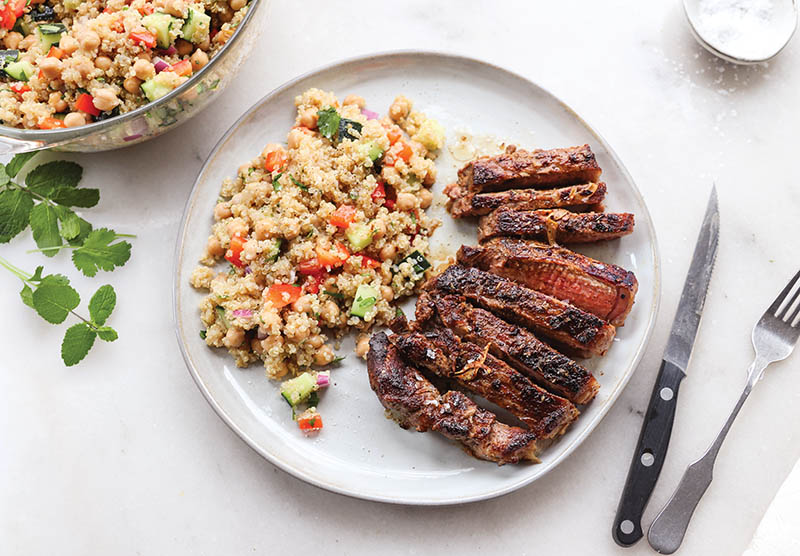
Garlic New York Strip Steak with Viral Quinoa Salad

Serves: 4

This mouthwatering NY Strip Steak is infused with bold, citrusy flavors from a zesty herb marinade, seared to juicy, tender perfection, and paired with the quinoa salad.

Every bite of these dishes delivers! It’s a wonderful pairing of savory steak goodness and fresh, vibrant vegetables and quinoa. The herbs come through on all fronts! It’s simple yet impressive, and absolutely perfect for a restaurant-quality experience right at home!

You might remember this quinoa salad from the way it went absolutely viral last year. But what makes a simple quinoa salad go viral? I think it’s the way all the ingredients work together so beautifully! The quinoa is tossed with crisp cucumbers, bell peppers, onions, chickpeas, and a light dressing, then finished with a medley of fresh herbs.

What I love most about this recipe is that when you make the marinade, you use half to marinate the steak and half doubles as the bright, tangy dressing for the salad. Hello, time saver!

Ingredients:
2 NY Strip steaks, about 1 inch thick
4-5 cloves sliced garlic
1 tsp olive or avocado oil
1 tbsp butter

Marinade/Dressing Ingredients:
1/3 cup extra virgin olive oil
3 tbsp red wine vinegar
2 tbsp lemon juice
3-4 cloves minced garlic
1 tsp minced fresh thyme
1 tsp minced fresh oregano
1 tbsp minced fresh chives
1/4 tsp red pepper flakes (optional)
1/4 tsp salt & pepper

Salad Ingredients:
2 cups quinoa (cooked and cooled)
1 cup chickpeas
2 tbsp minced red onion
2/3 cup diced bell pepper
1 cup diced cucumber
(1/2 large cucumber)
2 tbsp minced fresh mint
2 tbsp minced fresh cilantro

Instructions:
1. Make the marinade/salad dressing by whisking all the ingredients together. You will use half for a steak marinade and half for the salad dressing.
2. Pat the steaks dry and place in a bag or wide rimmed dish. Pour half of the marinade on top, turning to coat. Set the rest of the marinade/dressing aside to use in the salad later. Cover the steaks and set in the refrigerator for at least one hour, up to overnight.
3. Meanwhile, make the quinoa salad. Add half of the salad dressing/marinade to a medium bowl. Add the minced red onion to the marinade and allow it to sit while you prep the rest of the salad ingredients. This will take some of the bite out of the raw onion.
4. Dice the bell pepper and cucumber and mince the mint and cilantro.
5. Add the cucumber, chickpeas, bell pepper, and quinoa to the bowl. Toss to coat. Season to taste with salt and pepper and stir in the mint and cilantro. Keep the salad covered and refrigerated until you’re ready to serve it.
6. Next, cook the steaks. Preheat your oven to 400°F. Heat a large, oven-safe skillet over medium-high heat.
7. To sear the steaks, heat the oil in the pan, then place the steak in the skillet and allow them to cook for about
3 minutes per side without moving them. Add the sliced garlic to the pan and top each steak with half of the butter.
8. Transfer the skillet to the oven to finish cooking for 3-5 minutes for medium rare (135-140F). Remove the skillet from the oven and check the internal temperature of the steaks.
9. Season with a sprinkle of salt and pepper and serve with a generous helping of the quinoa salad.

Herby Spring Vegetable Frittata

Serves: 4

This herb-loaded, veggie-packed frittata is giving all the weekend brunch vibes!

But because frittatas are incredibly simple to make using just one skillet, it’s a simple way to make any morning a whole lot more flavorful.

Mushrooms and thyme give the frittata a deep, earthy flavor, while the chives and dill freshen and brighten every bite. Asparagus adds extra texture and savory Parmesan cheese balances it all out. Even my mushroom-despising kids gobbled up every bite! Serve it up with smashed avocado, crispy potatoes, and toast.

Ingredients:
8 large eggs
1 cup sliced mushrooms (about 4 oz.)
1 cup asparagus, cut into 1-inch pieces
1/3 cup milk
1 tbsp minced fresh chives
1 tbsp minced fresh dill
1 tsp minced fresh thyme
4 tbsp shredded parmesan cheese,
plus more for serving
2 tbsp olive oil, divided
1/2 tsp salt
1/2 tsp black pepper

Instructions:
1. Preheat your oven to 375°F.
2. Meanwhile, prepare the vegetables and herbs. Slice the mushrooms, trim and cut the asparagus into 1-inch pieces, and mince the herbs.
3. Heat 1 Tablespoon of olive oil in a 9-inch, oven-safe skillet over medium heat. Add the mushrooms and cook for about 3 minutes, stirring occasionally. Add the asparagus pieces and cook for another 2-3 minutes until slightly tender.
4. While the vegetables cook, whisk the eggs, milk, salt, and pepper together in a large bowl. Stir in the herbs and Parmesan cheese.
5. Reduce the heat to low and spread the vegetables evenly across the skillet. Drizzle the remaining oil over the vegetables. Pour the egg mixture into the pan.
6. Allow the eggs to cook, gently pulling the mixture from the sides toward the center of the pan, allowing the eggs to fill in the space, about 2-3 minutes.
7. Once the egg mixture slows at filling in the edges, transfer the skillet to the oven.
8. Bake for 8-10 minutes, until the eggs are fluffy and completely set in the center.
9. Remove the skillet from the oven. Carefully slide the frittata out of the pan and allow it to cool slightly. Season with a little more salt and pepper and sprinkle with extra parmesan cheese. Slice into 4-6 pieces and serve.

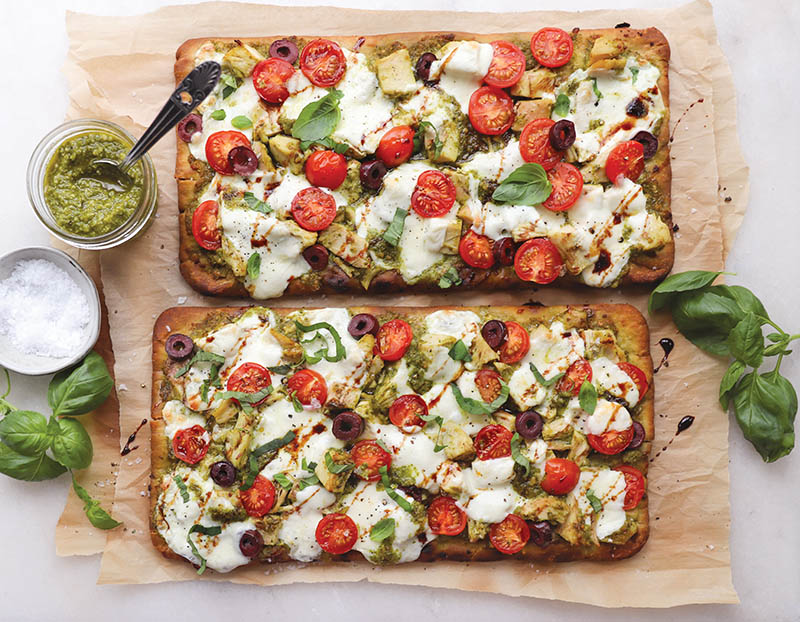
Oven Baked Italian Pesto Chicken Flatbread

Serves: 4-6

Enjoy this flavor-packed flatbread recipe as a shared snack during happy hour, a game-day treat with friends, or as an easy weeknight meal.
The crispy flatbread is topped with homemade pesto, chicken, tomatoes, fresh mozzarella cheese, and olives, and finished with balsamic glaze and more fresh basil. The homemade pesto really brings the flatbread to the next level!

To save time, repurpose leftover chicken or use store-bought rotisserie chicken.

This meal comes together in a snap! Best of all, you can cook in the oven or on the grill, but either way, it’s guaranteed to disappear in minutes!

Pesto Ingredients:
2 bunches of fresh basil, large stems removed (about 2 packed cups)
1/3 cup pine nuts
1/2 cup extra virgin olive oil
1/4 cup grated Parmesan cheese
2 cloves garlic

Flatbread Ingredients:
2 flatbreads (or substitute naan)
1 1/2 cups cherry or grape tomatoes, halved
8 oz. fresh mozzarella
1/4 cup sliced olives
1/2 – 2/3 cup pesto
1 tsp olive oil
2 cups of cooked, cooled chicken
1 tbsp balsamic glaze
Fresh basil, for serving

Instructions:
1. Make the pesto. Add the garlic, basil, pine nuts, and Parmesan to a food processor. Pulse for 30 seconds until broken down into a finer mixture. Turn the food processor on low and slowly drizzle in the oil. Blend just until smooth. Season to taste with salt and pepper.
2. Preheat the oven to 400°F. Slice the tomatoes and olives in half. Cut the cooked chicken into bite-sized pieces. Set them aside.
3. Brush the bread on both sides with the oil. Set it directly on the oven grates or on the grill for 2-3 minutes. Remove from the oven and set on a baking sheet.
4. Spread 1/4 – 1/3 cup of pesto evenly over each flatbread. Arrange the chicken, halved tomatoes, and olives on top. Spread the shredded or sliced cheese on top.
5. Bake in the oven or carefully transfer to a well-oiled grill and cook until the cheese is melted and bubbly, about 7-9 minutes.
6. Sprinkle with salt, pepper, and fresh basil, and drizzle with the balsamic glaze. Cut into individual pieces and serve right away while still hot.

Notes:
• Optional: Toast the pine nuts in a medium-hot skillet for 3-4 minutes, just until fragrant, before making the pesto! It will bring out more of the nutty flavor.
• Add fresh baby spinach and/or thinly sliced red onion to the flatbreads for extra flavor!
• Be careful not to over blend the pesto. It should be smooth, but still have a bit of texture to the consistency.
• You can freeze any leftover pesto for later! Spoon the pesto into a cube tray, freeze for 3-4 hours, then pop out the cubes and transfer to an airtight container or bag. Freeze for 3-4 months, per USDA.


Three Garden Resolutions for the New Year

By: Lindsey Cline-Shrader

Whether you clink champagne glasses in your cocktail best or from your couch, it’s impossible to escape the fever of new beginnings this time of year. The new year buzzes with the promise of fresh starts, making it the perfect time to nurture a new garden ethic or adventure. Here are three impactful garden resolutions for 2025: transitioning to organic methods, creating pollinator havens, and starting a lush vegetable patch.

1. Make the Switch to Sustainable Gardening

Sustainable gardening fosters healthier, more resilient gardens that benefit both your backyard and the ecosystem beyond.

One impactful way to begin this transition is to cease herbicide and pesticide use. These toxic chemicals seep into the soil and trickle into waterways, disrupting soil microbes that form the base of our delicate food web and decimating beneficial insect populations, such as bees and butterflies.

Embracing organic weed control protects the delicate balance of beneficial life thriving in your garden. In garden beds, simple practices like mulching, which suppresses weeds while enriching the soil, or hand-pulling persistent invaders can replace chemical sprays’ quick but damaging effects. Ask yourself if you can make peace with dandelions and violets in your lawn? (No one has yet to criticize my less-than-perfect turf.)

There are gentler options than commercial herbicides for stubborn weeds in stonework. If aggressive crabgrass or the like threatens to take over your patio, try flame weeding, which involves burning weeds with a propane torch (check local fire restrictions before doing so). Or, a mixture of three-part vinegar to one-part table salt and several drops of dish soap acts as a natural weed killer. (Many recipes call for commercial-grade vinegar, which I find unnecessary.) This mixture also damages soil, but the effects are reduced in paved areas and far less catastrophic than industrial herbicides.

Occasionally, herbicides may be the most effective solution for removing invasive species. In these instances, paint it on newly cut stems, roots, or stumps with a paintbrush rather than spraying to reduce environmental impacts. As always, wear protective gear. Be aware that in response to lawsuits over Roundup’s links to cancer, chemical company Bayer recently replaced glyphosate, the active ingredient in most Roundup products, with new herbicides. Unfortunately, independent studies suggest these replacements are even more toxic to insects, trees, and humans than the original glyphosate-based formulas. Glyphosate is still available at local garden stores.

By avoiding insecticides, we protect beneficial predators and allow plants to strengthen their defenses through natural insect interactions. Insects improve plant resiliency—a nibble from a caterpillar or nematode encourages plants to utilize their natural defenses by producing protective compounds or toughening their tissues. This interaction helps plants adapt, boosting their defenses against future insects. Plants’ roots send out signals to one another, helping entire plant communities maintain resiliency.

Spiders and predator insects, such as wasps, praying mantes, ladybugs, and beetles, help control prey insect populations like mosquitoes and flies. Insecticides indiscriminately kill beneficial insects and disrupt this natural pest control. Transitioning to organic gardening may require patience and dedication, but the reward is a garden full of resilient, vibrant life.

2. Create a Pollinator Paradise

Pollinators are critical to ecosystems and food production, yet they face increasing threats. This year, take simple steps to create a sanctuary for them by leaving perennial stems high, fallen leaves where they lie, and planting for all three seasons.

Leaf cover and plant stems are vital winter shelters for overwintering insects. By letting leaves remain in your garden beds, you mimic the forest floor’s rich, insulating carpet, cradling insect life through the colder months while enriching your soil. Similarly, hollow plant stems and native grasses offer nesting and hiding places, protecting pollinators in their most vulnerable states.

Three seasons of blooming plant life sustains pollinators (and ourselves) throughout the year. While summer blooms are easily covered, early spring and late fall bloomers fill essential gaps for pollinators. Early-blooming ephemerals like bloodroot, Virginia bluebells, or native trees provide much-needed nectar for emerging pollinators. Late-season stalwarts like asters and goldenrods support these crucial creatures as they head into hibernation or prepare for migration.

3. Grow Your Own Fresh Harvest

Amidst busy lives, harvesting a sun-warmed tomato or a crisp kale leaf from your garden is profoundly fulfilling. Starting a vegetable patch is a New Year’s resolution that not only reduces waste and promises a bounty of fresh, healthy food but creates a deeper connection to nature (and, per my therapist, counts as rest for the busy-minded).

Perennials are an easy gateway to gardening as they forgive the constant seeding and weeding. Plant them once, and they’ll reward you with years of harvests and minimal upkeep. My favorites are blueberry and currant shrubs and a grape arbor, which also provides summer shade. Perennials like asparagus, artichokes, and rhubarb (as well as annual squashes) require space but little else.

If you’re going for gold, raised beds offer better drainage and soil depth. Two 4’ x 4’ cedar raised beds keep our family flush with easy-to-grow cucumbers, kale, tomatoes, garlic, and green beans. Rich, loamy soil gives vegetables the best start, and a drip hose will keep them thriving throughout the season.

These three garden resolutions reflect care for the environment, an eye for natural beauty, and a heart for personal growth. Here’s to a year of sowing new habits and reaping the rewards. Next year, we’ll toast your success among your flourishing sanctuary, whether it be a drift of milkweed, a simple patch of pumpkins, or a thriving space full of blooms.