An online skin care shop helps women uncover their true skin
Wash, moisturize, repeat. Skin care routines can be monotonous and ineffective. After using the entire skin care store that is on your bathroom counter, your skin is often still left dry, rough, and stripped of its natural oils. The process then repeats itself. But Myscha Gaines is breaking that cycle.
In 2014, Gaines took a trip to Disney World, where she discovered the wide world of sugar scrubs. She realized they were so expensive, and the price didn’t match the quality of ingredients. So, she returned to Lynchburg with an idea—to create an affordable body scrub that was good for the skin.
Photo by Ashlee Glen
“I literally just came home and said, ‘Let me see if I can recreate what I had experienced.’ I came up with a couple of different formulations solely based on the things that I already had in my house,” Gaines explained.
Her business, EmGe Naturals, began as an oil-based sugar scrub in a glass jar. It was her mother-in-law’s idea to decorate the jars, and they began to hand out Gaines’ homemade sugar scrub to family and friends.
Gaines and her husband then saw how these homemade sugar scrubs could be used for good. Profits made from the scrubs went to their nonprofit that provided first night backpacks to children entering foster care. From there, Gaines began to attend vendor events and distribute her products in local stores.
EmGe Naturals was growing, but it paused in 2015 when Gaines’ grandchildren came to live with her. Four years later, Gaines knew she needed to start making scrubs again.
“I was like, ‘Okay, what can I do to help around here? To help our household?’ We relaunched EmGe in the latter part of 2019 as an online business,” she said.
Since then, EmGe Naturals has gained a steady online clientele. For Gaines, the business is still a one-woman show. She makes local deliveries with the help of her son and mails orders as far as Alaska and Canada. Her business and products have evolved throughout the entire process.
“The product itself has been an evolution,” Gaines detailed. “The product is now more shea butter–based than oil-based. The skin benefits are phenomenal when using shea butter.”
Shea butter is full of antioxidants, such as vitamin E and A. It protects the skin from damage and improves its natural barrier. This ingredient, along with other all-natural ingredients, makes EmGe products different from other skin care products on the market.
Body scrubs are not the only products EmGe offers. Body wash, butters, lotions, and salts are also available on the online store. Gaines perfected the production of the body butters and lotions after receiving a diploma in skin care formulation in August. To achieve the best result, a routine is required, but it is a simple one.
Photo by Ashlee Glen
“Anytime you’re using a scrub, you want to protect this new skin that you have revealed. A body butter or body lotion is the way to do that. Because you have exfoliated, it improves the effectiveness of your lotion. The dead skin that was there would be blocking the moisturizer from being able to impact your skin,” Gaines pointed out.
She added, “The most important thing is consistency.”
With a simple line up of a scrub followed by a butter or lotion, consistency is much easier to achieve when compared to other multi-step beauty regimens out there.
“We focus a lot on our face. We tend to neglect the rest of our body. Especially if you’re a busy mom running around, you get your face straight but forget the rest,” Gaines added.
Having an entire body skin care routine is important because having soft skin feels good on the outside, but it can feel even better on the inside. One of EmGe Naturals main goals is for the customer to “love the skin they’re in at any age.”
“If we can alleviate your dry skin for you, then that helps with your confidence. It helps you feel more carefree,” Gaines assured. “The fact is, we all feel better and carry ourselves differently when we’re feeling good and looking good.”
Select EmGe Naturals products are now available exclusively at Something Else Boutique in River Ridge Mall, or you can shop online at emgenaturals.com.
2022 Lynchburg Living Giving Back Awards
Lynchburg is filled to the brim with generous, mission-driven, philanthropic people, and the hundreds of nonprofit organizations in our area are a result of that. Across the Lynchburg region, organizations are holding the hands of those in our community who are vulnerable, hurting, or in need of extra support.
We are so honored to tell the story of just a few of them.
The Giving Back Awards are an opportunity for the community to give back to the nonprofits by nominating them a designation. This award signifies the impact the organization has made in the community and validates even further the incredible work that the organization has done throughout the year.
Flip through these pages, read the profiles of the award recipients, and consider supporting them in their number one needs and upcoming goals.
What to Consider When Planning a Will
No matter your age or economic status, planning a will is one of the most important estate planning steps you can take. If you pass away without having a will in place, your estate—your money, home, and assets—will be divided up according to state law. If you have particular wishes or recipients for each of those assets, a will can ensure they go to the right person.
“It will never hurt to have a will that states your wishes,” explained Sam Patel of Patel & Dalrymple, PLLC. “More practically, people often make a will after a major life event—marriage, buying a house, having a child. These are just a few examples of things that might make your wishes change, and it can help to update your estate plan accordingly.”
Determine Your Executor
One of the first steps toward creating a will is determining who the executor of your will and estate will be. This executor will act as your personal representative and will be in charge of handling the details of your will. This person should be someone you implicitly trust. You should talk with this person ahead of time to ensure they are up to the task, and then let them know where to find all important documents, such as your will, insurance policies, and passwords for important financial accounts.
“Consider discussing your estate plan with your family after you’ve put it in place,” said Keith Orgera of the Law Offices of Ron Feinman. “Generally, it is far better for your loved ones to know what is going to happen when you die rather than to get surprises after it happens. Talking to everyone in advance, while not a fun conversation, can avoid a lot of hurt feelings and squabbling after you’re gone.”
Ask the Important Questions
“I would suggest one decision and one question,” said Orgera. “It’s important to decide what you want to accomplish with your will. They are powerful instruments and can do many things. Knowing what you want the will to make happen is more important than who exactly will be your executor or who gets the Buick. Related to that is the question: ‘Is a will the best way to achieve what I want?’ Once you know what you’re trying to do, you can talk with your estate planner about the best way to accomplish it and how.”
Once you have your will in place, it’s important to make sure it continues to reflect your current wishes. Consider updating your will once a year, making sure to update it after marriages, divorces, births, deaths, and other life events.
Look at the Bigger Picture
“A will is just one component of an estate plan,” explained Peter Davies of Davies & Davies Law Firm. “An estate plan should address powers of attorney, advance medical directives, wills, beneficiary designations, tax planning, and possibly trusts, among other things. An estate plan should be in place for someone when they have kids, get married or divorced, have a blended family, have tax concerns, have health issues, and so on. A good estate plan addresses many aspects, not death alone.”
While a will is a powerful document that can enact your final wishes, it doesn’t necessarily accomplish everything. A legal professional can help you evaluate the details that fall outside of a will and help you put together a more comprehensive estate plan that covers the entirety of what you’ve worked hard to save or build.
Hire a Professional
Some things are too important to leave up to chance. A poorly drafted will can be worse than no will at all. Often, self-prepared wills aren’t signed and finalized correctly. For example, a self-prepared will could have an executor or family members who are listed as beneficiaries, who also signed on as witnesses. That could either invalidate the witness to your will or prevent the witness from receiving any benefit under the will.
“This isn’t a time to DIY,” furthered Davies. “A comprehensive estate plan assembled by an attorney specializing in estate planning can go a long way to prevent a mess.”
An attorney will help you sort through the maze of estate planning so you can feel confident that your final wishes will be fully enacted.
“A lot of things can pass outside of a will; sometimes the entirety of a person’s property,” said Patel. “This can be beneficial in some circumstances, to avoid probate taxes and costs, or to avoid public scrutiny of a probated will. This is something to discuss with your beneficiaries, and with your attorney. There are lots of ways to pass on your belongings, and it’s always good to know your options.”
Lynchburg Living 17th Annual Guide
Not sure where to start with that holiday shopping list? You’ve come to the right place! Our annual Holiday Gift Guide is an overview of unique gift ideas, all found in local stores.
A Perfect Pairing
Dishing up exquisite portions of food and art, ElectricCoArt, Bistro & Market brings a big city vibe to the “World’s Best Little Town”
Tucked away from the heat of a typical Virginia summer day, and with an ice-cold carafe of water on the table in front of me, I sat with a passionate group of people who are on a mission to elevate Bedford’s art and food scene—all under one roof.
Surrounding our interview group is art—lots and lots (and lots) of art. From large, multi-colored abstracts to traditional pastoral landscapes to shelves displaying the most detail-oriented, whimsical sculptures I’ve ever seen. Almost every empty space in this historic, magnificent room is filled. It’s hard not to be inspired here.
“People walk in and say, ‘I feel like I’m in New York City or Downtown Philly.’ They will pick a city and fill it in. And that’s our goal,” said owner Wendy Witt.
ElectricCoArt, Bistro & Market Owner Wendy Witt and her partner, Bill Mauser. Photo by Ashlee Glen.
The vision for ElectricCo started forming when Witt, a real estate agent, had the Depot Street building listed for sale.
“We just started daydreaming about what this building could be,” she explained, adding that her partner, Bill Mauser, had been looking at vacant commercial spaces to put his blacksmith forge.
Once the couple made the move to buy the space, they had the end goal in mind—a maker’s market, art gallery, and restaurant. Naming the business was easy and was pulled straight from history—the ElectricCo building was constructed in 1895 as the original Bedford Electric Department and it functioned that way until 2000.
Photo by Ashlee Glen
Getting to their end goal, however, didn’t unfold quite like they thought it would and ended up happening in stages.
“We wanted to open up everything all at the same time, but we soon realized that wasn’t going to happen. The market was first and was the easiest,” Witt said.
In June 2021, their makers market opened to the public. It’s located on the lower level of the two-story building, with its own separate entrance, and features a little bit of everything—pottery, candles, jewelry, clothing, and more. Witt says local makers and artisans, who had been working at home during the pandemic, jumped at the chance to have a spot to showcase their goods.
Next came the art gallery, located upstairs. Witt and Mauser didn’t have much experience in this arena and weren’t sure how easy it would be to find artists who wanted to display their work in a new Bedford gallery. They were stunned by the initial feedback.
“It went so much easier than we expected.
As we started talking to artists, they told us, ‘oh my gosh, we are dying for a place to show’ or they were even looking for a second location to show,” she explained. “We got a lot of compliments from artists about how the place looks and feels.”
The front of the gallery is where visitors can peruse—and purchase if they choose—a wide variety of local and regional artwork, and artists swap out their pieces often so there is always something new to see. Keep walking to the rear part of the gallery, and you’ll find a larger, more comprehensive showing from a featured artist that typically stays on display for about six to eight weeks.
With the market and gallery underfoot, the restaurant seemed straightforward—a completion of their business model trifecta. It was going to be a relatively simple eatery, a limited kitchen offering some select sandwiches. But just like an artist who lets their imagination guide them on a canvas, the restaurant idea started taking a different direction when renovations began.
“We didn’t expect the demo of the building to open up the spaces as much as they did. The kitchen went from two small, dark rooms to a big open kitchen. We started knocking out walls, removing sheetrock, found windows that were hidden,” Witt said. “The whole vibe just changed.”
And the more the environment changed, the more their expectations for the restaurant expanded. Witt and Mauser’s limited kitchen concept had morphed into a full-service, fine dining experience.
Photo by Ashlee Glen
“Then, Chef Thomas and we came together, so it’s like it was all supposed to happen,” Mauser added.
The “cupid” in this serendipitous introduction, according to Witt, was the man who installed the restaurant’s kitchen equipment. One interview later and Chef Thomas Schmidt was hired to lead the way for ElectricCoBistro, which opened to the public in April.
Schmidt, a Blacksburg native who now lives in Lynchburg, graduated with honors from the Culinary Institute of America in New York. His resume includes the Sanderling Inn on the Outer Banks and the Willow Grove Inn in Orange, both of which are highly rated in the culinary world.
“After that, I broadened my foundation into some other things and then the opportunity to come back to fine dining arose with ElectricCo and I jumped on that and couldn’t be happier,” he said.
Creating a forward-thinking, upscale menu in a small town comes with its challenges—one of them being, you don’t want to scare people off.
“So it’s only about this much intimidating,” Mauser joked, holding up his thumb and forefinger.
Schmidt quickly jumped in to add, “You want it to be friendly, somewhat familiar. So people won’t go, ‘what is that?’ Our ingredients are all recognizable and everything is from scratch.”
There’s a lot of fusion-style cuisine. Schmidt has enjoyed pairing many well-known dishes with flavors inspired by Asia, France, or Germany. For example, one of their top selling appetizers is prosciutto risotto balls stuffed with mozzarella and topped with a Southwestern marinara and Mexican cheese. Schmidt’s recipe for ahi tuna with Asian slaw and sushi rice further highlights his love for international flavors.
Their chicken marsala is also a huge hit with customers, along with the bistro’s grilled salmon entrée.
“We have a few things on the menu that are standbys because they are so popular. Ultimately we will probably have a base menu, but we will always be switching things out,” Schmidt said.
The menu is dynamic, just like the art on the walls and Schmidt doesn’t have to work too hard to find inspiration for new dishes—he just looks around.
Photo by Ashlee Glen
“When the art is always changing, you want the food to change too,” Schmidt said. “You want it to be as special as the art.”
Those two elements, art and food, play delightfully off of each other here at ElectricCo—creating a special experience not only for locals but hopefully lots of out-of-towners as well.
“We want art lovers from New York to Atlanta to come up here to our area, from Roanoke to Lynchburg,” said Witt. “We want to create an art scene in this region and be part of that.”
Photos by Ashlee Glen
A 120-Year Legacy
The Academy Center of the Arts Continues to Hone their Mission
Photos Courtesy of The Academy Center of the Arts
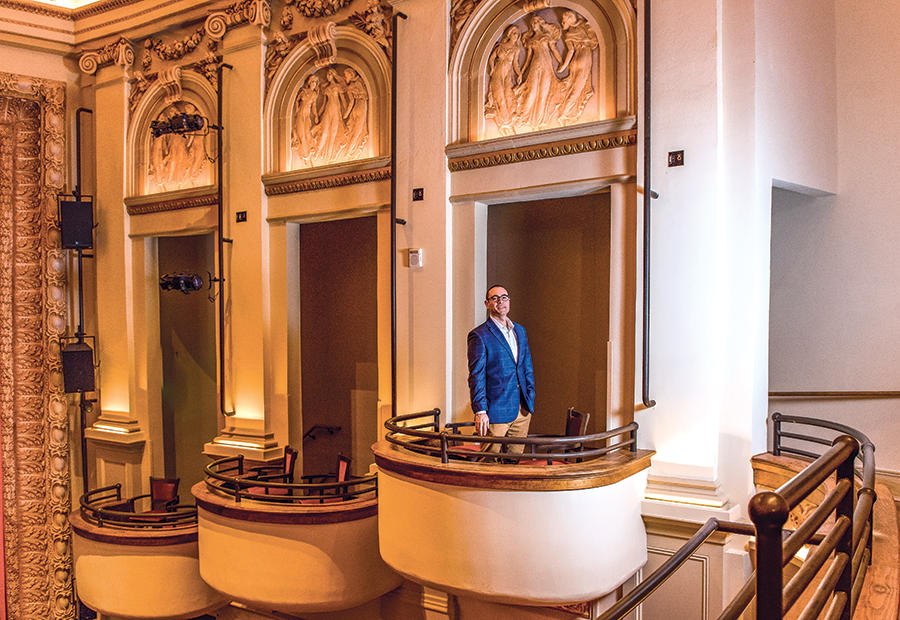
In its nearly 120-year history, the Academy Center of the Arts has seen highs and lows.
It was once a prominent, glamorous theater that brought in traveling shows, musicals, and performers.
At its lowest point, it was shuttered for six decades before restoration groups fought and fundraised for years to finally renovate the historic landmark back to its former glory.
Dr. Bill Kershner, volunteer archivist at the Academy, said there have been several stages in the life of the theater lasting longer than a century.
The golden age of the Academy began in 1905 and lasted until about 1915, he said.
The Academy opened in February of 1905 and had first and second class touring companies who would come to the Academy after their Broadway shows.
Photos Courtesy of The Academy Center of the Arts
“Lynchburg was an important stop because these touring companies didn’t want to travel without making any money every day. They didn’t want to play for, say, a week in Washington D.C. and then a week in Atlanta, and then lose a couple of days traveling. So they would book these things together,” Kershner said. “So Lynchburg was on that circuit. We had the same shows that everybody read about during this period.”
The Academy also offered cheaper events that were popular with different groups in the community.
“So the Academy always served several different parts of the community,” Kershner said. “It wasn’t just the wealthy folks.”
Aside from the touring companies, the Academy also held concerts and recitals, some of them by internationally famous acts. They even tried wrestling in 1914, and Kershner says he is still wrapping his head around how that was pulled off.
Parts of the Academy burned down on April 20, 1911, and the interior was destroyed. No one knows what caused the fire, but the best guess was it was caused by the furnace, Kershner said.
It was rebuilt and reopened in December of 1912 and the interior was even grander than the original—and it was that version that became the prototype for the restorations in 2015. The next period of the Academy brought in silent films, though the building wasn’t fitted for that type of venue until a third stage was built in 1928 for talking movies.
“For about two years, it does first run films and the Academy is once again on the forefront of entertainment in Lynchburg—but that only lasts a few years, because in 1930 the Paramount, designed as a movie theater, opens across the street, and after that they’re really a second-run theater,” he said.
Most people who remember the Academy from this time will remember viewing the serial films shown on Saturdays.
The theater showed some movies that were about a year or two old, ran serials, and held the occasional vaudeville show until it ultimately closed in 1958 and remained shut for 60 years until it reopened in 2018.
For the first 10 years of its closure, it fell into disrepair until the announcement that the 5th Street bridge would be built right through it in the late 1960s
A group of citizens rallied to secure a historical landmark status in 1969 and got the bridge rerouted, Kershner said, and although that group had hoped to restore it, raising money was difficult, so it continued to sit for another 15 years until the early 1980s when it was bought by Liberty University who had the idea to restore it.
That never happened though.
In the 1990s it was sold to the Friends of the Academy for the low price of about $10, Kershner said, and in 1996 it merged with the Fine Arts Center.
“That’s when the Fine Arts Center was torn down and they raised the money for the Warehouse Theater and the building next door, which became the art galleries,” he said.
It wasn’t for another 20 years when other spaces were being renewed downtown that people saw possibilities for the Academy to be a part of that renovation work. “People saw that downtown was coming back to life,” Kershner said.
Photos Courtesy of The Academy Center of the Arts
In 2015 they began seriously raising money and were successful, which was around the time that CEO Geoff Kershner—Bill Kershner’s son—took over.
“So that was pretty gratifying to us that it was while Geoff was executive director that it actually happened,” he said.
By December 2018, the historic theater was back open after a $30 million restoration project.
Nearly 50 years after community members were able to begin fundraising efforts for the Academy and save it from demolition, the beloved historic space was able to live on with the same mission it’s had all along of serving citizens from all backgrounds.
That inclusivity is an important piece of Chief Programming Officer Michelline Hall’s job, who said the mission of the new Academy is to have arts be accessible for all people in the community.
“A part of that is having camps and classes that people can attend and participate in and then another piece is providing financial support for people who can’t afford it,” she said.
New to the Academy that was not a part of its original function is the art galleries and educational classes that the community now has an opportunity to be a part of.
It recently has begun offering Academy in Motion, a mobile arts program that seeks to impact members of the Lynchburg community by providing arts access to groups and individuals with barriers that would otherwise prevent exposure to the arts on their physical campus.
Hall said the bus goes to the YMCA, adult day care centers, and schools to bring programming straight to participants.
She said it also has a partnership with the Virginia Cooperative Extension on an initiative called Plates and Paints, which is a food and nutrition program. The program works with people digitally to make a healthy plate of food in a way that is diverse in color just like a paint palette would be.
The Academy is also open for school field trips and offers students to take a class, see a performance or the art galleries, or learn the history of the building.
Photos Courtesy of The Academy Center of the Arts
“That’s the programmatic aspect of being intentional about how often we’re creating those moments where we’re able to tie in that educational and cultural component because a lot of these kids, just by expanding their horizons, you never know what they may decide they can do,” Hall said.
Hall said the Academy is going to invest in the best acts and artists that it can bring in, but wants to make sure that it’s bringing everyone to the table to enjoy it.
“I don’t know how many doors were opened just from people seeing something or experiencing something or hearing someone that inspired them and allowed them to go down a certain path,” Hall said. “I’m not anticipating that kids that come in here to all become amazing visual artists, but maybe they feel like they can do something else in their lives that they thought they wouldn’t be able to do.”
That’s a beautiful thing about the arts. The arts are cross-cultural, Hall said, and reach across all demographics.
“Good music touches everyone,” she said. “It doesn’t have a zip code, it doesn’t have a salary cap or limit. There are certain things about the arts that just unify all of us together.
And we’re trying to constantly be the catalyst for that.”
Continuing the Legacy of Education
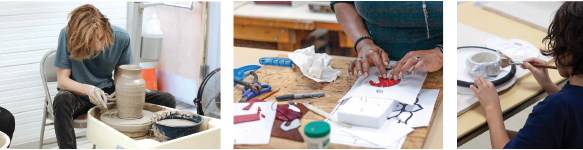
Carefully crafted pottery and vibrant stained-glass line the shelves and windows of the Jackson Heights Art Studio, a creative haven for many of Lynchburg’s passionate artists.
Opening officially as the Jackson Heights Art Studio in 2013, this unique neighborhood studio exists to carry out the legacy associated with the building’s long-standing history of devout education and community.
“It’s a really special thing to show up somewhere for the first time and know you are a part of something greater,” Sara Billings, a pottery instructor at the studio, said. “That is the reality we try to create and remind people of every time they walk through the doors.”
Formerly known as the Jackson Town Elementary School, the building was purchased from the Lynch family in 1826 by free African Americans. One hundred years later, in the midst of segregation, the men of the neighborhood built the two-room schoolhouse so the children in the community could attend school, according to Doug Washington, a museum volunteer who presented the “Jackson Town Tour.”
Although the school no longer educates and guides elementary grade students, it cultivates the same spirit of education through creativity for all ages and walks of life.
Currently, the art studio is open Tuesday, Wednesday, and Saturday at varying times for pottery classes, and on Thursday evenings for stained glass classes. With 10 potter’s wheels, an array of clay and glazes for creating hand-built wheel projects, and vibrant colored glass sheets for stained glass, the space naturally opens a new door of creative expression for many.
The art space sustains the legacy of shaping an intentional space to educate, learn, and grow by striving to make classes hands-on and supportive, no matter your experience level. Located at 720 Winston Ridge Road, the art space is now a part of the City of Lynchburg’s Parks and Recreation Department.
Photos Courtesy of Jackson Heights Art Studio
“We truly are a small part of a bigger picture with such support from the Parks and Recreation Department,” Brittany Helm, the Community Recreation Programmer for the studio, said. “We are striving to teach people a new craft. Whether they’ve been doing pottery and stained glass for years and years, there is still always something to be discovered.”
Helm was placed in the Community Recreation Programmer role as the studio grew to require more attention. The art space is now professionally managed with full financial support from the City of Lynchburg’s Parks and Recreation Department.
“It is so unique that the Lynchburg Parks and Rec. department funds this art studio,” Helm said. “It’s not often you see a department with so much responsibility tending to the community the way the City of Lynchburg does.”
In July, the studio closed its doors to participants for an entire month for the installation of entirely new floors. After its final facelift, there will be a grand re-opening on September 3 for the public.
“The renovations are important because we are always improving and expanding and seeking out ways we can improve the space for the sake of our students,” Billings said.
In addition to the aesthetic updates, the studio seeks to ensure that there is a place for everyone by providing participants with a financial assistance program.
“We really try to make our classes accessible. We don’t want finances to be something that holds anyone back from attending a class,” Billings said. “The financial program is how I was able to continue my journey with pottery; it was this very program that helped me start taking classes again while I was in college.”
Billings, one of the two highly skilled pottery instructors at the studio, juggles three businesses while also instructing at the art studio on Tuesday’s and Wednesday’s from 9 a.m. to 12 p.m.
For Billings, the pottery prevails as her “labor of love” and creating a piece is a “long and patient process,” she explained.
“Ideally, I get my students throwing, centering, and creating at least one piece in their first class with me,” Billings said. “The next week you come in, the clay will be in the ‘leather hard’ stage, where we are able to trim it. From there, it goes in for its first firing, then you glaze it, and fire it for a final time.”
Pottery and stained glass alike require patience and focus. Several students unanimously described the classes as “a form of therapy” and “their favorite form of self-expression.”
“Even if you get one piece out of an entire session, there is something so special about being able to engage with what’s in front of you and turn everything else off around you,” Helm said.
Pottery and stained glass, like any experience, has the ability to teach a lesson through simply trying and experimenting.
“Failing at pottery is a practice in and of itself,” Billings said.
“You learn to forgive yourself and realize at the end of the day, it’s really just mud. We want students to leave and realize, ‘I can do this again next week and do it even better.’”
To learn more about the Jackson Heights Art Studio and to sign up for an art class, visit the Parks and Rec website, www.lynchburgparksandrec.com. To keep up with upcoming events, programs, and activities, you can follow along on their Instagram, @jacksonheightsartstudio.
“It’s Like Living in an Art Project”
A Lynchburg Midcentury Time Capsule Meets Its Perfect Match
Is it possible that sometimes a house chooses its owners?
Much like a rare antique sitting boxed up for decades in an attic, or a valuable painting relegated to the back rack at a thrift store, it waits for just the right old soul who will lift it up with a sense of reverence and say, “There you are.” It seems an impossible idea given the recent real estate market, but when you hear the kismet story of Hannah Poucher and Grant Kittrell, it may lead you to wonder if maybe, just maybe, their house chose them.
Photos Courtesy of Daryl Calfee
The Discovery “We knew the second we looked through the windows that we wanted to live here forever,” Hannah, now 32, said of their love-at-first-home-sighting experience.
It was August 2019, and she and Grant, now 30, were making plans for a wedding and their future together, when something akin to Zillow lightning struck. A little listing with just five vague pictures popped up—a circa 1954 midcentury modern in the middle of Lynchburg. Within the hour, the couple found themselves peering through the windows, unable to believe their own eyes. It was meant for them, they knew it, but they needed to move fast.
“We weren’t pre-qualified, we had never looked at any houses before, we had to Google after we saw this place—’how to get a mortgage’—we didn’t know anything!” Hannah, a military recruiter for Liberty University, said. “But we knew if we didn’t jump at this, we wouldn’t get another shot at something like this in town.” A bidding war ensued, but the home seemed to intuitively know who it wanted as its next caretaker. The couple closed in November 2019 and made a defining decision in honor of their new-old home.
“We wanted to live in the space for at least a year before doing anything radical,” Hannah explained. “We wanted to understand what it was like to be here as people within a space where it was designed to work like this. So, we decided no big changes for the first year.”
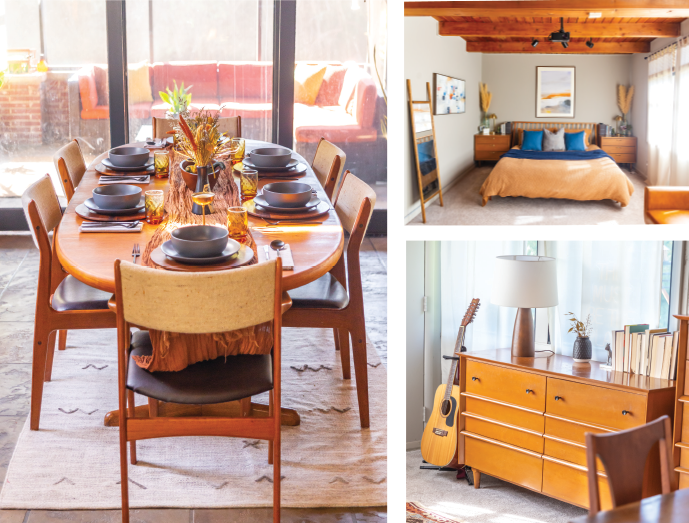
An Intentional Interior It turns out, there was much the home wanted to teach them. Grant and Hannah took pleasure in learning about its history and thoughtful layout, taking note of each delightful detail, like how the abundant natural light shifted across the open-beamed ceiling throughout the day.
“We both, perhaps in different ways, came to this space with appreciation for art and design,” Grant, a writer, illustrator, and musician who works at Randolph College, said. “The midcentury modern style is very intentional and leans in the direction of sculptural, so there’s not a day that we don’t look around and say, ‘Hey look at that! Isn’t that really amazing?’ So, we are living in this space that we see as a piece of art, and really it is.”
Photos Courtesy of Daryl Calfee
Within that first learning year, they came to understand the unique reason for the way things were designed. Like the greater abundance of windows on one side of the house to allow for passive solar heat. Or the fact that the floors, which look like stone, are in fact stamped concrete designed to hold thermal mass, making what should be a cold underfooting somehow warm and earthy.
The biggest discovery, however, came in the form of a large manila folder filled with the home’s blueprints, original building materials, past pictures, and a booklet of original paint colors from The Frank Lloyd Wright Sierra Sunset Collection.
“When we found that folder, with the Frank Lloyd Wright paint palette, we realized that there was incredible intention behind it,” Hannah said. “So, for example, this color isn’t black, this is the Midnight color from that collection that is part of a larger palette. It was already here. We only painted the kitchen cabinets.”
Furnishings with Soul While their commitment not to change the home’s interior held strong after moving in, it did need some furnishings. Some true-to-the-era furnishings.
They dove in with both feet and hands.
“Pretty quickly, Hannah became a master of the Facebook Marketplace,” Grant laughed. “She would stay up late at night looking for furniture. So as soon as I got off work, we would take off and go to places we had never seen before, out in the countryside, and pick up an old piece of furniture that someone maybe didn’t really know what they had.”
The hunt for pieces soon evolved into restoration of those finds as needed. Grant and Hannah became quick students of the specific approach to refinishing midcentury pieces.
“We aren’t talking about just sanding and staining, you’re talking about burning through wood veneer if you mess it up and how things aren’t stained, they are toned and sealed and lacquered,” Hannah said.
Photos Courtesy of Daryl Calfee
“I think the more work we put into a piece, the more we favor it.”
Her current favorite piece? A hutch from Lane Furniture, whose factory was once headquartered in Altavista. They discovered the piece in Rustburg, and it is now situated proudly in the area that opens from the kitchen into the dining area.
“We got it on Facebook Marketplace and the seller’s mother had bought it originally from Lane. So it’s a Virginia piece and the time period is right,” she recalled.
What you won’t find a lot of on the home’s ever-evolving furniture front are many new items.
Not because they are purists, Hannah explained, but because of what’s available on Marketplace, what’s within their budget, and what they can restore back to life now and perhaps replace later.
“I can probably count on one hand the number of new things that are in this house,” she said. “And while sustainability might not be the first thing we think about, it’s definitely a driving force. I think in terms of a level of purism, that’s what we are working towards.
It feels like such a perfect space, and we want to honor it with things from that time period.”
Photos Courtesy of Daryl Calfee
An Apartment Evolution Of course, as with most self-imposed rules, there is almost always an exception. For Hannah and Grant’s “no changing the house for a year” rule, that exception came in the form of an efficiency apartment just across the home’s attached breezeway, where they cut their teeth on the basics of home renovation.
“We focused a lot of our initial energy there because it was a smaller space; we weren’t as overwhelmed and we figured we could learn in there and not have to live in it if we made any mistakes,” Hannah said.
While the essential layout existed when the couple bought it, the apartment needed some finishing work. They took to painting the kitchen cabinets the same green as the main home’s kitchen, updated the floors with a light luxury vinyl tile they laid themselves, and furnished the small bedroom, kitchen, and bath with interesting finds, such as a 1965 Sears Roebuck & Co. bar sourced in Roanoke and a white 1930s stove from Farmville. While not decade-specific to the home, Grant said, “when you bring something this old from the 30s, you’re bringing a long history into this space and the possibilities of whatever life it lived before.”
The renovations came with inherent lessons for the couple, and they reflect now that it better prepared them for future renovation jobs still ahead, like their dream of expanding the home’s main kitchen.
“We have learned to work with each other a little better and be patient with each other in different ways we didn’t know at that point,” Grant said. “Coming home each day and laying flooring every day…we learned a lot!”
From the Inside Out Much is to be made of the home’s interior, and for good reason, but the property’s grounds are stunning in their own right. In fact, it is the marriage of the two, one spilling by design into the other, that creates a zen-like cohesion with nature from nearly every vantage point.
Photos Courtesy of Daryl Calfee
“We both love and appreciate a lush, green space and this has a lot of bamboo, a big maple, and some really intentional plant life,” Hannah said. “So when you’re looking out these windows, the lines are blurred between outside and inside.
It feels like a really natural space and really a sacred space almost.”
The pair have worked diligently to make conscious updates to the home’s exterior, including retrimming the formerly gray windows to a crisp black, something akin to adding eyeliner to an already lovely face. They cut back layers of bamboo and, as a reward, have witnessed more wildlife at play, from a family of foxes to finches taking up residence in one of the many birdhouses Grant made to a shy resident doe the couple affectionately calls “Jean.”
Most warmer nights of the year, you will find Hannah and Grant on their back patio area, nestled in wicker egg chairs, beverage in hand, dreaming into the future about their vision for the space. Their ultimate hope is to continue to collaborate with their cherished home in order to share it with others—an ever-welcoming, one-of-a-kind retreat.
“Mixing the inside and outside is always a goal,” Grant said. “Having a nature trail on the property is a dream, or hosting yoga or meditation classes here, maybe along with some creative writing workshops.
I would also love to make this place more sustainable, perhaps with solar power.”
It is little wonder that whatever the pair chooses to do next will be with great planning and purpose for the home that somehow, some way, chose them. Three years into their adventure, they still wake every morning with a wide-eyed sense of awe for their surroundings.
“I think, ‘How is this even a possibility? How could this even possibly be our home?’” Hannah smiled. “There is a lingering sense of wonder and excitement every day that we are in this space.”
Photos Courtesy of Daryl Calfee
Follow Along Want to follow along with the home’s furnishing adventures and projects?
Check out Hannah and Grant’s Instagram page dedicated to the home @clerestorymod. “Clerestory” is the word for windows that are above normal ceiling height and project into the roofline, which their home boasts in abundance.
2022 Lynchburg Dental Guide
Lynchburg’s Resource to Local Dental Care
Not sure where to go for your oral health or dental treatments? Look no further than the experts referenced in our Area Dental Guide. From braces for your kids to the dental professionals you want in your corner when there’s an issue, we have you covered.
A Garden Oasis
Create a calming landscape with low-maintenance plants
Imagine stepping into your yard in the early morning with a cup of coffee in hand. The steam from your mug gently rolls into the thin layer of fog that has settled over the space.
It’s that perfect time of day when the crickets have ceased their nightly chatter, but the birds have yet to rise. It’s quiet and calm.
You deeply inhale the crisp morning air, open your eyes, and take in the stunning landscape before you. You’re not overwhelmed by the weeding that needs to get done, or the plants that are overgrown. Why? Because you’ve created a calming landscape with low-maintenance plants, so you can continue to enjoy peaceful moments just like this.
If this type of restful scenario is exactly what you’re looking for at home, we have rounded up a few native plants, upright perennials, and ornamental grasses that are inspired by nature and guaranteed to create a no-fuss garden oasis right in your backyard.
Upright Perennials
Perennials are plants that return year-after-year with no need to replant. When you’re planning your low-maintenance garden oasis, look for sturdy perennials that grow well in our zone—7a.
Russian Sage Russian sage has the same stunning pale green foliage that common garden sage has, but it’s accompanied by gorgeous purple flowers. A full sun perennial, Russian sage is deer resistant, drought tolerant, and pollinator friendly. It also grows in pretty much any soil type and requires zero maintenance—win, win.
Because this is a relatively tall plant, consider how your overall garden will layer and plant these toward the back or up against your walls or fencing.
Bloom Time: Early summer to fall Height: 2 – 4 feet Spread: 2 – 4 feet
Autumn Joy Sedum Autumn Joy Sedum is considered a succulent because it stores its water in its leaves and prefers dry, poorly fertilized soil, making it the perfect no-water, low maintenance plant!
When the flowers bloom, they start out pink and turn into a beautiful bronze color as the weather cools. Because it blooms fairly late in the season, it’s a great cool weather nectar source for pollinators.
Bloom Time: Late summer to fall Height: 18 – 24 inches Spread: 18 – 24 inches
Daffodils You’re undoubtedly familiar with these cheerful yellow beauties. They’re a landscaping favorite along roadsides and cityscapes because they’re a “plant it and forget it” type of flower.
To stick with a more pastel or neutral color palette for your calming oasis, opt for white or coral varieties rather than bright yellow.
Ornamental grasses are not only low maintenance, attractive additions to your landscape, but they are excellent at providing food and shelter for birds.
Pink Muhly Grass This grass is a showstopper due to its pink pillowy plumes.
Plus, it blooms in late summer to fall, so it’s a great option for introducing subtle color late in the season.
Pink muhly grass is less invasive than other ornamental grasses, so you can keep it relatively contained within your planned landscape.
Bloom Time: Late summer to fall Height: 3 – 4 feet Spread: 3 – 4 feet
Blue Oat Grass Blue oat grass is an easy-to-care-for ornamental grass with a mounding habit, which means it stays self-contained. With steel blue blades of grass, it will add a serene color to your garden oasis.
And while the color doesn’t typically arrive until fall, you will still benefit from gorgeous beige and golden colors starting in June.
Maiden Grass Maiden grass boasts a graceful form on a large frame.
With coppery flower heads that appear in early fall and become silvery white in the winter, it’s a landscape addition that provides visual interest almost year-round. Maiden grass can become very tall, so only plant this ornamental grass if you have the space.
Bloom Time: Fall to winter Height: 3 to 8 feet Spread: 3 to 5 feet
Whether you pace yourself through planting to build your garden oasis over time, or jump right into a complete garden at once, these perennials will put you at ease and allow you more time to simply enjoy your beautiful landscape.