Have Paint, Will Travel

Raleigh artist, Chris Jones, finds beauty and inspiration in the Hill City

In the early 19th century, French painter Pierre-Henri de Valenciennes wrote a treatise entitled Reflections and Advice to a Student on Painting, Particularly on Landscape where he encouraged fellow artists to paint “en plein air”, or to paint landscapes while in the landscape. The act of immersing oneself in the elements, and painting the lines, light, and contrast exactly as they were rather than exactly as memory served, became the backbone of French landscape painting transforming from minor genre to primary art form as the 19th century progressed.

Today, artists around the globe still choose to paint en plein air—opting for mobile canvases and ever-changing environments as a way to keep their perspectives fresh and inspired. Chris Jones, a Raleigh-based artist, is one of them.

A renaissance man of sorts, Jones has always been a creator.

Chris Jones paints en plein air on Grace Street. Photo by Ashlee Glen.

“When I was 8 or 9 years old, there was a guy on TV named Jon Gnagy [host of the TV series You Are an Artist and Learn to Draw],” he explained. “He would draw something and show how a shadow might follow the contour of the land. It was all black and white TV back then, but he was drawing with charcoal so it didn’t matter. I ordered his book, which was on sale, and I devoured it. I drew everything in it and learned a lot about composition and perspective.”

Jones continued to pursue art through adolescence and into high school, when he became interested in photography, architecture, and design. After graduating high school, he began pursuing a degree in architecture and design from NC State University’s College of Design while supplying photography to local ad agencies.

“When I got to College, though, I realized it was design and art that I wanted, rather than architecture,” he remembered. “The closest art school was in Chapel Hill, so I took a semester there. It was a young program at the time, so I went on to look at Baltimore College of Art and California Institute of Art. Somewhere along the way, I got sidetracked a bit.”

At the time, Jones was a drummer in a band—a passion that started when he was six years old and still continues to this day.

“I ended up recording two albums with a band named Glass Moon at Electric Lady Studios and then toured for two years,” he said. “We had recorded in the West Village of New York, and I loved the city, so I ended up moving to New York after the tour was over. I left design school and decided to pursue photography full-time instead.”

Within six months in New York, Jones was getting work as a location photographer—and that work continued for the next 25 or so years.

“When I wasn’t traveling on assignment, I would hang out with artists and friends, and I would draw or paint on and off throughout those years. After my wife and I raised our children, we retired and moved to the west coast. I moved back to Raleigh in 2019, and when COVID hit, I put my camera down, picked up a paintbrush again, and started painting everyday. Now I have a stack of paintings that I don’t know what to do with,” he laughed.

Photo by Ashlee Glen

In a journey that may seem all too familiar to artists—one where passions are pursued and given the space to transform—Jones’s creative life has been a whimsical dance between music, photography, and painting. Each medium has offered a unique chance to view life in just a slightly different way.

“When COVID hit, there was this existential fear that we all had of, ‘What can I touch? Am I going to die? How many years do I have left to do what I’m doing?’” he explained. “I had already done photography and I had played drums all my life. I wanted to do painting and fine art. That was the third leg of my desires as a child, and COVID allowed me to explore it because I was at home.”

Now, Jones has been painting almost daily for over two years. He leverages his early love for architecture and design, and explores composition, light, shadows, and intensity of colors in architectural spaces in and around his home base of Raleigh.

Photo by Ashlee Glen

“Raleigh is a very happening place that’s growing very fast,” he said. “Part of my job as an artist is to document that. I like drawing and painting buildings. Because of the architectural influence I had as a kid, I love seeing how Raleigh is growing and trying to paint that.”

But Jones’s exploration of architectural beauty and growing cities doesn’t stop in Raleigh. Jones recently traveled to Lynchburg and found inspiration.

“When I drove to Lynchburg, I drove down Grace Street by mistake,” Jones explained. “As I drove down Grace Street, I immediately saw two scenes that begged to be painted—the first was the historic Fire Station No. 2 building and the second was a gorgeous brick building where you could see where the facade had been at one point. When I have that instant strike, it says to me, ‘Let’s see if I can paint it.’ The same happened on Church Street. I could have easily painted there for two weeks.”

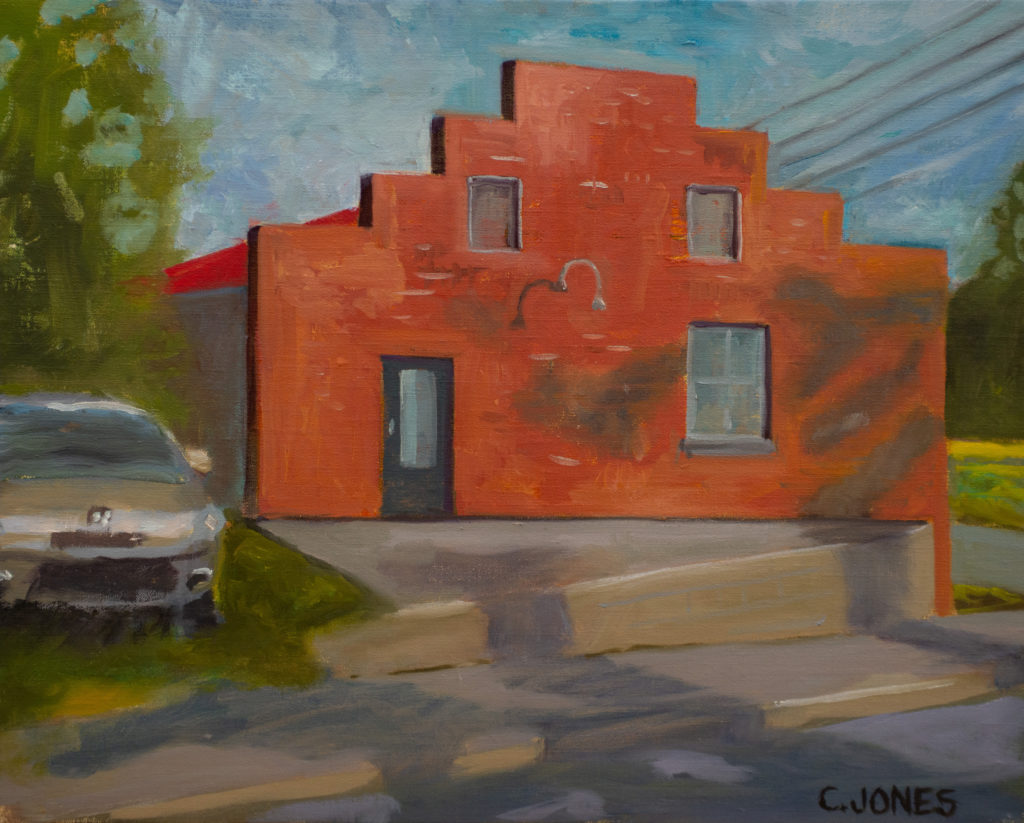
Engine Company Number 2- 24×24 oil on panel
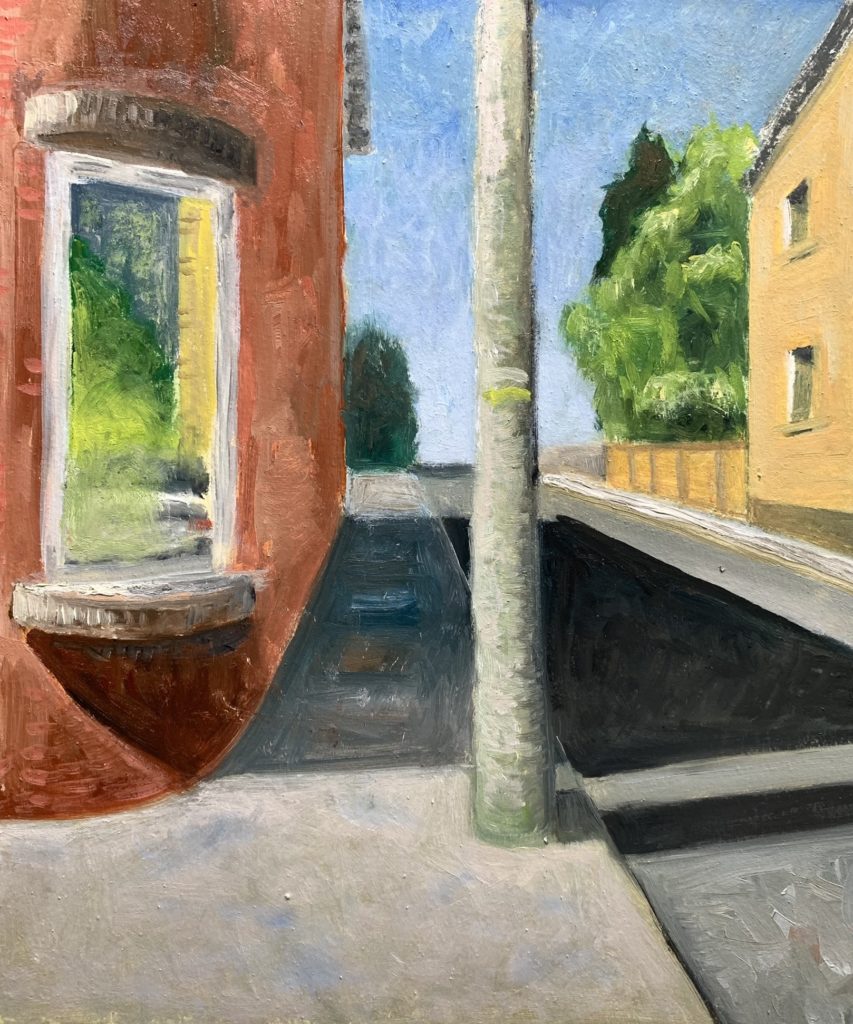
Church Street- 11×14 oil on paper
Old Facade on Grove Street- 16×20 oil on panel

With his canvas and paint tools in tow, Jones stopped and painted the two Grace Street buildings en plein air.

“I was struck by [the Fire Station No. 2 building] because of the way the light hit it, plus it was beautifully designed in the first place,” Jones recounted. “I had this fantastic feeling of having been there in the day when it was being used, and seeing fire trucks come out of the door.”

Jones spent an afternoon getting the architectural lines and sunlight reflecting off the fire station just right before returning back home to Raleigh, but not before Lynchburg had a chance to leave an impression on him.

“Lynchburg is going through a renaissance of sorts, it seems,” he said. “I loved to see all of the hip looking youngsters walking around. If I didn’t love living in Raleigh, I’d be hard pressed not to want to move to Lynchburg.”

To see more of Chris Jones’s art, visit his portfolio at www.chrisjonespaints.com and find him on Instagram at @chrisjonespaints. He is currently accepting commissions, and his Lynchburg paintings are available for purchase.


Finding Your Home’s Art Style

Curating art for your home is a big investment, and a lifelong journey. The first step in that journey is finding an art style that resonates with you. That art style will ultimately set the stage for the artists that you gravitate toward, the mediums that you prefer, and the overall tone that each room in your home will have.

But how do you determine which art style you love when there are so many talented artists out there? It starts with spending time with art before ever making the first purchase.

The Different Types of Art Styles
Walk into any art gallery or art museum and you’ll see myriad art styles. An expert would be able to immediately note the nuances in brush strokes, the relevancy of the time period, or the backstory of the art that makes it so powerful. But for those of us who simply want to curate an aesthetically pleasing and uniquely styled home, here are the primary art styles you can focus on.

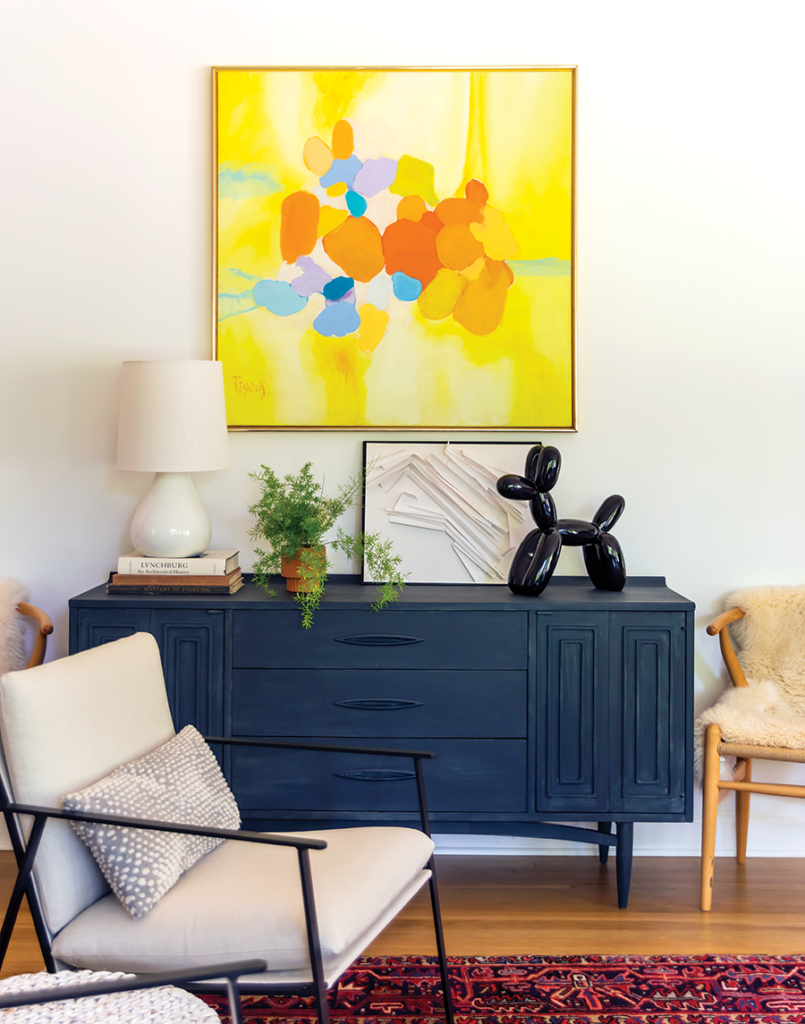
Home Featured in Lynchburg Living September/October 2021. Photo by Daryl Calfee

Abstract Art
Abstract art is an art style in which an artist uses shapes, colors, and textures to create an image that’s not based on reality. Abstract art can take the form of a painting, sculpture, photography, design, or any other art form that doesn’t accurately represent a subject or object.

One of the most unique aspects of abstract art is that it’s always open to interpretation. A viewer doesn’t always immediately know what the piece is about—it is abstract after all—but over time, certain emotional or intellectual qualities can be seen in the piece that can make it uniquely special to the viewer.

Contemporary Art
In short, contemporary art is art that’s made today by living artists. Because of that broad sweeping definition, it’s an art style that is ever-evolving and often reflects the complex issues that shape our diverse and rapidly changing world.

While the art world is still debating what eras technically define the contemporary art style, most can agree that the starting point is the late 1960s or early 1970s.

Within the contemporary art style, more niche movements can be found. Pop art, photo realism, conceptualism, minimalism, and street art are all styles that can be explored if you want your home’s art style to make a statement.

Fine Art
Fine art is artwork that has been created for the sole purpose of being appreciated for its beauty and intellectual or emotional influence, rather than its function. Of course, with art being so subjective, what distinguishes something as “fine art” can be left to the interpretation of the viewer.

Within the fine art style, painting, sculpture, and photography can all be explored for your home. And while there are countless fine artists across different mediums and centuries, a few examples of visual fine artists are Rembrandt, Matisse, Van Gogh, Monet, and Degas.

Home Featured in Lynchburg Living January/February 2020. Photo by Heather Kidd

Determining Your Home’s Art Style
Your goal is to create a stylish and cohesive home, so it’s important to choose not only an art style that resonates with you, but also to find an art style that accents your existing home furnishings.

When you walk into an art gallery or store, have the space you’re hoping to find art for in mind. Maybe even have a photo or two on your phone to use as a reference. Know what the dimensions of the wall are, and the existing color palette of the wall paint, furnishings, and rugs.

From there, slowly walk through the art selections and pay careful attention to the art that evokes an immediate reaction. The old adage “I’ll know it when I see it” has never been more true when it comes to choosing art for your home. If you see a piece of art and it creates a feeling of excitement or positive emotion, it may be something you can work with.

This feeling of excitement and emotion may even help you eliminate the art styles that aren’t quite for you, making your future art shopping trips even easier.
After you’ve narrowed your selections down to the pieces that resonate with you, pull out your handy reference photos and measurements and consider how the piece will work within your existing space. Consider how the colors will play with each other, or how much wall space the piece may occupy. Consider the frame that it’s currently in—if it’s framed at all—and whether the style suits your tastes or if you’ll have to budget for a reframe.

It’s important at this stage to avoid talking yourself into an art purchase. Remember, art is a big investment in and of itself, so if you have to completely rework the rest of your space to accommodate your new purchase, it may not be worth it.

Your art style is a way to express your personality within your home. And just like with any other personal style, opinions can change over time. Allow yourself to continuously explore art of all styles by supporting local art galleries and artists. Learn the colors that strike an emotion, or the details that draw you in. Over time, your home’s art style will become even more honed and beautiful.


Beautifully Blended

Vibrant, nutrient-rich smoothies to jumpstart your day.

Recipes & Photos Courtesy Millie’s Living Cafe

There’s nothing more beautiful than a brightly colored smoothie that’s packed with healthy fruits and proteins. And the best part? Making them is a breeze. Simply toss all ingredients into a blender, blend until smooth, and you’ll have a delicious and healthy beverage to start (or end) your day with. Thank you to Millie’s Living Cafe for sharing their recipes with us!

healthy-smoothie-recipes
Pumpkin Smoothie
1 1/2 cup banana
1/3 cup ice
1 cup cashew or almond milk
4 tbsp pumpkin puree
2 tbsp maple syrup
2 tsp vanilla extract
1/2 tsp cinnamon
1 tsp pumpkin pie spice
Dash of salt
After blended, top with So Delicious Cocowhip and cinnamon
Summer Sunrise
1 frozen pack dragon fruit
1/2 of a fresh mango
1/2 of a fresh pineapple
1/2 tbsp agave
1 cup coconut water
Protein Smoothie
3/4 cup blueberries
3/4 cup bananas
1 tbsp almond butter
1 scoop protein
(i.e. Garden Of Life Vanilla Plant Protein)
1 1/4 cup cashew or almond milk


The American Flag Cake

Patriotic Patisserie That is Sure to Impress
Photos by Ashlee Glen

Celebrations are often synonymous with some type of food. Consider the Thanksgiving Turkey, the Christmas Ham—or the spicy chicken wings folks like to eat on Superbowl Sunday.

But there are some special days that are often lacking in the food department. Some of our most beloved celebrations have yet to properly be associated with a special food. Yes, I am looking at you, Independence Day. The 4th of July was meant for so much more than watermelon and hot dogs!

I would like to see this fantastic Flag Cake recipe get a permanent place on America’s birthday table. It’s delicious, surprisingly easy to make, and its dramatic appearance will make your guests gasp when you bring it out. Also, if you don’t have time to decorate, let your guests help out. It’s fun!

I like to serve this cake with a sweet strawberry drink called Saft. Saft is a homemade, fruit flavored syrup with Swedish origins. Mix some of the syrup with water to make a refreshingly sweet, all-natural alternative to Kool-Aid.

AMERICAN FLAG CAKE
Serves: 18-20 People

Cake
2 1/4 sticks (255 grams) of unsalted butter, softened
3 cups sugar
6 large eggs
1 cup sour cream
2 tsp vanilla extract
3 cups (385 grams)
all-purpose flour
1/3 cup corn starch
1 1/4 tsp kosher salt (reduce to
1 tsp if using table salt)
1 tsp baking soda

Icing
4 cups heavy cream
1 tbsp sugar

Decoration
1 pint blueberries (for the number of rows you see in the photo,
you need 72 berries)
1 1/2 pint raspberries (for two long and two short double lines
you need 128 berries)

Directions
Heat the oven to 350 degrees. Butter and flour an 18 x 12 x 1 1/2 inch sheet pan.

In a stand mixer with paddle attachment, cream the butter and sugar until it looks light and fluffy. Reduce the speed and mix in the eggs, one at a time. Add the sour cream and the vanilla and beat another minute until smooth.

In a separate bowl, mix together the flour, corn starch, salt and baking soda. You can sift the dry ingredients if you have the patience, but lightly beating with a hand whisk works, too.

Now, slowly mix the dry ingredients into your stand mixer bowl until just combined.

If you will be serving the cake directly in the pan, just pour the batter into the buttered pan. However, if you are planning to turn out the cake and serve on a board or tray, use a sheet of parchment paper in addition to greasing and flouring the pan.

The batter will be fairly thick, so spread it evenly into the pan and smooth the top with a spatula. Bake in the middle of the oven until a toothpick comes out clean, or about 25 minutes.

When the cake has cooled completely, whip the cold heavy cream along with the sugar on high speed until thick and spread over the cake.

Decorating with berries can be as simple or complicated as you make it. If you go for perfection you may want to set aside around 30 minutes and use a ruler to space the rows of blueberries and raspberries. If you prefer a quicker, more rustic approach, strawberries cut in half make a good alternative to raspberries and you will be done in
10 minutes.


SWEDISH SAFT
Makes: About 1 Pint

Ingredients
1 lb. fresh strawberries, hulled and halved
1 1/4 cup sugar
1 lemon, juiced
1 1/2 cup water

Directions
Add strawberries, sugar, and water to a heavy-bottomed saucepan. Bring to a boil, then reduce to a simmer. Cook until the sugar has dissolved then turn off the heat. Add lemon juice. Let the mixture cool before straining it through cheesecloth to remove the strawberry solids. Store in a snap-top bottle in the refrigerator. Will keep for one month or longer.

To enjoy a glass of saft, mix 1/4 cup of the syrup with 1 cup water. Ice is optional!


Decorating with Plants

Without a doubt, houseplants are having a moment. From major retail collabs with plant wizards such as Hilton Carter or local Facebook listings with propagated plants for sale, they’re everywhere lately. Interior design is no exception to this trend and proves that you can integrate plants in some unexpected but accessible ways.

Here are the best tips we gathered to get you started from local experts Emily McGowan, Owner and Lead Designer for Elm Home Design, and Tera Janelle of Tera Janelle Design.

Why Try It?

Yes, it’s a trend right now, but plants are timeless, says McGowan, “Plants in a home add so much warmth…[and they] add interest and texture without making it look too cluttered.”

For Janelle, bringing the outdoors in is part of her routine. “Each year when spring arrives, we pick up ferns and set them in large planters around the house, both indoors and out,” she says. “They can be a bit messy, but they always bring a sense of breezy spring and summer to the house.”

In the cooler months, Janelle adds “dry, decorative grasses to the bar cart for some seasonal coziness.”

Where To Start
“The best advice I could give is to start simple and small,” says McGowan.

When choosing new plants, she always speaks with the horticulturist: “I explain what I’d like the plant to look like, how large I want the plant to get, and how much time or energy I want to put into it, etc.” These questions can help guide you to the right selections.

McGowan says while “Google is your friend” for immediate questions, purchasing from “local nurseries is your best bet; they will always have a wealth of knowledge.”

Ultimately, McGowan recommends choosing a plant because you “love the shape and look of it.”

Where to Place Them
McGowan loves a classic vignette when staging a room with plants. Start with a coffee or side table and “stack two to three books and with a small potted plant on top of them,” she says; or “place a pretty, potted plant on open shelving, countertops, entry tables, etc.; plants literally will work anywhere!”

For Janelle, she prefers specific plants in certain spaces. “Potted orchids are one of my absolute favorite potted plants,” she says. “They can last a month or longer and can be found affordable at the grocery store; I love them on a bathroom vanity or in a shower, and they thrive in the humidity.” Hanging plants can also do well in smaller spaces such as bathrooms; both pothos and hoya plants fill out nicely and are resilient.

In a kitchen, Janelle will add potted herbs—great for cooking, while also “lending a casual English feel” to the space. McGowan loves small potted plants by the sink. For the island, “a collection of oversized branches is one of my favorites,” Janelle says. “Butterfly bush branches, Japanese maple, forsythia, magnolia, and even ‘scrub trees’ are a few easy-to-find favorites.”

Finally, don’t neglect even the most mundane spaces in your home such as your pantry and laundry room. “Blooms feel casual and inviting,” says Janelle, “And they bring a dose of fresh air to the workhorse rooms of the house.”

Vessels
Keep in mind the general aesthetic you want for your home when choosing how to display your plants. Take a small maidenhair fern—for a classic, traditional feel, you can nest it inside of a bust (a popular choice right now) or, for a more down-to-earth approach, select a simple terra cotta pot (these patina over time for some added charm).

Both McGowan and Janelle recommend baskets to house larger plants. “I love [fiddle leaf figs] set in affordable baskets, with plastic planter liners tucked inside,” says Janelle. Situate these larger plants (say monstera, snake, or rubber plants) near a fireplace, in a corner, or, says McGowan, next to a console table.

Janelle recommends always keeping several clear vases of different shapes and sizes on hand; “I’ve purchased these everywhere from Walmart to Goodwill to Pottery Barn,” she says. “They are super versatile and great for gifting cuttings from your yard and garden.”

For something unique, think outside the box. With the proper lining, pitchers, distinctive mugs, and baskets can all be repurposed to house a plant.

The Importance of Patience
My grandfather has cared for hundreds of houseplants throughout his lifetime; his best care tip: “Be patient; things take time.”

McGowan echoes this wisdom, saying, “It’s a commitment to have some plants, and you have to be willing to take the time to care for them. In the long run, it’s worth it to have that greenery in my spaces.”


The Modern Traditionalists

Mother and Daughter Homes Span Design Spectrum

Lisa Richards and Michele Fredericks both love design. One might say it’s in their genes. Mother and daughter share the same bright blue eyes that light up with mutual passion when discussing a home’s form and function. Their individual styles, however, play out in unique fashion in each of their Boonsboro homes. Lisa is an artist who appreciates traditional architecture, French furniture, and lush gardens. Michele is an architectural designer and gravitates toward what she describes as “warm modern” design.

They invited Lynchburg Living into their homes to talk about their distinct approaches to home design.

modern home decorMichele’s Home: “Making Mid-Century Modern”
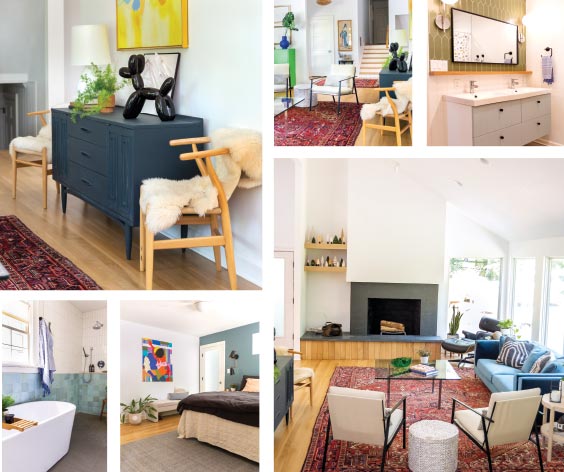
It was not initially the kind of home Michele thought she would buy. As a “never-Split-Level” kind of girl, she was surprised to find herself attracted to the 1958 split four-level home on a large swatch of land just a few miles from her parents’ home. Still, Michele had confidence she could transform the ho-hum house into a light-filled modern retreat for herself, her husband Jonathan, and their two sons.

The one challenge? “We were on a tight budget for all of our renovations, just the two of us quitting our jobs, not having new jobs, and moving from one country to the next,” Michele said.

Before landing back in Lynchburg, Jonathan’s job took them to such far off places as Germany and Hawaii, where they picked up some valuable aesthetic preferences. Topping the list of their renovation desires: opening up the floor plan and the ceiling, overhauling the kitchen and bath spaces, and adding more natural light throughout.

Though Michele designs project schematics for clients every day in her role at the architecture firm Atelier 11, she knew she could use some reinforcements to make faster decisions for her own home. Enter Bryn Namavari, Michele’s friend from grad school and a designer for the company CB2 in California. The two put their heads together to check the boxes the family wanted. Once the floor plan was created, they partnered with contractor John Joyer of Driven Builders and job super Mike Wright to bring their vision to life.

The duo’s decisions paid off. Walking into the home today, what was once a walled apart and dark layout now soars high with vaulted ceilings and warm white walls. Light pours in through large, drape-free windows and skylights in the kitchen. Pendant lights by AllModern glint off the large Quartzite slab from Roanoke Granite atop the kitchen island. IKEA cabinets with custom fronts from Semihandmade further modernize without being stark. Carefully selected pieces from antique shops, former home locations, and Michele’s lineage adorn the home.

“A lot of the Asian influences are things from my grandmother because my grandfather was in the Navy and they lived in Okinawa. So that is her original silk painting [hanging in the entry] from the ’50s in the original frame, so I started with that,” Michele said.

traditional home decorAdjoining the fireplace, with its soapstone hearth and surround from a quarry in Schuyler, VA, are two shelves that host Michele’s one and only true collection, an assortment of wooden trees handmade in the black forest in Germany.

“When I found those—I don’t collect things, but that became an obsession for me because I really like the form of those and how simple they are so now I have a little typology going on,” she explained.

Once the main floor living space renovation plans were complete, Michele turned her attention to the home’s three bathrooms and master bedroom. Tight on money and space, she had to get creative, knocking out hall closets to steal extra space for the bathrooms. In the master bedroom, the problem was too much space, so Michele subtracted some square footage to create a walk-in closet. In the bathrooms, she once again sourced IKEA for vanities with Semihandmade custom fronts. Smaller splurges in the master bath came in the form of an acrylic soaking tub and Cloe Baby Blue tile from Bedrosians Tile surrounding the integrated shower-tub area.

The dust has now settled on the 1.5 years of renovations at the Fredericks’ home and what remains is an airy and eclectic mix of old and new, calming and colorful—exactly as Michele planned it.

“I love an unexpected pop of color,” she said. “I do white walls everywhere because I love color but I don’t love color on the walls. So I want my weird, found, and very bright objects to speak for themselves.”

traditional home decorLisa’s Home: Stylish Symmetry with Gardens Galore
When Lisa and her husband, Jim, decided to finally build their stately brick home in 1995, it had been a long time coming. Lisa, a studio artist whose work ranges from pencil sketching and portraits to oil paintings and watercolors, points to a self-portrait she painted at that time of a 33-year-old version of herself with a certain,
shall we say, “expression” on her face.

“The look I have in that portrait is, ‘If you don’t build me this house soon, I’m selling the property’,” she laughed, recalling that the couple first bought the land and paid it off over six years before they started their new build.

Today the telling self-portrait hangs in Lisa’s art studio inside her quarter-century-old home that has seen a lot of life and expansion over the years. Lisa chose to model her home after the George Wythe house in Colonial Williamsburg, a timeless classic she knew would age beautifully over the years. Michele was just 11 when she and her sister, Laura, picked their bedrooms in the family’s home.

In the time that has passed, Lisa has thoughtfully filled the home with a mixture of antiques, finds from markets in places such as Atlanta, Charlottesville, and France, and an abundance of art. The home’s art collection includes portraits of Michele and her sister as children, “Covid portraits” Lisa painted of her three grandchildren, and a framed still life that was Michele’s first true piece of art at 16, which won an award at the Lynchburg Art Festival. It’s items like these, infused with meaning, that comprise much of what fills the home today.

“I have collected things over the years, over time. Everything has a memory,” Lisa said.

In the living room, for example, six patterned plates hang on the wall, a gift from a close friend who passed away in 1999 from breast cancer. As Lisa carefully collected items over time, her home watched her kids grow up and have children of their own, itself remaining a constant place of gathering for family and friends around the kitchen island.

“I have memories of sitting here sewing Halloween costumes with a day’s notice. And all the family dinners, and making curtains,” Lisa said. “Everything happened here in the kitchen; all of life happened here.”

While the kitchen, with its warm white cabinets, blue toile curtains, double gas range, and hanging copper pans, has not changed much over the years, Lisa did decide to swap out the backsplash and countertops. A slab of granite with beveled edges from Rockfab now adorns that well-loved kitchen island. Off the kitchen, a laundry room was added with creamy cabinets and a place to wash the Richards’ two Yorkies.

traditional home decor and gardensAnother addition off the back of the house came in the form of an oversized sunroom, filled with Parisian-style pieces and offering the feel of a tree house with wall-to-wall windows surrounded by greenery.
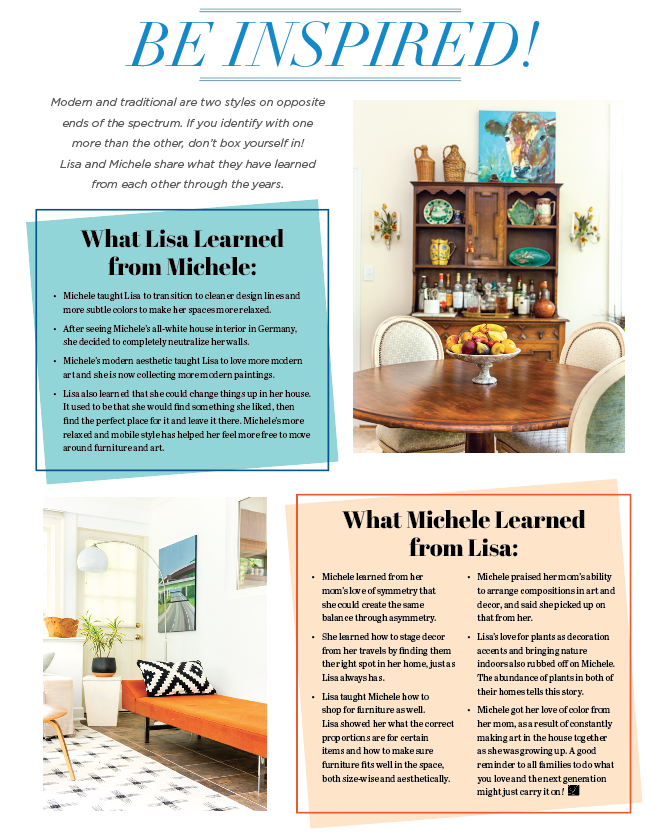
“My main goal [with the sun room addition] was to see outside,” Lisa explained. “I wanted everything low, everything subtle, because I’m an avid gardener so our big thing is the gardens and the outdoors.”

Indeed, the yard at the Richards’ house is something to behold. From the large Magnolia tree in the front yard and the newly planted Camellias in the back beds to the quaint potting shed overlooking the lush landscape, it’s little wonder why Lisa’s home was chosen to be on the 2022 Lynchburg Garden Tour. She is self-taught as a gardener, and the grounds of her home are now a designated habitat, which means pesticide-free growing, and also contain several bee houses.

“I’m really into my bees,” Lisa said. “Lynchburg is now a ‘Bee City’ and our Lynchburg Garden Club and Hillside Garden Club are working together to promote this.”

From entry to exit at both Lisa’s and Michele’s homes, each provides a serene space to let daily life with family unfold, filled with equal parts practicality and an effusive creative spark. Like mother. Like daughter.


be inspired


Photos by Daryl Calfee


Lynchburg Living Giving Back Awards 2020


2020 Community Impact Appreciation Winners

Financial investments, in-kind donations, mentoring programs—there are numerous ways that local businesses contribute to the overall betterment of the greater Lynchburg region.
To complement our Giving Back Awards, the Lynchburg Living Community Impact Appreciation feature is a way to give local businesses a pat on the back as well. This year, we selected eight businesses to recognize for their outstanding efforts behind the scenes.


Apocalypse Ale Works

How does your business impact the community?
When the COVID-19 pandemic first hit in March, the service industry was abruptly decimated. Not only did that affect our own livelihood, but it also affected all of our friends within the restaurant and service industries as well. We quickly partnered with Sysco for a food drive for all furloughed workers. We have continued collecting non-perishable foods to help support our community. Additionally, we have been working closely with local officials on improving infrastructure and have already committed another $24,000 on a project that will help dozens of local businesses in our area. Finally, this November will be our Apocalypse Helps Give Back Month, where we will partner with a different local charity every Saturday and help raise money, food, and clothing for our local neighbors.

Why does your business choose to focus on these causes? 
Our goal is to help move our community forward. Big box stores provide jobs and goods to our community, but we strive to be more than that. Whether it’s providing food, hosting fundraisers for families in need, or helping our local infrastructure grow, a rising tide floats all ships.

Founded: 2012
Located: 1257 Burnbridge Road, Forest
Number of Employees: 9


Beacon Credit Union

How does your business impact the community?
Beacon Credit Union understands the importance of giving back to the community. We have sponsored events and campaigns that have raised awareness and more than $57,000 for our nonprofit organizations. In addition, we understand that our employees want to serve in the community as well, so we award PTO hours to our employees who volunteer at approved charities. Beacon also believes in the investment of children and their futures. Each year, we award six scholarships, $12,000 total, to students in our community to assist them in their educational journey.

Why does your business choose to focus on these causes? 
Ultimately, it is our responsibility as human beings to care for one another. It’s an honor to be part of this community, and we want to pay it forward. We believe that a charitable focus is imperative to any business organization and that it brings both the community and employees together for a common goal.

Founded: 1939
Located: Branches in Lynchburg, Madison Heights, Bedford, Danville, Buena Vista
Number of Employees: 80


Brownstone Properties, Inc.

How does your business impact the community?
Since our company’s beginning, we have supported programs and events focused on children and education. This past year, we sponsored the Bedford Hills Elementary School Carnival and Linkhorne Middle School Color Run. These events helped raise funds to support the PTO at each school and also provide assistance to teachers for programming needs. We also were the title sponsor of The Optimist Club of Lynchburg Oratorical Contest. This contest was created to encourage middle and high school students to participate in public speaking as part of a global competition through Optimist International.

Why does your business choose to focus on these causes? 
Our company set a goal to support local causes very early. Over the years, as our owners got involved with their own children’s schools, education became a recurring cause. Through personal involvement it was impossible to ignore both the financial need and the need to encourage and engage these young people to be their best. In addition, we have supported various athletic, band, and theatrical programs of local schools because we also recognize the importance of extracurricular activities in the development of our youth.

Founded: 1998
Located: 3720 Old Forest Road, Lynchburg
Number of Employees: 18


CloudFit Software

How does your business impact the community?
CloudFit exists to generate funding for nonprofits including KidFit and JobFit. KidFit provides mentoring and opportunities via athletics for all youth whether they can pay or not. KidFit trains youth in Lynchburg in speed, strength and agility as well as enables athletic camp and travel ball opportunities for youth. JobFit enables students and career changers to get real training and real experience, including paid internships, to lower the barrier to entry for great IT careers. CloudFit employees get to volunteer a number of hours per year as PTO for CloudFit.

Why does your business choose to focus on these causes?
CloudFit was literally founded to enable KidFit and other charities—the company bylaws require that CloudFit support KidFit and other charities. CloudFit’s founders believe that their mission on earth is to change the industry through CloudFit, but more importantly to use CloudFit to generate revenue that will help change lives through KidFit, JobFit and beyond. CloudFit is headquartered in Lynchburg because of a desire to help the Lynchburg region by providing hope and game-changing job opportunities for the wonderful people in this region.

Founded: 2018
Located: 300 Lucado Place, Lynchburg
Number of Employees: 140


I Scream You Scream

How does your business impact the community?
This has been a difficult year for all, but we did not want our local nonprofit groups to suffer or be unable to continue their great causes, so we continued our Community Give Back program. Our program started in 2016 with the goal to help local nonprofits, organizations, and individuals in need. This year we have donated a percentage of sales to local schools, church groups, humane societies, sports organizations for individuals with disabilities, a local fire department and other organizations.

Why does your business choose to focus on these causes? 
We believe we all have the privilege and responsibility to use our talents and gifts to help others. Reflecting on our business, we feel we had a platform and opportunity to help and connect people, businesses, and organizations by giving financially, using our large social media following to advertise the efforts of local nonprofits, and provide a place for these groups to connect with the families of our community. Communities are stronger when people are united and working together for the betterment of all. Loving people is what it is all about.

Founded: 2012
Located: 13955 Wards Rd. Lynchburg
Number of Employees: 17


Jersey Mike’s Subs

How does your business impact the community?
• Month of Giving Fundraiser, raised $7,087.89 for The Habitat for Humanity of Greater Lynchburg
• Three times per year, Meals on Wheels Fundraiser generates $12,000+ in donations
• COVID Donations
• Donated 850 subs to feed both hospitals
• Donated 150 subs to feed the Lynchburg Police Department
• Donated $6,176.03 to local schools through Spirit Fundraiser Nights
• Donated 1,100 Free Sub Coupons to local teachers
• Donated $3,576 to local organizations through our BOGO Fundraiser Coupons
• Donated 115 lunches to the Boys and Girls Club Golf Tournament

Why does your business choose to focus on these causes? 
Jersey Mike’s Subs as a company has a long-standing tradition of giving back and supporting the community that supports us. Our mission is Giving… Making a difference in someone’s life. We believe that making a great sub sandwich and making a difference can be one in the same. It gives us great pride to know that we have been able to make such an impact on the Lynchburg community since opening our first store in 2008.

Founded: 2008
Located: 3919 Wards Road, Lynchburg; 3901 Old Forest Road, Lynchburg
Number of Employees: 40-45


Sentry Equipment & Erectors, Inc.

How does your business impact the community?
Sentry makes a community impact through working with the youth of Lynchburg. Our engineers and shop team have welcomed many students into our facility to demonstrate first-hand how our equipment is designed and assembled. Last fall, Sentry hosted Ross Learning Academy’s STEM program students, during which our team gave students thought-provoking, hands-on exercises and a tour of the facility. Additionally, our engineers often visit Lynchburg City Schools to explain how our Electrical Engineering group brings our systems to life.

Why does your business choose to focus on these causes? 
Sentry’s passion is to ignite the young minds of Lynchburg. We love our community and hope to help the next generation get excited about their education in a hands-on environment. Here at Sentry, our team takes great pride in the work that they do, and to share that with the youth of Lynchburg is an honor.

Founded: 1980
Located: 13150 E Lynchburg Salem Turnpike, Forest
Number of Employees: 221


The Water Dog

How does your business impact the community?
Since opening our doors in Downtown Lynchburg, we have made it a priority to give back to the organizations around us, including the Downtown Lynchburg Association, Riverviews Artspace, Lynchburg Humane Society, Miller Home for Girls and many others. We also enjoy bringing our community together through a variety of events such as Pints After Pedals, Oktoberfest, and TWD Runner’s Club. In 2019, we reinvested in Downtown Lynchburg by purchasing The Glass House and have made an economic impact with that venue by donating a portion of our proceeds from the events we hold.

Why does your business choose to focus on these causes?
At face value, what we try to do is pretty simple: bring together great craft brews and tasty food with an awesome environment and some pretty rad people. But on a deeper level, we are passionate about connecting with the people and organizations around us that call Downtown Lynchburg home.

Founded: 2016
Located: 1016 Jefferson Street, Lynchburg
Number of Employees: 50


Best of Hall of Fame Sept/Oct 2020


Pump Up Your Patio

Is a too-small patio putting a damper on your parties? Or is the blazing afternoon sun making you sweat during that 5 p.m. beverage? It might be time for an outdoor space overhaul.

“You have to balance aesthetics with function,” says Rebecca Mahanes of Land Tech Group.

First, she says they usually address space issues. “The big thing is being able to have space for furniture and people to gather,” she says, adding that many standard new builds only provide a small concrete pad in the backyard. Their team will start by using pavers or concrete to make an area large enough for the homeowner’s entertaining needs.

Another common complaint that prevents patio usage—the sun. “In Forest, where a lot of newer homes are being built, there is not a lot of shade,” says Mahanes. “Pergolas are becoming more popular.” The slats or some type of fabric can provide the extra shade homeowners need to feel comfortable. Not only does it look good, it’s typically a very economical addition, she says.

Whether you have an unlimited budget or just enough money for one cool feature, we hope you can gain some ideas from this stunning project Land Tech completed a few years ago in Forest’s Ivy Lake neighborhood:

Overall Aesthetics:
It’s always trendy to have your outdoor entertaining area blend into its natural environment. Here, Mahanes says the homeowners wanted a rustic look. A stacked stone retaining wall adds to that vibe as well as the A-frame metal roof over the kitchen area.

In-Ground Hot Tub:
This custom in-ground hot tub has a water feature that runs on a pump and flows into the spa. It’s partially raised so that guests who don’t want to get in the water can still socialize with those who are.

Fire Bowls:
These run on gas/propane and can either be turned on with a wireless antenna or lit with a match. “I love these because they create a warm ambience,” says Mahanes. “It’s not just about having the space but also having the nice lighting at night.” Landscape lighting is another way to create a cozy atmosphere.

Outdoor Kitchen:
These are a highly popular addition to outdoor areas right now. Mahanes says those who seek one out always want a grill, but many are also starting to request smokers, such as a Big Green Egg. Outdoor kitchens function best if they are covered well and have enough counter space to operate like an indoor kitchen.

Fire Pit:
“This home’s fire pit is really the centerpiece that ties the whole area together,” says Mahanes. She adds that there’s about a 50/50 split between wood burning and gas fire pit installations. “People who like the smoky smell choose wood for the camping ambience. Those who choose gas just want to come out, turn it on and be done.”