Cold Weather Crops

Prepping a productive winter garden

Wow, what a summer. If you’re a gardener, your garden this year has been a labor of love. Drought, peppered by random, short-lived downpours and scorching hot days, made this a difficult season.

Soon, our days will grow shorter and cooler, marching slowly toward autumn. Maybe you’re not ready to be done yet. Your green thumb is still a little itchy. Well, I’ve got great news for Virginia growers: gardening doesn’t have to be reserved for the warm months of May through August!

With a little planning, you can grow and harvest fresh veggies all year, and keep your soil healthy for early and easy spring planting.

There are just a few things you need to know before hitting the dirt:
1. When is the first “killing frost”?
2. Which veggies are frost-hardy?
3. When do you need to plant them?

Here in zone 7a, our average first killing frost date is around October 14. This is the date that the frost becomes strong enough to kill tender plants. Generally speaking, you’ll want your fall/winter vegetable garden started well before this date, in August or September. However, gardening hacks such as cold frames and hoop houses can protect those more tender plants through the frost and extend the growing season well into winter. (See sidebar on page 71.)

Since most hobby gardeners stop growing in the fall, it’s not always easy to find garden-ready plants for sale after August.

This means you may have to start from seed. When purchasing veggie seeds for the winter garden, you’ll want to look for the words “hardy” or “frost-tolerant.” These are the varieties especially equipped to handle the cold.

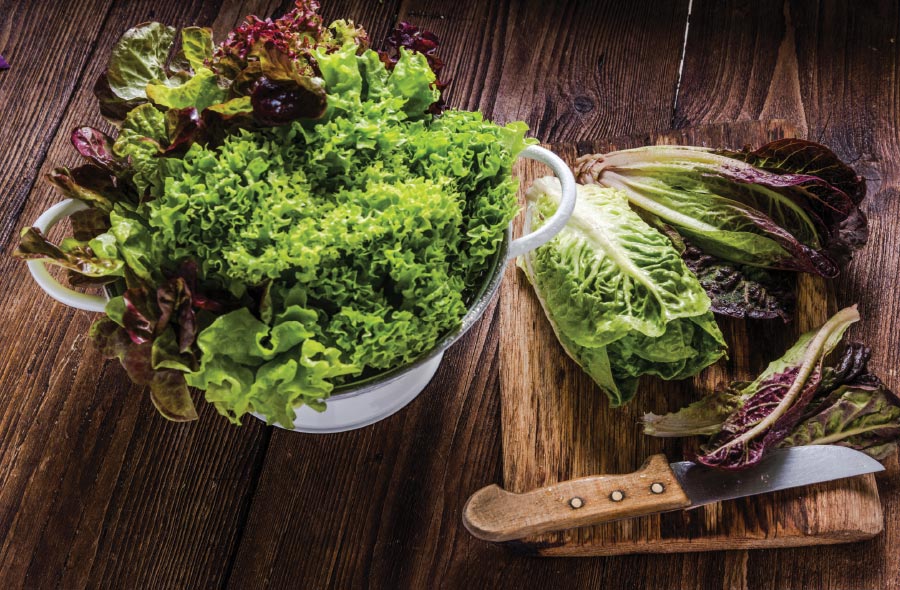
winter garden lettuceSo what exactly can you grow through the colder months?
Some of the most nutrient-packed produce we enjoy thrives with a little frost. Here’s a list:
Brassicas: Veggies in this family such as broccoli, kale, and kohlrabi actually grow better in the fall, and can even survive snow if they’re planted early enough to get established before the really cold weather sets in.

Carrots and their friends (such as radishes & turnips) love a little frost and actually get sweeter, because they naturally produce a surge of sugar to protect themselves from the cold. That means tastier harvests for us!

Peas: This is probably my favorite.

Snow peas and sugar snap peas grow well in the fall garden. Plant new seeds every two weeks for a constant harvest as long as they’ll hold out. Depending on the harshness of our winter, you can plant right through November!

Brussels Sprouts: Like carrots, they actually get sweeter after a frost.

Lettuces and greens: Little leafy guys such as collards, lettuces, mustards, arugula and endive are tender, but given the right conditions they can tolerate the cold and provide a long harvest of healthy veggies. Plant these in cold frames or hoop houses in a sunny location to protect them from the chill, and reseed every few weeks.

Garlic and onions: These can be planted as late as October and November, and love a nice, long growing season. But don’t expect a winter harvest, they’re slow to grow (but worth the wait).

green onions winter gardenThere are some really nice benefits to cold weather gardening. For one, I’m not on my hands and knees in 90 degree weather pulling weeds and plucking cherry tomatoes. But also, there are far fewer pests and diseases to worry about, fewer weeds, and—I hesitate to say this, but—a winter garden requires a bit less work. It also keeps your soil loose and productive so that it’s ready in the spring.

Winter gardening is fun and experimental, because our winters are a little unpredictable. I love trying new things to see what can survive.

How to Extend the Season withCold Frames
A cold frame, defined: A cold frame is a shelter from frost that uses sunlight to maintain warmth and moisture for your veggies. You can spend a lot of money on cold frames, but they don’t have to be fancy or expensive at all.

My method
I use my collection of old windows—which can be found everywhere on the internet for cheap and sometimes free—and whatever I have laying around my yard to construct cold frames.

If you have good sunlight on a particular side of your house, you can even use your wall as the fourth wall for your cold frame. I build a little box, usually out of wood or hay bales, and then I place a window on top of it. I like my window to have a little angle to it in order to capture the most sunlight. You can find plans for cold frames online. The more airtight and sealed, the warmer the temperature will remain inside.

Why they work
Cold frames allow you to harvest longer, and even plant later, in the season. They keep the soil warm and they keep ice off of tender leaves. For most of the list of vegetables I mentioned, you’ll want to get them planted no later than the end of September, especially the tender ones like greens. But if you use a cold frame, you can plant continuously much later into the season.

For example, carrots like a good frost, but they (like most vegetables) can’t survive extreme low temperatures or constant freezing. So after the first fall frost, or once it starts to get consistently cold outside, you can plant your next carrot harvest into cold frames. I succession-plant carrots and greens all winter long in my cold frames. They get a little slower to mature in the cold, but planting every week or two gives me a nice consistent harvest.

Final tip
One thing to remember about cold frames is that on warmer days, you’ll want to crack the top open a bit to allow some air flow and moisture reduction. Then close them overnight and on those bitter cold days.


The Modern Traditionalists

Mother and Daughter Homes Span Design Spectrum

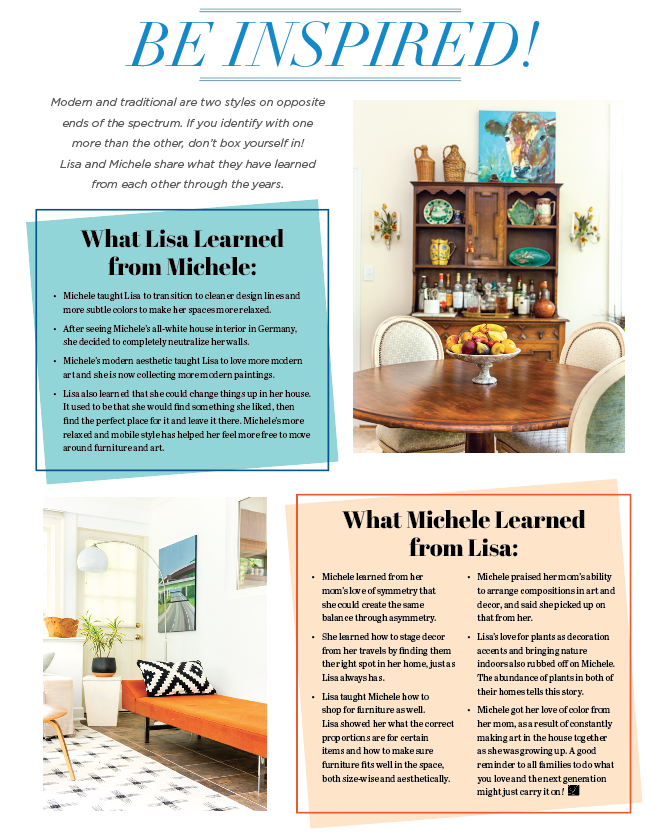
Lisa Richards and Michele Fredericks both love design. One might say it’s in their genes. Mother and daughter share the same bright blue eyes that light up with mutual passion when discussing a home’s form and function. Their individual styles, however, play out in unique fashion in each of their Boonsboro homes. Lisa is an artist who appreciates traditional architecture, French furniture, and lush gardens. Michele is an architectural designer and gravitates toward what she describes as “warm modern” design.

They invited Lynchburg Living into their homes to talk about their distinct approaches to home design.

modern home decorMichele’s Home: “Making Mid-Century Modern”
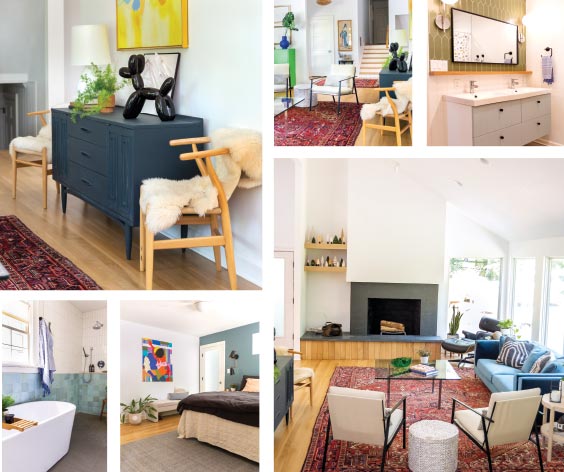
It was not initially the kind of home Michele thought she would buy. As a “never-Split-Level” kind of girl, she was surprised to find herself attracted to the 1958 split four-level home on a large swatch of land just a few miles from her parents’ home. Still, Michele had confidence she could transform the ho-hum house into a light-filled modern retreat for herself, her husband Jonathan, and their two sons.

The one challenge? “We were on a tight budget for all of our renovations, just the two of us quitting our jobs, not having new jobs, and moving from one country to the next,” Michele said.

Before landing back in Lynchburg, Jonathan’s job took them to such far off places as Germany and Hawaii, where they picked up some valuable aesthetic preferences. Topping the list of their renovation desires: opening up the floor plan and the ceiling, overhauling the kitchen and bath spaces, and adding more natural light throughout.

Though Michele designs project schematics for clients every day in her role at the architecture firm Atelier 11, she knew she could use some reinforcements to make faster decisions for her own home. Enter Bryn Namavari, Michele’s friend from grad school and a designer for the company CB2 in California. The two put their heads together to check the boxes the family wanted. Once the floor plan was created, they partnered with contractor John Joyer of Driven Builders and job super Mike Wright to bring their vision to life.

The duo’s decisions paid off. Walking into the home today, what was once a walled apart and dark layout now soars high with vaulted ceilings and warm white walls. Light pours in through large, drape-free windows and skylights in the kitchen. Pendant lights by AllModern glint off the large Quartzite slab from Roanoke Granite atop the kitchen island. IKEA cabinets with custom fronts from Semihandmade further modernize without being stark. Carefully selected pieces from antique shops, former home locations, and Michele’s lineage adorn the home.

“A lot of the Asian influences are things from my grandmother because my grandfather was in the Navy and they lived in Okinawa. So that is her original silk painting [hanging in the entry] from the ’50s in the original frame, so I started with that,” Michele said.

traditional home decorAdjoining the fireplace, with its soapstone hearth and surround from a quarry in Schuyler, VA, are two shelves that host Michele’s one and only true collection, an assortment of wooden trees handmade in the black forest in Germany.

“When I found those—I don’t collect things, but that became an obsession for me because I really like the form of those and how simple they are so now I have a little typology going on,” she explained.

Once the main floor living space renovation plans were complete, Michele turned her attention to the home’s three bathrooms and master bedroom. Tight on money and space, she had to get creative, knocking out hall closets to steal extra space for the bathrooms. In the master bedroom, the problem was too much space, so Michele subtracted some square footage to create a walk-in closet. In the bathrooms, she once again sourced IKEA for vanities with Semihandmade custom fronts. Smaller splurges in the master bath came in the form of an acrylic soaking tub and Cloe Baby Blue tile from Bedrosians Tile surrounding the integrated shower-tub area.

The dust has now settled on the 1.5 years of renovations at the Fredericks’ home and what remains is an airy and eclectic mix of old and new, calming and colorful—exactly as Michele planned it.

“I love an unexpected pop of color,” she said. “I do white walls everywhere because I love color but I don’t love color on the walls. So I want my weird, found, and very bright objects to speak for themselves.”

traditional home decorLisa’s Home: Stylish Symmetry with Gardens Galore
When Lisa and her husband, Jim, decided to finally build their stately brick home in 1995, it had been a long time coming. Lisa, a studio artist whose work ranges from pencil sketching and portraits to oil paintings and watercolors, points to a self-portrait she painted at that time of a 33-year-old version of herself with a certain,
shall we say, “expression” on her face.

“The look I have in that portrait is, ‘If you don’t build me this house soon, I’m selling the property’,” she laughed, recalling that the couple first bought the land and paid it off over six years before they started their new build.

Today the telling self-portrait hangs in Lisa’s art studio inside her quarter-century-old home that has seen a lot of life and expansion over the years. Lisa chose to model her home after the George Wythe house in Colonial Williamsburg, a timeless classic she knew would age beautifully over the years. Michele was just 11 when she and her sister, Laura, picked their bedrooms in the family’s home.

In the time that has passed, Lisa has thoughtfully filled the home with a mixture of antiques, finds from markets in places such as Atlanta, Charlottesville, and France, and an abundance of art. The home’s art collection includes portraits of Michele and her sister as children, “Covid portraits” Lisa painted of her three grandchildren, and a framed still life that was Michele’s first true piece of art at 16, which won an award at the Lynchburg Art Festival. It’s items like these, infused with meaning, that comprise much of what fills the home today.

“I have collected things over the years, over time. Everything has a memory,” Lisa said.

In the living room, for example, six patterned plates hang on the wall, a gift from a close friend who passed away in 1999 from breast cancer. As Lisa carefully collected items over time, her home watched her kids grow up and have children of their own, itself remaining a constant place of gathering for family and friends around the kitchen island.

“I have memories of sitting here sewing Halloween costumes with a day’s notice. And all the family dinners, and making curtains,” Lisa said. “Everything happened here in the kitchen; all of life happened here.”

While the kitchen, with its warm white cabinets, blue toile curtains, double gas range, and hanging copper pans, has not changed much over the years, Lisa did decide to swap out the backsplash and countertops. A slab of granite with beveled edges from Rockfab now adorns that well-loved kitchen island. Off the kitchen, a laundry room was added with creamy cabinets and a place to wash the Richards’ two Yorkies.

traditional home decor and gardensAnother addition off the back of the house came in the form of an oversized sunroom, filled with Parisian-style pieces and offering the feel of a tree house with wall-to-wall windows surrounded by greenery.
“My main goal [with the sun room addition] was to see outside,” Lisa explained. “I wanted everything low, everything subtle, because I’m an avid gardener so our big thing is the gardens and the outdoors.”

Indeed, the yard at the Richards’ house is something to behold. From the large Magnolia tree in the front yard and the newly planted Camellias in the back beds to the quaint potting shed overlooking the lush landscape, it’s little wonder why Lisa’s home was chosen to be on the 2022 Lynchburg Garden Tour. She is self-taught as a gardener, and the grounds of her home are now a designated habitat, which means pesticide-free growing, and also contain several bee houses.

“I’m really into my bees,” Lisa said. “Lynchburg is now a ‘Bee City’ and our Lynchburg Garden Club and Hillside Garden Club are working together to promote this.”

From entry to exit at both Lisa’s and Michele’s homes, each provides a serene space to let daily life with family unfold, filled with equal parts practicality and an effusive creative spark. Like mother. Like daughter.


be inspired


Photos by Daryl Calfee


Rug Refresh: How to Choose a Rug You Will Love

Rugs are the best of form and function.

As grounding elements, rugs can often set the tone of a room while also serving an important role throughout the home. Whether looking for a soft place to land, protecting wood floors, or covering ugly ones (we’ve all been there), there’s no doubt that the right rug can complete a space.

While replacing all of the rugs in your home at once may not be in the cards, addressing those in the most visible, high-traffic areas is a great place to start. For insights on how to make a choice you will love, we called in expert help from Brittany Sydnor, Lynchburg-based owner of BeFound Collective (befoundcollective.com), an online shop of vintage, hand-woven rugs sourced from all over the world.

Picture It
Before identifying your rug style, it’s important to understand your personal design style. For help with that, Pinterest is a great resource.

“Search by room names and focus less on the rug and more on the overall space. What is it about those rooms that resonate with you? From there, pick it apart and determine the rug style that best supports the space you’re trying to create. You might be surprised to discover that the style of rug you’re attracted to doesn’t align with the aesthetic you’re trying to create. Once you determine the style you love, I recommend sticking with wool or other natural fibers as they tend to wear better over time and are easier to maintain,” Sydnor said.

Easily Influenced
Let’s be real, many of us are influenced by what we see on social media these days. And in the Instagram world in particular, rugs are having a full-blown moment. So what are the trends emerging as a result?

“Vintage and antique Persian and Turkish rugs have always been a timeless choice for the most discerning rug buyers, but in the last several years, a younger audience has emerged and we’re seeing design influencers placing antique Persian rugs in some of the most unexpected spaces,” Sydnor said. “It’s a testament to their versatility and longevity in design.”

Size It Right
Once you set on a style, rug sizing can be the next difficult challenge and with good reason—Sydnor said it’s hands down the most important consideration when selecting a rug.

“In living spaces, aim to have all of your furniture legs resting on the rug or at the very least, the front legs of each piece,” she advised. “For large areas, like living rooms and open concept spaces, we love to use natural fiber rugs (sisal, seagrass, etc.) as a neutral base layered with smaller rugs on top. They can be purchased online in custom sizes (search “custom natural fiber rug”) and are comparatively cost-effective. This approach allows for flexibility with your topper rug and creates layers of texture.

For odd-shaped rooms, custom rugs are certainly an option and most carpet stores can take a broadloom carpet (typically thought of as wall-to-wall) and create an area rug, tailored to your space.

It’s also worth noting that many hand-woven rugs, particularly old Persian and Turkish pieces, are sized outside of modern standards (4’x6′, 5’x8′, etc.).
We recently helped a client place a 7’x16′ antique Persian Bidjar gallery runner in a long, narrow home library. We would have never found this size outside of looking for vintage or going custom.”

rug investmentMaking a Beautiful Investment
As any homeowner can attest, rugs don’t often come cheap. However, for something you walk over all day, the price is often worth the investment. Sydnor said she has a “buy what you love and you’ll always make room for it” mantra that extends to rugs, particularly vintage and antique pieces.

“Because no two are the same, if you love it, snag it. There will never be another just like it. That said, it’s important to balance love with space realities. Collecting smaller rugs is a solid approach because even if you aren’t in your forever home, they can easily transition from dwelling to dwelling.

For instance, something in the 3’x5′ range will work as a doormat, at the side of a bed, in front of a kitchen sink, and so on.”

Keep It Clean
For basic cleaning and care, Sydnor said, first start by using the floor setting on your vacuum and avoiding the fringe, which is one of the most vulnerable areas of a hand-woven rug. On occasion, take your rugs outside for a sun bath–the UV rays act as a natural disinfectant and will help kill off odors and bacteria.

“We recommend professional cleaning as needed and at least once every year or two, depending on the amount of traffic your rug receives,” she said. “It’s also important to keep the perimeter of the rug (fringe and binding) secure so that you don’t lose any of that precious weave. Lastly, do not—I repeat, do not—tape your antique rugs to the floor. The residue from the tape will be nearly impossible to remove later and impacts the stability of the foundation. We recommend thin, felt wool pads under all rugs.”


By Johanna Calfee | PHOTOS BY DARYL CALFEE


Getting to Know Virginia’s Cantaloupes

Memories of a sweet summer job

Virginia loves melons. They grow wonderfully in our climate, and they make the perfect sweet addition to every picnic table. However, there is one melon that has brought Virginia some attention: the cantaloupe, a deceptive fruit with a blandly colored, rough netted rind and soft, juicy center.

There is a hidden beauty in these modest melons. They aren’t printed on tablecloths and sundresses or painted into Norman Rockwell’s idyllic picnic scenes. However, I would argue that they should be. After all, despite the cantaloupe’s quiet, non-ostentatious reputation, it is the most popular melon in America, consistently outselling the pompous watermelon.

But despite loving and growing up around cantaloupes, I can honestly say I didn’t fully appreciate them either until I spent a summer years ago deep in cantaloupe juice. That kind of intimacy with a melon? Well, let’s just say it changes things.

If you are traveling north on Route 43 in Bedford County towards the Peaks of Otter, you will spot a quaint little store resting in mountain shadows and encircled by crouching peach trees. The single ancient gas pump still works, and inside you’ll find the best pie in the Blue Ridge, among other wonderful treats.

At Mountain Fruit and Produce, where I worked that summer, we got cantaloupes by the box load. By the shopping cart load. By the truck load. And we sold it, too, hand over fist.

Restocking dry goods on the shelves involved battling the crates of cantaloupes that were left in the aisle for lack of better floorspace. We sold them whole, we sold them in slices, in ice-cream form, and in juice form.

People would wander up the mountain specifically in search of a good cantaloupe. They would tap their fingers against the rind, sniff the bottom where the vine was once connected, give it a good shake and inquire as to where each cantaloupe was grown until they settled on the perfect one—the cantaloupe of their dreams. Over the course of that one summer we probably sold a thousand cantaloupes. Suddenly, a large portion of my hourly wages was thanks to this one particular fruit.

That summer I sliced, diced, peeled, pulverized and blended hundreds of pounds of cantaloupe. I would arrive at the store in the morning and be ushered to a shopping cart straining under the weight of our most recent shipment. It was delivered to us from the orchards in beat up flatbed trucks loaded down with farm hands.

I learned even more tips and tricks on spotting the perfect cantaloupe: one that is nearly round, weighs about three pounds, gives just a little when you squeeze it, and makes a nice hollow knocking sound when tapped.

Unlike the watermelon, the cantaloupe is easy to work with. A sharp blade slices through the rind with little effort and the center of the fruit is so soft that if the knife wielder is not careful, he may lose control of the tool and cut himself, caught unaware when the blade falls rapidly through the meat. (Trust me.) Once halved, the delicious sun-colored fruit clings closely to the thin rind where a ring of light green brings the two together. The fruit is light, soft and sweet.

At the center of each half is a hollow cavity where around 400 little seeds are stored in a runny liquid, best removed by a metal stirring spoon. But as I learned at Mountain Fruit and Produce, you must be careful to not scrape away too much of the fruit. In the cantaloupe ice-cream business, every bit counts.

Long before becoming a beloved summer farmers market find, the cantaloupe wasn’t even grown in the U.S. It originated in Iran, India and Africa, around 5,000 years ago, where it grew naturally and was a staple food for the natives of each region. Europe’s first encounter with the cantaloupe, however, is quite an interesting tale.

There is much debate surrounding the truth of this story, but it is worth being told. Thirty miles north of Rome, there was a small papal village by the name of Cantalupo di Sabina. In this village rested the country estate of Pope Paul II, a very large, very demanding Pope who held his office from 1464 to 1471. During this time, an envoy of Armenians arrived from the East bearing gifts of melons, namely, the cantaloupe. Pope Paul had one taste and was mystified. He became obsessed with the cantaloupe, devoting garden space to the wandering vine and demanding that they be grown and harvested in the best possible conditions, ensuring the best possible outcome.

Paul was a pious man. (Maybe. It’s debatable.) But his desire for the melon was insatiable, and in July of 1471, at the age of 54, Pope Paul II suffered a heart attack and died. What brought on this heart attack? He suffered severe indigestion brought on after gorging himself on multiple cantaloupes hours before his death. Or so the story goes.

Fast forward several years and Christopher Columbus brought the cantaloupe with him on his maiden voyage to the New World in 1492. The fruit grew wonderfully in America’s fertile, loamy soil and thus the cantaloupe turned a new leaf, feeding settlers, natives, colonists and revolutionaries, to eventually find a soft landing place in every grocery store across the U.S.

Virginia has particularly loved and embraced the cantaloupe. In fact, in pre-pandemic years, we had a thriving festival dedicated to it. The Virginia Cantaloupe Festival began in 1981 in Halifax County, where it is suggested that the best of the best cantaloupes are grown. In past years, the festival limited ticket sales to “only 1,500” and they would always sell out.

With all of this information in mind, I hope the next time you discover that pale orange cube in your fruit cup you won’t dismiss it entirely. The cantaloupe is not meant to be plucked before its prime, crammed into a plastic cup alongside other, less worthy fruits and refrigerated for weeks on end. It is meant to be enjoyed fresh, in its boldest colors. Or better yet, as a dessert.

To this day, enjoying a spoonful of freshly made cantaloupe ice cream at Mountain Fruit and Produce brings back memories of that summer where I learned to respect this misunderstood melon.

How to Choose a Cantaloupe

Color—The outside should be a uniform pale, creamy yellow, with no green or white.
Webbing—The web-like texture covering the melon should be consistently rough ridges all the way around.
Stem—A ripe cantaloupe will fall on its own from the vine. The point where the stem was attached should be a little indented. If it is poking or bulging out, it could mean the farmer cut the melon too early.
Scent—The stronger the smell at the stem, the riper the melon.
Feel—Give it a good squeeze. If it’s hard, it’s not ripe. It should give a little in your hands. If it’s squishy, it’s overripe. That doesn’t mean it’s a goner! These are great for juicing.
Sound—Finally, give it a little knock. You should hear a low, solid thunk. A high-pitched sound could mean unripe.


Anchored Cottage

A Forest Family Finds Rest and Recreation at SML

PHOTOGRAPHY BY DARYL CALFEE

What is it about water that resets us? Beckons us back, calls forth renewal and peace merely by its presence. As though by its mere glimmer, its understated aliveness, we will be bathed in something restful, something essential. It’s what drives us to make long trips and spend hard earned dollars every summer to be near it, in it, and around it.

For one Forest family, it was exactly this draw to the water that led them to seek out a nearby haven at Smith Mountain Lake. Busy as most families are with two teenagers, Brian and Kimberly Baker stopped a few years ago to take stock of the time left with their children, Makenna, 17, and Nick, 16, and decided to search for a place where they could make lasting memories like the ones they both created around lakes as kids themselves.

“Interestingly enough, we actually both grew up going to lakes in upstate New York, separately from each other,” Brian said.

“We both have really fond memories of spending time with our families,” Kimberly added. “Very low key. Very slow paced. You’re on lake time and you just enjoy each other’s company.”

After months of hunting with local realtor Liesel Lancaster, they found the perfect place in May 2019—a serene cottage steps from the water in Huddleston, and just 35 minutes from their own home in Forest.

“I think we knew right away,” Kimberly said. “Something we loved about this house was how close it was to the lake. Some of the properties we looked at had 20 to 100 steps down to the water and we loved that in five steps here you could be right on the dock.”

Another feature of the home was that it was move-in ready, and came fully furnished. While having furniture at the ready was attractive on paper, Kimberly is talented at interior design so Brian knew it was just a matter of time before she put her touch on the place. He just underestimated how quickly that would happen.

“We had two months before closing and as we are going through it and looking at pictures, Kim is coming up with ideas and all of a sudden our home garage is turning into storage. And by the time the closing date came, we had Habitat for Humanity here at the [lake] house and we donated darn near everything,” Brian explained. “So it went from fully furnished—we don’t have to worry about anything—to we are going to make it our own.”

The home started in many ways as a lovely blank canvas for Kimberly to paint her personality onto, with an open floor plan, built-ins in the living room, a master suite, and large screened-in porch on the main level. Below is a family room, game area, and the kids’ sleeping quarters. Outside, a large patio area under the screened porch offers space for larger groups to mingle without having to throw on a towel.

“We loved that [the home] was set up to entertain, we loved that it had a fire pit and a hammock and a screened-in deck and lots of outdoor entertainment areas. … I just want it to be a comfortable place where people can come and spend time and feel at home and for it to be cozy and not stuffy,” Kimberly explained of her design approach.

She quickly went to work customizing the home with her own chic lake decor. Jute, sisal, rattan, and rope accents flow through all manner of rugs, lighting, and accessories. Walls were painted Benjamin Moore Sailcloth, with Benjamin Moore Hale Navy accents in guest bedrooms. Designer finds mix seamlessly with vintage and second-hand pick-ups. Local and regionally sourced items range from a Greenfront Furniture light fixture in the kitchen to coffee tables from Virginia Furniture Market, a side table from Katrina & Co. Shoppe at James T. Davis, vintage signs from Reclaimed in Moneta, and club chairs in the living room from On Second Thought Consignment Shop in Forest.

High top stools at the kitchen’s breakfast bar and pillows strategically strewn throughout the home bring in fabric shades of blue and coral. Framed art of freshwater fish gestures at the recreation available outside, and also reminds the family of one of their favorite moments when Makenna caught a 15-inch largemouth bass off the dock.

Because of Kimberly’s clear vision, the home’s transformation neared its completion soon after they bought it, minus one important element that finally fell into place just a few months ago.

“I had this canoe in mind when we bought the house. I love the idea of having a canoe hanging out on the screen porch, so that was kind of the cherry on the cake getting that and hanging it,” she said. “The canoe is actually from Maine but the previous owner moved it to Roanoke and Brian found it for us. So that to me is the final piece, like, I’m happy, I’m done, I don’t need to do anything else!”

With the home’s decor complete, all that remained for the Bakers to do was name their spot on the water. Kimberly came up with “Anchored Cottage” after Hebrews 6:19 which reads, “We have this hope as an anchor for the soul, firm and secure.” Anchored Cottage has already proven to be a memory maker for the family, including a sweet 16th birthday party, Brian learning how to wakeboard, and the first time they got a visit from the Ice Cream Boat, which is exactly like it sounds—frozen desserts for sale, cheesy music and all.

“[The driver] takes Venmo and I don’t even have to leave my float in the water to enjoy some ice cream!” Kimberly laughed. “The first time that happened I was floating in the water, listening to music, with my ice cream and I was like—I have arrived. Best day ever!

As for Makenna and Nick, the water has offered an endless playground for time with friends, water sports, and growing their own boating skills on the lake.

“They love to ski and wakeboard. Nick has his boating license and he likes to jet ski so he’s trying to convince Makenna to get her boating license too so they can jet ski together,” Kimberly said.

“He’s also tired of taking her everywhere!” Brian added with a laugh.

When it comes to the adults making memories, the couple thinks of the time they’ve spent hosting old and new friends as they stop by, soaking in mountain views from the dock, Kimberly kayaking all the way to the dam and back (Brian: “That’s impressive!”), and quiet evening boat rides.

“It’s the least amount of boats you’re going to see in the summertime and the water turns the same color as the sky at sunset, which is something I’ve never seen before,” Kimberly said.

For Brian, the memory he most consistently makes for himself is on the screened-in porch in the quiet of the morning, coffee cup in hand, looking out over the water—a childhood connection to the lake coming full circle for both him and the next generation.

“It’s peaceful. There’s no noise, there’s no boats out yet. When the trees fill in it almost feels like a tree house and you’ve got Huddleston’s biggest pool in your backyard,” he said. “Being out here and being on the water, you transport away from the mundane things of life and you get a reprieve. It’s unbelievable.”


Water & Colors

A Forest Home Renovation Sparkles Like the Sea

In a design world often filled with grays and neutrals, Rachele Novak sees her home in color. Though it didn’t begin that way when Novak purchased her house 12 years ago in a well-loved Forest neighborhood. The upsides of the home at the time included good bones and a decent layout, but dark cherry kitchen cabinets, brownish-green backsplash tile, and peachy taupe paint told the tale of a builder-grade home that had been sitting on the market for a year following the 2008 recession. Then there was the driveway, which slants sharply toward the garage.

“I was just driving around the neighborhood, and I drove by this house and I thought, ‘What idiot would buy that house with that crazy driveway?’” Novak recalled with a laugh. But the home did have one major selling point in her eyes. “It has a phenomenal private backyard with a creek and spectacular sunsets,” she said.

Today, both that “crazy driveway” and “phenomenal backyard” act as welcome mats for Novak, her two teenage children, and their 8-year-old Shih Tzu named Honey. Thanks to some grading and landscaping help from Southern Landscaping Group, the driveway is no longer the first thing visitors notice. Instead, the front door, painted in Ming Jade by Sherwin Williams, acts as a wink and a nod to the colorful surprise awaiting inside.

Stepping through the door, a shimmering flush mount light envelopes the foyer with glamour and warmth. To the right of the foyer is a lush “piano room” as Novak calls it, though the room no longer holds a piano. To the left, a dining space gleams bright with a chrome and crystal chandelier above the dining table, deep blue grasscloth on the walls, and large-scale art above the sideboard.

“Art for me is really interesting and calming,” Novak said. “The art in the dining room—I call it ‘The Asian Lady’—is actually a mosaic when you get up close to it. And that just fascinates me. I can just sit in there and look at that for a long time and that engages me.”

The art in the first two rooms of the home is a fitting preview to what the rest holds. Lush with texture, tile, and textiles, a calming green and blue colorway runs from the foyer to the back deck and beyond, paying homage to Novak’s childhood by the water in Virginia Beach. The finished product is the result of Novak’s instinct that the house could become something special, and her wisdom in bringing in expert help six years after she moved in.

An accountant for her family’s company, Velocity Construction, Novak knows what she likes but she also realized her limitations, so she hired interior designer Kate Avello to guide and bring her ideas to life.

“I just think she is phenomenal. I can’t say enough how well she picks up on what you want and what you like and pulls that into a vision, even though your vision might be in 15 different places,” Novak said. “She just had a whole vision and brought it all together and it was true to the house structurally.”

Because there were multiple design projects to tackle, they decided to start in the kitchen, removing a large arch that visually cluttered the area and adding a clean white column for structural support and an open air feel. Novak’s budget led to some creative innovations when it came to the original dark kitchen cabinets, with Avello leading the charge on how to cut meaningful corners while splurging on key details.

“Cabinets are super expensive—I have no idea why but they are—and we hated the cabinets so we knew we would paint them but Kate said you need to get new door fronts and drawers because the existing ones were so traditional,” Novak explained. “We found an online source for it and it was super cost efficient to do it that way, to not have to order entirely new base and upper cabinets. We just changed those out.”

Once the cabinets were refaced, the uppers were painted a crisp white, the lowers went light gray, and trim board was added to the room-facing side of the lowers to create the illusion of custom moulding. New cabinet pulls and quartz countertops were installed, a glittering sun-catcher style pendant was hung above the high-top eating bar, and a lucid blue tile backsplash was stacked vertically in modern rows. Novak also had a wall of custom wood cabinets made and installed just beyond the eating area for more pantry and storage space.

As the kitchen was transforming, so did the adjacent living room. Custom drapes and pillows by local seamstress Michelle Bonheim brought in patterns with Eastern world flair, and a teal crushed velvet ottoman, recovered by Phil’s upholstery in Lynchburg, added more color and texture sitting beneath a glass coffee table. But the home’s transformations didn’t end there.

“As we started to open things up, Kate said if you want to do anything in your master bath, this is the time because we have the ceiling open which exposed all the plumbing and I wanted to put in a heated tile floor. So that brought in my master bath. I’m still not sure how the powder room got brought into that, but it did!” Novak recalled.
The last minute choice to redo the powder room is still one of Novak’s favorite decisions. The geometric wallpaper alone is a show-stopper, boasting on its label that it is “on order to her Majesty the Queen.” That alone would have made many a homeowner happy but Avello and Novak weren’t finished and kicked the dazzle up a notch further by adding glimmering 3D glass tile above an aqua vessel sink and artwork by Novak’s 16-year-old daughter, Elle.

Upstairs, the master bath also underwent an overhaul with the installation of a large soaking tub, glass-enclosed shower, and sparkling wall tile reminiscent of mermaid gills above the double vanity. The master bedroom itself also received a modern makeover. Soft custom made drapes and linens by Bonheim line the room with luxury, while a wooden sleigh bed, intimate art by NYC artist Kristen Somody Whalen, and abundant mirrors create a calm but colorful atmosphere. The showpiece of the master bedroom, however, is undoubtedly the ceiling. Avello transformed the tray ceiling into a work of art by creating a pattern with moulding, topped with a crystal chandelier.
“My bedroom is my sanctuary. To me, it feels like a spa,” Novak said. “Sometimes I stare up at my ceiling because I love the geometry of it and the whole room is very soothing.”

Soothing is also how Novak describes her back yard, which she has a bird’s eye view of from her new deck. The Trex seating area, cable railing, and black spiral metal staircase lead down to a stone landscaped area with a firepit, all of which were created by Southern Landscaping Group.

“In the summer, everything is in bloom and grows up like a jungle and you feel like you are just in privacy, on your own,” Novak said.

From the emerald front door to the scenic backyard, Novak’s total home transformation took several years but these days, when she often works from home, she finds each detail well worth the investment.

“This whole house is my happy place,” she reflected. “I am just so comfortable here. I can relax and I feel safe. It’s just kind of everything to me.”


PHOTOGRAPHY BY DARYL CALFEE


Your Best Vegetable Garden Ever

Avoid These Five Pitfalls to See Success

I love our Virginia summer mornings when the fog lays low over the fields as a bright new sun stretches its sleepy arms. Usually, the heat of the previous day is subdued in the night, and the mornings are cool and comfortable. This is when I find myself most productive. I have a cup of coffee, take a few minutes to greet the day from the porch, and then stroll over to my favorite part of my yard: my vegetable garden.

Many people, myself included, find gardening to be a sort of soul-affirming ritual. It makes us feel closer to the earth and for me, closer to God. It slows down our thoughts and narrows our focus while we care for things small and tender. It gives us something to share with our friends and neighbors (and gardeners love to share) and it allows us to enjoy the fruits of our own hard work, directly.

A lot of people are hesitant to start a vegetable garden. It can seem a bit overwhelming. Still, 2020 saw a worldwide spike in home gardening as people developed pandemic-inspired anxieties about food security, and suddenly had the time to test out their green thumb. Growing your own food isn’t hard to do and it ensures healthy, accessible nutrition for you and your family, even in uncertain times.

I say, “it isn’t hard,” but also acknowledge that there are a slew of factors that cause new or amateur gardeners to get overwhelmed. Here are some pitfalls to avoid
so you won’t give up this season.

Pitfall One: Stretching yourself too thin
My eyes are sometimes bigger than my appetite. When you’re tending to everything from a veggie patch to fruit trees to gourd trellises to chickens, it can be a bit much. For your first season, set reasonable goals. You don’t need to go from zero to a five-acre farm. A 10×10 patch is a whopping 100 square feet, is manageable by one person, and can really pack a ton of produce. There’s nothing wrong with going smaller, either.

Also, beginners are better off starting in the spring when the weather is pleasant and the ground is warm and soft before attempting winter growing. You’ll want to pick a spot that gets plenty of sun—at least six hours a day. It also needs to be convenient. Make sure your hoses reach, you don’t have to hike to it, and it isn’t in the way of your other outdoor activities. These little inconveniences can cause a gardener to neglect their patch.

Pitfall Two: Not paying special attention to your soil
Good dirt covers a multitude of sins. It’s arguably the most critical component of successful gardening, so we’ll spend a minute here. It’s worth having a soil test done to find out what you’re lacking. You’ll want to do it as soon as possible, and you can pick these up for cheap at any garden center. You’ll send off a sample of your soil, and the lab will send you a report detailing your pH and nutrient levels. I know this sounds like it could get complicated, but it really isn’t.

There are many nutrients found in healthy soil, but the three that plants need the most are: nitrogen for healthy green leaves, phosphorous for strong roots, and potassium for overall plant hardiness and disease resistance. On garden fertilizers, you’ll see these nutrients identified as N (nitrogen) P (phosphorus) and K (potassium). When choosing a fertilizer, it’s a good rule of thumb to get a complete fertilizer with a higher middle number (phosphorous). Something in the 10-20-10 range is a good start. Organic additives such as compost are also great for adding nutrients to the soil.

Of course, in order for plants to have full access to these nutrients, proper pH is absolutely critical. Most garden plants prefer a pH range of six to seven. If your pH is low, you can bring it up by adding agricultural lime. If it’s high, you can lower it by adding aluminum sulfate or sulfur. You can find all of this at a garden center. Most soil tests even include advice for how to amend soil for certain issues.

Pitfall Three: Planting garden enemies together
First off, I highly recommend starting from seed. Read my article in our previous issue, (“Starting from Scratch,” March/April, available online) to learn all about seed starting. While it’s a little too late for that this year, there’s always next season.

Select your plants from a local garden store. You can find decent stock at department store garden centers, but your local stores will have a wider variety of stronger, healthier plants.

When it’s time to actually put your plants in the ground, remember this: Everyone likes to spend time with friends, and vegetables are no different. Some plants do better when grown near their companions, with whom they have symbiotic, mutually beneficial relationships.

On the contrary, some plants do not get along. For example, tomatoes love how basil repels the insects that threaten them. However, tomatoes do not appreciate the way broccoli competes for much needed nutrients in the soil. Meanwhile, zucchini and squash have a great relationship with beans, which replenish nitrogen for the hungry squash. But zucchini and squash should not be planted near pumpkins, which are unruly and can cross-pollinate, infecting the flavor of your squash.

Another thing to keep in mind is don’t plant tall plants at the “front” southern-facing side of your garden, where they will soak up all that long-day sun but overshade smaller plants in the back. I like to plant my taller plants on the sides of my garden (east and west) and leave the long center open for shorter plants.

Pitfall Four: Neglecting routine maintenance
It’s so important to visit your garden every day if you can. Your plants will thank you, and so will your mind and body. Remember, gardening is good for you!

When you check on your garden, make sure that you’re not letting weeds encroach on your veggies as they eat up vital soil nutrients and choke out your plants. Ensure that your plants get regular waterings, and when mother nature isn’t providing enough rain, get out the hose! Feed your plants if they start to look wilted or discolored. Side-dress with a little compost or a gentle water-soluble fertilizer.

Pitfall Five: Getting lazy during harvest time
Reap the rewards of your hard work! Fruits left on the plant can quickly grow too large, which causes them to lose flavor or be eaten up by wildlife. Also, regular harvesting is another component of routine maintenance, since it encourages new growth for most garden favorites.

The best part about learning to garden is that the first season is the toughest. But there is some kind of spiritually satisfying joy that comes from plucking a snap pea or a cherry tomato off the vine and snacking as you tend to errant weeds under the summer sun. After your first successful season, you’ll be hooked for life.
Be careful—gardening is addictive!


2021 Lynchburg Idea House


Lynchburg Area Private School Guide 2021


Lynchburg Living Top Teacher Award Winners 2020-2021