Home and Garden Expanded Sections
Story & Photos by Susan Timmons
As passions go, gardening and art are at the top of my list. It’s pure joy to combine my love for flowers, plants, and indeed all nature, with my love for painting, sculpture, and other visual arts. I can’t pass by a blossom or interesting stick, shell, rock, or sloughed-off bark without taking pleasure in its shape, color, texture, or some other compelling characteristic.
Even as a small girl, I had a penchant for bringing newly discovered natural treasures home to savor their wonders for a while longer. This early pleasure gave rise to a lifetime of combining favorite finds in simple, unpretentious groupings with a flower and an interesting branch, or perhaps several of each, to enjoy the arrangement of the whole while featuring each special element.
This innate predilection, combined with an art degree and travel to Japan (where I felt a kinship with the Ikebana style of flower arranging), fueled my interest in floral arts and lured me to several Fine Arts & Flowers exhibitions at the Virginia Museum of Fine Arts in Richmond and a similar exhibition, named Art in Bloom, at the Taubman Museum in Roanoke in March 2017. There I reveled in the magic of the unique art form created from pairing museum masterworks with floral arts that interpret them to create works of art that transcend both.
Pairing Masterworks with Floral Arts
 These exhibitions reflect a trend in recent decades in the U.S. toward floral design with an objective of story-telling, education, and enlightenment—a purpose deeper and more complex than merely presenting elegant, beautiful arrangements that conform to classical principles of design and current aesthetic norms. The arrangements are NOT a floral copy of the masterwork.
They engage, expand, and enrich the artistic experience, and the result is a new creation that is greater than the individual effect of either. This synergy not only enhances and enlivens the selected masterworks, but also has a practical effect of drawing large crowds and increasing knowledge and appreciation of the featured artworks, as well as offering floral artists a perfect venue for displaying their artistry.
According to Victoria Jane Ream, in her 1997 book, Art in Bloom, the concept of this art form was first conceived by Charles (Chuck) Thomas at the Museum of Fine Arts in Boston with the first Art in Bloom exhibition in 1976. It was a raving success, and the concept quickly spread to museums across the U.S. in cities such as San Francisco, Birmingham, Denver, Detroit, Rochester, Milwaukee, Minneapolis, Houston, New Orleans, San Diego, Santa Barbara, Philadelphia, Salt Lake City, Hartford, Baltimore, and Richmond.
Today, these exhibitions, called by a variety of names, are a well-established practice. They continue to grow in popularity, expanding the museums’ visitor base and financial coffers through popular related events, such as galas and lectures.
Richmond’s VMFA organized its first museum-wide exhibition of Fine Arts & Flowers in 1987. This year the VMFA promises yet another spectacular biennial museum-wide FA&F exhibition of floral designs inspired by masterworks in their collection with 84 exhibitors from across the state. Floral designs will be created by members of the Garden Club of Virginia, Virginia Federation of Garden Clubs, and other garden clubs in Virginia.
The 2018 exhibition will be Wednesday, October 24 through Sunday, October 28 and is free and open to the public Thursday-Friday, 10 a.m.-9 p.m., and Saturday-Sunday, 10 a.m.-5 p.m. The VMFA is promoting special events that kick off on October 24 and include renowned guest speakers, several luncheons, a luncheon-fashion show featuring designs by VCU students, workshops, docent guided exhibition tours, curator talks, and a variety of family activities. For a complete schedule and advance purchase of tickets (recommended), visit www.VMFA.museum/FAF or call 804-340-1405.
According to the VMFA website, “Proceeds from Fine Arts & Flowers events will benefit the inaugural tour of VMFA on the Road, the museum’s new artmobile for the 21st century. Through interactive learning experiences with staff educators, virtual-reality tours of VMFA exhibitions, and a traveling gallery of original artworks, VMFA on the Road will bring the museum experience directly to citizens in all areas of the Commonwealth.” This traveling gallery will, of course, enrich our own community here in Lynchburg.
Representing Lynchburg
 Lynchburg has been well represented in previous VMFA Fine Arts & Flowers exhibitions by local Garden Club of Virginia member clubs, Hillside Garden Club and Lynchburg Garden Club. And the tradition continues this year. Imagine my excitement last December when I was invited to submit an entry into the 2018 FA&F exhibition, partnering with my fellow Hillside member and friend, Carter Paxton!
The next steps were an opportunity to prioritize masterwork preferences from a pre-selected list sent by exhibition chairs, assignment, and instructions to guide us through a polished process, including informative meetings at the VMFA and regular related communications. Our assignment is a 19th-century painting, A Boar Hunt in Poland, by the French artist Carle Vernet. Carter and I then started considering possibilities for our creation. Where to begin?
At our first meeting in Richmond, Carter and I not only received a private docent-led visit and discussion of our artwork, but we also were schooled by experienced, knowledgeable, energetic, and enthusiastic exhibition chairs on guidelines and factors to consider in our design toward a goal of enhancing and enlivening the masterworks, including:
• The subject matter of the work of art
• The aspects of culture and the historical time period of the work of art. Floral designers are not limited to only using design elements and materials that match the culture and historical period.
• The inspiration, mood, and meaning of the artist in creating the work of art
• Color – hue, value, and intensity
• Composition, line, shape, and pattern
• Positive and negative space
• Shape and form
• Mood
• The effects of light
• Texture
• Medium and materials
• Scale of the work of art
• How the viewer connects and reacts to the work of art
Well-organized exhibition chairs gave us logistical details pertaining to display pedestals, arrangement size constraints, lighting, and the required written description to explain how we created our floral art to be shared with visitors. They also shared information on floral and container requirements, set-up day, and daily watering/refreshing. Since the flower arrangements must be in top shape for the entire five-day duration of the exhibition, we were urged to use cut flowers with long vase life that perform well in dry museum conditions and offered examples of flowers to avoid for various reasons, such as short vase life, expense, or seasonal availability.
Carter and I analyzed our painting and researched our artist and his oeuvre, as well as the historical context and Romantic period in which this artwork was painted. We next considered our approach, style, and design; and we agreed to keep it simple and symbolic, with a focus on emphasizing the structural elements and color palette of the painting as well as the energetic action and mood.
We next decided on a container —a repurposed wooden box that evokes a feeling of the woodlands setting—and tested the liner for leakage (an absolute no-no at the VMFA); and we found a replacement liner after discovering the original wasn’t reliable. Then we hashed out details of our basic design and debated materials to use, selecting a couple of swirling fantail willow sticks (I had to include sticks, of course) to interpret the high-spirited horses, a rough pinecone to represent the boar, and spikey white spider mums to conjure up images of snarling dogs. Then we tackled challenges and decisions that weren’t so easy.
Challenges
 The requirement that all plant material be sourced from professional florists for protection of artworks from bugs, diseases, molds, etc. is completely understandable; and Strange’s Florist in Richmond is the official source for most floral material, although other professional sources may be approved. However, for garden club arrangers whose comfort zone traditionally is plant material from our own gardens or scoured from surrounding countryside, this is both constraining and challenging. (Happily, a concession is made for us to use our own favorite sticks if well-seasoned and sprayed.)
A key to our design is the concept of power and control in this violent sporting scene as symbolized by the Polish nobleman’s lush red velvet coat. But what red flowers will be best? We love velvety roses and are most comfortable working with roses, but their growth habits (straight stems, upward facing blooms, etc.) don’t lend themselves to our design. Shall we use gladiolas? Will florist-provided gladiolas hold for five days? If not, how many additional glad stems must we provide to replace wilted flowers during the exhibition period? Ordering deadline for Strange’s Florist is September 8. The jury’s still out.
We’re still considering technical and mechanical details and have decided on frogs (pin holders) and a wire cage in deep water rather than floral foam for anchoring our flowers to give them a better shot at lasting five days. And we did a five-day water test on the dried fantail willow sticks to be sure the submerged stems wouldn’t turn soggy and fall over. How will we cover our wire and still leave a watering hole and finger hole for testing water level? Will it all come together as envisioned? We’ll give it all a trial run before wiring and gluing elements in place. And we’ll remain flexible to changing course as other challenges present themselves.
We continue to research this painting’s place in history since we learned that Verner, although French and painting in Rome, produced the artwork in 1831, right in the middle of the Polish rebellion of 1830-32. This cosmopolitan artist had supreme skill and control in balancing technique and narrative. Could he, as a master lithographer and political wit as well as master equestrian and horse painter, be making a political statement about this uprising as well as a statement about an exotic, intense, and grisly sporting scene? After all, the 19th-century Romantic period in art history featured fine arts subjectively interwoven with philosophical and political ideas and events of their time. These artists embraced emotionalism and rebellion against social conventions in addition to energetically expressing love of the natural world.
Food for Thought
 As we know, creating a work of art using flowers and other plant material is a bit tricky. A painting, once the artist applies paint, is a permanent addition to the artist’s oeuvre; and with quality materials and care, the artwork can be preserved for millennia.
But flowers and the art works created by arranging them are ephemeral. So floral artists offer fleeting beauty for perhaps a day, or up to a week or even longer for some hearty varieties. Floral artists aren’t looking to amass a body of artworks for posterity. They revel in the process and delight in the product for a fleeting time; living in and for the moment. Then that moment passes, and they create again, as would sand artists awaiting the next big wave to wash away their creation.
This very characteristic of floral design is precisely what makes it such a complex and appealing challenge. We know that appreciating the beauty of botanic forms and their place in the order of life has inspired and informed the practice of floral artistry of devout spiritualists, royals, nature lovers, and aesthetes dating as far back as 2,500 BC in Egypt; and the art form was revered in ancient India and China before gaining global following. Purposes throughout history have ranged from pure decoration to celebration of the gifts of nature to a spiritual or religious discipline, and much more as cultures have evolved and flower arranging has become a common language of artistic expression worldwide.
And now we have yet a new purpose of expressing the essence or spirit of a work of art, integrating perceptions and feelings into the arrangements that educate members of the public to have more discerning eyes and open minds when they view the artworks, seeking to understand finer points of symbolic interpretation, and encouraging others to see the artwork as well as botanical materials in an entirely new light.
Why not consider such an exhibition in Lynchburg? The Maier Museum at Randolph College comes quickly to mind as an ideal location. I’d love to see how floral artists interpret the spirit of works of art in the Maier’s permanent collection.
Meet the Gardener
Susan Timmons served in the 1970s as Virginia’s first Environmental Impact Statement Coordinator, then Assistant Administrator and Acting Administrator of Virginia’s Council on the Environment and editor of The State of Virginia’s Environment. During that time she also served on the Board of Directors of the National Association of Environmental Professionals and received the National Wildlife Federation’s Award for Environmental Communications. More recently, she worked in higher education and nonprofit management and, in retirement, she serves as a member of the Speakers Bureau of the Hill City Master Gardeners Association with a series of talks on “Gardens of the World.”
An Eclectic Bedford Home
By Charlotte Farley photos by Heather Kidd
Before Patrick Ellis and Mitchell Bond bought their home in downtown Bedford, they had visions of living a more simplified and creative life that might tie in their seminary education. “We referred to it as ‘moving to Kansas’,” jokes Mitchell.
It all clicked during a Christmas visit to Montvale.
“We said, ‘Well, maybe this could be Kansas’,” recalls Mitchell, a Bedford native. After years of living and working in D.C. (Mitchell was a higher education administrator and Patrick was an educator), the two made the move to Bedford with the idea of purchasing a frame shop in town and also using it to hold artist retreats.
Their plan took a different course when Mitchell and Patrick announced their plans to show local art. “Folks showed up out of the woodwork,” Mitchell explains. They purchased a larger building on Court Street in order to support the needs and interests of the growing Bedford creative community. Goose Creek Studio—their custom framing business—emphasizes work by area artists and houses artists’ workshops.
One could argue that their Victorian house is a gallery, too: more than 425 pieces of artwork hang from walls and shutters or sit on shelves and sills. Nearly every door finds itself adorned with art.
“To be honest, we’ve traded, bartered, or acquired most of what you see in here,” Mitchell points out. He and Patrick have personal connections to the artists and artisans behind each piece; Mitchell says it’s like “being surrounded by your friends.”
They are surrounded by friends here indeed, both in the flesh and by way of their original visual representations. Many attribute the creation of the Bedford Artisan Trail to Patrick and Mitchell. However, Mitchell indicates that the art and the creators were present long before he returned to his hometown.
 “We just brought a little organization and a little butt-kicking to the process to get people talking to each other and working together. Everything we do mission-wise, through the house and through the shop, is to get these folks together and make connections, so yes, we were part of the instigation for the artisan trail, but we didn’t build it; it was already here.”
At home, Patrick and Mitchell have a dedicated gallery for hosting select shows. A quiet, light-filled space that overlooks a garden, the walls are filled with their personal collection of artwork when not featuring art for a special show. “It’s all art that’s kind of at the intersection of faith and spirituality, and when we say spirituality we just don’t mean Christian,” Patrick says. Even the windows contribute to the chapel-like feel of this space—Patrick made the functional shutters in the shape of gothic church windows for that very reason. “We think all art has a spiritual component,” he explains.
The gallery neighbors the kitchen, a space that was used as a knitting classroom during one of the building’s former lives. Patrick and Mitchell transformed it into a functional kitchen by installing cabinets, countertops, a sink, and appliances. Form and function marry here, with pots suspended overhead for quick access and frequently used items occupying open shelves/shelving. The custom island features marble from Mitchell’s great aunt’s house, and Patrick built the rest of the island to go around it. A local artisan fashioned a settee from an old twin bed; the rest of the kitchen is furnished with yard sale finds and, of course, art. It’s not common to find so much artwork in a kitchen, but it’s also not out of place here since Patrick and Mitchell see walls as prime real estate—Patrick likes to joke that “the kitchen is really in need of a serious remodel, so we just hang lots of artwork on the wall so you don’t notice it!” One particularly eye-catching display includes a fun and quirky series of puns based on the Warhol soup cans made by George Wachob. Patrick points to one: “This is ‘vegetable beef,’ because the vegetables are fighting.”
While the property was otherwise move-in ready, another room on the main level underwent a different kind of transformation. Mitchell turned the sun-soaked dining room into his personal studio. “It didn’t make sense to have a dining room we never used when we both needed space to work,” Patrick points out. Here, Mitchell makes fused glass, stained glass, and mosaics. While they don’t walk around barefoot in this room, they do dine in here occasionally. The blue dining table was a gift from a customer; custom pottery by Nancy Blankenship serves as dinnerware. Paintings of their dogs (Simon, Luther, and Sidd) dress the doorway, and over the window hangs a board holding a series that depicts the O Antiphons, separated by washers to tie them together visually.
It is fitting to the property’s history that Patrick and Mitchell continue to conduct business there, through their studios, since it accommodated a series of businesses for more than 20 years. Patrick’s studio is adjacent to Mitchell’s. He possesses an undergraduate degree in art from the University of Georgia, and says his art has evolved over the years. “I was doing these studio things, and now I’m doing these constructions—found objects assemblages,” such as the totem poles flanking the Goose Creek parking lot. A prime piece in Patrick’s studio: a cabinet he built that features Mitchell’s mosaic work. Other works of art nod to different themes from religious literature: Adam and Eve are over a storage cabinet, and artist John Pfluger’s miniature animals live on a shelf under a verse from Genesis, done in graffiti art.
 Step into the wide main hallway and find arched entryways, an original staircase, and a two-story foyer. Patrick confesses that one of the reasons he loves this house is because the foyer offers enough wall space for an oversized piece of artwork spread across three canvasses.
Upstairs is a cozy den and a warm, inviting guest room with eggplant-colored walls. “Our friend has a guest room she uses as a prayer room, and we wanted to create a space that was meditative,” says Patrick as he points out the hand-painted images of various saints. The end of the hallway leads to a room that a massage therapist used to rent back in the property’s more commercial days. “We joke that half of Bedford has been naked in this room!” Patrick laughs. Nowadays, it’s an eclectic, art-filled master bedroom complete with a full-length church pew and Mitchell’s collection of cookbooks (“I love to read cookbooks—better than a novel!” he admits).
The way out the back door reveals a lush garden comprised of perennials: rosemary, lavender, coneflowers, Russian sage, asters, butterfly weed, irises—all are at home here. Native stones from Montvale’s Goose Creek Valley and pottery from a friend provide added visual interest, with the back of the garden anchored by columns that once were part of the cupola at the Bedford County Courthouse. Patrick salvaged the columns during the cupola replacement. “They were put up there in 1946, and they were just going to throw them away,” he recalls. “I thought they were neat, just a cool little feature.”
A final “cool little feature” Patrick points out is a sign by the back porch that reads The Portiuncula Guild, a nod to St. Francis’ church in Assisi. “It means ‘the little portion’,” he explains. This is how he and Mitchell see their home, as well: a home that focuses on living simply, sharing work, and building community—and they are thankful for it. “We’ve been just amazed at what we’ve found in this area,” Patrick says. “You know, it’s just amazing.”
As Interest in Downtown Life Grows, a Local Family is Providing the Historic Homes
From HGTV to the “swipe left” feature on Instagram, American culture is more preoccupied than ever before with all things “home renovation.” Indeed, few pleasures are more enjoyable than viewing the dingy “Before” photos of a hapless property, only to then compare them to the glorious “After” images. Lynchburg, with seven substantial historic districts and low cost of living, is the perfect incubator for this phenomenon, and home renovation projects continue to pop up all over the city.
Many locals have turned this trend into a dedicated pursuit, such as Victoria Bartholomew, a real estate agent who rehabilitates rundown properties in Downtown Lynchburg’s historic neighborhoods along with her husband Damien and her dad Dan Hague. Together, the three of them comprise Rise Up Properties, which renovates historic homes and downtown spaces.

Before the “After” Photos
Victoria, like many young professionals, wears a lot of hats; Damien does as well being the owner and operator of Rise Up Climbing on Church Street. And while they enjoy the renovation process, it’s labor intensive and decidedly unglamorous. [Case in point: Damien’s job was to mow the lawn in the midday heat while this interview and photos were taking place.]
 Victoria herself is no stranger to the nitty-gritty work that goes on behind the scenes. She recalls using her “16-year-old twiggy arms” to help her dad run wire for his historic home years ago on Washington Street.
Flash forward to fall of 2017, and Victoria and her dad are still working on properties together with Damien joining in about eight years ago. Together, they purchased five properties in Daniel’s Hill, the district that boasts views of the James River with Point of Honor at its southern border. Four homes are on Cabell Street with one on F Street. The plan is to “renovate and resell” them, a distinction Bartholomew makes because “they aren’t ‘flips’ with new paint and flooring.” Instead, they “take it all down to the studs.”
“We Gutted Everything”
A few days before the initial Open House for 129 Cabell Street, the first home of five to be renovated, Victoria is giving us a tour in mid-May.
“This house was very dark because that window was the only window in the dining room,” she says, pointing. “So there was a wall here, there was a wall here—this was a cave in here. So, it was like… Okay! That’s not going to work. And then all the ceilings were dropped, so we had to pull all that stuff down…”
Victoria speaks quietly but quickly, describing all of the changes with sweeping and dismissive gestures. “Obviously,” she concludes, “we gutted everything.”
And that’s not an exaggeration. What sounds daunting to most is par for the course here, and it’s exactly what they love to do. Victoria, Damien, and Hague do the majority of the work on their numerous projects—“You can catch us down here on Cabell Street almost any morning of the week working away,” she says. Collectively, they determined what needed to be done and how they wanted to do it; when certain elements demanded a highly specialized skill, they hired out as needed.
“I am the design leader on the project,” Victoria says. “My dad focuses on the construction plan for the project, and Damien is the one that keeps us in check and also ends up doing a lot of the physical labor (I call him the Light Fixture King). We do all the work on the house and act as general contractor on our own projects.”
Perhaps the most critical decision with 129 Cabell revolved around the existing layout and improving the flow from the living room to the kitchen and dining rooms. This was where Victoria’s “wall here, wall there,” description was given, and seeing the openness and light-filled rooms today makes it hard to imagine the original “cave” she describes.
Yet, Victoria thrives in that in-between of the “Before” and “After,” knowing it’s atypical: “People have a hard time visualizing it,” she says, adding that if they show an unfinished project to prospective buyers, they’re unlikely to come back. That’s okay, because to Victoria “half the fun is picking the finishes and fixtures; I enjoy it.”
After removing some walls, improving the flow and reconfiguring the kitchen, they also had to tackle some major “functional elements” such as all new wiring, plumbing, HVAC and insulation.
“We have to save the historic character but also update it to a standard we would all want to live in today,” Victoria explains.
Renovating essentially boils down to finding a way to merge these modern amenities with the character and unique elements of a home’s original style. In 129 Cabell, the real character exudes from the exposed chimney that runs through the center of the home, providing a stunning focal point while also delineating the front living room from the dining area.
“We are big fans of new wiring, adding air conditioning, insulating walls, but you better believe I love old windows, original wood floors and any type of wood work,” says Victoria. “We will go to really great lengths to save those.”
Other unique elements they preserved include the original claw foot tub in an upstairs bathroom, the fireplace mantel, the detailed scrolling and paneling woodwork on the staircase, which they painted, and the original windows, which they cleaned up.
As a real estate agent, Victoria knows today’s buyers and the amenities they prioritize. So, 129 Cabell Street was updated to include an en suite with a tiled, walk-in shower, a true rarity in historic homes. Victoria also worked in open shelving and exposed brick for the kitchen to stay on trend. And one of her favorite elements is choosing the distinctive light fixtures—especially ones that will make a strong statement.
 A Love for Historic Homes
So, considering the intense labor involved, why historic homes in Lynchburg? For one, Victoria has lived here since she was eight years old, saying, “My family is here because of old houses. I believe the ‘youngest’ house I’ve ever lived in was [from] 1921, and so it’s a family thing—it’s in my blood.” She studied Architecture and Urban Planning at Virginia Tech, an experience that “provided extremely useful lessons in community development and working within existing constraints to plan for the future.” Upon graduating, Victoria saw more historic homes per capita in Lynchburg than in most other cities; with so much selection in style, size, and age, she saw an opportunity.
“With historic homes, there is no one exactly alike,” she says. “Walking into every historic home I’ve ever been into really keeps me hooked; there are so many possibilities and often so much potential.”
In recent years, she has become increasingly devoted to the downtown sector, volunteering with various organizations and focusing on renovating several homes. Now, she says, “We are certainly seeing an increased draw to those areas. People want to walk downtown, live in diverse communities, not live in a ‘cookie cutter house,’… and be surrounded by beauty—the historic districts offer all of this currently at a lower price than many other parts of the city.”
She says renovating historic homes is “genuinely a passion project,” adding, “I had many clients looking for this type of house, which is why we decided to renovate and resell, because we knew there were buyers and had nothing to show them. What a great thing to be able to renovate a vacant long-dilapidated house and turn it back into a contributing structure!”
For now, they’re certainly doing their part—129 Cabell is officially on the market, and Rise Up Properties is already fast at work on 117 and 119 Cabell, the next two homes in queue.
So You Want a Fixer-Upper?
Pros:
• Initial purchase costs will be lower on a home that needs work done
• You control final colors, fixtures, and changes to meet your preference
Cons:
• Most projects will take a large amount of time and cash (versus a turnkey property purchased with a conventional loan)
• Historic homes require city approval of exterior changes
• Unforeseen problems typically arise that may stall progress
• Managing the timetable can be tricky (electrical before drywall, etc.)
Victoria’s Caution:
“It takes a lot of work and money, and you have to love it.”
WORDS & PHOTOS BY SUSAN TIMMONS
They’re in vogue. The cool kid on the block. Such a hot item that CVS on Langhorne Road featured a vividly blooming batch for sale last week, and they flew out the door.
They’re the Dr. Seuss characters of the plant world. Curious, quirky, even outlandish to eyes attuned to typical Lynchburg flora. Some have symmetrical rosettes or other geometric shapes; others are oddly formed. Some look like foreboding rubbery cartoon creatures from ocean depths or outer space; others are so fuzzy and cute you almost want to cuddle them. They come in every color of the rainbow—subtle to brazen.
Some are edible or have herbal healing properties. One produces tequila, and another is a source of a USDA Schedule I controlled substance.
These plants are called succulents from the Latin word sucus, meaning juice, or sap. Dictionary synonyms for the word succulent are “tender, juicy, moist, fleshy, pulpy, soft, tender…” The common denominator is their capability to store water. Some, such as cacti, are especially adapted to living in arid conditions with poor soil conditions (xerophytes); others, such as bromeliads, can live in moist tropical environments in trees (epiphytes). And some, such as crassula, can even live under water (aquatic).
According to publications by experts, they have a variety of water-saving features, including:
• special metabolism adapted for efficient photosynthesis
• photosynthesis in stems, rather than leaves
• limited number of pores for oxygen and carbon dioxide exchange
• compact, cushiony, columnar, ribbed, or spherical growth patterns to reduce sun exposure
• spiny, waxy, or hairy outer surface areas to reduce water loss
• shallow roots to grab moisture from dew or short showers
• water conservation when external temperatures are high (120+ degrees F)
 Where They Grow
Succulents can adapt to brutal environments. They can live on salty sea coasts and dry lakes, and they can survive concentrated levels of dissolved minerals. High temperatures and low precipitation force them to collect and store water to survive long dry periods—up to many months.
Since succulents conserve water by means other than the fleshy leaves we typically see in plants native to our Piedmont region of Virginia, they are naturally adapted to dry environments all over the world. Various species are found in desert, semi-desert, and flat grassland areas in the Americas, southeastern Europe, Africa, India, Asia, Siberia, Australia, and more.
The rocky, arid coastline of California is one of those habitats where succulents grow naturally. Yet, for many years Californians turned their backs on their native plants and favored English-style lawns and other water-intensive trappings of our U.S. East Coast gardens as high fashion. Fortunately, in recent years, environmentally sensitive California coastline homeowners, as well as hotel and other commercial building managers, have responded to water shortages by “going native” and designing elegant gardens featuring their native water-saving succulent plants.
Another rocky coastline with a fascinating display of succulents is on the Mediterranean Sea. Jardin Exotique (Exotic Gardens) in Monaco boasts one of the largest, most magnificent, and meticulously labeled collections in the world, with several million succulents planted on a cliff overlooking the royal palace and the sea. The initial collection was acquired from around the world by Prince Albert I of Monaco in 1899, and he founded the Jardin Exotique in 1914 to showcase these trophies. Some original specimens are still there.
This is indeed a mecca for succulent aficionados. Though most of the plants in the collection could not normally be grown on the Riviera because of the cold mistral winds from the north, the Jardin Exotique is fortuitously protected by a mountain range, tempered by mild sea breezes, and hydrated by fog.
I’d always been a bit curious about succulents and somewhat amused by their odd and foreign appearance in our lushly vegetated and water-rich Virginia. But I’d never truly warmed up to them until a top-notch guide at the Jardin Exotique inspired more earnest education, quashed my (embarrassingly) provincial aversion to many succulents as simply weird oddballs of the plant world, and converted me into an enthusiast.
Closer to home, the most spectacular collection of succulents I’ve seen in the U.S. is in the world-class Desert Botanical Garden in the Sonoran Desert within the city of Phoenix, Arizona. The focus of this plant museum is to preserve Arizona’s natural desert habitat with research, exhibitions, conservation, and educational programs. Over 50,000 desert plants, including endangered species, inhabit 50 acres.
I’d never felt the allure of succulents pull my heart as well as my head into their world until this past January when visiting this magnificent botanical garden with my husband Tim’s knowledgeable and engaging Scottsdale cousin Donita as our guide. I was not only cured of my ignorance, but also officially seduced!
 Here in Lynchburg
Now that I’m hooked, outdoor succulents grab my attention all over Lynchburg. During the years I worked at Randolph College, I had little appreciation for the flamboyant and commanding May-June white yucca blooms rising above the red brick wall against the backdrop of dark, leafy greens in front of Presser Hall. In retirement, I now honor them as one of the joys of my daily walking regimen.
And I can’t help but marvel at the spectacular stand of prickly pear cactus in front of Betty Bright cleaners near the southeast intersection of Route 221 and the Route 501 Expressway. Betty Bright’s patch of prickly pear blooms sunshine yellow during May and June each year, sets striking red fruit each fall, and delights passersby year after year. Who’d have guessed succulents would grow so successfully in a parking lot along a busy traffic artery in Lynchburg? As one of the hardiest of the cacti, it’s certainly adapted to our summer humidity and winter freezes. And there are other tough succulents along that stretch of road. It’s a veritable succulents road show.
When giving a talk on succulents at the Templeton Senior Center recently, I discovered that my audience was well familiar with numerous yucca, prickly pear, agave, and other conspicuous succulent plants growing outdoors in Lynchburg and our surrounding counties. Have you noticed any?
Although succulents certainly are not yet on Lynchburg gardeners’ “most popular plantings” list, they do show up in traditional Virginia gardens in small doses and happily coexist with neighboring native and other exotic plants. I successfully grew several lovely varieties of sedum, including the ever-popular “autumn joy,” hens and chicks (sempervivums), ice plant, and other succulents whose names I can’t recall, in my own perennial gardens, and they survived our winters.
A bonus of sedum is the beauty of the flowers in late summer and fall and their attractiveness to bees and other pollinators. Once flowers are spent and dry, they add visual interest to the winter garden and offer their seeds to birds.
However, most succulents prefer warm temperatures and are not able to withstand freezing. Due to the water stored in their leaves, freezing will often result in the plant getting mushy leaves and/or dying. So, most succulents around Lynchburg live in pots in homes.
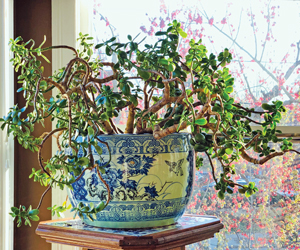
My all-time favorite potted succulent is a decades-old jade plant that has withstood a couple of moves, neglect, and schlepping to church and other places when a specimen’s been needed. It even survived our most recent move with a maladjusted cat who decided its sandy soil was preferable to his kitty litter box for relieving himself. After discovering this assault on my venerable jade, I intervened and nursed it back to health. And it managed to regain its vitality and spread to 40 inches wide. These plants are tough.
I even had large potted bottle/ponytail palm (beaucarnea) for years that lived outdoors in summer and in the dark and cold (but not freezing) garage in winter. This is one of the varieties of succulents that sports a bulbous lower trunk for storing water, and we didn’t water it all winter. In keeping with our family tradition of sharing plants, my son Reid now enjoys it in his sunroom in Mathews County in the winter and on his screened porch in summer.
Until recently, the potted succulents seen most often in Lynchburg were typically passed in families or friend to friend, usually through cuttings. Reid and one of our daughters-in-law, Leisa, are now growing jade plants from cuttings from the mother plant (that’s also been passed around in the family). With the widespread rise in popularity of interesting varieties new to us, succulents are now more frequently purchased through nurseries, florists, and big box and grocery stores (and even pharmacies).
In addition to those already mentioned, popular varieties historically have been kalanchoe, euphorbia, bromeliads, Christmas cactus, aloe vera, agave, and snake plant (sansevieria). In years past, indoor succulent collections typically started with a little aloe vera at the ready for treating burns or a tough snake plant, with other varieties added over time. Today, a wide array of tiny succulents sporting fascinating shapes and showy blooms seem to be everywhere.
 Care and Crafts
Since most succulents are not cold-hearty, they’re enjoyed as annuals for only one season if planted in the garden. But if planted in pots for outdoor display in summer and moved indoors for protection during winter, they can be enjoyed for years. As potted houseplants, succulents require little maintenance and don’t demand fertilizing or regular repotting.
When planting succulents in the garden, it’s important to remember that they need good drainage, or roots will rot and they will die. Our native compacted red clay doesn’t cut it for most succulents. We must amend the soil to give them a mixture containing sand or gravel or tuck them into stone walls or other places where their roots will not sit in soggy soil.
Most potted succulents need watering only every few weeks or less frequently. You can even take an extended vacation without a plant sitter and they’ll survive. Succulents are the ticket for those of us who choose to wean ourselves away from drama queens, whether in friendships or flowers.
While many succulents require bright light, too much direct sunlight can result in color change. Some green succulents tend to take on red tones (called “blushing”), especially along the edges, if light is intense. Bright light, but not direct sunlight, is best for many, yet some (like snake plant) thrive in low light, so it’s important to learn and follow the individual preferences of each variety.
One of the amazing qualities of succulents is easy propagation. The most common way to propagate is through a cutting, which is simply a several-inch piece of cut stem with leaves. It’s left for a week or so to “cure” and produce a callus, then placed in a growing medium such as sandy soil—and roots most likely will grow. This is the method I use for sharing my jade. Another method is division, which requires uprooting an overgrown clump, easing roots and stems apart, and separating into several plants.
While I confess I’ve only infrequently upped my floral design game by featuring succulents in arrangements, experts confirm that they’re an excellent choice for bridal bouquets, topiaries, vertical gardens, and other uses where you need plant material that won’t quickly wilt. I do know from experience that succulent rosettes can last without a water source for days. If misted or in wet floral foam, they may last for weeks. They are excellent for crafting and can even be attached with glue for decorating packages, holiday ornaments, or party favors.
 Rising Stock
Succulents have in recent years captured the imagination of gardeners in Virginia and continue to gain an admiring following. They are versatile and require so little care that it’s no wonder they are such a hit. I lunched recently at Amuse at the Virginia Museum of Fine Arts in Richmond, and tiny potted arrangements of succulents graced all the tables. They charmed us, and we overheard other patrons compliment them, noting how well they work with mid-century modern décor. And how sensible for a restaurant to have live plant material on tables that doesn’t require daily refreshing!
Succulents even have their own fan clubs. The Cactus and Succulent Society of America (CSSA, cssainc.org) founded in 1929, includes over 80 affiliated clubs and thousands of members worldwide. The primary purpose of the society is “to enjoy succulent plants through horticulture, travel and scientific discovery, with a concern for habitat preservation and conservation issues in deserts worldwide.” And closer to home in Washington, D.C. is the National Capital Cactus and Succulents Society (www.washington-dc.cactus-society.org).
Contributing to the increasing popularity of succulents is their unique and intriguing appearance. They can look downright weird. Their shape can be spiraled, spiked, sword, crested, corkscrew, moon, snake-like, wavy, ridged, ribbon, knobby, paddle, plumed, or like a tongue depressor. They can look like snakes, eels, snowflakes, spider webs, pinwheels, a pile of pebbles, or a string of pearls. And that’s not all. They can be covered with protective thorns, prickles, or fluff.
Size can range from minuscule to mammoth. It’s no wonder that standing next to a huge saguaro cactus in Phoenix’s Desert Botanical Gardens, Tim and I felt downright Lilliputian.
Aloe succulents are tagged with names such as partridge breast, gold tooth, blue elf, and hercules. Other succulents boast names like pig’s ear, calico kitten, bear paws, rosary vine, silver torch, and rat tail cactus. With monikers like that, it would be impossible for a curious creature like me not to be fascinated with these amazing plants.
 Meet the Gardener
Susan Timmons served in the 1970s as Virginia’s first Environmental Impact Statement Coordinator, then Assistant Administrator and Acting Administrator of Virginia’s Council on the Environment and editor of The State of Virginia’s Environment. During that time she also served on the Board of Directors of the National Association of Environmental Professionals and received the National Wildlife Federation’s Award for Environmental Communications. More recently, she worked in higher education and nonprofit management and, in retirement, she serves as a member of the Speakers Bureau of the Hill City Master Gardeners Association with a series of talks on “Gardens of the World.”
Lynchburg Living writer Charlotte Farley sat down for an exclusive interview with Steele Marcoux (style director at Country Living and former editor-in-chief at Coastal Living) and Meg Braff (Long Island-based interior designer) when they were in town for Design on Stage, presented by the Academy of Center of the Arts. Charlotte, Steele, and Meg discussed the best ways to refresh your space. They talked everything from how to use trendy colors to imbuing your space with personality and timelessness—and according to Steele, farmhouse isn’t going anywhere yet.
 Summer is a time to slow down and savor. From taking long-awaited (and much-needed) vacations to trying out new summer cocktail recipes, we look for ways to relax and refresh ourselves in the summertime. Before you settle down with a glass of lemonade and a Pinterest marathon, see what renowned designer Meg Braff and style director Steele Marcoux have to say about revitalizing your home (and yourself) this summer.
Incorporate Trends Without Going Overboard
From chintz to farmhouse, there’s a kind of design that speaks to you, and it can be tempting to go a bit, shall we say, overboard on trends. After all, you want your home to look like it belongs to you and not Mrs. Everybody Fixer Farmhouse, so how can you incorporate a trend (such as the ubiquitous but enduring) farmhouse look or millennial pink and make sure your home doesn’t look stuck in 2018?
Steele explains that she looks to trends for color inspiration. “I was just at market in New York and saw a lot of yellow, so maybe I’ll bring in a yellow pillow or accessory to freshen things up because I don’t currently own a single yellow thing. But I’m not going to go full tilt with (something like) lemon patterns everywhere,” she points out.
According to Meg, one great way to adapt to trends is to look to professional designers that you admire and take cues from them. “If you have a monochromatic living room and lavender happens to be the color du jour, you could have a pair of lavender lamps, or add some artwork with some lavender in it, or even just a cashmere throw on your sofa. It kind of takes you in a different direction.” That’s one advantage of having a very neutral, monochromatic house, she says: you can always play around with your décor and palette.
Approach trends with small changes, just as you would with your fashion. Meg says, “if there’s some great new wedge heel out, you might buy a pair and find that it updates the rest of your outfits, and that’s the same with interior style.”
Earthy is Always in Style
 By adding a few small touches, you can enliven your space without taking on the task and investment of a major overhaul. The experts agree that fresh flowers and plants can add a great impact for little effort. “Bring in flowers! Anyone can go to the grocery store and pick up a seasonal bouquet,” says Steele.
Meg points out that ferns last for a long time and don’t require a lot of fuss. “I have ferns all winter in my house. I bring the outdoors in to keep it feeling fresh,” she explains. Following that train of thought, don’t be afraid of using other earthy elements throughout the year to speak to the season.
Look in Unexpected Places for Insight
Something Steele always tries to channel is the mantra of returning to the things you’ve always loved. For example, she loves china. “I love tabletop, and sometimes I feel like things need a refresh, so I’ll go back and look at china patterns that I love and pull a color from there. Because that’s something that I’ve always loved, I can find inspiration there.”
Of course, it’s ok if china isn’t your thing—but it’s a good idea to figure out what is. “If you have things you collect, or a rug that you love, or if you love art—go look towards that for a new idea,” Steele suggests.
Also, look at your wardrobe—what color do you see repeated throughout? Do you have more polka dot dresses than you have places to where them? Is there a certain pattern or fabric that you keep reaching for? You can always go and evaluate your closet for insight and ideas.
Reorganize to Achieve Elegance and Relaxation in One Space
The phrase “timeless style” refers to a style that, like a true lady, never reveals its age. “Timeless style” weds elegance and panache into one relevant space. Sounds lovely, doesn’t it? So how can you breathe new life into your space for a look that’s both timeless and of-the-moment?
If you have a collection of some kind (and most of us do), consider how you have it displayed. Is everything simply stacked together on a shelf, or is it a truly eye-catching arrangement?
Try exhibiting your otherwise traditional collection in a way that’s a bit more modern.
Meg believes that—along with a blue and white palette—items made from organic materials never go out of vogue. A beautiful farm table with a rich patina, an intriguing grouping of stoneware—these are enduring elements of style, as are mainstays like paintings that portray scenes from nature (such as landscapes) or artwork sculpted from natural materials. “People look to country living or beach living as aspirational, in a sense that those are relaxed environments,” she explains. As time goes on, modern living, even with all of its amenities, has more of us yearning for something simpler, so when we see reminders of those places, we, in turn, establish a more relaxed setting in our homes.
Not everything has to be Whole Foods–organic, of course. Everything from antiques to modern sofas can look timeless—the trick is all in how you look at it, literally. Juxtaposing a piece of fine furniture against a piece of modern art or layering textures creates visual interest. Steele refers to Meg, the master of mixing textures: “Some of her greatest spaces have really beautiful antiques—with a jute rug. That just takes the edge off of everything.”
 Figure Out What Makes You Happy
It doesn’t matter what time of year it is—we all want to come home and unwind at day’s end. The summer, with its bounty of daylight, begs us to linger a bit longer over cold drinks and conversation, so it’s the prime time to create a great space at home to do just that.
According to Steele, creating the right surrounding for yourself can really affect your mood, and Meg agrees that the right arrangements can help make you feel rested as well as more productive. She believes that figuring out who you are and what you need to feel fulfilled to start your day is so important.
To guide your direction, ask yourself what you want to see when you wake up in the morning: Do you like a lot of spare space or do you want to have all the things that you love around you? Do you want a room that’s completely monochromatic, or do you prefer contrasting colors?
“Start with the core of what makes you happy and build it out from there. You can start with visuals, and you can find that in a magazine,” says Meg.
Steele strongly suggests that you study a space that draws you in. “Ask yourself—what is it about this room? Study it.
Is it the color? The furniture? The level of accessorization?”
Having a space that’s well-organized and tidy is the best starting point, of course—getting rid of messes and visual clutter has an instant and calming effect. After that, Meg advises that we should be mindful about what new items we’re bringing in. “Most of us don’t live in such enormous places where you have a space for everything. You have to be selective and think about your choices.”
The next step: make sure you have warmth and personality—which Meg describes as bringing in a variety of textures and items. “Have a good balance of things you love and things that are functional, things that are upholstered and things that aren’t, and you’ll achieve balance. Finding balance is important,” Meg says. “Stay true to what you love and what feels good to you, and what you feel best represents you.
Give Yourself Plenty Of Time
It’s so tempting to want to have your house done pronto, especially if you’ve spent time poring over loads of images for inspiration. Just remember that you’re not on a deadline for having your home “done.”
Steele advises all of us to slow down. “That was advice that a really good friend of ours gave me when I bought my first house. She said, ‘Just go slow. Add a piece here or a piece there and have the confidence to go slow’.”
Meg agrees: “You don’t have to have it done! I’m still doing my house, and in theory, I moved in 18 months ago. I mean, I’m still doing my dining room. I can’t figure out my dining room!” she laughs. “It does take confidence to feel like, ‘oh, my friends are coming over, and I’m having a dinner party, and my dining room isn’t done.’ We’re all a work in progress, and the house is a work in progress, too.”
The moral of the story here: don’t forgo having people over just because things aren’t photo-ready.
Steele laughs, admitting that’s the mistake she makes. “I won’t have anyone over because I don’t have curtains in my dining room—and no one cares whether there are curtains up or there or not!” she laughs.
So, this summer, maybe you’ll get around to hanging those curtains up, or changing them out, or taking them down altogether. Take your time to enjoy freshening things up, enjoying the process, and doing what you need to do in order to make your home feel lighter, fresher, and more you.
This is part two of a two-part series on garden design. Be sure to check out Susan’s part one from our March/April issue, “Garden Design: Making It Your Own”.
Environmental sustainability matters to millennials. It ranks among their top three most important issues, along with college affordability and health care, according to a recent survey by Virginia21, a millennial advocacy organization. Millennials’ passion for environmental quality is fueling the flames of political advocacy and informing thoughtful personal choices.
This news sparks flashbacks of my own fervor for environmental advocacy at their age when I was employed as Virginia’s first Environmental Impact Statement Coordinator in the early 1970s. Passing the torch to millennials makes my heart sing and gives us all hope for the future of this earth.
Contemporary approaches to gardening reflect the values of environmental champions of all generations. And enhanced awareness and commitment to sustainability translates into garden design and plant material selection that favor sustainability over adherence to historical design norms.
 At Home with Nature
What gives us greater joy in spring than a flowering dogwood announcing the end of winter? What better shades us from intense summer sun than a majestic white oak tree? These and a multitude of other native plants are a large part of what we love about living in Central Virginia. And they are the environmentally sustainable choice for our gardens.
I’ve touted native plant guru Dr. Douglas Tallamy and his book, Bringing Nature Home, in several previous issues of Lynchburg Living. Another valuable resource is a new book by Repp Glaettli, Piedmont Native Plants: A Guide for Landscapes and Gardens, reminding us of the aesthetic beauty of local native plants, supporting nurseries in stocking the best varieties, and cultivating deeper understanding of the cultural and natural heritage of native plants in nearby counties of our shared Piedmont region. It also offers practical tips for best growing practices and catalogues native trees, shrubs, vines, grasses, and perennial wildflowers.
First and foremost, contemporary sustainable garden design relies on the right plants for the right locations, accounting for site conditions: size, climate, soil, water, nutrition, and other plant needs. Native plants in the right place require little soil amendment, watering (once established), nutritional supplements, and human pampering. After all, since they’re in their native habitat, they demand no extra fuss.
I fell in love with one native plant at a time and added it to my yard. Then when rose rosette disease claimed dozens of my antique roses and I knew that I could not replant with roses, I chose natives to replace them and never looked back. I was committed to bringing nature home.
Pollinator Power
When I climbed the pasture fence at our farm to retrieve what I’d assumed was a piece of trash that looked suspiciously like a plastic Cheetos bag, I was immediately infatuated with an amazing orange blooming plant covered with monarchs and great spangled frittilaries. Googling it, I discovered it was aptly named butterfly weed, and I couldn’t resist digging it up for my yard. And… voila! I launched my commitment to creating a pollinator garden.
Most of my “starter” native/pollinator plants for my yard and garden came from our farm pastures, woods, and (I confess) even roadside ditches before natives started catching on with local nurseries in response to popular demand. For city folks, stock from country cousins, friends, or nurseries is a better choice than digging from property you don’t own. However, harvesting and transplanting roadside milkweed into a pollinator garden for monarch caterpillar sustenance seems a more noble act than leaving it for inevitable VDOT spraying or mowing.
Natives that attract pollinators, such as Joe Pye weed, coneflower, mountain mint, monarda, and summer phlox, can vigorously populate or happily co-exist with exotic cultivars in lush English-style borders and can vibrantly complete the formal design of a classical Italian garden or a French-style parterre, if that’s your preference and you’re not about to start over with your garden design. They also work well in modern, minimalist gardens; and hybrid designs are just fine.
They’re actually more interesting and contemporary.
Fun garden ideas that have been enjoyed for decades and are gaining increasing popularity are wildflower meadows sporting a mixture of pollinator-attracting flowers and native grasses, as well as woodlands gardens. They typically require a fairly expansive open or wooded area, although “mini-meadows” or tiny wooded areas in city backyards for wildflowers such as native large-flowered trillium can work well too.
The point of pollinator gardens is, of course, to attract and support a wide variety of birds, bees, butterflies, and insects, many of which require specific native plants for nourishment at various stages of their life cycle, with the classic example of milkweed for monarch caterpillars. It’s important for all of us, millennials and older folks, to understand that these host plants and the pollinators they support are critical to the biodiversity necessary for a healthy ecosystem.
 Managing Water
A concept that’s turned into a viable alternative garden design and has gained traction in recent years is rain gardens. Rain gardens are basically an effectively engineered way to deal with areas where rain collects or that flood periodically from run-off from impervious surfaces such as buildings, roads and walkways. They are depressions in the landscape that gather water but eventually drain. What they’re NOT is swamp land, ponds, water gardens, or other land that remains wet or under water as a usual thing.
Plants that work in rain gardens can survive periodically standing in water, followed by dry spells. We have a prime example of a well-designed rain garden here in Lynchburg’s downtown Riverfront park. The area is subject to runoff from our city that rises on the bluffs above it. You’ll notice the garden is designed with trenching, sunken beds, and bridges leading to the adjacent performance area.
The garden’s been scientifically engineered with layers of rocks and other devices so water can drain slowly, removing pollutants, and be absorbed back into the earth rather than running directly into the James River. Rain gardens are an environmentally sound method of dealing with city storm water run-off, water conservation, and river water quality. Planted with site-appropriate plants, they are a beautiful, as well as functional, solution to environmental degradation from soil erosion and river pollution.
If the idea of hiring professionals to design a backyard rain garden seems too grand or expensive, but you have issues with rainwater runoff from your roof, driveway, or other impermeable surfaces, you can simplify matters with a Do-It-Yourself version, as I did. My roof drainage problem resulted in a mud hole at my basement door after every heavy or prolonged rain. With steep slopes rising from this door on both sides to downspouts at the corners of the first floor of the house, water inevitably cascaded downhill, taking soil with it, to… guess where! What to do?
First, I hauled in rocks and pavers and hand-built dry stack stone walls and a stepping stone path over permeable garden fabric to the door. (When my husband Tim calls me his “Rockette,” it’s definitely not because I’m a long-legged NYC dancer!) I then angled out terraced slopes behind the walls and added large rocks for soil retention. Next, I affixed one end of 15-20 ft. PVC pipes to each downspout to run the water out from the house, and planted small trees, shrubs, and perennials that could handle periodic flooding. I camouflaged the pipes with rocks and polished the terraces off with mulch. And, miraculously, it worked! I didn’t even know my home-grown concoction was a variation on a garden design with the official name of “rain garden.”
Water gardens, on the other hand, are just that: pools, streams, waterfalls, fountains, and other water features. As we’ve seen from looking at the history of gardens through time, water features with wonderful water plants have been integral to gardens for centuries, and they can be incorporated into indoor or outdoor spaces. They have never faded in popularity, and likely never will.
While sunken gardens offer the option of flooding and deep watering through slow absorption (and are typically more necessary and likely in arid climates), our area is more likely to embrace raised gardens that promote speedy drainage. They also serve the function of providing elderly or mobility-challenged gardeners the ability to enjoy gardening at a comfortable height, thereby meeting physical, medical, psychological, and spiritual needs.
 Designs Turn Sideways, Up, and Down
When space is limited, or even if not, sometimes a small, simplified pocket, porch, patio, courtyard, or even alleyway garden is preferred. These tiny gardens can be exquisite, lovely, inviting, and a pleasure to their creators and guests.
Vertical gardens are enjoying a resurgence with a return to inner-city living, smaller home lots, condos, and other close living quarters where garden space is likely to be curtailed or non-existent, as well as in hotels, commercial offices and restaurants. Whenever I see a successful one, I find myself searching for the source of water and soil or other medium for nutrient delivery necessary for plant life. And I typically find a well-engineered structure that serves as a framework to hold individual plants and an irrigation system. I’m intrigued, but this isn’t something I plan to do at home. My engineering skills were pretty much tapped out with my “rain garden” project.
Espaliered (mid-17th century French from Latin) plants are trained to grow flat against a wall. While this age-old method historically was used for fruit trees and ornamental shrubs, its popularity has expanded in modern times to include any plant material, native or exotic, that can be trained in this fashion, such as magnolia, Lady Banks roses, and pyracantha. Lattice and similar framework are traditional supports for espaliered fruit and other types of trees, but permanently installed hooks with wires and other modern engineering options are available to carry higher and heavier loads.
Tower Gardens, made possible by modern technology, are a contemporary idea. One example is the hands-on tower garden project of the Princess Anne Garden Club in Virginia Beach that’s instilling a love of gardening while teaching environmental sustainability to the generation following Millennials (pre-K – 12th grade) in three public schools. The towers are 6’ x 4’ with slots for 28 plants, with herbs, vegetables and flowers grown in each cell, without soil; and each tower sits on a 20-gallon basin of nutrient rich water that supports the plant material. And they’re on wheels for easy movement.
This 21st century growing method is called aeroponic, with the root system aerated through misting with a nutrient-rich spray. It’s a first cousin to hydroponic growing methods that have been around a long time and which use a liquid nutrient solution for root immersion. I got my first glimpse of how efficient and effective this process can be on a behind-the-scenes tour at Disney World about 15 years ago. Thousands upon thousands of plants on high conveyer belts were producing abundantly to feed throngs of visitors. Will aeroponics and hydroponics, already used extensively in China, be the next “big thing” in the U.S. to address both environmental and economic issues in food production and home gardening?
Understated Elegance
In addition to prioritizing environmental concerns, contemporary garden design also reflects artistic and aesthetic values, which currently lean toward asymmetrical, angular, and pared down to essential elements tied together by hardscaping in a unified architectural sensibility. Current U.S. taste tends to draw more heavily on the Japanese Zen tradition than more elaborate and symmetrical layouts.
A “less is more” philosophy guides today’s design.
Hardscaping often creates the “garden bones” in contemporary designs that yews, boxwoods, and other workhorse plants provide in traditional gardens. Natural materials such as stone and slate continue in popularity, and manmade materials, including pavers that offer permeability, have come a long way aesthetically as well as functionally. With low maintenance as a goal, these gardens may have self-watering planters, be all green, or feature repeat patterns of only one plant, such as an interesting native grass. Or they may include several varieties planted in repetition for contrast.
Visual interest is on many different levels even in these sleek designs and may include vertical plantings on privacy or partition walls. A focal point is always necessary, and several focal points can be effective if judiciously placed. Good lighting is essential for a dramatic spotlight on prized features, as well as for safety on pathways and near potential hazards, such as pools and ponds.
As my millennial grandchildren would say about contemporary gardens, “This is not our grandmother’s garden!” This grandmother freely admits sentimental attachment to the design of her old-fashioned country cottage garden with organically shaped English borders overflowing with a lush jumble of hundreds of exotic and native plant species.
Yet, I also respect and am strongly drawn to the elegant, serene beauty of refined minimalist and other Zen-like contemporary concepts. These fit the millennials’ mindset to shed the shackles of traditional concepts of political partisan tribalism or strict precepts of traditional garden design they perceive as inconsistent with their values and priorities.
I get it. After all, I’m already a kindred spirit with millennials in their desire to sustain our environment.
Inspiration Through History and Culture
WORDS & PHOTOS BY SUSAN TIMMONS
As economics and culture go, so go gardens. Gardens inevitably reflect their time and place in history. From subsistence gardens that give sustenance for survival to glorious, grand-scale pleasure gardens that flaunt wealth and power, garden and landscape designs run the gamut.
Our ornamental gardens in Lynchburg typically fall comfortably between these two extremes. They have been greatly influenced by those that came before us yet are uniquely American both in design and plant material.
Setting the Standard
Let’s take a sweep through time to see how gardens evolved throughout Western civilization and consider what that means to us when we design our own garden. A good starting point is late 15th century Renaissance Italy, which boasted gardens prized for their design, elegance, and political and social message to complement villas of the ecclesiastic and secular wealthy around Rome and Florence. As the Renaissance progressed, villas and their companion gardens became increasingly larger and more elaborate, reflecting classical ideals of proportion, formal order and symmetry, architecture and literature, and the desire to impress.
Prime examples are the Medici’s Boboli gardens at the Pitti Palace in Florence, the Vatican gardens in Rome, and the magnificent 16th century High Renaissance Villa d’Este at Tivoli. The latter boasts a magnificent terraced garden featuring elaborate water courses, pools, fountains (including a water organ), a grotto, and delightful visual surprises at every turn. This garden exemplifies the typical Italian design of a central axis with cross axes leading the eye to focal points, terraces on the side of a steep hill affording spectacular vistas, and adornment with classical and mythical statuary. These and similar, albeit often less elaborate, gardens throughout Italy set the bar for ideal garden design for the Western world.
This basic standard for gardens was adapted in many ways as it spread eastward across the northern shores of the Mediterranean into France and Spain, where steep shorelines meant it took great effort to move the earth and chisel terraces out of high cliffs. Another challenge was to engineer increasingly clever ways to channel waters by advancing knowledge gained from the construction of Roman aqueducts. The reward was lush gardens with exotic plant material and spectacular views of the sparkling blue Mediterranean.
The formal Italian garden was climatically and culturally tailored and embellished through Renaissance France, with Versailles as an extreme example of the trophy garden to display worldly wealth and status. And the French took the idea of conquering and controlling nature to its utmost extreme with fantastic forms of precision topiary, elaborate open and closed parterres, dramatic water features, and endless sculptural and other ornamentation.
Then, of course, the English would not be outdone by the French, so formal Italian- and French-style gardens became the rage there too, and many still today accompany palaces and great country manor houses, such as those in the Cotswold Hills. At Blenheim Palace, birthplace of Winston Churchill, the formal Italian garden is nestled closest to the palace (for exclusive use of the residential Marlborough family and their guests), while the French, via Italian, influence is obvious in the terraced water features and classical sculptures that are open to the public.
The Focus Shifts
Then, in the 18th Century, along came the most famous English landscape designer, Lancelot “Capability” Brown, who transformed the concept of gardens into a more relaxed design in tune with the natural landscape. He designed 170 or so parks and numerous estate gardens with a departure from classical formal symmetry and a celebration of the countryside beyond. His goal was to create gardens that looked as if they were nature’s own creation. But they only seemed so.
He, in fact, moved hills, created lakes, naturalized waterfalls, and strategically planted clumps of trees (a design feature adopted by Thomas Jefferson for Poplar Forest) to look as if they were there all along. Looking past the formal gardens at Blenheim Palace out toward the countryside is a showcase of “Capability” Brown’s brilliant artistry in nature. Thus was born “The English Landscape Style” that to this day influences our gardening here in Virginia.
Another significant shift that changed gardens and garden design forever resulted from the Industrial Revolution. Tools were developed, such as the lawnmower, to make cost and workload of planting and maintaining lawns and gardens manageable for middle class folks who couldn’t afford teams of hired gardeners. With new building materials and engineering skills, “glass houses” at London’s public Kew Gardens were constructed to shelter tropical and temperate plants from around the world for viewing by the general population. An appetite for gardening was, of course, whetted.
When Thomas Jefferson traveled in Europe, he embraced worldwide plant exchange. His fascination with plants and gardens compelled him to bring numerous exotic species of plants to America, and many have grown in popularity through the years.
As the middle class proliferated, well-designed public gardens grew in number and educational value. Love of gardening and interest in garden design was no longer the exclusive privilege of the rich and powerful. Gardening today in England and the U.S., and indeed around the world, has become one of the most popular hobbies and is accessible to almost everyone.
New Styles and Honored Traditions
English garden design further evolved through concepts developed by Gertrude Jykll (1843-1932), horticulturalist, garden designer, writer, and artist, who thoroughly understood plants, color theory, and other principles of art—line, form, structure, color. To her a garden was a blank canvas to which she could translate her knowledge into brilliant, artistic garden designs. Her robust combinations of color created exuberant flower borders that bloomed profusely in sequence as the gardening season progressed, and her aesthetic strategies and motifs have greatly influenced U.S. gardeners, including myself.
Vita Sackville-West, 20th century novelist and designer of the famous Sissinghurst Castle garden, masterfully embraced the concept of individual “garden rooms” with windows and doors in walls and yew hedges linking a multitude of rooms—each with a unique purpose, design, and character. Some of her other concepts expressed at Sissinghurst were mown grass paths, one-color gardens, and roses on brick walls (as we see in our Old City Cemetery). Another notable artistic English gardener was Rosemary Verey, who, according to a eulogy after her death in 2001, “brought the art of clipped boxwoods, laburnum walks and ornamental vegetable gardening to America.”
We in the U.S. continue to be greatly influenced by English garden designers/writers/lecturers, including modern-day experts Penelope Hobhouse (who designed many gardens in the U.S. as well as England), Mary Keen (who visited and spoke in Lynchburg last year), and Heidi Howcroft (who has also visited Lynchburg). The list of English garden gurus could go on and on. Most have taken historic concepts, refined them, created their own oeuvre, and taken our U.S. gardens to the next level. And we in Lynchburg listen to what they have to say.
As for U.S. garden designers, we already know that Thomas Jefferson, informed by his European travels, set the bar; and we must not forget landscape and garden architect/designer Charles Gillette, who in the first half of the 20th century so aptly created landscapes to pair with Colonial Revival architecture, most notably in Richmond, and earned fame as being the father of what’s known as the “Virginia Garden.”
Since our heritage continues to be of such value to us in Virginia, we revere Rudy Favretti, noted horticulturalist and designer of garden preservation and restoration projects, to complement historic sites, and William D. Rieley, landscape designer in Charlottesville, who works with the Garden Club of Virginia and serves as consultant for ongoing garden archaeological research at Poplar Forest to “honor the past while looking toward the future.”
Other Influences
As important as the evolution of garden design through Western civilization may be to us, it’s not the whole story. Let’s journey east from Italy, where West meets East, and consider that European gardens adopted many design motifs (as well as plants, such as the rose) from the East. Mogul gardens of Northern India were created with Muslim, Buddhist, Persian, Christian, and even Mesopotamian influences. These, like Italian gardens, adhere to principles of formal symmetry. They follow strict geometric and symbolic guidelines and proudly rely on mastering the flow of water, essential to exotic plant survival—a common denominator for all successful garden designs.
Far Eastern garden design also developed over a couple of thousand years. Rather than relying on formal symmetry, famous and elegant Chinese gardens, such as the Lingering Garden in Suzhou, create an entire landscape of rocks, water, plants, pagodas, and pavilions artfully compressed in a relatively small space. Every stone, structure, and horticulture specimen holds scholarly or spiritual significance. According to UNESCO, this and other gardens of Suzhou are the “most refined form” of the art of garden design.
Japanese gardens have certainly made their mark on the Western world. They, like Chinese gardens, can typify complex landscapes, but with cultural variations in their carefully-placed rocks, streams, meticulously pruned trees, and raked sand/soil—designed to stimulate intellectual and spiritual contemplation. Or they may be Zen minimalist, simple, and unadorned to invite meditation and serenity.
The most recent trends to influence our garden design are an outgrowth of environmental concerns. The Native Plant Movement, embracing the critical role of pollinators for bio-diversity and healthy ecosystems, has benefited from substantiation by scientific research translated into lay terms, most notably by Professor Doug Tallamy of the University of Delaware. Understanding native plants and their value in home gardens is further changing the way we design our gardens to focus more on open, loose, and natural looks rather than closed, contrived, and exotic ones.
Designing YOUR Garden
I’ve been fortunate to experience guided tours of iconic gardens all over the world to inspire my vision for my own garden and make informed decisions on what would work for me in translating aspects of gardens from various cultures, and from grand scale to a smaller, simplified, more “human” scale. But if garden travel isn’t in your future, you can easily Google and read to help you sort through garden designs—historic and current trends.
What appeals to you? What’s your vision? And what will work for you? This is the starting point for any garden design.
To help answer these questions, consider your values, goals, desires, lifestyle, and personal preferences. Are you looking for material or spiritual rewards from your garden? Your ideal garden may be an elegantly designed showplace, or you may prefer as simple a setting as possible to grow your favorite flowers. It may be a retreat for private enjoyment of the senses of sight and sound or to soothe your soul. Or you may be looking for an attractive outdoor extension of your home as a garden room (or rooms) for dining, entertaining, relaxing, or playing.
Are you more of a scientist or an artist? You may be focused on growing, propagating, and sharing interesting and healthy plants or more interested in creative, eye-catching arrangements of color, shape, and form. Or you may want it all with a combination of these attributes. It’s not necessarily one or the other. But it is a matter of knowing yourself. It’s up to you to decide.
If all this is confusing or if you need help with your design, there are excellent professional landscapers and garden designers in our area to offer guidance and assistance. Although most of my gardening has been DIY (see my “DIY Garden Design in 8 Steps” on the following pages), I’ve sought help for specific design and planting challenges at times—both Rosser Landscaping & Design LLC and Rainfrost Nursery have offered excellent suggestions as well as quality plant material and workmanship. And don’t forget that the Hill City Master Gardener Association offers the free services of Master Gardeners to come to your home and offer advice.
You may choose to develop a grand garden scheme or master plan before lifting your first shovel full of soil, or you may let your garden design evolve over time, as mine did, by focusing on one challenge or section of your land at a time. Again, there’s no right or wrong way for home gardens. It’s your garden. Within constraints of law and a reasonable nod toward community cohesion, express yourself and do it YOUR way!
Meet the Gardener
Susan Timmons served in the 1970s as Virginia’s first Environmental Impact Statement Coordinator, then Assistant Administrator and Acting Administrator of Virginia’s Council on the Environment and editor of The State of Virginia’s Environment. During that time she also served on the Board of Directors of the National Association of Environmental Professionals and received the National Wildlife Federation’s Award for Environmental Communications. More recently, she worked in higher education and nonprofit management and, in retirement, she serves as a member of the Speakers Bureau of the Hill City Master Gardeners Association with a series of talks on “Gardens of the World.”
Dig Deeper
www.rosserlandscaping.com
www.rainfrostnursery.com
www.hcmga.com
Driven by visions of sunny afternoons and backyard barbecues, we spend the spring preparing our homes for the warmer weather by sweeping off the porch, shopping for new patio furniture, and filling planters for the deck. This is an annual weekend ritual for many of us, but we tend to leave out one important component of our homes’ exteriors: the front door.
In…or Out?
When you’re in the throes of spring cleaning, evaluate your entryway and determine if the door is in good condition. Examine the bottom corners of wooden doors for rot or dents and look for rust on metal doors. Edward Coleman, owner of Anything Doors, points out that doors rot at the bottom corners where the threshold and doorjamb meet. “The only way to really fix it is to take the whole thing out and reframe it—you can try to patch it, but it’s like putting a band aid on the situation,” he explains.
Did you determine that your door needs replacing? Don’t just run out and buy any old exterior door—take advantage of the chance to change or add some style. Coleman notes that Chippendale doors are very popular in the Lynchburg area—in particular, the Williamsburg and the Monticello designs (see Cindy Greer’s great Chippendale door on page 21), according to Michael Pearl of Bailey Spencer Hardware. Pam Smith from Sentry Exteriors adds that many customers are coming in with requests for Craftsman-style wooden doors.
Also, don’t forget to look at your storm door. Is there a quick repair you can make that you just haven’t gotten around to yet? Now’s the time! Maybe it’s in good shape, but it needs some cleaning. If it’s rusted, broken, or otherwise taking away from the appeal of your entryway, you can replace it or just remove it. Storm doors are optional and totally a matter of personal preference.
Add Some Color
If you aren’t in the market for a new front door, but you recognize that yours could look lovelier than it does right now, why not make it a new color? Do not feel like you have to paint your front door to match your shutters. While that makes for a cohesive appearance,
it’s not a design necessity.
Check out these charming color combinations:
• Black shutters with a red door
• Brown shutters with an aqua door
• Navy shutters with an orange door
• Wooden shutters with a gray door
• White shutters and a green door
Smith notes that, surprisingly, yellow doors have become more popular recently. “It looks so pretty on a brick house especially—that or Tiffany blue—but you really have to love it,” she says. She suggests a dark stain on wood doors for a rustic look; if you’re interested in painting your door, Smith always recommends black. “It looks classic, timeless, and makes everything look clean and fresh—and your wreaths will pop!” she says.
If you go with a dark color for your door, be sure that the entryway has some sort of awning or covering over it. Coleman likes to remind homeowners that “if you paint your doors a dark color, it won’t last as long because the sun beats down on them, and if you have a storm door on top of a dark color, you’re just baking the door.” Not only will the paint inevitably fade and peel faster, but the door will also age faster, develop problems sooner, and ultimately not last as long.
Hardware and Accessories
Now that you’ve decided whether to keep, paint, or replace your door, consider updating your door’s hardware. After all, hardware can be both beautiful and functional, and many designers see hardware as furniture’s jewelry. If you’ve scoured the aisles or the internet looking for the just-right drawer pulls for your kitchen, have you thought about doing the same thing for your front door?
Pearl’s store carries solid brass hardware and hinges in five different finishes. “Some people hear solid brass and only think shiny yellow, but with other finishes (as in bronze or satin nickel), they can have rust-proof hardware that can withstand the seasons of Virginia.” Whether you choose brass, brushed nickel, wrought iron, or something else entirely, make sure that your metals match. Sure, mixing metals is en vogue right now (and Rolex has been doing it forever), but the one place where the mis-match looks like a mis-take is on the front door. From doorknockers to house numbers to the actual doorknobs themselves, keep it streamlined and down to one finish.
The door is new or clean and colorful, the hardware is gleaming—you’re almost there. Add a new welcome mat and, perhaps, a wreath, and you’re finished. (At least for now—there’s all the rest of that spring cleaning you need to do!)
It’s easy to recreate any look you see in a magazine or on TV with paint—and there are plenty of blog posts out there that will teach you how to do just that, step by step. After a while, though, those looks—those trends—grow tiresome. You start seeing the same paint color, the same backsplash, and the same mirrors at all of your friends’ houses, and it all becomes ubiquitous—not personal. You might have considered stenciling a wall, but that sounds like a lot of time (and a lot of work). What will you do?
Try wallpaper.
Using the right wallpaper in strategic places is one way to set your home apart in the sea of HGTV replicas. When you approach the way you decorate your home the same way you choose clothing for yourself, you select the right color, size and pattern that looks the best to you—and looks the best in your home.
What wallpaper can do for you
“Today’s wallpaper is fresh, new and clean, and can even look like wall texture or a painted-on design,” says interior designer Moyanne Harding of Interiors by Moyanne. Sydney Stephens, wallpaper specialist at James T. Davis, agrees and says there are wallpapers available now that have the look of tile, wood—even shiplap.
“There’s been an increased demand for wallpaper over the past year, especially from the younger generation,” Stephens reports. Millennials come in frequently, requesting wall coverings in grass cloth and geometric prints such as trellises.
What advantages does modern wallpaper have over paint?
• Revamps and refreshes your space
Harding likens wallpaper to a work of fine art. “It can transform a room like nothing else in an instant,” she explains.
• Conceals
“Wallpaper is really great for covering imperfections and unevenness in the walls,” says Stephens.
• Protects
Durable heavy-duty vinyl paper can be wiped and washed off, making it perfect for a kitchen or bathroom (or house with young children).
Fear not
While peel-and-stick and pre-pasted wallpaper are still available, a more popular option is the paste-to-wall product, which is what Stephens normally recommends since it’s easier to work with. “You roll the paste on the wall like a paint and then just stick the paper to it.” She also notes that the product stays wet for a little while, so you have some time to move it around if necessary. Today’s easy-strip products are also much more user-friendly than their predecessors were, so it won’t be as painful when the time comes to re-do a room.
Best applications
• Foyers, stairwells and bedrooms will make a grand impression with the right wallpaper, says Harding. She also likes to use it in closets (such as linen closets or larger walk-in closets) for a nice surprise, and in bathrooms.
• Stephens finds it really striking in dining rooms and kitchens.
• Thinking about an accent wall? Wallpaper adds a natural focal point when used sparingly.
• You can also use it in smaller applications, like framing wallpaper as art or adding punch and visual interest to the back of shelves.
Other tips and wisdom
After you put this magazine down and type in “wallpaper ideas” into Pinterest, Stephens recommends getting in touch with a professional so you can make sure you have the right products and the right directions on how to either hang or remove wallpaper.
If you’re still on the fence about the idea, ask yourself if you want your space to go from “ok” to “wow.” Harding shares this: “I always get a chuckle when I hear a resistant client because I know I am going to push them over to the other side of loving what wallpaper can do.”