Lynchburg Restaurant Week 2022

Our 11th annual Lynchburg Restaurant Week is here to remind you that you needn’t travel far for amazing food—but you’ll still want to have your passport on hand. We are excited to introduce our new Lynchburg Restaurant Week passport program, which will allow you to eat some of the best food in Lynchburg while also giving you the chance to win an awesome prize!

Tear-out the passport card and take to any—or, ideally, all—of this year’s 14 participating restaurants. Simply enjoy a meal, get your passport punched (once per restaurant), and mail your card to us by July 8. The person with the most punches will win a weekend stay at the gorgeous 2022 Lynchburg Living Smith Mountain Lake Idea House (featured in this issue)!

In the event of a tie, a random drawing will be conducted to determine the winner. Please see the passport card for additional details.

Start planning your Lynchburg Restaurant Week (June 18-25) itinerary now by feasting your eyes on the participating restaurants’ mouthwatering menus, found in the pages ahead.


Smokin Secrets

Just in time for barbecue season, two of the region’s top pitmasters are here to help you up your game

It’s one of the oldest cooking techniques around and requires hours—if not days—of preparation, along with a sizeable amount of “trial and error” experience, to be successful.

Despite all of this, we can’t get seem to get enough of those delicious smoked meats.

“Barbecue is already something that people gravitate toward down South,” says Ken Hess, owner of County Smoak on Timberlake Road. “People are drawn to the smell of smoke and fire. It’s something in our genetics.”

Add in reality TV shows such as “BBQ Pitmasters,” the introduction of new and improved barbecue technology, and lots of time at home during a worldwide pandemic, and it feels like everyone we know is spending their weekends gathered around their backyard grill or smoker.

Hess has been mastering his barbecue technique since working as a catering chef at the Greenbrier more than two decades ago. In 2002, he participated in his first barbecue competition right here in Lynchburg. He later returned to Central Virginia to open County Smoak in 2020, and a cult following for the restaurant’s mouthwatering meats was soon to follow.

Luckily, you don’t have to have a culinary degree to get really, really good at your smokin’ skills. Marvis Trent, owner of Blue Ridge Barbecue, laughs when reminiscing about his humble beginnings many years ago.

“First thing I ever tried to smoke was chicken on a Weber grill,” he recalls. “And it was awful, absolutely awful.”

Trent, who has been a part of the local restaurant industry since 1976, also recalls a failed attempt to add a barbecue menu at Cattle Annie’s when it first opened.
“We thought if we had the equipment, that’s all we would need,” he explains. “The right equipment helps, but knowing about rubs and cook time… there is a lot of trial and error.”

Trent took his passion for barbecue to his own backyard—where there was less pressure—slowly improved his end result, and opened his own business that’s become a local favorite, Blue Ridge Barbecue, in 2010. They have expanded to two locations: one on Timberlake Road and another in the Graves Mill Shopping Center.

While they are experts now, these two men know what it’s like to be at the beginning—and they also know the pang of disappointment you might feel when you take a bite of your 48-hour project and it’s just not quite what you wanted.

Read on for their insight and advice as we kick off grill and smoker season.

You’ve gotta know how to use it.

First things first: we want to speak directly to the folks who are in the market for a new grill or smoker. There are so many different types of products on the market—and a limited number of pages in this magazine.

Hess is a big advocate of ceramic cookers, such as The Big Green Egg, for their versatility. (He actually owns six of them and admits that “it’s a bit of a problem.”)
Trent adds that right now, Oklahoma Joe’s products—a brand of offset smokers and grills—are having a moment. There are also pellet grills, cabinet or vertical smokers—the list goes on and on.

But here’s the thing: it’s not about which type of grill or smoker you have or how much money it cost you, but rather whether you know how to use it.

“The general backyard enthusiast can go to Lowe’s and walk away with something for $150 using wood or charcoal and come exactly in line with what they would find in any barbecue restaurant,” Trent says.

Hess adds, “Whenever someone asks me which kind of grill or smoker to buy, I always ask them three questions: what’s your budget, how much involvement do you want, and how much room do you have?”

Answer these questions, talk to your friends about their experiences, and know that you can be a successful smoker—if you put in the effort.

Splurge on a really good thermometer (or two).

A thermometer is the one piece of barbecue equipment that is non-negotiable.

“Most cookers now, whether it’s a propane cooker or charcoal, have pretty decent temperature gauges. But there is no such thing as too many thermometer probes,” Trent says.

Hess adds, “Thermometers are the key because a lot of times people are like ‘it’s been cooking for 12 hours, it’s got to be done,’ but each pork butt is different. We have a target for 203-210 degrees for our pork butts, but sometimes it could be 212 degrees before it’s ready.”

Hess uses Thermapens at his restaurant and at home. You can even find thermometers and smokers with Bluetooth capability so you can check the temperature of the meat from your phone any time, anywhere.

Timing really is everything.

We could also title this section: “Get used to counting backwards.”

Let’s say you have a big family dinner set for Saturday at 6:00 p.m. Hess says you should plan to pull out your meat by 3:00 p.m.

“Give the meat plenty of time to rest and let the juices redistribute,” Hess explains. “The bigger the piece of meat, the longer you need to let it rest.”

You will also need to factor in plenty of time before cooking for seasoning. Trent has friends who start seasoning their meat days before they plan to cook.

“They want that seasoning to permeate the meat as much as possible,” he explains, adding that he brines all of his poultry at least 12 hours in advance, 24 hours if possible.

“A brine is just a salt and water solution and brown sugar or white sugar to offset the saltiness,” he adds. “It helps whatever you are cooking hold in moisture a lot better.”

Leave it alone!

Whether it’s to show off your prized piece of meat or to just “make sure” everything looks okay, you have to train yourself to stop opening the lid of your grill or smoker.

“Every time you open the lid you are letting heat out,” Trent says. “It adds at least 20 or 30 minutes to the cook time. The meat cooks better if it’s a constant temperature versus a fluctuating temperature.”

Hess agrees and says a long period of low, regulated temperature (aka “low and slow”) is truly the foundation of good barbecue.

“If you are cooking it at 250 degrees, you have to keep it at 250,” Hess says. “When we put the meats on at about 6:00 in the morning, we don’t open the smoker again until noon to check temps.”

Once you get closer to the end of the cooking time, it’s okay to check, because according to Hess, it doesn’t take long for a meat to go from undercooked to overcooked: “You have a 15- to 20-minute window to where it might jump to 220 and it’s overcooked.”

Less is always more.

From your rubs to your wood choice, there are an endless amount of choices and combinations.

Keep in mind that smoking meat was historically a very simple affair.

“I had a customer who brought me barbecue and it was moist like it should be but it felt like you were chewing on a piece of charcoal,” Trent recalls. “I asked him how many different types of wood he used, and he said he used five [different types].”

There are some complementary wood combos out there, such as oak/hickory and apple/oak, Trent explains. If you choose any more than two wood types, however, you may end up with an unintentionally unpleasant flavor.

The same rule can be applied to rubs. Start with one that you like and then experiment with combinations from there.

Hess suggests keeping a barbecue journal—including details such as seasonings, wood, length of time cooked, etc. He used to do this back when he started. If you aren’t pleased with the end result, don’t completely overhaul your technique.

“When you make changes, change one thing,” Hess says. “Don’t change the charcoal, the rub, and the wrapping all at once. One thing at a time.”

Get in touch with your (meat) feelings.

You know how your Grandma just “knew” when a pie crust was ready to roll out by the way it looked or felt?

The more you smoke meats, the more you’ll start to get a sense of how they feel, which can tell you if they are ready.

“When we are training new cooks, it takes a good three to four months of pulling meats every day to for them to get the feel of it,” Hess notes.

He adds that the thermometer you use can be a good gauge of “readiness.” If the thermometer is hard to remove, your meat isn’t done; on the other hand, if the thermometer comes out easily, also described by Hess as a “hot knife through butter,” then you are probably good to go.

As we already mentioned, every piece of meat is different. The good and the bad part about barbecue is that there are no strict rules or cook times. It’s an industrious art full of endless options, “feelings,” and delicious dinner options.

Now that you know some of their “smokin’ secrets,” Hess and Trent also wanted to pass along their favorite recipes for you to try at home this summer.

baby back ribs

Korean-Style Sticky Baby Back Ribs
Makes: 2 slabs of ribs
Prep Time: 30 min.
Cook Time: 4-5 hours

Sauce
3/4 cup low-sodium soy sauce
1/4 cup water
1 cup light brown sugar
1/4 cup mirin
2 tablespoons sesame oil
1 tablespoon rice wine vinegar
1/4 teaspoon black pepper (ground)
1/2 teaspoon Gochugaru chili flakes (Korean chili flakes)
2 teaspoons sriracha sauce
1 tablespoon fresh grated ginger
1 1/2 tablespoons fresh grated garlic
1 scallion, chopped
1/2 cup orange marmalade
1/2 cup honey
3 tablespoons corn starch
3 tablespoons water

Binder
3 tablespoons Chinese mustard

Rib Rub
4 tablespoons dark brown sugar
2 tablespoons paprika
1 tablespoon kosher salt
2 1/2 teaspoons black pepper (ground)
2 1/2 teaspoons Gochugaru chili flakes (Korean chili flakes)
1 teaspoon ground mustard powder
2 teaspoons garlic powder
2 teaspoons onion powder
1 teaspoon ground ginger

Mop
2 tablespoons Gochujang paste
(Korean chili paste)
1 cup ginger ale

Meat
2 baby back ribs (average 3 pounds)

Directions
Mix all the ingredients for the sauce (except the cornstarch and water) and bring to a simmer.

Combine cornstarch and water to make a slurry to thicken the sauce. Slowly add the slurry until the sauce is thick enough to coat the back of the spoon. You can make this a few days ahead of time.

Combine all the rub ingredients in a bowl. This can also be made ahead and stored in an airtight container.

Set your grill or smoker up for indirect grilling. You do not want to cook these ribs directly over a fire. The rub and sauce for these ribs contains sugar and can burn.

Get your smoker to 275 degrees Fahrenheit. While the grill is preheating, remove the membrane from the back side of the ribs. Rub the Chinese mustard on each side of the baby back ribs. Then, season each slab with the dry rub. Place the ribs on the smoker.

Heat the Gochujang paste and ginger ale until the Gochujang dissolves into the ginger ale. This mixture will now be the mop sauce for the ribs.

After 45 minutes, brush or mop a light coat of the mop sauce on the ribs. (If you mop too early it will wash the spices off the ribs. Make sure the rub has set to the ribs before applying the mop sauce.) Mop the ribs every 30 minutes.

Continue to smoke the ribs until they become tender. (This can take 3 more hours.) You can check this by lifting the ribs and seeing how they bend. Another trick is to push two rib bones in opposite directions to see if the bones pull away from the meat.

If the ribs are close to being tender, apply the Korean barbecue sauce to each side of the ribs.

Cook for 10 more minutes or until the sauce becomes tacky.

Cut the ribs into individual ribs, garnish with chopped peanuts, if you would like, and serve.

spicy asian coleslaw

Spicy Asian Coleslaw
Makes: 12 side servings
Prep time: 30 minutes
Cook time: 2-4 minutes

Ingredients
1 shredded head cabbage
1 shredded carrot
2 green onions, sliced
1 tablespoon rough chopped cilantro
1 red bell pepper, julienne cut
Salt and pepper

Dressing
1 cup canola oil
1/4 cup soy sauce
1/2 jalapeño pepper deseeded
1 tablespoon sambal oelek
1 tablespoon Dijon mustard
1 tablespoon coarsely chopped ginger
1 tablespoon rice wine vinegar
2 teaspoons Gochugaru chili flakes (Korean chili flakes)
2 1/2 teaspoons honey
1 teaspoons sesame oil
3/4 teaspoon chopped garlic
1/2 teaspoon lemon juice

Directions
Add the dressing ingredients into a food processor and puree until smooth. Set aside.

In a large mixing bowl combine the shredded cabbage, carrot, and bell pepper. Add the dressing and mix well. Season the slaw to taste with salt and pepper. Refrigerate until needed.


Roasted Southwest-Style Pork Loin
By Marvis Trent

Makes: 6-8 servings
Prep time: 20 minutes
Cook time: 2 1/2-3 hours

Ingredients
3-4 pound pork loin
2 tablespoons olive oil
4 cloves minced garlic
1/2 cup chipotle seasoning
(McCormick’s or Mrs. Dash)
1 16oz. bottle of Tony Chachere’s
jalapeño butter injectable marinade
1 16oz. jar of Herdez salsa verde

Directions
Preheat smoker/cooker to 275 degrees.

Inject pork loin with TC marinade following instructions on bottle.

Rub untrimmed pork loin with 2 tablespoons of olive oil and rub in minced garlic and chipotle seasoning. Sear all sides of the pork loin to a light golden brown.

Put 4 to 5 ounces of hickory wood chips into smoker box on cooker and then cook pork loin for 1 hour and 15 minutes.

Remove pork loin from cooker and place in roasting pan. Make 3 cuts from end to end about 1½ inches deep. Pour ½ jar of salsa verde over pork loin, making sure salsa fills the cuts. Place back in cooker and cook another 45 minutes.

Remove from cooker and pour remaining salsa verde over pork loin. Wrap pan in aluminum foil and cook for another 30 minutes or until internal temperature reaches 145 degrees, then remove from cooker and let rest for 10 minutes before slicing and dicing into smaller chunks. Spoon pan drippings over finished product.

Serve in tortillas with usual condiments, such as pico de gallo, avocadoes, or Herdez street sauces.


By Shelley Basinger | Photos By Ashlee Glen


Mizumi Japanese Bistro & Moon Tea of Lynchburg

In early January, the city’s newest Asian eatery opened on the newly revamped Main Street in downtown Lynchburg. Located under one roof is Japanese fusion restaurant Mizumi Japanese Bistro and local boba tea staple Moon Tea of Lynchburg, which debuted as a food truck in July 2021.

“As Moon Tea got famous, we needed a local location or building,” Manager David Kang said. “So, we decided to combine the two restaurants together.”

Mizumi-Japanese--Bistro-&-Moon-Tea-1

According Kang, they purchased the Main Street property in October 2021 and renovated the building over a two-month span. When deciding what to name the restaurant that would accompany Moon Tea, he says they were inspired by the nearby waterfall in Hollins Mill Park.

“‘Mizumi,’ in Japanese it means ‘waterfall’,” Kang said.

The restaurant is across the street from the Lynchburg Community Market and in walking distance from the city’s business hub, making it poised to benefit from the recent completion of the Main Street Renewal Project.

Since the grand opening on Jan. 8, Kang said Mizumi and Moon Tea have enjoyed a consistent stream of 300 to 400 customers each day. The busyness picked up even more when students from local universities returned to Lynchburg to start their spring semesters.

Many customers enjoy the 30-plus flavors of bubble and fruit teas Moon Tea offers, while others are drawn to the go-to Japanese cuisine—hibachi and ramen, among other dishes—served by Mizumi. What keeps them coming back is not only the clean, bright atmosphere of the restaurant, but also the quality and freshness of the fare.

Mizumi-Japanese--Bistro-&-Moon-Tea

“I know the other places do it well too, but I can say that [our] taste is different, our freshness is different,” Kang said. “Also, for bubble teas, we have our own recipes.”

What’s the secret? According to Kang, nearly every tea and food item on the menu—everything from Thai tea to teriyaki sauce—is made fresh daily from Mizumi and Moon Tea’s unique recipes.

“Every day we boil fresh milk teas, unsweet teas, unsweet milk teas and we make our own green teas and everything,” Kang said. “So, we don’t buy it from other places, we just make it our own.”

At a Glance:
Mizumi & Moon Tea
1125 Main Street, Lynchburg
mizumiva.com
Hours: Monday – Sunday
11:30 a.m. to 9:30 p.m.


Photos Courtesy of Downtown Lynchburg Association


Plant-Based Pleasures

You may not believe me when I say it, but a plant-based meal can be just as delicious and satisfying as a meat-based meal—and it can be quick, easy and affordable to boot. The key to plant-based pleasures is simple: Skip the fake ingredients and go back to the roots!

First, let’s get some things out of the way regarding my view of plant-based eating. Yes, I eat meat. No, nothing plant-based can ever be as delicious as barbecue ribs. Yes, plant-based is a just a buzzy way to say “vegan.” No, you will not become protein deficient from one meatless meal. Yes, your kids will (probably) like it.

In his book The Omnivore’s Dilemma, food writer Michael Pollan verbalized a food philosophy that really resonated with me: “Eat food. Mostly plants. Not too much.”

The first statement, “Eat food,” refers to the idea of avoiding heavily processed foods and instead focusing on simple ingredients. In the context of plant-based ingredients, that is solid advice.

Walk down the aisles of any modern grocery store and you will find an abundance of vegan foods that are made to replace something they are not (think “Beyond Meat” or vegan cheese). My advice: Skip the wannabees and instead look to the cultures that have cooked vegan for centuries for plant-based advice. Recipes from places such as India and Morocco often boast amazing flavors—and many are meatless.

Chickpea Curry
This Chickpea Curry recipe is a prime example of all the things that are great about plant-based dining. It’s quick and easy to make, has no strange ingredients, is filling and healthy—and, is absolutely delicious!

Time: ~30 minutes | Serves: 4-5
Ingredients
2 tablespoons olive oil
2 red bell peppers, cut into 1/2 inch pieces
1 1/2 teaspoon kosher salt
1/2 teaspoon black pepper, freshly ground
1 fresh jalapeño, seeds removed, finely minced
4 garlic cloves, minced
1 tablespoon fresh ginger, finely minced
1 tablespoon curry powder
2 cans of chickpeas (15 oz.), drained and rinsed
1 can diced tomatoes (14.5 oz.)
1 can coconut milk
1/2 cup of parsley, chopped

Instructions
Heat the oil in a Dutch oven (or other large, thick-bottomed pot) over medium heat
and add the bell peppers. Cook until they
just begin to brown, about 5 minutes.
Add jalapeño, ginger, garlic, curry powder, salt and pepper and cook about 30 seconds. (Don’t let the garlic burn!)
Add chickpeas, tomatoes and coconut milk and bring to a boil. Simmer for about 20 minutes while stirring occasionally. While stirring, mash about a quarter of the chickpeas. Add the parsley. Serve over rice and enjoy!

avocado-toastBetter Avocado Toast
Avocado toast is not only the greatest culinary contribution of the millennial generation, but it’s also a wonderfully versatile meatless meal, snack, or brunch. Try this version that kicks up the flavor profile a couple of notches with lemon and olive oil.
Time: 10 minutes | Serves: 2
Ingredients
1 large, ripe avocado
2 large slices of crusty
bread, toasted
2 tablespoons olive oil
1 teaspoon lemon zest
1 pinch of salt, pepper

Instructions
Toast the bread slices under a high-heat broiler on both sides. Cut the avocado in half and remove the pit. Using a large spoon, scoop out the flesh from both halves. Thinly slide one half, longways, and mash the other half.
In a small bowl, mix olive oil, salt, pepper and most of the lemon zest. Add the flesh from the mashed avocado half and mix. Spread the mixture evenly over the two slices of toast and arrange the sliced half on top. Sprinkle with the remaining
lemon zest and, if you like, some finishing salt (such as Maldon). Serve as is, or with a poached egg!

lemon-shelleyThe Lemon-Shelley
Since we are celebrating the culinary pleasures of plants—and the departure of our fearless editor, Shelley Basinger (be sure to read her editor’s letter)—we cannot skip over the wonder that is a well-crafted cocktail. This recipe showcases plants to the extreme with herbaceous chartreuse (infused by 130+ plants), gin (juniper berry, herbs and spices), agave syrup (agave plant—no, it’s not a cactus) and the queen of citrus: lemon.

Ingredients
2 oz. gin
1/2 oz. chartreuse (green)
1 oz. agave syrup
Fresh-squeezed juice from 1/2 lemon
Sparkling water to taste
Lemon peel or a sprig of your favorite herb
for garnish

Instructions
Add a scoop of fresh ice to a cocktail shaker. Add the gin, chartreuse, agave syrup and lemon juice. Fill an old-fashioned glass (the low, wide kind) with ice. Strain cocktail into glass, topping off with sparkling water. Garnish with a twist of lemon—or a sprig of your favorite herb!


Photos by Ashlee Glen


Cauliflower Power

Why you should stock up on this versatile veggie of the moment

Lowly cauliflower is not so lowly anymore. High in B-vitamins, a similar nutrient called choline, vitamin C (as much as half of your day’s target amount) and other antioxidants and phytonutrients, along with fiber and protein, cauliflower offers anti-inflammatory and cancer protection properties, gut health and brain development, among other things.

Still, I suspect that does not entirely account for the recent cauli-craze. I am willing to bet that it is cauliflower’s low calorie and carb count that is responsible for elevating this cruciferous vegetable to celebrity status. It certainly isn’t the aroma, at least not while cooking.

Whether you are plant-based or paleo—or eschew labels but wouldn’t mind cutting a few calories and carbs—cauliflower plays nicely with others, working well as a substitute for higher carb and calorie foods such as potatoes and rice. Widely available as heads, florets, or the wildly popular riced version, cauliflower has a terrific texture whether raw or cooked.

But let’s be honest: it simply does not taste like rice, no matter how much soy sauce you add. On the other hand, bathed in a cornstarch-and-water slurry before being deep fried, drained well, and tossed in Buffalo or sweet chili sauce, it tastes especially delicious for the occasional splurge. But then, maybe anything would.

On the following page is a tasty recipe I developed to showcase the queen of the crucifers: spoonbread, which was a bit of a delicious accident as I was attempting to make bread.

However, if you aren’t much of a cook, just microwave some florets in the bag and process with a modest amount of dairy/non-dairy butter and milk, sea salt, freshly ground black pepper and—do not even think about leaving these ingredients out—roasted garlic and lemon zest.

Betsy DiJulio is an award-winning art teacher, practicing artist, vegan cook and author of The Blooming Platter: A Harvest of Seasonal Vegan Recipes.

Recipe from The Blooming Platter: TheBloomingPlatter.com or on Instagram: @bloomingplatter


Cauliflower Spoonbread

If cornbread and a souffle had a love child, it would be spoonbread. My version is low calorie–even with rich plant-based butter—and includes no corn, but somehow has a slightly corny taste. Regardless, it is luscious. You can leave out the garlic and onion powders and serve with maple syrup for breakfast or brunch.

1 pound frozen riced cauliflower, cooked (I use the steam-in-
bag type)
1 cup plain nondairy milk
(I use unsweetened soy)
3 tablespoons flaxseed meal
1 tablespoon vegetable-based oil
1/3 cup coconut flour (lends a slightly sweet flavor)
1 1/2 teaspoons baking powder
1/2 to 1 teaspoon sea salt
1/4 teaspoon garlic powder
1/4 teaspoon onion powder
1/8 teaspoon ground black pepper
2 tablespoons melted butter
(I use Miyoko’s)
Optional garnish: escabeche
(I enjoy mine with cherry tomato halves, cucumber, peppers, onion, garlic, star anise, and fresh thyme)

Grease an 8” souffle dish and set aside. Preheat oven to 350 degrees. Place all ingredients, except butter, in large food processor and process until smooth. Transfer to prepared dish, drizzle with butter, and bake for
45 minutes for a soft consistency or 50 for a slightly firmer consistency. The dish is spoonable while warm and sliceable once cooled. Yields 4 servings.

Sidebar
Cauliflower and Cancer Prevention
Cruciferous vegetables, such as cauliflower, are often studied by cancer researchers.

According to the National Cancer Institute at the National Institutes of Health, these veggies contain a group of substances known as glucosinolates, which are sulfur-containing chemicals.

During food preparation, chewing, and digestion, the glucosinolates are broken down to form biologically active compounds such as indoles, nitriles, thiocyanates, and isothiocyanates.

Indole-3-carbinol (an indole) and sulforaphane (an isothiocyanate) have been most frequently examined for their anticancer effects.

These compounds have been found to inhibit the development of cancer in several organs in rats and mice, including the bladder, breast, colon, liver, lung, and stomach.

Other popular cruciferous vegetables include cabbage, Brussels sprouts, and broccoli.


Toast of the Town

RAISE A GLASS TO THESE FOUR HANDCRAFTED DRINK RECIPES, EACH REPRESENTING A POPULAR PART OF TOWN

Photos by Ashlee Glen

What better way to celebrate the start of a new (and hopefully, improved) year—AND our 2022 Best Of Lynchburg winners, of course—than with a few creative cocktails?

The greater Lynchburg region is home to some fabulous, forward-thinking bartenders who take their boozy concoctions seriously. We asked bartenders from four local restaurants, in four different greater Lynchburg neighborhoods, to share a celebratory toast that embodies their neck of the woods.

From smoked ice (yes, you heard that right) to a wine-infused simple syrup, they pulled out all the stops for the recipes found on the following pages.


DOWNTOWN

The Purple Stiletto
Crafted by Paul Kelley at Shoemakers American Grille
Available to order!

Ingredients
1.5 oz Empress gin
.5 oz St. Germaine Elderflower Liqueur
1.5 oz grapefruit juice
Splash of fresh-squeezed lime juice
Edible flowers (garnish)

METHOD
Combine ingredients, shake, and strain, preferably into a
martini glass, and garnish
with edible flowers.

Taste Test

The Purple Stiletto is a classic cocktail with a modern twist, very similar to the historic-meets-trendy vibe the Downtown Lynchburg area is proud of. The flavor is nicely balanced—not too sweet, not too sour—which will make you want to enjoy this one again and again.

Nod to the Neighborhood

The Purple Stiletto reflects the history of Shoemakers and specifically the Craddock Terry Hotel as one of the largest shoe manufacturers in the world at one time. The Craddock Terry Hotel building turned out 2,100 pairs of women’s shoes per day. The hotel complex, including the King Building, which houses Shoemakers and Waterstone Pizza, was an early example of urban revitalization in Lynchburg and kicked off the revival of Downtown Lynchburg.


FOREST

Country Cabernet Club
Crafted by Zac Stinson at Benjamin’s Restaurant
Not available for order. (Unless Zac gets flooded with requests, he says.)
Make this one at home!

Ingredients
2 oz Tito’s vodka
.5 oz to 1 oz fresh-squeezed lemon juice
1 oz cabernet simple syrup
Splash of club soda
Cherry, lemon and thyme (garnish)

Simple Syrup
1 cup cabernet sauvignon
1 cup brown sugar

METHOD
Combine wine and brown sugar in a saucepan and simmer until thickened. Shake all ingredients over ice. Strain into glass and garnish with cherry, lemon and thyme. Lemon juice amounts can be adjusted for preference.

Taste Test

Cool and refreshing, with a hint of natural sweetness, the Country Cabernet Club reminds us a little bit of a boozy Southern lemonade.

Nod to the Neighborhood

Although Forest is one of the region’s “newer” neighborhoods in terms of development, history is not lacking in this picturesque part of town that always has the Peaks of Otter in the background. The homemade cabernet simple syrup pays homage to Thomas Jefferson, Founding Father and wine enthusiast, and his Poplar Forest retreat home nearby. Some Forest folks are more “country” (think hunting and hiking); others are more “country club” (think elaborate fire pits and golf). Wherever they fall on the recreational spectrum, this drink has a broad appeal for many palates.


BOONSBORO

Tobacco & Iron
Crafted by Cliff Olds at The Dahlia
Not available for order.
Make this one at home!

Ingredients
1.5 oz McCauley’s Whiskey
.5 oz Luxardo Cherry Liqueur
Splash of smoked water simple syrup
Dash of Blackwater Bitters’ Orange Bitters
Torched orange rind twist and rosemary (garnish)

Simple Syrup
1/2 cup smoked water (see below)
1/2 cup sugar

METHOD
Begin by smoking ice in oven-proof container in a preheated smoker set at 275 degrees for
1 hour. (Even though ice will melt, smoke adheres better to a colder surface.) Cherrywood wood chips are preferable. Chill and then strain to remove ash. Take 1/2 cup chilled smoked water and 1/2 cup sugar and boil gently until all sugar is dissolved. Chill before adding
to cocktail.

In a glass, add whiskey, cherry liqueur, homemade simple syrup and dash of bitters. Stir lightly. Add pre-chilled steel cubes so as not to water down the cocktail. Garnish with a torched orange rind twist and rosemary.

Taste Test

Tobacco & Iron has a lot going on—in a good way. One sip and your taste buds take in the refinement of this elevated take on a classic old fashioned with a mellow—yet mysterious—finish.

Nod to the Neighborhood

Tobacco and iron were the primary products of early Lynchburg, in the days of founder John Lynch, when the ferry system was in full swing. The trade of these goods through the years helped lay a strong financial foundation for many of the families that later relocated to the up-and-coming “suburbs” of Rivermont Avenue in the late 19th century, creating some of the beautiful, classic older homes located in this area. Even the garnishment of this drink pulls from its surroundings, representing the unique and sophisticated architecture found in the Boonsboro neighborhood.


TIMBERLAKE ROAD

Candy Apple Sangria
Crafted by Aaron Quinn & Danielle Johnson at Iron & Ale
On the menu at Iron & Ale!

Ingredients
2 oz of dry red wine (preferably cabernet sauvignon)
1.5 oz cinnamon simple syrup
.75 oz green apple cocktail mixer
.75 oz cinnamon whiskey
2 oz apple cider
Splash of club soda

Simple Syrup
1 cup sugar
1 cup water
4 cinnamon sticks

METHOD
Start by simmering your sugar, water and cinnamon sticks until mixture is thickened. Remove cinnamon sticks.

In a glass or cocktail shaker, combine all ingredients with ice, and shake thoroughly. Rim a glass in caramel, and dip in cinnamon sugar. Add ice to the rimmed glass, strain the cocktail into the glass and add a couple of splashes of club soda.

Taste Test

Drinking the Candy Apple Sangria is equivalent to bobbing for caramel-covered apples in a tub of wine. It’s a cozy cocktail for fall and winter but also sweet and refreshing enough to transition to the warmer months.

Nod to the Neighborhood

What we are calling the Timberlake Road side of town is broad and more loosely defined—stretching across the west side of Lynchburg along Timberlake Road and encompassing a host of smaller communities such as Cornerstone, where this drink originated. Like this playful sangria, the Timberlake Road region has a youthful ambiance—from the college students in Cornerstone to younger families with children in various neighborhoods. Not to mention you’ll find plenty of people playing on the water in the Timberlake community during the summer.


FAITH FAMILY AND THE RIGHT FLOUR

THE WOODRUFF’S CAFÉ AND PIE SHOP TEAM SHARES THEIR SECRETS TO SUCCESS

Photos by Ashlee Glen

Darnette Hill sits at a corner table folding boxes for what’s expected to be another bustling day at Woodruff’s Café and Pie Shop in Amherst County.

It’s Wednesday morning—since they’ve been closed since Saturday, they know customers will start rolling in right when the doors open at 10 a.m. The display case is full, and the shop’s ovens are working overtime, filling the tiny cinderblock building with mouthwatering scents of cranberry, sweet potato, and chocolate.

As she folds, Darnette and her twin sister, Darnelle Winston, laugh—with happy tears in their eyes—as they tell stories about “Mama,” who passed away in May of this year at 104 years old. Mary Woodruff, the matriarch of the family pie shop, used to fold boxes at the very same table and loved chatting with customers as they waited for their orders.

“She was here every day, no matter what,” said Winston, who works in the front part of the store and occasionally bakes.

“And Mama was negative about nothing. She was always positive,” added Hill. “We never thought about it until after she was gone just how positive she was.”

It was Mary’s positivity, along with the constant support of the whole family, that has kept Woodruff’s Café and Pie Shop going through the years, explained Angie Scott, owner of the shop and younger sister to Darnelle and Darnette: “‘Just have faith, Angie,’ Mama would always say.”

But it wasn’t always easy.

IN THE BEGINNING

Woodruff’s opened in January 1952 as a general store on land owned by Scott’s grandfather, selling gas and oil, chicken and hog feed, and grocery items. Her father built it with friends out of cinderblock.

“They did very well, the whole community stopped in,” Scott said. “A lot of people didn’t have cars so they would walk to the store.”

Woodruff’s was also home—Scott and her sisters lived with their parents upstairs, above the store. She recalled their unusual alarm clock.

“Mama would be so busy down here that she would take a broom and bang it into the ceiling that was right below our room,” Scott chuckled as she reenacted her mother’s morning ritual.

Thirty years later, the general store closed, unable to compete with big grocery chains. The building sat empty for a while before becoming an apartment and then a fish market for a couple of years.

In the ’90s, Scott’s wheels started turning as she attended a family reunion on her father’s side and learned more about the history of her family in the area near the shuttered store.

“I just really wanted to carry that history on,” she said.

A SLOW REVIVAL

With a 10-year background in the restaurant industry and a community college degree, Scott followed her heart and reopened Woodruff’s in 1998.

“It was small, I wanted it to be a little café,” she explained, adding that the dessert case didn’t come until later when she wanted to offer something sweet for lunchtime customers.

“I started going through cookbooks and finding recipes from family. Of course I used my mom’s sweet potato pie recipe,” Scott said.

By the early 2000s, she was branching out and baking other types of pies—but business was still slow. Scott even got a second job waiting tables to make ends meet. She was starting to feel like her faith in the business was running out.

“But the Lord kind of did some work in those 10 years and sent people that would help me,” said Scott.

One of those people arrived in 2012, a Southern Living writer who happened to be in the area for an assignment about apple orchards. Someone told the writer to stop by Woodruff’s for a slice of pie.

“I was making apple pie that day when she came in. She took a bite and said, ‘This is the best apple pie I’ve ever had’,” Scott said. “We were in their fall issue in 2013. Things started to turn around then.”

Things turned around so much that they had a hard time keeping up with demand, especially with just one oven at the time.

“I was turning people away because at 11 o’clock the pies were gone. So I had to bring in another oven,” she said.

More publicity came in 2015 when PBS produced a show called “A Few Good Pie Places.” Then in early 2020, the pinnacle of media coverage—the Today show came to Amherst County for a feel-good story about Mary and her role at the shop. It’s not uncommon now to have visitors from all over the country.

“We had a gentleman and his mother come from Ohio just this last weekend. They said [our shop] was on their bucket list. So we were able to give them a history and talk to them,” Scott said. “They bought five pies. People do that type of thing all the time.”

They now have five standard ovens, and recently added a dough press machine to save time making crusts. Scott’s next goal is to upgrade the space to a commercial kitchen.

MORE OR LESS

So what makes a Woodruff’s pie so irresistible that it’s worth a six-hour drive? Like many seasoned family cooks who have spent years creating the same recipes—it’s often kind of hard to explain.

“We don’t have many rules, I guess you would say,” Scott said. “Just trial and error.”

One of those trial-and-error experiences was finding the right flour.

“I had bought this expensive flour and it just didn’t work. We ended up using Walmart flour,” she said, adding that a customer offered to test it for them. Turns out, their favorite flour was low in gluten: “If the gluten [in your flour] is too high, you won’t get a good crust.”

The crust is the foundation of a good pie—and you might be surprised who is behind the Woodruff’s batter.

“Larry is the backbone of the kitchen,” explained Scott of her husband, an often unsung hero in all of the shop’s publicity through the years. “He is the best cook out of all of us. He makes all of the pie batter. He makes crumble, which is a big deal. He also makes our chicken salad and pimento cheese. We really couldn’t do this without him.”

Larry and Angie agree—it all comes down to timing. First, don’t overmix your dough when making pie crust. Next, according to Larry, how long you let the dough sit after mixing can affect how easy it is to work with if you are making a lattice top (his specialty).

“If she rolls this out and it sits for a few minutes, it seems to fall apart. If we use it right away, it doesn’t have to be quite as thick,” he explained.

They use a milk wash instead of an egg wash for the tops of their pies. Why? “Because we got tired of cracking so many eggs!” Scott laughed. “Milk does the same thing.”

When it comes to your fillings, follow your favorite recipe (and use fresh, local ingredients if possible) but don’t be afraid to experiment. For example, your family might like the taste of cinnamon a little more or less than a recipe calls for. You’ll actually see “more or less” several times in the pie recipes Scott shared with us on the following pages.

Finally, a little trial-and-error tip about fruit pies: “Put them on the lowest grate in your oven. I finally figured that out,” Scott said. “That will keep them from getting soggy.”

BEING MERRY WITHOUT MARY

Heading into the first holiday season without “Mama” will be an adjustment for this close-knit family. Partly because Mary Woodruff adored Christmas—from the caroling to the decorations—and equally loved a good snow.

But it may be her grateful spirit they remember—and try to emulate—this time of year.

“If someone gave her the smallest gift she would just love it and praise them for it. She was always so grateful for every single thing she received in her life,” said Hill.

Every single thing including that cozy corner table where Mary had the opportunity, every single day, to do what she loved the most—help the family business thrive.

“Even on her death bed and she only had weeks left, she was like, ‘I need to go over to Angie’s and fold some boxes’,” Scott recalled. “It’s been different without her and it always will be, but we are doing okay.”


TRY A PIE
Angie Scott shares a few of their top-selling recipes, but they are keeping their crust concoction under wraps. Use your own recipe or pour these fillings into a store-bought crust for an easy dessert option.

Cherry Pie

Ingredients
4 cups tart cherries
1 1/4 cups sugar
Pinch of salt
Butter
1/3 cup clear gel (a modified food starch found in baking aisle)
Dash of cinnamon or nutmeg

Instructions
Mix or toss ingredients lightly. Spoon into unbaked pie crust. Dot with butter. Top with lattice or regular crust. Brush crust with milk or egg wash. Sprinkle with sugar. Bake at 375 for 40 min.


Apple Cranberry Pie

Ingredients
6 cups apples (your favorite)
1/2 cup fresh cranberries
1 cup sugar (more or less)
2 tablespoons flour
Pinch of salt
3/4 teaspoon cinnamon
1/2 teaspoon nutmeg
1/2 teaspoon orange extract (more or less, optional)
Butter

Instructions
Mix dry ingredients. Dot apples with orange extract or a little fresh zest. Toss all together with cranberries. Spoon into unbaked pie crust. Top with crust or use cookie cutters to decorate. Dot with butter.

Bake at 375 for 55 minutes. When cool drizzle with icing. (You can make your own with confectioner’s sugar and water.)


Mama’s Sweet Potato Pie

Ingredients
2 hand-sized sweet potatoes (about 2 pounds), well cooked
1 1/2 stick butter
2 cups sugar
1 cup whole milk
4 well beaten eggs
1 pinch salt
2 teaspoons vanilla
1 teaspoon lemon extract
2 teaspoons nutmeg

Instructions
Mix well. Pour into two large unbaked, 9-inch, deep dish pie crusts. Bake at 375 degrees for 1 hour.


Pecan Pie

Ingredients
1 cup pecan halves
1/2 cup pecan pieces
1/2 cup sugar
1/2 cup brown sugar
1 cup light corn syrup
3 eggs
1/2 cup butter
1 teaspoon vanilla

Instructions
Layer pecans in pie crust. Mix all other ingredients together and pour over pecans. Bake at 350 degrees for 1 hour.


Festive Treats

That Are On the Nice List

You don’t have to skip the sweets this holiday season to stay focused on your fitness goals. Local blogger Laura Miner, founder of Cook at Home Mom (cookathomemom.com), shares a few of her favorite diet-friendly desserts that are perfect for parties or after a weeknight meal at home.

Chocolate Pumpkin Protein Balls
paleo, grain-free, gluten-free

Who doesn’t love a good no-bake dessert recipe during a busy time of the year? These little bites of fall flavor are easy to whip up and are always crowd pleasers. But Laura prefers to savor them by herself with a steaming hot cup of coffee on a chilly morning. She also likes that they aren’t overly sweet and the pumpkin flavor is subtle.

Servings: 4 (16-18 balls)
Calories: 352

CLICK HERE FOR THE RECIPE!


Snickers-Stuffed Dates
paleo, vegan

These are an absolute must-try if you’re like Laura and love that classic combo of chocolate and peanut/almond butter. With just four ingredients, this no-bake dessert is also a fan favorite due to its convenience.

Servings: 8
Calories: 160

CLICK HERE FOR THE RECIPE!


Sweet Potato Chocolate Mousse
paleo, vegan

Laura came up with this recipe as a way to satisfy her husband’s post-dinner sweet tooth without derailing from their clean-eating habits. It’s a concoction that’s so delicious, no one—including the kids—will ever know it is made with vegetables!

Servings: 4
Calories: 246

CLICK HERE FOR THE RECIPE!


Chocolate Covered Apple Slices

With apples as a base and nuts providing protein, you won’t feel so guilty about snacking on this treat anytime of the year.

Servings: 4-6 (4 slices)
Calories: 198

CLICK HERE FOR THE RECIPE!


Dudes Can Cook

A pep talk from Lynchburg Living’s tried-and-true (and sometimes bearded) food contributor

Anyone calling themselves a Man should be able to cook. No, I’m not talking about grilling a hot dog or microwaving leftovers, but a proper, kitchen-made meal, from scratch. Gone are the days when the kitchen was the realm of women. A modern man should be self-sufficient enough to feed himself without depending on his better half—or on takeout.

The good news for cooking-challenged dudes is that most anyone who can read and follow basic instructions can cook a fully edible meal. Why not make this the day when you step away from the sideline and join the game!

Cooking is not only a skill that will keep you alive and healthy, it will surely also score you some points with the ladies!

The three keys to cooking success:
1. Read the recipe from beginning to end before you start.
2. Make a time plan by counting backwards from the start time of your meal.
3. Measure out all ingredients in separate bowls/cups.

Get great recipes
I’m just going to come out and say it: Most cookbooks are garbage. They may tell fun stories and feature pictures of celebrities, but it’s not unusual that the recipe measurements are off or ingredients are left out altogether. Instead, search online for recipes by Ina Garten and Alton Brown, or get a cookbook from “America’s Test Kitchen” and you will not be disappointed by the outcome.

The truth about knives
Unlike what you’ll hear on an infomercial on late night TV, you seriously don’t need a lot of tools. Instead, use that money to get a good chef’s knife. An 8-inch Victorinox Fibrox will set you back less than $40 but will do the job better than most 15-knife sets that you’ll pay hundreds for.

Pro tip: Don’t fall for the siren song coming from that hand-forged $500 Burlwood and Damascus steel show piece. It might look good in your kitchen, but it won’t make you a better cook.

What about skillets?
You need two basic skillets; one cast iron and one non-stick. Generally speaking, cast iron is your go-to for browning meats, and a great Lodge brand cast iron skillet will only set you back about $35. The second skillet you need is a basic non-stick pan. You use that for fragile things that may stick in cast iron, such as fried eggs or fish. You can even go for the cheapest for about $20.

Pro tip: Replace your non-stick skillet every year or so because they get scratched up and you don’t want pieces of the coating in your food.

Ingredients matter
Splurge on quality ingredients when you can because they taste better and are better for you. Eggs from a local farm have higher nutrient density than factory-farmed eggs. Wild-caught fish from Alaska tastes better than the sewer-farmed stuff from China. And fresh produce from your neighborhood farmers market can’t be beat by the supermarket greens that were picked weeks ago and likely travelled from across the country—or the world!

Pro tip: If you can’t find local produce, explore the frozen veggie section of your supermarket for flavorful, affordable and long-lasting goodness.

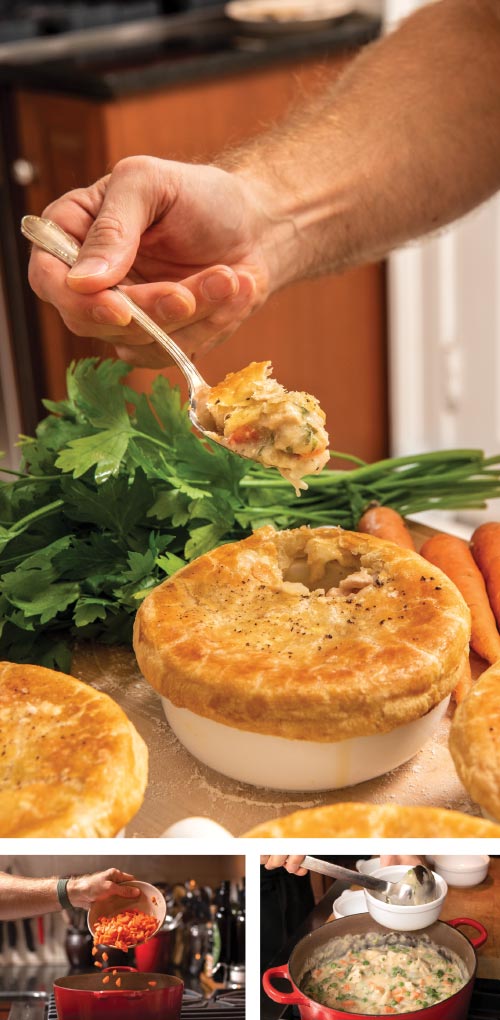
Ok, now you know more about cooking than 90 percent of all home cooks, so let’s put your skills to the test with this easy, flavorful and filling Chicken Pot Pie recipe on the following page.

chicken pot pie

Chicken Pot Pie
SERVINGS: Makes 4 individual pot pies

TIME: Takes about 1h 45 min from start to finish
Special equipment: Four oven-safe ramekins, 12-14 oz each

INGREDIENTS:
3 chicken breasts (should make about 3 cups cooked, cubed)
1 sheet of frozen puff pastry, thawed in fridge overnight
1 egg (for egg-wash)
4 cups of chicken stock
1 stick of unsalted butter (that’s 8 tablespoons)
1 large onion (should make about 1.5 cups, chopped)
3/4 cup of all-purpose flour
1/4 cup heavy cream
3 carrots (should make about 1.5 cups, diced)
1.5 cups frozen peas
1.5 cups pearl onions (not critical but great!)
1 bunch parsley (should make 1/2 cup, chopped)
3 teaspoons kosher salt (Diamond Crystal kosher salt is seriously a magic ingredient!)
1 teaspoon black pepper, freshly ground

INSTRUCTIONS:
Preheat oven to 350 degrees. Place chicken breasts on a baking sheet, smooth side up. Rub with olive oil on both sides and sprinkle with a few pinches of salt and pepper. Cook in the middle of the oven until the internal temp reaches 165 degrees, about 30 minutes. Let cool slightly, then dice into half-inch cubes. Set aside.

In a large saucepan, melt the butter over medium heat. Add the chopped onions and cook until translucent, about 5 minutes. Add the flour and stir for about 2 minutes, then add the chicken stock and bring to a simmer. Stir until the stock starts to thicken, then add the salt, pepper, and heavy cream. Add the cubed chicken, carrots, peas, pearl onions and parsley and give everything a good stir to combine. Bring out your four ramekins and fill 90% full with chicken-veg mixture.

Go get your thawed sheet of puff pastry from the fridge. Unfold and place on a slightly floured surface. Using a rolling pin, roll out the dough until the sheet is about 25 percent larger. Cut out four circles, half an inch larger than the top of your ramekins.

In a cup, mix the egg with 1 tablespoon tap water to make an egg wash. Brush the top of each ramekin with the egg wash. Place one dough circle on each ramekin, crimping the edges slightly to seal. Brush the dough with egg wash and cut a few slits in the top to allow steam to escape. Place your pot pies on a baking sheet and cook on middle rack for about an hour or until the top looks golden brown and delicious!


Photos by Ashlee Glen


Camp Trapezium

Adding another unique brewery experience to Central Virginia

There is a new future for a historic landmark in Amherst.

Camp Trapezium, the western outpost of Trapezium Brewing Company in Petersburg, opened up in the renovated Amherst Milling Co. in June, offering small-batch craft beers, brick oven pizzas, wings and salads.

Amherst Milling Co., a mill and farming supply store built in 1890, ceased operations in 2017 and was purchased the following year by the Petersburg-based Waukeshaw Development. The company renovated the mill, farmhouse and land into a haven for family-friendly fun, craft beer and an immersive experience drawing much praise and appreciation from the local community.

“One of the most fun parts about getting [Camp Trapezium] open [was] the number of people who drove past every day for months, well before we were open, and just wanted to pop their heads in and take a look,” said Rachel Jesten, hospitality manager. “Everyone tells us the same thing. They say, ‘Boy, I used to buy my grain here for years. This was our local farm shop… they used to sell everything here.’”

Camp Trapezium’s beer menu currently features award-winning ales brought in from the Petersburg location, but the ultimate goal is for the brewery to also become a producer of its own beers that will incorporate ingredients grown on their farm. According to Jesten, head brewmaster James Frazer’s idea is to use the local flora to influence the fermentation process.

“[Camp Trapezium] is almost the even artsier cousin of [Trapezium Brewing Company],” Jesten said. “So, we are doing a lot of wild fermentation, mixed-culture ales. Basically, anything James Frazer wants to try… This is really a cool playground for that.”

In addition to the brewery and restaurant, the 76-acre property is open for guests to walk around and explore. Featuring a farmhouse that has been renovated into an AirBnb with eight suites, a permaculture farm, live animals roaming around and a water wheel that Waukeshaw hopes to make operational for hydroelectric power production within the next few years, Camp Trapezium is as much a historic site as an eatery.

“We want [Camp Trapezium] to be a really immersive experience,” Jesten said. “We love the idea of people coming down to the area and not just making a day trip out of it but making
a weekend.”


By Christian Weaner | Photos courtesy of Trapezium Brewing Co.

Camp Trapezium
140 Union Hill Rd., Amherst
(434) 381-2635
www.trapeziumbrewing.com/amherst