Back to Basics

Helpful Hints for Your Home Kitchen

While many of us daydream about cooking elaborate, gourmet meals for in-home dinner parties, the reality is most of our time in the kitchen is typically spent preparing a quick bite for ourselves or our families in between meetings or soccer games.

We want it to be easy, painless, somewhat healthy and—of course—we want it to taste good. If you need a little pep talk to get you recharged or retrained in your home kitchen, we are here with loads of basic advice—tips to save you time, space, money (and maybe even a finger!).

Editor Shelley Basinger spent some time with Chef Stephanie Fees, owner of Scratch Pasta in the Lynchburg Community Market, to pick her brain on the do’s and don’ts of the kitchen. From culinary school to the Greenbrier to West Manor, she shares what she’s learned over the years. Then, we expanded our search for advice by getting insight from Chef Robert Patton at the Culinary Institute of Virginia.

Bon Appetit!


stephanie

Chef Stephanie Fees, owner of Scratch Pasta.

Stephanie’s 3 Kitchen Truths
1. Always start with a sharp knife. “The first thing you learn in culinary school is how to sharpen your knife manually, using a sharpening stone. Because the saying goes—a sharp knife is a safe knife. The less you have to work to cut something, the less likely you are to cut yourself. If you don’t have a sharpening stone, just make sure yours is as sharp as possible. The test is always to cut through a tomato without having to press or push on the skin.”

2. Don’t be afraid of salt during the cooking process. “This is one of my big things, especially when it comes to your pasta water. People will add a couple of teaspoons, but you actually want tablespoons of salt in your water. Most of the salt is going to stay in the water. I also believe in salting your food as you cook versus adding it at the end. When you add salt to your finished dish, the food will just taste salty instead of flavorful.”

3. Beware of clever marketing tactics. “‘All natural’ on the label doesn’t mean it’s your personal idea of what all natural means. If you look up the FDA requirement for ‘all natural,’ it’s very broad. If you’re able to pay extra for meat, buy organic. There are legal guidelines for organic meats and vegetables, but you can put an ‘all natural’ label on just about anything. Another option is to buy from a local provider so you can ask them exactly where the meat came from and how the animal was raised. But don’t buy something just because of what it says on the label—unless it’s organic.
You are wasting money.”


pasta water7 Kitchen Tricks and Tips
Don’t throw out the pasta water. “I try to use a spider or tongs when I pull out my pasta so I can preserve the water. You can add it to a sauce or toss it with some cheese to make a carbonara. You will get that little bit of thickening that you need.”

Use a microplane instead of a grater for parmesan cheese. “Parmesan cheese is a super dry cheese and doesn’t melt easily, so the smaller it is, the more quickly and evenly it will melt.”

Try a spoon instead of a knife when peeling fresh ginger. “When you use a knife, you lose a lot of the volume. Use a spoon to peel it back and just get the skin off.”

Bonus tip: “Since you usually only need a 1/2 a teaspoon for what you are making, chop up whatever you have and put it in the freezer.”

Two plastic lids can save you a lot of prep time. “While working at the Greenbrier after culinary school, I was cutting cherry tomatoes for salads one at a time. Someone in the kitchen showed me how to take two plastic lids, put the tomatoes between them, and cut eight of them at once. It was a game changer. This is also a great trick for moms who are cutting up grapes for their small children.”

Save the chicken bones. “I keep chicken bones in the freezer from when I buy a rotisserie chicken. Then, I will put them in a crockpot or instant pot overnight to make chicken stock. Just cover it with water or add carrots, onions, celery, garlic—whatever you want. The great thing is you can control the amount of salt, and the flavor is far superior to store-bought.”

Use kitchen scissors instead of a pizza cutter.

“I didn’t have a pizza cutter one day and improvised. The scissors worked like a charm, if not better! I really don’t like single use items. So if you can take that one thing out of your jam packed drawer, I think that’s a huge plus. I’m all about having fewer things in your junk drawer.”

Be consistent with the type of salt you use. “Kosher salt is said to have a cleaner taste and is less salty than iodized salt by volume by about 30 percent. So you can salt your food more evenly without it being too salty. But whether you use kosher salt or iodized salt, you just have to be familiar with the salt that you use and how it makes things taste.”


5 of Her Favorite Things
Instant Pot: “I love mine so much and think everyone should have one. I use it just about every day and I can’t say that about many appliances that I have. These electric pressure cookers save your cooking time on everything and it turns out so well. Ribs, rice, chicken stock, yogurt—I’ve made everything in my instant pot.”
Cookbooks: “I think people get a lot of recipes from Pinterest these days then are disappointed by them. Just because there is a pretty photo doesn’t mean the recipe is all it’s cracked up to be. Find the right source material—blogs that you trust, cookbook authors that you trust. I use the internet for quick recipes, but my cookbooks are my go-to for complex dishes.”

Restaurant food containers: “I store all of my food in these plastic containers (you can buy them on Amazon) instead of Tupperware because they are stackable and really compact. And if you lose one, it’s only a couple of cents.”

Pre-peeled garlic: “In the produce section you can purchase garlic cloves that are already peeled and separated (not the chopped stuff in a jar). For me this is a huge time saver and then the leftover cloves stay fresh for a while in the fridge.”

Electric Egg Cooker: “This is one of the only single use items that I own. I can’t ever seem to get hardboiled eggs the way I want them and this does the job perfectly.”
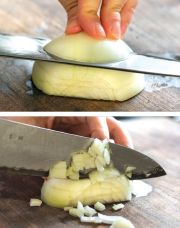

onion dicingOnion Dicing 101
Do you need a refresher in cutting an onion? Stephanie believes there are technically two “right” methods—the “culinary school way” and then the “home kitchen way.” Both are perfectly acceptable. The only difference is your final product might not be as evenly diced.

Professional: Cut off the top of the onion first, trimming the root end but leaving it intact. Then, slice the onion down the middle and peel it. Cut the onion horizontally in layers to the root end. Then come back and cut back vertically in both directions before cutting off the root end. Those first horizontal cuts can be tough for people who aren’t as savvy with a knife or who are not using a sharp knife.

Home Kitchen: A very similar approach but in this case you cut off the top and root end of the onion first, then slice from side to side (so the onion would be in half moons if you separated the pieces), then turn and slice from top to bottom. The pieces won’t be as pretty as the “professional” way, but it’s a lot quicker!


10 Mistakes You Could Be Making In The Kitchen
By Angela Blue

Information from Chef Robert Patton, CEC, CCA, Campus Director for the Culinary Institute of Virginia. Overcooking your vegetables. Unless you are serving them to small children, the vegetables should still have a slight bite to them.

Cooking bacon on the stovetop. Instead, cook it in the oven in a glass baking dish. It saves a ton of mess and allows you to do other things on the range top.
Mistreating your fresh herbs. Trim the root ends a little bit, and then dunk them in a jar with water as you would a bouquet of fresh flowers. For cilantro and parsley, place a damp paper towel over the herbs and store in the refrigerator. For mint, rosemary, thyme, sage and hardier herbs, keep them in their vase out on the counter
at room temperature.

Refrigerating things that don’t like to be cold. Common sense might suggest that keeping things cool in the refrigerator is good for everything—but it’s not. Many items that are often refrigerated don’t need to be, and worse, some things behave badly in there. Potatoes and tomatoes, for example, suffer on the molecular level and lose much of their texture and flavor.

Overcrowding the pot or pan. This doesn’t allow the food to cook properly. Cook in smaller batches or invest in a larger pan. You’ll get a much better result.

Rinsing the noodles. Your pasta wants to wear its sauce like a nice jacket. When you rinse your pasta after cooking it, you are washing away the starch that makes the sauce stick to it. The result? Slippery pasta to which sauce won’t cling.

Not letting food rest. Food needs naps too!

When you take meats and baked dishes out of the oven, they need to sit for a few minutes before serving.

For meats, this prevents the juices from running away from the meat, and for baked dishes like casseroles and lasagna, it helps the liquids be reabsorbed into the food
so you’re not left with a big soupy, slippery mess.

Being afraid of the high heat. Sautéed vegetables, for instance, do better at a higher heat for a shorter period of time.

Tossing your vegetable scraps. Put fennel fronds, carrot ends and other vegetable scraps into a re-sealable plastic bag and keep in the freezer. When it’s full, make vegetable stock.

Not having fun! Don’t be afraid to get out of your comfort zone and experiment.


8 Unique Uses for Ordinary Kitchen Utensils
BY GRACE SILIPIGNI

Among the drawers overflowing with Tupperware containers, bakeware and other miscellaneous kitchen utensils, there are certain culinary devices that can be found in nearly every kitchen, each which can serve a variety of functions. From strainers turned into makeshift steamers to turkey basters serving as pancake makers, we’ve selected eight, common household utensils and offer suggestions on how they can better serve your baking and cooking needs.

Waffle Iron. Waffle irons are the jack of all trades. Not only do they prepare the beloved breakfast item, but can serve as a panini press or quesadilla maker as well. Other sweet treats such as cinnamon buns and brownies can be baked between the two griddles too.

Ice Cream Scoop. This household staple has several uses besides the simple function that its name conveys. Ice cream scoops also happen to measure the perfect amount of batter when preparing muffins, while also serving as the perfect tool for hollowing out the cavities of squash and pumpkins.

Strainer. While strainers are typically used after vegetables, noodles or other foods prepared in a pot of boiling water, we suggest combining the two utensils to create a makeshift steamer. Simply place your strainer, ideally one made from stainless steel, over a pot of boiling water and fill with broccoli, carrots, asparagus or your other favorite vegetable. Then place a lid over the strainer and allow it to steam for several minutes before removing it from the pot.

Tongs. Our alternative suggestion for tongs is somewhat counterintuitive to their purpose, but is certainly helpful. We suggest using the center of the tongs for juicing. Simply place a lime, lemon or other citrusy fruit between the arms and squeeze the open end of the tongs to juice the fruit. This trick is especially useful when preparing large pitchers of lemonade.

Turkey Baster. Turkey basters make their annual debut every Thanksgiving and then are stored away in a drawer for the remainder of the year. It so happens though that turkey basters serve as the perfect pancake maker. Fill the baster with your favorite buttermilk pancake batter and squeeze circles or other fun shapes onto a griddle.
Slotted Spoon. This trick is great for bakers and an easy way to get mess-free egg whites. Over a bowl, simply crack an egg into the slotted spoon to separate the yolk from the whites. Whichever portion of the egg you do not use, refrigerate in an airtight container and save for scrambled eggs or an omelet.

Roller Pin. If you aren’t making sugar cookie cut-outs or a homemade pie crust, the rolling pin may seem obsolete. This device actually serves a wide variety of functions for both cooking and baking. Use the pin as a meat tenderizer to flatten chicken or to crush up graham crackers and candy for baking.

Egg Slicer. This culinary gadget can slice much more than a hard-boiled egg. Try using it to dice up strawberries, avocados and soft cheese, as well as to mince garlic and ginger.


Stock Up Essentials For A Well-Equipped Pantry
Oils (vegetable or canola, extra virgin olive oil, toasted sesame oil): Keep a variety on hand for a little drizzle to finish a dish or to top a salad for added flavor and texture.

Vinegars (apple cider, red wine, rice wine): Each have a distinct flavor profile. A splash of vinegar does wonders to “brighten” up a dish’s
flavor and can be used to replace some of the salt.

Soy sauce: It’s an essential to add a depth of flavor, some umami mouthfeel and also a salty taste.

Worcestershire sauce: Most don’t know that it’s made from anchovies and also offers those umami flavors and a great savory saltiness to dishes.

Sriracha Hot Sauce: It offers a great heat and flavor without having too much vinegar flavor.

Local honey: A little bit of good quality honey instead of sugar not only adds sweetness but also depth of flavor.

Dijon mustard: This adds another layer of flavor, slight heat and also can be used to emulsify or bind a salad dressing together.

Sea salt: Have a nice sea salt on hand, not to use during cooking but to finish a dish and add a
great flavorful burst.

Canned beans (black, cannellini, navy, kidney or garbanzo): Having these on hand can give you a quick go-to meal.

A good quality stock or base: This will add that savory quality and can be handy in a pinch for a quick soup or sauce starter.

Canned tomatoes (paste, diced, sauce/puréed): These are a go-to for a quick sauce when tomatoes are out of peak season.


America’s Favorite Couple

Step away from the grill this summer and let someone else do the work once in awhile. We recommend these three unique local burgers, all perfectly paired with craft beer.


The Mac Attack
at Beale’s Brewery
510 Grove St., Bedford • www.bealesbeer.com

Two house ground chuck and brisket blend patties topped with American cheese, homemade mac and cheese, and hot sauce. (Add bacon for extra flavor.)

Take your napkin and tuck it into your collar because this burger experience isn’t for the prim and proper. The Mac Attack at Beale’s Brewery combines the classic American cheeseburger with an all-time favorite comfort food—then a rich and complex tangy hot sauce seals the deal.

According to pitmaster Neal Agee, “Everything on this burger is made in house, fresh daily.” Be sure to ask for a fork because you’ll want to scrape up every last bit of this messy creation from your plate.

Wash it down with: A flight of Beale’s beers that are brewed just feet from where you sit. (Pictured: Gold, Silver, Red and Black)


Black & Blue Bacon Jam Burger
at Benjamin’s Restaurant
14900 Forest Rd., Forest • www.cowsandcrabs.com

80/20 Sterling Silver ground chuck topped with blue cheese crumbles, Benton’s Smoky Mountain Tennessee bacon mixed with caramelized onions, brown sugar and local honey, and Arugula.

Sweet, spicy, creamy, smoky, juicy—if it’s possible to pack every savory flavor into one beef experience, Benjamin’s Restaurant accomplished that with their Black & Blue Bacon Jam Burger. “It has a wider spectrum of flavors and unique ingredients than most other burgers,” explained owner Benjamin McGehee.

The bold blue cheese is the perfect complement to a unique “bacon jam” and some spicy Arugula. We would give this burger two thumbs up but we’re too busy stuffing our faces.

Wash it down with: Ben recommends a “big IPA” that can stand up to the burger’s powerful flavor, particularly the Hells Frozen IPA from Apocalypse
Ale Works.


The Hogtown
at Fifth and Federal Station
801 Fifth Street, Lynchburg • www.fifthandfederal.com

8oz. burger cooked to your preference topped with slow cooked pulled pork, house smoked bacon and a savory bacon bourbon jam.

Barbecue… bacon… bourbon… your encounter with a burger doesn’t get much more Southern than this.

The Hogtown is crafted 
by Fifth and Federal’s
Chef Rufus, formerly
of Toy Town Soul
Food in Amherst—this piece of pork lovin’ goodness is a nod to the nearby Madison Heights.

Y’all will not be able to put this one down after the first bite.

Wash it down with: Their house brew, Chaos Federal Reserve—a Scottish ale brewed by Chaos Brewing Company then aged in Smith Bowman bourbon barrels.


Vegan Vibes

Experience a menu that’s animal-free…but full of taste!

When you step inside the cozy space that is home to Urbavore on Church Street, you may see some familiar faces. Elizabeth Russell and Matthew Kaplan owned the Cheesy Rider food truck prior to opening their vegan brick and mortar restaurant at the end of 2017.

While the food truck was always vegetarian, the idea of opening a permanent space serving only vegan food has been the long-term goal. Both Elizabeth and Matthew are vegans who love to cook but also enjoy dining out. They realized the lack of options for vegans in Lynchburg and wanted to fill that void. The twosome chooses not to consume or purchase products made from animals out of concern for the environment, animal rights and their personal health.

However, regardless of your beliefs about the vegan lifestyle, there is something for everyone at Urbavore.

On a recent visit I enjoyed the Diner Burger with “cheese” (they use a vegan brand called Follow Your Heart), diner sauce, and sweet potato chips. My meal was prepared fresh, tasted delicious and was loaded with flavor.

The menu appeals to all palates—even if you think you don’t like vegan food. It is full of dishes that meat and dairy eaters love, just substituted with plant-based alternatives. With the exception of a few items, everything is made in-house including the burger, the sweet potato chips and the soups.

But they’ll admit when someone else can make it better. For example, the cheesecake comes from a vegan bakery in New Jersey that Elizabeth tells me came after a failed attempt to make the dessert themselves. After that, “we found someone who knows what they’re doing,” she says.

Their bread comes from local favorite Lorraine’s Bakery at the Lynchburg Community Market. Urbavore’s Reuben Burger is topped with “curtido,” which is an El Salvadoran ferment made by Gathered Threads in Roseland. When the temperatures warm up, the goal is to source more produce from farms around Lynchburg as well.

The husband and wife team love their downtown location and are excited to be part of its revitalization. Dinner service is in full swing, and they have applied for an ABC license. Elizabeth’s next plan is to get a retro scooter and deliver to downtown businesses. Long-term goals include fine dining in a larger space.

At Urbavore you can order waffles any time of day, enjoy crab cakes without eating seafood, or try the “eggs” on toast for dinner. Wash it all down with a Virginia-made Kombucha if you like. Finish feeling full and satisfied without the guilt; so you’ll never feel bad about grabbing a slice of that cheesecake or some chocolate pudding on your way out!


Mango Habanero Balsamic Shrimp

Put away the slow cooker and soup ladle… and emerge victoriously from the doldrums of winter mealtimes with this spring-inspired recipe. Remember your backyard grill? Clean it up, then follow directions to create this tasty shrimp marinade with contrasting flavors of mango, chili peppers, red onion and garlic. It’s perfect for a twist on the typical family dinner—or better yet, invite some friends over and take advantage of a warmer spring evening on the porch!

Ingredients:
1 small red onion (minced)
2 garlic cloves (minced)
1 lemon (zest and juice)
3 tablespoons White Mango Habanero Balsamic Vinegar
1/4 cup extra virgin olive oil
Salt to taste
Freshly cracked black pepper to taste
2 pounds large shrimp (peeled and cleaned; tail on)

INSTRUCTIONS:
Mix together the marinade ingredients in a zip-top bag or baking dish then add the shrimp. Allow the shrimp to marinate for 20-30 minutes in the fridge. Remove shrimp from marinade and skewer onto soaked wooden skewers. Preheat grill. Place shrimp on the grill and cook for 2 minutes per side or until cooked through but not tough. Remove from skewer and serve with your favorite side dish. Drizzle with more balsamic vinegar if desired.

Serves 4

Cooking Tip:
For the best possible results, buy fresh shrimp on the day that you plan to grill them. Shrimp thaw quickly and can go bad even more quickly. Make sure that you buy either jumbo or colossal sized shrimp for easier grilling.


Upscale Oils

From flavor infused to Southern grown, add some interest to your next meal with these local recommendations

You don’t have to be a gourmet chef to create memorable food. With the right oils and other condiments, you can please any palate.

Humans have long devised ways to preserve food and add flavor at the same time. Salt, herbs, vinegar and oil are primary examples.

Olive oil and balsamic vinegar can also provide health benefits without saturated fats and excess sugar.

Many people mistakenly think oil and vinegar are just for making salad dressings, said Christina Long, co-owner of Favored Flavors at River Ridge Mall. Nothing could be further from the truth, she said, noting that you don’t even have to cook to enjoy them.

Olive oils and balsamic vinegars can be drizzled on everything from entrees to desserts.

“The gourmet is in the bottle,” her husband Jason Long chimed in.

With olive oils infused with different flavors such as Valencia orange, mushroom sage, kaffir lime ginger and black truffle, Favored Flavors offers combinations that marinate meat or spice up ice cream.

The Longs buy certified, pure olive oil imported from Tunisia and Spain. They have chosen to avoid Italian olive oil because of reported connections to the Mafia, Christina said.

They work with a distributor in Arizona who infuses the oil with essential oils of other plants. It takes about two weeks to receive their orders, making their oils among the freshest you can buy.

Their balsamic is 25 Star, from Modena, Italy, with no added sugar, an ideal topping for diabetics, Christina said.

“A proprietary blend makes ours thicker and sweeter than most on the market,” she said, noting that balsamic that runs to the bottom of the bowl has too much wine vinegar in it.

All their products are vegan friendly and allergen-free, Christina added.

“Our goal is to have healthy options here in the shop,” Jason said.

The shop offers tastings any time, but also has special samplings just in front of the store to get shoppers to try their wares.

They might offer macaroni and cheese with truffle oil, gelato with Persian lime olive oil or oatmeal with balsamic vinegar.

“When we do the tastings, we try to keep it simple so they can recreate it at home,” Jason said. “We’ve learned a lot about flavor combinations and healthier eating.”

The Longs decided to become entrepreneurs after Christina’s job at Nationwide disappeared when the company left Lynchburg. She had loved visiting a shop called Drizzles in Cape Charles and realized she could start her own shop.

Jason soon joined in full time and they currently have two part-time employees with plans for a third.

The store sells much more than oils and vinegars, including Himalayan salts, spices, skin and body products, gifts and locally crafted chocolates and teas. The store also offers a 10 percent discount with a same-day movie ticket or a 10 percent discount for Planet Fitness members to support nearby businesses in the mall.

The Longs first opened their business in downtown Lynchburg on Main Street and had a successful year in 2016, but when construction to repair aging water and sewer lines began, business fell off. They say the move to the mall was a good one.

“We’re more central here than downtown,” Jason said.

For folks who like to shop downtown, however, there is still an opportunity to buy olive oil at the Lynchburg Community Market.

Chef Stephanie Fees, owner of Scratch Pasta Co., made a surprising discovery as she searched for olive oil to go with her homemade pasta.

“I was trying to find, for the market, the most local products possible,” said Fees, who launched her business in July 2017.

While the vast majority of U.S. olives are grown in California, it turns out Georgia has a similar climate.

She heard that a well-known chef, Sean Brock of Husk in Charleston, S.C., was using an olive oil produced in Georgia and tracked down Georgia Olive Farms online.

According to their website, in early 2009, five farmers in southeast Georgia got together with the dream of resurrecting olive oil production in the Southeast, which had existed in the 1800s.

In 2011, Georgia Olive Farms harvested the first commercial crop of olives grown east of the Mississippi in more than a century from their orchards near Lakeland, Ga. Their oil is an extra virgin olive oil, collected from only the first pressing of their fruit.

“I think it’s a good, all-purpose oil,” Fees said, adding it has a neutral flavor and thick consistency, which is good for pasta or salad.

She doesn’t buy flavored oil, but prefers to add her own flavors, usually garlic and chives or other herbs.

“It makes the best steak you’ll ever have,” she said.

Fees uses a lot of the olive oil at home.

“As much pasta as I cook and eat, I go through olive oil and salt by the gallon,” she said.

A graduate of Virginia Episcopal School in Lynchburg, Fees completed a nine-month certification from the Institute of Culinary Education in New York City in 2010. She later returned to the Lynchburg area after her mother purchased West Manor and offered her the position of head chef. When her family sold the property in 2015, she decided to make her own pasta.

“People have loved it,” she said. “I get a lot of repeat customers who come every week.”

Alongside her pastas, many also are discovering the Georgia olive oil.

As many cooks know, starting with a good olive oil is key, and it’s very simple to make your own flavored oil.

At Isabella’s Italian Trattoria, for example, they offer customers bread with olive oil and balsamic with each meal.

“We infuse extra virgin olive oil with garlic and rosemary,” said executive chef Kevin Crews.

It’s a quick, easy process. They warm the oil in a pan with roasted garlic cloves and sprigs of rosemary, a combination that’s hard to beat for an appetizer.

Whether you want to experiment with your own combinations or buy them already in a bottle, flavored oils can enhance almost anything you eat.


Do The Stew

The simple and delicious basics of slow cooking

Many years ago, I attended a week-long project management training at the company where I was working. It was a great experience and I find myself using the things I learned almost every day.

We learned about various methodologies and models for good, sound business management, but one stuck in my mind most of all: It was called THE TRIPLE CONSTRAINTS. The illustration had a triangle graphic on it with a word in each corner—CHEAP, FAST, and GOOD. At the bottom it said: PICK TWO!

The idea was that it’s rarely possible to do something well, quickly and at a low price. One factor will have to give. For instance, if you are going for GOOD and CHEAP, it will not happen FAST.

You will have to take your time. And while there are always exceptions, this model transfers nicely to cooking too!

Time is always a factor in cooking. The more time you have available for preparing a meal, the more satisfying the result can be, especially if you have a limited budget. A medium rare Porterhouse steak will not take long to cook, but you definitely pay a premium price. However, a beef stew that’s cooked low and slow can be made with a cheaper cut of beef, but outshines any steak when you take your first bite of it.

The Components of a Stew
A basic meat stew does not have a lot of mandatory ingredients. The essential ingredients are meat, a cooking liquid, vegetables and seasonings.

Meat
The best cuts of beef to use are the ones with the most flavor. Typically these are tougher cuts—definitely not steak cuts—and come from parts of the animal which have seen the most use and exercise. These cuts tend to have a marbling of fat and lots of connective tissue. The good news is that the connective tissue completely breaks down when slow cooked and a natural gelatin-like thickening comes from it, enriching the stew broth, turning it into a very flavorful gravy.

Meat without fat or connective tissue will be dry when slow cooked. The parts to look for include chuck, shoulder, flank, rump and brisket.

Vegetables
Which vegetables you choose for your stew is simply a matter of taste and texture. But a good place to start is onions, carrots and celery—sometimes referred to as “mirepoix.” This is the holy trinity of aromatic vegetables and is as essential as salt and pepper to a stew. Another staple for stews is tomatoes, often in the form of paste. Root vegetables like potatoes or turnips are also a good choice, especially if you are feeding a large number of people.

Cooking Liquid
The stew will need a liquid to cook in for the meat to give off its flavor and create the gravy. Water is technically an option, but most cooks tend to go with something more flavorful such as beef stock, or even beer if you dare. The classic French beef stew known as Boeuf Bourguignon uses red wine—typically a red Burgundy, but any dry red will work. These include Cabernet Sauvignon, Merlot or Pinot Noir, but be sure the wine is good enough to drink if you’re using it in your dish.

Seasonings
Herbs, spices and other seasonings are essential to a stew and can dramatically influence the flavor. A common strategy is to go light on salt and pepper when starting to cook the stew and add more towards the end. This is because flavors may intensify as the stew is reduced down and your stock may be salty enough. The opposite can be said for herbs, where time is needed to release the flavors. My favorite way to use herbs is to make a small bouquet out of a handful of parsley sprigs, thyme and a couple of bay leaves. This is sometimes referred to as “bouquet garni.”

Now that you know the basics, check out one of my favorite recipes:

Simple Beef Stew
Prep time: About 10 Minutes
Cook time: 3h (check after 1.5h)
Servings: 6
Equipment: 5-6 quart, cast iron Dutch oven

Ingredients
2 tablespoons olive oil
2 tablespoons butter
2 lbs of beef chuck, cut into 1-inch cubes
1 yellow onion, diced
4 garlic cloves, minced
4 cups beef stock
1 tablespoon Worcestershire sauce
2 tablespoons tomato paste
1 teaspoon kosher salt
1 teaspoon freshly ground black pepper
1 tablespoon sugar
4 medium carrots, sliced large
1 herb bouquet of parsley, thyme and bay leaf

Instructions
Heat your oven to 325 degrees. Meanwhile, over medium-high heat, brown the beef cubes on all sides in olive oil and butter in two different batches in a 5-6 quart cast iron Dutch oven. Set aside the browned beef cubes on a plate.

Next, add the diced onions to the same pot with the remaining oil and butter. Stir and cook for two or three minutes until softened, then add garlic and cook briefly. Pour in the stock and add all the other ingredients. Add the beef back into the pot and stir to combine. Cover and place in the middle of the oven.

Leave your stew alone for 1.5 hours before checking progress. The liquid should cook down and get thicker, but if dissolves too much, add additional water or stock as needed. Put back in oven for another 1.5 hours or until the liquid is nice and gravy-like and the meat falls apart easily. If you feel the liquid is not thick enough, just mix 1 tablespoon melted butter with 2 tablespoons
all-purpose flour in a cup and stir into the stew. Cook on the stove for 5 minutes until it thickens up.

Taste the stew and add seasoning as needed.

I use kosher salt and lots of fresh ground pepper. Serve in bowls with your favorite side and some fresh parsley on top. Rice or mashed potatoes are good options—but a crusty slice of bread under the stew is my favorite.


Upscale Diner Food at My Dog Duke’s

Come. Sit. Stay.

It’s the perfect slogan for one of downtown Lynchburg’s most recent culinary additions.

My Dog Duke’s Diner at 1007 Commerce Street opened in November, and customers have been heeding the commands.

“It’s a welcome addition to downtown’s growing list of eating options,” said lunch customer Judy Walker. “The menu is varied enough to appeal to most tastes. I try to eat mostly plant-based foods, prepared in a healthy manner, so I was happy to see several sandwiches and salads that appealed to me. I had the Harvest Salad, which was fresh and tasty and exactly the right size for lunch.”

The gleaming counter and stools are reminiscent of an old-fashioned diner, but it’s an updated, shiny version. Plate-glass windows front the street and exposed wooden beams also appealed to Walker.

“The decor puts a slightly modern spin on the classic diner, making it seem like a place that would appeal to all ages,” she said.

“The noise level was much less than expected for a full lunch crowd, and I was able to carry on a conversation easily. Service was excellent—no waiting but also no hovering. I’ve been recommending it to everyone.”

The diner started out serving breakfast and lunch, but soon added an impressive dinner menu.

Open seven days a week from 7 a.m. to 9 p.m., the eatery also offers brunch on Saturdays and Sundays from 7 a.m. to 2 p.m.

As you might expect, breakfast is served all day long. You can order “The Barking Dog,” a buttermilk biscuit with bacon, egg and white cheddar cheese for $5, or try “The Benny Nova,” egg, salmon, Hollandaise sauce on an English muffin for $9.

As a vegetarian, I sampled “The Italian Job,” a tasty croissant with egg, provolone, arugula, red onion and tomato with Dijonaise.

The Espresso Bar features coffee and its kin: espresso, cappuccino, latte and mocha, as well as chai and tea.

The lunch menu offers a variety of sandwiches for $9 including the diner musts— meatloaf, Reuben and Italian. There’s also the more whimsical “Green Goat,” which features zucchini and goat cheese with avocado, green apples and Green Goddess Dressing. The diner also offers gluten-free buns for sandwiches.

Salads range from $9 to $11 and can be topped with grilled chicken or grilled shrimp for an additional $4.

“The menu offers a nice variety of sandwiches and salads, and the bread is especially good,” said Anne Nash, another lunchtime customer.

“I’ll definitely go again.”

The dinner menu suggests pan-roasted “striploin” or shrimp and grits for $18, as well as Joan’s lasagna or a hot roast turkey platter for $13. And yes, meatloaf is on the dinner menu, along with fried chicken and “Barking Dog Burgers.”

A full-service bar includes a nice variety of wines, craft beers and ciders, and signature mixed drinks, including martinis and margaritas.

Brunch features free-range fried chicken and waffle, as well as a vegetarian skillet.

If you can’t find something you like to eat and drink at this diner, you don’t like to eat and drink.

The diner is owned by the Parry Restaurant Group, which also owns Shoemakers, Waterstone, El Jefe, Fire & Hops and Bootleggers in Lynchburg, and other restaurants throughout the state.


Save Room

Before you start that New Year’s Resolution, check out these 4 locally-made desserts that we’re sweet on

Tis the season for overindulging, pouring another one, excessive eating—and definitely ordering dessert. These days almost everywhere you turn there is a bakery, pastry shop or food truck ready to supply whatever your sweet tooth desires. Check out these top local treats—just don’t ask us to pick a favorite!


Holiday Macarons
at Mrs. Joy’s Absolutely
Fabulous Treats

Mrs. Joy’s Absolutely Fabulous Treats has gained national attention due to the lovely owner Mrs. Joy, who won Food Network’s Christmas Cookie Challenge in 2015. Her cookies are certainly tops, but they’re just a tiny sampling of all that she has to offer at the cozy Commerce Street business.

I was most interested in hearing about the treat Mrs. Joy has a love/hate relationship with—the delicate macaron. Even if every intricate step is followed the exact same way each time the macaron is prepared, outside factors such as the weather can prove disastrous to the final product. “They are the most finicky treat that I make and every time they go into the oven I pray they grow feet and look like they are supposed to,” she explained.

The good news is Mrs. Joy has perfected her macaron-making technique. The peppermint flavor macarons (made in the shape of an actual peppermint) are perfect for a hostess gift this holiday season. Or scoop up a few Christmas ornament macarons to take to a family dinner. Call ahead to make your order today.


Key Lime Bites
at Simply Irresistible Bakery

Sometimes the best treats are inspired by a “need” in the kitchen. Loretta Toulon, owner of Simply Irresistible Bakery on Jefferson Street, can make just about anything. But people swoon over her Key Lime bites.

“When I worked at Depot Grille, one of the managers was obsessed with my Key Lime pie. He asked if there was a bite-sized version he could just pop in his mouth whenever he wanted and this recipe was what I came up with,” she explained.

Her Key Lime bites have a lime sugar cookie crust with a Key Lime pie filling; we are sure you won’t be able to just have one.


The Jefferson
at Ice Cream Dream

Years ago, Bobby Walker used to dream of having an ice cream shop. Now, his ice cream dream is a reality on Jefferson Street, where he runs a hip, well designed, and unique sweet shop.

You’ll find all of your favorites on the menu, plus something you may not expect—Belgian waffles.

“I like the waffle idea because you can have so much fun creating different options using waffles, ice cream, and various toppings,” said Bobby. “Our ‘Classic Waffle’—a house favorite—comes with a golden brown Belgian-style waffle topped with fresh strawberries, whipped cream, a dash of powdered sugar, and a honey drizzle. It’s kinda like cake and ice cream. How can you resist?”

Oh Bobby, we can’t.

The waffles are scratch made in house each day and seem to be most popular for weekend brunch or even a late-night snack. The top seller waffle (and my personal favorite) is “The Jefferson,” which is topped with strawberries, bananas, whipped cream and Nutella, and a honey drizzle.


PSL
at Rookie’s

Rookie’s in Forest, previously known as Mookie’s, is the genius brain child of Jordan Nickerson and his wife Holly. They opened their “windows” in March and have been cranking out handcrafted ice cream sandwiches from their charming food trailer ever since. Jordan says for him, baking is therapeutic and gives him the freedom to do something he enjoys. But it’s also challenging and he’s constantly learning.

While the best seller for the husband wife duo is the Classic Chocolate Chip Cookie with Vanilla Ice Cream, there are plenty of seasonal treats to enjoy this time of year. Pumpkin Spice lovers can rejoice over the PSL, which is a Snickerdoodle Cookie with Pumpkin Ice Cream. They make the cookie from scratch and the ice cream comes from local favorite, Homestead Creamery.

When asked how he comes up with new flavors, Jordan tells me, “We just test and try until we find something that is awesome!”


From McDonald’s to Main Street Eatery

Wendy Williams Takes Over One of Lynchburg’s Classiest Restaurants

Lynchburg’s beloved Main Street Eatery & Catering Co. recently changed ownership. But don’t worry, the new leader knows exactly what she’s doing. And we couldn’t help but share her climbing-the-career-ladder story.

Wendy Williams was raised in a small town southeast of Syracuse, NY and was introduced to Lynchburg by family who worked for Virginia Episcopal School. They encouraged her to consider Randolph-Macon Woman’s College when she graduated high school.

Family support and a huge love of horses sealed the deal and she packed her bags for RMWC. Her restaurant career started there. Wendy worked in the dining hall throughout college and then bounced around many local restaurants—McDonald’s, The Windmill and Milano’s to name just a few—learning all aspects of the various jobs.

Wendy graduated RMWC in 1982 and soon met who would end up being a long-time employer. She began to wait tables at the Rutledge Inn for owners Michelle and Urs Gabathuler. Soon after, they sold the Inn and bought Emil’s Restaurant in Boonsboro Shopping Center (currently Isabella’s).

At Emil’s, Wendy did it all. She was a server, deli clerk, bartender, cashier, hostess, and quickly became the restaurant manager until 1996, when Emil’s was sold and became Meriweather’s.

Wendy continued to work for the Gabathulers and helped open Main Street Eatery in 1998. She has proudly worked every job in the restaurant and has been there off and on for the last 19 years.

In October 2016, when the Gabathulers announced they were ready to retire, Wendy jumped at the opportunity. She tells me she was definitely “in the right place at the right time” and owning the restaurant is a long-time goal.

“I have reached my pinnacle. This is what I have always dreamed about,” says Wendy. “The old owners set high standards and I will keep up the reputation of great food and great service.”

Wendy took over in March of this year. Of the transition, Wendy tells me it was smooth. After setting up her LLC and getting the appropriate license and permits, she partnered with Louis Cambeletta and got to work.

She made a few minor changes, but nothing customers would likely notice. She also made a few tweaks to the menu but says “what sells, stays.”


Enjoy Happy Hour Any Hour

with Nomad Coffee Co.’s Unique Mocktails

Nomad Coffee Co. is a caffeine station on wheels and, at the same time, tries to feel a little bit like happy hour too.

Owner Josh Davies and his wife Jeanne say they are proud to offer some things you may not be able to find at brick and mortar coffee shops, such as their coffee mocktails. Josh says the inspiration for these caffeinated, non-alcoholic drinks came from his experience working with another Nomad employee at a call center.

“We would talk about how nice it would be to have a cocktail on the clock. When Nomad became a full-time thing, we started serving call centers in town. So, I came up with the idea to make a couple of drinks people would enjoy at work, would keep them caffeinated, and would taste like they have arrived at 5 p.m.,” says Josh.

Then, a visit to a local distillery led to the creation of their customers’ current favorite mocktail, the Smoking Train Hopper—iced coffee, a shot of espresso, house made bourbon simple syrup, cherry, hickory smoke syrup, topped off with orange bitters from Blackwater Bitters.

“[At the distillery] they were smoking cocktails that day and it was an awesome experience plus the cocktail was one of the best I’ve ever had. So, for just 50 cents more, we will smoke the Train Hopper on oak chips right in front of you,” Josh explains.

Check Instagram and Facebook on Sunday to find out where Nomad will be each week; they also do frequent giveaways.

Then, cozy up with a Smoking Train Hopper with all the fun of a cocktail, minus the hangover!