Taste of Lexington & Rockbridge County, VA

Savor local foods & drinks produced in the southern gateway to the Shenandoah Valley.

It’s easy to find local foods and drinks on menus throughout Rockbridge County, Virginia, but you can also skip the middleman and go straight to the source. Get out and visit some local producers, from modern farms to historic mills, coffee roasters to craft breweries, cheesemakers to chocolatiers, and you’ll discover award-winning, crave-inducing items so high quality they make even the most refined taste buds swoon.

Wade’s Mill is the oldest continuously-operating commercial grist mill in the Shenandoah Valley. Local grains have been stone-ground the traditional way at this site since 1750. No wonder it’s listed on the National Register of Historic Places and the Virginia Landmarks Register. “Until steam, the mill was the most efficient energy source,” says John Siegfried, owner and miller. He grinds an average of 300 to 400 pounds of grain a day and supplies restaurants in Lexington and other cities in Virginia and Maryland. Grits, cornmeal, flour and other treats—many made of heritage grains—are available for purchase. Explore three floors of historic milling equipment and museum displays.

On Saturdays at select times from April through December, the historic 21-foot iron Fitz overshot water wheel is demonstrated. To linger at this picturesque site, check into the overnight accommodations.

Lexington Coffee Roasters has been named one of the “12 Best Coffee Roasters in the U.S.” by Forbes and “Some of America’s Best Coffee” by USA Today. Its focus is on sourcing top-quality beans from Latin America and Africa. Visit the roastery on Route 11 to see the coffee roasting process, discover innovative brewing processes and equipment, and sip coffee and espresso drinks. Take home some freshly roasted coffee beans and order online when your supply runs low.

Craft beers, wines, and ciders flow in abundance in Rockbridge County with four breweries (all stops along the Shenandoah Beerwerks Trail), four vineyards, and a cidery. On Route 11, Devils Backbone Outpost Tap Room & Kitchen produces more than 120 different beer recipes, all based on European brewing traditions. Enjoy a pint or sampler flight alongside hearty fare at the bar or in the outdoor beer garden.

Great Valley Farm Brewery & Winery (Photo Above: Chris Weisler) produces Belgian-style ales and Cabernet Franc, Gruner Veltliner, Lemberger and Vidal Blanc varietals using ingredients from its 27-acre farm in Natural Bridge. Sip pints or tasting flights against panoramic views of the Blue Ridge Mountains.

In downtown Lexington, Heliotrope Brewery produces what co-owner Erik Jones calls “wild farmhouse beers” using local ingredients. “We even foraged a wild yeast to give the beer terroir.” The beer lineup will change seasonally and cover a range of styles including IPAs, saisons, pilsners, and lagers among others. Savor a 12-ounce pour from a stemmed glass alongside a creative pizza, made to order in the brick oven.

Rockbridge Vineyard & Brewery, a two-time winner of the coveted Virginia Governor’s Cup, produces small-batch wines in a range of styles. Vinifera, hybrid, and native vines grow on 17 acres. Sample through the portfolio in the tasting room then enjoy a glass of your favorite while gazing out at the breathtaking view of Shenandoah Valley. Lexington Valley Vineyard has been handcrafting red and white wines since 1999. Enjoy them by the glass or bottle while relaxing on the deck and gazing out at the 67-acre property. Jump Mountain Vineyard welcomes visitors to its 32-acre farm on Saturdays and Sundays. Enjoy tastings, wines by the glass, or stock up on several bottles of red and white varietals to savor at home.

Sip small batch cider at Halcyon Days Cider Company. This family-owned cidery boasts a stunning labyrinth orchard. Inspired by the legendary labyrinth at France’s Chartres Cathedral, 2,500 dwarf apple trees are planted in a circuit that stretches 1.7 miles from the center to outer edge. Wander through 50 different apple varieties, from heirloom American, modern American, classic Europe, and Central Asian ancestral apple trees. Step into the pavilion for stunning 360-degree views of the Alleghany and Blue Ridge Mountains. All hard ciders are made using Virginia grown apples in a range of tastes from tangy to spicy to sweet.

Labyrinth at Halcyon Days Cider Company

Labyrinth at Halcyon Days Cider Company
Photo: Steve Shires.

Cocoa Mill Chocolates has gained a national reputation for its indelible treats, all made Awards and accolades from The Wall Street Journal, Bon Appetit, Chocolatier, U.S. Air Magazine, CBS Morning News, The Washington Post, among others. The chocolatier strives for excellence each step of the process—using fair trade chocolate, choosing natural ingredients and freshly hand-crafting confections for each order. Whether you bite into a truffle, gourmet bark, dipped fruit, chocolate-covered pretzel or peppermint, or other treat, trust that it’s made with high-quality ingredients and attentive precision.

Sweet Things Ice Cream Shoppe is Rockbridge County’s only homemade ice cream shop. Its retro décor may spark nostalgia, but its now-antique equipment churns out treats that modern equipment can’t replicate—including homemade waffle cones. “We’ve been in business since 1982, but our waffle irons date back to the 1950s,” says owner Chris Williams. And that aroma will get your mouth watering the moment you step into the door! The best-selling cookies and cream flavor ice cream is dark brown, not the usual white, thanks to the fact that this ice cream machine can crunch and crumble a whole lot more real Oreo cookies than modern machines. Flavors like mint chocolate chip, cookie dough, banana, black raspberry, and dozens more—scooped into cones, sundaes, shakes, and other treats—lure locals and visitors alike. Grownups, don’t miss the Guinness beer-flavored ice cream.


Best Beach Getaways

Try Wildlife Refuges Off-Season

Fall, winter and spring can provide the best beach time, especially when a pandemic requires us to keep our distance from each other.

Sunrises come later and sunsets come earlier. Dolphins still play in the waves and crabs scuttle across the beach.

For bikers, hikers, paddlers and surf fishers, the weather can be balmy or brisk, but not suffocating, and for birders, it’s the best time of year.

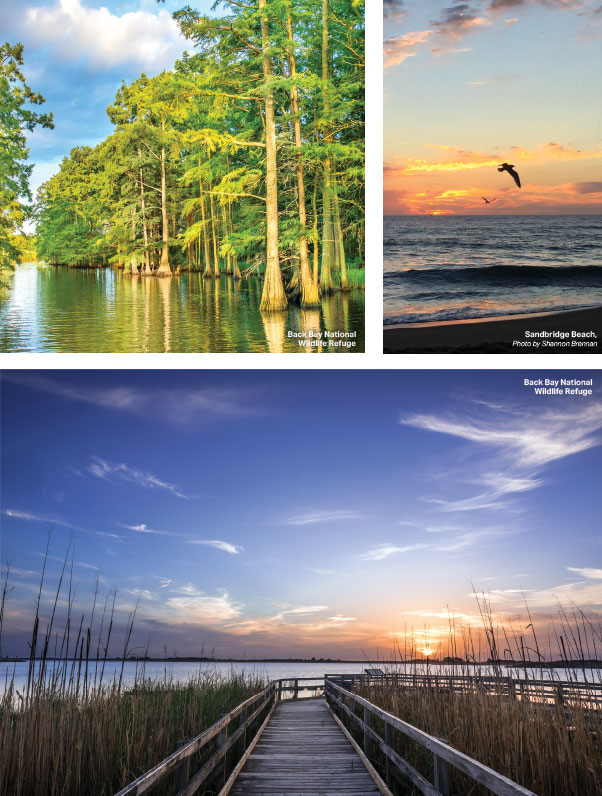
Virginia’s Back Bay National Wildlife Refuge, established in 1938 to protect migratory and wintering waterfowl, supports up to 10,000 snow geese and a large variety of ducks and other waterfowl during the annual peak migration, usually in December and January.

The refuge encompasses nearly 10,000 acres of beach, dunes, woodlands of live oak and loblolly pines, farm fields and marshes, along with the freshwaters of Back Bay.

Located just north of North Carolina, this coastal refuge also provides habitat for threatened and endangered species including sea turtles and piping plovers, small shorebirds that are declining rapidly.

More than 300 species of birds have been observed at Back Bay, primarily during winter months. Mammals include river otters, mink, opossums, raccoons, foxes, and white-tailed deer.

Canals provide a glimpse of venomous cottonmouth snakes, swimming across the water, along with brown and northern watersnakes. On warm days, a variety of turtles, including red-bellied, painted, eastern mud, and snapping, may warm themselves on logs or lurk beneath the surface.

This slender strip of land is covered in common reeds, which can reach 15 feet in height, providing cover for many animals, including humans as they stroll along boardwalks.

Groundsel or sea myrtle, with lovely white flowers, attracts butterflies and other pollinators, and provides seeds for birds.

Wax myrtle, a traditional source of wax for bayberry candles, is a favorite of the
wintering yellow-rumped warbler.

On a visit in October, the refuge was full of yellow in the form of goldenrod and smooth beggarticks. Great Plains lady’s tresses, a spiky plant with white blossoms, and blue mistflowers, could be spied along the trail.

Entrance to the refuge is just south of Sandbridge, a long narrow barrier island, 16 miles south of Virginia Beach.

We stayed at an Airbnb at Surfside at Sandbridge, an RV resort, just north of the refuge and enjoyed views from our canal-side porch. For dinner, we ordered takeout from the nearby Baja Restaurant with its many seafood options. For a breakfast treat, the homemade doughnuts at the Sandbridge Seaside Market are not to be missed.

travel

A short stroll from our Airbnb mobile home took us to the Atlantic Ocean, where only a handful of people splashed along the water’s edge, tossed in a fishing line, or flew kites.
A five-minute car ride took us to the entrance to Back Bay National Wildlife Refuge. Outdoor trails are open a half hour before sunrise and a half hour after sunset, and there is no entry fee from Nov. 1 to April 1.

All vehicles must park at the visitor center, which was closed due to COVID-19. To protect wildlife, no dogs are allowed in the refuge.

From the parking area, folks can walk along boardwalks to Back Bay or to the ocean. You can also bike or hike the four-mile trail to False Cape State Park or continue to the North Carolina line for an 8.8-mile trek one-way.

Several adventurous types were backpacking into False Cape, where primitive tent camping is available for a complete getaway.

While at Sandbridge, we couldn’t resist a trip north to Kiptopeke State Park, where the annual hawk migration count was underway. To get to the eastern shore, you must traverse the Chesapeake Bay Bridge-Tunnel, which is an amazing experience in itself.

The Bay Bridge-Tunnel is a four-lane 20-mile-long vehicular toll crossing that provides direct access from southeastern Virginia to the Delmarva Peninsula (Delaware plus the Maryland and Virginia Eastern Shore).

Spectacular views of the Chesapeake Bay along the bridges also offer glimpses of brown pelicans and black-backed gulls, the largest gulls in the world. As you take two plunges under the bay in two separate tunnels, you appreciate the engineering required to disappear under the water as giant cargo ships ply overhead.

As you leave the bridge, you enter the Eastern Shore of Virginia National Wildlife Refuge, one of the most important avian migration funnels in North America. This 1,100-acre refuge is the scene of a spectacular drama as millions of songbirds and thousands of monarch butterflies and raptors converge on their journey south. Favorable weather patterns push migrating species through the area in waves.

Numerous tree swallows swirl overhead and monarch butterflies float aloft. Protected habitats such as these provide critical stopover areas where birds, monarchs, and dragonflies can rest and feed before resuming their arduous journey.

We saw several sharp-shinned and a handful of cooper’s hawks and bald eagles at the refuge before continuing on to Kiptopeke. While it turned out to be a slow day for migrating raptors, we saw hundreds of pine siskins and a dozen red-breasted nuthatches, northern species which only venture south when there is a poor seed crop in Canada.

Another winter getaway awaits near the Maryland state line at Assateague Island National Seashore, famous for its wild ponies and the annual summer roundup at Chincoteague.

To our south, the Outer Banks of North Carolina are also thick with off-season delights. Pea Island National Wildlife Refuge offers some of the best winter birding.

The refuge is 13 miles long and covers 5,834 acres of land, located on the north end of Hatteras Island. The bird list for Pea Island boasts more than 365 species; the wildlife list has 25 species of mammals, 24 of reptiles, and five of amphibians.

These refuges are among 567 National Wildlife Refuges administered by the U.S. Fish and Wildlife Service, many along the East Coast.

No matter what coastal wildlife refuge or state park you choose, you have many choices for outdoor activities, wildlife viewing, and the peace and serenity of open spaces.


A Taste of Suffolk History

APPOMATTOX NATIVE AND FRENCH-TRAINED CHEF TRANSFORMS A MAGNIFICENT NEOCLASSICAL HOME, ONCE IN A STATE OF DISREPAIR, INTO A ONE-OF-A-KIND B&B

Violet-eyed film icon Elizabeth Taylor knew how to make an entrance—on screen and off. In the grand foyer of the Truitt House in downtown Suffolk, I can’t help but imagine an impossibly bejeweled Taylor elegantly descending the shallow steps of the home’s exquisite floating staircase. She may have done just that when she visited the mansion along with her sixth husband, would-be U.S. Senator John Warner.

No doubt many distinguished guests have graced the building’s stately neoclassical portico—defined by six massive white pillars—since it was originally completed in 1909 by lumber tycoon George W. Truitt. Truitt reportedly positioned the house such that it would be the first thing visible to people disembarking at Suffolk’s bustling passenger train station, so perhaps he had a flair for the dramatic entrance himself.

Luckily, these days you needn’t be Hollywood royalty nor wealthy magnate to enjoy the Truitt House, which has been transformed into a one-of-a-kind bed and breakfast as spectacular as it is warm and welcoming. Its proprietor and patron saint, Ruth Baker, not only calls the house home—she occupies the third floor that was once a ballroom—she is its sole keeper, resident chef and delightfully loquacious host.

“This is where it gets real,” Baker tells me in the middle of the foodie’s dream that is her tricked-out kitchen on the first floor. A graduate of the French Culinary Institute in New York City, Baker prepares gourmet meals here for her guests, occasionally her fun-loving French neighbors and probably anyone who asks nicely enough. She seems like the sort of person who would whip up a perfect beef bourguignon just because someone wondered aloud how to spell it. But this kitchen was far from dreamy when she first laid eyes on it seven years ago.

“He thinks the house found me,” Baker says of architect Seth Ballard of Ballard+Mensua Architecture. He was instrumental in restoring the grandeur of this hidden gem, just off Main Street in a town whose historic charm and peanut fame bely a growing culinary and cultural scene. If it weren’t for a virtual tour that mysteriously popped up on her computer and Ballard’s declaration that he’d never seen the home’s equal, Baker might not have made the leap of faith—she would probably call it a temporary lapse of sanity—that led her to purchase the delipidated 8,500-square-foot home for $440,000 in 2012.

She made a promise to her late husband before he passed away that she would pursue her dream of earning a culinary degree, and she did. Owning a bed and breakfast was next up on the Bucket List. She had four appointments scheduled to view properties in Lynchburg, near her hometown of Appomattox, when fate called her to an auction in Suffolk. The next thing she knew, she was the owner of a beautiful behemoth with distinctive echoes of Jefferson’s Monticello. Then came the list of repairs and replacements that soon proved longer than War and Peace.

Fast forward many nights without electricity, at least one mysteriously crashing chandelier and a revolving door of contractors who overpromised and underdelivered. She finally opened to the public in fall 2019. And then—COVID. When people asked her, and they often did, why she took on such an all-consuming and expensive project, her go-to response was, “I must be bat-shit crazy.” The phrase became a mantra of sorts, so much so that a friend gifted her with a framed plaque commemorating it. Faith and a sense of humor, she says, got her through. The stunning results speak to her tenacity as well as the talent and vision of Ballard, who also convinced her to establish a 501c3 nonprofit for the building’s long-term upkeep.

While the coronavirus pandemic has presented unprecedented challenges for travelers and the hospitality industry alike, one could hardly ask for an enchanting getaway more friendly to social distancing—or friendly in general—than the Truitt House. “Spacious” is an understatement for a home with nine fireplaces. With accommodations for a maximum of 10 overnight guests in four bedrooms separated by a large landing on the second floor, you are welcome to luxuriate in comfort as far from others as suits your fancy.

All four bedrooms have stunningly renovated private bathrooms, bedecked in Italian marble—two in a cool, calming jade tone and two in classic black and white—accented by a pattern inspired by a quilt belonging to Baker’s grandmother. New Tiffany light fixtures with oblong crystals perfectly mimic the shape of those on the original bedroom overheads. Room prices range from $140 to $250 per night for the king suite with adjoining sitting room, handsomely appointed with overstuffed leather sofa and chairs and access to a wide, shallow balcony overlooking the home’s solid marble front porch.

The marble trim that surrounds the home’s base is one of its many unique exterior and structural features. Large steel supporting beams in the basement and elsewhere are virtually unheard-of in private homes of the era. The exterior walls are four bricks thick—or 16 inches—and had to be painstakingly repointed. Another marble porch outside the back door leads to the home’s original carriage house, still in a state of disrepair, but which Baker envisions someday being transformed into a restaurant.

The overnight guest price includes a cooked-to-order breakfast from the chef herself, a yogurt parfait with house-made granola if you prefer a lighter start, or whatever satisfies your dietary needs or heart’s desire. But believe me when I say you should accept Baker’s offer, as my husband and I did on our recent visit, of traditionally prepared Eggs Benedict—sinfully silky Hollandaise drizzled over expertly poached Happy Eggs, Wright Bacon and English muffins served with creamy parmesan polenta.

Chilled water, coffee and other beverages are available 24/7 in the butler’s pantry fit for a king. One of the most charming rooms in the house, it has been beautifully updated with custom cabinetry and countertops made from 200+-year-old Blackwater sinker cypress, while captivating original details such as the tiny double-door plate warmer built into the antique radiator harken back to meals prepared here over the last century. The warm wood and sun-lit Eastern exposure of the adjoining breakfast room beckon visitors for coffee and conversation any hour of the day.

The main area of the first floor features a huge formal dining room and living room, joined by the foyer to form an even bigger entertainment space that opens on either side to two terraces that flank the building. Fourteen-foot ceilings and Palladian windows large enough to walk through—or dance a conga line through as Baker recalls happened at a certain New Year’s Eve party—bathe the rooms in natural light and give the entire space an open, modern feeling. In the living room is a small musician’s mezzanine accessible by a tiny, winding staircase, from which performers once would have entertained party guests.

Perhaps the most fascinating room in the house is the octagonal study, aka library or “Decoy Room,” as Baker has dubbed it in honor of a single antique wooden duck decoy displayed there and given to her by well-known Eastern Shore collector Tommy O’Connor. The room’s floor, trim and mantle are crafted from incredibly rare curly pine, in this case thought to be sourced from a single tree and distinguished by its psychedelic burled pattern. An original oil painting permanently mounted above the fireplace, Art Nouveau light fixture, rich emerald green walls and four sets of French doors complete the ambience.

The study, like the rest of the home, is filled with an eclectic mix of furnishings, décor and conversation pieces. Inspired by Benjamin Moore’s Williamsburg Paint Color Collection, the interior walls and, in some cases, the ceilings have been given a colorful makeover from the beige-on-beige bland Baker inherited. Now there are brilliant golds, deep corals, comforting blues and various shades of Mr. Truitt’s favorite, green. She recalls many a late night perched on paint scaffolding with the help of friends who shared her wonder at seeing the space come to life, including decorator Jerry Freeman, General Manager of Artéé Fabrics, who provided expertise on the overall interior design.

There’s plenty to explore within walking distance of the Truitt House’s location caddy-corner to the Suffolk-Nansemond Historical Society. Don’t miss The Suffolk Center for Cultural Arts, The Suffolk Seaboard Station Railroad Museum, The Riddick’s Folly House Museum and historic Cedar Hill Cemetery. Check out Uncork’d, a delightful nearby wine shop, or head over two blocks to Nansemond Brewing Station to get your IPA or oatmeal stout fix. If outdoor adventures are your thing, plan a kayak route or hike through nearby Great Dismal Swamp Wildlife Refuge.

If you’re looking to eat out, and you should, Harper’s Table, Sushi Aka and The General Public are just a few of Baker’s recommendations. At the Truitt House, however, eating in is just as tasty a proposition, if not more so. Chef Baker will design a menu to your liking, priced accordingly, lovingly prepared and freshly served for you and your fellow guests.

When my husband and I visited, she was kind enough to treat us to a fabulous four-course feast that began with an amuse-bouche of tomato and nectarine with goat cheese and balsamic reduction and continued with a classic Caesar salad with anchovies that has absolutely ruined me forever on substandard restaurant versions. The main event was a fish dish called Filet de Truitte à La Grenobloise or Sautéed Trout, Grenoble Style, perfectly crisped in brown butter and singing a diva-worthy citrus high note of lemon and capers. She topped it all off with a Vanilla-Brandied Cherry Ice Cream Bomb with a crust made from cocoa, ground pistachios and graham crackers. The bomb indeed.


Make your own dramatic entrance at the Truitt House this fall and beyond—and be sure to bring your appetite. The Truitt House is located at 204 Bank Street in Suffolk. Book a stay, request a gourmet meal or plan a special event by visiting TheTruittHouse.com.


Old Buildings Turned Breweries

Seven Unique Destinations for Virginia Beer Lovers

With Lynchburg experiencing its own brewery boom, you may have beer on the brain when considering your next weekend road trip. Belly up to this tour of Virginia breweries, all located in historic, repurposed spaces. We’ll take you inside old schools, a bus station, a movie theater, a barn and even a Western Auto.


Bristol Station Brews & Taproom
41 Piedmont Ave, Bristol
276-608-1220, bristolbrew.com

Ken Monyak opened what is now called Bristol Station Brews & Taproom in 2015 at a former Greyhound bus station on Piedmont Avenue in downtown Bristol. The station opened in 1936, and, though closed for more than 30 years, it still features some original architecture.

“We were able to get the original drawings for the building,” Monyak says. “So we know what the original configuration of the bus station was.”

With plans in hand, Monyak began brewing beer at the former food counter and set up a bar at what was once a ticket counter. “We tried to put it back where it was in 1937,” Monyak says, “but with the thought process that it was being a brewery.”

Bristol Station’s most popular brands include Piedmont Pilsner and California or Bust, a New England–style IPA.


Box Office Brewery
177 E. King St., Strasburg
540-233-3353, boxofficebrewery.com

Tom Price serves suds where couples once witnessed westerns and romances. Standing on Strasburg’s bustling East King Street, the Box Office Brewery occupies the former Strand Theatre, one of the oldest movie houses in Shenandoah County.

The front lobby was constructed in 1918; the theater was added in 1920 and remained open until 1959. Unfortunately, some walls caved in due to decay, says Price, the brewery’s co-owner. “We saved the old stage lumber,” he adds.

The owners also saved six murals plus 150 movie posters that had been discovered in the attic.

Today, the staff serves Curtain Call Coconut Porter and Goldie Hawn Ale on what looks like old movie reels.

“We saved every possible thing from the theater,” Price says. “And we try to stick to the movie theme as much as we could. It’s turned into a destination. And it’s been fun to watch.”


Moon Hollow Brewing Company
4237 Prices Fork Rd., Blacksburg
540-505-2293, moonhollowbrewing.com

What was once a kindergarten classroom now serves as a beer bar for the Moon Hollow Brewing Company of Blacksburg.

Open since January, this brewery occupies space inside the old Prices Fork Elementary School, a building that has also been carved into apartments for seniors age 65 and up.

“We generally get more business from young parents and middle-aged adults,” says Liz Aker, a pourer at Moon Hollow. “And all of our beer names are themed to the moon and astronomical things and astronomy.”


Wild Wolf Brewing Company
2461 Rockfish Valley Highway, Nellysford
434-361-0088, wildwolfbeer.com

In the beer-rich community of Nelson County, brewers count clear mountain water among the assets for making great beer. That’s certainly the story at Wild Wolf Brewing Company, where you’ll find a restaurant inside the former Rockfish Valley School, open from 1910 to 1939. The adjacent brewery produces such flavors as Blonde Honey, a customer favorite.


Molly’s Bicycle Shop & Molly’s Blind Dog Brewery
4515 W. Hundred Rd., Chester
804-530-9022, mollysbicycleshop.com

Molly’s Blind Dog Brewery takes its name from a nearly-blind, completely deaf Australian Shepherd. “She is a dog,” says the brewer, Chad Ritter. “She’s here just about every day.”

In Chester, the staff answers the phone “Molly’s Bikes and Brews.” And the top-selling beers include Strawberry Single Track Blonde.

Open since 2019, this microbrewery sits inside Molly’s Bicycle Shop, which is housed in a re-purposed commercial building that was once a scuba diving shop, just a few miles outside of downtown Richmond.

“There are no walls,” Ritter says. “It’s bikes and beers right up in here.”


Stable Craft Brewing
81 Livery Lane, Waynesboro
540-490-2609, stablecraftbrewing.com

Right in the middle of a horse farm, Craig Nargi brews beer in Augusta County. He bought the farm in 2006 and opened the brewery in 2016. He’s also transformed it into a wedding venue.

Look for a dozen beers on tap inside a barn. All the while, you’ll hear horses. “We still have an active stable,” Nargi says. “We still have horses. It’s still a working farm.”

Nargi grows five types of hops. “And we use all of our hops in our beer,” he says. “We use sort of a flat-base recipe. So we complement that recipe with different hops that the brewery wants to explore. It’s sort of like our hops are the brown sugar in a chocolate chip cookie recipe.”


Twin Creeks Brewing Company
111 S. Pollard St., Vinton and
1 Old Salem Turnpike (Explore Park), Roanoke
540-400-0882, twincreeksbrewing.com

Twin Creeks Brewing Company operates two locations in the scenic Roanoke Valley. In Vinton, you’ll find the original brewery inside what was once a Western Auto. And, just off the Blue Ridge Parkway, Twin Creeks operates inside Explore Park at a historic tavern.

“They are about 15 minutes apart, but they’re completely different atmospheres,” says co-owner Andy Bishop. “The Vinton one is at a downtown location. And the one at Explore Park is like a very rustic, outdoor getaway setting.”

The Explore Park location opened in 2019 inside the Brugh’s Tavern, built in the 1700s at a site just off U.S. 11 at Troutville. The tavern was moved about 30 years ago. “There have been a couple of restaurants there over the years, but we are the first brewery,” Bishop says.

Now, the catchphrase says, “From Brugh to Brew,” Bishop says. “We make Brugh’s Brew and Brughgrass Ale.”


Wild Horses

Virginia’s Pony Herds

Darcy Cole takes off down a trail on Assateague Island in Virginia’s far northeastern corner. Here, she hunts horses.

And when she sees one? She starts shooting. Over and over. With a camera.

This photographer captures the famous Chincoteague Ponies in pictures and promotes these ponies with calendars, an identification book, baseball caps and T-shirts that showcase their beauty—and their beautiful surroundings in the Chincoteague National Wildlife Refuge on Assateague Island.

“I’m trying to do this as a business,” says Cole. “But I would do this anyway, because I just like to be out there and watch them.”

Cole likes seeing the babies. As many as 70 are born each year among this breed, she says.

But it takes work. Cole is gone for several hours a day—about 300 days a year—on treks that range from six to 16 miles, venturing to see the northern herd that chomp on grass and salt marsh in a seaside oasis just below the Maryland border.

“I describe it more as a passion,” Cole says. “I document the herd. I take lots of notes, so when a mare has a foal, I can look back at my notes last year and can tell who the probable sire is.”

However, the origin of the Chincoteague Ponies isn’t as well documented.

One story says the breed stems from a Spanish galleon that wrecked off the coast, and the ponies came galloping out of the sea onto the island. Still more say the ponies originated from early Virginians who let their horses graze on Assateague.

Cole subscribes to both theories, saying she feels the ponies must have come from a mixture.

“We know for sure that there was a shipwreck,” Cole says. “And we know that new ponies started showing up on the tax records after that shipwreck.”

While the Chincoteague Ponies are her passion (dating back to 2013), Cole has twice trekked to the other side of the state to search for Virginia’s other wild pony breed.
“They have a lot of lookalikes that look like ours,” Cole says of the Grayson Highlands Ponies. “Their ponies are smaller, and they have some colors that we don’t have. And the terrain is very different. So it’s a real contrast between the flat terrain and the mountain terrain.”

The Grayson Highlands Ponies are an increasingly famous breed in Grayson County, just above the North Carolina border in Southwest Virginia. These rock hopping horses live in the Mount Rogers National Recreation Area and adjacent Grayson Highlands State Park in what you might call an inverse environment compared to the marshy sea-level sands of Assateague.

Not much bigger than miniature horses, the Grayson Highlands Ponies stand about four feet tall and forage for food by nibbling grasses that grow between rocky outcrops at elevations nearly a mile in the sky.

These ponies arrived in 1974, thanks to horse breeder Bill Pugh, who put the horses on the mountain environment to help keep the bald areas open.

Those bald areas—crossed by the Appalachian Trail—were created when large-scale logging took place in this area about a century ago.

“But there’s not near as much grass on top of that mountain as there used to be,” says Wilburn Ridge Pony Association President Brother Moore. “There are hundreds of acres up there that used to have grass, and it’s gone.”

According to Moore, their ponies are scattered.

“And they just go wherever they want to. They can go from Elk Garden plum to Troutdale. There are no fences to stop them,” he says.

The Chincoteague Ponies have become a tourist attraction over time. However, this year, in the wake of the COVID-19 pandemic, large-scale gatherings have been canceled, and that means there will be few if any spectators at the annual pony swim, held on the last Saturday of July, when “Saltwater Cowboys” of the Eastern Shore round up Chincoteague Ponies to swim from Assateague Island to Chincoteague Island.

In turn, the annual pony auction is being held online (July 23-29), as a way to continue a tradition that began in 1924, says Denise Bowden, spokeswoman for the Chincoteague Volunteer Fire Company.

The auction thins out the herd and raises money for the fire department. But, due to the coronavirus, the annual carnival in Chincoteague will not be held, resulting in as much as a $500,000 loss for the fire department, Bowden says.

Each year, like the “Saltwater Cowboys” of Chincoteague’s fire department, members of the Wilburn Ridge Pony Association round up the youngest ponies and then put them up for auction.

Proceeds from the auction help pay for the remaining herd, as well as raise money for local fire departments at Troutdale and Rugby.

Unfortunately, the auctions of the past few years have been plagued by varmints: Coyotes are often to blame for the killing of young ponies—between their births in spring and when the auction arrives during the Grayson Highlands Fall Festival in late September.

“Coyotes get the best part of them,” Moore says. “They’ll just be disappearing a few at a time.”

Either breed—Chincoteague or Grayson Highlands—have about 150 in total; those numbers are kept in control by auctions.

On sale, a Chincoteague Pony might fetch $4,000. One pony sold for $25,000 in 2015.

Grayson Highlands Ponies sell for a few hundred bucks. And one has gone for as low as $35.

“We used to have a lot of dealers come there and buy a whole load,” Moore says. “And now it’s just individual people buying one.”

You don’t have to be in the market for a pony to take in the beauty of these mysterious animals. But there are some words of advice from locals.

The small ponies of the High Country are given dietary supplements during winter. But they are often also given treats by travelers on trails—what’s considered a no-no among officials at Grayson Highlands State Park.

“We recommend that you do not feed them anything at all,” says Theresa Tibbs, an office manager at Grayson Highlands State Park.

Healthy snacks such as carrots and apples can have dangerous chemicals, Tibbs says. “So we ask people to not feed them. It’s on signs and in brochures.”

Another thing: These shaggy creatures may appear playful. But be forewarned, Tibbs says. “Even though they come up to people, they really are wild. And people need to respect that.”


God’s Thumbprint

BURKE’S GARDEN PROVIDES A QUAINT AND QUIET GETAWAY

A trip to Burke’s Garden is a trip back in time. Located in remote Tazewell County in Southwest Virginia, this farming community includes 14 Amish families who still rely on horse and buggies and foot-powered scooters for transportation.

Before you enter the valley, you are encouraged to get gas at the intersection of Virginia routes 61 and 623, where old-fashioned pumps require motorists to pay inside. There are no gas stations, or even stoplights, in Burke’s Garden. Route 623 winds through deciduous forests on the north side of Garden Mountain and is the only paved road into the valley. (If you come in the gravel road from the south, it’s suggested you bring a chainsaw.)

The name Burke’s Garden conjures a fertile place full of flowers and vegetables, and while there are some big gardens and a greenhouse, this unique spot in Southwest Virginia is mostly a cattle-farming community.

Vast fields for grazing extend as far as the eye can see when viewed from the southwestern rim of this valley, often called “God’s Thumbprint.” The valley is circled by Garden Mountain and sits 3,100 feet above sea level, making it the highest valley in the state.

My husband and I hiked the 1.5-mile section on the Appalachian Trail to Chestnut Knob for a spectacular view of the valley. The AT continues along the spine of Garden Mountain on its southern rim. The mountains around it rise to 4,408 feet on the ridge of Beartown Wilderness.

The oval, bowl-like valley was once the bed of an ancient sea. About 8.5 miles long and four miles wide, the valley resembles a large volcanic crater, but it was actually formed when underground limestone caverns collapsed. Limestone is reflected in the milky color of the streams that flow through the landscape.

If you are looking for a quiet getaway in a peaceful setting, this is the spot. A few folks have Airbnb rentals, including Tamra Blackburn, who lives just outside the valley. In late September, we spent a lovely three-day weekend in her “Cabin at Little Creek” with a view of the backside of Garden Mountain. Barred owls and screech owls serenaded us at night before we drove into the valley to enjoy one of the darkest skies in the state. The Milky Way shone brightly across the 180-degree sky.

Amish families don’t use electricity and the 300 or so folks who live in the valley are scattered. There are no streetlights or stadiums to pollute the night sky with too much light, making it a perfect spot for amateur astronomers.

We visited Burke’s Garden for its annual Fall Festival, held the last Saturday in September, which attracts nearly 10,000 visitors to this corner of the state. More than 100 vendors sold crafts, art, and food, while local bands played country and bluegrass at the Burke’s Garden Community Center.

Colorful pocketbooks, dresses, brightly painted pumpkins, and waist-high carvings of bears were among the homemade items for sale. Barbecue sandwiches, grilled corn-on-the-cob, warm glazed donuts, and hand-churned ice cream satisfied hungry visitors. Pumpkins, winter squash, mums, and honey were on sale at nearby Rolling Gardens Farm.

Sara White, who has organized the festival for the last two years, said she would like to see it grow even bigger. A native of Burke’s Garden, White said the festival, which just celebrated its 32nd year, used to have more local participants. “When I was little, everybody’s house had something set up,” she said. White would like to increase local participation again. Most of the vendors are from outside of the valley—from nearby hamlets or even West Virginia and North Carolina. Proceeds from the festival help pay for the bands and upkeep of the community center.

We enjoyed the festival, but we also liked the quieter day before, when we ate a buffet dinner at the General Store, run by an Amish family from Ohio. Skylights provided the primary light indoors as the sun sank behind the mountains, and chicken cooked in a smoker outside near the porch, where we ate. The store is full of jams, jellies, candies, and other items produced by Amish in Ohio, while the local, warm homemade bread melts in your mouth.

Mattie’s Place is the only other store and restaurant in Burke’s Garden, located off Gose Mill Road. Her selection of breads is even larger and her breakfasts and lunches are popular among locals and visitors alike. Bicycles are also available for rent at her store.

The Burke’s Garden Artisan Guild is a new arts cooperative that features handmade art of some 40 local artists including giant hex signs, colorful quilts, paintings, wood carvings, and other pieces. Many of the barns around the valley display hex signs.

The clearest symbol of Amish culture, however, is the horse and buggy, which serves as the primary means of propulsion for these people, who speak Pennsylvania German, also known as Pennsylvania Dutch. Schoolchildren use scooters to travel to and from their small schoolhouse in their traditional clothing.

In the 1990s, a small number of Amish families moved to Burke’s Garden, but later they moved out after being unable to purchase enough land and attract enough other Amish families to form a viable community. In recent years, the Amish have returned to Burke’s Garden and have a thriving community.

Long before their arrival, however, the area was occupied by varying cultures of indigenous peoples. Burke’s Garden was first surveyed by Europeans in 1748. One of the surveying party, James Burke, is said to have thrown away or planted some potato peelings while cooking around a campfire. A year later, when the party returned, they found a bumper crop of potatoes. The area was dubbed Burke’s Garden as something of a joke, but the name stuck.

In the late 19th century, agents for the Vanderbilt family tried to buy land for a large estate in Burke’s Garden. Nobody wanted to sell, and the Vanderbilts instead constructed their Biltmore Estate near Asheville, North Carolina.

A National Historic District, Burke’s Garden boasts a Lutheran Church dating to 1871, along with its 180-year-old cemetery.

Burke’s Garden is a popular spot in October, when the mountains blaze with fall color. Winter can be harsh and almost impossible to get in and out during snowstorms. It’s often 10 degrees cooler in this high valley than in the lower ones nearby, which can make it a lovely place to visit in the spring or summer as well.

Bird watchers will find spring and fall migrants as well as year-round residents, including bald eagles.

Whether you come to birdwatch, hike, bike, stargaze, or visit the Fall Festival, Burke’s Garden is a quiet retreat to a slower pace of life, where it’s perfectly acceptable to do nothing at all.


An Antiquing Adventure: Take a trip down memory lane

A 1963 Econoline serves as the backdrop to Debbie Sirockman’s desk at Virginia Found Goods, a giant warehouse filled with, well, just about everything. The difference between antiques and junk, she says, is that antiques are “authentic vintage.”

“Almost everything in here is one-of-a-kind,” Sirockman said of the stock in her warehouse, which she opened two years ago just outside of Altavista.

Displays of antique cameras, toys, kitchen items, tools, furniture, and countless odds and ends fill the warehouse.

The Econoline is not for sale. Neither is an old Airstream, but both are imposing props that entertain customers.

Her shop was one of several stops I made one November day as I ventured out to learn about the art of “antiquing.” Whether you want to make it a daytrip, or a weekend getaway, experts like Sirockman say authentic “antiquing” really is all about the hunt—and you might have to leave your zip code.

A native of New Jersey, Sirockman searches far and wide for her own treasures. Flea markets, garage sales, salvage, and estate sales are primary sources, from places as far away as Italy and Amsterdam.

At Lou’s Antique Mall in Amherst, my next stop, Nancy Simmons said their visitors have come from Russia, France, Wales, and England. The Russian visitor was looking for old soul albums, she said.

The mall concept allows a variety of dealers to work from one location. At Lou’s, Simmons said about 12 dealers sell a variety of goods, and each dealer usually has a specific focus. Lou’s has an even larger store in Danville.

Simmons said at their store, they have seen a resurgence in the furniture market. “Right now furniture is a big seller, especially the old oak,” she said.

The shop is full of large farm tables, buffets, Amish furniture, hall trees, and even an old ice box.

“Just about everything goes through a slump, then it comes back out,” she said. “People like unusual things. They love the jumble. They never know what they will find.”

That treasure hunt aspect is what keeps many people coming back, sometimes week after week, as dealers bring in new items all the time.

At Bell Treasures in Bedford, my third stop, I ran into vendor Terri Foster who is always adding new items to her booth. She’s been selling there for nine years. “I feel like you’re cheating if you find it on eBay,” she said.

Many people use the internet to get an idea of what an antique is likely to sell for, which is an excellent place to start, but there is nothing like finding something you want in person. It’s also easier to assess what shape an item is in.

Cheryl Reynolds, another vendor at Bell Treasures, said small things are popular in their two-level store. Primitive items such as braided rugs and dolls are popular, as are mid-century modern pieces. Quilts, crafts, vintage clothes, paintings, and toys fill every nook and cranny.

Because of its proximity to the National D-Day Memorial, Bell Treasures has a section of World War II items, including uniforms, and often gets shoppers who have visited the memorial. Reynolds said one young shopper from Normandy told her he had met his American wife at the memorial.

Bell Treasures also sees a lot of local shoppers who come in frequently because new items come in almost daily. Miranda Laucella, 22, was recently examining shelves and admitted she does more looking than buying.

“You never know what you’re going to find,” she said, noting that her mother got her into antiquing.

Art Dodd, owner of Estates Revisited in Lynchburg, worked for Estate Specialists until it closed seven years ago. When he opened his own store on Lynchburg’s Main Street, he had a good understanding of what sells. He is in the business of buying whole estates, as well as putting items on consignment.

Bedroom furniture, especially queen and twin beds, are popular, as well as small end tables, he said. For the kitchen, farmhouse tables made from reclaimed wood by a local carpenter can be ordered at Dodd’s store. Any furniture made from solid wood sells well because customers know it’s not going to fall apart, he added.

Many items in antique stores aren’t truly antiques, but college students and first-time apartment dwellers aren’t concerned with age, as much as affordability, Dodd said.

Glassware, including china, crystal, and stemware is very difficult to sell, as are any collectibles.

“Nobody’s collecting anymore,” he said. “The younger generation is into more minimal décor.”

While Lynchburg’s downtown has several antique shops, they all have their own niche. In addition to furniture and primitive cabinets, Dodd said vintage local artwork is popular, even if the artists are not well-known.

Vintage postcards and scenes of the city also sell well.

Regional books are in demand, including Allen Chambers’ Lynchburg: An Architectural History. “That’s the one everybody hunts for,” Dodd said.

Aside from the thrill of the hunt, antique shops provide the ultimate in reuse. Back at Virginia Found Goods in Hurt, salvage is big these days, Sirockman said, noting that corbels are popular. These shops also offer value—for example, a new door from a big box store can easily cost $400, while a solid oak salvaged door might only be $100 and last years longer, she said.

Sirockman said perusing is often times the point. People who spend a day visiting antique shops often want a single, smaller item or just enjoy walking down memory lane. Some search for pieces in a china pattern that matches one they inherited.

So whether someone actually finds a treasure they are looking for, an antique store is sure to bring back childhood memories and provide a peek at the past. “Sometimes it just therapy,” Sirockman said.


Explore: Reach for a New Workout WINTER/SPRING 2020

Indoor rock climbing provides fun, full body fitness

You won’t hear anyone walking into Rise Up Climbing on Church Street complaining about how it’s “leg day” or instantly popping in their AirPods to tune out the rest of the world. That’s because rock climbing doesn’t feel like a workout, or a visit to a typical gym, at all. “[Rock climbing] tricks you into working out because you are trying to solve this problem, this [climbing] route and that’s what you are focused on,” explains General Manager Steven Baker.

Baker himself turned to rock climbing as a way to stay fit because he hated the gym atmosphere. At Rise Up, he has found a passion for this challenging activity—as well as plenty of friends along the way. “The climbing community is awesome because we are very social. Someone is always cheering you on,” he explains.
If you’ve always wanted to try rock climbing, what are you waiting for? With cooler temperatures putting a damper on many outdoor activities, now is the perfect time to explore Rise Up’s incredible indoor facility.

Getting Started

Rise Up offers day passes for anyone who is interested in giving rock climbing a try. (There are memberships for those who want to make it a part of their consistent workout routine.)

Don’t be intimidated once you walk in. You will be ready to climb in under 30 minutes, which includes a short orientation that tells you everything you need to know. Your pass includes a harness; climbing shoe rentals are available as well and you can purchase chalk for your hands.

According to Baker, beginners are not only welcome at Rise Up, there are routes created specifically for these new climbers. “We cater to first timers so we have routes that are similar to climbing up a ladder,” he says. “On beginner routes, every hold is enormous and is easy to hold on to.”

The Workout

Once you begin your climb, you’ll start feeling the burn—and not just in your arms, which is what many people assume. “It’s largely your legs that do the work, your core, your back. The way that we design the routes, we’re almost like a choreographer is with dance. We are trying to force you into different movements so you are working different parts of the body,” says Baker.

Generally, Baker says a climbing session lasts between 1.5 and 3 hours. You won’t be moving the entire time. “There is a decent amount of resting involved in rock climbing. You will really push yourself and then you give your body a good five or 10 minutes of rest,” he says.

Once you finish climbing, you will be “wiped,” according to Baker. And also expect some soreness the next day. “Generally, people will use muscles they never would otherwise,” he explains. “Even some small muscles in the feet!”

Become a Regular

With 60 different 40-foot rope climbs and up to 100 different boulder problems, you will not get bored on a return visit to Rise Up Climbing. Proof of that—roughly 60 percent of Rise Up’s revenue comes from memberships.

Baker says about half of their climbers use it as their sole form of exercise. Others like to climb as a form of cross training. “We have CrossFit people who do it. Runners who do it. It’s good for those people because you can determine how intense you want your workout to be. If you need it to be an easy day, for example,” he says.

Another group that can benefit from rock climbing are those who are getting their strength back after an injury. Rock climbing is low impact. “You are only pulling up your own body weight and it’s assisted by your legs,” Baker says.

A Step Further

Rise Up offers plenty of classes for all ages and skill levels that will help you improve your technique and, ultimately, your workout.

And for those wanting to take their rock climbing skills from Rise Up to the real thing, the gym is now partnering with Blue Ridge Mountain Guides to offer classes for people who want to transition to outdoor rock climbing.

Learn more about Rise Up Climbing, memberships, classes and more at www.riseupclimbing.com.


The New Boar’s Head

A $15.5 million renovation is helping the iconic resortdefine southern hospitality for the 21st century

For years Charlottesville’s iconic Boar’s Head Resort has been quietly updating its image. But last May it unveiled the equivalency of a facelift: A $15.5 million renovation of its central inn and restaurant aimed at redefining Southern hospitality for the 21st century.

“The past three years have brought a lot of positive changes,” says Communications Manager Joe Hanning.

“Our goal has been to retain the best of our historical heritage and character, but take a big step into the future. We wanted to revitalize the Boar’s Head experience in a way that will bring a more accessible local presence and appeal to the tastes of well-heeled millennials and modern travelers alike.”

The journey began with the addition of executive chef Dale Ford in late 2016. He’d spent 25 years helming some of the finest resort kitchens in the Southeast and was tasked with rebooting the Old Mill Room restaurant.

“When the restaurant opened in 1965, it was the standard bearer for high-end cuisine in the region,” says longtime Charlottesville food writer Shea Gibbs. Chefs sourced trout from onsite streams and bought meat and produce from local farmers decades before the farm-to-table movement took root. Such practices won the restaurant a four-diamond rating from AAA in 1987 (about 650 in North America enjoy the distinction).

But eventually area eateries caught up. Booms in the late ’90s and 2010s brought a fine dining renaissance to Charlottesville. Seasonal, locally sourced menus became the norm. A treasure-trove of artisan producers arose to meet demand.

“This area is like a heaven for chefs that want to cook with local ingredients,” says Ford.

Moving to Charlottesville brought unprecedented solicitations from farmers asking what he’d like them to grow. “Our farm community is world-class. They strive to understand a restaurant’s needs and go the extra mile to try to meet them.”

Ford fast developed partnerships with more than 20 local farms and food artisans. Organic heirloom produce came from Rockingham County’s Wayside Farm, heritage-breed meats from Waynesboro’s Autumn Olive Farms, homemade sausage from Madison butchery Papa Weavers, mushrooms from Sharondale Mushroom Farm, award-winning regional cheeses from Caromont, and much more. Ford used the items to reinvent the classic Southern staples the restaurant was known for. He updated bar menus to include products from the best regional vineyards, distillers, brewers and cidermakers. Partnerships with Charlottesville’s Three Notch’d Brewing brought custom, small-batch beers on tap. Nightly vegan specials were added.

But Ford’s ambitions went further. The rise of a farm-to-table ethos had shifted social tastes—formal dining had all but vanished; the era of smart casual ensued. Ford loosened dress codes and hired staff that would create a friendly, people-first atmosphere that catered to urban sophistication but brought a sense of relaxed countryside luxury.

“You tell me a place has a suit-and-tie dress code and I think of stodgy senior citizens sitting in a vacuum of silence,” jokes Hanning. “That formality was a barrier between us and a lot of people—particularly younger locals and travelers. [The demographic] had a tendency to misidentify us as an old-school country club for Southern aristocrats.”

Ford and Hanning agreed: Renovations were necessary.

The building housing the inn, main lobby and restaurant was built between 1819-1830. The National Trust for Historic Preservation named it an official Historic Hotel of America in 2001. But its last major update came in the 1960s—and it showed.

“The rooms were pretty cloistered; they didn’t encourage mingling or socializing,” says Hanning. There were dark color schemes, dim lighting, antique leather, and décor suggesting Antebellum-era hunt experiences. “It felt like a winter hunting lodge. It was definitely dated.”

The overhaul began in Feb. 2018 and took 15 months to complete. The resort asked Atlanta-based architectural design firm, Johnson Studio at Cooper Carry, to totally reimagine the property—most notably the main entrance, lobby, bar and 130-seat restaurant.

The results are nothing short of fantastic.

Guests enter the lobby by way of an elegant porte cochère with stone columns and slate shingles. Inside, they find a series of large open rooms with bright colors, loads of soft-seating options and walls hung with local art. Dividing walls have been removed or replaced with French doors. Enlarged windows fill rooms with sunlight and lend an open-air feel. Cocktail waiters patrol the area, which is open to the public. The space flows into the restaurant, but feels more like a sister lounge than a waiting-room.

The restaurant—renamed The Mill Room—has repackaged its nearly 200-year-old hardwood flooring, exposed rafters and massive hand-hewn support beams. Their impressiveness is augmented by vintage chic additions that infuse the room’s warm historical character with a hip, Brooklyn-esque allure.

Sculptural glass globes hang from minimalist wrought iron fixtures. They’re ringed with bronze and outfitted with soft vintage bulbs. A black, glass-backed bar runs the length of the dining room bringing a speakeasy feel. It is manned by an able mixologist and flanked by a big, walk-in wine closet with windows. The room is anchored by a fireplace and antique hand-carved surround, but opens onto a wall of windows offering natural light and views of a nearby lake and green, rolling hills.

Ford has made further additions behind-the-scenes. In late 2018 he enlisted the help of Charlottesville ag-tech firm, Babylon Micro-Farms, to transform an empty stone building into a state-of-the-art hydroponic garden. He worked with the Thomas Jefferson Center for Historical Plants to obtain seeds for heritage varieties of salad greens and edible flowers. The system yields about 300 heads of lettuce a week and enables the restaurant to source 100 percent of its salad ingredients in-house. It is the first in the U.S. to achieve the feat year-round.

Ford will also use the facility to sprout plants for an onsite farm garden, which will launch in 2020.

“We view these projects as the announcement of an entirely fresh Boar’s Head Resort experience,” says Hanning. “Our aim is to bring our world-famous Southern hospitality into the 21st century. We want people to come here and think, ‘Wow, so this is what the New South is all about—amazing!’”


O’ Christmas Tree Farm

Local growers offer a variety of trees— and lots of holiday cheer

Whether it’s a long-held family tradition or an experience waiting to be crossed off your bucket list, there’s something enthralling about the hunt for the perfect Tannenbaum. Perhaps it’s the visions of family gathered around on Christmas morning, warmed by kinship and good cheer; perhaps it’s the memories made along the quest, traditions formed and Kodak moments captured while the kids are still getting along.

Whatever the reason, Central Virginia is home to a handful of tree lots and farms where traditions new and old find their roots. Even if your family swears by artificial trees, it’s worth taking a day to explore someplace new where you can stop and smell the pine needles, sip a warm drink and snap some Christmas card photos.

These particular farms are family-friendly and guaranteed to make spirits bright:

Green Needles Christmas Tree Farm
Over the river and through the foothills, eight acres of white pines and Canaan, Douglas and concolor firs grow in the blissful solitude of Green Needles Christmas Tree Farm. Owned and operated by Jon Perdew, the farm is a 30-minute jaunt from Lynchburg and mere miles from regional icons like the James River and the Blue Ridge Parkway, making it the perfect destination to behold the scenery of the season.

Perdew purchased the farm from its previous owners 14 years ago, and although farming and agriculture don’t flow through his bloodline, they’re second nature to him. The Maryland native worked as an irrigation contractor in his home state until his children’s higher education brought the Perdew family south, where he tried his hand at growing Christmas trees.

Fraser firs are hard to come by in Central Virginia because of the region’s climate. However, Perdew knows that some people have their hearts set on bringing one home, so Green Needles provides a selection of fresh, pre-cut Frasers grown in Floyd County each season.

Besides the ample selection of trees, homemade wreaths and the occasional appearance by Mama Crockett’s Cider Donuts and Sourdough Pizza Company, Green Needles offers fun for all ages. Find one of the three tire swings hanging around the farm or sip hot chocolate and mosey out to the foot bridge overlooking the pond.
And if you don’t get enough of the rambling landscape when you visit to score your tree, you can reserve the farm’s old Christmas shop-turned-Airbnb for a night or two in the off season. In the warmer months you can find Perdew at the Forest Farmers Market with the fruit and flowers that also sprout at the farm.

Green Needles Christmas Tree Farm
1175 Yew Tree Lane, Coleman Falls, VA 24536


Dancing Hill Christmas Tree Farm

Dancing Hill Christmas Tree Farm
Considered one of Bedford’s best-kept secrets, Dancing Hill Christmas Tree Farm will make you feel right at home among the towering trees, sprawling fields and glimpses of Blue Ridge Mountain vistas.

A Bedford native and retiree from the Virginia Department of Forestry, owner Richard Miles began planting trees in 1980 to learn more about the process as he helped others establish their own tree farms and to add a little extra cash to his children’s college fund.

Miles’ plan sprouted, quite literally, into a local legacy. Of the farms in the region, Dancing Hill is one of the oldest individually-owned—and with the help of his children, Miles plans to keep the farm up-and-running as long as he can.

On the farm’s 35 acres (six of which belong solely to the trees), Miles hosts an array of white and Scotch pine, blue spruce and small assortment of firs. Like Green Needles, Dancing Hill also offers pre-cut Frasers from Rifton Farm and Nursery in Floyd County.

Pack a picnic lunch and tailgate in the field, then wander over to the gift shop to find the perfect keepsakes for all your loved ones before cozying up on the front porch with a cup of hot chocolate. And don’t forget to pose for some family photos with the antique sled or the handcrafted Santa Claus, snowmen and reindeer displays—this year’s Christmas cards will be a hit for sure.

If your schedule is too full of festivities to visit on the weekend, the farm is open seven days a week. Just 10 minutes from local eateries in downtown Bedford, you and the kids can easily grab lunch and head for the Hill.

Dancing Hill Christmas Tree Farm
1401 Dancing Hill Rd., Bedford, VA 24523


Ingemont Farms
On the outskirts of Roanoke, Ingemont Farms is a quaint and cozy winter wonderland. The farm is nestled on a hilltop overlooking nearby mountain ranges and five acres of picturesque terrain where the friendly farm dogs Jake and Jed frolic and roam.

When owner Geoff Trevilian’s grandfather started Ingemont Farms, their staples were blueberries, pigs, chickens and eggs. Trevilian added Christmas trees 40 years ago, fostering a passion for the green giants that had taken root in his childhood. When Trevilian was growing up, his “job” was to pick out the family’s tree every year; as an adult, it seemed fitting to be a place where other families could establish the same tradition.

Aside from his grandfather’s influence, Trevilian was greatly inspired by late local forester Robert Kennedy and attributes much of his success as a tree grower to Kennedy’s skill and bestowed wisdom.

At Ingemont, you have your choice of white pine, Leyland cypress, Douglas fir and a few Frasers, as well as Canaan Valley firs which, according to Trevilian, are a great replacement for Fraser firs if you can’t find the perfect one. You won’t see any pre-cut trees at Ingemont, however. According to Trevilian, it’s important to the farm that its visitors know their trees were grown there.

The farm has a “you pick, we cut” method to ensure the quality of the cut and the safety of the procedure. But if that goes against your tradition, Trevilian says not to worry—visitors are free to cut their own trees if they’d like.

Ingemont opens for tree-hunting Friday, Nov. 29 from noon till dark and every Saturday and Sunday to follow until Christmas. Weekday visits to the farm can be made by appointment.

Ingemont Farms
1697 Camp Jaycee Rd. Blue Ridge, VA 24064


Tree Tips
If you’ve never gotten a Christmas tree straight from the farm before, the excursion may seem like a daunting task. Luckily for rookies, Perdew, Miles and Trevilian offer a few simple tips:

  1. Plan ahead. Trees looks much smaller in the field than they do indoors; Perdew suggests measuring the space your tree will occupy in your home and having a gameplan for how you’ll get it there so you don’t end up with an oversized tree awkwardly anchored to the top of your vehicle.
  2. Fragrance. Consider which fragrance you want wafting through your home. It may sound odd, but according to Miles, different trees have different smells. Because of their sap, some spruces tend to release an unpleasant aroma, while pines smell more earthy and Leyland cypresses emit a somewhat fruity scent.
  3. Watering. You’ll want to get your tree in water within five hours of cutting it if at all possible, adding water each day as needed. Trevilian suggests adding water twice a day for the first few days after bringing the tree inside.
  4. Ornaments can make or break your tree (literally). The heavier your ornaments are, the stiffer you’ll want your branches to be. Miles suggests hanging weighty ornaments closer to the center of the tree and filling the outer branches with the lighter, more delicate ones to avoid a Christmas catastrophe.