This year—as we focus on the health/safety of ourselves, our families and our communities more than ever before—there is no better time to celebrate the men and women who are working behind the scenes in the healthcare industry. These “Healthcare Heroes” can be found in a variety of roles but all have one thing in common: a true heart for service to others.
In our second annual Healthcare Heroes campaign, we chose eight individuals (doctors, MD and DO, are excluded). Each was either nominated or recommended to us by someone who has seen their impact firsthand.
We also want to note we recognize there are so many Healthcare Heroes who did not make this list. Space in a printed magazine is limited, but we salute everyone in the healthcare industry who sacrifices so much to improve the well-being of our community.
Change Your Course
Disc golf is a refreshing, challenging activity for all fitness levels
Photos by D.W. Moore
One of the fastest growing sports in the Lynchburg area isn’t played on a court or field. It’s free and you can play it on your lunch break. If you haven’t tried disc golf yet, you might want to give it a shot. “I think there’s something for all ages when it comes to disc golf,” says Trevor Freitas, Athletics and Aquatics Supervisor with Lynchburg Parks and Recreation.
How to Play Disc golf is a lot like regular golf, played on a nine-hole or 18-hole course. Except instead of using clubs and balls, you use discs (heavier and smaller Frisbees). The goal is to get your discs from the tee to the basket in as few throws as possible. You can throw the disc any way you want: overhand, underhand, sidearm—or anything else you can come up with. It usually takes about an hour to play an 18-hole round.
Like golf, you will have to navigate around obstacles: trees, tough hills, even ponds and creeks. Finding your way around the course is fairly intuitive, but if you are unsure where to go look at the diagram located at each hole: there’s an arrow that shows you where to go next.
The game is free to play, but you have to provide your own discs. Freitas recommends getting at least a “driver” disc and a “putter” disc. You would use a driver for longer distance shots and a putter around the baskets. Locally, he says Play It Again Sports is a great place for beginners to buy inexpensive discs. Make sure you bring a good pair of walking shoes as well.
Where to Go Lynchburg Parks and Recreation runs two 18-hole courses, at Peaks View Park and Sandusky Park. The course at Peaks View offers two sets of baskets on each hole, to suit people of different skill levels. Freitas describes the Peaks View course as being moderate in difficulty, and Sandusky as moderate to high. Both courses feature holes in the woods, so you will have to navigate around some trees.
One great thing about disc golf is that you can play it year-round. The parks are open from dawn to dusk every day. Freitas says he’s seen plenty of people out playing in January and February on nice days.
A sign at the newer Sandusky course offers thanks to the Peaks and Creeks Disc Golf Club and the Liberty University Disc Golf Team for putting in countless volunteer hours to make that course a reality. LU Disc Golf Coach Steve Bowman helped design the course as well.
There are also disc golf courses located at LU, the University of Lynchburg and Randolph College that are open to the public.
Why It’s Exercise You might not think of disc golf as a great way to exercise, but you will get more health benefits than you realize.
“You’re doing something to take your mind off the actual exercise part of it,” says Freitas.
Playing a round means about an hour to 90 minutes of fresh air—and it also gets you moving. You’d be surprised how many steps you will clock in 18 holes, going up and down hills. Freitas says you should expect to burn about 200 calories just from walking around the course.
Some people take it to the next level. “I’ve seen people out there that are looking for more of a cardio workout.
They’ll pick up their disc, throw it, they’ll run or jog to where the disc landed,” says Freitas. “There are people who go out of their way to make it a workout. But most people walk it.
It’s very low impact on the joints.”
Learn more about the Peaks View and Sandusky Park disc golf courses at www.lynchburgparksandrec.com.
Go with Your Gut
As probiotics surge in popularity, we asked Angie Chapman—sales associate at Nature’s Outlet in Forest—to answer a few top questions.
Lynchburg Living Editor Shelley Basinger: Angie, first off—what exactly are probiotics? Angie Chapman: Probiotics are what you call healthy gut bacteria. It’s also used to describe the supplementation of good gut bacteria.
SB: How can they help you? AC: Your gut is what really runs the body, so having a healthy gut biome can affect how your body and mind works, how you react to stimuli, how your body heals and its immune system. You want to make sure all the little bacteria are in balance for your body’s needs.
SB: How do we develop bad gut health? AC: Existing good gut biome can be damaged by many things including: overdoing sweets, alcohol and tobacco, certain medications and some artificial sweeteners.
SB: There are different strains of bacteria in various probiotics. Why is that? AC: Certain strains have been proven ideal for men while others work best for women. Some target lung health and others focus on bacteria to help with mood.
SB: In what forms can you take probiotics? AC: Probiotic supplements typically come in capsules, though some come in powders and liquids. They are also naturally occurring in fermented and aged foods such as sauerkraut and certain cheeses and meats.
SB: Should you take them on a certain schedule? AC: We typically recommend that you take your probiotics with a high fiber meal. For some, this is breakfast—for others, it will be dinner. The reason for this is that the fiber acts as food for the bacteria and can keep it healthy while it reaches the gut. The best results will come from personal experimentation with what timing works for you.
SB: What are some misconceptions about probiotics? AC: That they aren’t important! Probiotics are a huge factor in total body health due to how interconnected your gut is with the rest of your body. Your immune system has its headquarters in your gut, and especially now, we have to keep it in tip top shape. There is a misconception that there is a one-size-fits-all probiotic. Every body, a physical body, is different! What works for some won’t work for others.
SB: Why have probiotics become more popular in recent years? AC: Right now, there are a lot of big names talking about them and a lot more science exploring it. The more the science brings to light and defines how bacteria helps the human body, the more people will be asking why they hadn’t paid more attention to their gut biome before.
SB: What should a person know before starting to take probiotics? AC: A few things: First, there may be an adjustment period for any probiotic supplementation. This means for a couple days you may feel some discomfort, usually gas. This is bad bacteria dying off in your gut and it will typically subside in a few days.
Second, prebiotics could boost the activity of your healthy gut biome. There are fiber- and bacteria-based prebiotic options.
The bacteria-based ones are effective for really getting rid of those overgrown strains that are causing troubles, priming your gut for the good bacteria you’re supplementing with.
Third, you may not see a difference. We’ve had people start a probiotic regimen and say they don’t notice anything different. That is what we call “maintenance.” You’re better able to maintain an existing healthy gut biome. It’s common in people who don’t have any existing issues linked to an imbalanced gut biome. Finally, you may not find your perfect probiotic for a while! Try different products to find what really works for you.
Coming Together
LOCAL RESIDENTS, ORGANIZATIONS UNITE DURING THE COVID-19 PANDEMIC
As unprecedented shutdowns from the coronavirus left people without work, food, or places for children to go, local governments, schools, and nonprofits stepped up to be sure people could meet their basic needs. Likewise, volunteers began helping neighbors and strangers alike during these unsettling times. People found creative ways to thank those who kept working, to keep businesses open, and to entertain each other— proving that in times of crisis, our greater Lynchburg community unites.
LENDING A HAND TO HEALTH CARE WORKERS
With nationwide shortages of masks and hand sanitizer, Central Virginians decided to take matters into their own, well, hands.
The Junior League of Lynchburg created “Mask-Her-Aid,” a project to sew masks for Centra. Existing sewing groups such as Patches ‘n Pieces Quilt Club and the Seven Hills Quilt Guild also jumped in to help.
Throughout the region, other women formed groups of their own. Emily Harris said friends at Blue Ridge Community Church called area hospitals to see if they would want cloth masks made by volunteers. The answer was a resounding, “Yes!” After receiving an “influx of requests” to donate masks, Centra Health said on Facebook that cotton masks would be used by patients and visitors upon entry in low-risk areas or used for covering coughs and preventing someone from touching their face.
Harris, a hair stylist and makeup artist, was unable to work because of the pandemic. With both a sister and a brother-in-law who are doctors, as well as friends who are nurses, she felt especially compelled to do something. “It makes me feel better to be of service,” she said. “It makes me feel helpful and hopeful.” Harris, who used to make designer bathing suits, had plenty of elastic on hand so she got busy, along with nine others on their sewing team.
In early April, about a week after getting a call from a family that works at Lynchburg General Hospital, nonprofit Vector Space organized an effort to create 3D-printed face shields for nurses in the non-COVID intensive care unit. After delivering 28 face shields to the hospital, Vector Space also started conversations with local anesthesiologists about prototyping ventilator parts and intubation boxes.
“We are so grateful for those that have stepped up to offer help with this project. Individuals and organizations have volunteered time and money, fired up their 3D printers and sewing machines, and sourced all kinds of materials to contribute to the cause of getting personal protective equipment and other needs to our medical community,” said Elise Spontarelli, co-founder of Vector Space.
Price Blair, a professor of physical therapy at the University of Lynchburg, learned that Centra needed glassware and alcohol for making hand sanitizer. Lab instructors Desi Justice and Steve Burris teamed up with mathematics professor Mike Coco to pull the supplies together from the university’s labs.
Randolph College also put some unused personal protective equipment to good use by donating items such as gloves, disposable lab goats, isolation masks and protective masks to Centra Health. “Our healthcare workers are on the frontlines and shouldn’t have to worry about their safety,” said Bradley W. Bateman, Randolph’s president.
Liberty University’s respiratory therapy program, which launched in 2019, loaned two mechanical ventilators to Centra Health for use at Lynchburg General Hospital. Dr. Brian Walsh, the program’s director, and his staff also provided online training to area medical personnel on how to operate ventilators.
Other notable donations to Centra Health include 3,700 masks and 100 hazmat suits from the Southern Baptist Convention of Virginia. The Centra Foundation released funding to purchase six new ventilators and five portable x-ray machines as well as conduct a public health campaign about COVID-19 for the region.
FEEDING THE MASSES
In response to school closures, Lynchburg City Schools immediately mobilized to prepare and bag meals for delivery to children age 18 and younger at school bus stops, beginning March 16. In just two weeks, the schools delivered 24,000 meals. In addition, Lynchburg Parks & Recreation supplied vans for meal delivery in many of the city’s housing complexes and at six community centers for meal pick-up. Other area school systems soon followed suit.
“I was honored to have been able to volunteer and take food out to the students of Lynchburg,” said Karl Loos, representative for the Lynchburg Educators Association. “Our food service colleagues are amazing. Everything was safely and perfectly prepared. Our bus drivers are outstanding ambassadors for LCS, as they spoke to every student and parent and represented us so well. Lynchburg should be proud.”
Park View Community Mission’s Food for Thought program continued to provide weekend food bags—with up to 7,000 pounds of food each weekend—at bus stops on Fridays.
Many area soup kitchens and food banks made sure individuals and families kept eating as well. Lynchburg Daily Bread started serving to-go meals instead of a sit-down meal. “We are the busiest we’ve been in six years,” said Tracey Dixon, executive director. “We have lots of new faces every day.”
The Daily Bread typically feeds 80 to 130 people a day, but were averaging 175 a day by late March. And while fewer restaurants were open to contribute donations, lots of individuals, businesses and churches stepped up. One man dropped off 10 hams, for example. “It’s been amazing,” Dixon said. “This community really is stellar.”
RESTAURANTS CHANGE GAME PLANS
Many customers were making a point of getting takeout from their favorite restaurants to help them stay open, while some restaurants changed their business model more significantly. “I was stressing really bad and my husband said we’ve got to try and think of something different,” said Adi McCauley, co-owner of Magnolia Foods.
So they turned her restaurant into a small grocery store, providing juice, milk, fresh produce, bread, and chips instead of pre-made salads and meals. Waterstone Pizza unveiled a similar idea inside their Jefferson Street restaurant, selling items that might not be found in local stores such as bread and toilet paper.
Mama Crocket’s Cider Donuts food truck began taking orders online, preparing the donuts, and then sliding them through a shoot to protect both their workers and their customers.
Myke Barron, one of the new owners of White Hart Café, has been continuing to provide curbside carryout to his customers, but has found another reason to work during this crisis. “What we’ve latched onto is a community kitchen,” he said.
Partnering with LOJ Ministries, a local nonprofit, and local churches, White Hart is preparing hot meals to be distributed to folks in need. For example, The Ramp Church has a relationship with James Crossing, so White Hart cooks and Ramp members deliver.
“We are building community and relationships with people, even if six feet away,” Barron said. “People are scared and isolated. Isolation is not what we’re built for. …We need to get the ‘why’ that we can all latch on to so we can come out stronger on the other side.”
PUBLIC EMPLOYEES KEEP WHEELS TURNING
Government policymakers pitched in to help businesses and individuals stay afloat. Lynchburg delayed business license tax payments, waived late fees on water, and promised not to cut water off to those who couldn’t pay. The Greater Lynchburg Transit Authority suspended fare collection to protect drivers and help people get to work, grocery stores, and essential services.
VIRTUAL LEARNING
Local schools—both public and private—quickly switched gears to map out online education plans for the rest of the school year. “It’s our intention for students to be better prepared when schools resume,” Dr. Tommy Coleman, LCS Director of Curriculum and Instruction, said in an online message in early April. LCS school administrators also addressed that virtual learning opportunities were created with an understanding that most parents are not teachers.
Local organizations also were fast on their feet to provide ways for residents to stay connected. A few examples are:
More than 1,000 people joined the live Facebook page hosted by the YMCA of Central Virginia to enjoy programs about exercise, crafts, cooking and more. The Lynchburg Regional Business Alliance started hosting Wednesdays@One, a webinar series to support local businesses. The Academy at Home Series, hosted by the Academy Center of the Arts, features live-streamed performances, tutorials and living room concerts from area performers.
CHANGING THE VIEW
All of the extra time at home together helped families unite in creative ways, including artistically. Here, siblings Bobby Vinson and Rebecca Spitzer used painter’s tape to section off the glass on their front door. Then, they painted the shapes different colors, creating a beautiful stained glass effect.
Staying Sane As You Work From Home
A licensed professional counselor shares some words of wisdom
You thought it was your dream come true—but “working from home” isn’t quite as easy as it sounds. Many challenges are surfacing as employees all over the country try to do their jobs from their kitchen tables.
With Gov. Ralph Northam’s recent announcement about continued closures through June 10 (hopefully earlier), we know lots of you might need a pep talk. Pamela Smith, LPC, CEAP, is a local licensed professional counselor with years of experience in individual and family counseling. Here are a few of her suggestions for the work-from-home crowd:
Follow a schedule—“I think we all work better with a schedule,” says Smith. “Even though we are working from home, try to get up at the same time every morning. Set an alarm.” Then, take a shower, dress as if you are going to the office, put on makeup or jewelry. This will help you get in the right mood, Smith says. Finally, be sure to map out how your day is going to go or create a to-do list.
Set reasonable goals—Stemming from the above, Smith says she hears many people complain that they just can’t seem to finish any of the tasks on their to-do list—and they feel stuck. She says lack of motivation is very common during this time of uncertainty and suggests trying the 5-minute rule. “Break down tasks into little pieces,” she says. “If you want to clean out the garage, maybe start with one shelf. If you want to do more, great.” When possible, use the same approach with your work tasks.
Find and make personal space—This especially applies to couples and/or families that are not used to being together as much. “I think we’ve got to talk to each other about this and figure out where everyone’s space is so that if we need to get away for a few minutes we can,” she says.
Stay hydrated and eat well—“Stress and eating can collide and thus we either overeat, avoid food or forget to eat,” Smith says. We all know we feel better when we are taking care of our bodies. One idea is to use this time to improve your cooking skills or find ways to challenge yourself to eat healthy on a budget.
Use a timer for breaks (preferably dance party breaks)—Breaks are essential for the work day—they clear your mind and reset your body. “I have a friend working from home with family who told me at five minutes to the hour, everyone stops what they are doing and gets up and dances. Just to break the ice and give everyone a good laugh,” Smith says. She suggests finding a new genre of music and to have some fun with your playlist.
Cut yourself (or your employees) some slack—In other words, be flexible. Slower internet speeds, children in the home and other factors will make it a lot more difficult for employees to be productive. “A lot of people struggle with change. This is a scary time,” she explains, adding that we, “need to lower expectations and practice radical self-acceptance, accepting everything about yourself, your current situation and your life without question, blame or pushback. You are doing the best you can in a very difficult situation.”
Anxiety-Busting Advice
5 Simple Steps You Can Take To Chill Out
Feeling a little anxious these days? Us too. It seems like no matter how hard you try, it’s very easy to find yourself consumed by the coronavirus and the “what happens next?” scenarios.
Pamela Smith, LPC, CEAP, is a licensed professional counselor with years of experience in individual and family counseling. If you start to feel anxiety creep in—about COVID-19, career changes, or even cabin fever with children—here are 5 actions she suggests that can help you regain some control.
Try square breathing. Imagine a box: breathe in for four counts, hold for four counts, breathe out for four counts, and hold for four counts. “This gets you to do some deep breathing but your head is in the game. You are less likely to let your mind start thinking of those stressful things. Because you have to count,” Smith explains. Her advice is to take is slow and don’t worry about quantity. Even just three or four breaths can help you reset.
Start a gratitude journal. At night before you go to bed, Smith recommends writing down three things that happened during the day that you are grateful for—no matter how small. “When you write, the information goes to a different part of your brain, you process it better than just thinking about it,” she explains. Then after you turn off the light and try to sleep, replay those three things in your mind. If you aren’t a writer, try bullet points or even draw a picture, she says.
Limit time watching the news and surfing social media. There is a big difference between staying informed and staying immersed in the daily news grind. “Don’t leave the news on 24/7 a day and when you get on social media, set a time limit,” Smith says. It’s easy to start clicking on every single opinion article but your mental health can’t handle an overload of negativity.
Practice mindfulness. For those unfamiliar with the term, mindfulness is about “staying in the here and the now,” Smith says. “Right now, we are so worried about the future and what’s going to happen. But we forget what we are doing right now.” Being mindful means you focus on the moment you are in. For example, when anxiety starts to build, focus on three things you see, three things you hear and three things you smell. “This allows us to re-center ourselves,” Smith says. “This is who I am right now. Let me move forward right now.”
Get moving, preferably outside. “I know for me, I was going to the Y and exercising four or five days a week so I’m struggling a bit,” she says. “Moving our body is so critical for not only our physical health but our mental health.” Whether it’s going for a walk or doing some gardening work, you will feel better after getting some fresh air and working up a sweat.
Need Some Fresh Air?
5 Local Trails Worth Checking Out
While “social distancing” continues, you might be searching for some new outdoor activities. Central Virginia is home to so many incredible hiking options—from easy hills to challenging climbs—but we particularly love these 5 local spots.
The Alpine Trail at Lynchburg’s Riverside Park Take care of your body and your mind with a hike on the Alpine Trail, the first dedicated hiking trail in Lynchburg. The Alpine Trail was built during the 1920s and ’30s when visitors could cross the James River onto “YMCA” island, which is now known as Treasure Island.
This secluded path winds through the steep, wooded hillside of Riverside Park off Rivermont Avenue—offering spectacular views of the James River. Nature lovers will also adore the frequent sightings of woodland birds, including migrating hawks.
Length: 1 mile Difficulty: Easy to Moderate Restrictions: Since the slope of the hill drops almost vertically onto the railroad tracks hidden below, this trail is not recommended for small children or individuals with disabilities. Strollers and bicycles are prohibited.
Where to Enter: Look for a marked entrance sign just past the Riverside Park Overlook. An entrance to the other end of the trail is found near the Fink Deck Truss Bridge.
New London Tech Trails
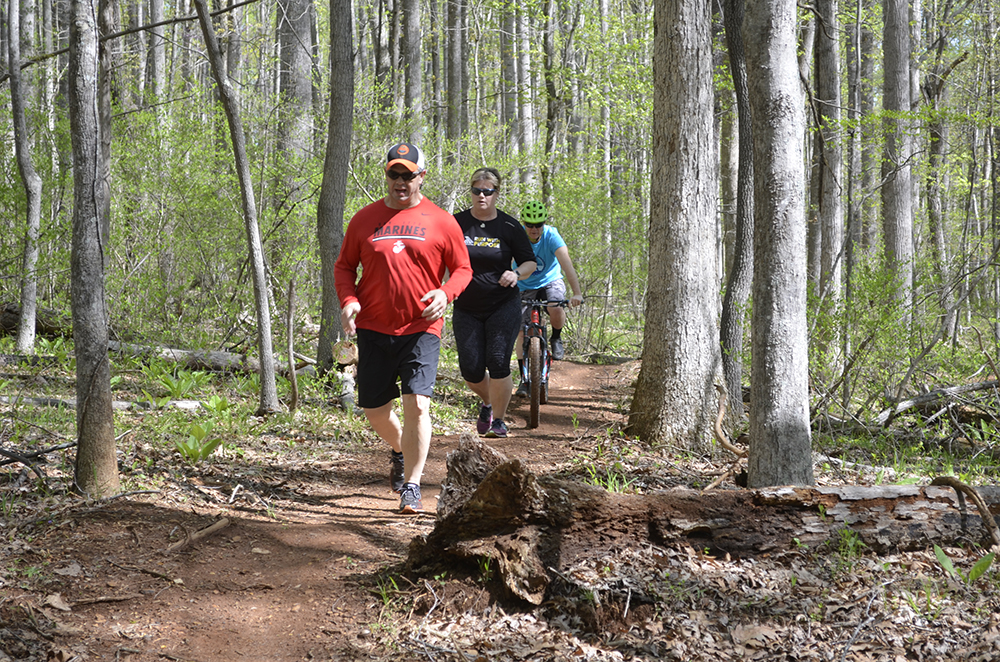
New London Tech Trails in Bedford County Perfect for hiking, trail running and mountain biking, the New London Tech Trails—built in 2017—is one of the area’s newer outdoor destinations. Although the trail system was designed as a “power lunch” option for employees in the New London Business and Technology Center park, it is open to the public as well.
With 6.5 miles of multi-use trails on 500+ acres, you have plenty of room to explore with friends, family, or even your furry companion. Length: 6.5 miles Difficulty: Easy to Moderate. These are smooth rolling terrain trails with limited trip hazards and clear lines of sight. Options: There are 5 color-coded trails to choose from—the longest loop is 4.3 miles. Where to Enter: The New London Business and Technology Center park is located off U.S. 460 at Meade Road.
The Cole Mountain Loop in Amherst County Wait—or is it Cold Mountain? Apparently both names are acceptable for this hike in the George Washington National Forest. (But Cole is the “official” one.)
Hikers of all skill levels are welcome on this loop that’s a part of the Appalachian Trail. You can make it a workout… or take it slow and observe nature along the way.
The best part about this hike—the Cole Mountain apex is a nod to The Sound of Music (you know, the part at the very beginning where Julie Andrews is running through the field surrounded by gorgeous mountains).
After making the trip up to the top, Cole Mountain hikers reach a wide-open pasture with panoramic views on all sides. It’s the perfect backdrop for selfies, professional shoots, or even a song from your favorite musical. Once you see the view, you may be moved to do pretty much anything.
Length: About 6 miles round trip Elevation Gain: 1,500 feet Difficulty: Moderate How to Get There: Take Route 60 west out of Amherst. Turn right on Coffeytown Road and then another right on Wiggins Spring Road. (Note: Wiggins Spring Road is a forest service road. The drive can get bumpy.) Where to Enter: The parking area is at the end of the trail but you enter about .2 miles north, on the blue-blazed Hotel Trail. Follow those blue blazes to stay on track. Take It a Step Further: Make the hike longer by combining the Cole Mountain loop with the nearby Mount Pleasant hike on the next ridge. Together, they make an 11.3-mile circuit. Be sure to pack a backpack and plan accordingly for this longer journey.
Sharp Top Trail in Bedford County With its impressive summit offering a 360-degree view of the region, Sharp Top Trail at Peaks of Otter is a bucket list hike for Central Virginia natives. Park at the Visitor Center to begin your journey.
Length: 1.5 miles Difficulty: Strenuous Time: Allow two hours for hiking up and one hour for hiking down. Add an extra half-hour for the spur trail to Buzzard’s Roost, which is a series of large rock formations offering different views of the area. What to Pack: Water—none is available at the top. Professional camera—to capture amazing photos.
Mike Donahue Trail in Campbell County Part of the Liberty Mountain Trail System, this particular trail is one of many you’ll find near the Snowflex Centre. We like it because it’s an easy 1-mile loop without a lot of elevation changes. (So you wouldn’t have to worry about getting stuck carrying a complaining child, for example.)
Length: 1 mile Difficulty: Easy to Moderate Where to Enter: The Trailhead is located at the parking lot of the Snowflex Centre. Take It a Step Further: For those wanting more of a challenge, try out the Lake Trail and Dirty Ridge trails nearby. Nearby Attractions: Once you’ve finished your hike, take the family over to the LU Monogram and grab some photos as you overlook the city.
NATURAL RELIEF FOR SEASONAL ALLERGIES
THINKING OUTSIDE THE (MEDICATION) BOX
This spring, just ask around (or simply pause to listen for the din of coughing, sniffling and sneezing), and you’ll discover that environmental allergies seem to be a common nemesis—especially in deciduous tree–dominated central Virginia. By taking a walk down any typical drugstore aisle, you can see just how prevalent the issue is by the number of “allergy relief” medications that stock the shelves. There are pink pills and green ones, nose sprays and eye drops. Look more closely at those labels, however, and you’ll see the unnerving plethora of potential side effects that result from continued use.
What if there was a more natural way to calm—or even eliminate—those bothersome allergy symptoms?
Nature’s vaccine
“I like to tell people that homeopathy* is a similar concept to that of vaccination,” explains Steffi Wells, a manager at Health Nut Nutrition in Wyndhurst. “Homeopathic supplements introduce your body to specific allergy triggers in order to gradually build up your immunity to those allergens.”
Wells recommends that those who suffer from seasonal allergies get a jump on natural treatments before symptoms begin. “It’s most effective to begin taking homeopathic supplements ahead of the season, starting with a higher dose and reducing the dose as the seasons continues,” she says. “Everyone responds differently, but many of our customers report a reduction in symptom severity—and some even eliminate symptoms altogether.”
So, how do you know which supplement is right for you? Many people have had testing done and know the specific culprits responsible for their sneezing and coughing. If this is you, you’ll be able to choose the perfect single-ingredient tincture from the shelf. And it’s perfectly fine to combine multiple supplements to create an individualized immune-boosting cocktail. “For people who don’t know what their specific trigger is,” says Wells, “the ideal is to take a supplement that has a combination of the most common allergens.” Again, as the body adjusts over time, the dose gradually decreases, with some people able to stop dosing by season’s end.
In addition to the vaccine approach, Wells recommends that allergy sufferers try a natural alternative to prevalent over-the-counter antihistamines: Nettle and Quercetin (both histamine regulators). “This supplement, that combines both, is ideal for immediate relief from sneezing and coughing,” she says. “And it works very well in conjunction with lower-dose homeopathy later in the allergy season.”
Moreover, this approach eliminates the grogginess and dryness often associated with antihistamine use. Although Nettle and Quercetin can be taken daily or as needed, there isn’t the same tolerance buildup like with antihistamines, which can require higher and higher doses for the same level of effectiveness.
Sweet relief
According to Wells, the most precise natural tactic to defend against spring allergies is to savor a few spoonsful of gooey golden goodness every day. “We sell a ton of locally sourced honey,” she says. “The bees have been spreading pollen specific to our region and to this particular year, so they’ve done all the work in identifying exactly the right ingredient.”
Much like the homeopathic supplements, ingesting the honey daily helps your body build resistance. Wells adds, “Taking just a tablespoon in the morning, one midday, and one in the evening can significantly impact allergy symptoms.” Health Nut Nutrition customers report that this sweet treatment is extremely effective—some families purchase a gallon of honey at a time. Bonus: Honey supplies antimicrobial qualities as well, delivering year-round benefits such as potential cold and flu prevention and faster recovery.
Turning to natural remedies isn’t new. In fact, many of the homeopathic ingredients have been used for millennia. And although their initial uses clearly predated laboratory studies, today’s science is demonstrating the hows and whys of these traditional treatments. So, if you’re one of those people who can sense the season’s transition not by the longer days but the number of sneezes, maybe it’s time to consider an alternative to those little pink pills.
*These statements have not been evaluated by the Food and Drug Administration.
To learn more about natural remedies for allergies or discover the many benefits of natural holistic health, visit the Health Nut Nutrition website at healthnutnutrition.com. Or check out their store located at 1701 Enterprise Drive, and take a tour of all their organic groceries, supplements, and beauty products.
Strength in Numbers
LIVESTRONG at the YMCA transforms the lives of local cancer survivors
There was nothing abnormal when Tina Barcellona got ready for bed one night during the spring of 2018.
The Concord resident had finished a long, profitable day. She even played several games of pickleball that afternoon with friends, one of her favorite pastimes.
The then–59-year-old tucked the covers over her body and took a deep breath, but something didn’t feel quite right. “I don’t even know what prompted me to feel my breast, but I did,” she said.
There was no pain, but it felt strange and unfamiliar—a small thickening that was definitely not normal. “I never presumed anything,” she said. “I just figured it was what it was.”
Several days later, Barcellona scheduled a mammogram appointment through her gynecologist’s office. Nothing problematic had appeared on her previous mammogram, so she wasn’t too concerned when she arrived. But that technician decided to make her an appointment at Virginia Baptist Hospital for a more advanced mammogram.
After a mammogram and a biopsy there, the phone rang a few days later. The doctor on the other line explained that her lump, an estrogen-fed tumor, was cancer.
“I cried that first day when they told me … and maybe a few times after that,” Barcellona said. “But that was it.”
Because Barcellona, like many others with cancer, was focused on moving forward. In the weeks and months that followed, she underwent chemotherapy to reduce the size of her tumor, then surgery to remove the growth. Barcellona, now 60 years old, has endured 36 radiation treatments since the operation. These physically taxing medical procedures can result in fatigue, hair loss, loss of appetite, and even nausea and vomiting.
Barcellona adjusted her schedule around her appointments, determined to defeat the sickness that burdens thousands in America. She fought to maintain a normal life. “I wasn’t going to let this cancer beat me,” she said. “I realized that this was the road I will have to take.”
Several months passed before Barcellona discovered LIVESTRONG at the YMCA, a no-cost, 12-week health and wellness class for cancer survivors that’s hosted through the YMCA.
Curious, Tina enrolled, but she didn’t realize the tremendous impact the program would carry.
“I got right into the program, and I haven’t regretted it at all,” Barcellona said. “It was just a blessing.”
LIVESTRONG at the YMCA launched in 2007 as a partnership between the LIVESTRONG Foundation and the YMCA to promote and educate the importance of physical activity following a cancer diagnosis. It is now a nationwide program and began in Central Virginia in 2018.
According to livestrong.org, a top concern among cancer survivors is a difficulty of returning to physical activity after treatment. The LIVESTRONG Foundation and the YMCA teamed up to satisfy that need.
“This is a program that can touch everyone one way or another,” said Randi Abell, the director of Central Virginia’s program.
“One of our goals is to introduce participants to as many facets of the YMCA and fitness as possible. Because the goal is for them to continue this healthy lifestyle.”
Although the program comes at no cost, the YMCA uses grant funding and donor supported financial assistance to continue and support it. It costs the YMCA roughly $725 per participant.
Abell’s goal is to serve 54 cancer survivors annually, which totals nearly $40,000 in collected funds each year. Since the YMCA of Central Virginia launched its initiative in 2018, the LIVESTRONG at the YMCA program has helped 60 survivors, including Barcellona.
“We’ve got some people in the community who believe in this,” Abell said, who also is an instructor and coach for the program. “For us, it’s hard to find someone who hasn’t been affected, directly or indirectly, by cancer.”
Participants utilize multiple aspects of the YMCA during their biweekly classes, including Zumba, yoga, cycling, weights, and even pool exercise classes. The program holds a 1-6 ratio between coaches and participants.
Instructors monitor and evaluate participants’ strength, cardiovascular conditioning, balance, and flexibility. Evaluations also assess quality of life before and after participation.
Arthur Brown, who is battling stage four prostate cancer, said the improvements were noticeable in his body after enrolling in the program.
“It seems kind of crazy that I can put my pants on in the morning without holding on to anything for support,” the 76-year-old, who recently graduated from the program, said. “It was a great experience. I pushed myself to do a lot more than what I had been doing before, and I think it really payed off.”
Three months ago, Brown could barely walk down his driveway without taking breaks. Now, he can nearly climb the Monument Terrace steps in Downtown Lynchburg all the way to the top without assistance, a goal he is determined to reach.
“I haven’t been able to walk all the way to the top of Monument Terrace yet without stopping, but I’m getting close,” he said.
Since the program’s inception, LIVESTRONG at the YMCA has served over 70,000 survivors in more than 800 communities nationwide. Although breast cancer is the biggest demographic among participants, the program is open to all survivors ages 18 or older, regardless of diagnosis.
“The cancer center is designed to treat or cure your cancer,” Abell said. “Survivorship is so much more than that. People want to get out of the clinic. They don’t want to be in a hospital setting anymore. They want to move on with their lives after their treatment is over.”
But the program is more than just physical activity; instructors equip participants with correct exercise techniques.
“Most people don’t know how to do exercise properly, so that’s why they avoid it,” Abell said. “We want to provide them with the knowledge, the tools, the resources, but also the competence to feel comfortable going into a wellness center later [after they complete the program].”
During the 12-week program, survivors receive free YMCA memberships, a tremendous benefit that also extends to their immediate family. And even after graduation, program alumni receive discounted YMCA memberships for a full year.
Lynchburg’s program graduated 17 survivors on Thursday, Dec. 5 at the Express YMCA location. Each participant received an award for their perseverance and growth.
Vera Parks, a breast cancer survivor, was in this group.
The 51-year-old fighter saw a drastic change in her life following her participation, which she credits to the exercise as well as the comradery she shared with fellow cancer fighters.
“It brought forth so much healing to be able to be in the midst of people who care,” she said. “They always made everything fun.”
As a coach, Beth Zeisig loves seeing participants truly enjoy their classes. “To bring joy to someone else—and to hear it in their words—really strikes a chord with me. It’s a ministry to me. …I truly believe God put me on the earth to help people,” she said.
Moving forward, and as Barcellona continues recovering from her cancer, she wants the LIVESTRONG at the YMCA program to continue to thrive.
“I just hope that more people can find out about the program… but also to support the program as well,” Barcellona added.
“They just made people stronger… even if people were really hurting on the inside.”
Parks agrees, saying LIVESTRONG at the YMCA truly improved her strength, both physically and mentally, so she can make the most of the rest of her life.
“They showed us that we could do some things that we thought we couldn’t do,” Parks added. “It made us feel powerful.”
For more information about LIVESTRONG at the YMCA, visit ymcacva.org, call the corporate office at (434) 771-7621 or visit any of the YMCA of Central Virginia Family Centers.