Minding Midtown

Penny Lane Properties Focuses Revitalization Efforts on Fort Avenue

By: Emily Mook / Photos Courtesy: Daryl Calfee / Photo Above: Palmera House Photo by Ashlee Glen

Daryl Calfee holds—and has historically held—an impressive number of professional titles, but his self-appointed moniker “Big Believer in Lynchburg” may very well be his most prominent, enduring, and inspiring designation.

You do not need to converse with Calfee for long to become aware of his steadfast passion for and action-backed investment in the Lynchburg community, but you will undoubtedly want to keep the conversation going to see what he has planned next in his ongoing efforts to improve and enrich life in the Hill City.

As the owner of Penny Lane Properties, a Class A Commercial and Residential Construction and Development firm that he (along with his first wife, Johanna, who passed away in 2023 after a courageous battle with cancer) established in 2009, Calfee has spearheaded adaptive reuse projects that now house some of Lynchburg’s most beloved commercial spaces: Casa Nueva Events, Palmera House, Taco Jesús, Golf Park Coffee Co., Farm Basket, Bentley’s on Bedford, Mission Thrift on Bedford Avenue, Marsh Roots Seafood Company, Truss Restaurant, Scratch Pasta Co., Bacon St. Bagels, Teachable Moments Preschool, Benaiah Prints Co., and Super Rad Arcade Bar, among others.

Over time, Calfee and the Penny Lane team—which currently includes COO John Rerick, Jesús Ochoa on project management, Brittany Sydnor on interior design, Brandon Sydnor on budget and finance, and Billy Hansen on commercial real estate—have shifted from an initial focus on rebuilding and restoring residential properties to a focus on commercial projects that more directly impact the community as a whole.
“We started out mostly doing residential flips, and that moved into commercial spaces,” Calfee remarked. “Our first project was a commercial space downtown in 2009, but after that, we couldn’t find anything else downtown, so we ended up doing a couple of residential projects next. Then, we moved on from those back into commercial because I wanted to hold on to everything that we did. I know that fixing and flipping are cool and show-worthy, but for long-term redevelopment and the betterment of our city, I wanted to do bigger projects that we could hold on to.”

When it comes to choosing commercial projects, Penny Lane seeks out spaces that have storied pasts and the potential to tell new—and often very different—stories in the future.

“We love doing the projects that nobody else wants to do,” noted Calfee. “When things have character, patina, and age to them, they create a different nature in your community than new construction does—not that there’s anything wrong with building new construction commercial, because we all need that for development—but old buildings just have so much character of their own, and we love bringing that back to life.”

As indicated by the aforementioned list of the firm’s commercial projects, Penny Lane has effectively breathed new life into Bedford Avenue. Having gained valuable insights from that work, the firm is now focusing its revitalization efforts on a bustling but largely underutilized area in Lynchburg: Fort Avenue.

“Fort Avenue was an untapped space,” Calfee said. “You’ve got a high traffic count and a key location in the middle of the city, but the truth is that it’s been underutilized and forgotten for so long. I had the opportunity to buy five buildings in a row from an old friend, and we were about to finish up Bedford Avenue. Looking at what we learned from Bedford Avenue, we said, ‘If we had acquired all of our Bedford Avenue properties at one time and redeveloped them as we went there, we would have paid less and we would have seen the benefit of increasing the property values around us—which, instead, we just had to pay for.’ I think that what we learned from Bedford Avenue is what we want to take to Fort Avenue.”

After buying those five buildings, Calfee—along with his wife, Erica Kerns-Calfee—discovered a former dry cleaner’s building on Fort Avenue and transformed it into event venue Casa Nueva, which opened last year. They subsequently bought the Bee Line garage building from Kevin Jones, owner and president of Bee Line Transport, Inc., and they plan to bolt Casa Nueva and the garage together and build up on the garage.

“We’re planning to add some rooftop terraces,” Calfee added. “If you can imagine, it’s the Fourth of July at the Hillcats Stadium and there’s a semi-pro soccer game happening over there—it’d be a cool spot to be in to watch fireworks.”

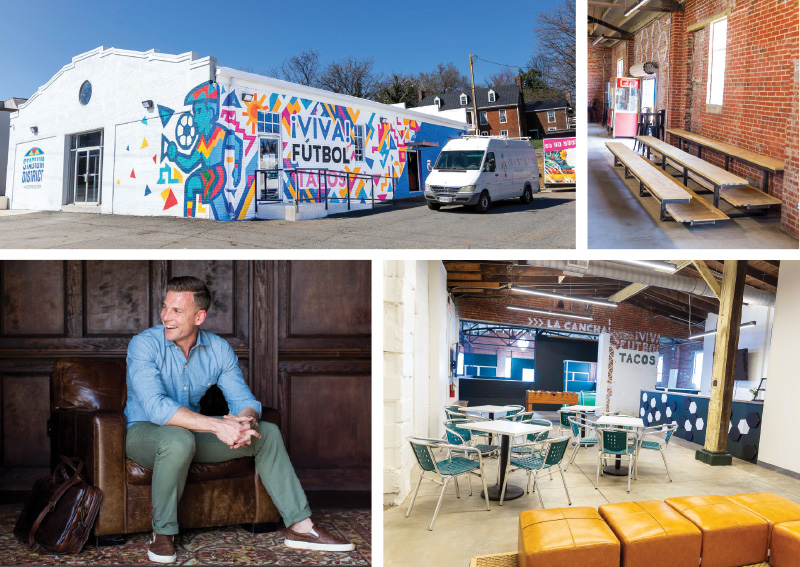
Penny Lane’s work at the other five Fort Avenue buildings has kickstarted with an exciting dual development that marries a fan-favorite sport (soccer) with a fan-favorite cuisine (Mexican): Stadium District Indoor Soccer and a second Taco Jesús location, both of which launched in March.

The project has been one of the most involved that Penny Lane has taken on yet—the Taco Jesús building did not have a roof—but Calfee said that it has also been one of the most rewarding projects yet.

“These buildings, every day, once you rebuild them, move into a state of decay if you’re not constantly maintaining them,” he remarked.

“As people age and end their careers, and as their financial resources change, they just don’t have the ability to maintain these buildings in the same way. That creates opportunities for guys like me to come along and say, ‘Hey, I can look at this with new eyes, and we can put something different in here.’ That place has been auto parts for the last 70 years or more. What we saw was something completely different, and I think that’s part of the ‘American Dream’ story. Not only are these old buildings getting new life, but there’s also this idea that there are people who might have been marginalized before who now have the opportunity to chase down that ‘American Dream’ by being part of these kinds of projects.”

Depending on how the venture goes, Calfee noted that an expansion into the building next door is possible and could allow for the addition of more fields and bigger fields. Redevelopment is also currently ongoing at the former site of The Carpet Shop, and Penny Lane is adding a new building and an infill lot in the middle of the two buildings for a mixed-use commercial, residential, and office space. The firm also recently completed work on the Humbles Building on Fifth Street.

With so many irons in the fire—Calfee is also the director of marketing at Hurt & Proffitt and a father of three children, among other roles—one may wonder how he does it all. While that question seems unanswerable, Calfee credits Kerns-Calfee, his friends and colleagues from both of his occupations, and others for their own tireless work and for their unwavering support of his endeavors.

“For me to have been carrying so much for so long, then for Johanna to pass, then for me to be a single dad, and then to find love and a partner in Erica—that’s an important part of my journey,” he said. “Having friends locally is a big part of my journey, too. When you think about the subcontractors and partners that we have in redevelopment, we’ve got some really great friends who do great work. We couldn’t do what we do without them. And then you think about finances; we couldn’t do what we do without folks like Luke Towles at Pinnacle [Financial Partners], Sherri Sackett at Select [Bank], H.B. Hunter at First Bank [and Trust], and Brent Jenkins at Freedom First [Credit Union].”

No matter what the future holds for Calfee in his many ventures, one thing is for certain: his love for and commitment to the Lynchburg community are for life.

“Being part of our city and improving our city are the most rewarding things about what I do,” he stated. “I love Lynchburg. Yes, my primary residence is across the county line, but that doesn’t change the fact that my entire portfolio of properties is in Lynchburg because I love it! We want to be here. We’re not outsiders—we don’t come in from somewhere else, make our money, and move out. In fact, we’re the opposite: We’ve invested all of our own money into these properties in order to make Lynchburg a better place to be. We’re just big believers in Lynchburg.”  

This article was originally published in the April/May 2026 issue of Lynchburg Business magazine.

“We Have a Different Story to Tell”

The Masterful Making of Lynchburg at War

By: Emily Mook | Photos By: Ashlee Glen

“Teamwork gives you the best opportunity to turn vision into reality.” – John C. Maxwell

As singular concepts, creativity and collaboration undoubtedly drive change.

A painter with a brush, a writer with a pen, a musician with an instrument—these and other solo creative pursuits account for much of the world’s great art and prove that individual perspectives and pursuits can change history. Non-creative acts of collaboration also make significant impacts by creating reliable systems, maintaining structures, and improving processes that are integral to modern human existence. The novelty of creativity and the consistency of non-creative collaboration both play important roles in shaping the world around us and in shaping our own understanding of ourselves and the roles we play as individuals and as members of a collective.

Then there is the magical and somewhat elusive point at which these notions converge and creative collaboration is born. When you consider your favorite bands, films, and other joint ventures that entail the intentional sharing of creative control and presence of multiple perspectives within a single project or process, you likely experience a feeling of serendipity. The best creative collaborations can make you think, “Those people were meant to make art together.” Within minutes of sitting down to interview Greg Starbuck, Lindsey Smith, and Daniel Dixon, I was struck by that very conviction.

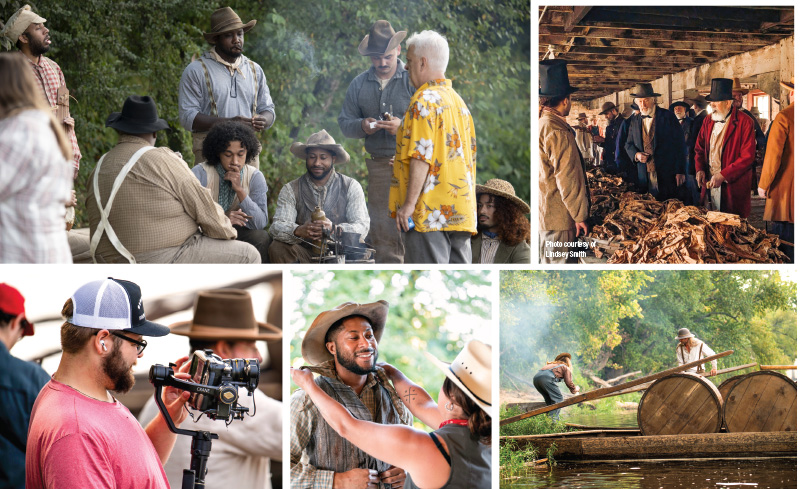
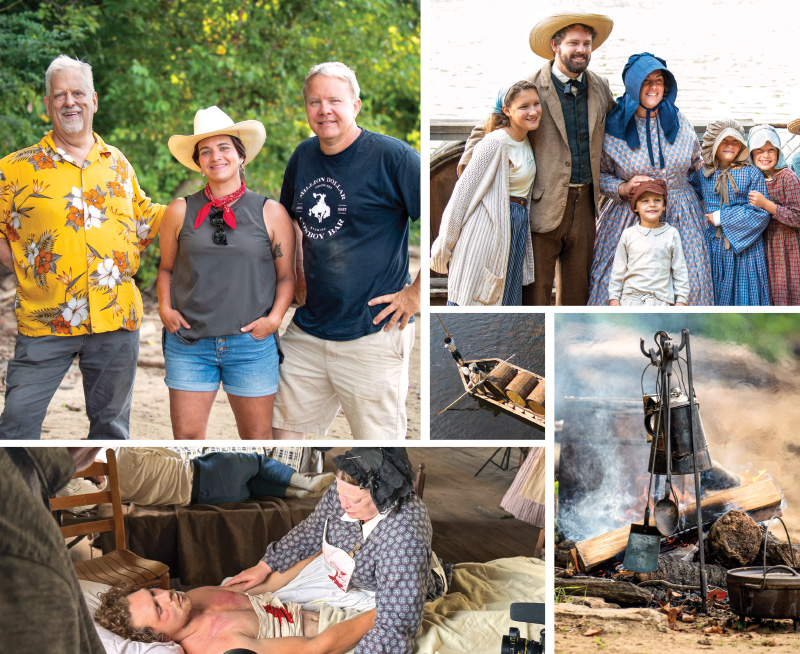
Starbuck, Smith, and Dixon are the three main collaborators on Lynchburg at War, a locally produced and filmed documentary that delves into the everyday experiences of distinct groups of people living—or stationed—in Lynchburg during the Civil War.

Starbuck, who has been the executive director of Historic Sandusky since 2002, is the documentary’s writer and director, Smith is its wardrobe supervisor, and Dixon is its production and set designer—but these titles barely scratch the surface when it comes to what the three have poured into the film.

“There’s not really a name for what we do,” Dixon noted. “If there’s a need to be fulfilled, we find a way to get it fulfilled. If there’s cohesiveness that’s needed, that’s what we handle. Every mile, every step of the way, the three of us are lockstep. We tend to be the triumvirate. ”

Lynchburg at War first came about after Starbuck’s 2010 film Hunter’s Raid: The Battle for Lynchburg wrapped.

“We had so much fun working on that film that as soon as it wrapped, we said, ‘Well, let’s do another one!’” Starbuck said. “We worked on it for a couple of years, set it aside, and then I started working on it again in 2016. Then a bunch of forces came together within the past year, and we thought, ‘You know, it’s time to go ahead and finish this.’”

Dixon and Starbuck, who met when Dixon’s construction company built some additions and did some renovations for Historic Sandusky when the organization was first getting its legs, worked on Hunter’s Raid together and discovered a shared propensity for pulling out all the stops.

“We are ‘more cowbell’ type people,” remarked Dixon. “Our director of photography, Rob Hodge, came to town one day. Greg had initially asked me if we could find a van that had a door in the side that we could shoot from the inside out to emulate a train car.

Well, instead of doing that, we ended up building a bunch of train cars! We built one, decided that wasn’t enough, built another, still needed more cowbell, built another, and so on. We like to max out to the extent that we can line up resources and find contributors who we know will fulfill their commitments. Doing things this way provides a real sense of enjoyment and a real sense of accomplishment.”

That level of dedication typifies Lynchburg at War to an even greater degree with the addition of Smith to the crew.

“Her qualities are endless,” Dixon said of Smith. “I knew she had a background in art, dance, and history. I asked her if she would be interested in getting involved in this project and she enthusiastically goes, ‘Oh yeah!’”

“And the next thing I know, I’m making 2,000 tobacco leaves!” Smith exclaimed with a laugh.

Those tobacco leaves, constructed from brown paper and then meticulously colorized, are just one of the myriad aspects of the film imbued with a reverent commitment to authenticity. The driving force behind this reverence is Starbuck’s extensive knowledge—bolstered by decades of research—of Lynchburg during the Civil War.

“I have collected so many primary and secondary sources and even did my master’s thesis paper on Lynchburg during the Civil War,” he stated. “The primary sources that really inform this documentary are people’s diary entries and letters. We’re trying to make the documentary really speak from their words and take ourselves out of the equation. One of the common problems of history is people interpreting it for their own purposes. We want to bring the original voices out to the forefront.”

Among those voices are those of African Americans, most of whom were enslaved and many of whom worked in tobacco warehouses and operated batteaux to transport tobacco hogsheads and other supplies during this period of Lynchburg’s history.

“The perspectives of African Americans are often lost because many of them did not write, and they were often mentioned as an afterthought in journals and letters,” remarked Starbuck. “Faithfully presenting their side of the story is a challenge, but it is critical to this presentation.”

The stories of women—especially those who assisted with war efforts—during this period are also largely underrepresented in film.

“These are untold stories,” said Smith.

“A lot of what we’re shooting has never been shot before. Anyone who has done any sort of genealogy knows that there are huge gaps in the information we have about our history. The stories that we’re telling—the Gunpowder Girls, the Ladies’ Relief Hospital, the batteaux scene—if we don’t tell their stories, who’s going to tell them?”

In addition to authentic and authentic-looking props—some owned or made by cast and crew members and others provided by Buzzards Roost antique shop owner Todd Hunley—telling these stories faithfully requires meticulously designed sets, period-accurate costuming, and dedicated actors.

“When it comes to production and set design, we don’t build from the ground up; rather, we look at how many possibilities are available to us,” Dixon noted. “You also have to shoot around so many things. Some of the places we use are very familiar to people and they would recognize them right away; for instance, we did a shoot in front of the chapel at the Quaker Memorial Presbyterian Church. So we say, ‘These are some possible places we could go; now who do we know there and how do we get access?’ We try to take each space and material we have access to and milk it like a sponge. For example, when we shot the Ladies’ Relief Hospital, we took apart all the platforms that we had used for the tobacco auction shoot and reassembled that sawmill lumber into tables, walls, and doorways.”

As far as costuming goes, LionHeart FilmWorks founder and costume designer (among several other titles) Kevin Hershberger has lent most of the film’s costumes.

His Richmond-based costume house is the largest historical costume house in the U.S. outside of Los Angeles and New York City.

“Usually, we’ll go to Richmond and pick out what we need for the upcoming shoot,” remarked Smith. “In costuming, we have to think about what the actions are going to be. Are these going to be women who are coming in from outside? Are they going to need a parasol or a fan? Are they going to take off a bonnet and hang it up? I love creating individual stories within the overall story.”

Of course, aesthetic authenticity is only half the battle when it comes to making a war documentary of such a high caliber; the actors must also imbue their roles with emotional heft and nuance.

In addition to staged scenes that have literally required the actors to get into character—for instance, the women in the Gunpowder Girls segment of the film actually assembled cartridges for a few hours—some serendipitous moments of impromptu collaboration have allowed the actors to more fully embody their roles.

“I don’t even know if this is a conscious decision, but what we do impromptu on micro and macro levels is we plan things out to a point,” Starbuck stated. “We get all the people together, and the people generally have an amazing amount of talent and creativity themselves. We put all the elements in place, and then we end up brainstorming on the spot. It just happens organically.”

A balance between fun and focus amongst the cast and crew—composed of a mix of professionals and amateurs—provides the ideal environment in which these unplanned moments can unfold.

“While we do have a great time on set, we understand that at the end of the day, we have a responsibility to tell these stories respectfully and accurately,” said Dixon.

This strong sense of community on set in some ways mirrors Lynchburg’s overarching experience after the Civil War.
“Lynchburg’s story is unique because it was really the only city in Virginia that wasn’t captured and then destroyed,” noted Starbuck. “Lynchburg’s recovery from the war in terms of economy, commerce, and race relations was probably better than any other city’s recovery in the South. There were Northern investors down here within weeks, stores were filled with goods, farms were not destroyed, and there was still some livestock here. Lynchburg resumed normal business pretty quickly, which goes against type. Lynchburg is a different story—a story of resilience, luck, and focus. We have a different story to tell.”

With filming still underway, that story is still unfolding. Starbucks hopes for a spring 2026 premiere and notes that the film will be released on Blu-ray.

As he sat back in his chair and beamed at his two closest and most trusted compatriots in this venture—this magical meeting place of creativity and collaboration—Starbuck voiced his own wonder at the magnitude of it all.

“Seeing what started as an idea in my head grow beyond my expectations has been so rewarding, as has seeing the fulfillment and joy on people’s faces both behind the scenes and in front of the camera,” he said. “We’re all dreamers. It’s hard sometimes in life to participate in something bigger than yourself and put your stamp on it. When you can give someone the opportunity to rise above the daily mundane and explore their dreams, you do it.”


Hip to Be Square

Squared Biscuit Co.’s Cutting-Edge Take on a Breakfast Staple

By: Emily Mook | Photos By: Ashlee Glen

For many of us, the pastimes and projects we pursued during the height of the COVID-19 pandemic proved to be provisional, but for some, these pursuits took root and blossomed into long-term, life-changing ventures. Jacob Laverty, founder and owner of Squared Biscuit Co., falls into the latter camp, and as a result, Lynchburg’s breakfast (and brunch) game is stronger than ever.

“I always knew that I wanted to own a restaurant with a simple concept that focuses on the ingredients,” Laverty said. “During COVID, I started randomly making buttermilk biscuits and refining how to make them. I studied classic and modern recipes to help come up with the biscuit recipe that we use today. Once I started getting the recipe honed in, I thought that I could try my chance with the [Downtown Lynchburg Association’s] Launch LYH program and see what could come from it.”

Laverty entered and ultimately left the 2023 program and promised himself that he would reenter in 2024; he did so, secured a grant, and opened Squared Biscuit Co. on Fifth Street on June 20, 2025.
Since opening, the restaurant has already become a downtown fixture known and sought after for its signature-shaped take on a breakfast staple: the square biscuit. In addition to its aesthetic appeal, the square biscuit reduces waste.

“The main advantage of the square biscuit is that it produces less waste than the standard round biscuit,” noted Laverty. “While it doesn’t fully eliminate the waste, we use whatever excess we have to create some pre-meal bites for our customers.”

Squared Biscuit Co. also prides itself on fresh, high-quality, and largely in-house-made ingredients and on efficiency. Biscuits are made fresh daily and without lard or liquid shortenings, and everything—even the pickles featured on their Nashville Hot Fried Chicken Biscuit—is made in-house (except for the hash browns). As Laverty puts it, the restaurant is “not a fast-food place, but we make quality food quickly.”

Specialty menu offerings include the aforementioned Nashville Hot (Laverty’s personal favorite due to its “balance of flavors, the heat, and the homage to Nashville”), Pimento Cheese and Hill City Hot Honey Fried Chicken Biscuit, Chipotle Onion Bacon Jam Biscuit, Smashed Sausage Biscuit, Biscuits and Sausage Gravy, and the Croque Madame, a decadent biscuit featuring ham and cheese smothered in a creamy béchamel sauce and topped with a sunny-side up egg and chives. Biscuits composed of various combinations of the classic ingredients—including ham, sausage, bacon, egg, and cheese—are also available, as are a variety of sauces, sides, and drinks.

Community is the cornerstone of Laverty’s business model. As such, he strives for a “simple, yet elevated” approach and vibe and offers a “variety of sandwiches and various pricing tiers.” He also has several plans in the works that will undoubtedly strengthen that community connection even more.
“Squared always has our community in mind first,”

Laverty remarked. “We know that downtown is a food desert, which is why we plan to add a grocery section in the future to help combat this need. We are also getting ready to launch our website, which will allow people to put in bulk orders with at least 24 hours’ notice, and we have a few dinner events up our sleeve that we will be announcing soon.”

As these developments take shape and Squared continues to grow and evolve, Squared Biscuit Co. will continue to serve its customers with a square meal and a comfortable and welcoming space to simply be.

“I’ve always loved the large city style of restaurants that are inconspicuous on the outside, but filled with delicious foods and great people,” said Laverty. “Squared is a place to bring friends or somewhere to just unwind and catch your breath.”


Crafting Change

The Scrappy Elephant’s Sustainable Approach to Arts and Crafts

By: Emily Mook | Photos By: Ashlee Glen

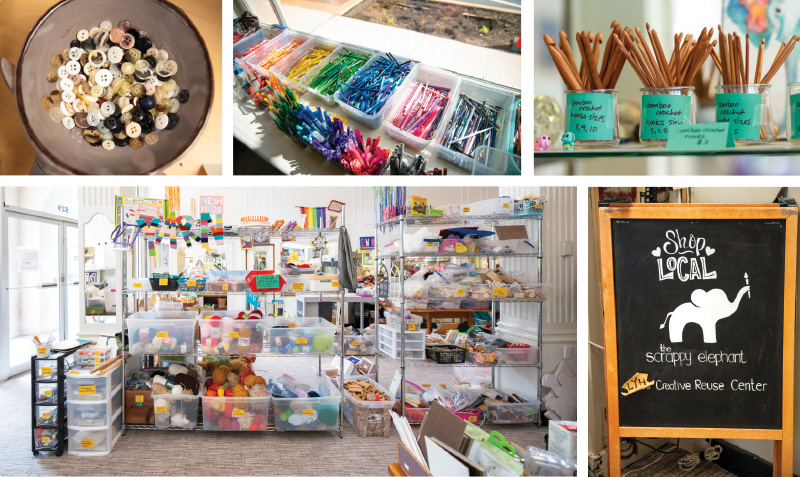
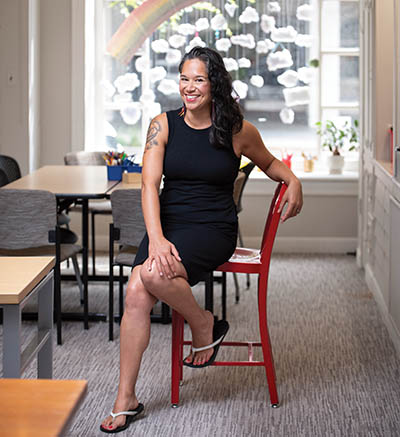
One of the most remarkable aspects of art is its ability to transform raw materials into a unique expression of creativity. When those materials are sustainably sourced, something even more remarkable occurs: as the materials are given new life many times over, several processes of transformation ensue and a mosaic of creative expressions exists within a single work of art. Of course, the environmental impact of creative reuse is also noteworthy; diverting materials from landfills helps curtail the production of methane and toxic chemicals that are harmful to the environment and to all living beings. Sarah Sweet is passionate about creativity and conservation, and she has built a business—with shops in both Charlottesville and Lynchburg—that is leading the charge in promoting both of these practices. That business, The Scrappy Elephant, has kept a staggering 199,431 pounds of materials out of landfills since opening in 2020.

After Sweet, a painter and former art teacher, had her daughter in 2013, she found herself grappling with increased concern for the environment. Determined to find meaningful ways to help mitigate the planet’s ongoing climate crisis, she discovered a creative reuse shop while on a trip in Nashville that would inspire her to ultimately open her own.

“As soon as I walked into Turnip Green Creative Reuse, I felt like I found what I was searching for,” Sweet recalled. “It was a place that combined my love of art and a way to positively impact the planet. I began researching Creative Reuse Centers as soon as I got home and visited as many as I could drive to in order to learn more.”

While networking with other CRCs around the country, Sweet made up her mind to open her own center and received some helpful advice from Utah-based CRC The Clever Octopus: choose a memorable name. Her choice, “The Scrappy Elephant,” is not only memorable, but also fitting for a female-led CRC and deeply meaningful to Sweet.

“When I was in Ghana, I had the amazing opportunity to see elephants in the wild,” she said. “I fell in love with them. And since elephant families are led by females, and this is a female-founded business, I knew I had to use them in the name. And I went with scrappy because it’s a scrap store! Also, a little from our website: ‘Elephants are creative communicators, kind, loyal, self-aware, and some of the most intelligent animals that exist. They can also paint!

Scrappy Elephant

The elephant embodies all the values The Scrappy Elephant holds dear: We are a place where creativity and kindness abound and where the makers who come here are aware of their impact on the future of this planet.’”

The Scrappy Elephant started as a 400-square-foot pop-up shop in Palmyra before expanding to an 800-square-foot space, also in Palmyra, in September 2020. In August 2022, the shop moved into what would become its central hub: an 1,800-square-foot space in Charlottesville. As the shop’s popularity grew, so did its square footage; it doubled in size in January 2024 and added on an 800-square-foot classroom space in July 2024. Then, as more and more Lynchburg residents visited the shop and expressed wishes for a CRC in Lynchburg, Sweet set her sights on opening a second location.

“After expanding a lot in 2024, I promised my team that 2025 would be a year to rest—but then a CRC near Lynchburg closed, and resting is not a strong suit of mine!” Sweet exclaimed. “We discovered the Launch LYH program and knew the timing was right to look into expanding into a new location and to spread creative reuse down south.”

Sweet opened a pop-up shop on Main Street in April 2025 and, after receiving one of the Downtown Lynchburg Association’s Launch LYH grants in June, Lynchburg’s branch of The Scrappy Elephant became a permanent fixture. Alongside these physical expansions and upgrades in both locations, staffing and offerings have also increased.
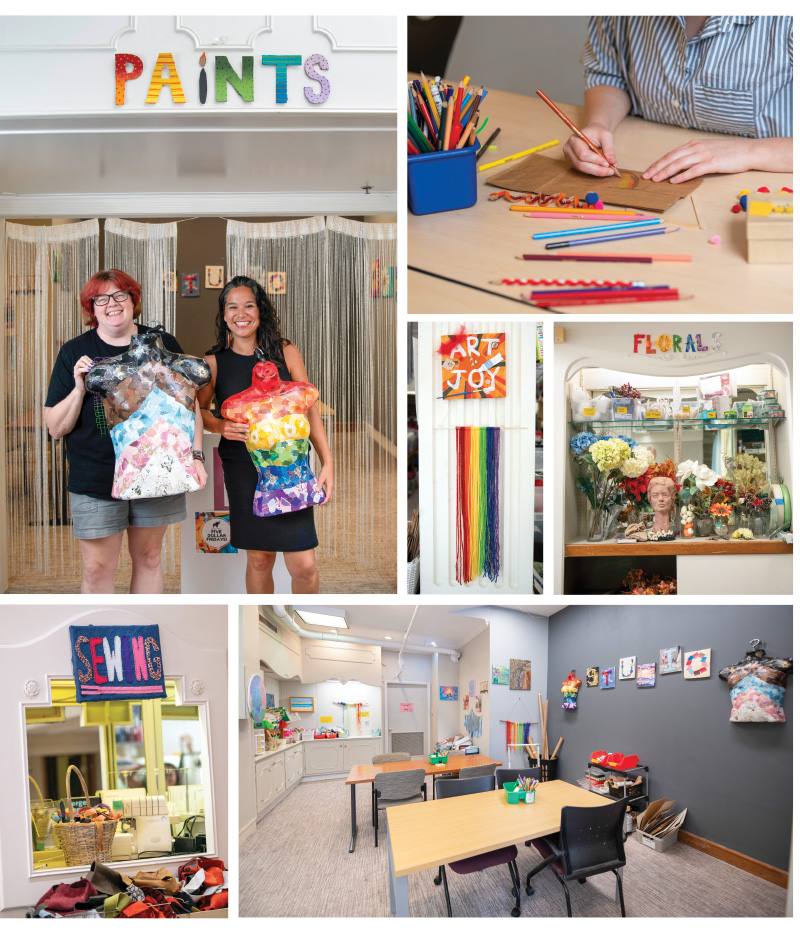
“We have also grown our staff (ten people now!) in our class and camp offerings, and we now have something called the Artful Elephant—we rotate eight artists every three months and give them the space to sell their work,” remarked Sweet. “We have always supported several nonprofits with our nonprofit rewards program; when customers shop, they receive a button that represents 50 cents and they choose which nonprofit they’d like to support. Each nonprofit then gets to come shopping for art supplies each month. Now, we are able to support even more with our Lynchburg location.”

Lynchburg’s current nonprofit participants are Amazement Square, Riverviews Artspace, The Arc of Central Virginia, Vector Space, and The Academy Center of the Arts.
Community members play a crucial role—in the capacities of shopper, donator, and even art class teacher—in helping The Scrappy Elephant achieve its mission of fostering creativity and creating joy while also reducing landfill waste.

As shoppers, customers can fill small, medium, or large bags for a fraction of the cost of new supplies. There is also a studio space available to rent for an hour of creative play or for two hours for parties.

As donators, community members are asked to check the shop’s website for a list of accepted items and to bring items in bags or boxes that they don’t wish to keep. Upon receipt of materials, staff members weigh and sort them meticulously to ensure an optimal shopping experience.

Finally, community members with art education experience are encouraged to inquire about teaching opportunities at The Scrappy Elephant.

“Most of our teachers are Scrappy customers,” Sweet noted. “Whenever people ask about teaching, I’ll have a chat with them to learn about their teaching experience, and then, if they are qualified, I put their class on our schedule.

Class prices are set by each teacher, and teachers receive 60 percent of whatever the class earns. In Charlottesville, we offer a wide variety of classes: mosaic, watercolor, bookbinding, crochet, knitting, sewing, printmaking, and more. In Lynchburg, we are slowly building up our class schedule. We have two amazing local Lynchburg teachers who have already taught classes and are offering more. One of our staff members, Marie, is going to be teaching some classes as well. If anyone is interested in teaching, please contact us!”

Of course, with increased participation comes an increased need for parking; as such, Sweet is hoping for a move this fall to a space with attached parking spots. More generally, she hopes to see an ever-increasing focus on conservation over consumption.

“Almost all of us have enough—if not too much—stuff,” she said. “I think it is important to stop and think before making purchases of any kind.

Owning this business has changed my shopping habits dramatically; I rarely shop for myself anymore and when I do, I almost exclusively shop secondhand. You can find almost everything you need at secondhand stores. I think it is important to think about voting with our dollar. There are many businesses that exist today to do good in the world and that put people and the environment before profit.”

The Scrappy Elephant undoubtedly does good in the world and possesses a unique ability to honor the past and, in so doing, also enrich and protect the future. There is also something singularly beautiful about knowing that a material that once helped someone express their creativity could someday help someone else express theirs too.

Sweet relishes the opportunity to facilitate this collective, cyclical process of making art and marvels at its far-reaching positive impact.

“So many people have been so grateful over the years to be able to bring us their deceased loved ones’ supplies, knowing that they will get used and loved again,” she stated. “So many people have been grateful to bring their supplies somewhere when they are moving so they don’t have to pack them all up and carry them along. So many people have gotten back into making art because of the Scrappy Elephant. So many people have started new hobbies after taking classes here. One person even told us that one of our meditation boxes (a simple upcycled cigar box filled with colored pencils, coloring pages, and a journal) saved her life and pulled her out of a deep dark hole. I love hearing how Scrappy is people’s happy place.”


Service through Sustenance & Skills

Park View Community Mission’s Comprehensive Fight Against Food Insecurity

By: Emily Mook | Photos By: Ashlee Glen

For many of us, food can be both fun and frustrating. When it comes to our culinary experiences, our emotions may range from excitement about trying a new recipe or restaurant to ennui over planning and preparation. We consider notions of form, function, and perhaps even presentation, and we may forget what a privilege it is to think about food in such certain terms and to contend with things like indecision and overwhelm rather than hunger and food insecurity.

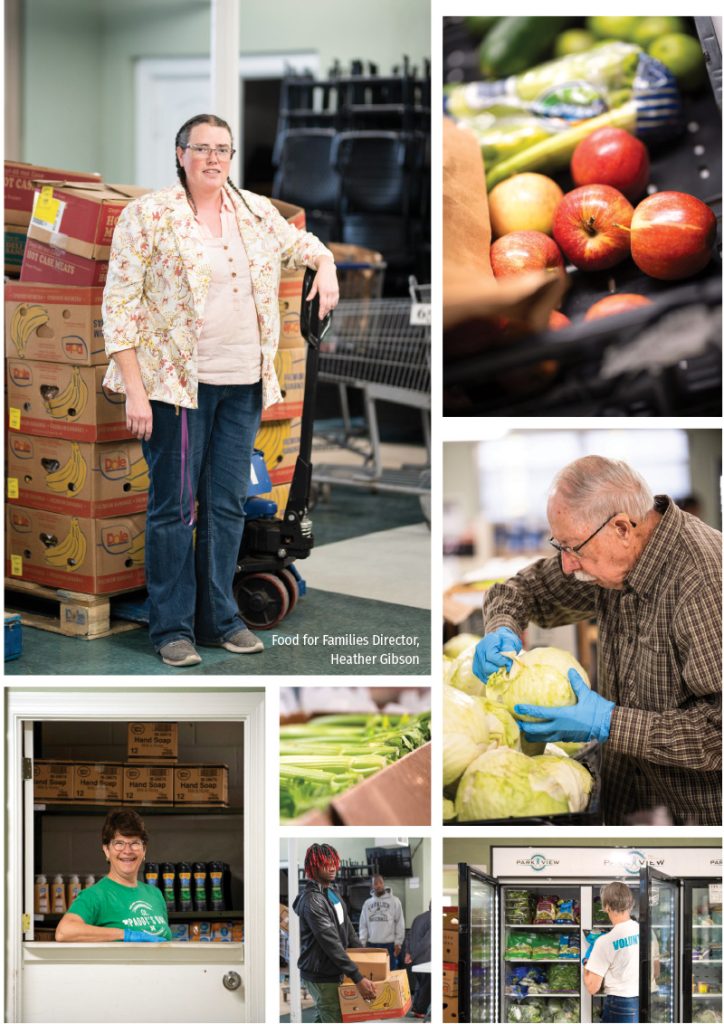
Merriam-Webster defines food insecurity as “the fact or an instance of being unable to consistently access or afford adequate food,” and according to the 2024 USDA Food Security Report (the latest data available), a staggering 13.5 percent of U.S. households experienced food insecurity in 2023. Lynchburg’s statistics mirror that figure very closely; according to Park View Community Mission’s Food for Families Director Heather Gibson, the latest Feeding America’s “Map the Meal Gap” data indicates that 13.6 percent of Lynchburg’s citizens are food insecure. That data also indicates that surrounding counties aren’t too far behind: Appomattox is at 12.1 percent, Amherst is at 11.8 percent, Campbell County is at 11.2 percent, and Bedford is at 10.7 percent. As these numbers continue to climb globally, nationally, and locally, food-distributing nonprofits are experiencing more demand than ever before and thus need more attention and community support than ever before. Lynchburg is home to several such organizations, including the outstanding and uniquely comprehensive 501(c)(3) Park View Community Mission.

Located at the corner of Memorial Avenue and Wadsworth Street, Park View Community Mission began as a weekly Wednesday night dinner service in 1996. It was spearheaded by the late Fred Fauber and the late Larry Brooks and initially run by members of the now-disbanded congregation of Park View United Methodist Church. Those weekly dinners continue today as the Park View Café, providing at least 100 meals each Wednesday from 4:30 to 5:30 p.m. A carryout setup—introduced after the onset of the COVID-19 pandemic—allows neighbors to dine in or take their meals to go. Volunteers (and Park View staff, as needed) conduct all steps of the process.

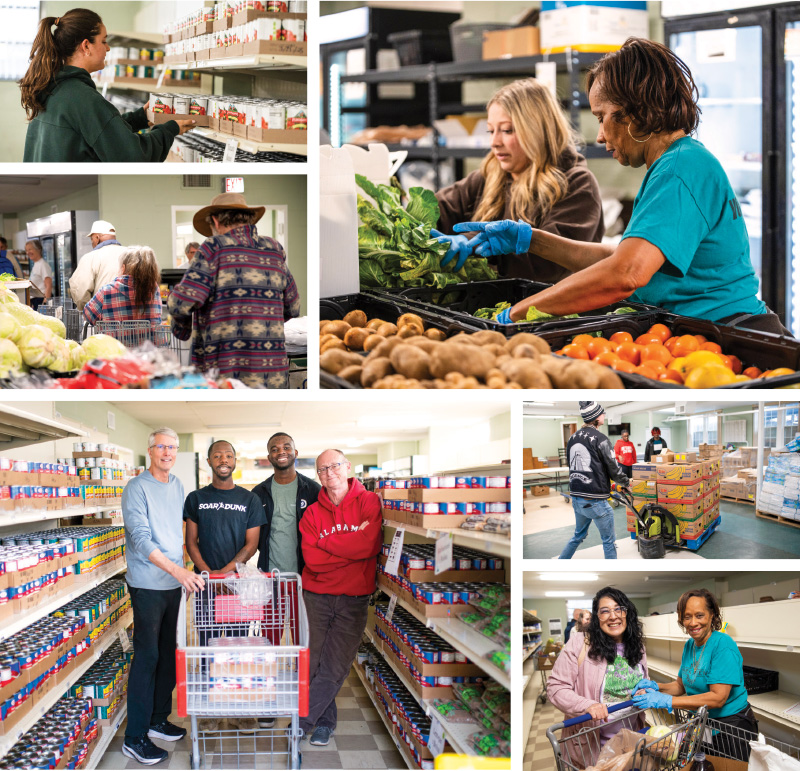
“Typically, we have various groups cook and serve the food,” Gibson noted. “Volunteers can come and help set up, serve, and take down at the end of the dinner. If they want to cook, they can reach out to the director of the Café and she can schedule a time for them to cook. If we don’t have enough volunteers, then the staff pitches in. Due to the bad weather in February, we had a group cancel, so I cooked chili for 100.”

After 20 years of providing weekly meals, Park View added a service that would ultimately become the cornerstone of their organization: a food pantry called Food for Families. Since its creation in 2006, Food for Families has grown into Lynchburg’s largest food pantry and into the largest client-choice pantry in the state west of Richmond.

The pantry is open from 9:30 a.m. to 2:00 p.m. on Thursdays and Saturdays, and emergency food bags are available to anyone who needs them on the days the pantry isn’t open.

“We began serving groceries to about 40 families per week, and we now serve over 400 families each week,” said Gibson. “In 2024, Food for Families served 16,479 families from Lynchburg, Amherst, Appomattox, and Bedford and Campbell Counties. We receive USDA food from the Blue Ridge Area Food Bank; this food is given free to anyone living in Virginia whose yearly income is below 250% over the poverty line. We also receive weekly donations from Walmart, Kroger, Panera, Little Caesars Pizza, Flowers Foods, Tree of Life Midtown, and Starbucks. Along with these donations, we receive donations from food drives done by churches and businesses along with donations from individuals. We can always use non-perishable donations.”

Park View also welcomes non-perishable donations for its Food for Thought initiative, which provides food during the weekends to Lynchburg students in need. Launched in 2018, this initiative provides elementary school students with bags including two breakfasts, two lunches, and three dinners and middle and high school students with access to food pantries.

“Students are identified by the guidance counselors of the schools, and parents sign a permission slip to allow their children to receive food,” Gibson stated. “Each school decides how to distribute the bags at the end of the day on Fridays. Some do it in the hallways and some in the last class of the day. Foods given out include ravioli, tuna, chicken noodle soup, cups of mac & cheese, individual cereal cups, shelf-stable milk, and snacks. Food for Thought provided 38,865 weekend meal bags last year.”

Food insecurity is a complex issue that extends beyond food scarcity, and thus the fight against it necessitates holistic education and support.

Park View’s remaining initiatives—the Clothing Connection, the Community Resource Center, and the Life Skills Institute—allow the organization to address and mitigate other roadblocks to food security.

The Clothing Connection provides free clothing, the Community Resource Center provides eviction and utility assistance and matches neighbors with other organizations as needed, and the Life Skills Institute imparts practical life and career skills.

“Our Life Skills Institute provides job readiness training through the ‘Vital Skills with Jeff from CVCC’ series,” remarked Gibson. “It teaches the necessary soft skills for retention, interviews, making career goals, and networking. LSI has classes on financial wellness and computer skills, as well as a series of cooking classes through the VA Extension Office. We also provide clothing for job interviews and to start your new job.”

In addition to offering these six invaluable initiatives, Park View is dedicated to raising community awareness about food insecurity and about how to join in the fight against it.

“We have an educational component to make people in the community aware of food insecurity,” Gibson said. “The directors of the programs are always willing to discuss Park View with civic groups, college classes, and churches. We also have the Teal Bag Initiative that has a food drive and educational components. We will give any organization a presentation and will provide teal reusable shopping bags with lists of needed items. We then arrange a pickup time for the bags.”

As demand for these comprehensive services continues to rise, Park View is hoping to find a larger physical space to meet that demand.

“With the increase in neighbors, we have outgrown our physical space,” noted Gibson. “Our neighbors have to wait outside until their numbers are called before they can come inside. We are looking at options to be able to serve more families in our community.”

Community awareness and support are critical in ensuring that Park View Community Mission can continue to serve our most vulnerable neighbors. As we consider our feelings about and relationships with food, may we also consider the feelings and needs of those whose relationships with food are less secure.

“Individuals can help in the fight against food insecurity by donating to local food pantries in both time and money,” Gibson stated. “It takes quite a few people to help stock the pantry and then help our neighbors grocery shop during distributions. The most rewarding thing about my job is knowing I am helping to feed our neighbors, but the most challenging thing is making sure I have enough food to go around.”


How Her Garden Has Grown

Unearthing the Nuanced Strata of Anne Spencer’s Life, Home, and Garden

By: Emily Mook | Photos by: Ashlee Glen

A museum is a paradoxical thing: a permanent fixture that seeks to preserve the ephemeral, a stationary monument to that which once buzzed with momentum, a tangible rendering of such lofty intangibles as hopes, dreams, fears, love, and perhaps even radical change.

These paradoxes are especially pronounced when a museum was once someone’s home, as is the case with the Anne Spencer House and Garden Museum. The eclectic beauty and thoughtful sophistication of Anne Spencer’s home and the profound tranquility and majestic splendor of her garden make an indelible impression and lend themselves pliantly to an oft-told narrative of Spencer’s life: she was an introspective creative who found respite—and helped others find respite—from the turmoil of their times in the carefully curated comforts of the home and garden she and her beloved husband, Edward, built and inhabited together. This narrative is not untrue, but it is also not close to complete. Spencer contained multitudes and made waves that continue to create ripples in and far beyond Lynchburg, and she frequently did so outside the walls and trellises of her Pierce Street abode.

Spencer’s granddaughter Shaun Spencer-Hester has served as Executive Director and Curator of ASHGM since June 2010 and has made it her mission to not only maintain and educate others about the physical spaces that her grandmother held so dear, but also to uncover and make known the complex, nonphysical layers of Spencer’s life and legacy. As more and more layers are revealed, may we come to a truer understanding of the seeds of change that Spencer and her colleagues sowed and strive to cultivate the resulting crops with care.

Spencer-Hester emphasizes to Museum visitors the kineticism of the luminaries who visited Spencer and of Spencer herself.

“When people come to visit the Museum, I try to reiterate the importance of the people who came there,” said Spencer-Hester. “They came to visit Anne Spencer, but those footsteps didn’t stay there—they went out into the community.”

Among those luminaries were James Weldon Johnson, W.E.B. Du Bois, Langston Hughes, George Washington Carver, Zora Neale Hurston, Countee Cullen, Marian Anderson, Thurgood Marshall, and Dr. Martin Luther King, Jr.

The accomplishments of these and other visitors are abundant, vast, and well-known on a global scale, but many of them achieved things right here in Lynchburg that may get overlooked. It is important to note that although Spencer ended up forging personal connections of varying degrees with some of these visitors, she did not simply offer her home as a place of rest and retreat for friends; rather, she wanted to facilitate change in and beyond Lynchburg by hosting those whose work she believed in and with whom she felt collaboration would be possible and fruitful.

“The people who visited Anne were here doing big things—they weren’t just walking around downtown going to the barbershop or buying groceries,” Spencer-Hester noted. “You have to realize that, at that time, it was a different town. African Americans had to be careful about where they went around town. These people were coming to pursue whatever interests they had with Anne and connecting with other like-minded people in the area. George Washington Carver came and they talked about plants and seeds and flowers. W.E.B. Du Bois came and they talked about justice and equality, as did many of the people who came to visit. And then there were writers like James Weldon Johnson, who was compiling The Book of American Negro Poetry, who came to talk about writing and activism.”

Johnson’s collaborations with Spencer were particularly noteworthy.

“When James Weldon Johnson came to that house, he came as a guest—someone my grandparents knew only as a field secretary of the NAACP from New York City,” stated Spencer-Hester. “He and Anne met with 22 other community members and established the Lynchburg chapter of the NAACP right there in that living room. He helped bring justice to Lynchburg by joining forces with Anne and other activists in the community.”

Langston Hughes and W.E.B. Du Bois also made their mark on a local level. According to Spencer-Hester, Hughes spoke at the University of Lynchburg [then Lynchburg College] in the 1940s and “Du Bois lectured at Virginia Seminary and conducted studies on African American culture and history in this area.”

Spencer herself didn’t shy away from speaking out either.

“Anne wasn’t just this little lady sitting in her garden on Pierce Street who wanted to be left alone,” Spencer-Hester said. “She was involved and active. She was boycotting public transportation and fighting for the integration of teachers for the school system. She was doing things here in Lynchburg that I don’t think she really gets credit for. Maybe she was a quiet mover about it, but she was definitely in the meetings. She confronted Carter Glass!”

Glass was a white newspaper publisher and politician from Lynchburg who advocated for segregation. According to Spencer-Hester, the confrontation occurred when Glass and Spencer both attended a public meeting in Lynchburg about education and the hiring of Black teachers.

“Carter Glass attended this meeting—which consisted mostly of African American attendees—and he got up to speak,” remarked Spencer-Hester. “He kept speaking and speaking, and my grandmother got up and told him to be quiet and sit down to give someone else a chance to talk. It was bold for a Black woman to do that!”

Indeed, Spencer’s boldness in the spheres of community and collaboration, of letting wild things grow and of cultivating positive change as a collective, is reflected in her home and garden—both during her life and after her death. For starters, both spaces resulted from a beautiful partnership between Spencer and Edward.

“The home and garden were definitely extensions of not just Anne, but also of her family,” Spencer-Hester noted. “Edward and Anne were both instrumental in making these spaces into places where people could feel comfortable and have open discussions. I don’t think people think of Edward as an artist, but he was definitely a creative. He utilized elements of math and science to construct, and Anne brought the arts, the colors, and the patterns. Together, they had a vision of what their home and garden could be.”

Additionally, the garden was just as much a hub of activity as it was a place of quiet contemplation for Spencer during her lifetime.

“The garden is often described as this place of leisure and a place of retreat for Anne, but they also partied in that garden!” exclaimed Spencer-Hester. “They had a party for Langston Hughes that was in the house but extended into the garden. There’s an article in one of the African American newspapers that says they had 350 people there! It’s a beautiful green space that they created, but that doesn’t mean that they just used it to talk about flowers and sip on mint juleps. They were having big discussions, celebrating weddings, and hosting children’s groups like the Jack and Jill Club.”

After Spencer’s death in 1975, this spirit of collaboration continued to define her home and garden. Spencer-Hester fondly recalls a memory of her father, Chauncey Spencer, going through photos of his parents’ garden and the resulting community restoration project that helped shape the garden into the resplendent space it is today.

“When I was younger, my father was going through photographs at home and asked my sister Kyle and me to help him pick out photographs of the garden,” Spencer-Hester said. “In 1983 he started asking around town about restoring the garden. By this point, the house had been made a historic landmark, and my father started really directing his attention toward the garden. He talked to us a lot about the garden and what it meant to him and how special it was. He ended up meeting with Jane Baber White, who later told me about the meeting. She said she immediately fell in love with the garden. The collection of small black and white photographs on display at the Old City Cemetery are the photographs my father gave to Jane.”

White was a landscape designer and a member of the Hillside Garden Club.

After meeting with Chauncey, she met with Lynchburg Garden Club member and fellow landscape designer Mina Walker Wood, and together they approached the Hillside Garden Club to inquire about taking on the major task of restoring the Anne Spencer Garden.

The Hillside Garden Club agreed, and thus the restoration began.

“Folks raised funds and donated trees and flowers and E.C. Glass students helped lay down brick,” recalled Spencer-Hester. “It was truly a community project, and not just a restoration project—people learned about Anne Spencer.”

Even the plants themselves that once populated and still populate the Spencers’ garden tell a tale of gathering and collective growth.

“Anne had quite a collection of roses, and we still have many of her original roses, as well as many of her plants and trees and shrubs,” Spencer-Hester remarked. “She also grew native flowers. She and Edward would drive the Virginia highways and dig up Virginia native flowers—don’t do that today; it’s illegal!—and bring them home and plant them in the garden. They had what we consider today an early pollinator garden, and there’s still evidence of that. She also loved and grew nasturtiums and wrote about them. She had a lot of lilies as well. I’m doing research in her archives at UVA, and there’s a huge collection on her garden. I’m going to meet with the [Hillside] Garden Club at some point about planting some new plantings in the garden from this research of her magazines and of catalogs she checked off and ordered from. This garden is a living thing. It’s something you have to preserve and continuously restore.”

Anne Spencer’s legacy, too, is a living and evolving thing, and Spencer-Hester’s incredible dedication to researching and disseminating all aspects of her grandmother’s life has allowed that legacy to bloom so very brilliantly. There is a lot of love in that stewardship, and there’s also a lesson: when it comes to your elders, do a little digging. You never know what you may unearth about them, about yourself, and about the garden we’re all growing, together.
“I didn’t know a lot of these things about my grandmother,” said Spencer-Hester.

“She was really something. I’m amazed and very proud. There’s a lot you don’t know about your elders until you’re older—or maybe not even when you’re older! It depends upon whether or not you’re interested. I tell people to ask their grandparents and parents and uncles and aunties simple questions while you can: ‘Where were you born?’ ‘What were your parents like?’ Even if it doesn’t seem important to ask these questions, it is. It’s amazing how all of our stories are intertwined.”


A Feather in His Cap

Greg Starbuck’s Remarkable Experience as a Historical Headwear Hobbyist

By: Emily Mook | Photos By: Ashlee Glen

If you know—or at least know of—Greg Starbuck, you likely already know that he wears many hats. If you don’t, however, he would simply like for you to know that he makes them. Starbuck has been creating authentically reproduced 19th century headwear, specifically Civil War kepis, for more than 40 years, and his experience doing so is like something out of a Hollywood movie—or, as it were, something in multiple Hollywood movies.

Starbuck’s early interest in American history paired with his early exposure to sewing made him ideally tailored for his eventual—and highly fruitful—hobby as a kepi creator.

“I grew up with a mother who was into quilting, so I grew up surrounded by sewing machines and fabric,” he remarked. “It was not an unfamiliar domain for me.”

Starbuck made his first cap at the tender age of 13, but the hobby really took hold during his time working at a historic Civil War site in Georgia in the 1980s.

Greg Starbuck“A big part of our programming involved people dressing up in uniforms,” he recalled. “Back in those days, you couldn’t just go online and order historical gear, so some of my colleagues and I would get together and sew things ourselves.”

Starbuck soon realized that he had a particular affinity for creating kepis.

“As time went on, I gravitated toward Civil War headgear because the pieces are distinctive and attractive—and small!” he said. “Making the headgear also entails working with fabric and leather, and I like working in both of those disciplines.”

According to Starbuck, the kepi is “ubiquitously associated with the Civil War,” but it actually originated in France. America adopted its style for the Civil War, and many other countries—including Japan, Mexico, and Germany—also adopted its style in the 19th century. With its easily identifiable shape and style, the kepi is undoubtedly an iconic historical artefact.

Starbuck’s ability to honor the kepi’s rich history while innovating and improving his creative process makes him a master in his field.

“The techniques, materials, and equipment I use have all evolved over time,” he said.

“Even though I’ve been doing this for more than 40 years, I’m still always learning.

It’s fun to discover new things. I may have done something a certain way for 20 years and then learn a new approach that’s easier and also produces better results. I’ve gotten more economical and streamlined over the years.

It’s natural to evolve and improve when you do the same thing for this long!”

Of course, innovation sometimes entails an enhanced aptitude for authentically replicating techniques of the past, as is the case with the fabrics Starbuck uses for his kepis.

“In the early days, I would just go to the fabric store and buy fabric, but now there are a lot of places that specialize in producing fabrics exactly the way they were produced in the 19th century,” he remarked. “They will weave the fabrics on looms and dye the fabrics with vegetable dyes rather than modern dyes.

The materials now are much more exciting to work with because they replicate what was used back then so well.”

From start to finish, Starbuck’s kepi-creating process runs like a well-oiled machine.

“I keep a pile of fabric and leather on hand,” he stated. “When I need to make something, I simply pick the right pattern out—I have 30 to 40 patterns—trace it, cut it out, assemble the basic framework by machine, and then hand-sew the rest. I then hand-sew the leather components like the visor and sweatband. I also have a supply of buttons on hand because each cap has a button on either side. I’ve literally accumulated thousands of buttons over the years! There’s also some ironing involved.”

As luck would have it, Starbuck took on another hobby in and beyond the 1980s that would ultimately help catapult his kepi-making hobby to A-list Hollywood heights: acting as a TV and film background extra.

“The 1990s and 2000s were a sort of golden age of historical movies, and I got to work on several of them as a background extra,” he recalled. “They [movie crews] typically use the same 40 people and just dress them up differently for different scenes. Being an extra got me slightly into the Hollywood network.”

Among the films Starbuck has appeared in are Ironclads, The Broken Chain, Tecumseh: The Last Warrior, Forces of Nature, The General’s Daughter, The Hunley, and the hugely successful and acclaimed The Patriot. He can be seen playing a squeezebox in a bar scene in The Hunley and playing a fife in the Charleston British headquarters scene in The Patriot.

Greg Starbuck

Starbuck’s first major motion picture costuming experience was as a props assistant on Gettysburg in 1993. He cites his first big costuming break as 2003’s Gods and Generals, saying that “the costume designer for that film was a history friend of mine, and he called me to see if I could create the headwear.” He designed and produced more than 80 pieces of principle headwear for all lead actors in the film including Stephen Lang, Jeff Daniels, C. Thomas Howell, and Bruce Boxleitner.

2003 proved to be a banner year for Starbuck; his next project was the blockbuster smash Cold Mountain. He both designed and handcrafted Civil War headgear for Jude Law and other actors and served as an advisor to the costume department.

Since 2003, Starbuck has worked on over a dozen film and TV projects, most notably 2012’s multi-Oscar winning, Steven Spielberg-helmed Lincoln.

“I did four caps for Spielberg’s Lincoln,” noted Starbuck. “They said they needed one of the caps by a certain date, but then they contacted me and said they needed it sooner for rehearsals in Baltimore because Spielberg wanted everyone to rehearse in full costume. I told them that even if I finished it that day and shipped it the following day, it wouldn’t make it in time, but they said, ‘No problem; we’ll send someone to pick it up.’ So, someone came and picked it up and drove it to Baltimore.”

Regardless of the size, scale, and commercial success of—and personalities involved in—Starbuck’s many projects, he says that every experience has been his favorite.

Greg Starbuck

“The energy, enthusiasm, and adrenaline rush on a movie set is unparalleled,” he remarked. “Each project is different, and those differences keep things fun and interesting!”

Similarly, whether Starbuck is making a kepi for a major celebrity, a museum exhibit, a living history or reenactment event, or a noncelebrity history enthusiast, he approaches each project with curiosity, enthusiasm, and a profound regard for both the client and the craft.

“I think the most rewarding thing is seeing someone really happy with what I’ve made for them,” he stated. “It’s great to see someone in their 60s acting like a kid at Christmas! It’s also great to see what you’ve made up on screen on a famous A-lister.

Of course, it’s not just about producing something—the process is also a form of relaxation therapy for me. It’s something I truly enjoy doing.”

No matter what his next move—or movie—may be, Starbuck tips his hat to the legacy he has built thus far.

“If I stopped tomorrow,” he said, “all of my dreams would have been realized.”


A Concerted Effort

The Community-Building Power of the Village Concerts Series

By: Emily Mook / Photos by: Brianne Friberg

The power of music is boundless and often paradoxical: it hearkens back even as it innovates, it defines moments in time and is defined by those moments in seemingly equal measure, it can inspire conflicting emotions within seconds, and it can transport listeners while simultaneously making them feel more grounded. And yet, despite its myriad complexities and its capacity for evading definition, music has at its center an abiding feature: the ability to foster meaningful connection. 

Music can—and does—mean entirely different things to different people, but anyone who listens to it can agree that it is meaningful, and so we find ourselves listening to it, talking about it, and perhaps even making it together. In the extraordinary case of Polly King and Van Holton, music has led to finding a life partner and hosting a groundbreaking concert series together that spotlights and nurtures music’s singular community-building power: the Village Concerts Series.

King started the Village Concerts Series in Palmyra, Virginia, in 2007 and met Holton
when he attended one of the concerts in 2009. Long before that fateful meeting, music had
played a significant role in both of their lives.

Co-organizers, Van Holton and Polly King

“I’ve been a groupie since the late 60s,” Holton remarks. “Nobody could ride in the backseat of my Volkswagen because I had so many boxes of 8 tracks back there!”

For King, music was a constant in a childhood characterized by frequent change.

“I was an army brat, and we ended up traveling quite a bit,” she recalls. “My mom loved to sing and cofounded a choir in Wilmington, North Carolina, many, many years ago. We always had a piano and I learned to play the flute.”

At a certain point, King realized that she felt more suited to playing a supporting role when it comes to music, and this realization played a role in her decision to get her master’s degree in Arts Administration.

“I always loved the arts in general and gravitated toward creative people,” she notes. “I always felt that many of my friends were more creative than I was, but I was a good organizer and support person. When I ended up going to graduate school at Virginia Tech, I went for a MFA in Arts Administration with the full intention of being the background person.”

After attaining her degree, King traveled widely and worked for the Baltimore Symphony, a chamber music and jazz producing company in Mount Gretna, and an ethnic folk arts center and a baroque chamber ensemble in New York City. Subsequently, her then-husband got an arts job in Abingdon and hired her to put together an arts series that they called “The New Traditions.”

“The series lasted about three years,” says King. “We featured music, lectures, and films. It was a lot of fun and really brought people together in a good way.”

These experiences, coupled with a desire for connection, led King to start the Village Concerts Series in Palmyra in 2007.

“I started the concert series in Palmyra because I was lonely,” she remarks. “I lived in a village of twelve houses, ten of which were occupied, and when I was home on the weekends, people were gone. I didn’t see very many people. So, I thought, ‘Well, I know how to push furniture back in my living room and put up folding chairs and host concerts,’ and that’s what I did. The first year was rough and I thought I wasn’t going to be able to continue because we didn’t have a lot of people coming for the parties, but then more and more people started coming and this wonderful community of music lovers was built up around a common theme of sharing live music.”

As luck would have it, one of those attendees was Holton, who had incidentally had a similar realization to King about playing a supporting role when it comes to music.

“It used to frustrate me that I can’t sing or play an instrument, but then I learned a word: aesthete,” he states. “An aesthete is an expert appreciator.  That’s me; I can do that!”

And so, although neither King nor Holton sang or played an instrument on that fateful day in December 2009, music—in its limitless capacity for facilitating connection—brought them together.

Holton built King a gardening shed (which was actually more suited to serve as a stage), and in 2013, the pair began hosting annual outdoor “SHED Song” concerts in addition to several indoor concerts per year. The two wed in their backyard in Palmyra in 2015 between the second and third bands of that year’s outdoor concert.

In 2018, the couple decided to move to Lynchburg. After looking into hosting concerts through various commercial venues, they ultimately decided to host concerts at their home on Harrison Street in 2020. After hosting one concert in January and one in March, however, the COVID-19 pandemic shut everything down. In late 2021, they moved to their current home and started presenting again.

Location changes aside, the Village Concerts Series has retained certain qualities from the start: it features a mix of Sunday matinee shows (seven to nine per year) and an annual “SHED Song” show the weekend before Father’s Day, attendees are invited through a mailing list and pay strictly on a voluntary basis, the shows are deemed “listening shows,” and the caliber of music presented is always topnotch.

Because attendance is limited to a mailing list—a longstanding but also ever-growing list—of Holton and King’s friends and friends of friends, Village Concerts are able to operate in a non-capital driven and organic capacity. The couple asks attendees for voluntary contributions and then makes up the difference from their own pockets.

“The folks who attend the concerts are not patrons—they’re friends,” notes Holton. “It’s not about commercialization. We don’t make or keep a dime. We love to introduce our friends to our other friends who just happen to be musicians!”

According to King, “guests can come up and talk to the musicians in the potluck line and have one-on-one conversations that they would never have elsewhere.” That intimate feel also extends to the concerts themselves in that they are considered “listening shows.”

“People come here and learn that musicians want to be listened to,” King says. “It’s rare to be at a show where people actually listen. We’ve had people cry in the audiences of the concerts we host because they’re so moved—the beauty of the music and the experience moves them to tears. People stop talking and truly listen, and the musicians really appreciate that.”

Village Concerts Series concerts are not limited to specific genres of music, but they all feature first-rate talent.

“When people ask what kind of music gets played at the concerts, I always say that it’s good music,” says Holton.
“It could be jazz, folk, bluegrass, rock and roll—it could be just about any genre. It’s professional, high-shelf music. These are artists who live to play music. I personally admire strong stage presence, beautiful timing, and a good backstory. I love to see what music does to a room.”

Past featured artists include Wayne Henderson, Mike Seeger, The Honey Dewdrops, The Steel Wheels, Will Kimbrough, Mary Gauthier, Ana Egge, Morgan Wade, David Olney, Love Canon, David Wax Museum, Arkansauce, Palmyra, Abe Partridge, The Matt Flinner Trio, Tony Furtado, Maeve Gilchrist, Danny Schmidt and Carrie Elkin, Eric Taylor, James and Vivian Leva, Danny Knicely, Tony Trishka, Robin and Linda Williams, Michelle Malone, Seth Walker, and more.

Additionally, at the time of publication of this issue, the Blue Newt Band—a popular and award-winning Lynchburg-based band from the 1990s through the 2000s—will have reunited for their first performance in almost 20 years for a special Village Concert on August 31. The show will have been open to the public and all voluntary donations will have gone to the Lynchburg Daily Bread.

An upcoming collaboration with the Academy Center of the Arts (ACOA) will also increase access to the Village Concerts Series’ unique charms. The Academy will host shows coordinated by Village Concerts in their new Music Hall or in the Warehouse Theater, with the first show slated for September 20.

“Polly and Van are bringing acts to the Academy that they could not bring to their own venue, whether because of audience size, cost of artist, etc.,” remarks Tabitha Abbott, Chief Operating Officer of ACOA. “These acts will be reviewed by an internal committee and presented through the Village Concerts brand. I love how Van and Polly have created a niche audience, and our hope is that we can bring their influence to downtown Lynchburg to continue to diversify the music scene in the arts and culture district. They have a reputation and a following and we are honored to combine our resources to benefit the community.”

As more and more voices add their harmonies to the beautiful melody that King and Holton have composed with the Village Concerts Series, Lynchburg stands to become an even more sought-after musical destination—a fact that is music to King’s ears.

“I find the sense of community especially rewarding,” she notes. “Even though I called the concerts ‘Village Concerts’ because I lived in the village of Palmyra, what has actually grown up around it is a village of people.”  


Watch for Wonder

Torbee’s Refreshing Approach to Children’s Television Programming

By: Emily Mook  |  Photos by: Ashlee Glen

When Tori Buckley Garris sat down to watch a children’s show with her then two-year-old son in 2020, she had no idea that inspiration would strike—and that this inspiration would lead her to not only create her own children’s show, but also lead her on a journey back to herself. At that time, Garris had a corporate job and was working from home due to the COVID-19 pandemic, but for much of her life up to that point, she had passionately pursued and made a name for herself through acting. She had thought that her acting days were behind her, but she suddenly found herself pulled back into that sphere with a new sense of purpose and direction.

“My son and I were watching a children’s show together,” Garris recalls. “It was kind of educational—more entertaining—and looking at it through my professional acting lens, it occurred to me that I could do something like this and it could be much less annoying! That was where the idea started.”

Garris’s acting journey began when she was very young.

“I’ve been acting as long as I can remember,” she says. “When I was in first grade, my music teacher said to my parents, ‘You have got to get that girl into acting. She has no stage fright, and it is so hard to come across someone with no stage fright!’”

Garris’s first public performance as a child was in a production of Joseph and the Amazing Technicolor Dreamcoat at a theater in Chicago, her hometown. She booked her first professional gig when she was 15 and consistently acted professionally from age 19 on.

After taking acting intensives in both Chicago and New York City over the subsequent years, Garris began to weigh the pros and cons of moving to either New York City or Los Angeles to pursue acting even more rigorously. Amidst her pondering, however, a different and more pressing thread of thought emerged.

“The more I thought about it [moving], the more I realized that I kept saying I was pursuing my acting career because that’s what the Lord had called me to do—because it’s what I was supposed to do—but I kept getting offered roles that went against my morals,” she remarks. “They were roles that I would not have been proud to play. If I kept saying I was doing this for the Lord, then why on Earth did I keep getting offered these roles? It was like God said to my spirit, ‘Because you say you’re doing this for me, but you’re actually doing this for you.’ So I literally stopped and said, ‘I don’t know how to do this any other way, so I’m just going to go and do something else.’”

Garris and her husband, Zac, ultimately moved to Central Virginia to be closer to family and friends and had a son, and Garris embarked on a corporate career.

Fast forward, then, to that fateful day when Garris saw a new path emerge in front of her—a path that would allow her to both rediscover her passion for acting and tap into her passion for being a mother. 

“I found that I still had that itch to be an actress,” she notes. “It’s what lights my soul on fire!”

That spark of inspiration ignited quickly into a plan, and thus was Torbee born. It didn’t take Garris long to form a vision and mobilize a team to bring that vision to life. In addition to her acting chops, Garris had some light editing experience and friends with a variety of creative talents who were willing to help.

Central to Torbee’s creation and continued success are two of Garris’s friends in particular: husband and wife Zach and Bryanna Boyd, who serve as the show’s director of photography and executive producer, respectively. Garris shot episodes of Torbee on her iPhone starting in 2021 before taking a break after the birth of her daughter, and when she began working with the Boyds at the beginning of 2023, a whole new world of possibilities emerged.

Garris remarks that the Boyds “immediately understood my vision, bought into the vision, and helped me refine what we were looking to build.”

The Torbee team also includes a graphic designer, songwriter, marketing specialist, and several musicians, colorists, and editors. The team frequently films episodes at Atelier Studio & Gathering Space and outdoors at HumanKind.

Garris’s vision for Torbee is centered around helping families “slow things down in a fast-paced world” and place “wonder at the center of everything.” She cites Mr. Rogers as a “huge source of inspiration because he was known for talking about how children need wonder.”

“In today’s society, we’re so obsessed with information, and we continually put wonder to the side—especially for kids,” she adds.

Garris hopes that Torbee can facilitate wonder by serving as a bridge between screen time and either play time or thoughtful discussion. As such, Torbee covers myriad topics that encourage off-screen engagement, and the videos are conveniently color-coded to indicate which topics are being covered: purple for imagination and creativity; blue for math concepts like numbers, counting, and shapes; green for nature and exploring; yellow for language and story time; and red for emotions and safety.

As a busy mom herself, Garris prioritizes sharing simple activities that use common household materials and showing the process from start to finish.

“I’ll often go to Instagram for inspiration and ideas for simple crafts to do with my kids, but usually life gets so busy that I’ll like and save all these videos and reels and will then never go back to them,” she says. “With Torbee, we want to show the whole process: an idea that we are actively putting into practice. We also just want to create so much content that parents can choose an activity that they already have the materials for.”

In addition to an upcoming series focused on puppet-making and puppetry, major projects with two partner organizations are in the works.

The Torbee team will be working with CASA (Court-Appointed Special Advocates) of Central Virginia on an episode entitled “Things To Know By Heart,” which will focus on helping parents and caregivers equip their children with knowledge they need to know in case of an emergency—namely first and last names of parents/caregivers, phone number, and address—and on helping children understand what makes an adult a “safe grownup.” A free downloadable and printable PDF resource will accompany the episode.

“CASA is a voice for the most vulnerable children,” states Garris. “We are not experts
on trauma, so we want to be able to lean on and promote and recommend organizations like CASA.”

The Torbee team will also be working with Freedom 4/24, an organization that aims to end exploitation of children and human trafficking, to produce episodes centering around personal safety and boundaries for six- to eight-year-olds.

“We want to empower kids to be able to say things like ‘My body is my own,’ ‘I don’t want you to hug or touch me,’ and ‘No is a complete sentence,’” she says. “We’re not ready to produce those episodes yet, but we’re going to be working with Freedom 4/24 and a couple of licensed therapists to create content that is age-appropriate and is focused on being empowering. That’s a really important mission for us.”

When it comes to contemplating Torbee’s future, Garris exhibits the same sense of wonder—of letting things unfold with an open mind, curiosity, and optimism—that typifies Torbee’s content. Beyond hoping to branch out into other languages and to do a traveling live show, she is open to a multitude of possibilities.

“We don’t have one specific vision of where the show could go, but we would love to continue to be a bigger and better resource for parents, caregivers, and kids,” she remarks. “We would just love for Torbee to be a beloved children’s show.”

For more information about Torbee and to find out where to watch episodes, visit torbee.tv.


A River Runs Through It

The Transportive Power of the James River Batteau Festival

By Emily Mook | Photos Courtesy of Holt Messerly & Faye Smith

There are no right or wrong answers to the question, “What makes Lynchburg Lynchburg?” but the annual James River Batteau Festival (JRBF) is undoubtedly a compelling and comprehensive candidate. It is integral to Lynchburg’s history and culture, it bridges Lynchburg’s past and present in both tangible and intangible ways, and it inspires enthusiastic participation in many and an impressive level of dedication in some. Since the inaugural JRBF in 1986, this annual living history reenactment has evolved to allow for advancements and increased community involvement while also staying true to its roots. This effort to strike a balance between tradition and innovation is much like a batteau’s journey down the James River: a delicate dance that requires collaboration, patience, diligence, fortitude, passion, and adaptability. This year’s Festival, which will run from June 15 through June 22, promises to be another dynamic celebration of Lynchburg’s history and of the river that runs through it.

The James River was the site of the first permanent English colony at Jamestown in 1607 and is recognized by Congress as the founding river of the United States. Incidentally, the James is also the founding river of Lynchburg.

“Lynchburg started as a depot for storing goods to be shipped on the batteaux and later the canal down to the markets in Richmond,” explains Robert Campbell, Upper James Senior Manager of the James River Association and longtime JRBF participant. “Over the years a settlement grew up on the hillside above the James where John Lynch ran his ferry across to the north bank on the Amherst County side. This little spot would eventually become Lynchburg, and it all had to do with geography and its position by the river.”

JRBF’s 120-mile, eight-day journey from Lynchburg to Richmond is full of visible reminders of the James River’s rich history.

“There are aqueducts spread down the River which are beautiful examples of stonework from the early 1800s and which carried the canals over the creeks and rivers entering the James,” notes Ralph Smith, Owner of High Peak Sportswear and former Festival Chairman (a position he held for 15 years). “There are also multiple sluices, which are places where the batteaumen—many of whom were slaves—cleared the rocks in particularly shallow places in the River. Many of these sluices are still functional today and are the only way to get a batteau around a ledge or shallow.”

It is important to recognize that many African American men—both enslaved and free—operated the batteaux that made Lynchburg the large city that it is today.

“In January 1854, Frank Padget, a slave and head boatman, lost his life in the process of saving others after the canal boat Clinton’s tow rope broke in the flooded James River at Balcony Falls,”
says Diane Easley, Archivist for the VA Canals and Navigations Society. “Lynchburg resident Sydnor Royall was on the Clinton and successfully swam to shore. Sam Evans, another African American boatman, rescued the rescue party the day after Frank Padget drowned. We need to appreciate the work these men did and learn more about their lives.”

Batteaux are 45 to 50 feet long, six to eight feet wide, flat-bottomed boats made of white oak. They are stored in lakes and ponds and kept submerged underwater to preserve the wood. Campbell, Smith, and Easley have all led or been part of batteau building crews. 

Building and operating batteaux are no simple feats, but dedicated crews happily take on these arduous tasks for JRBF year after year.

“Maneuvering a boat that large and heavy using the same methods that would have been used in the 1700s is truly a unique skill in this world that only a few have mastered,” Campbell remarks. “Wooden poles are used to give the boat momentum and on the other side of that to help slow the boat down. Large sweeps at each end of the boat are used to maneuver the vessel as it shoots through rapids. Batteaux cannot take too many big hits on rocks, so the whole idea is to navigate through a rapid—however long, narrow, curvy or shallow it may be—without having the batteau strike a rock. It is extremely challenging, but for those of us who like a challenge, it is a truly amazing thing to take part of.”

Luckily, when hiccups inevitably occur during the Festival, many hands are on deck to assist.

“More times than I can count, batteaux have gotten hung up on the rocks of this rapid [Goosby Falls] and required sometimes 40 people to be in the water to free the boat,” Smith says. “It’s a great sense of community and nobody needs to be asked to help.”

Although traveling by batteau makes for the most authentic Festival experience, “a trip down the James is great no matter what boat you’re in,” as Campbell says. Those looking for a more laid-back experience may choose to travel by canoe or kayak and to join for a day or two rather than the full eight days. After launching near Percival’s Island, the batteaux and accompanying boats travel to a new camp each day, located respectively in Stapleton, Bent Creek, Wingina, Howardsville, Scottsville, Slate River, Cartersville, and Maidens Landing.

JRBF’s singular sense of community is further bolstered by shared meals and stories and impromptu concerts at the camps and on the River.

Photo courtesy of Faye Smith

“One of the hidden gems of the festival is the fantastic, authentic music that usually comes out while a couple batteaux are hiding in a creek on the side of the James River underneath a 250-year-old aqueduct that has better acoustics than a lot of famous music halls,” notes Campbell. “Those are some of the magical moments that happen while we’re on the River that can never be planned, but end up being as perfect and unique as they are elusive and irreplaceable.”

Of course, in order to provide a framework for these serendipitous moments, the Festival itself must be meticulously planned. Longtime leaders and innovators are looking to the next generation to take the helm. Easley works closely with Dr. William E. Trout III, the Founder of the VA Canals and Navigations Society and one of the founders of the Festival, and she observes that “as we are coming up on the 40th anniversary of the JRBF, we need to recruit younger people for it to continue another 40 years.”

Fortunately, this necessary passing of the torch is already well underway. Smith’s two sons are both longtime participants in the Festival, and his eldest son is the co-founder of the James River Batteau Company.

Photo courtesy of Faye Smith

“My son Will, along with his close friend Will Cash, started the James River Batteau Company in 2022,” Smith remarks. “They give tours out of Scottsville on batteaux.  The business is doing very well, and they were booked for most of last summer. I always dreamed of finding a way to make a living being a batteauman but thought it was impossible. But now my son and his friend are actually making it happen, which is tremendously exciting and gratifying for me.”

JRBF’s success is a direct reflection of the people who plan, run, and participate in it with care—perhaps confirming that what ultimately makes Lynchburg Lynchburg is the people.

“The people who gather to run the river every year are some of the most amazing people that you’ll ever meet,” Campbell says. “There are people from all walks of life. We all put our lives aside for a week to run these big boats down the River with our friends and family and experience living history. We are all in it together while we’re out there. We look out for each other, help each other off of rocks, and help repair each other’s boats, and we laugh and have a good time while we’re doing it!”