In the Heat of Summer: Gardening with Resilience

By: Lindsey Cline-Shrader

As we move from a cool, rainy spring and step into the season of summer squash, sticky, sweet watermelons, and thick humidity, watering quickly becomes one of the gardener’s main challenges. Each year, our summers become hotter and drier—changing how our gardens grow and how we care for them. But plants don’t have to suffer. With a shift in approach, summer gardens can remain beautiful, healthy spaces.

Water Deeply and Early

The best time to water is early in the morning. This gives plants a strong start to the day and allows leaves to dry out by the afternoon, reducing the risk of powdery mildew and fungal diseases. Morning watering minimizes evaporation, meaning less water is wasted, and more reaches the roots.

Whether tending a new bed or maintaining an established one, water deeply and less often. Quick watering encourages shallow root growth, making plants less resilient to drought. Light watering can run off without soaking in if the soil is very dry.

Aim to imitate about one inch of rainfall—placing a shallow pan in the garden can help gauge your efforts. Or dig six inches down and check how far the water has reached.

Choose the Right Plants

Most importantly, plant the right plants in the right place. Choose drought-tolerant plants for sunny, dry areas. Many native species are naturally adapted to our summer
heat and bloom all season. You can also include Mediterranean plants like lavender, rosemary, sage, and lamb’s ear, which thrive in hot, dry conditions.

You’ll often hear gardeners talk about “hydrozoning”— a fancy term for grouping plants with similar water needs.

Keeping thirsty plants together and separate from drought-tolerant ones makes watering more efficient and offers spaces to enjoy after spring blooms disappear.

Reduce your garden maintenance by placing ornamentals in part shade or rich-soil pockets. Unless planted in a thoughtful place, common plants like roses, lilacs, rhododendrons, azaleas, and hydrangeas will likely need afternoon shade, yearly soil amendments, and weekly watering to look their best.

Observe Your Microclimates

Most often, the best improvements and the garden you dream of comes from simply paying attention. Which areas get the most afternoon sun, and which are partially shaded? Which areas have reflected heat from a building or pavement? Which areas get water from a downspout or depression?

These microclimates determine how much watering a space will need. Look for signs of heat stress—sunburnt leaves, brown or yellow leaf edges, or midday wilting—that signal a plant needs to be moved in the fall. Today’s observations shape next season’s plans and slowly build a resilient garden.

Quick Tips

Organic mulches help retain moisture, cool soil, improve soil health, and reduce weeds. Healthy soil holds moisture better, and planting densely helps plants thrive.

Shade new plants during establishment (the first 4-6 weeks after planting) in the summer. Shade cloth, other plants, or umbrellas can provide enough relief for plants to get fully rooted before the summer heat takes them out or slows their growth.

Install a rain barrel, which has two-fold benefits: first, it captures and reduces runoff and erosion, and second, it provides water when our water table dips in mid-summer. The James River Association periodically offers rain barrel workshops.

Use drip irrigation and soaker hoses to conserve water and deliver it directly to plant roots. Overhead watering wastes more water and encourages foliar diseases. If you prefer hand-watering, consider a watering wand to avoid over-spray and water roots directly.

Check containers daily. Potted plants dry out quicker than plantings, especially in terracotta pots that absorb moisture.

Unless you have self-watering pots, containers often need water daily during heatwaves. Top with mulch to help retain moisture.

Gardening is an act of resilience for us and the landscape. In the face of a changing climate and other environmental setbacks, we can begin with small, hopeful acts of restoration: planting native, reducing water use, and planning our spaces for resiliency. By creating habitat and beauty, we may find resiliency for ourselves, too.


10 Drought-Tolerant Native Plants

Common Yarrow
(Achillea millefolium)
A tough, spreading perennial with finely cut foliage that blooms all summer.

Black-eyed Susan
(Rudbeckia fulgida)
A cheerful and resilient bloomer that handles heat, neglect, and clay soil.

Little Bluestem
(Schizachyrium scoparium)
A native warm-season grass with a striking fall color that grows in nearly any place.

Narrowleaf Mountain Mint
(Pycnanthemum tenuifolium)
Consistently ranks highest in pollinator support,
is also deer resistant, and thrives in tough, dry soils.

Wild Bergamot
(Monarda fistulosa)
Lavender-pink flowers throughout late summer, deer resistant and adapted to dry soils.

Butterfly Weed
(Asclepias tuberosa)
A tap-rooted milkweed with bright orange flowers, ideal for dry, sandy soils.

Beardtongue
(Penstemon digitalis)
Grows easily in dry, well-drained soil with beautiful upright white blooms in spring.

Threadleaf Coreopsis
(Coreopsis verticillata)
Light, airy foliage with bright yellow blooms; thrives in hot, dry gardens.

Field Goldenrod
(Solidago nemoralis)
A showy, graceful goldenrod of manageable size that tolerates drought and thrives in tough soil.

Purple Lovegrass
(Eragrostis spectabilis)
A low, airy native grass with delicate pink-purple seed heads.


Weed Less, Grow More

A Native Gardener’s Guide to Long-Term Success

By: Lindsey Cline-Shrader

In the early days of my garden, weeding became a kind of ritual. I’d save phone calls for the task—earbuds in, kneeling in the dirt, losing track of time while I yanked out invasive plants and tried to stay ahead of the chaos. There was something satisfying about the rhythm, but I realized I was also giving weeds the perfect conditions to thrive.

Weeds are opportunists. Bare soil, open space, and soil disturbance create the perfect storm for unwanted plants to thrive. Remember you can follow these tips and plan like a pro—but weeding is still part of the garden contract, written in clay and weed seeds.

Learn Your Weeds and Pull Them Early

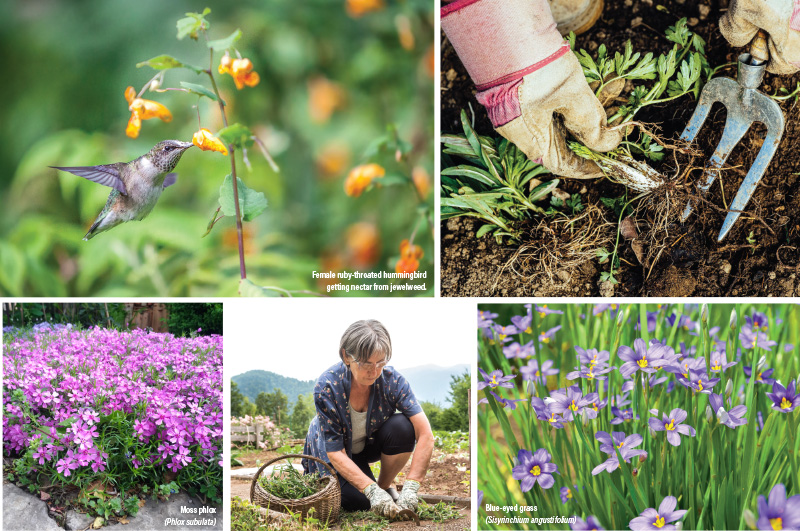
First, knowing what you’re dealing with can maximize your efforts and help avoid pulling beneficial plants. I once mulched right over jewelweed—now one of my favorite native “weeds” that provides crucial nectar for migrating hummingbirds. While apps aren’t perfect, I’ve found PictureThis highly accurate in identifying common weeds and native lookalikes. Double-check IDs when possible through extension offices, the Virginia Native Plant Society Facebook group, or a field guide. Then you can look up its life cycle, how it spreads, and how to remove it if needed. It’s helpful to know if weed root pieces can resprout, like mugwort, so you know it’s worth extra time to dig it out thoroughly or if a quick pull makes a difference.

Weeds tend to show up most in disturbed areas and during the first few seasons of a new garden.

The key is to pull them while they’re small. At this stage, the plant’s roots haven’t established deeply, nor have they had a chance to set seed.

Weekly walkthroughs in the garden allow you to catch trouble spots early. A five-minute weed pull now can save hours down the road by preventing seed spread or fast-growing rhizomes.

Dense Planting: Crowd Out the Competition

One of the most effective tools in weed mitigation is dense planting. Closely spaced plants shade the ground with their foliage, blocking sunlight from reaching weed seeds and preventing them from germinating. This method mimics plantings found in nature where the ground is always covered with plants (except in mature forests, where deep leaf litter takes over).

Groundcover plants are key—adding color and interest and outcompeting weeds for light, moisture, and nutrients. My favorites are violets, moss phlox for sun (Phlox subulata), woodland phlox for shade (Phlox divaricata), native coral bells (Heuchera Americana), or the many varieties of sedges (Carex spp.). You could also try partridge berry (Mitchella repens), lyre-leaf sage (Salvia lyrata), or blue-eyed grass (Sisyrinchium angustifolium).

Go Easy on the Compost

It’s tempting to add compost or fertilizer to “support your plants,” but richer soil can work against you when it comes to weeds. Many fast-growing weeds thrive in nutrient-rich soils, and research shows that weeds can absorb added nitrogen and phosphorus more quickly than many ornamental or native species, giving them a competitive edge. Native plants are adapted to native soils and grow beautifully without added nutrients.

Say No to Systemic Herbicides

While chemical herbicides promise convenience, systemic products—including pre-emergent granules—can have serious ecological consequences. These chemicals persist in soil, harming beneficial fungi, bacteria, and invertebrates critical to healthy plant growth. Herbicides have been linked to pollinator decline, affecting bees and butterflies that rely on garden plants for food. A new study published in Science magazine recently showed that butterfly populations in the US are down 22 percent in the last 20 years.

Organic methods call for time and planning, but they protect the biodiversity we rely on for pollination and pest control.

A Living Solution to a Persistent Problem

Mulching and pulling sprouts early help beat the weeds while your ground covers fill in the gaps.

That early attention can stave off the July jungle, giving your plants time to fill in before invasive plants gain ground.

I still take calls from the garden with my favorite weeding tool in hand—because some things, like death, taxes, and weeds, are just part of life. But with the right approach, there’s a lot less of it. The goal isn’t perfection—it’s balance. With the right approach, the weeding gets easier, the soil gets healthier, and the garden starts to take care of itself.

What to Pull & What to Let Be

A quick guide to common weeds in Central Virginia

Japanese Stiltgrass
(Microstegium vimineum)
An aggressive annual grass that spreads by seed. Smother with mulch or wood chips in early spring and densely plant over. Mow once in late summer, just before flowering. Cut low to remove the hidden cleistogamous (self-pollinating) flowers tucked in at the base of the leaves.

Creeping Charlie
(Glechoma hederacea)
A low-growing, creeping ivy that thrives in disturbed, shady lawns. Suppress it with healthy plant cover and regular mowing.

Mugwort
(Artemisia vulgaris)
A fast-spreading perennial by rhizomes.
Mow before seeds mature in summer to prevent spread. Pull young plants in spring before rhizomes develop. Smother with landscape fabric, and stabilize bare soil to reduce future growth.

Better Left Alone (or Tolerated):

Native Strawberry
(Fragaria virginiana)
Often mistaken for a weed, this spreading ground cover feeds bees and birds and helps stabilize soil in sunny or partly shaded spots.

Violets
(Viola spp.)
Native, early-spring bloomers that spread easily. While not everyone wants them in their lawn, they’re great for pollinators and ground cover in shady spots.


The Best Way to Mulch

When, Why, and How to Get It Right

By: Lindsey Cline-Shrader

Mulch can be an unsung garden hero; it helps soil retain moisture, regulates temperature, reduces weeds, and prevents erosion.

I recommend filling bare soil in garden beds with plants or leaf piles, but in the meantime, mulch provides a fresh look and a boost to soil health during the first several years of a new garden’s life.

When to Mulch
Although any time is fine, the best times to mulch are early spring and late fall. In spring, mulch helps soil stay moist before the summer heat sets in and gives plants a head start against weeds. Mulch helps regulate soil temperature, keeping it cooler during the summer by absorbing the sun’s ultraviolet rays and converting them into less intense, long-wave rays.

During the fall, mulch helps maintain soil temperature, safeguards plant roots from the damaging effects of frost heave—the upwards swelling of soil during a frost or freeze—and protects plant roots as they transition into dormancy. If you need to overwinter potted plants, mound mulch around them to insulate their roots and keep moisture levels steady.

Two men working in the garden. Mulching.Choosing the Right Mulch
Different types of mulch serve various purposes. Here are a few common options throughout Central Virginia: Bark Mulch: Readily available and long-lasting, bark mulch is ideal for trees and shrubs. Hardwood mulch tends to become alkaline, suitable for most plants that don’t require acidic soil. Avoid dyed or colored mulches, which may contain harmful chemicals, and rubber mulch, which offers no ecological benefits.

Wood Chips: Similar to bark mulch but often longer lasting. Many bagged wood chips contain chemicals or artificial coloring, but arborists frequently provide untreated chips for free or minimal cost.

Landscape Fabric: Landscape fabric may be sold as a weed-blocking miracle, but it quickly becomes a soil and maintenance nightmare. It prevents organic matter from enriching the soil and smothers soil life by reducing oxygen and water exchange. Over time, weeds grow on top and through it, creating an entangled mess of plastic fibers and soil that’s tedious to remove.

Shredded Leaves & Leaf Mold: Nutrient-rich and excellent for vegetable and flower beds. They break down quickly, improving soil texture and moisture retention. However, they can mat down if applied too thickly, reducing air circulation and water penetration. Shredding leaves before application or using a thin layer helps prevent this issue. The Xerces Society notes that a loose layer of leaf litter provides habitat for ground-nesting bees. Small leaf piles between plants create excellent habitat for insects.

Pine Straw or Pine Chips: Light and easy to spread, this is a good choice for plants that prefer acidic soil, like blueberries, rhododendrons, hydrangeas, and azaleas.

Straw: Useful in vegetable gardens but should be sourced carefully to avoid weed seeds—and double-check that you avoid livestock hay with crop seeds. Some vegetables, like garlic, tomatoes, strawberries, and potatoes, thrive in straw mulch.

Compost: While compost offers similar benefits to mulch like improving soil nutrients and suppressing weeds, compost is not to be confused with mulch. Excessive compost can disrupt soil nutrient balance, making plants weak, floppy, and susceptible to disease. Compost is best as a soil amendment, particularly for restoring degraded or compacted soils.

Gravel & Stone: Suitable for dry, arid landscapes where leaf litter is not a natural ecosystem function but not ideal for temperate regions like Central Virginia. Gravel does not improve soil health and can increase heat reflection, potentially stressing plants in hot summers. As weed seeds are typically spread by wind, they quickly settle in gravel, making it ineffective for weed suppression unless applied in a deep layer.

Recycle Yard Waste: Thick layers of grass clippings can become a barrier that seals the soil’s surface and repels water. Instead, a simple dry mixture of leaves and grass clippings is a beneficial, easy, and free option.

Pitfalls to Avoid
While mulch provides many benefits, some organic mulches, shredded bark, and particularly wood chips are essentially carbon bombs. When wood chips decompose, the microbes that break them down take nitrogen from the soil, temporarily reducing the available nitrogen for plants.

This brief exchange usually lasts a few months; some sensitive plants may turn yellowish to pale green. The microbial populations rebound as the mulch breaks down, and plants typically recover. Over time, the mulch will improve soil health as decomposition progresses.

Add about one-half pound of high-nitrogen fertilizer per 1,000-square-feet to balance nutrients when using wood chips. Or stick to a thin layer of these mulches (two-inches or less) and avoid mixing them directly into the soil.

Avoid piling mulch directly against tree trunks or plant stems, which can trap moisture and lead to rot or disease. The infamous “mulch volcano” buries part of the tree’s stem and roots, increasing the likelihood of basal rot and even death. Instead, keep mulch away from the base of trees and shrubs and lay no more than 3 inches extending to the tree’s drip line.

How to Mulch Effectively
First, remove any existing weeds before mulching. Mulch prevents new weeds from growing but won’t kill most established weeds. Second, apply a one- to three-inch layer—too little won’t stop weeds, while too much can suffocate plant roots. Most gardeners mulch yearly, which is all most gardens will need.

Mulching is an easy and effective way to conserve water, reduce weeds, and improve soil quality. Whether preparing for summer droughts or protecting plants from winter cold, mulch is a simple tool that provides a fresh look and, when used correctly, improves plant growth and soil health in new gardens.

Mulching beds with young seedlings of vegetables with dry grass


Three Garden Resolutions for the New Year

By: Lindsey Cline-Shrader

Whether you clink champagne glasses in your cocktail best or from your couch, it’s impossible to escape the fever of new beginnings this time of year. The new year buzzes with the promise of fresh starts, making it the perfect time to nurture a new garden ethic or adventure. Here are three impactful garden resolutions for 2025: transitioning to organic methods, creating pollinator havens, and starting a lush vegetable patch.

1. Make the Switch to Sustainable Gardening

Sustainable gardening fosters healthier, more resilient gardens that benefit both your backyard and the ecosystem beyond.

One impactful way to begin this transition is to cease herbicide and pesticide use. These toxic chemicals seep into the soil and trickle into waterways, disrupting soil microbes that form the base of our delicate food web and decimating beneficial insect populations, such as bees and butterflies.

Embracing organic weed control protects the delicate balance of beneficial life thriving in your garden. In garden beds, simple practices like mulching, which suppresses weeds while enriching the soil, or hand-pulling persistent invaders can replace chemical sprays’ quick but damaging effects. Ask yourself if you can make peace with dandelions and violets in your lawn? (No one has yet to criticize my less-than-perfect turf.)

There are gentler options than commercial herbicides for stubborn weeds in stonework. If aggressive crabgrass or the like threatens to take over your patio, try flame weeding, which involves burning weeds with a propane torch (check local fire restrictions before doing so). Or, a mixture of three-part vinegar to one-part table salt and several drops of dish soap acts as a natural weed killer. (Many recipes call for commercial-grade vinegar, which I find unnecessary.) This mixture also damages soil, but the effects are reduced in paved areas and far less catastrophic than industrial herbicides.

Occasionally, herbicides may be the most effective solution for removing invasive species. In these instances, paint it on newly cut stems, roots, or stumps with a paintbrush rather than spraying to reduce environmental impacts. As always, wear protective gear. Be aware that in response to lawsuits over Roundup’s links to cancer, chemical company Bayer recently replaced glyphosate, the active ingredient in most Roundup products, with new herbicides. Unfortunately, independent studies suggest these replacements are even more toxic to insects, trees, and humans than the original glyphosate-based formulas. Glyphosate is still available at local garden stores.

By avoiding insecticides, we protect beneficial predators and allow plants to strengthen their defenses through natural insect interactions. Insects improve plant resiliency—a nibble from a caterpillar or nematode encourages plants to utilize their natural defenses by producing protective compounds or toughening their tissues. This interaction helps plants adapt, boosting their defenses against future insects. Plants’ roots send out signals to one another, helping entire plant communities maintain resiliency.

Spiders and predator insects, such as wasps, praying mantes, ladybugs, and beetles, help control prey insect populations like mosquitoes and flies. Insecticides indiscriminately kill beneficial insects and disrupt this natural pest control. Transitioning to organic gardening may require patience and dedication, but the reward is a garden full of resilient, vibrant life.

2. Create a Pollinator Paradise

Pollinators are critical to ecosystems and food production, yet they face increasing threats. This year, take simple steps to create a sanctuary for them by leaving perennial stems high, fallen leaves where they lie, and planting for all three seasons.

Leaf cover and plant stems are vital winter shelters for overwintering insects. By letting leaves remain in your garden beds, you mimic the forest floor’s rich, insulating carpet, cradling insect life through the colder months while enriching your soil. Similarly, hollow plant stems and native grasses offer nesting and hiding places, protecting pollinators in their most vulnerable states.

Three seasons of blooming plant life sustains pollinators (and ourselves) throughout the year. While summer blooms are easily covered, early spring and late fall bloomers fill essential gaps for pollinators. Early-blooming ephemerals like bloodroot, Virginia bluebells, or native trees provide much-needed nectar for emerging pollinators. Late-season stalwarts like asters and goldenrods support these crucial creatures as they head into hibernation or prepare for migration.

3. Grow Your Own Fresh Harvest

Amidst busy lives, harvesting a sun-warmed tomato or a crisp kale leaf from your garden is profoundly fulfilling. Starting a vegetable patch is a New Year’s resolution that not only reduces waste and promises a bounty of fresh, healthy food but creates a deeper connection to nature (and, per my therapist, counts as rest for the busy-minded).

Perennials are an easy gateway to gardening as they forgive the constant seeding and weeding. Plant them once, and they’ll reward you with years of harvests and minimal upkeep. My favorites are blueberry and currant shrubs and a grape arbor, which also provides summer shade. Perennials like asparagus, artichokes, and rhubarb (as well as annual squashes) require space but little else.

If you’re going for gold, raised beds offer better drainage and soil depth. Two 4’ x 4’ cedar raised beds keep our family flush with easy-to-grow cucumbers, kale, tomatoes, garlic, and green beans. Rich, loamy soil gives vegetables the best start, and a drip hose will keep them thriving throughout the season.

These three garden resolutions reflect care for the environment, an eye for natural beauty, and a heart for personal growth. Here’s to a year of sowing new habits and reaping the rewards. Next year, we’ll toast your success among your flourishing sanctuary, whether it be a drift of milkweed, a simple patch of pumpkins, or a thriving space full of blooms.


Designing with Nature

The Art of Native Plant Gardens

By: Lindsey Cline-Shrader

In garden design, native plants aren’t only chosen for their adaptability and ecological benefits; a growing trend embraces the beauty of native plant gardens. Native plants are celebrated for their striking aesthetic potential and following fundamental design principles helps maximize their beauty. From pairing plants for color and texture to mastering scale and color theory, designing with nature has never been more rewarding.

Scale

Scale refers to the size of elements in the overall space. In large suburban or rural yards, mature trees, a forest, or built elements like pergolas help fill the space and create a sense of scale that matches the garden’s size. The mistake I often see is making small, colorful perennial beds that demand maintenance but quickly get lost in an ample space. This leaves the gardener, as I’ve frequently felt, overwhelmed. 

Instead, plant in drifts or clusters of the same species to create a strong visual impact and avoid a scattered look. Large swathes of a few plant species unify an expansive landscape. Use natural materials like stone walls or boulders to blend the garden seamlessly with its surroundings. A well-placed fence or hedge can make the scale more manageable and break up the space.

In expansive gardens, open spaces or lawns provide a visual break.
Balance these areas with planted sections to avoid monotony with too much lawn and prevent chaos with too many planting beds.

In smaller urban gardens, compact plants and furnishings make the space harmonious. Here, the key is to use layers of smaller trees, then shrubs and perennials to bring the canopy down to earth and balance the space. For smaller spaces, consider smaller drifts of three to five plants to create interest. 

Creating Visual Hierarchy

Creating a visual hierarchy guides the viewer’s eye through the garden. Each garden area or “room” should have one focal point: a flowering shrub, bright perennials, a garden shed, a fountain, or a hardscape element like a fireplace or fire pit. To add impact, surround the focal point with ground covers and perhaps a dwarf tree. This layering technique adds depth and interest, ensuring no element overwhelms the space.

If hardscapes create the focal point, plantings are vital to softening them and creating harmonious spaces. Plants mitigate the harshness of stone or concrete by adding warmth, texture, and color. Limiting hardscape areas to specific purposes, such as pathways or seating areas, prevents them from overwhelming the garden’s natural beauty. 

Color Pairings

Color theory can help guide a visually stunning garden. Harmonious color schemes, such as monochromatic (different shades of the same color), analogous (colors next to each other on the color wheel), and complementary (colors opposite each other on the color wheel), can enhance your garden’s aesthetic in unique ways.

Monochromatic Color Schemes

For a serene and cohesive look, consider a monochromatic scheme using shades of green or white and green. This style works particularly well in shady spaces and around quiet seating areas. Native ground-covering grasses like Carex (my favorite is Carex vulpinoidea) provide a tranquil backdrop. Layering multiple leaf shapes and sizes over the base grass adds depth and interest while maintaining a soothing space. 

Analogous Color Schemes

Analogous color schemes incorporate colors adjacent to each other on the color wheel. This style brings harmony and unity to the garden, creating a cohesive look that’s perfect for gathering areas, outdoor dining spaces, and often for front or back entrances. The smooth transitions between colors create a sense of comfort and tranquility, making these areas feel welcoming.

Complementary Color Schemes

Complementary color schemes (colors opposite on the color wheel, such as blue and orange) attract attention and create lively, engaging environments. They are perfect for bold entrances, focal points, or larger entertainment spaces.

Warm Color Schemes

Warm colors, such as reds, oranges, and yellows, create a sense of warmth, energy, and vibrancy. These colors evoke excitement: warm colors advance toward the viewer, naturally drawing the eye and making spaces feel dynamic or further enhancing focal points. Warm colors thrive in sunny spots, where the natural light enhances their brightness and intensity.    

Cool Color Schemes

Cool colors, including blues, greens, and purples, evoke calmness, serenity, and a sense of spaciousness. These colors recede from the viewer, making spaces feel extensive and tranquil.

Cool colors perform well in shaded or moist areas, where their subtle tones can create a refreshing feel. Their receding nature can give the illusion of depth and distance, making compact areas feel more expansive.

Plant Textures

Plant textures add depth and contrast, particularly to monochromatic spaces. Fine-textured plants, such as grasses or ferns, bring a delicate, airy quality, ideal for lightness and movement. These can be strategically placed near pathways or seating areas to draw the eye and soften hard edges. Coarse-textured plants, like large-leaved vines or shrubs, provide a dramatic contrast and can serve as striking focal points. By layering and contrasting these textures, you can create a balanced yet dynamic garden.

Designing with native plants allows for a harmonious blend of ecological benefits and aesthetic appeal, creating beautiful and sustainable gardens. You can transform any space into a stunning natural haven by carefully considering scale, visual hierarchy, and color theory. Embrace the art of native plant gardening to enjoy a landscape that thrives with minimal maintenance while offering a captivating visual experience.


TransformingYour Yard

Conservation Landscaping Best Practices

By: Lindsey Cline-Shrader

Conservation landscaping blends aesthetic appeal and ecological responsibility. It creates spaces that are not only visually stunning but also conserve resources and create havens for wildlife. The key to enchanting, low-maintenance gardens are also conservation landscaping best practices, such as dense planting, no-till gardening, and plug planting.

Dense Planting

The benefits of dense planting are manifold. Dense planting minimizes the space available for weeds to grow, a needed “win” in Virginia summers. A dense network of root systems enhances the soil’s ability to absorb water, reducing erosion and runoff, improving soil structure, and promoting deep infiltration. 

Dense plantings can increase the number and variety of plants, supporting a range of pollinators and beneficial insects and reducing the distance they must fly for nectar. Furthermore, dense planting provides shade and reduces temperature fluctuations in the soil. It also allows plants to signal to one another about threats from insects or diseases, creating a stable environment for growth and more successful plants. 

Dense planting may bring English cottage gardens to mind, but it can be adapted to various styles. Try a single ground cover grass species between forbs (herbaceous flowering plants) in modern gardens, or a mix of plant textures for added interest in shade gardens, or overlapping plant blocks for simplicity and artistry in Arts and Crafts style gardens.

No-Till Gardening

Another conservation landscaping practice, no-till gardening, preserves soil structure and the life within it. Traditional tilling disrupts soil microorganisms, depletes organic matter, and leads to erosion. No-till gardening maintains the natural soil structure, allowing deeper water infiltration and root growth. Undisturbed soil holds more water over time, helping plants withstand drought.

No-till also protects the habitat of beneficial soil organisms, such as earthworms and mycorrhizal fungi, which recycle soil nutrients. 

When creating new beds, use sheet mulching or cover crops. Sheet mulching involves layering organic materials (like compost, topsoil, or mulch) to suppress weeds and build fertility. The “lasagna” method uses cardboard to smother turfgrass, followed by topdressing with organic materials. Studies show cardboard slightly reduces carbon and oxygen in the soil, but those levels rebound in less than a year.

My favorite method for creating new garden beds is to mow the grass as low as possible and then compost in place by layering grass clippings and leaves in two-inch-thick layers. This builds soil and smothers most turfgrasses within several weeks. 

I recommend steering clear of solarization with plastic and landscape fabric. Solarization with plastic tarps generates microplastics and pollutes soil. Landscape fabric hampers the exchange of air and water in the soil, reducing soil health and decreasing plant vitality. Most weed seeds are wind-dispersed, allowing them to germinate on top of fabric, rendering it useless. Fabric can strangle trees and shrubs and typically becomes trash after several years.

Plug Planting

Plug planting establishes gardens efficiently, particularly perennials and native plant species. Plugs are small, young plants typically grown in deep but narrow containers—allowing strong root growth with minimal height. Plugs require smaller planting holes, minimizing soil disruption and root damage. 

Young plants adapt quickly to their environment, establishing roots more rapidly than larger, more mature plants. Plug planting allows for precise placement, enabling the intricate patterns recommended for dense plantings. Plugs often cost less than larger plants, allowing you to cover larger areas with less investment. 

Plugs are planted directly into the ground like larger plants, though a narrow spade creates less disturbance and awakens fewer weed seeds, encouraging a smoother first-year garden.

Additional Conservation Efforts

Efficient water management is essential in conservation landscaping. Although our area has an abundant water table, capturing water during rainy spells can protect our water supply during summer droughts. 

Adding rain barrels to downspouts not only provides extra water in hot, dry summers but may reduce overflow into city storm water drains. Rain gardens, beautiful spaces in their own right, reduce erosion and pollution by capturing and filtering water runoff. These gardens slowly absorb rainwater, promote groundwater recharge, and create unique micro-habitats in damp to wet soil. 

One final touch in conservation landscaping are accessories that provide food, water, and shelter to turn your garden into a habitat haven. Bird feeders, birdbaths, nesting boxes, berry-producing shrubs, and small water features support wildlife. Brush piles, logs, and dead trees provide shelter, breeding sites for reptiles and amphibians, and food sources for birds like woodpeckers. 

By implementing these practices in our own landscapes, we can support biodiversity, conserve resources, and enhance beauty. We have a role in nature, and our collective efforts can make a significant difference. 

Top 5 Native Plants for Rain Gardens

1. Swamp Milkweed (Asclepias incarnata) attracts monarchs and other pollinators with clusters of pink to mauve flowers. 

• Full sun to partial shade and wet to moderate soils

2. Joe-Pye Weed
(Eutrochium purpureum) attracts pollinators and adapts to clay soils with large cluster or pink to purplish flowers.

• Full sun to partial shade and moist to wet soils

3. The Lobelias:
Cardinal Flower
(Lobelia cardinalis) & Great Blue Lobelia (Lobelia siphilitica) attract hummingbirds and butterflies to their vibrant red and blue tubular flowers on tall spikes.

• Full sun to partial
shade and consistently moist soils

4. New York Ironweed (Vernonia noveboracensis) provides height to borders and late-season nectar for bees and butterflies with vibrant fuchsia flowers.

• Full sun to partial
shade and moist,
well-drained soils

5. Blue Flag Iris
(Iris versicolor) provides showy blue-purple
iris flowers among
sword-like leaves.

• Full sun to partial shade and wet, boggy soils


Exploring Virginia’s Wild Culinary Frontier

Foraging and Food Forests Resurge as Locavore Trends Take Root

By Lindsey Cline-Shrader

Virginia’s lush landscapes contain a cornucopia of edible treasures. Like much of our evolving local food system, the art of foraging has undergone a renaissance, capturing the imaginations of foodies, homesteaders, and environmentalists. From upscale eateries’ haute cuisine to grassroots gatherings, foraging offers culinary delights and a pathway to health and sustainability—and, of course, this path sparks debate.

In modern culture, foraging has resurged with every back-to-the-land movement starting in the 1930s, 1960s, and early 2000s when, rather than subsidizing, foraging joined a broader movement of sustainable food systems and permaculture design. The current ease of information sharing is building a new generation of wild food advocates. Foraging experts and online influencers like Alexis Nikole and Gabrielle Cerberville translate in-depth wild food knowledge into quick, digestible videos for their respective 1.7 million and 359,000 Instagram followers. 

Viewers already educated in the flaws of a chemical-heavy industrial food system are ready for the good news. While more people get outside to taste and test, a growing awareness of responsible foraging practices has taken root.

Wild ramps are the poster child for a well-loved and occasionally over harvested wild food. In early spring, this edible onion carpets the forest floor of the Blue Ridge and Allegheny Mountains. Ramps are prized for their unique flavor profile, which adds a spicy, earthy depth to dishes. For decades, foragers and chefs were beckoned to the hills to bring ramps to high-end restaurants in DC and beyond. 

While ramps often grow in patches of hundreds, they take up to seven years to produce flowers and several more years for the seeds to germinate. This slow growth, coupled with their particular growing conditions, led West Virginia to ban harvesting in many parks and recreation areas as wild populations began to disappear. Responsible harvesting now includes taking a leaf or two from large plants and rarely, if ever, harvesting bulbs. 

The lesson from ramps has led some farmers and gardeners to revive the concept of sustainable cultivated food forests. This ancient practice, a lesson from Native American culture and cultivation practices, means planting in multiple layers, which builds an ecosystem and creates more food per cubic foot. For example, a canopy top layer might consist of nut trees like oak and chestnut, followed by understory fruit trees like pawpaw and persimmon, interplanted with berry bushes like elderberry and blueberry. The herbaceous and ground-cover layers can include your favorite hardy edible perennials like wild strawberries, asparagus, rhubarb, sorrel, Jerusalem artichokes, mayapples, or wild violets.

My food forest would first and foremost contain yaupon holly, the only caffeinated plant that grows wild in Virginia and across the South. Yaupon seems to be a lightly caffeinated wonder plant full of antioxidants, vitamins, minerals, amino acids, and theophylline and theobromine, the “pleasure molecules.” 

Since it’s locally grown, yaupon has a smaller carbon footprint and causes less environmental stress compared to coffee farms. Project Communitea, a Richmond-based company, grows and sells yaupon tea regionally and online.

Treasures like the pawpaw, a custard-like fruit, tempt some palates (and decidedly not others) with their creamy sweetness. Despite their delicious fruit, pawpaws refuse to submit to the conventional horticultural industry. The first challenge lies in their flowers, which emit a faint musky odor that fails to attract many critical pollinators for fruit production. Additionally, the fruit’s delicate nature makes it unsuitable for shipping and storage, limiting its commercial viability. 

Thus, pawpaws remain wild, found in thickets along bottomlands and streamsides, leaving us to celebrate and preserve wild populations and enjoy the fruits where we find them. Or, for the adventurous, to cultivate pawpaw trees in gardens. If this entices you, remember that pawpaws are dioecious, so you’ll need both male and female trees for fruit set and pollination. Edible Landscaping in Nelson County grows and sells pawpaw trees and a variety of edible plants. 

Beyond this hidden gem, more commonly found herbs and plants offer nutritional value right outside your door. The humble dandelion, often considered a nuisance, reveals its charm in everything from teas and tinctures to infused oils, syrups, and vinegar. Roots can be stored in a dirt-filled basket in a shed or basement to provide a steady supply of greens throughout winter.
Dried, mature leaves make a medicinal tea full of vitamins A, C, and K and many minerals. The bloom is the main ingredient in dandelion wine, for which there are nearly as many recipes as winemakers. 

Chickweed

Other flavorful and spicy greens include the common horseweed, which can be thrown into salads or blanched and added to soups. Chickweed grows abundantly in moist, shaded areas and can be eaten fresh or brewed into a tea for soothing medicinal properties.

While it’s easy to dismiss wild food as lackluster, renowned chef René Redzepi proved that foraged foods hold their own. He prioritized indigenous ingredients in his culinary creations and earned three Michelin stars for his Danish restaurant, Noma. 

Chefs like Alan Bergo, a former chef in fine-dining restaurants, left the kitchen to write the popular The Forager Chef’s Book of Flora, which eventually spawned a TV show and earned a James Beard award.

Virginia’s landscape offers edible wonders waiting to be discovered and savored. The resurgence of foraging in our evolving local food scene reflects a broader cultural shift toward sustainability and connection with the land. Let’s hope the allure of wild foods continues to inspire us to revere and appreciate nature’s bounties.  


Transforming Lawns for a Healthy James River

Opportunities for Lynchburg Homeowners to Lead in Water Conservation Efforts

What do Lynchburg lawns have to do with waterways from Blackwater Creek to the iconic Chesapeake Bay?

How we manage our yards isn’t just for show. It affects animals from the smallest damselfly to the trophy smallmouth bass in our local waters and impacts wildlife downstream to the Chesapeake Bay. Ramifications ripple out to the benefits we receive, like clean drinking water and our opportunity to paddle, fish, and enjoy our rivers. In fact, lawns and water quality are so intertwined that nonprofit and government programs might help you cover the costs of transforming soggy, poor turfgrass into native plant gardens or bare riverbanks into forests.

Pollution from cities and farms has damaged local streams into the James River and beyond for decades. The Chesapeake Bay has nearly become a “dead waterway,” with aquatic life and fish drastically disappearing from its waters. In 2010, the Environmental Protection Agency devised a plan to reverse this course by setting goals for Virginia to reduce pollution by 2025.

This is where homeowners and their backyards come in. Picture those “dead” areas in your lawn that won’t grow turfgrass, bare dirt at new building sites, or water rushing down driveways to stormwater drains.

Bare soil from new building sites and poor lawns has become the leading cause of pollution in the James River. Sediment wreaks havoc: it smothers river bottom habitats, elevates water temperatures, and clouds water, which kills underwater plants.

The other primary water pollutants—excess nutrients, nitrogen, and phosphorus—come from agricultural fields and overly fertilized lawns. Nutrients foster problematic algae blooms that create oxygen “dead zones” that suffocate aquatic life and lead to fish kills. 

The good news is that homeowners can reduce runoff in several ways. Replacing lawns, especially those with poor cover or near streams, with lush native gardens, preserves water quality—root systems act as a shield, grabbing pollutants, sediment, and nutrients before they enter water sources.
These gardens are carefully designed to absorb excess nutrients, hold soil in place, and create critical wildlife habitat. They require no fertilizers or chemicals, further reducing nutrient pollution.

Recently, City of Lynchburg and Campbell and Amherst County homeowners became eligible for a state program, the Virginia Conservation Assistance Program (VCAP). This program helps cover costs for pollution-reduction projects, like rain gardens, conservation landscaping, and permeable pavements. 

“The projects I want to see installed are the ones that solve water issues for individuals. Whether they have erosion and soil loss on their property, standing water issues, or need to contain water for raised beds—the right project for the location and landowner are the priority,” says Blair Blanchette, VCAP Coordinator. 

Concrete exacerbates polluted runoff as water picks up other pollutants like bacteria and pesticides, then flushes straight to local creeks. Projects that slow water runoff, such as rainwater harvesting or dry wells, can keep lawns and gardens healthy and provide water during dry spells while significantly reducing polluted runoff.

The James River Association’s Buffer Program works with landowners in the James River watershed to plant forested areas along creeks or streams called buffers. Buffers stop pollution as gardens do while building cooler, clearer, more stable streams, providing habitat for sensitive species like herons and brook trout.

“Everyone can have an impact. Trees are part of the answer, and anyone, especially those with open streamside land, can grow trees to help clean our water,” says Anne Marie Roberts, Senior Restoration Field Manager for the James River Association.

Through a technical modeling program, Roberts can see precisely how much a buffer reduces pollutants like sediment and excess nutrients. Through such programs as these and continued community investment, the James River can return to total health. Luckily for many of us,
it may start with a lush forest or a beautiful garden.

WHERE TO BEGIN

Virginia Conservation Assistance Program (VCAP)

Government program managed by Soil and Water Conservation Districts (SWCD) aims to help residential homeowners reduce urban stormwater runoff.

Who: Homeowners, businesses, schools, places of worship, and community centers in Lynchburg, Amherst, and Campbell counties (R. E. Lee District) or Bedford County (Peaks of Otter District)

What: Design, prepare, and install “best management practices,” including conservation landscaping, impermeable surface removal, permeable pavement, green roofs, rainwater harvesting, and more. Up to 80% of project cost reimbursed. 

Get Started: Visit Releeconservation.com or Poswcd.org 

The James River Buffer Program (JRBP)

The James River Association and the Chesapeake Bay Foundation provide technical and financial support for landowners to create forest buffers along stream banks.

Who: Landowners in the James River watershed with a creek, stream, or river frontage 

What: Design, prepare, install, and provide three years of maintenance support to restore forested buffers. 100% project cost provided.

Results: Since its launch in 2019 and with support from Department of Forestry, 1,084 acres of buffers installed across the James River watershed, including 358,331 native trees.

Get Started: Visit jamesriverbuffers.org 

Conservation Easements

The Central Virginia Land Conservancy works with landowners to save the farms, forests, waterways, and rural landscapes that make Virginia beautiful. Land conservation easements save land through voluntary, permanent agreements that outline how land can be used. 

Who: Landowners in Amherst, Appomattox, Bedford, Buckingham, Campbell, and Nelson counties and Lynchburg

What: Permanent agreements to protect land from intense development. Tax credits and deductions based on the reduced land value.

Results: 5,900 acres protected 

Get Started: Visit www.cvalc.org


Embracing Native Plants

Why Prioritizing Native Plant Habitats is So Important

By Lindsey Cline

It’s early morning; heavy dew casts a silver shine on the grass as the soft sun’s rays emerge over the woodland tree line. A group of Carolina chickadees flit up and down honey locust trees. They flicker from the trees to the birdfeeders, regularly startled by squirrels and bossy blue jays. On other days, white-throated sparrows sing all afternoon, a fox slips along the garden edge, and rabbits nest under a ninebark shrub.

The yard in this scene is not unique; a standard suburban 100’-by-50’ with a small patio. What brings wildlife to the backdoor are native plant garden beds 12 feet deep and running the length of space. 

Here, among the songbirds, it’s easy to forget the threat that development poses to wildlife, but nature is in trouble: the native bee population declined by 90 percent in the past decade and more than half of bird populations are dwindling. While the majestic Monarch butterfly’s endangerment demands headlines, others, like the sturgeon, which were once so numerous that European settlers could “walk across the James River on their backs,” and the little brown bat, which hibernates in Blue Ridge Mountain caves, face extinction. 

Gone is the assumption that “protected” spaces can save the wildlife we have left…much of Virginia’s 16 percent of land protected from development lacks prime habitat as it remains open for logging and agriculture. What if we welcomed insects, songbirds, amphibians, and reptiles into our developed lands?

The revolution is here, fueled by well-gloved gardeners and well-aware homeowners creating wildlife habitats in their backyards, community parks, and locally owned fields. 

Apex predators require vast wild tracts to roam, but many species—especially the foundation of the food web—can thrive in neighborhood yards. And the backyards we have!

More than half of Virginia’s land is urban, suburban, or metro-adjacent. Virginians managed 1.7 million acres of turfgrass lawn in 2004 (last year of available data); we can estimate at least 2 million acres today. Imagine some of these lawns, which offer no ecological value, as gardens that restore essential bonds between flora and fauna.

The key to creating those habitats? 

Native plants.

Native plants excel at supporting wildlife: acorns for squirrels, fruit and berries for bears and foxes, cover for rabbits and fawns, and nesting trees for birds and owls. Native plants allow wildlife to breed, feed, and live. 

One can’t explain the importance of natives without diving into the world of insects. Insects, the foundation of a rich food web, nourish birds, fish, frogs, toads, salamanders, and bats. They are indispensable to ecosystems: insects decompose organisms, recycle nutrients, pollinate plants, and disperse seeds. Insects have spun a web of mutually beneficial relationships within ecosystems, particularly with native plants.

Insects adapted over time to exploit plant qualities during each stage of their lifecycle: hiding places for eggs, foliage for young caterpillars to eat, and nectar and pollen for adults. This dance is intricate—insects must time their lifecycles to correspond with their hosts. This process led the majority of insects to evolve so deliberately that they rely on a handful of plant lineages. Because of this specificity, insects can’t quickly adapt to non-natives. 

Entomologist Doug Tallamy proved that insect populations decline without native plants. Famed biologist E.O. Wilson explained that if insects vanished, flowering plants would follow, then reptiles, amphibians, birds, and finally mammals.

The remaining debate, with experts on both sides, is the ease of establishing native gardens. Some claim that natives require less care and maintenance; others argue that unstoppable deer herds and infuriating groundhogs prefer them. 

Implementing this new garden ethic falls in all directions—obstacles aren’t more significant than “traditional” gardens; they’re simply different. We must become the first-time hosta-obsessed gardeners we once were—learning new plant communities. While culture now denounces pesticides and praises pollinator gardens, the lack of practical advice and hands-on resources, not to mention the dearth of native plants themselves, can leave us overwhelmed with the task of implementing our new-found inspiration, especially if our marching orders include the astounding “saving nature.”

But gardeners are an optimistic bunch. As Yiyun Li writes, “One garden with the same unblinded hope and the same willingness to concede as one lives, always ready to say:
If not now, later; if not this year, next year.”

It’s possible to delight in the wildlife that garden sanctuaries support. More than once, my toddler watched with wonder as a box turtle marched from one garden bed to another. Despite my garden failures, Carolina wrens still nest in the wild grape vines and painted lady butterflies cover white snakeroot drifts. Whether our endeavors can reverse the tide remains to be seen, but the evidence makes a strong case that it’s worth our efforts.

We’re now challenging presumptions that to garden, we must hail overtly blooming peonies and roses. Instead, we might try delicate shooting stars in spring, striking purple baptisia for summer blooms, or pair rich violet asters with deep golds of goldenrods in fall. 

Nature deserves to exist on its own merits, but we can keep high expectations around our homes and relish in our desire for beauty. While re-creating indigenous plant communities offers maximum habitat, native plants anywhere contribute to the effort and can work for tidy front entrances, side yards, or around entertaining areas. 

Try them—you may (or may not) become a morning birdwatcher, but you will open the door to a stunning garden and a movement of new and vital wildlife refuges.