Every Stitch a Story

Preserving a Hidden Language of Freedom

By: Shannon Kelly | Photos By: Ashlee Glen

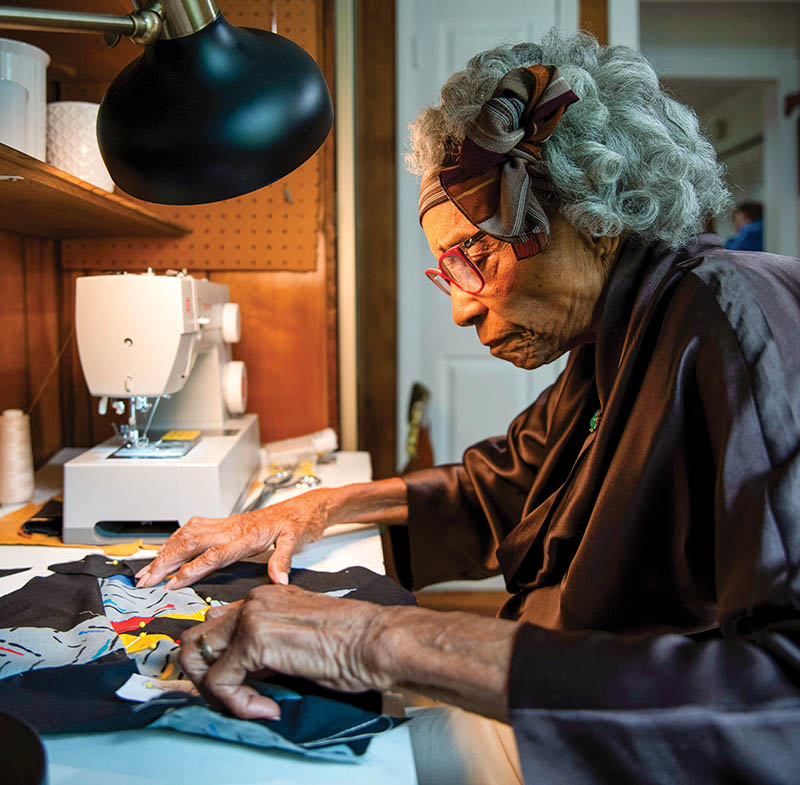
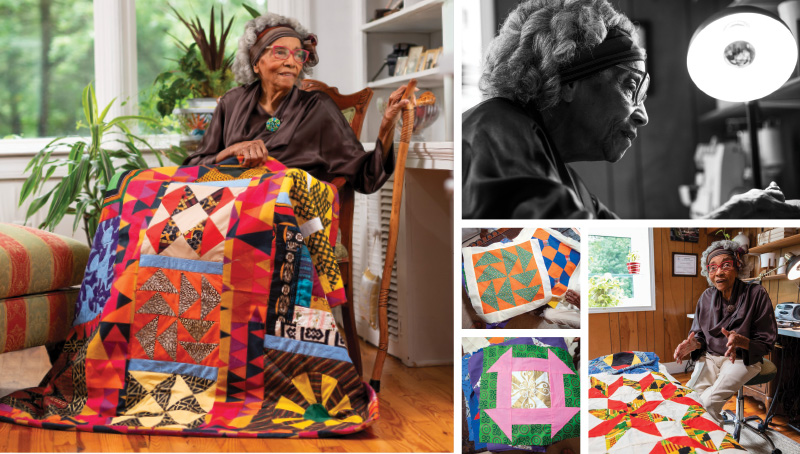
At 99 years old, Edith Younger Edmunds is still stitching—and with every thread, she’s weaving a deeper connection to her heritage. What began as a childhood pastime has evolved into a late-in-life mission: bringing the story of the Underground Railroad to life, one quilt pattern at a time.

Edmunds has been quilting since she was seven, but it wasn’t until her 80s that she discovered a powerful intersection between her lifelong craft and the coded patterns once believed to guide enslaved people to freedom.

Though the historicity of the quilt code is disputed, it is nonetheless a fascinating story, and the distinct patterns are a rich part of art history.

As children, Edmunds and her twin sister—two out of the family’s twelve children—used scraps from their mother’s sewing projects to create patterns, which they sewed onto magazine pages. The result was a quilt, which the girls’ father proudly showed off any chance he got.

“He called it a spread. ‘Go get that spread so I can show it to my friend.’ He said, ‘This is what my girls did, my twins did, seven years old.’ He was so proud of us doing that,” Edmunds said.

When she got older, Edmunds got paid to do alterations and saved some money to buy her first sewing machine, which had a treadle. Later, she bought a motor to modify it.

“I put that motor on myself, and that made me be able to sew a little faster, and I could get things done quicker,” she remembered.

Edmunds was a stay-at-home mom after she started her family, but once her daughter, Amy, started school at Sinai Elementary, Edmunds got a job as a teacher’s aid there—but she never stopped sewing. She went on to work in the fabrics department for Belk’s, where she spent 18 years of her career.

“I crocheted, I did needlework, I did embroidery. All of this was a part of my…I call it my career of sewing,” she said.

Edmunds passion for sewing and, in particular quilting, pivoted and grew when she learned about how textiles were said to be used in the Underground Railroad.

“I guess it probably was about 15 years ago, may not have been that long. I was reading a little magazine called Guidepost, and in that little book, it had a picture of the Underground Railroad in it… I ordered the pattern of the Underground Railroad, and I made the first hanger, and it turned out so pretty,” she said.

From there, Edmunds tackled more patterns and learned about their symbolism as she went. She read books on the history of the Underground Railroad, and when the movie Harriet came out, she and her daughter both loved it; Harriet Tubman’s story spurred Edmunds’ interest in the Underground Railroad.

In 1860, around the time of the Civil War, Virginia had the largest enslaved population of all the Confederate states. Four generations of the Edmunds family have come from Halifax County. According to the 1860 census, enslaved people made up the majority of the county’s population. Nelson Edmunds, Amy’s great-great-grandfather, was born on the Red Field plantation there.

He would have been five or six years old at the time of emancipation, Amy—who researches her family’s genealogy—said.

While none of her ancestors ever escaped —at least not to the Edmunds’ knowledge—Edmunds was nevertheless fascinated by the inventive ways abolitionists, allies, and escapees operated the famous covert network. The story of the quilt code is one where messages were hidden in plain sight, under the guise of commonplace household items that would seem totally innocuous to individuals who weren’t in the know.

These quilt patterns were fascinating and also challenging for Edmunds to undertake.

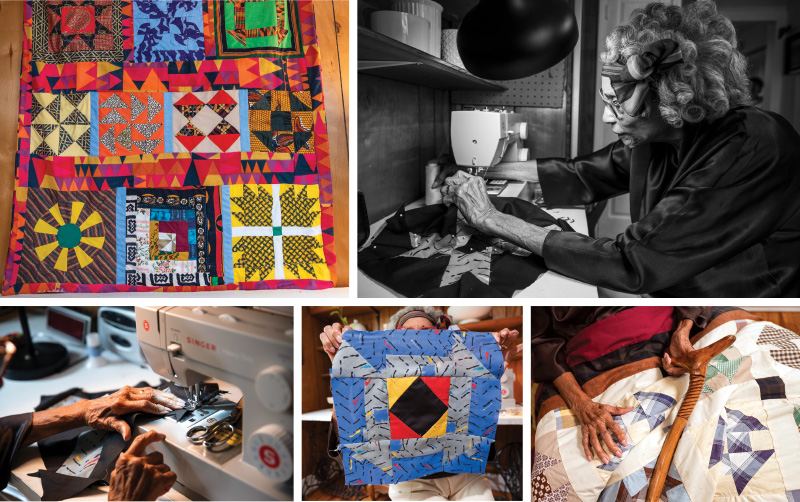
The Crooked Path, for example, is tricky to achieve due to the cut of the pattern.

“That means that… you can’t walk straight,” Edmunds said. “They walk zigzag, so if somebody is trying to catch up with them, they can’t follow their crooked road.”
Whether taking a crooked path or a straight one, passengers on the Underground Railroad could identify allies by a “shoofly” pattern, made with four triangles around a center square.

“The shoofly is a person who would secretly help the enslaved. By that, I mean…this secret person would hide the enslaved in caves, or a church, or graveyard. He would do that, risking his own life,” Edmunds explained. “He would give them clothes to clean themselves up so they could go downtown and pass as free. They would be dressed in clean clothes, because when you’ve been walking to escape, your clothes get dirty.

So, this shoofly, he would help them.”

The bear paw pattern is characterized by four squares in the center, with outer edges that look like a bear’s paw.

“That bear paw, it tells the enslaved to follow the bear. It would go to where food and water were,” Edmunds said.

The flying geese; the bow tie, or hourglass; Jacob’s Ladder; nine-patch; the North Star; all these patterns are associated with the tradition of a quilt code.

Pattern recognition was the key to reading these symbols, Amy said: any colors could be used, but the colors themselves did not hold meaning.

“To look at the bear claw, somebody may have made it using blue and red. Somebody else may have made it using all black, but they would have had to have been able to focus on that design, to recognize it, no matter what the color or how incremental the seamstress had made the different parts, but to still be able to see that overall design,” she said.

These patterns could theoretically be combined to form messages, as well.

“That’s part of the intrigue in creating these images. It’s like, how many messages can I combine? Or, what if I wanted to try to create a message that has multiple meanings? And you can do that. You can imagine that, but I also have such an appreciation for the eye that the guide must have had, to be able to see the design so clearly, in spite of it being different every time,” Amy said.

Quilting takes a lot of time, and a lot of materials. Enslaved women who endeavored to make any of these patterns likely had extremely limited resources. Amy added: “There was no JoAnn’s Fabric.”

“From our perspective, it was difficult for us to imagine them making a full-sized quilt with a repeating pattern of the same square. It occurred to us that it is possible that they may have made something similar to a string quilt, and then just attached almost like an applique, one of these patterns,” she said. “If you knew what you were looking for, you would recognize it.”

Perhaps due to limited textile resources, the patterns were sometimes etched in dirt or marked elsewhere in another fashion.

Travelling the Underground Railroad was treacherous for anyone involved.

Out of the numbers of enslaved people who fled, relatively few made it all the way to freedom, Amy said.

Edmunds has been on a mission to educate others about the Underground Railroad, and the story of the quilt code, sharing her interest in the general history of the system, but also her perspective as a seamstress.

She has visited schools where she showed children how mathematics and art collide when it comes to quilting, hoping to inspire them, and demonstrate how the subjects they learn in the classroom apply to real life. The wagon wheel pattern is a prime example.

“The wagon wheels have a lot of different angles to be cut, and put together,” Edmunds said. “I told them, I said, ‘Now, all these pieces are not the same. You’ve got a rectangle, you’ve got a triangle, you’ve got a square.’ I said, ‘You’ve got to know how to measure to get those angles just right. If you don’t, your pattern’s not going to come out right.’”

Edmunds has done a variety of other engagements where she educates communities about the Underground Railroad and the quilt code. She brings samples of her work along, displaying them for audiences to examine as she delivers an informational presentation. She has participated in television interviews, a segment with NPR, and worked with various news outlets.

At 99 years old, quilting and educating remain Edmunds’ passions. She has no plans to slow down. She brings textile projects with her even on car rides. Looping is one of her more recent practices, in addition to embroidery, crochet, and quilting.

“I just like staying busy,” she said.


Nature Is Healing

The Importance of Kids Spending Time Outside

By: Shannon Kelly  |  Photos Courtesy: Jill Waugh

Nature is healing,” said Catherine Eubank, founder of ONE Forest School near Smith Mountain Lake in Bedford County. 

Her sentiment echoes myriad studies on the healthful impacts of spending time outdoors—and studies that examine what can happen when there is a lack of connection to the natural world.

“Nature deficit disorder” is a term coined by Richard Louv in 2005, in his book, Last Child in
the Woods
. In an interview with Jill Suttie for Greater Good Magazine, Louv said the term
“is not a medical diagnosis, but a useful term—a metaphor—to describe what many of us believe are the human costs of alienation from nature: diminished use of the senses, attention difficulties, higher rates of physical and emotional illnesses, a rising rate of myopia, child and adult obesity, Vitamin D deficiency, and other maladies.”

Louv further said urban planning and loss of green spaces contribute to diminished engagement with nature.

Some places in and around the Lynchburg area aim to remedy that.

ONE Forest School

Located near Smith Mountain Lake in Bedford County, ONE Forest School is an accredited forest school and is also accredited by the American Camp Association for the summer camp program it offers. Launched in 2017, the school operates on a 10-acre campus on Deerhead Nature Preserve.

Open to children from preschool through eighth grade, ONE Forest School’s curriculum and setting aims to address what Eubank said is a root cause of school and workplace violence, substance use issues, and suicide rates, particularly among young people: a lack of knowledge on how to healthfully manage strong emotions, and how to communicate them appropriately. 

Part of addressing this issue starts with acknowledging its connection to nature deprivation.

“If you’re in the middle of the forest, and you are not surrounded by anything but sticks and twigs, and beautiful images, and the birds tweeting, it’s a natural sedative. It’s been scientifically proven, the endorphin levels rise in your brain, and all the things that you need to quiet your mind are already right there,” she said.

Eubank has seen the transformative difference nature immersion makes on children as they learn to acclimate to more time outside—building sure-footedness and tuning in to nature rather than manufactured noise and artificial stimuli.

Playing with sticks, making mud cakes, working the garden, putting on skits, making crafts, sharing in talk circles, and spending time in the sand box are all part of the holistic experience. Students learn to identify the flora and fauna by touch, sight, and smell. 

“The kids that have been in public school, and were made to sit down, and made to be quiet have a really hard time also adjusting to our way of things, where we don’t sit down, and we’re moving around, and we’re investigating, and looking, and touching, and feeling, and speaking, and communicating. We have to use that time as an unschooling process,” Eubank said.

More details about ONE Forest School can be found at oneforestschool.org.

Camp Kum-Ba-Yah Nature Center

In the City of Lynchburg, Camp Kum-Ba-Yah is a 47-acre nature oasis that, according to its mission statement, “serves emerging social needs through the process of engaging children, families and community in meaningful outdoor experiences.” In 2021,
the camp expanded on that mission by placing 42 of its acres under a conservation easement and rebranding to a new name: Camp Kum-Ba-Yah Nature Center.

Featuring a large field, creeks, and some pools, the property is predominantly wooded. Pollinator and sensory gardens are tended there, along with native plants. Students and campers who participate in certain programs have the opportunity to help in the vegetable garden, harvest their own food, and cook with it, learning about nutrition and how to make healthy meals that benefit physical and mental wellbeing. 

Being outside tends to make one want to learn, said Amy Bonnette, Camp Kum-Ba-Yah’s executive director. 

“Not 100 percent, but the majority of the behavior issues or challenges you might see in a traditional classroom setting just disappear, and a lot of children who might struggle in a traditional academic atmosphere can really thrive and succeed, and are willing to ask questions, and willing to share, and are able to use their hands to explore and to learn,” said Gage McAngus, program director at Camp Kum-Ba-Yah Nature Center. “It’s been really phenomenal, because in discussions we’ve had with teachers, they’ve seen a completely different side of their children.”

Further initiatives underway at Camp Kum-Ba-Yah Nature Center include building renovations, handicap accessibility improvements, addition of a kitchen and event space, and the organization is working toward the goal of breaking ground for a new amphitheater. The nonprofit camp also has scholarships available for a limited number of eligible kids.

“I want people to find their place in the woods,” Bonnette said. The experiences at the nature center help develop confidence and self-esteem in the children who participate, building community, exploring new interests and activities, cultivating listening and communication skills, and developing compassion for other living things as they interact with the natural world and with each other. Leadership and mentoring opportunities are also available for teens through the camp’s programming.

“There seems to be a real kind of gentleness when it comes to nature that you might not get from the anxiety that can come from being in front of a screen, playing a video game, or watching a show that’s going to end after 20 minutes with an ad in the middle.

They really are able to take time to breathe, and to calm down, and to appreciate just the beauty of what’s around them every day,” McAngus said. 

There are a few public access points around the property to walking trails, athletic fields, and pollinator gardens the community can enjoy. The KinderWoods area is also open to the public every day from 9 a.m. ’til dusk when summer camp is not in session.

More information and a calendar of events is available online at campkumbayah.org  


Debunking Common Food Myths

One Healthcare Professional Weighs In

There seem to be endless, conflicting studies and opinions on foods that are good for you, and foods that are not. Claims volley back and forth; data suggests something one day, and another thing the next. 

Red meats; milk and dairy; eggs; tallow. Some tout these commonly debated foods as necessary nutrition; others say they are unhealthy for the body. 

Dr. Michael Jones, a medical bariatrician, said in many ways, the surface is just being scratched in metabolic health research—and there is no “silver bullet food.” >>

“Nutrition research is notoriously difficult, because our test subjects are free-living subjects, and a lot of the data we get is self-reported, because we can’t force people to do what we want them to do,” Jones said.
“Now, that doesn’t mean it’s worthless.
We get good insight. But it takes repeated studies in different populations over time, looking at different angles to start putting it together like a jigsaw puzzle.” 

Dairy

Jones said his general advice is to limit dairy. Although he does not forbid dairy consumption, humans do not need it.

Milk contains “a little bit of Vitamin D, but you can get more Vitamin D by eating the right veggies. You don’t really have to have milk to get your Vitamin D,” Jones said. “Calcium? OK, a reasonable amount of calcium. There’s also a lot of foods where, if we’re eating a broad variety of healthy foods, we’ll get our calcium intake as well. You don’t necessarily really have to have milk to do that.”

Jones said the main culprit in many dairy products—like most other foods—is added sugar. Yogurts, ice cream, flavored milk drinks; all include added sugars. 

“At the center of most metabolic conditions…we end up tracing a lot of this back to insulin resistance,” Jones said. “Abnormal glucose metabolism, and abnormal utilization of insulin, and abnormal production of insulin.” 

Alternative sources of some commonly-cited dairy nutrients are available. Sunlight, fatty fish, egg yolks, soy milk, beef liver, and cheeses—both in moderation—are good sources of Vitamin D, Jones said.

Red Meat

Controlled studies on the impacts of red meat, especially its impact on LDL, or “bad” cholesterol, are limited. However, Jones said current research suggests LDL cholesterol and its link to cardiovascular diseases tends to be more genetic. 

“A lot of the rise in LDL cholesterol is not lifestyle-dependent. It’s largely more genetic,” Jones said, citing studies published in some journals. “Now, triglycerides and HDL cholesterol tend to be linked to dietary choices. Contrary to popular understanding, it’s not as much the fat intake as it is the sugar intake.” 

As a medical specialist, Jones said he is more inclined to treat a person for insulin resistance, get high blood pressure under control, or otherwise treat underlying risk factors and cultivate good exercise habits to reduce cardiovascular risk than he is to instruct them to cut out red meats. 

Alternative protein sources include lean meats; certain seafood; eggs; legumes, like beans, lentils, and chickpeas; nuts and seeds; soy products, including tofu, edamame, and tempeh; whole grains, like brown rice, quinoa, barley, farro, and bulgar; and cheese and yogurt in moderation.

Eggs

Some studies have linked eggs to increase in cholesterol. Other studies say eggs are packed with important nutrients, show no correlation to elevation in cholesterol, and are an excellent food to incorporate in one’s diet.

“Personally, I think eggs are great,” Jones said. “They’re a great source of protein. We’ve never found a significant increase in somebody’s cholesterol and risk of cardiovascular disease that we can pin on eggs alone.”

Eggs have one gram of carbohydrate each, and Jones said he frequently recommends them. 

Tallow

Tallow is a saturated animal fat predominantly used as cooking grease, and in things like candles, soaps, and lubricants. It can also be used in skin care, providing natural vitamin-rich moisturizer. 

Concerns about tallow typically revolve around its status as a saturated fat.

While tallow can be used healthfully, Jones said, it is not one of his normal recommendations and
should be moderated.

“Tallow is not something I have gotten into the habit of recommending routinely, as it does have some benefits, but could also have some reasons to limit,” Jones said. 

Nutrients found in tallow include vitamins A, D, E, K, and B12, and selenium and zinc. Other taste benefits are a high smoke point, and a source of beefy flavor for dishes like stew. Tallow can also be cheaper to purchase than some plant-based oils and butters. 

“Fats in general sort of have been given a bad rap,” Jones said. “To this day, we still don’t really have any great cause and effect studies showing a direct causal relationship between saturated fat and cardiovascular disease. There is a correlation that could eventually be proven to have causation, so I’m not out here telling my patients, ‘Look, live completely off of bacon.’ But I don’t tell people they shouldn’t eat it, either.” 

Jones said his family uses these fats to season some of their foods. 

“As for how much to use in nutrition, I know of no helpful studies looking at this, though I do believe that the idea of saturated fats as the bogey-man are a bit overblown,” he said. “In the end, however, if someone is overly fixated on tallow they may find themselves guilty of ‘majoring in the minors’. For most Americans, there is much lower hanging fruit to pick as it relates to our eating habits.”  

How to make healthy choices? 

Jones’s top three health-promoting foods, which he recommends, are a variety of leafy greens; fish, particularly salmon; and avocado. 

“There are very few perfect foods, and the characteristics of one food that might be perfect for one person, depending on their health and their conditions, might be slightly different for somebody else, but in general, I think we can categorize health-promoting foods,” Jones said.

Consuming unprocessed, or minimally processed foods, is crucial to overall health and longevity.

While studies agree that processed foods are less healthy, and in some cases even harmful, prone to causing health problems over time, scientists are still trying to find out what exactly about the processing causes such detriment to human health. It is best to avoid processed, or hyper-processed, foods as far as possible, Jones said.

“We pretty much have honed in on the fact that processing of foods makes them less helpful for us, and in some cases harmful. We don’t completely understand why,” Jones said. “The more that oat looks like it did when it was on the stalk… chances are, the better it is for you.”

Jones developed an acronym to help guide individuals in food and nutrition choices: eat CLEAN

C = Clear of additives and preservatives. 

L = Low glycemic index.

E = Eclectic. A wide variety of healthy foods.

A = Anti-inflammatory.

N = Non-processed.


Patrick Henry Through The Eyes of His Descendent

Patrick Henry Jolly Gives A New Perspective at Red Hill

Photos by Ashlee Glenn

I personally believe that if we think of our founding fathers, obviously George Washington would be on the highest pedestal—but I firmly believe that if, given the opportunity, he would reach down, take Patrick Henry’s hand, and pull him up on that same pedestal. I really do,” said Patrick Henry Jolly, the fifth-great grandson of Virginia statesman and revolutionary, Patrick Henry. 

Patrick Henry’s home, Red Hill, sprawls over 1,000 acres, straddling Charlotte and Campbell counties. From the house at the top of a hill, one can see down over the fields to where the Staunton River flows. The land is owned by the Patrick Henry Memorial Foundation, which works to preserve Henry’s third and final Virginia home and keep the legacy of Red Hill alive.  

The Revolutionary orator, lawyer, and politician from Virginia became most famous for his “Liberty or Death” speech, uttering seven words that remain on the tongues of almost every United States citizen today. While other figures like Thomas Jefferson and George Washington might be more prominent in the public mind, Patrick Henry was also a founding father.

Many visitors to Red Hill might have met or seen Jolly giving a tour, or reciting Henry’s most famous speech at the organization’s annual July 4 event. For 35 years now, Henry’s fifth great-grandson has been working with Red Hill and helping to educate others about his forefather, the place he lived, and the people who lived there with him. 

Growing up, Jolly always knew he was descended from Patrick Henry through his mother. They even had a family heirloom: the now-famous ivory letter opener Henry held when he made that famous speech and, in the spirit of the Roman senator Cato, declared: “Give me liberty, or give me death!” 

“I’ve heard people say it has more significance to the American Revolution than the Liberty Bell,” Jolly said of the letter opener. To him as a child, he said it just looked like “an ivory popsicle stick.”

Jolly always felt proud seeing Henry’s portrait in school history books, and hearing his name mentioned—but not until his late 20’s did he really start learning about his forefather. 

“It was in the late 1980s that I was asked, in Ohio, to do a talk about Patrick Henry for a DAR group,” Jolly said. “I agreed, and as I began to prepare, I realized I didn’t know that much, which is a little bit embarrassing.” 

Jolly first visited Red Hill as a high school senior with his mother, and he instantly fell in love with the place. It was as though something in him remembered it. 

More visits to Red Hill followed over the ensuing years, and by the late 1990s, Jolly was more involved with Red Hill as an organization. He played the violin, taking up the instrument Henry played; he met with school groups and led tours whenever he was in town; and finally, he started dressing in period costume to read Henry’s “Give me liberty, or give me death” speech on Independence Day. 

The original property was comprised of 3,000 acres, said Hope Marstin, executive director of Red Hill. It was always in the hands of descendants, up until 1944, when one of Henry’s great granddaughters died and Red Hill was not passed on. Concerned citizens banded together to save it, since Patrick Henry himself was buried there. Thus, the foundation was born.

“It started out, the place was kind of in ruins when his great-granddaughter died, and the Foundation formed to save it, and just started restoring and preserving everything slowly until [we got] where we are now,” Marstin said. 

Over the last few years with renewed vigor, Red Hill continued its mission to restore humanity to the enslaved people who also called Red Hill home—67 of them who are known. 

Jolly and Red Hill have been actively working to tell an honest and complete history of the estate and Patrick Henry. 

“I just think Red Hill… they’re committed to telling the complete, truthful story of Red Hill, and slavery is part of that story. This is Patrick Henry’s Red Hill, and Patrick Henry’s Red Hill included 67 enslaved individuals,” Jolly said.

When asked what his favorite part of Red Hill is, Jolly will say it’s the house, and its stunning views down to the river. The most special place, however, is another question altogether and, for him, the most special place at Red Hill is the Quarter Place cemetery. 

One day in 2019, Jolly wrote down all the names of enslaved people recorded in an inventory of Henry’s possessions—listed along with articles of furniture, instruments, and other items—walked down to the Quarter Place cemetery alone, and read each name aloud among the 147 total graves. Not all those buried there are known. 

Jesse. John. Peg. Critty, who is believed to have been the cook. Maria, Eliza, Violet. Bob and Peter; Polly and Betty. The list goes on. To this day, Jolly reads the names off as he leads lantern tours down to the Quarter Place cemetery. 

“To me, these people need to be celebrated,” Jolly said. “Patrick Henry wrestled with the concept of slavery, as many founders may have. He knew that it was wrong, but at the end of the day, he was a slave owner. He owned other human beings, 67 of them here at Red Hill… what I can do, personally and as part of Red Hill, is to celebrate their lives. To honor their lives.” 

Multiple descendants have been identified through the genealogical research conducted at Red Hill, Marstin said, both out of state and “around the corner.” Red Hill recently had its third annual event honoring and remembering the enslaved people who lived at and operated Red Hill, and descendants were invited.

“We had always—well, for decades—done genealogy on Patrick Henry’s descendants, but now, working the other side of it with the enslaved descendants, it’s a nice way to bring those two groups together, to just talk about the past, and make that connection,” Marstin said.

Red Hill’s top priority is education, Marstin said, and this includes working in and with schools around the area, especially elementary grade classes. 

Three of Jolly’s main takeaways he hopes to impart on visitors are the character of Patrick Henry; his significance to history and legacy in the modern day; and the beauty of Red Hill as a home and land.

“One takeaway would be Patrick Henry’s character, and his modesty. Another one would be his importance, not only in Virginia history, but in American history,” Jolly said. 

The property of Red Hill—the final home of the three Henry owned over the course of his life with the other two, Pine Slash and Scotchtown, located in Hanover County—is also special. Its rolling fields, wooded areas, stretch of river, and cemeteries all contribute to a serene home. The house itself is modest, not a Monticello or Mount Vernon mansion, Jolly said. That is fitting, he said, because that was Patrick Henry.

“When he called this one of the ‘garden spots of the world,’ it still is,” Jolly said.  


Larger Than Life

Artist Richard Riley Creates Surreal, Spooky, and Sublime Replicas

Photos by Ashlee Glen & Courtesy of Richard Riley

He has created pop culture and movie prop and character replicas for major amusement parks, Disneyland, orthodontist offices, museums, and myriad private clients. Madison Heights–based Riley Replicas has shipped creations around the globe, finding his work featured in France, Germany, Hungary, Japan, and Australia. What turned into a full-time passion enterprise for Richard Riley began as a side job when the artist needed a second income. 

In 1999, Riley was working for a fire extinguisher company. The Lynchburg-area native needed a second job to supplement his regular paycheck, and an idea came from his brother. 

Riley’s brother subscribed to a magazine called Toy Fair, which catered to action figure collectors, he said. The magazine was hiring artists to make dioramas they could stage their featured action figures in. 

“He was like, ‘Why don’t you try that?’ I said, ‘Sure, why not?’” Riley said. So, he made some dioramas, took photographs of them, and sent them in to the magazine in response to their job advertisement. He was hired on the spot.

Riley worked for the magazine making dioramas for a year, until operations shifted and the work started drying up. Riley’s brother, once again, gave him another idea.

“My brother, again, showed me where people were making replicas of figures from Star Wars and he said, ‘They’re selling them on eBay.’ And again, I was like, ‘I can do that!’ So I just jumped into it and started making these small figures,” Riley said. 

After launching that endeavor, Riley got what he considers his big break in the replica-making world. 

In 2003, a New York City client who owned a comic book shop commissioned Riley to make some Star Wars replicas for his private collection. This contract had Riley making a replica every two weeks. One of his first projects was a Jabba the Hutt replica, re-creating the infamous sloppy space slug. 

One day, the client asked Riley if he would start making some Star Wars mask replicas. His vision was to put them on full-size mannequins, dressing them to look like various Star Wars characters to set up around his comic bookstore. 

“I had no idea how to even begin to make one, but I could either lose a customer or figure it out, so I told him ‘I’ve never done a mask. I know the principles behind it. Let me try something but of Styrofoam.’”

The Styrofoam mask was a success. 

Styrofoam has been Riley’s go-to material ever since. 

Sometimes he works with fiberglass or uses plastic resin molds when making multiple pieces of the same item, but Styrofoam is by far the most common and primary material used to create his replicas. 

“It’s more economical for the client, and also it’s so forgiving,” Riley said. “If you cut something or if you carve something and it’s not exactly right, just cut that part out, put a new piece in, and then carve it again. No big deal.” 

In 2015, Riley went full-time with his business. 

He is mostly a one-man show, except on occasion where he needs something like a metal frame or a metal decoration for a particular replica. In these cases, Riley said he hires a local specialist for whatever service he needs. 

All of Riley’s clients find him online, he explained. 

“The internet has completely changed how people like me do work,” Riley said. 

In a competitive market, Riley chooses not to limit himself to a hyper-specific niche and makes sure he always delivers by his promised deadline.

“I’ve really diversified when it comes to what I make,” he said. “I don’t try to pigeonhole myself.” 

The most fulfilling part of his work, Riley said, is troubleshooting—figuring out how to go from nothing to the final product. Each creation is different and requires a different process as a result.

“I know what the piece is going to look like before I finish it. In my mind’s eye, I know exactly what it’s going to look like. It’s just the figuring out how to get to that point because certain pieces will require it to be hollow. Other pieces may require it have an internal structure. It might have to have a metal frame in it, or a wood frame in it,” Riley said.

The least favorite part of his job is shipping the items, particularly large ones, Riley admitted. Trying to pack and pay for everything can be a headache. When possible, he said he drives a project to its destination himself. 

One hundred percent of his work goes out of state, Riley said. Although he is based in Virginia, no client has contacted him directly from the Commonwealth. 

Riley’s annual commissions vary year by year, but this year he is booked solid through 2024. Clients are on a waitlist for next year, he said. Sometimes, he might only do five jobs a year, but they are usually major ones. 

In May, Riley had a replica of the head of the shark from the classic movie Jaws. The nearly four-foot piece will be mounted on the wall of a 1970s/1980s movie-themed Texas restaurant, he said. As a major fan of this movie, the job was an extra special one for the artist. 

The dream job would be to make a replica of the full-sized shark from Jaws, Riley said. That, along with a life-size T-Rex and some spaceships from the Star Wars universe. 

If people visit Kings Dominion during Halloween, they might see one of Riley’s creations on display: a cemetery arch. This commission was made through a New York-based firm working with the amusement park. Other Halloween pieces can be found at Six Flags amusement park, and Disneyland in California. 

Out of his extensive portfolio, three projects stand out to Riley among the most memorable. 

Around 2013, Riley made a replica of a Star Wars creature for a car manufacturer. His work was featured in that year’s Super Bowl advertisement for the manufacturer. 

A few years ago, Riley received a commission to make an ancient-looking statue of the legendary Greek hero Hercules fighting Cerberus, the three-headed dog who, in mythology, stands guard in the realm of Hades. After delivering the piece, Riley found out it was displayed at an event the president attended. 

Riley said his personal favorite project was making Max, the dog from Dr. Seuss’s How The Grinch Stole Christmas. This piece went to an orthodontist office in South Carolina, where the holiday theme was “the Grinch.”

Chris Jerrigan, the orthodontist at this office, has been a regular client of Riley’s for five years now. He practices what he calls “experiential marketing,” setting up elaborate quarterly themes in his office. Countries of the world; Disney themes with castles, cottages, and soon an eight-foot dragon; and a 12-foot Rockefeller Center replica; seasonal themes for Halloween and Christmas—there is always something set up in the small-town practice. 

“I always wonder if he’s not going to get snapped up by Lucasfilm or Universal to start making their stuff. It’s just crazy, his level of talent,” Jerrigan said. 

Riley’s biggest piece of advice to fellow artists, which he wishes he had done, is to take business courses.

“Whatever job or dream someone has, there’s absolutely no reason why they can’t follow it. None whatsoever,” Riley said.