To Hellgate & Back

LU Professor Brings Unique Ultramarathon into its 20th Year

When the clock strikes midnight on the second Saturday of December each year, there is no sign of bedtime for a group of runners at Camp Bethel in Fincastle. In fact, physical rest will only come approximately 18 hours later. Because the only way these athletes are getting back to where they started is via 66.6 miles of darkness, woods, steep elevation gains, and possibly—depending on the season—extreme winter weather conditions.

But this is the Hellgate 100K—and the race roster is full yet again.

“I think Hellgate is appealing to people because it’s such a difficult race,” said Dr. David Horton, race director. “People are attracted to tough things, to unique things.”

Horton, a professor of health sciences at Liberty University for more than 40 years, has a lot in common with the men and women who come out each year to attempt Hellgate, the race he founded in 2002.

Photo by Keith Knipling

Despite his impressive athletic resume, the 72-year-old didn’t start running until he was an adult, attempting his first ultramarathon (a race longer than a 50K) in 1979, not long after he started teaching at LU. After that accomplishment, he was hooked—it was the first of about 30 marathons and 160 ultramarathons he would log in the coming decades. Horton also ran across the United States twice.

“Volkswagens are suited for mileage but not for drag racing. I’m suited for longer distance runs,” Horton said with a laugh. “I found the further I went, the better I did.”

Alongside this newfound passion, Horton felt called to bring more ultramarathon opportunities to others. He founded the Mountain Masochist Trail Run 50 Miler (Montebello) in 1983, the Holiday Lake 50K (Appomattox) in 1996, and the Promise Land 50K (Bedford) in 2000.

Photo by Keith Knipling

Through the years, he directed these races, and dozens of others, but over time has passed each one on to someone else to lead—all except Promise Land and Hellgate, his two favorites.

Hellgate has had the same course since it was created 20 years ago. While it’s a 100K, the exact distance down the Glenwood Horse Trail ended up, ironically, being 66.6 miles.

Photo by Keith Knipling

According to Horton, Hellgate seems to have the largest and strongest following in the ultrarunning world.

“Runners from 30 or more states come and run it,” he said of the approximately 150 participants who take part each year.

John Anderson, a 47-year-old father and veterinarian in Crozet, will mark his tenth Hellgate experience this December. He is hoping for his ninth top-10 finish.

“Hellgate is like a test at the end of each year—a life test,” said Anderson, who started running marathons once he turned 30. “Not only are you in shape to tackle this race, which is so hard, but also are you in a mental space where you can handle the race?”

Photo by Keith Knipling

Each runner has to train and prepare for 13,000 feet of elevation gain during the Hellgate course; that’s about 2.5 miles of hills. Much of the terrain is covered with leaves and very uneven.

As is typical in the Virginia mountains, the weather is a mixed bag from year to year.

“We have anywhere from nice weather in the 70s to 10 degrees with a foot of snow. But we have never canceled a race,” Horton explained. “Two years ago, it rained for 10 hours during the race. We called that race Watergate, instead of Hellgate.

Photo by Jay Proffitt

There was also Snowgate one year.” There is also the dreaded Hellgate Eyes—a condition where your cornea literally freezes, causing blurred vision. About five or six athletes deal with this each year, Horton says.

The 12:01 a.m. start time means the first seven hours of the race are practically pitch black, with handheld flashlights or headlamps helping to guide the way.

Along the trail, Horton and his team set up nine aid stations that are manned by dedicated volunteers. These stations provide help to runners if they need it and also make sure they stay on course, especially during the nighttime hours.

All of the darkness is a prelude to Anderson’s favorite part of the race: “And then, the sun comes up. It’s like a rebirth, but right when things are getting tough,” he said.

Photo by Keith Knipling

In a way, the Hellgate race—with its demand for physical and mental fortitude— mirrors the life of its founder and director, who has been the subject of two movies, Extraordinary and The Runner.

After several knee injuries and surgeries left him unable to pound the pavement (or trail), Horton had to hang up his marathon days about a decade ago. But he didn’t take that as a reason to stop competing and quickly transitioned to distance biking.

This past summer, Horton completed a bike race from Portland, OR, to San Diego and finished it in just over 13 days. He has also biked across the United States twice.

Photo by Jay Proffitt

“Did I want to switch to biking? Nope. I wish I were still running,” said Horton. “But you always look for different challenges. And since I teach at LU, I want to be an example to my students.”

Horton holds himself to a very high standard—and is equally as tough on the athletes that choose his races. This is one reason why Anderson keeps coming back year after year.

“David has been there for several 100-mile races that I have done, and when things are tough, and he knows they are tough, he doesn’t coddle you, or give you false bravado—he will say a comment or two that makes you realize that this is your race and what you choose to do with it is your decision,” said Anderson.

Photo by Jay Proffitt

Last year, the fastest Hellgate runner completed the race in just over 10 hours. The average time is around 16 hours. There is an 18-hour time cap.

Horton is proud to say that 90 percent of the people who start the Hellgate race finish it within that time frame.

“It’s not about who wins, it’s about challenging yourself to do something you aren’t sure you can do,” he said.

Photo by Jay Proffitt

As for his personal finish line, Horton has no plans of slowing down anytime soon. Retirement isn’t on the table just yet, and the Hellgate and Promise Land races will continue “indefinitely,” much to the delight of ultramarathon runners like Anderson.

“Virginia arguably has the best ultrarunning community on the East Coast, and I would argue, the nation. It’s a tight knit group, and this is OUR race,” Anderson said. “Everyone respects Hellgate and takes some pride in it.”


A Perfect Pairing

Dishing up exquisite portions of food and art, ElectricCoArt, Bistro & Market brings a big city vibe to the “World’s Best Little Town”

Tucked away from the heat of a typical Virginia summer day, and with an ice-cold carafe of water on the table in front of me, I sat with a passionate group of people who are on a mission to elevate Bedford’s art and food scene—all under one roof.

Surrounding our interview group is art—lots and lots (and lots) of art. From large, multi-colored abstracts to traditional pastoral landscapes to shelves displaying the most detail-oriented, whimsical sculptures I’ve ever seen. Almost every empty space in this historic, magnificent room is filled. It’s hard not to be inspired here.

“People walk in and say, ‘I feel like I’m in New York City or Downtown Philly.’ They will pick a city and fill it in. And that’s our goal,” said owner Wendy Witt.

ElectricCoArt, Bistro & Market Owner Wendy Witt and her partner, Bill Mauser. Photo by Ashlee Glen.

The vision for ElectricCo started forming when Witt, a real estate agent, had the Depot Street building listed for sale.

“We just started daydreaming about what this building could be,” she explained, adding that her partner, Bill Mauser, had been looking at vacant commercial spaces to put his blacksmith forge.

Once the couple made the move to buy the space, they had the end goal in mind—a maker’s market, art gallery, and restaurant. Naming the business was easy and was pulled straight from history—the ElectricCo building was constructed in 1895 as the original Bedford Electric Department and it functioned that way until 2000.

Photo by Ashlee Glen

Getting to their end goal, however, didn’t unfold quite like they thought it would and ended up happening in stages.

“We wanted to open up everything all at the same time, but we soon realized that wasn’t going to happen. The market was first and was the easiest,” Witt said.

In June 2021, their makers market opened to the public. It’s located on the lower level of the two-story building, with its own separate entrance, and features a little bit of everything—pottery, candles, jewelry, clothing, and more. Witt says local makers and artisans, who had been working at home during the pandemic, jumped at the chance to have a spot to showcase their goods.

Next came the art gallery, located upstairs. Witt and Mauser didn’t have much experience in this arena and weren’t sure how easy it would be to find artists who wanted to display their work in a new Bedford gallery. They were stunned by the initial feedback.

“It went so much easier than we expected.

As we started talking to artists, they told us, ‘oh my gosh, we are dying for a place to show’ or they were even looking for a second location to show,” she explained. “We got a lot of compliments from artists about how the place looks and feels.”

The front of the gallery is where visitors can peruse—and purchase if they choose—a wide variety of local and regional artwork, and artists swap out their pieces often so there is always something new to see. Keep walking to the rear part of the gallery, and you’ll find a larger, more comprehensive showing from a featured artist that typically stays on display for about six to eight weeks.

With the market and gallery underfoot, the restaurant seemed straightforward—a completion of their business model trifecta. It was going to be a relatively simple eatery, a limited kitchen offering some select sandwiches. But just like an artist who lets their imagination guide them on a canvas, the restaurant idea started taking a different direction when renovations began.

“We didn’t expect the demo of the building to open up the spaces as much as they did. The kitchen went from two small, dark rooms to a big open kitchen. We started knocking out walls, removing sheetrock, found windows that were hidden,” Witt said. “The whole vibe just changed.”

And the more the environment changed, the more their expectations for the restaurant expanded. Witt and Mauser’s limited kitchen concept had morphed into a full-service, fine dining experience.

Photo by Ashlee Glen

“Then, Chef Thomas and we came together, so it’s like it was all supposed to happen,” Mauser added.

The “cupid” in this serendipitous introduction, according to Witt, was the man who installed the restaurant’s kitchen equipment. One interview later and Chef Thomas Schmidt was hired to lead the way for ElectricCoBistro, which opened to the public in April.

Schmidt, a Blacksburg native who now lives in Lynchburg, graduated with honors from the Culinary Institute of America in New York. His resume includes the Sanderling Inn on the Outer Banks and the Willow Grove Inn in Orange, both of which are highly rated in the culinary world.

“After that, I broadened my foundation into some other things and then the opportunity to come back to fine dining arose with ElectricCo and I jumped on that and couldn’t be happier,” he said.

Creating a forward-thinking, upscale menu in a small town comes with its challenges—one of them being, you don’t want to scare people off.

“So it’s only about this much intimidating,” Mauser joked, holding up his thumb and forefinger.

Schmidt quickly jumped in to add, “You want it to be friendly, somewhat familiar. So people won’t go, ‘what is that?’ Our ingredients are all recognizable and everything is from scratch.”

There’s a lot of fusion-style cuisine. Schmidt has enjoyed pairing many well-known dishes with flavors inspired by Asia, France, or Germany. For example, one of their top selling appetizers is prosciutto risotto balls stuffed with mozzarella and topped with a Southwestern marinara and Mexican cheese. Schmidt’s recipe for ahi tuna with Asian slaw and sushi rice further highlights his love for international flavors.

Their chicken marsala is also a huge hit with customers, along with the bistro’s grilled salmon entrée.

“We have a few things on the menu that are standbys because they are so popular. Ultimately we will probably have a base menu, but we will always be switching things out,” Schmidt said.

The menu is dynamic, just like the art on the walls and Schmidt doesn’t have to work too hard to find inspiration for new dishes—he just looks around.

Photo by Ashlee Glen

“When the art is always changing, you want the food to change too,” Schmidt said. “You want it to be as special as the art.”

Those two elements, art and food, play delightfully off of each other here at ElectricCo—creating a special experience not only for locals but hopefully lots of out-of-towners as well.

“We want art lovers from New York to Atlanta to come up here to our area, from Roanoke to Lynchburg,” said Witt. “We want to create an art scene in this region and be part of that.”


Photos by Ashlee Glen


Calling All Good Dogs

Centra Looks to Rebuild Pet Therapy Program

Joyce Bailey wandered into the world of pet therapy quite by accident close to 20 years ago, when she took her young Bichon Frise, Amie, to a trainer.

“The trainer said, ‘You know, she would make a good therapy dog’ and told me the tester was coming into town in the next couple of weeks,” Joyce recalls. “Well, she passed with flying colors!”

Before long, Amie was a familiar face (or should we say, snout) in hospital rooms, nursing homes, and classrooms in the Lynchburg area. Bailey later added another Bichon Frise, Cece, to the family about seven years later, who quickly followed in the footsteps of her big sister.

Bailey rotated her therapy visits between the two dogs until Amy passed away four years ago. Now, Cece remains as one of the “old school” therapy dogs you’ll find roaming the halls of Centra Health’s two hospitals.

“It just pleases me so much to bring Cece in and see somebody smile and have a nurse say, ‘That’s the first time we’ve seen a smile from that patient.’ That warms my heart,” Bailey said.

Photography by Ashlee Glen

According to Therapy Dogs International, therapy dogs are simply defined as dogs with outstanding temperaments. They tolerate other animals well, love children, and enjoy meeting new people.

Therapy dogs can often be confused with service dogs or emotional support animals, but therapy dogs do not provide a specific service for people with special emotional or physical needs. As further explained by the American Kennel Club, the purpose of therapy dogs is to lend comfort and affection to people in a facility or setting such as a hospital.

“There are sensory benefits. When you touch a dog, it’s warm and soft. Also, I think there is something about a dog’s eyes. When they look you in the face with those eyes and they are so accepting,” said Bailey.

While you may be thinking “my sweet pooch could be a therapy dog,” many organizations, such as Centra, require that therapy dogs be certified by a reputable organization such as Therapy Dogs International, which is who Bailey used to gain her dogs’ certifications.

“It’s not so much about being a trick dog but they have to walk on a leash without pulling, they have to sit when you tell them to sit, and stay when you tell them to stay,” she explained. “What I thought would be the hardest for my dogs was to leave them with someone they don’t know then leave the room for three minutes and not have them panic.”

Photography by Ashlee Glen

Sylvia Beamer, director of volunteer services at Centra, explained that proof of certification is just the first step in the vetting process for their therapy dog program, which was officially formed in 2015. Dogs also have to go through Canine Good Citizen training from the American Kennel Club.

“We interview the handler as well as the pet to make sure both are a good fit for the organization and patient population. We onboard them just like any other volunteer and have an orientation. Then we will shadow the pet and make sure the pet is doing well and truly fits the therapy mode that we need,” Beamer explained. “After they are shadowed by another experienced handler, they are able to go out on their own.”

Unfortunately, there hasn’t been much paperwork to sift through or shadowing to oversee recently. According to Beamer, there are only two or three therapy dogs on Centra’s list right now. Ideally, they would have 20 to work with in both hospitals.

“During COVID we had pets that aged out of the program or handlers who were in bad health,” she said, adding that the pandemic likely affected certification testing schedules. “Now we are truly looking for more therapy animals and are trying to build our program back up.”

It’s worth the effort because the benefits for patients are clear. Beamer notes that in a hospital setting, oftentimes patients have a furry friend at home that they miss.

Photography by Ashlee Glen

“Or it could be someone who doesn’t have any visitors because their family lives elsewhere. Or simply just someone that the nurses have identified is going through some depression. The nurses are great about making sure the therapy dogs are offered to the right rooms,” she said.

In one case, Bailey and Cece weren’t exactly welcome—at least not at first.

“I stopped by an open door and this patient said, ‘oh no, don’t bring that dog in here.’ I stood at the door and said that’s fine, I hope you feel better. I walked on and pretty soon the patient yelled out to me…. ‘you can come in with the dog.’ So I came in,” Bailey recalls. “A little bit later she said to me, ‘I think I would like to pet that dog.’ She petted her. Then after I left, she got out of her chair, walked into the hallway and called after me… ‘tell me what kind of dog that is, I think I might want to get one of those!’”

Therapy dogs have a knack for turning skeptical individuals into “dog people.” Just ask Beamer.

“To be honest I have always had a fear of dogs, until we had pet therapy. I had a couple of bad circumstances in the past,” she explained. “Not only have I witnessed what pet therapy does to calm a patient, they also have such a calming effect on me.”

She says the visits from dogs like Cece are also great for hospital staff, who work long hours in a high stress environment. They also encourage handlers to take the therapy dogs through waiting rooms.

“For a family who is waiting for news, that’s a stressful time. There is no simple surgery. When those pets go through the waiting room, that just brings the family some relief,” said Beamer.

Photography by Ashlee Glen

If you are considering seeing if your pooch has what it takes to be a therapy dog, here are a couple requirements for certification, as listed on the website for the Alliance of Therapy Dogs, another well-known and reputable therapy dog organization:
∙ Dogs must be at least one year old.
∙ All breeds are accepted.
∙ Dogs must be current on all vaccines required by local laws, have a negative fecal test every 12 months and be clean and well-groomed for each visit.

The testing process depends on which therapy dog organization you are working with. Each organization has its own set of standards and checklists. It’s recommended that you work with a program that is recognized by the American Kennel Club (see sidebar).

And if your dog does pass the certification test, just a warning—you may end up on the receiving end of the therapy, too.

“There were days when I would pull into the hospital parking lot and think… I don’t know if I have the energy to do this. But when I left I felt 100 times better than when I went in,” said Bailey. “The hospital is a great leveler. You walk into a room and you don’t know whether you are talking to a CEO of a company or someone who lives under a bridge. Everybody is the same. I just felt exhilarated after talking to everybody and seeing my dog make everyone so happy.”


Looking for a Therapy Dog Program?
The American Kennel Club has a full list of organizations they recognize at this link: www.akc.org/sports/title-recognition-program/therapy-dog-program/therapy-dog-organizations/


Smokin Secrets

Just in time for barbecue season, two of the region’s top pitmasters are here to help you up your game

It’s one of the oldest cooking techniques around and requires hours—if not days—of preparation, along with a sizeable amount of “trial and error” experience, to be successful.

Despite all of this, we can’t get seem to get enough of those delicious smoked meats.

“Barbecue is already something that people gravitate toward down South,” says Ken Hess, owner of County Smoak on Timberlake Road. “People are drawn to the smell of smoke and fire. It’s something in our genetics.”

Add in reality TV shows such as “BBQ Pitmasters,” the introduction of new and improved barbecue technology, and lots of time at home during a worldwide pandemic, and it feels like everyone we know is spending their weekends gathered around their backyard grill or smoker.

Hess has been mastering his barbecue technique since working as a catering chef at the Greenbrier more than two decades ago. In 2002, he participated in his first barbecue competition right here in Lynchburg. He later returned to Central Virginia to open County Smoak in 2020, and a cult following for the restaurant’s mouthwatering meats was soon to follow.

Luckily, you don’t have to have a culinary degree to get really, really good at your smokin’ skills. Marvis Trent, owner of Blue Ridge Barbecue, laughs when reminiscing about his humble beginnings many years ago.

“First thing I ever tried to smoke was chicken on a Weber grill,” he recalls. “And it was awful, absolutely awful.”

Trent, who has been a part of the local restaurant industry since 1976, also recalls a failed attempt to add a barbecue menu at Cattle Annie’s when it first opened.
“We thought if we had the equipment, that’s all we would need,” he explains. “The right equipment helps, but knowing about rubs and cook time… there is a lot of trial and error.”

Trent took his passion for barbecue to his own backyard—where there was less pressure—slowly improved his end result, and opened his own business that’s become a local favorite, Blue Ridge Barbecue, in 2010. They have expanded to two locations: one on Timberlake Road and another in the Graves Mill Shopping Center.

While they are experts now, these two men know what it’s like to be at the beginning—and they also know the pang of disappointment you might feel when you take a bite of your 48-hour project and it’s just not quite what you wanted.

Read on for their insight and advice as we kick off grill and smoker season.

You’ve gotta know how to use it.

First things first: we want to speak directly to the folks who are in the market for a new grill or smoker. There are so many different types of products on the market—and a limited number of pages in this magazine.

Hess is a big advocate of ceramic cookers, such as The Big Green Egg, for their versatility. (He actually owns six of them and admits that “it’s a bit of a problem.”)
Trent adds that right now, Oklahoma Joe’s products—a brand of offset smokers and grills—are having a moment. There are also pellet grills, cabinet or vertical smokers—the list goes on and on.

But here’s the thing: it’s not about which type of grill or smoker you have or how much money it cost you, but rather whether you know how to use it.

“The general backyard enthusiast can go to Lowe’s and walk away with something for $150 using wood or charcoal and come exactly in line with what they would find in any barbecue restaurant,” Trent says.

Hess adds, “Whenever someone asks me which kind of grill or smoker to buy, I always ask them three questions: what’s your budget, how much involvement do you want, and how much room do you have?”

Answer these questions, talk to your friends about their experiences, and know that you can be a successful smoker—if you put in the effort.

Splurge on a really good thermometer (or two).

A thermometer is the one piece of barbecue equipment that is non-negotiable.

“Most cookers now, whether it’s a propane cooker or charcoal, have pretty decent temperature gauges. But there is no such thing as too many thermometer probes,” Trent says.

Hess adds, “Thermometers are the key because a lot of times people are like ‘it’s been cooking for 12 hours, it’s got to be done,’ but each pork butt is different. We have a target for 203-210 degrees for our pork butts, but sometimes it could be 212 degrees before it’s ready.”

Hess uses Thermapens at his restaurant and at home. You can even find thermometers and smokers with Bluetooth capability so you can check the temperature of the meat from your phone any time, anywhere.

Timing really is everything.

We could also title this section: “Get used to counting backwards.”

Let’s say you have a big family dinner set for Saturday at 6:00 p.m. Hess says you should plan to pull out your meat by 3:00 p.m.

“Give the meat plenty of time to rest and let the juices redistribute,” Hess explains. “The bigger the piece of meat, the longer you need to let it rest.”

You will also need to factor in plenty of time before cooking for seasoning. Trent has friends who start seasoning their meat days before they plan to cook.

“They want that seasoning to permeate the meat as much as possible,” he explains, adding that he brines all of his poultry at least 12 hours in advance, 24 hours if possible.

“A brine is just a salt and water solution and brown sugar or white sugar to offset the saltiness,” he adds. “It helps whatever you are cooking hold in moisture a lot better.”

Leave it alone!

Whether it’s to show off your prized piece of meat or to just “make sure” everything looks okay, you have to train yourself to stop opening the lid of your grill or smoker.

“Every time you open the lid you are letting heat out,” Trent says. “It adds at least 20 or 30 minutes to the cook time. The meat cooks better if it’s a constant temperature versus a fluctuating temperature.”

Hess agrees and says a long period of low, regulated temperature (aka “low and slow”) is truly the foundation of good barbecue.

“If you are cooking it at 250 degrees, you have to keep it at 250,” Hess says. “When we put the meats on at about 6:00 in the morning, we don’t open the smoker again until noon to check temps.”

Once you get closer to the end of the cooking time, it’s okay to check, because according to Hess, it doesn’t take long for a meat to go from undercooked to overcooked: “You have a 15- to 20-minute window to where it might jump to 220 and it’s overcooked.”

Less is always more.

From your rubs to your wood choice, there are an endless amount of choices and combinations.

Keep in mind that smoking meat was historically a very simple affair.

“I had a customer who brought me barbecue and it was moist like it should be but it felt like you were chewing on a piece of charcoal,” Trent recalls. “I asked him how many different types of wood he used, and he said he used five [different types].”

There are some complementary wood combos out there, such as oak/hickory and apple/oak, Trent explains. If you choose any more than two wood types, however, you may end up with an unintentionally unpleasant flavor.

The same rule can be applied to rubs. Start with one that you like and then experiment with combinations from there.

Hess suggests keeping a barbecue journal—including details such as seasonings, wood, length of time cooked, etc. He used to do this back when he started. If you aren’t pleased with the end result, don’t completely overhaul your technique.

“When you make changes, change one thing,” Hess says. “Don’t change the charcoal, the rub, and the wrapping all at once. One thing at a time.”

Get in touch with your (meat) feelings.

You know how your Grandma just “knew” when a pie crust was ready to roll out by the way it looked or felt?

The more you smoke meats, the more you’ll start to get a sense of how they feel, which can tell you if they are ready.

“When we are training new cooks, it takes a good three to four months of pulling meats every day to for them to get the feel of it,” Hess notes.

He adds that the thermometer you use can be a good gauge of “readiness.” If the thermometer is hard to remove, your meat isn’t done; on the other hand, if the thermometer comes out easily, also described by Hess as a “hot knife through butter,” then you are probably good to go.

As we already mentioned, every piece of meat is different. The good and the bad part about barbecue is that there are no strict rules or cook times. It’s an industrious art full of endless options, “feelings,” and delicious dinner options.

Now that you know some of their “smokin’ secrets,” Hess and Trent also wanted to pass along their favorite recipes for you to try at home this summer.

baby back ribs

Korean-Style Sticky Baby Back Ribs
Makes: 2 slabs of ribs
Prep Time: 30 min.
Cook Time: 4-5 hours

Sauce
3/4 cup low-sodium soy sauce
1/4 cup water
1 cup light brown sugar
1/4 cup mirin
2 tablespoons sesame oil
1 tablespoon rice wine vinegar
1/4 teaspoon black pepper (ground)
1/2 teaspoon Gochugaru chili flakes (Korean chili flakes)
2 teaspoons sriracha sauce
1 tablespoon fresh grated ginger
1 1/2 tablespoons fresh grated garlic
1 scallion, chopped
1/2 cup orange marmalade
1/2 cup honey
3 tablespoons corn starch
3 tablespoons water

Binder
3 tablespoons Chinese mustard

Rib Rub
4 tablespoons dark brown sugar
2 tablespoons paprika
1 tablespoon kosher salt
2 1/2 teaspoons black pepper (ground)
2 1/2 teaspoons Gochugaru chili flakes (Korean chili flakes)
1 teaspoon ground mustard powder
2 teaspoons garlic powder
2 teaspoons onion powder
1 teaspoon ground ginger

Mop
2 tablespoons Gochujang paste
(Korean chili paste)
1 cup ginger ale

Meat
2 baby back ribs (average 3 pounds)

Directions
Mix all the ingredients for the sauce (except the cornstarch and water) and bring to a simmer.

Combine cornstarch and water to make a slurry to thicken the sauce. Slowly add the slurry until the sauce is thick enough to coat the back of the spoon. You can make this a few days ahead of time.

Combine all the rub ingredients in a bowl. This can also be made ahead and stored in an airtight container.

Set your grill or smoker up for indirect grilling. You do not want to cook these ribs directly over a fire. The rub and sauce for these ribs contains sugar and can burn.

Get your smoker to 275 degrees Fahrenheit. While the grill is preheating, remove the membrane from the back side of the ribs. Rub the Chinese mustard on each side of the baby back ribs. Then, season each slab with the dry rub. Place the ribs on the smoker.

Heat the Gochujang paste and ginger ale until the Gochujang dissolves into the ginger ale. This mixture will now be the mop sauce for the ribs.

After 45 minutes, brush or mop a light coat of the mop sauce on the ribs. (If you mop too early it will wash the spices off the ribs. Make sure the rub has set to the ribs before applying the mop sauce.) Mop the ribs every 30 minutes.

Continue to smoke the ribs until they become tender. (This can take 3 more hours.) You can check this by lifting the ribs and seeing how they bend. Another trick is to push two rib bones in opposite directions to see if the bones pull away from the meat.

If the ribs are close to being tender, apply the Korean barbecue sauce to each side of the ribs.

Cook for 10 more minutes or until the sauce becomes tacky.

Cut the ribs into individual ribs, garnish with chopped peanuts, if you would like, and serve.

spicy asian coleslaw

Spicy Asian Coleslaw
Makes: 12 side servings
Prep time: 30 minutes
Cook time: 2-4 minutes

Ingredients
1 shredded head cabbage
1 shredded carrot
2 green onions, sliced
1 tablespoon rough chopped cilantro
1 red bell pepper, julienne cut
Salt and pepper

Dressing
1 cup canola oil
1/4 cup soy sauce
1/2 jalapeño pepper deseeded
1 tablespoon sambal oelek
1 tablespoon Dijon mustard
1 tablespoon coarsely chopped ginger
1 tablespoon rice wine vinegar
2 teaspoons Gochugaru chili flakes (Korean chili flakes)
2 1/2 teaspoons honey
1 teaspoons sesame oil
3/4 teaspoon chopped garlic
1/2 teaspoon lemon juice

Directions
Add the dressing ingredients into a food processor and puree until smooth. Set aside.

In a large mixing bowl combine the shredded cabbage, carrot, and bell pepper. Add the dressing and mix well. Season the slaw to taste with salt and pepper. Refrigerate until needed.


Roasted Southwest-Style Pork Loin
By Marvis Trent

Makes: 6-8 servings
Prep time: 20 minutes
Cook time: 2 1/2-3 hours

Ingredients
3-4 pound pork loin
2 tablespoons olive oil
4 cloves minced garlic
1/2 cup chipotle seasoning
(McCormick’s or Mrs. Dash)
1 16oz. bottle of Tony Chachere’s
jalapeño butter injectable marinade
1 16oz. jar of Herdez salsa verde

Directions
Preheat smoker/cooker to 275 degrees.

Inject pork loin with TC marinade following instructions on bottle.

Rub untrimmed pork loin with 2 tablespoons of olive oil and rub in minced garlic and chipotle seasoning. Sear all sides of the pork loin to a light golden brown.

Put 4 to 5 ounces of hickory wood chips into smoker box on cooker and then cook pork loin for 1 hour and 15 minutes.

Remove pork loin from cooker and place in roasting pan. Make 3 cuts from end to end about 1½ inches deep. Pour ½ jar of salsa verde over pork loin, making sure salsa fills the cuts. Place back in cooker and cook another 45 minutes.

Remove from cooker and pour remaining salsa verde over pork loin. Wrap pan in aluminum foil and cook for another 30 minutes or until internal temperature reaches 145 degrees, then remove from cooker and let rest for 10 minutes before slicing and dicing into smaller chunks. Spoon pan drippings over finished product.

Serve in tortillas with usual condiments, such as pico de gallo, avocadoes, or Herdez street sauces.


By Shelley Basinger | Photos By Ashlee Glen


Bringing New Life into a Historic Home

Couple continues their 110-year old Tudor’s story—with a modern eclectic twist

April marks one year since newlyweds Victoria Bartholomew and Jordan Reeves bought their Tudor on Rivermont Avenue. Bartholomew, a local REALTOR®, renovator and historic home lover, had been keeping her eye on the home for a while—25 years to be exact.

“I moved to Lynchburg when I was eight years old and the house we lived in was literally across the street,” she explained. “I looked at this house a lot when I was a little kid and I really liked it.”

The couple put in an offer on the 2,600-square-foot home without even seeing the inside yet, but it did not disappoint once they did—offering an abundance of natural light, unique woodwork and some untouched mid-century updates. It also helped that they knew the home’s architect was the famed Stanhope Johnson, who designed hundreds of houses and buildings in Lynchburg in the first half of the 20th century.

Victoria-Bartholomew-Jordan-Reeves

“All of the [Stanhope] houses are different. Stylistically, there are some similarities, there is a symmetrical look to his homes… but the details are all different,” Bartholomew said.

They were also drawn to the upkeep; although built in 1913, this home needed the least work of any other home they had considered. Most of the improvements they have made in the past year have been cosmetic—such as adding wallpaper, installing new light fixtures and reverting the fireplace’s original tile back to its former glory.

“We stripped years and years of paint off of the fireplace. It was peach. They painted the original tile peach,” Reeves laughed. “Which is extremely offensive if you like the original details of old houses.”

Reeves and Bartholomew not only like original details, they respect them—or, as I noticed as they excitedly showed me around their beloved home, they celebrate them.

“We think it’s those details that make the houses really unique and special,” Bartholomew explained.

historic-home

That doesn’t mean the couple holds back on infusing the old home with their own unique style. Bartholomew and Reeves have found they often agree on interior design choices, with Bartholomew describing her style as leaning towards “maximalist”—making the most out of her spaces—and modern eclectic.

“But we are not stuck on a certain style. I’m always a believer that if you paint the walls, you have good rugs and you have art… it’s a beautiful space,” she said.

“We also really like saturated colors.”

This is particularly evident in the home’s living room, where a mustard yellow couch from Interior Define contrasts gorgeously with rich blue-gray walls (Inchyra Blue by Farrow & Ball) and a red Persian rug.

The couch is actually the only “new” piece of furniture they have in the home. Everything else was purchased secondhand, such as estate sales or on Facebook Marketplace.

inside-historic-home

“There are stories to every single piece of furniture in this house, which is a lot of fun,” Bartholomew said. “There is definitely something warm and nice about giving something new life.”

One example is the living room’s mid-century storage unit, part of a set, which holds records and other collectibles. Bartholomew purchased the furniture locally from a man whose grandparents had brought it over from Denmark.

Behind the living room is what the couple has lovingly dubbed “the grandpa room”—partly because of its iconic wood panel walls that give off that “gentleman’s library” vibe. The room was added to the home during a major renovation in the ’50s and hasn’t been changed since; Reeves describes it as a perfect “slice” of mid-century style.

The grandpa room is also the place where the couple proudly displays items from their grandparents. Bright green chairs were a gift from Bartholomew’s step-grandparents and a flag from Reeves’ grandparents’ house hangs on the wall.

wood-panelling-revival

“My grandfather was an architect so we have some of his books in here and framed some of his plans,” Bartholomew added.

A powder room off the grandpa room was also a later renovation to the home and was a practical addition, serving as the only bathroom on the lower level. Of course, this couple was curious to see what the original space looked like.

“We found the original house plans and this used to be a pass through and there was a door leading in to the kitchen,” she said.

In the foyer, floor-to-ceiling black wallpaper (by Hygge & West) with an eye-catching metallic floral design is more proof of the couple’s willingness to take bold risks.

“We love it because it looks different depending on the light or the angle,” said Reeves.

There is minimal artwork in the foyer, so as not to cover up the wallpaper, which is a work of art itself, they explained. But they did allow one of Bartholomew’s large eccentric cat paintings—one of three cat-focused paintings downstairs. The foyer’s gorgeous crystal chandelier light fixture was not changed, since it was original to the home.

In the dining room, warm yellow walls (India Yellow by Farrow & Ball) are covered in colorful artwork Bartholomew has accumulated over the years. Throughout our tour, she pointed out piece after piece, many of them created by family members, including her grandfather and mother.

Some pieces of furniture can be considered works of art as well. Bartholomew bought the side chairs in the dining room on Facebook Marketplace from a missionary who had just returned to the area.

“The wooden part of the chair was handmade by a builder in Kenya when they were there. The man who bought them did the leatherwork,” Reeves explained.

Plants are another décor essential in this home—and they play the most prominent role in the dining room.

“It’s a jungle in here. I’m a sucker for living things!” Bartholomew laughed. The couple has five “elderly” cats and two dogs—a pit bull, Otis, and Great Dane, Ida, who nudged her way into the photo shoot numerous times.

A unique half-door leading to the kitchen helps keep the pets separated at times. The kitchen was renovated in 2007 and while the couple would love to update the style at some point, they don’t feel like it’s a “need” right now.

“It’s hard to justify going into a full kitchen reno, since it’s perfectly functional,” said Reeves.

They did update the lighting over the island; it coordinates with the dining room fixture found along the same sight line. Red Persian runners in the kitchen break up some of the light wood in the floor and cabinets.

Moving into year two in their beloved home, Bartholomew and Reeves plan to stay busy with more home projects, such as new wallpaper in their bathrooms that were also last updated in the ’50s. But the colorful tile is staying, they say.

“A lot of people will buy these homes, and you can get them very cheap, and they will pull out everything and replace it,” said Reeves.

But as is proof by their dedication to saving fireplace tile and preserving wood-paneled nooks, Bartholomew and Reeves see themselves almost as long-term visitors in their historic home, characters in its evolving story.

“You are not the forever owner of a house,” Bartholomew explained. “You are just a piece in its history.”


PHOTOS BY ASHLEE GLEN


Editor’s Letter March/April 2022

The Best Learning Experience

In March 2016, I got a text from a friend, the former of editor of Lynchburg Living, telling me about her old spot opening up. “I thought of you,” Johanna Calfee said.

At the time I was five months pregnant with my daughter, and had just left the local TV industry for a marketing job, so I wasn’t really envisioning another career change. But the more I learned about the Lynchburg Living editor position, I realized it was one of those opportunities you just couldn’t walk away from. Before I knew it, I was officially accepting the job.

In the months that followed, I got a crash course in the magazine world.

I learned that a “dummy book” may sound stupid, but it’s actually the layout of the entire magazine. I learned writing a two-word headline can sometimes take days. I learned there is a difference between a hyphen and a dash…and that there are actually two different kinds of dashes.

I learned that I had a lot to learn.

While I had grown accustomed to the simple, no-fluff copy needed for TV news, this job challenged me to go back to the creative writing roots of my childhood and teen years, where there is room to elaborate. My first long-form feature was a lesson in patience, organization and time management.

And after spending about nine years working in local media, I thought I knew pretty much everything about greater Lynchburg—but turns out I didn’t even know the half of it. From the scope of our nonprofit community to a plethora of amazing artists, I re-discovered this region from a different viewpoint—and I have absolutely loved it.

But in life, sometimes it’s about learning when to move on.

As I approach nearly six years in this position, I have made the very difficult decision to move on to a new career opportunity. I am grateful to have been given the enormous responsibility to lead this magazine and its sister publications and extend a huge thank you to the leaders in our home office for entrusting me with these pages.

I particularly want to thank my co-worker, friend and Lynchburg Living art director, Chris Meligonis. He has held me together through challenging deadlines, two fussy babies, and all of the personal and professional in-between. If you want to know who the true backbone of this magazine is, it’s Chris.

I can honestly say I am moving on to my next chapter with more appreciation for the magazine industry, creative writing, and, most of all, the incredible community we all call home.

And also, I must add, a life-changing understanding of hyphens.

All My Best,
Shelley Basinger, Managing Editor
Shelley@lynchburgmag.com


Impressive Upgrades

Behind-the-scenes at three local business makeovers

When it comes to interior design and style, there is often a lot of focus on our homes and personal spaces. But timely renovations and updates are just as important in the business world too. These improvements—whether they are large or small—can substantially improve the overall ambiance for employees and customers, leading to less turnover and, hopefully, an improved bottom line.

Here, we spotlight three recent business overhauls that show a dramatic transformation from start to finish.

Milano’s Enoteca & Italian Ristorante
Renovations Started: Late Spring 2021 | Renovations Completed: Aug. 2021

Local favorite Milano’s Enoteca & Italian Ristorante in Boonsboro is almost unrecognizable after a major renovation last year.
“The life cycle of a restaurant’s décor should change about every 10 years. For some it might be a few coats of paint and for others it goes a lot further, like we did,” says Chef Jason Arbusto.

Before the updates, the style inside the restaurant was dated—brown wood furniture, red carpet and yellow walls.

Arbusto and owner David Abdshah hired Sarah Girten of Sarah Girten Interior Design to oversee the renovations. They all sat down and sketched out their ideas, agreeing that a clean, modern look would carry the restaurant into the future.

“Our new aesthetic was aimed to be appealing to all ages. It is bold, but in a sophisticated and fun way. We also wanted it to be able to stand the test of time,” said Girten.

The red carpet was replaced with an eye-catching wood-grain laminate design. The front wall turned into a stunning focal point; it is now a vibrant blue and is used as a display for wine bottles.

Black metal partition screens, made locally, provide some privacy for patrons without feeling bulky. Murals and various patterns of wallpaper are scattered through the space.

“We really loved the idea of the décor being an experience. Each section has its own unique décor, which we did intentionally, so there is a different vibe depending on where you sit,” said Girten.

But probably the biggest change at Milano’s during this makeover was the addition of a new patio.

“Outdoor seating is huge for us; it’s the most popular when the weather permits,” said Arbusto.

When joining the restaurant in early 2021, Arbusto had updated the restaurant’s menu, keeping classic favorites while adding some new homemade dishes. After those changes, he says they “wanted an ambiance or vibe that matched the food we were serving.”

Now, he is confident that the two go hand in hand.

Lynchburg’s Finest Real Estate
Renovations Started: Feb. 2021. Renovations Completed: May 2021

Lynchburg’s Finest Real Estate has been located in Wyndhurst since 2015. While they love their location, the two-story building on Goldenrod Place was due for some updates.

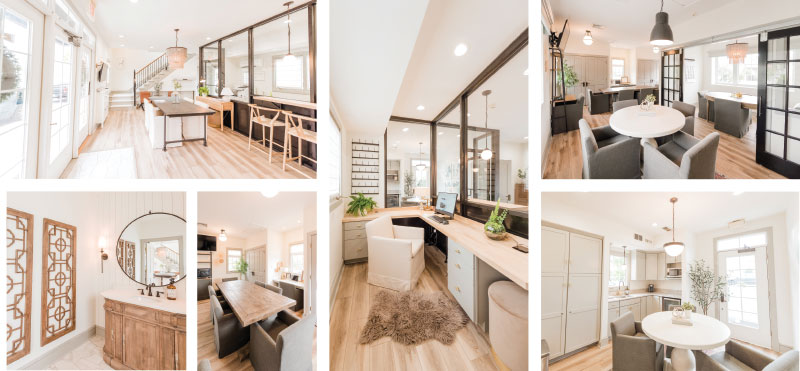
“The layout felt uninviting, which is not at all who we are. We were definitely stuck in the late ’90s, early 2000s with the design,” said Betsy Ferguson, principal broker and owner. “By changing the entire floor plan of the main level we are able to physically show a warm welcome to each person that comes through our doors.”
Ferguson oversaw the project with general contractor Joel Olenik. She also designed the floor plan by hand and chose all interior elements and furnishings.

The first order of business was to remove the large, bull pen–style front desk that used to be located right inside the front door. In its place now is a wooden conference table surrounded by white, cloth-covered chairs. A large beaded chandelier overhead gives the space a warm glow.

Glass-enclosed offices line the back of the room, giving staff privacy while also keeping visitors in sight and allowing more natural light. The black partitions pop against light wood furniture, including bar stools and a counter work station. Matching cognac chairs offer more seating downstairs for agents.

“To keep our package affordable for our agents we chose not to use the traditional desk fee,” she explained. “What we quickly found out is that without assigned office spaces we eliminated the ability for someone to close a door and talk behind. It truly has set an open tone for the entire culture of our office and agent atmosphere.”

The makeover also included the downstairs powder room as well as the second floor, where they removed a wall. Now, Ferguson can host weekly training sessions for agents with ease.

“Our agents and clients love the bright, light and warm atmosphere. With no assigned offices there is a seat for everyone at the table, to grow, collaborate and belong,” she said.

river ridgeRiver Ridge
Renovations Started: July 2019. Renovations Completed: Ongoing Through 2022

Lynchburg’s River Ridge Mall has been a regional shopping destination since it opened in 1980—but in the years leading up to the first wave of renovations in 2019, the mall had seen better days.

“The national landscape for malls has been ‘cloudy’ over the last decade. River Ridge, like many malls built in the ’70s and ’80s, was due for a facelift,” said Lauren Spencer, marketing manager for JLL, the mall’s management company.

River Ridge is owned by Liberty University; the multi-million dollar renovation project is a collective effort by LU’s executive leadership and their architects/contractors.

Just look up to find one of the most transformational elements of the mall’s interior redesign. Raised ceilings with both natural light and light sculptures give shoppers what Spencer describes as an “uplifted and invigorating shopping experience.”

The center court area was another spot that immediately saw major improvements, including a large format fireplace, amphitheater and restaurant-style dining at Iron & Ale Bistro. More recently, the Food Hall was remodeled with a contemporary design aesthetic and the addition of new eateries. Outside, “fresh-faced, large and inviting main entrances” were also updated.

“The rebranding of River Ridge invokes a modern-yet-timeless feel that provides first-to-market retailers with the urban-esque design they are accustomed to in larger cities,” said Spencer.

An indoor-outdoor shopping experience has been at the center of the overhaul at River Ridge. The East End redevelopment, featuring national retailers such as Dick’s Sporting Goods, was completed in late 2020. Currently, the West End is in its final phase of redevelopment and will offer the first restaurant—Papa Gallo—with indoor and outdoor accessibility as well as green spaces for family and community events.

As updates continue in 2022, Spencer says they are already seeing the hard work pay off: “Our retailers have seen a significant increase in their foot traffic, especially during the 2021 holiday season, where many retailers saw some of their highest numbers in sales compared to the past few years.”


Artist Profile: Meg Davies Jan/Feb 2022

Visual Artist

Editor Shelley Basinger: Meg, have you always called Central Virginia home?
Meg Davies: I was born and raised in Lynchburg. I studied art at James Madison University and then lived back and forth between Hawaii and Uganda for several years before coming back home.

SB: When did you first become interested in art?
MD: Since childhood. I would fall asleep with crayons and markers in my bed and ask my mom “Can I draw now?” the minute I woke up. That passion for art has only gotten stronger each year and to be a professional artist is definitely living out my dream.

SB: What types of training have you received?
MD: I did receive formal training through the art program at James Madison University. But my grandmother, Pat Dougherty, is an artist and she always had room for me in her studio when I was growing up. She gave me a wonderful foundation early on and JMU helped me find direction.

SB: What inspires your art?
MD: It’s a broad answer, but life! Life is so full of places to find inspiration. I have a series of bug art, which all started by collecting cicada shells with my son.

SB: What are some of your favorite pieces you have created so far?
MD: My sketchbooks are by far my favorite works of art. However, being fairly private,
I rarely let people see them. As far as what’s out in the world, I’m most proud of work that opens people up to sharing their stories with me. The bug series did that. I quickly learned that countless people have a connection to bugs whether through nicknames, memories, or funny experiences.

SB: What types of challenges have you faced as an artist?
MD: Learning to be flexible enough to embrace change can be a challenge for me in life as well as art. When I find myself in a creative rut, it is usually because I need to change my technique for a while, the structure of my schedule, or how I let the outside world impact my art. Making changes, large or small, can open the floodgates of creativity.

SB: What are you currently working on?
MD: I am completing commissions and mapping out what I want 2022 to look like. It’ll start with another series of botanical work, which is represented with Liza Pruitt, an art representative in Richmond, and a fresh set of landscapes for Findings Art Store in the Boonsboro Shopping Center.

SB: What’s next for you?
MD: Experimenting with new techniques is something that excites me. I’ve worked the same style for years—which is great—but I’m eager to see how I can continue to grow through controlling less, playing more, and pushing my style in new directions.

SB: What advice do you have for future artists?
MD: Some of the best advice ever given to me was to simply draw, draw, draw. It is so relaxing and also provides endless inspiration for future work. Something I’ve also learned over time is to separate yourself from your artwork. Creatives put themselves out there on a continual basis, which of course comes with judgment and sometimes rejection. As much as our art is a part of us, it is freeing to realize that our worth isn’t wrapped up in the external validation. Lastly, meet with other artists on a regular basis to support each other. It’ll be good for your soul and for the art community as a whole.


STAY IN TOUCH
Follow Meg on Instagram, @meg_davies_design or visit her website, www.megdaviesdesign.com.


Toast of the Town

RAISE A GLASS TO THESE FOUR HANDCRAFTED DRINK RECIPES, EACH REPRESENTING A POPULAR PART OF TOWN

Photos by Ashlee Glen

What better way to celebrate the start of a new (and hopefully, improved) year—AND our 2022 Best Of Lynchburg winners, of course—than with a few creative cocktails?

The greater Lynchburg region is home to some fabulous, forward-thinking bartenders who take their boozy concoctions seriously. We asked bartenders from four local restaurants, in four different greater Lynchburg neighborhoods, to share a celebratory toast that embodies their neck of the woods.

From smoked ice (yes, you heard that right) to a wine-infused simple syrup, they pulled out all the stops for the recipes found on the following pages.


DOWNTOWN

The Purple Stiletto
Crafted by Paul Kelley at Shoemakers American Grille
Available to order!

Ingredients
1.5 oz Empress gin
.5 oz St. Germaine Elderflower Liqueur
1.5 oz grapefruit juice
Splash of fresh-squeezed lime juice
Edible flowers (garnish)

METHOD
Combine ingredients, shake, and strain, preferably into a
martini glass, and garnish
with edible flowers.

Taste Test

The Purple Stiletto is a classic cocktail with a modern twist, very similar to the historic-meets-trendy vibe the Downtown Lynchburg area is proud of. The flavor is nicely balanced—not too sweet, not too sour—which will make you want to enjoy this one again and again.

Nod to the Neighborhood

The Purple Stiletto reflects the history of Shoemakers and specifically the Craddock Terry Hotel as one of the largest shoe manufacturers in the world at one time. The Craddock Terry Hotel building turned out 2,100 pairs of women’s shoes per day. The hotel complex, including the King Building, which houses Shoemakers and Waterstone Pizza, was an early example of urban revitalization in Lynchburg and kicked off the revival of Downtown Lynchburg.


FOREST

Country Cabernet Club
Crafted by Zac Stinson at Benjamin’s Restaurant
Not available for order. (Unless Zac gets flooded with requests, he says.)
Make this one at home!

Ingredients
2 oz Tito’s vodka
.5 oz to 1 oz fresh-squeezed lemon juice
1 oz cabernet simple syrup
Splash of club soda
Cherry, lemon and thyme (garnish)

Simple Syrup
1 cup cabernet sauvignon
1 cup brown sugar

METHOD
Combine wine and brown sugar in a saucepan and simmer until thickened. Shake all ingredients over ice. Strain into glass and garnish with cherry, lemon and thyme. Lemon juice amounts can be adjusted for preference.

Taste Test

Cool and refreshing, with a hint of natural sweetness, the Country Cabernet Club reminds us a little bit of a boozy Southern lemonade.

Nod to the Neighborhood

Although Forest is one of the region’s “newer” neighborhoods in terms of development, history is not lacking in this picturesque part of town that always has the Peaks of Otter in the background. The homemade cabernet simple syrup pays homage to Thomas Jefferson, Founding Father and wine enthusiast, and his Poplar Forest retreat home nearby. Some Forest folks are more “country” (think hunting and hiking); others are more “country club” (think elaborate fire pits and golf). Wherever they fall on the recreational spectrum, this drink has a broad appeal for many palates.


BOONSBORO

Tobacco & Iron
Crafted by Cliff Olds at The Dahlia
Not available for order.
Make this one at home!

Ingredients
1.5 oz McCauley’s Whiskey
.5 oz Luxardo Cherry Liqueur
Splash of smoked water simple syrup
Dash of Blackwater Bitters’ Orange Bitters
Torched orange rind twist and rosemary (garnish)

Simple Syrup
1/2 cup smoked water (see below)
1/2 cup sugar

METHOD
Begin by smoking ice in oven-proof container in a preheated smoker set at 275 degrees for
1 hour. (Even though ice will melt, smoke adheres better to a colder surface.) Cherrywood wood chips are preferable. Chill and then strain to remove ash. Take 1/2 cup chilled smoked water and 1/2 cup sugar and boil gently until all sugar is dissolved. Chill before adding
to cocktail.

In a glass, add whiskey, cherry liqueur, homemade simple syrup and dash of bitters. Stir lightly. Add pre-chilled steel cubes so as not to water down the cocktail. Garnish with a torched orange rind twist and rosemary.

Taste Test

Tobacco & Iron has a lot going on—in a good way. One sip and your taste buds take in the refinement of this elevated take on a classic old fashioned with a mellow—yet mysterious—finish.

Nod to the Neighborhood

Tobacco and iron were the primary products of early Lynchburg, in the days of founder John Lynch, when the ferry system was in full swing. The trade of these goods through the years helped lay a strong financial foundation for many of the families that later relocated to the up-and-coming “suburbs” of Rivermont Avenue in the late 19th century, creating some of the beautiful, classic older homes located in this area. Even the garnishment of this drink pulls from its surroundings, representing the unique and sophisticated architecture found in the Boonsboro neighborhood.


TIMBERLAKE ROAD

Candy Apple Sangria
Crafted by Aaron Quinn & Danielle Johnson at Iron & Ale
On the menu at Iron & Ale!

Ingredients
2 oz of dry red wine (preferably cabernet sauvignon)
1.5 oz cinnamon simple syrup
.75 oz green apple cocktail mixer
.75 oz cinnamon whiskey
2 oz apple cider
Splash of club soda

Simple Syrup
1 cup sugar
1 cup water
4 cinnamon sticks

METHOD
Start by simmering your sugar, water and cinnamon sticks until mixture is thickened. Remove cinnamon sticks.

In a glass or cocktail shaker, combine all ingredients with ice, and shake thoroughly. Rim a glass in caramel, and dip in cinnamon sugar. Add ice to the rimmed glass, strain the cocktail into the glass and add a couple of splashes of club soda.

Taste Test

Drinking the Candy Apple Sangria is equivalent to bobbing for caramel-covered apples in a tub of wine. It’s a cozy cocktail for fall and winter but also sweet and refreshing enough to transition to the warmer months.

Nod to the Neighborhood

What we are calling the Timberlake Road side of town is broad and more loosely defined—stretching across the west side of Lynchburg along Timberlake Road and encompassing a host of smaller communities such as Cornerstone, where this drink originated. Like this playful sangria, the Timberlake Road region has a youthful ambiance—from the college students in Cornerstone to younger families with children in various neighborhoods. Not to mention you’ll find plenty of people playing on the water in the Timberlake community during the summer.


A Pause on Evictions

COVID-19 LEGISLATION, PROGRAMS AFFECT TENANTS AND LANDLORDS IN GREATER LYNCHBURG

While the City of Lynchburg has been growing and changing in many positive ways over the past decade, the city’s housing stability issues have not been improving along the same curve.

One major symptom of this problem is evictions.

According to data compiled by the Virginia Legal Aid Society in Lynchburg in 2019, when compared to the number of evictions in other mid-size cities, Lynchburg had the 10th highest absolute number of evictions in the country in 2016 (1,207 evictions).

Fast forward to 2020, and the onset of the COVID-19 pandemic, and the statistics changed again. Sarah Quarantotto, executive director of Miriam’s House, saw a “dramatic” drop in cases at the nonprofit.

“Most households with children become homeless due to a rental [payment] situation,” she explained. “Over the past year we saw a 50 percent reduction in families becoming homeless. … The eviction moratorium was a major factor.”

The Center for Disease Control (CDC) eviction moratorium was initially issued to “protect public health and slow the spread of COVID-19” explained the Virginia Poverty Law Center, as well as protect “residential tenants who have fallen behind on rent from being evicted until 2021.”

Landlords could still evict for non-rent lease violations and the order did not forgive rent, only pushed it off.

“The protections of those moratoriums certainly slowed things. People had breathing room,” said Jeremy White, managing attorney at the Lynchburg office of VLAS.

However, as White explains, a tenant couldn’t stand back and do nothing. To request protection via the now-expired CDC eviction moratorium, the tenant would have to make the declaration that they were eligible.

“It was on the tenants to fill that out,” White explained. “There were plenty [of evictions] still going forward after the main protections had expired.”

The CDC eviction moratorium was extended several times, with the final extension ending on October 3, 2021.

However, state protections for Virginia tenants continue until June 30, 2022, after Gov. Ralph Northam signed a new budget bill in August 2021.

In order to evict a tenant based solely upon the nonpayment of rent, the landlord must first give the tenant a 14-day nonpayment notice informing the tenant about the Virginia Rent Relief Program (RRP). This pool of money can pay rent, past due amounts and even court costs for qualifying tenants as far back as April 2020.

Then, during the 14-day period, the landlord must apply for RRP on the tenant’s behalf unless the tenant pays in full, enters a payment plan, or the tenant already has applied for RRP.

“If a tenant is experiencing any financial hardship during the COVID pandemic, then the landlord has to apply for rent assistance. Until that process is attempted, landlords aren’t supposed to be taking any action,” White explains, emphasizing that a person doesn’t have to be struggling specifically because of COVID-19, such as a lay off. The RRP has very broad coverage.

If it sounds confusing, White agrees—it is.

“From a practical standpoint that’s where we are at right now, trying to get people to the right place. We have rent relief navigators, thanks to a recent grant, who help navigate that process. Because it’s not super simple info,” White said. “It’s been changing so rapidly, it really makes it difficult for the average person to understand.”

There was a move to simplify the RRP system late last year; state officials combined the tenant and landlord portals on Dec. 1, 2021. This updated, one-application system will ensure that tenants, landlords, and all stakeholders have access to rent relief information faster and easier than before—and that the funds are handed out in a timely manner.

“Virginia is sort of leading the country in dispersing the funds; some states don’t have a system at all. Virginia is doing better than most,” said White.

Even before the pandemic, the rental environment was changing in Virginia. Virginia lawmakers were enacting new protections for tenants, becoming a lot more “tenant-friendly” than they had been historically, said Luke Malloy, an attorney with Petty Livingston Dawson and Richards who represents landlords in the region.

The changes started with the Virginia Residential Landlord and Tenant Act. This act oversees the rights, remedies and responsibilities of landlords and renters concerning the rental process.

“Historically, that [act] did not apply to what was called ‘mom and pop landlords’, with fewer than four properties. The [legislative] change made it apply to all landlords. That was a large shift,” said Malloy.

Then the COVID-19 pandemic hit, leading to those emergency laws regarding tenants.

“These enactments at the state and federal level were further designed to keep people in their homes and keep them from being evicted,” Malloy said.

While Malloy is sympathetic to the concerns for tenants, he says landlords can sometimes be overlooked in the eviction/housing debates.

“What used to be the failure to pay rent situation, five-day notice and court hearing is now a much lengthier process to allow tenants more time to apply for relief and essentially avoid there being an eviction on that basis,” Malloy said.

In working with landlords on their cases, he sees their burdens firsthand.

“They still have mortgages to pay. Financial constraints. Tensions they face,” he said. “There’s been such a push and pull on the eviction process from stakeholders on both sides. And it’s been such a quickly changing subject that the courts have been very hesitant to proceed on evictions for failure to pay rent.”

White emphasizes that the intent of the RRP program is to bridge the financial gap between landlords and tenants, so that neither entity is struggling.

“We have just heard that there is still $500 million available in rent relief so it really is vital to connect landlords and tenants to the RRP system,” he says.

Despite that high number, everyone is aware that at some point, the RRP money will run out.

“We are kind of bracing ourselves for the surge [of evictions] but it hasn’t come yet,” said Quarantotto. “Right now, the state is projecting that the Rent Relief Program will last through all of 2022.”

And what then? Quarantotto believes Lynchburg’s eviction rate will continue to be an issue in the coming years if the city doesn’t address barriers to housing stability—such as a lack of affordable rentals.

“There are a ton of folks who are paying 50 to 70 percent of their income on their rent. It’s not sustainable. It doesn’t allow for any crisis in their life, such as getting sick and losing a week at work or their car breaking down,” she explained. “The story we hear every day is a family was getting by okay and a crisis happens, then they can’t pay their rent, they get evicted, go to grandma’s for a few months, then end up homeless.”