Understanding Your Beat

Get to know your heart rate to improve your health and fitness journey

Walk into almost any gym, or even simply stroll the mall, and you’ll spot a very familiar accessory in our 21st-century world—the Apple Watch. Just a quick glance down at your wrist can tell you how many steps you’ve taken, how many calories you’ve burned, how long you slept last night and your heart rate at any given time. The last of these may be one of the most unsung metrics of health and fitness.

By definition, your heart rate, also known as your pulse, is the number of times your heart beats per minute. You have a “resting” heart rate when your body is in a complete state of rest, an “active” heart rate when you are moving, and a “max” rate that you would reach at the peak of an intense workout.

“Knowing your ‘normal’ resting and active heart rate can be important to signify if there are any heart or other health conditions that need to be addressed, especially as we age,” says Tasha McConnell, M.S., certified personal trainer and head trainer at Burn Boot Camp Lynchburg. “A good time to check your resting heart rate is right after you wake up from a good night’s sleep and before you get out of bed.”

The American Heart Association defines anywhere from 60-100 beats per minute to be a normal resting heart rate. “There are some experts that believe 50-70 is actually a better ideal resting rate. Keep in mind a healthy heart rate will vary from person to person and depends on the situation,” she says, adding that factors such as stress, anxiety, hormones, medications, supplements, and fitness levels are all variables.

Once you know your resting heart rate, you will want to start keeping track of where that number is when you are exercising. “Knowing your max and active rate can help you understand how hard to push during a workout,” McConnell says.

Calculate your max heart rate first to act as a benchmark.
“Generally, you will take 220 minus your age. This is an estimate
and it will vary person to person,” McConnell says. “A good goal in terms of health and fitness would be to stay at about 85% of that number during intentional exercise.”

So for a 35-year-old woman, your max heart rate would be approximately 185. During a workout, staying around 157 beats per minute would show you are pushing yourself hard enough and optimizing your workout.

Keep in mind that your max heart rate is not a number you want to sustain for long periods of time. McConnell says not only is it difficult, it could be dangerous, with symptoms such as shortness of breath, dizziness and chest pains likely for an average, healthy person.

“These would all be warning signs to slow down,” says McConnell. “Your body is wired for survival and would warn you if it sensed something wrong.”

Your watch won’t tell you to stop—that’s up to you! It’s also important not to take the numbers too seriously. According to McConnell, the accuracy of fitness trackers is often debated. “They use a green LED light that can monitor blood flow through the wrist. Blood flow at the wrist is said to be slower versus near the heart,” she says, but counters that fitness trackers can be a useful tool for fitness to act as a baseline for users.

When all else fails, get your heart rate—resting, active or max—the old-fashioned way. Find your pulse at your wrist or neck. Count the beats for one minute or, if you are short on time, count the beats for
15 seconds and multiply by four.



Kitchens that Pop

Homeowners gravitate toward statement-making cabinet choices

Anyone who follows home décor trends on social media and beyond will already know: bolder, more saturated colors are edging their way into a world of all-white kitchens. Sometimes it’s subtle—a hint of an interesting hue on the kitchen island. Other times, more in-your-face with a bright paint choice all over.

Tracy Kearney, a certified kitchen designer at Cornerstone Cabinets and Design in Forest, says while white is still the cabinet color of choice for clients in Central Virginia, they are starting to hear more requests for color—a movement she believes may have stemmed from the pandemic.

“I believe it’s because people are trying to flip their moods, increase their energy levels, and add a little more fun in the home,” Tracy says. “Because the home has now become the safe haven.”

The cabinet colors people choose are largely dependent on their individual personalities, she says—but in general, blues and greens have been their top “pop” color request. “I have been doing a lot of designing for wellness and living healthy,” she says. “We are trying to bring the outdoors in.”

redesign your kitchen

For those who are less adventurous and can’t quite commit to a bold cabinet option anywhere, Tracy says they will suggest using a contrasting neutral color, such as Cityscape by Sherwin Williams, somewhere less pronounced, like the kitchen island. Or, choosing a color for just the lower cabinets has also been a popular way to add contrast to the room without overdoing it.

Alongside the introduction of color, Tracy has seen unique cabinet textures become popular as well, tying into a natural, outdoor-inspired aesthetic. “The textured melamine finishes have the look and feel of real wood, but they offer a more modern style. Plus they are water resistant, as well as a cleanable and stain-proof surface. Something that can be more desirable in today’s world,” she explains.

They are also getting ready to introduce some weathered wood looks to clients. “Getting back to those earthy tones and going after the wood grain texture more so than the color,” Tracy says. “I think this is also going to be a popular option for kitchen islands.”

Accenting these unique cabinet colors and finishes is the hardware, which Tracy calls the “jewelry” of the finished product. Right now, satin brass and black are their most popular hardware finishes.

She says when it comes to choosing a more saturated cabinet color: “The contrast is really important with the hardware. We don’t want to lose the hardware in the cabinet color.”

Regardless of where you end up on the rainbow of options during your next new build or renovation project, Tracy’s consistent piece of advice to clients is this: remember to make it your own—“I always advise people to do what brings them the most joy. Nowadays, it really is all about joy.”


Artist Profile: Beatriz Gutierrez Mar/Apr 2021

Wood-Fired Pottery

Lynchburg Living Editor Shelley Basinger: Beatriz, you aren’t originally from the area—or even the country! Tell us a little bit about yourself.
Beatriz Gutierrez: I grew up on the island of Tenerife, Spain. My journey with clay began in Scotland at the age of 28 and continued when I moved to America to study at the Penland School of Craft in North Carolina in 2010.

SB: What other types of training have you received to improve your skill?
BG: I am grateful for the mentorship I have received from other potters since the beginning. Most recently, I have been studying wood firing with
Kevin Crowe at Tye River Pottery in Amherst County. We stopped last March when the COVID-19 pandemic began. He has a big kiln that requires 12 people and seven days to be fired. All the work is loaded into the kiln, but we are still waiting for when we can gather safely to fire.

SB: I’m sure you are looking forward to that day! Meanwhile, you spend a lot of time at your own studio in the Coleman Falls area of Bedford County.
BG: We have been building my studio for most of the past decade, using reclaimed materials collected over the years, including all of the bricks used in the construction of my kiln. That is one of the reasons why everything has happened very slowly. I have broadened my skills by being involved in every step of the process. I have worked mostly with my husband, Paul, with the occasional help of friends and neighbors.

wood fired pottery

SB: What is a typical day like for you at your studio?
BG: Depending on the weather and the time of the making cycle, I start my days with wood preparations: splitting and stacking. In addition to wood from my property, I purchase locally harvested wood from a logger down the road. The wood needs to be dried enough for the success of the firing—that is why it is stacked is so carefully. Inside the studio, you will find me clay mixing, reclaiming clay, mixing, maintaining my glazes and throwing. I mainly use a kick wheel to make my work and I harvest local clay to make my pieces.

SB: What types of challenges have you faced?
BG: Transitioning from mid-range temperature electric firing (how I used to make my pottery) to wood firing has been a difficult challenge. Over the past year, I have not had a lot of work available to sell because I am still working out the details of the kiln.
It could take me one to three months to produce enough work to fire my kiln and with the preheat,
it takes three days to fire.

SB: What are some of your favorite pieces you
have created so far?
BG: I love all of the shapes I am making. Tea pots are so much fun! Making the jars with the right curve is always a good challenge. Then, the lids
and the spouts and the handle. I love putting all of the parts together in a way that pleases my eye. When they end up working beautifully, it’s a great feeling of satisfaction.

SB: That transitions perfectly to my next question. What do you love so much about working with clay?
BG: Clay has memory—it records the process of making, shows the quality of the thoughts I had when working. When the clay is exposed to the flames of the fire in the kiln and vitrifies, all the conscious and unconscious choices in the making process are revealed. This is always a bit shocking. The power of pots relies on how ordinary and mundane they are. Objects we use every day on our tables.

SB: What’s next for you? What do you have planned in the coming year or in the future?
BG: There are so many pots I want to make this coming year: casserole dishes, planters, baking dishes. Each new form is an adventure.


Lynchburg is for Bloody Mary Lovers

The iconic T.C. Trotter’s has a new home for its must-have, multi-use Moose Mix

When Lonnie Hoade and Paul Webster received a call from Virginia ABC last October, the owners of T.C. Trotterʼs Moose Mix for Bloody Marys were equal parts thrilled and intimidated. “We suddenly had an order for 18,000 bottles to be delivered by the first week in December,” Lonnie explained of the very tight timeline.

But when you’ve invested so many years into a product, a little hard work doesn’t scare you off. Many who have lived in Lynchburg over the past few decades have watched the evolution of Moose Mix—from its local restaurant roots to its current location on Commerce Street, which serves as a manufacturing center and tasting room.

Lonnie and Paul’s tried-and-true Bloody Mary recipe, now recognizable across the country, was born at T.C. Trotterʼs Restaurant where Paul was the bar manager.

Casually known as “Trotterʼs,” the restaurant was located in what’s now Rivermont Pizza on Rivermont Avenue for three decades.

“[Our Bloody Mary] became very popular and was served in that glass,” Paul said, pointing to the stemmed and slightly fluted glass on the tasting room counter. “It was five dollars a glass and came with two shots of vodka. We just had cases and cases of those glasses because on weekends, we would serve so many of them.”

“When we first started to notice the demand for it [outside the restaurant], it was around 2004,” Lonnie explains. “Lynchburg College students would call us and want some so we were delivering it around the state. It wasn’t even shelf stable at that point.”

moose mix

Photo by ASHLEE GLEN

Back then, everyone knew it as “Trotterʼs Bloody Mary Mix”—but eventually they decided on a name change that combined autonomy from the restaurant with a bit of personality.

“We licensed it as Moose Mix because he makes it,” Lonnie said, referring to Paul and his nickname. They started bottling it for sale in 2007.

That same year, the owner of T.C. Trotterʼs decided to close the restaurant, but Lonnie and Paul didn’t let Paul’s famed Bloody Mary mix die out. Back then, and still today, each bottle is prepared by hand, every step of the way.

“From the labor to the packaging and then we put it on pallets and deliver it ourselves,” Paul explains. Each batch of Moose Mix takes about 2.5 hours from start to finish. The bottles are capped at high heat so there are no preservatives.

Now, the demand for their product reaches as far as New York, Florida, and California, with plenty of customers in between.

What makes the mix so popular, Lonnie and Paul believe, is its homegrown taste.

“When we are at festivals, people say, ‘This tastes fresh.’ Some brands can taste manufactured,” Paul says. “It is very flavorful. It has spice as in flavorful spice, not burn-your-mouth spice.”

Lonnie also believes their mix “holds up” better than other brands, making your classic Bloody Mary taste good down to the last drop: “We don’t add any water so it doesn’t water down. The end of the your drink, it’s just as good as the beginning.”

tc trotters moose mix

Photo by ASHLEE GLEN

In 2016, Lonnie and Paul took what they learned from their experience at T.C. Trotter’s and opened Moose’s Café in Boonsboro. There, they continued making and selling their Moose Mix but also let it inspire some culinary creations as well—from the “Moose Island” dressing they used on their popular Reuben (a homemade Thousand Island with Moose Mix in place of ketchup) to a Gazpacho made with fresh local vegetables.

“We’ve done chili with it. We’ve done spaghetti sauce. People have told us about ribs that they have done,” Lonnie explains. “There are so many possibilities aside from the Bloody Mary.”

In fact, marketing their Moose Mix as more than just a base for a Bloody Mary has been an important step in their business model.

“At festivals, invariably, people would come to our booth and say ‘what is this’ and we would say ‘Bloody Mary mix’ and one of them would go ‘yeah!’ and the other would go, ‘ew, no.’ But we would let that person taste the shrimp we grilled in it. It would give us another avenue to reach people and find new customers,” says Paul.

In 2020, they made the decision to close Moose’s Café so they could focus even more on their Moose Mix.

Because when you are this husband-and-wife team, you like to be busy—even if it means bottling 18,000 bottles of Moose Mix by hand in less than two months. A deadline they met, by the way.

moose mix

Photo by ASHLEE GLEN

Now, they are able to enjoy a much slower pace as they maintain their case count at the ABC distribution center in Richmond. They’ve also had Absolute Vodka show some interest in doing a new promotion in 2021.

So slower, but not too slow, they hope. Lonnie and Paul are looking forward to the start of spring and warmer weather that will bring increased foot traffic outside of their Commerce Street location. “That’s why we are excited to be here. We get the impression it will be like a festival once it’s warm. We want to have tasting trays outside,” Paul says.

As Lonnie and Paul can attest through their journey, it doesn’t take much to bring people together in Lynchburg.

But a good cocktail never hurts.

“People can criticize it, but I’ve lived in a lot of places and this city is so great,” says Lonnie. “There is a connection here, something wonderful.”


Bang For Your Buck

Home needs a refresh?

Whether you are itching to sell in the new year or are contently settled in your forever home, seasoned renovators recommend tackling one of these projects in 2021.

Paint, paint and more paint.
Dig out those old gym shorts and roll up your sleeves—because the number one way to add value to your home is to paint it.

“I call it an emotional change,” says Daryl Calfee, owner of Penny Lane Properties, which specializes in renovating old houses. “It’s the hands down best return-versus-cost improvement you can make.”

paint color trend

Statistics show on average, just painting the exterior of a home can improve its value by five percent—that’s a large chunk of change. Painting the inside is also effective, especially for those who plan to sell their home in the new year.

“A well-chosen palette that brightens, refreshes and even smells new goes a long way with buyers,” Calfee says.

Painting is also the number one recommendation from Josh Redmond, local real estate agent who also renovates homes to sell or rent, and Owen Hurst, who has years of home renovation and woodworking experience. Since 2014, the two have partnered on more than a dozen local renovation projects.

“We use ‘Repose Gray’ for a reason. It works in any space, large or small, with any style or color,” Redmond says of their preferred paint color, adding that it is a true gray that doesn’t pull from other colors such as blue or purple.

A neutral paint color is ideal when considering a home’s resale value, which Redmond says is something he’s often asked about when homeowners are considering home renovations.

paint colors do matter

“It’s helpful to know if the time and investment you make in your home will increase the value for potential buyers down the road,” he explains. “If you enjoy the changes, and they can improve the home, that’s a win-win.”

For those with no plans moving in the near future, below are a few much brighter paint recommendations.

Update landscaping.
Another exterior update that can drastically increase the value of your home is landscaping, one of the building blocks of impeccable curb appeal.

“It’s the first thing that gives people a ‘wow’ factor within seconds of pulling up to your home,” Redmond says.

For many homeowners, a landscaping update might not be a massive overhaul—just a few loads of mulch and a sunny Saturday’s worth of work.

updating landscaping

“Start by trimming existing bushes and plants, rake out all clippings and leaves, make sure to pull weeds and spray weed killer for the future, then put down a good landscape fabric, if you haven’t before. Finally, when all else is done, you can mulch,” says Dan Vollmer, associate broker with REMAX 1st Olympic and home project enthusiast, who adds that removing dead trees should also be a priority.

If you need to plant brand new bushes, shrubs or small trees, consider your houseʼs style and architecture—for example, if there’s not a lot of interest in the front, you would choose higher plants or shrubs. Your local nursery can help you make selections.

According to Lynchburg Living gardening contributor Ashleigh Meyer, the biggest problem for most who DIY their landscaping is planting too deep. “The root collar needs to be about two inches above the existing grade. This is right where the stem transitions into the first/highest root,” she says. “You also want to make sure the hole youʼre planting in is nice and wide so that roots spread out rather than encircle the stem.”

Change out light fixtures and/or hardware.

Older light fixtures can really date a home, says Vollmer—but new ones don’t have to break the bank or require an expensive bill.

“Shop local stores and online sites for great deals, and try to stick to the same finishes throughout,” he explains.

update light fixtures

Along with your fixtures, consider changing out your door handles and hinges too—even faucets. “There are lots of options and styles for this,” says Cole Rice, real estate agent with Lauren Bell Real Estate. “Brushed nickel, matte black, oil-rubbed bronze, even gold—it’s coming back!”
Refinish wood floors.

They are often the “ta da” discovery of home reality shows—the moment when gorgeous hardwood floors are unearthed below faded linoleum or lime green carpet. If you have hardwoods that have seen better days, now may be the time to shift your home improvement focus down.

“Refinished wood floors are worth their weight in gold,” says Calfee. “Walking into a home with refinished wood floors immediately gives a high-end feel and the reflection of light brightens the room.”

Calfee says you can expect to pay around two to three dollars per square foot to have your floors professionally refinished or you can rent a sander and products yourself from ACE Hardware locally. Keep in mind while this is not an extremely difficult DIY project, it is time intensive and requires multiple steps to complete.

Become a master of plaster.
Before there was drywall, there was plaster—a material most likely used in homes built before the 1950s. If you have an older home, this refresh project is for you.

“Repairing plaster walls offers an organic texture and elevated value that sometimes drywall lacks,” Calfee explains. “Ceilings can and will be a pain, so covering them with drywall at times makes sense if they are too far gone to repair.”

If you want to add subtle texture and value to drywall, Calfee says use Roman Clay. It’s simply
applied with a putty knife and will give your walls a subtle marbling texture.

DIY a new backsplash.
According to Hurst, one of the best ways to make a big impact in your home is to go for a new kitchen backsplash—and to try it yourself.

“I originally taught myself how to do it years ago by watching YouTube tutorials—there are so many out there and really good ones to learn from,” he says. “If someone is willing to take on the project, they could do it in one weekend and have a big impact for a pretty low cost.”

Hurst installed a traditional white subway tile in his own kitchen when they renovated last year; he and his wife love it for the simple, classic look and how the white tile brightens their space.
It’s also the best option for beginners. Subway tile is typically very affordable and is the easiest to install in Hurst’s opinion.


Best Beach Getaways

Try Wildlife Refuges Off-Season

Fall, winter and spring can provide the best beach time, especially when a pandemic requires us to keep our distance from each other.

Sunrises come later and sunsets come earlier. Dolphins still play in the waves and crabs scuttle across the beach.

For bikers, hikers, paddlers and surf fishers, the weather can be balmy or brisk, but not suffocating, and for birders, it’s the best time of year.

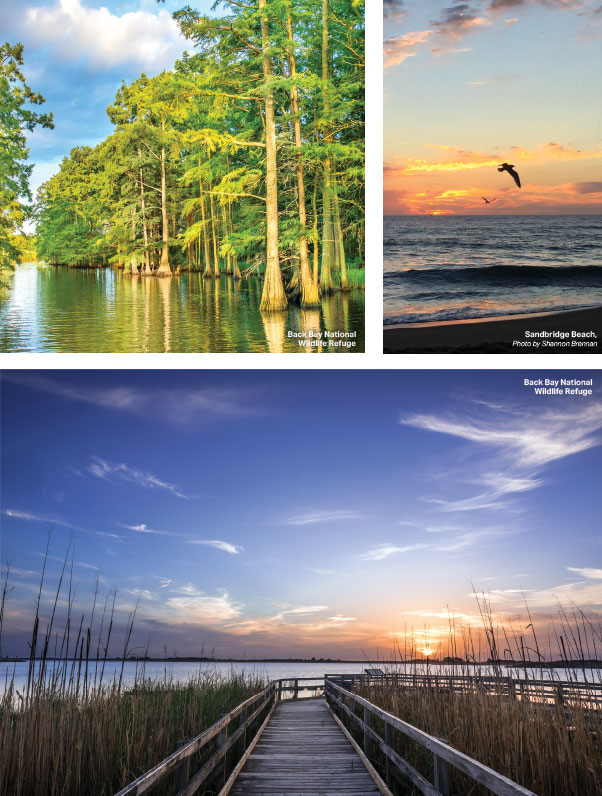
Virginia’s Back Bay National Wildlife Refuge, established in 1938 to protect migratory and wintering waterfowl, supports up to 10,000 snow geese and a large variety of ducks and other waterfowl during the annual peak migration, usually in December and January.

The refuge encompasses nearly 10,000 acres of beach, dunes, woodlands of live oak and loblolly pines, farm fields and marshes, along with the freshwaters of Back Bay.

Located just north of North Carolina, this coastal refuge also provides habitat for threatened and endangered species including sea turtles and piping plovers, small shorebirds that are declining rapidly.

More than 300 species of birds have been observed at Back Bay, primarily during winter months. Mammals include river otters, mink, opossums, raccoons, foxes, and white-tailed deer.

Canals provide a glimpse of venomous cottonmouth snakes, swimming across the water, along with brown and northern watersnakes. On warm days, a variety of turtles, including red-bellied, painted, eastern mud, and snapping, may warm themselves on logs or lurk beneath the surface.

This slender strip of land is covered in common reeds, which can reach 15 feet in height, providing cover for many animals, including humans as they stroll along boardwalks.

Groundsel or sea myrtle, with lovely white flowers, attracts butterflies and other pollinators, and provides seeds for birds.

Wax myrtle, a traditional source of wax for bayberry candles, is a favorite of the
wintering yellow-rumped warbler.

On a visit in October, the refuge was full of yellow in the form of goldenrod and smooth beggarticks. Great Plains lady’s tresses, a spiky plant with white blossoms, and blue mistflowers, could be spied along the trail.

Entrance to the refuge is just south of Sandbridge, a long narrow barrier island, 16 miles south of Virginia Beach.

We stayed at an Airbnb at Surfside at Sandbridge, an RV resort, just north of the refuge and enjoyed views from our canal-side porch. For dinner, we ordered takeout from the nearby Baja Restaurant with its many seafood options. For a breakfast treat, the homemade doughnuts at the Sandbridge Seaside Market are not to be missed.

travel

A short stroll from our Airbnb mobile home took us to the Atlantic Ocean, where only a handful of people splashed along the water’s edge, tossed in a fishing line, or flew kites.
A five-minute car ride took us to the entrance to Back Bay National Wildlife Refuge. Outdoor trails are open a half hour before sunrise and a half hour after sunset, and there is no entry fee from Nov. 1 to April 1.

All vehicles must park at the visitor center, which was closed due to COVID-19. To protect wildlife, no dogs are allowed in the refuge.

From the parking area, folks can walk along boardwalks to Back Bay or to the ocean. You can also bike or hike the four-mile trail to False Cape State Park or continue to the North Carolina line for an 8.8-mile trek one-way.

Several adventurous types were backpacking into False Cape, where primitive tent camping is available for a complete getaway.

While at Sandbridge, we couldn’t resist a trip north to Kiptopeke State Park, where the annual hawk migration count was underway. To get to the eastern shore, you must traverse the Chesapeake Bay Bridge-Tunnel, which is an amazing experience in itself.

The Bay Bridge-Tunnel is a four-lane 20-mile-long vehicular toll crossing that provides direct access from southeastern Virginia to the Delmarva Peninsula (Delaware plus the Maryland and Virginia Eastern Shore).

Spectacular views of the Chesapeake Bay along the bridges also offer glimpses of brown pelicans and black-backed gulls, the largest gulls in the world. As you take two plunges under the bay in two separate tunnels, you appreciate the engineering required to disappear under the water as giant cargo ships ply overhead.

As you leave the bridge, you enter the Eastern Shore of Virginia National Wildlife Refuge, one of the most important avian migration funnels in North America. This 1,100-acre refuge is the scene of a spectacular drama as millions of songbirds and thousands of monarch butterflies and raptors converge on their journey south. Favorable weather patterns push migrating species through the area in waves.

Numerous tree swallows swirl overhead and monarch butterflies float aloft. Protected habitats such as these provide critical stopover areas where birds, monarchs, and dragonflies can rest and feed before resuming their arduous journey.

We saw several sharp-shinned and a handful of cooper’s hawks and bald eagles at the refuge before continuing on to Kiptopeke. While it turned out to be a slow day for migrating raptors, we saw hundreds of pine siskins and a dozen red-breasted nuthatches, northern species which only venture south when there is a poor seed crop in Canada.

Another winter getaway awaits near the Maryland state line at Assateague Island National Seashore, famous for its wild ponies and the annual summer roundup at Chincoteague.

To our south, the Outer Banks of North Carolina are also thick with off-season delights. Pea Island National Wildlife Refuge offers some of the best winter birding.

The refuge is 13 miles long and covers 5,834 acres of land, located on the north end of Hatteras Island. The bird list for Pea Island boasts more than 365 species; the wildlife list has 25 species of mammals, 24 of reptiles, and five of amphibians.

These refuges are among 567 National Wildlife Refuges administered by the U.S. Fish and Wildlife Service, many along the East Coast.

No matter what coastal wildlife refuge or state park you choose, you have many choices for outdoor activities, wildlife viewing, and the peace and serenity of open spaces.


Central Virginia Fitness Bucket List

Recommendations for a range of fitness levels

Beginner
Sign up for your first 5K.

In a normal year, there is no shortage of race opportunities in Central Virginia, especially for those seeking a shorter distance such as a 5K. While the pandemic canceled many races or made them go virtual last year, we are hopeful that the 5K lineup will return to normal (or close to normal) at some point in 2021. Beginners can find a range of 5K training plans online, or seek out support from a trainer or friend with running experience.

Join an obstacle race with your family or friends.
From climbing walls to balancing teeter-totters, the Face the Forest race at Thomas Jefferson’s Poplar Forest in partnership with the YMCA is the only family-friendly event of its kind in our area. All ages are welcome at this annual event that also includes lots of mud—so don’t wear your brand new running shoes!

Face the Forest
Date/time TBA
poplarforest.org.

Get out of your comfort zone with a new fitness activity.
Fitness amateurs can often catapult themselves into a healthier lifestyle simply by trying something new. A couple of ideas to get you started: try indoor rock climbing at Rise Up in downtown Lynchburg, play disc golf at one of the area’s numerous courses such as Peaks View Park, or rent a bike from Bikes Unlimited on Jefferson Street and explore the Blackwater Creek Trail.

Moderate
Dip your toe into the world of triathlons.
For active adults who are ready to try the challenge of a triathlon, the Smith Mountain Lake Triathlon is a great place to start—but it’s also one that experts love competing in year after year due to the excellent conditions and mountain views. The swim features a sandy beach start and a crisp, clear lake.

The bike and run courses are rolling, but not too challenging.

Kinetic SML Sprint Triathlon
May 1, 2021
kineticmultisports.com/races/smithmountainlakesprint/

Hike a moderate/strenuous peak at sunrise.
We are beyond lucky to live in an area with so many gorgeous hiking opportunities. Typically, those boasting a level of moderate to strenuous have the best reward: a spectacular view of Central Virginia. A sunrise hike adds an extra layer of challenge because it likely requires an early weekend wakeup time—which we all know is difficult.

Tackle a long-distance bike race.
You don’t have to travel far to find a long-distance cycling opportunity right here in Central Virginia: the Storming of Thunder Ridge, hosted by Beacon Credit Union and the YMCA. With breathtaking views, this race has options for a range of abilities with a choice of 27-, 45-, 49-, 75- and 100-mile routes. The 27- and 45-mile routes are better for moderate cyclists, featuring rolling hills and back roads.

Storming of Thunder Ridge
May 23, 2021
ymcacva.org/storming-thunder-ridge

Advanced
Set a new long-distance running goal.

For those who have plenty of 5K T-shirts sitting in their dresser, and consistently beat your PR, it might be time to transition to a long-distance race. The Virginia 10-Miler is a great option because many local runners are already familiar with the shorter version. Or you could take a “racecation” to Richmond and join the city’s marathon, half-marathon or 8K.

Virginia 10-Miler
September 25, 2021
virginiatenmiler.com

Richmond Marathon
November 13, 2021
richmondmarathon.org

Take your running skills to the next level with a trail race.
The Mountain Masochist Trail Race is a 50-mile course through the Blue Ridge Mountains that is a physically challenging combination of roads, jeep trails, and single track. You must train hard for this race—both physically, mentally and even spiritually, organizers say. This year, the race will start and end at Camp Montebello in Nelson County.

Mountain Masochist Trail Race
November 6, 2021
eco-xsports.com/events/mountain-masochist

Start training for a long-course triathlon.
One of the most popular, and most difficult, long-course triathlon races is the Ironman—consisting of a 2.4-mile swim, 112-mile bicycle ride and a marathon 26.22-mile run. We are fortunate to have an Ironman race in Roanoke that’s set for June of this year. If you haven’t started training yet, you may want to set your sights on the 2022 race to give yourself more time to prepare.

Ironman 70.3 Virginia’s Blueridge
June 6, 2021
ironman.com/im703-virginia-blue-ridge


Artist Profile: Jennifer Lipford Petticolas Jan/Feb 2021

Playwright and Performer

• JLP Productions, owner
• DC Black Theatre Festival, committee member

Lynchburg Living Editor Shelley Basinger: Jennifer, you have a very long history in the area’s theater community—particularly writing your own original plays. When did you first develop a love for the stage?
Jennifer Petticolas: I worked behind the scenes doing set design and building sets while attending Livingstone College
in Salisbury, North Carolina. When I declared my English major, my dean said, “Are you sure you don’t want to do theater?”

He saw something in me then that I didn’t see. But I chose English because I have always enjoyed writing and especially creative writing. That love started at Dunbar High School in Lynchburg, with Mrs. Jordan and Mr. Watson.

SB: Where did life take you with that English degree?
JP: After finishing college, I got a teaching job at a junior high school in Baltimore.

I had been teaching three or four years when the faculty wanted to do a play about the history of our country and incorporate some dance into it, so I volunteered to write it. That was the first play that I wrote, and it really piqued my interest.

SB: When did you return to Lynchburg? And did you get involved in theater right away?
JP: I came back to Lynchburg in 1976. I remember my oldest daughter was trying out to be in Annie and told me, “Mom, I want to be Annie.” I told her I didn’t know if they would cast her in that role, and she ended up being casted as one of the orphans. She said, “Well, if I can’t be Annie, I’m going to be the best dancing orphan up there.” I thought if she can do it, I can do it too! Later on, I was cast in For Colored Girls and started getting involved with the Fine Arts Center (now Academy Center of the Arts).

SB: Since then, you’ve written numerous plays that have gotten acclaim both locally and beyond. What are some of your favorites?
JP: One piece that I was most proud of focused on suicide awareness. A friend, Kim Kittrell, came to me and told me about how her daughter, a former E.C. Glass student, had committed suicide at college. She wanted to get the message out that there is help for people who are struggling with depression. I did an interview with Kim, which was a very difficult process. She talked about her daughter being a dancer and how her daughter always felt like every woman should have a little black dress. I titled the play that, Little Black Dress, to symbolize a sophisticated woman and also, depression. I also got help from the medical community to make sure we were giving out the right message. This play has been performed in Virginia, Maryland and D.C. The Campbell County Branch of the NAACP presented us with an award for the play.

Another favorite is Sunday’s Child, a play I wrote for Johnson Medical Center about the life of Dr. Robert Walter Johnson.

I did a lot of research for that one, including interviewing about 30 or 40 people on the telephone and visiting his grandson’s house in Maryland.

SB: You also have focused on black history through the years. Most recently, “People Died: The Struggle for African American Voting Rights” was shown at the Lynchburg Museum.
JP: That was a little different than a play, six short monologues highlighting six real-life individuals who died fighting for African American voting rights in the ’60s. After we did that Lynchburg City Council Member Sterling Wilder came to me and said, “That lit a fire under me.” It just feels good to know that you are making a difference, causing people to think differently. That has been my whole purpose.

SB: Could we see anything new from you in the coming year?
JP: Suga is a play I started working on a few years ago. It’s about a husband and wife—the husband has diabetes and high blood pressure—and how his health affects their sex life. I’ve thought about taking that off the shelf. When George Floyd was killed, I started working on a piece about Floyd and Emmett Till.

It feels like I’m always working on something!

SB: Finally, what advice do you have for aspiring playwrights?
JP: Just keep pushing. You have a story in you, I think we all have stories in us. Write those stories. If you need help, reach out.


Get in Touch:
Email Jennifer at jlp7139@yahoo.com
or send her a message on Facebook.


Artist Profile: Dotti Stone November/December 2020

Mosaic Artist

Lynchburg Living Editor Shelley Basinger: Dotti, there are very few people teaching and specializing in mosaics. How did you develop an interest for it?
Dotti Stone: Back in the late ’70s and early ’80s,
I started doing some stained glass commission work while having a career doing portraits, weddings, and corporate photography in Northern Virginia and D.C. until 2005. In the early 2000s, when I went to visit a cousin in Rochester, we went to an art show and I saw some mosaics there. I thought, “This is kind of interesting,” so I started taking some classes.

SB: What intrigued you the most about mosaics?
DS: The history of it goes back so far, thousands of years, and it’s such a solid, durable artform. There are a lot of excavations going on in parts of the world, and they uncover these magnificent floors. That’s what I love about mosaics. You can make things that go on the wall, sculptural works, or, in some cases, you can walk on them. It became a passion of mine to get this out to people, to appreciate the history and enjoy it as an art form.

SB: You are able to do that through your mosaics classes at Bower Center for the Arts in Bedford.
DS: Yes, I teach beginner kids all of the way up to more experienced adults. A lot of people enjoy just taking a pot and putting a lot of different colors on it. But in all of my classes, I try to get more into the art form of it. Even with kids, they like to play with things, but they like to see something that takes on some shape.

SB: What is one of your favorite pieces you’ve created so far?
DS: “Breaking Down the Barriers to Cultural Diversity” is one of my favorites (see photo at top). It was a part of the Immigration exhibit the Bower Center hosted last year. When we did that exhibit, we had no idea what kind of response we would get. But it was very well received.

SB: And coordinating exhibits like that one is another role you play at the Bower Center?
DS: I’ve been associated with the Center since 2009 or a little before. I started teaching a class at that point. Then, somewhere along the way I became the exhibits manager. There is an exhibit committee, and we plan what exhibits we are going to have. Several years ago, Bower Center began reaching out to artists in other states to participate in one or two annual national juried exhibits, in order to diversify the artwork the community can enjoy in addition to following their favorite local and regional artists.

SB: What are you working on now?
DS: I’ve been working on a mandolin that I’ve had for ages. I mosaicked a travel guitar and a violin. At one point, I wanted to do a cello, until I realized how many square feet I would be working with!

SB: That would be a LOT of work! How do you plan out your mosaics?
DS: I usually start with a few sketches, but when I want to be able to move or resize one or more components without constantly redrawing, using a computer facilitates these design changes, experimenting with color, plus enlarging to the final size to make a “cartoon,” which is mosaic vocabulary for the pattern.

SB: Seems like patience is important if you are interested in mosaics.
DS: It does take a long time to complete a piece, and you do have to have patience. The time doesn’t matter if it’s really something you are just drawn to and, as warn I my students, it’s very easy to get hooked on mosaics.


Get in Touch d.stone@bowercenter.org


Editor’s Letter November/December 2020

Have you ever experienced a major gift-giving fail? I have—and it was just last Christmas.

My daughter asked for a play kitchen, and Santa shipped it to our house the first week of December so that we could assemble it (wink wink). Instead of actually opening the cardboard box and inspecting its contents, we did what most normal, busy parents do—we pushed it to the side, of course.

You can tell where this story is headed.

Once the kids were asleep on Christmas Eve, we rolled up our sleeves, finally opened that box, and found a heavily damaged kitchen in such disrepair we couldn’t even assemble it. Thankfully, my daughter was young enough that she believed our story about Santa accidentally leaving the kitchen in his sleigh and how he was going to have the mailman drop it off in a few days. Crisis averted, but I had learned my lesson.

This year, I started doing my shopping very early—September to be exact—as I started looking around town for local items to include in this year’s Holiday Gift Guide. While we couldn’t feature everyone, we did our best to highlight a range of gift options from stores across Central Virginia. As we all know, it’s been a tough year for the retail industry, and local stores need you to shop small now, more than ever. I hope as you flip through this year’s guide, starting on page 75, that you either see something you have to buy or, at the very least, are simply inspired to visit one of our area’s numerous locally owned stores.

Also inspiring in this issue, our annual Giving Back and Community Impact Awards. The needs in the region are even more pronounced in 2020, but local nonprofits and businesses haven’t missed a beat in filling the gaps. We chose 15 outstanding nonprofits and eight community-focused businesses to feature in this year’s respective features. As you make a budget for your Christmas shopping, consider carving out a donation for a cause that speaks to you or even giving the gift of your time.

Even though it feels like 2020 has been the longest year ever, I personally don’t want the next two months to fly by. Here’s to being present this holiday season—and remembering to check your presents too.

Cheers,

Shelley Basinger, Managing Editor
Shelley@lynchburgmag.com