Your Personal Oasis

A guide to creating a garden

If you are short on space or time, the intense planting that occurs in a “pocket garden” yields very big rewards. Pocket gardens are not a new concept. Those of us who are addicted to plants have created them in our spaces for years by layering plant upon plant—whether vegetables or ornamentals—in the soil and on our porches or balconies.

Pocket gardens have recently resurfaced as trendy stars in the world of gardening—we even have a brand new “pocket park” in Downtown Lynchburg. (Learn more about that project on page 21.) The basic idea is to take the barren, empty spaces around your yard and turn them into intensely planted areas. Put your creativity to work and look for underutilized surfaces around your home, apartment, condo, business, your child’s school and “go green”—even up the walls! In fact, especially up the walls. Dream big with endless possibilities.

Before you get too deep into the details of what and how to plant, you need to decide
what purpose you want your garden to serve.

It can be designed to help you achieve any of the following things:

Create a barrier to block out ugly views or traffic

A retaining wall, a raised bed or just an elongated bed can provide the structure for the barrier. Fill it with screening trees like arborvitae and other plants to reduce noise pollution and block the views of the city streets.

Create a place for reflection, conversation, reading or al fresco dining

By placing a pocket garden in the more intimate areas of your yard or enclosing a small area for a special purpose, you can “carve” a cozy space out of your larger landscape.

Remember a few years back when “garden rooms” were all the rage? This is a similar, but simpler idea. A seldom-used patio seems much more important when you’ve given attention to making it a special retreat. Build a wall, layer plants, enclose the space with planted beds, cover it with a pergola and then plant on top of that for a green ceiling.

Imagine sitting by a fire pit in the fall or the bubbling of a fountain in the background during the summer—it doesn’t get much lovelier. >>

Create a welcoming arrival area for family and guests

Placed either along your front walk or parking area, you can create a sweep of lush vegetation that invites visitors and family. As they travel through it, they will enjoy the green space.

Create a purpose for wasted, dull space.

A lot of homes and apartments have wasted space between the parking pad and the door.

You may have a partly enclosed area by your garage or one wall of your house that is creating a dead zone. If it’s a sunny area, you could trellis a rose or two up the wall and underplant it with perennials such as catmint (nepeta), German thyme, or a low-growing carex variety. While you are planting, you can leave space to add bulbs like bearded iris, daffodils, or crocosmia. In addition, you could also choose to add a few flowering annuals that you can have blooming to brighten the space all summer.

Basically, you want to create a lush space that feels like a little oasis in what was once a dull and uninteresting area that you just passed through on your way to the front door.

Create a focal point in your landscaping

Do you have a yard with no real interesting features? Lay or plant a path that leads to your pocket garden and make that your focal point in the distance to draw people into the yard. Once you know what it is you want to achieve with your
design, it’s time to roll up your sleeves and get busy. Here are a few considerations and precautions as you plan and plant your personal oasis:

Planning Considerations

• Any kind of plant, succulent, shrub, vine or tree has the
potential to be used as long as its growing requirements can be satisfied in the spot you are designing. You are only limited by your imagination.

• The point is to create an intensely planted space with multiple levels of vegetation in order to keep you engaged in the garden. This should not be an area where you have a lot of mulch between plants. If you are on a budget and can’t do it all at once—
no worries. Just keep your end game in mind and every season, add a detail that fits into your plan.

• The amount of color is up to you. You can choose either a calming or a stimulating palette of plants as long as it suits your style.
Also, be sure that you choose a plan that you can maintain.
For example, if you don’t have three hours on a weekend to water and deadhead annual flowers, then you may want to limit how many different blooming pots you use and incorporate more houseplant or shrub plants.

• You can add interest with different elements such as a few colorful seasonal pots or an architectural detail like a wrought iron remnant in either a functional or decorative capacity. Also, consider hanging a mirror on the wall to make the area appear larger.

• If the space is large enough, add in cozy seating (a café table for two) or a water feature to enhance the overall experience.

Planting Precautions

• If you want to use a tree in your pocket garden, consider smaller options like a ginkgo, crepe myrtle or Japanese maple.

• If you plant shrubs, use varieties that won’t sucker and/or spread (for example—forsythia, lilacs or Virginia sweetspire will spread) as they may crowd out your other desired features.

• Connected to the above, when selecting your plants make sure you allow room for them to reach their mature height and width without crowding out your walkways, paths or other areas that you want to remain clear and passable.

Structures for Privacy

• Bamboo fence rolls from a landscape store create instant walls and privacy. It may look flimsy but it is quite durable with proper maintenance.

• Grouping traditional trellises in a way that pleases you can provide additional places for hanging plants, candles or string lights.

• Deck railing used vertically instead of horizontally is also a fantastic “wall” material.

• Using recycled wooden pallets is economical and versatile. Pallets are very sturdy and the possibility for what you can hang on them is endless. Anything from grow bags to tin cans with holes for planting will work. (Find more ideas on Pinterest.)

Not only do pocket gardens encourage creativity, they can be maintained more easily. By arranging plants in this intensive way, there is less need for mulching and weeding. If your plants are not in pots, you will conserve water because the plants will shade the soil and keep the soil temperatures lower.

So, what are you waiting for? Go take a walk around your home. Look for that “boring” area and plan where you will create your own personal oasis to be enjoyed for years to come.

Limited (or Nonexistent) Yard?

Consider Creating A Green Wall

If you are out and about or pay attention on social media, you probably already know that green walls are everywhere these days—from shopping malls to restaurants to businesses.

One idea for those in apartments—hang a large piece of wide window-paned chicken wire and make a living wall out of succulents “stuffed” into the wire and filled with slightly damp moss. They’ll make it in our growing zone with just a few light waterings for an entire summer. (If it’s 3×3 you can attach the wire with a nail or a hook at the top and two on each side so the wind won’t blow it around.

If it’s larger then you may need to staple the chicken wire to a wood frame.)

Another idea is to attach screw-in-eye bolts to the ceiling every eight inches,
add string or wire and build a vertical wall across the front of your balcony.

Add potted plants below the hanging string that will entwine and climb the string
and you’ve created a green screen that will produce some shade as well.


Kaye Moomaw


Living Out Loud July/August 2019

Money for Meals on Wheels
For the third year in a row, Lynchburg Living donated to Meals on Wheels of Greater Lynchburg in connection to our annual Lynchburg Restaurant Week (June 22-29). This year, we pledged 25 percent of our sponsorship proceeds to the nonprofit. In June, editor Shelley Basinger presented a $500 check to the organization’s executive director, Kris Shabestar.

We want to extend a special thank you to our 2019 LRW sponsors, Forest Hill Endodontics and Third Street Brewing Company, for their contributions!

Clarification
In the article “Getting Serious About Oral Care” in our May/June issue, we referred to one of our experts as “Dr. Elena Black, a dentist with advanced specialty training in orthodontics.” We should have referenced her as Elena Black, DDS, PhD, to include her degrees.

Vote Today
Visit lynchburgliving.com today to cast your vote in two of our very popular contests!

Nominations open on July 1 for the Best Of Lynchburg Awards—recognizing your favorite businesses, restaurants, destinations and more. Voting ends on August 31. The results will be published in the January/February 2020 issue of Lynchburg Living.

Voting for our Giving Back Awards continues through July 20. Select the nonprofit you think should be recognized for its contributions to the Central Virginia region. The winning nonprofits will be featured in our November/December issue.


The Buzz July/August 2019

BEHIND THE SCENES
We are fortunate to have so many unique historic destinations in Central Virginia. Some are very well known—others… well, you may drive right by them and not even realize it!

In early May, Lynchburg Living Editor Shelley Basinger and Photographer Ashlee Glen got a chance to go inside Mead’s Tavern, which was built in 1763. The unassuming white house located right off 460 is being restored after Liberty University purchased it a few years ago.

Archaeologist Randy Lichtenberger led a tour of the home, which included the basement (watch your head!). Then, archaeologist Keith Adams showed a few artifacts they have uncovered so far in their excavations.

Learn more about the history and discoveries at Mead’s Tavern in our This City department on pages 41-46.

It was a hard day’s work for Lynchburg Living Art Director Chris Meligonis—but the backdrop was easy on the eyes.

In early June, he helped style a photo shoot for this issue’s Taste feature at a co-worker’s beach house. (VistaGraphics is based in Virginia Beach.) COVA Magazine Editor Angela Blue and Photographer David Uhrin were also a part of the effort. The best part of this photo shoot was when it came time to “clean up”—the team spent the rest of the afternoon enjoying the food in the beach breeze.


SeaQuest STATS

This interactive, aquatic attraction will open in Lynchburg in a few months. We have everything you need to know before you plan your first visit… broken down by the numbers.

10 U.S. locations:
Lynchburg’s SeaQuest is one of four new locations opening by late fall (others are in Connecticut, New Jersey and Florida). The current six locations are in Utah, Colorado, California, Texas, Nevada and Minnesota.

$14.95 adult passport, $9.95 for children ages 2-11:
This price gets you admission for the entire day so you can take your time exploring at your own pace.

Approximately 1,200 animals from 300 species:
From fish to birds and reptiles to mammals, SeaQuest houses both freshwater and saltwater species. Guests leave with more knowledge about their unique habitats, dietary needs and personalities.

22,000 square feet:
The Lynchburg location is located inside River Ridge.

5 continents:
Don’t be fooled by the name. Once inside SeaQuest, guests will meet animals from the Amazon rainforest, Egypt, Asia, the Caribbean and Iceland.

257 rescues:
These fish and marine-life animals were rescued across SeaQuest’s locations.

30-minute “Snorkeling with Stingray” sessions:
Put on a wetsuit and take a swim in Seaquest’s largest tank while meeting, touching and feeding some of its friendliest residents.

75 jobs created in Lynchburg:
SeaQuest started hiring for the Lynchburg location in March. The positions include 10 marine hausbandry team members; 10 to 12 bird, reptile and mammal team members; and positions in other areas such as management and marketing. The majority of those positions will be filled in late July/early August. Be on the lookout for a hiring fair in that time frame.

More than 100,000 foster children admitted for free across all sites in the U.S. annually:
SeaQuest Cares also partners with community-based organizations at all locations to support local needs.

More than 300,000 school-aged children participate in SeaQuest field trips every year:
The students have interactive encounters with sharks, stingrays, birds, reptiles, amphibians, tropical and cold water fish.


Save the Date
American Red Cross Blood Drive
Saturday, Aug. 24
River Ridge
SeaQuest will give out free passes to all donors!

Learn more at lynchburg.visitseaquest.com or find them on Facebook: SeaQuest Lynchburg.


Great Strides

Improving Walkability in Local Communities

By Emily Mook & Shelley Basinger

How often do you walk to the store, to your child’s school, or to work? Maybe these places are too far from where you live. Or—maybe there really isn’t a safe route to get you there.

According to Anne Nygaard, a planner in Lynchburg’s office of community development, many communities used to be a lot more walkable. In fact, walking to school or to the store was common in the mid-20th century. “But in the ’50s and ’60s we sort of stopped building sidewalks and started prioritizing the car over multi-modal transit. People returned from war, got their car and their single-family house out in the suburbs. This was a nationwide trend,” she explains.

Thankfully, that trend is shifting—and we are seeing walkability become a priority once again across Central Virginia.

In Bedford, the Central Virginia Planning District Commission is in the process of preparing the town’s “Bike|Walk Plan” in an effort to help people connect to and through the community and to promote a healthy and active lifestyle. Mary Zirkle, the town’s economic development coordinator, proposed the plan to the CVPDC in spring 2018, and they agreed to help make it a reality. “This plan didn’t intend to reinvent a wheel but to bring together past ideas and current projects with next step ideas,” Zirkle says.

“It allowed us to look at what was suggested and completed in the past and pick up from other plans as well as ideas from new public input.”

A public open house held in late 2018 provided valuable insight in terms of Bedford citizens’ specific needs and wants. “One of the most important aspects of the public meeting was having people draw where they currently walk or bike around and out of town,” Zirkle notes. “It was very illustrative to have them show us how they use the public space now and where they have issues or concerns.”

Additionally, a survey made available to the public for two months gleaned detailed and helpful results. “Simple things like the condition of sidewalks, the lack of crosswalks, and the limited number of bike racks were brought up. The need for a bus was also mentioned several times,” says Zirkle.

The survey also indicated that Bedford’s famous walking “Loop” could use some updates and gave citizens the opportunity to rank five major projects in order of importance.

Because the plan is still in its draft stages, the order and exact parameters of these items are subject to change. That said, the survey results indicate that the order of importance is as follows: first, the trail connecting Liberty Lake Park to Falling Creek Park; second, the trail connecting the D-Day Memorial to downtown Bedford; third, the trail connecting the Bedford YMCA to Liberty Lake Park; fourth, a bike route from the town to Peaks of Otter along Route 43; and fifth, Little Otter River Greenway connecting Route 43 and 122.

In addition to these five projects, Zirkle says there are a few basic initiatives that should be addressed promptly such as repairing current sidewalks and installing new sidewalks and bike lanes throughout town.

While improved sidewalks and other pedestrian updates were ignored for decades in Lynchburg due to a suburban zoning ordinance that was adopted in the ’70s, there has been a renewed focus on walkability in the city over the past 20 years. In 2013, the city adopted the “Better Streets Policy” into its comprehensive plan, a move that said city officials were committed to building sidewalks and making other pedestrian and transportation related–improvements. Then in 2016, the city adopted a zoning ordinance update that requires developers to include sidewalks in their plans. “[The ordinance] does not emphasize exactly how the sidewalks will look, but this does address the pure safety aspect of making sure residents can walk in these areas,” says Nygaard.

For example, Nygaard mentioned the Wards Road area, which saw its biggest boom of growth in the ’90s. At the time, there were no requirements for any sidewalks. As a result, the city has been working over the past decade to make that area walkable—and safer—with the addition of the pedestrian bridge and connecting sidewalks/paths.

Nygaard says the quality of the walking environment is also a crucial component of their plans—especially when the goal is to change a person’s mindset.

“You have some people who have the choice to drive or walk. How do we get them to choose to walk more?” she asks, explaining that street trees, crosswalks and connectivity to other parts of town make walking more enjoyable and ideal.

Also, the Downtown 2040 master plan released in late 2018 includes a chapter on mobility and calls walking “transportation’s lowest common denominator.” It says with each downtown project, walkability will always be prioritized.

When listing off all of the proven benefits of walkability, Nygaard mentions improvements in safety, the environment, the economy, social equity, and the promotion of a healthy, active lifestyle.

“Just the idea of making sure you have some level of exercise worked into your day.

Also, having places to run and bike, too,” she says.


Artists Profile: Chris Russell July/August 2019

For The Birds
Local man with learning and developmental challenges breaks stereotypes with woodworking creations
By Logan Smith

Chris Russell has always appreciated nature.

But something was different when the 46-year-old and his father, Mark Russell, stepped outside their Boonsboro home nearly a decade ago.

A bluebird, perched on a tree limb several yards away, caught their attention. Bright blue coated the feathery creature’s head and back, and a rusty orange pigment highlighted its soft belly and neck.

“Chris watches nature very closely,” Mark Russell, 71, said of his son who was born with mental health challenges, intellectual challenges and a seizure disorder. “He loves walking through the woods and observing animals.”

The bird remained on the branch for a short period, possibly looking for soft grasses or pine tags to enhance its nest. After surveying its surroundings, it fluttered out of sight—but not out of Chris’s mind.

His observation, although brief, prompted a conversation with his father that ultimately changed Chris’s life—and the Lynchburg community—for the better.

That day, Chris learned about the struggling bluebird population and the necessity for human intervention. Bluebirds experienced a decline in population during the 20th century, but have gradually recovered thanks to the efforts by many, including Chris Russell.

Bluebirds reside in meadows and small openings surrounded by trees. You may see them perched on wires or low branches, and they commonly use woodpecker holes as homes, according to the Cornell Lab of Ornithology, a member-supported organization dedicated to the understanding and protection of the natural environment.

After observing the bluebird in its simple, yet beautiful setting, Chris decided to make a difference.

“For the Birds” was born.

Artist profileFor more than eight years, Chris has used his woodworking skills to handcraft high quality bluebird houses, wood duck boxes and other products. He operates his business at Wall Residences in Madison Heights, an organization that assists individuals with intellectual and developmental disabilities.
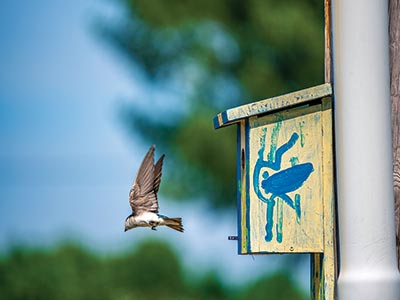
He sells his woodworks to members of the greater Lynchburg community and to several retailers including Ace Hardware.

“If I don’t help them, then the baby bluebirds will get eaten by other animals,” Chris explained. “[For the Birds] gives me a place to go when I’m extra bored at home. If we don’t build the birdhouses, the birds will get eaten by the hawks. We don’t want dead birds.”

Chris uses western cedar and pine to craft his birdhouses. Unlike many birdhouses purchased online, Chris fastens his birdhouses with wooden screws, not nails, to guarantee a secure, crack-free surface.

Unique equipment decorates Chris’s shop, including a table saw, drill press, electric sander and chop saw. A long, heavy concrete table stores most of the wood.

Chris works hard, sometimes daily, and he occasionally juggles multiple orders at once. While he executes most of the hands-on work, his father and several employees assist when needed.

“I just love for Chris to be able to make a difference and to be proud of everything,” Mark Russell said. “I’m 71 and he’s 46, but I just love for him to have a real productive and positive life.”

Chris’s intellectual disabilities include reading comprehension and math, and his medical side effects result in weight gain. He also struggles with PTSD and anxiety.

Similar to those with Asperger syndrome, Chris cannot read emotions. He does not have Down syndrome, although many may mistakenly assume.

Despite his disabilities, Chris’s love for people outweighs his condition. You may find him at a coffee shop with a friend, playing bongos at his church, or volunteering with Meals on Wheels.

“[I like] going out and having fun, staying happy, seeing people and having regular conversations with them,” Chris said.

Through his hard work, love from his family and gracious support from Wall Residences, Chris has taken agency over his life. Not only has he helped the natural habitat, but he has also made his own money to purchase CDs, movies, food and coffee.

Other than Chris’s earnings, “For the Birds” does not generate profit, but he normally breaks even on materials.

Mark expressed satisfaction that his son has pierced the traditional mold of citizens with disabilities by staying occupied and adding value to the greater Lynchburg community—instead of simply occupying a facility.

“The important thing for Chris is that he owns his own life,” Mark said. “People need to be in the community, not just living in a nice house somewhere.”

Watt Foster, CEO of Foster Fuels, has been one of Chris’s faithful customers for years, purchasing more than 120 birdhouses to spread over 2,000 acres.

“When I see all the bluebirds on my farm, I appreciate Chris and his efforts,” Foster said.

bird houseFoster noted that Chris’s birdhouses are excellent, complete with precise sizing, crawl capability for baby birds, and an easy opening door for nest cleaning. Chris sometimes even installs small screen ladders for baby birds and ducklings to comfortably crawl out of their home.

“[Chris] is passionate, and dealing local is important to me,” Foster said. “Chris is fun, and I really enjoy being with him.”

Chris has lived in Lynchburg for more than 40 years and enjoys interacting with members of the community like Foster. But the great outdoors is his greatest joy—he loves walking through the woods and keeping an eye out for numerous wildlife including birds, turtles and foxes.

“I like to watch birds, and I love nature. It’s neat to see all kinds of nature,” Chris Russell said.


Digging In

Unearthing stories and secrets at New London’s “Magnificent House”

In the decades before the American Revolution, New London, Virginia, was what 19th-century historian Henry Howe described as “a place of considerable importance.”

Then the county seat of Bedford County, New London boasted 70 to 80 homes, an arsenal and a magazine. There also was a court house, pictured in Howe’s book, Historical Collections of Virginia, as a rectangular wooden structure surrounded by a simple fence.

Across the road from the court house, on the present-day corner of Alum Springs and Town Fork roads, was Mead’s Tavern. It was built in 1763 for Col.

William Mead, a French and Indian War veteran, and his business partner Benjamin Howard.

Mead, who lived on a nearby plantation called Royal Forest, owned the tavern for 20 to 25 years, but never personally operated it. He and his family later moved to Georgia, where he died in 1805. The tavern that bears his name still stands, although it has traded hands and uses numerous times since then.

“[It’s] a remarkable survival from the colonial backcountry,” Dan Pezzoni, an architectural historian who’s been studying the tavern, said. “Historical, architectural and archaeological analysis is revealing and has the potential to reveal a wealth of information about everyday life in 18th-century New London, one of western Virginia’s most important colonial and early national communities.”

In the mid-18th century, the two-story, Georgian tavern would have been an unusual sight in what was then wilderness. “We take two-story buildings for granted today, but in the colonial backcountry, they were a rarity,” Pezzoni said.

“Even in Williamsburg, the colonial capital, many taverns were only a story and a half. William Mead’s business partner …
wasn’t exaggerating when he described the tavern as ‘a very Magnificent [sic] house.’”

Mead's TavernThe Mead’s Tavern research is sponsored by Liberty University. Liberty bought the tavern in 2015 and later purchased the Alum Springs Hotel, a 19th-century resort named for the nearby alum springs. The hotel, which sits a stone’s throw from the tavern, is thought to be on the site of the aforementioned arsenal.

Keith Adams, director of Hurt & Proffitt’s Archaeology and Material Conservation Labs, also is working on the project. He said the tavern could be the “oldest, still-standing structure in the region” and with its close proximity to the court house it “saw many events and people over the years.”

Numerous historic figures made appearances in New London, which sat along a popular route between the East Coast and the frontier. Various accounts provide a “who’s who” list of early visitors, among them Thomas Jefferson, Patrick Henry, Daniel Boone and George Rogers Clark.

Gen. Andrew Jackson, eventual seventh president, passed through in 1816, fresh off his victory at the Battle of New Orleans. According to “The Papers of Andrew Jackson: 1816-1820,” he and his family were en route from Washington, D.C., to their home in Nashville, Tennessee.

While at a tavern in New London—which tavern isn’t stated—Jackson was allegedly challenged to a duel by a local youth. A passage from “New London Today and Yesterday,” by local historian and educator Daisy I. Read, tells the story this way: Jackson was drinking hard cider with Col. Alexander Austin, a friend in New London, when they were approached by “Long Bill” Callaway who, as Read puts it, “had already had more than his share of cider.”

Callaway started an argument with “Old Hickory” and “made a remark to which the general took exception and was immediately challenged to a duel,” Read writes. “Knowing Jackson to be a sure shot, entirely sobered by this time, the young man spent a sleepless night; and it was only through the intervention of the youth’s father the facts were made known, the proper apologies were made by young Callaway and the duel called off. But there was a scared young Callaway!”

Donna Donald, history professor at Liberty and secretary for the Friends of New London, a nonprofit that works to preserve the town’s historic structures and share its history, didn’t dispute the entertainment value of the story. She did, however, question its veracity.

“The Andrew Jackson story might be just that,’ she said.

While Donald and others might question the stories that were passed down, there’s no denying the evidence left behind at the tavern. Artifacts discovered thus far have included, among other things, smoking pipes, ceramics, glassware, buttons, pins, thimbles, keys and gaming pieces.

Many items were found at the site of the tavern’s original front porch. Randy Lichtenberger, an archaeologist with Hurt & Proffitt, said a “dense deposit of artifacts”—he called it a “midden”—was found there beneath six inches of dirt.

Asked about the most exciting discoveries they’d made at Mead’s Tavern, his colleague Adams said, “I know most people think of objects as exciting, but as far as excitement, the idea of discovery, no matter what is being uncovered, is exciting to me.

“Finding archaeological evidence for the early 18th-century porch, after many weeks of carefully removing all the layers of 21st-, 20th- and late-19th-century debris that accumulated over roughly 250 years—that’s exciting.”

Adams added that the “historical sequence of porch configurations being revealed through the porch project will add greatly to our knowledge of the evolution of the structure as it changed over time to fit each new use.”

The focus of Liberty’s investment in New London is providing educational opportunities for its students. “President [Jerry] Falwell is really interested in history and he wants to have hands-on experience for our students,” Roger Schultz, dean of Liberty’s College of Arts and Sciences, said. “He seemed passionate about the potential for our history students.”

Students have assisted the architects and archaeologists at Mead’s Tavern as part of classes in public history, historic preservation and digital history.

Rachel Gilbert, who graduated from Liberty in May with a Master of Arts in Teaching degree, worked on the project for Introduction to Public History, a class she took for her undergraduate degree in Secondary Education-Social Studies.

In addition to compiling a “Chronology of New London” for the Friends of New London website, Gilbert worked as a tour guide for New London Day,
a fall festival that celebrates the history of New London. Last year’s event drew about 1,200 people. (See sidebar below for event information.)

“We gave tours of Mead’s Tavern all day, describing the historic uses of the building over its 250 years and how we know some of those things, based on records, archaeological finds and structural clues,” she said. “We had an amazing turnout.”

Schultz recalled one instance where a student found a piece of flintlock rifle.

“He was grinning ear to ear,” Schultz said. “He lit up; he was so excited.

The archaeologists working with us, they really enjoy working with the students. … It’s so interesting. The students just love it, especially when you have specialists who are so knowledgeable about what they’re doing.”


Photos By Ashlee Glen


Faces of Lynchburg July/August 2019


Upfront July/August 2019

Smith Mountain Lake Pirate Days
July 17-21
Batten down the hatches and raise your Jolly Roger as pirates take over Smith Mountain Lake! Back by popular demand, the lake’s “Pirate Days” weekend includes numerous events and activities such as a Pirate Ball, Pirate Trivia Night, and Pirate Ship Parade. Learn more at www.visitsmithmountainlake.com/sml-pirate-days/.

Steve Miller Band with Marty Stuart and His Fabulous Superlatives
July 20, 7 p.m.
Classic rock meets classic country in this incredible summer tour that’s making a stop at Lynchburg’s Riverfront Park. Find ticket information at www.cityauditorium.com.

State Games of America
July 31-August 4
Approximately 15,000 athletes from across the country will descend upon the Hill City to compete in this Olympic-style event at Liberty University.  Sports competitions include track and field, archery, yoga, figure skating and much more. Opening ceremony is August 2. Visit stategamesofamerica.com for more information.

Daniel’s Hill History Days
August 17 (10 a.m. – 1 p.m.), August 18 (1 – 4 p.m.)
The Lynchburg Museum needs your help documenting the untold stories of Daniel’s Hill and illustrating African American life in the neighborhood through the years. Gather your old photos, memorabilia and memories and stop by the Carriage House at Point of Honor.

Race 4 the Fallen Glow Run
August 24, 8 p.m.
Bring the whole family to Percival’s Island for a colorful, nighttime event that raises money for the Police Benevolent Foundation. Register today at runsignup.com


Local Openings And Closings
Hello! to Mighty James River Company, a fully mobile float company on the James.

Hello! to wine tasting room Reserve by VinoWine on Jefferson Street.

Goodbye to McCraw’s Furniture, an iconic furniture and collectibles shop on Main Street.

Hello! to a second location of Market at Main in the Boonsboro Shopping Center.

Hello! to Sugar Rush, a new candy shop in River Ridge Mall.

Hello! to Wingstop on Wards Road.

Hello! to an expanded Oshun Organics in the Lynchburg Community Market.

Goodbye to Emerald Stone Grille on Jefferson Street.

Hello! to Everyday Sommelier, a wine education and tasting shop on Fifth Street.

Hello! to home furnishings store Bailey Grey Interiors in the Boonsboro Shopping Center.

Hello! to BVA Mercantile, a home décor/furniture store, in Downtown Bedford.

Hello! to Main Street Nutrition, a wellness and shake bar located inside the Holiday Inn Downtown.


A Fresh Start

Father’s Café and Bakery Joins the Community Market Family

For Father’s Café and Bakery, May 18 was like a family reunion.

After a five-year hiatus, owner Ken Reed and his team re-opened their ovens in a new location inside the Lynchburg Community Market. The bakery serves fresh and handmade breads, muffins, pastries and gourmet donuts.

“Welcome to our little hole in the wall,” said Reed.

After Reed moved from the Catskills in upstate New York to Lynchburg in 2004, he opened his first Lynchburg bakery, Father’s Table, in Forest. On March 29, 2014, Reed closed that shop and pursued a career at Runk & Pratt.

When the well-known Lorraine Bakery closed in the Lynchburg Community Market late last year, Reed looked into the space. The previous manager of the market was a former customer of Father’s Table and encouraged Reed to recharge his former passions.

Reed described the celebration of his bakery’s rebrand and re-opening as “humbling.”

“I think we will do okay here, it’s a good location. The people at the market are wonderful,” said Reed.

For hours on that first opening day, hungry customers waited in line for baked goods like ciabatta bread, cinnamon rolls, muffins, crusty French bread, danishes and other Reed-designed creations.

“The reception of the vendors and the shoppers has been overwhelmingly positive. I really felt welcomed last weekend,” said Reed.

Through laughs, the 63-year-old said the experience almost made him emotional.

“A lot of our old customers have come and are so happy that we are in business again. … It’s like I had unfinished business,” said Reed.

Hannah Frazier is the manager at Father’s Café and Bakery and previously worked at Lorraine Bakery as a crepe maker. When she knew her time there was coming to a close, she approached Reed and asked to be a part of his work family.

“[Reed] is so great, he is so nice and he is so respectful. It’s really hard to keep him from giving everything away,” said Frazier.

One example of his generosity and connection with the community—Reed added challah (a special bread in the Jewish community) to the menu per request of a local rabbi so that those local congregations can properly observe the Sabbath. Reed also works hard to ensure his breads are primarily GMO-free—they also use cage-free eggs.

Frazier described their home in the community market as having “a special atmosphere” and said there’s not another place in Lynchburg like it. With over 45 diverse vendors, the market has been a fixture in the city for generations.

“Where else are you going to go in Lynchburg where there are all these farmers and all these artisans?” said Frazier.

Reed started baking when he was 15 years old. He studied at culinary school in New York and later baked for a Bible college and Christian conference center in upstate New York. When he’s not baking, he’s outside in his garden or fishing. He practiced taxidermy for 20 years and enjoys working with his hands.

“But—baking is my passion,” said Reed.


By Lillian Abbatacola
Photos by Ashlee Glen