Artist Profile: Jennifer Lipford Petticolas Jan/Feb 2021

Playwright and Performer

• JLP Productions, owner
• DC Black Theatre Festival, committee member

Lynchburg Living Editor Shelley Basinger: Jennifer, you have a very long history in the area’s theater community—particularly writing your own original plays. When did you first develop a love for the stage?
Jennifer Petticolas: I worked behind the scenes doing set design and building sets while attending Livingstone College
in Salisbury, North Carolina. When I declared my English major, my dean said, “Are you sure you don’t want to do theater?”

He saw something in me then that I didn’t see. But I chose English because I have always enjoyed writing and especially creative writing. That love started at Dunbar High School in Lynchburg, with Mrs. Jordan and Mr. Watson.

SB: Where did life take you with that English degree?
JP: After finishing college, I got a teaching job at a junior high school in Baltimore.

I had been teaching three or four years when the faculty wanted to do a play about the history of our country and incorporate some dance into it, so I volunteered to write it. That was the first play that I wrote, and it really piqued my interest.

SB: When did you return to Lynchburg? And did you get involved in theater right away?
JP: I came back to Lynchburg in 1976. I remember my oldest daughter was trying out to be in Annie and told me, “Mom, I want to be Annie.” I told her I didn’t know if they would cast her in that role, and she ended up being casted as one of the orphans. She said, “Well, if I can’t be Annie, I’m going to be the best dancing orphan up there.” I thought if she can do it, I can do it too! Later on, I was cast in For Colored Girls and started getting involved with the Fine Arts Center (now Academy Center of the Arts).

SB: Since then, you’ve written numerous plays that have gotten acclaim both locally and beyond. What are some of your favorites?
JP: One piece that I was most proud of focused on suicide awareness. A friend, Kim Kittrell, came to me and told me about how her daughter, a former E.C. Glass student, had committed suicide at college. She wanted to get the message out that there is help for people who are struggling with depression. I did an interview with Kim, which was a very difficult process. She talked about her daughter being a dancer and how her daughter always felt like every woman should have a little black dress. I titled the play that, Little Black Dress, to symbolize a sophisticated woman and also, depression. I also got help from the medical community to make sure we were giving out the right message. This play has been performed in Virginia, Maryland and D.C. The Campbell County Branch of the NAACP presented us with an award for the play.

Another favorite is Sunday’s Child, a play I wrote for Johnson Medical Center about the life of Dr. Robert Walter Johnson.

I did a lot of research for that one, including interviewing about 30 or 40 people on the telephone and visiting his grandson’s house in Maryland.

SB: You also have focused on black history through the years. Most recently, “People Died: The Struggle for African American Voting Rights” was shown at the Lynchburg Museum.
JP: That was a little different than a play, six short monologues highlighting six real-life individuals who died fighting for African American voting rights in the ’60s. After we did that Lynchburg City Council Member Sterling Wilder came to me and said, “That lit a fire under me.” It just feels good to know that you are making a difference, causing people to think differently. That has been my whole purpose.

SB: Could we see anything new from you in the coming year?
JP: Suga is a play I started working on a few years ago. It’s about a husband and wife—the husband has diabetes and high blood pressure—and how his health affects their sex life. I’ve thought about taking that off the shelf. When George Floyd was killed, I started working on a piece about Floyd and Emmett Till.

It feels like I’m always working on something!

SB: Finally, what advice do you have for aspiring playwrights?
JP: Just keep pushing. You have a story in you, I think we all have stories in us. Write those stories. If you need help, reach out.


Get in Touch:
Email Jennifer at jlp7139@yahoo.com
or send her a message on Facebook.


Downtown Lynchburg

Imagine waking up and sipping your morning coffee while taking in this picturesque view of downtown Lynchburg.
The Krise on Ninth Street was built in 1907 as the city’s first skyscraper. After renovation and restoration work, the impressive architectural building has been converted into luxury loft-style apartments.

Take a virtual tour at www.thekriseluxurylofts.com.


Playing With Your Food

Charcuterie boards are colorful, creative and always crowd-pleasers (even when there’s not a crowd).

Pinterest. Instagram. Weddings. Taking up their own endcap at the grocery store.

The charcuterie board business is booming right now.

Maybe it’s just a coincidence that these boards began to explode about the same time as the pandemic. They serve as a fun way to eat anything (fun moments are important during a pandemic), a good way to gather and share with your “quaranteam,” and can even be made into single servings for socially distanced gatherings.

The term “charcuterie” refers specifically to the process of curing meat products such as salami, bacon, and ham.

Most traditional charcuterie boards are spilling over with meats, various types of cheese, and other accoutrements. However, themed boards with more eclectic choices—see sidebar on page 137—are becoming popular as well.

Michelle Ayers, owner of Purple Door Gourmet Kitchen, has been making charcuterie boards for a decade but has seen their popularity rise this year along with their larger counterpart: the grazing table.

“I have done very large displays as long as 18 feet for an event for 300 people to small trays for two to 20,” she says. “This is my absolute favorite part of my work. I always dreamed of playing with food for a living and now I get to do it every day.”

The Purple Door Gourmet Kitchen and Catering

The Purple Door Gourmet Kitchen and Catering

Food Checklist
Every board is unique, but Michelle says the checklist in her head for a charcuterie board always includes color, texture, flavor, and variety.

“Every board needs to have assorted cheeses, cured meat, olives, nuts, chutney, crispy bread and chocolate,” she says.

Personal chef and health coach Megan Current, of The Current Dish, also receives numerous requests for charcuterie boards. She always starts with the “forward points”: the meats and cheeses.

“The rule of thumb for cheeses is making sure to have an aged cheese, such as cheddar, and a
soft cheese. I like brie. Then a hard cheese such as gorgonzola,” she explains. “For the meat,
I include a variety of favorites such as prosciutto, peppered salami, and capicola.”

From there, Megan likes to include local jams and honeys, pickles, olives and fruit. But she will branch out depending on the season or occasion—for example, a caramel dip for apple slices or cake pops for a birthday board.

The Current Dish

The Current Dish

Building Your Board
Once you’ve gathered your items comes the trickier part for amateurs. Part of the appeal of a charcuterie board is the way it looks. As Michelle explains: “I believe you eat with your eyes first.”

First, decide what will be your focal point.

A brie or goat cheese log works well, or use folded meats in a creative way.

“Some people like to make a prosciutto river, sort of a swivel line down the middle of the board,” Megan says.

Folding or rolling meats will not only allow you to pack more items onto your board, but it also looks nice. Depending on your types of cheeses, mix it up and have one sliced and another cubed, for example. For accoutrements such as olives, fruit or nuts, put some into small bowls and others directly on to the board.

“Rosemary or mint sprigs are a pretty way to fill in any holes and add some greenery,” says Megan.

Better Than Dip
For those with new fitness goals in the new year, charcuterie boards can also be a smarter appetizer choice. “You have an option of foods that are whole and less processed, many with single ingredients,” Megan says. “Also, it’s so much easier to fill up on these foods compared to something like chips and dip.”

Better yet, it’s the one-size-fits-all appetizer for family members or friends with various dietary preferences. You can order or create a board with a little bit of everything on it and let everyone pick and choose what they want.

Whether you make your own, or let a professional such as Megan or Michelle take control, the sky is limit when creating a charcuterie board. Have some fun and be sure to share your photos with us on Facebook or Instagram with the hashtag, #LynchburgLiving.


Take it further

Not-Your-Average Charcuterie Board. While lacking the traditional cured meats, these boards
pull from the idea of arranging your food in a “choose-your-own” display.

TACO Board:
Chips or Shells, Small Pitas, Salsas, Cheese, Guacamole, Veggies

VEGAN Board:
Carrot “Bacon,” Tomato “Ham,” Assorted Fruits and Vegetables

BRUNCH Board:
Bagels, Capers, Smoked Salmon, Cream Cheese, Red Onion, Fruit


Central Virginia Fitness Bucket List

Recommendations for a range of fitness levels

Beginner
Sign up for your first 5K.

In a normal year, there is no shortage of race opportunities in Central Virginia, especially for those seeking a shorter distance such as a 5K. While the pandemic canceled many races or made them go virtual last year, we are hopeful that the 5K lineup will return to normal (or close to normal) at some point in 2021. Beginners can find a range of 5K training plans online, or seek out support from a trainer or friend with running experience.

Join an obstacle race with your family or friends.
From climbing walls to balancing teeter-totters, the Face the Forest race at Thomas Jefferson’s Poplar Forest in partnership with the YMCA is the only family-friendly event of its kind in our area. All ages are welcome at this annual event that also includes lots of mud—so don’t wear your brand new running shoes!

Face the Forest
Date/time TBA
poplarforest.org.

Get out of your comfort zone with a new fitness activity.
Fitness amateurs can often catapult themselves into a healthier lifestyle simply by trying something new. A couple of ideas to get you started: try indoor rock climbing at Rise Up in downtown Lynchburg, play disc golf at one of the area’s numerous courses such as Peaks View Park, or rent a bike from Bikes Unlimited on Jefferson Street and explore the Blackwater Creek Trail.

Moderate
Dip your toe into the world of triathlons.
For active adults who are ready to try the challenge of a triathlon, the Smith Mountain Lake Triathlon is a great place to start—but it’s also one that experts love competing in year after year due to the excellent conditions and mountain views. The swim features a sandy beach start and a crisp, clear lake.

The bike and run courses are rolling, but not too challenging.

Kinetic SML Sprint Triathlon
May 1, 2021
kineticmultisports.com/races/smithmountainlakesprint/

Hike a moderate/strenuous peak at sunrise.
We are beyond lucky to live in an area with so many gorgeous hiking opportunities. Typically, those boasting a level of moderate to strenuous have the best reward: a spectacular view of Central Virginia. A sunrise hike adds an extra layer of challenge because it likely requires an early weekend wakeup time—which we all know is difficult.

Tackle a long-distance bike race.
You don’t have to travel far to find a long-distance cycling opportunity right here in Central Virginia: the Storming of Thunder Ridge, hosted by Beacon Credit Union and the YMCA. With breathtaking views, this race has options for a range of abilities with a choice of 27-, 45-, 49-, 75- and 100-mile routes. The 27- and 45-mile routes are better for moderate cyclists, featuring rolling hills and back roads.

Storming of Thunder Ridge
May 23, 2021
ymcacva.org/storming-thunder-ridge

Advanced
Set a new long-distance running goal.

For those who have plenty of 5K T-shirts sitting in their dresser, and consistently beat your PR, it might be time to transition to a long-distance race. The Virginia 10-Miler is a great option because many local runners are already familiar with the shorter version. Or you could take a “racecation” to Richmond and join the city’s marathon, half-marathon or 8K.

Virginia 10-Miler
September 25, 2021
virginiatenmiler.com

Richmond Marathon
November 13, 2021
richmondmarathon.org

Take your running skills to the next level with a trail race.
The Mountain Masochist Trail Race is a 50-mile course through the Blue Ridge Mountains that is a physically challenging combination of roads, jeep trails, and single track. You must train hard for this race—both physically, mentally and even spiritually, organizers say. This year, the race will start and end at Camp Montebello in Nelson County.

Mountain Masochist Trail Race
November 6, 2021
eco-xsports.com/events/mountain-masochist

Start training for a long-course triathlon.
One of the most popular, and most difficult, long-course triathlon races is the Ironman—consisting of a 2.4-mile swim, 112-mile bicycle ride and a marathon 26.22-mile run. We are fortunate to have an Ironman race in Roanoke that’s set for June of this year. If you haven’t started training yet, you may want to set your sights on the 2022 race to give yourself more time to prepare.

Ironman 70.3 Virginia’s Blueridge
June 6, 2021
ironman.com/im703-virginia-blue-ridge


The Easiest Homemade Guacamole Recipe Ever

Need to whip up an easy, yet healthy, appetizer? This recipe is for you.

Avocados are an excellent source of healthy fats such as omega-3 fatty acids, which are beneficial to your brain and skin. They are also an excellent source of vitamins C, E, K and B-6, as well as folate, magnesium and potassium. Better yet? Homemade guacamole is a winter-friendly dish. Avocados are typically available year-round, thanks to the hard work of growers in Mexico and parts of South America.

Gluten Free
Paleo | Vegan

Ingredients:
3 avocados, peeled, pitted and diced—dicing gives it a chunkier texture
1 lime, juiced
1 teaspoon sea salt
1 large jalapeño, diced (seeds removed)
1/4 cup of fresh cilantro, chopped
1 teaspoon minced garlic
(or garlic powder)

Directions:

Mix the ingredients together in a bowl (yep, that’s it!) and enjoy with chips or over your favorite tacos or tortilla soup—but do so quickly, because it will go fast!


April Likins lives in Forest and is an Institute for Integrative Nutrition- and Duke Integrative Medicine-trained health coach. Learn more at aprillikins.com.


Best Of Winners 2021

The Results Are In. Thousands of you visited our website last year to vote in our 2021 Best Of Lynchburg contest.

From your favorite spots to eat to your preferred medical providers, this list shows you who
Central Virginians recommend.

Flip through to see who earned gold, silver, bronze and honorable mention in numerous categories—and congratulations to this year’s winners!


Camellias Stars of the Winter Garden

Winter can be somewhat depressing for those of us who love to look out the windows and see a beautifully lush and colorful landscape. It seems as though the gardens and flowers we maintained through the warmer months have been washed in a sea of gray and brown. Not so inspiring.

But chilly doesn’t have to mean charmless.
Enter: Camellias. These evergreen queens of the winter landscape thrive in our region and add a burst of color and class to our otherwise empty garden beds. Beloved for their glossy and substantial foliage, elegant cold-season blooms and overall versatility, they really are the gem of the year-round garden.

They thrive in more acidic soils and prefer shade, making them great for filling in those difficult-to-cultivate spaces, and with so many varieties, there is a camellia for every landscape.

Camellia Types
Camellias are originally native to Southeast Asia where they’ve been a treasure of meticulous Japanese gardens for hundreds of years. Their blooms tend to come in shades of red, pink, and white with waxy evergreen foliage. In the United States, we primarily cultivate two species of camellias: Sasanquas and Japonicas. Sasanquas bloom from early to mid-season, beginning in late fall and continuing through the first part of winter.

Japonicas begin their blooming season in late winter and show off their color through the spring. Of course, each of these species has hundreds of hybrids. Planting a few carefully selected types will result in an almost year-round display of showy, eye-catching blossoms.

Basic Care
Maybe their reputation for being difficult plants to grow comes from their high-class, rose-like appearance. It’s really a myth that these shrubs are challenging, and they actually grow well with little attention as long as they are properly planted in the right spot.

While camellias can be planted in winter, it’s best to wait until spring so that they have time to take root before the cold weather comes. This is generally a good rule of thumb for anything you might want to plant.

white camellia

Choose a location in your yard with a lot of shade. That’s right—these beauties are shade lovers! If you’re like me, you’re constantly on the hunt for ways to fill out those darkened spaces and camellias make excellent candidates. Like a proper Victorian lady, they need to be sheltered from the hot midday sun. Some varieties can handle more sunlight than others—so do some research before planting—but most prefer a bit of sun in the morning, then cool, dappled light throughout the afternoon. They like the consistently moist soil that shade provides, but they don’t like wet feet, so you’ll want to make sure the soil is well-drained to prevent rot and disease. Nutrient-rich, organic material with a slightly high pH is ideal.

As with most garden shrubs and trees, correct planting is absolutely vital to healthy growth and a long lifespan (camellias can live for more than a hundred years). One of the more common planting mistakes is burying the plant too deep. So dig a hole that is just deep enough to cover the root ball. It’ll need to be at least twice as wide so that the roots can spread out. If the roots encircle the ball when removed from the pot, carefully cut the encircling roots and spread them away from the root ball. Fill the hole back in with healthy organic material, and water generously. Mulching will also aid in water retention, protect the roots from extreme temperatures, and prevent weeds from overtaking the space. Just be sure to keep the mulch out of direct contact with the stem.

As your camellias continue to grow, make sure they are watered regularly.

They do not handle drought well, especially during the blooming season. Otherwise, caring for them is pretty simple. They don’t typically require fertilizing, and they only need to be pruned for aesthetic purposes. Left to their own devices, they will likely grow quickly and bloom prolifically.

Camellias in the Landscape
Because of the multitude of varieties, camellias can serve a number of purposes in the landscape. They can grow to be quite large—between six and 12 feet in height and width! However, different varieties grow to different sizes, and most can be pruned to maintain your desired aesthetic.

Thanks to their thick, appealing foliage they make
great screens. They can be used as hedges for a little privacy from your neighbors or to hide unsightly fences and foundations.

Some varieties are prone to keeping a low, sprawling profile and can make for unique and attractive ground cover.

For a more formal focal point, they can be trained and shaped as small, winter-flowering trees. They can also be used as espaliers, growing up and spreading along flat, vertical surfaces such as walls. This requires a decent amount of work, but for those who enjoy pruning and training plants, camellias are a great choice. Sasanqua varieties work best for this purpose.

When thinking about adding them to a full, year-round landscape, consider planting camellias among azaleas and rhododendron, which have similar needs and structures. They can fill in the space with color when your camellias are out of bloom. Hydrangeas make another dramatic summer-blooming companion. Of course, anything you plant with camellias will need to be shade-tolerant, but don’t worry about giving the camellias too much shade. As long as they get just a little sunshine at some point in the day, they will be fine. Use them to fill in the understory below crepe myrtles and Japanese maples. Scatter some hostas throughout and you’ll have yourself a perfect shade garden with year-round color.


Best Beach Getaways

Try Wildlife Refuges Off-Season

Fall, winter and spring can provide the best beach time, especially when a pandemic requires us to keep our distance from each other.

Sunrises come later and sunsets come earlier. Dolphins still play in the waves and crabs scuttle across the beach.

For bikers, hikers, paddlers and surf fishers, the weather can be balmy or brisk, but not suffocating, and for birders, it’s the best time of year.

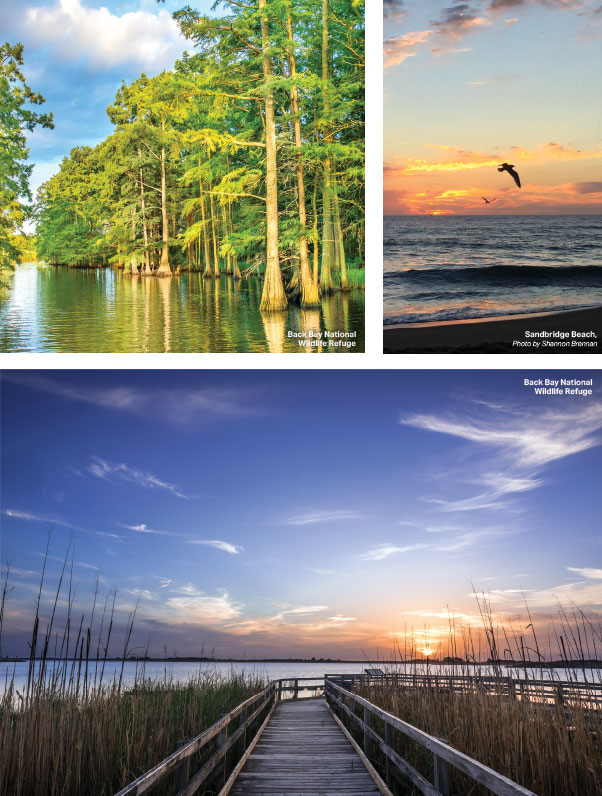
Virginia’s Back Bay National Wildlife Refuge, established in 1938 to protect migratory and wintering waterfowl, supports up to 10,000 snow geese and a large variety of ducks and other waterfowl during the annual peak migration, usually in December and January.

The refuge encompasses nearly 10,000 acres of beach, dunes, woodlands of live oak and loblolly pines, farm fields and marshes, along with the freshwaters of Back Bay.

Located just north of North Carolina, this coastal refuge also provides habitat for threatened and endangered species including sea turtles and piping plovers, small shorebirds that are declining rapidly.

More than 300 species of birds have been observed at Back Bay, primarily during winter months. Mammals include river otters, mink, opossums, raccoons, foxes, and white-tailed deer.

Canals provide a glimpse of venomous cottonmouth snakes, swimming across the water, along with brown and northern watersnakes. On warm days, a variety of turtles, including red-bellied, painted, eastern mud, and snapping, may warm themselves on logs or lurk beneath the surface.

This slender strip of land is covered in common reeds, which can reach 15 feet in height, providing cover for many animals, including humans as they stroll along boardwalks.

Groundsel or sea myrtle, with lovely white flowers, attracts butterflies and other pollinators, and provides seeds for birds.

Wax myrtle, a traditional source of wax for bayberry candles, is a favorite of the
wintering yellow-rumped warbler.

On a visit in October, the refuge was full of yellow in the form of goldenrod and smooth beggarticks. Great Plains lady’s tresses, a spiky plant with white blossoms, and blue mistflowers, could be spied along the trail.

Entrance to the refuge is just south of Sandbridge, a long narrow barrier island, 16 miles south of Virginia Beach.

We stayed at an Airbnb at Surfside at Sandbridge, an RV resort, just north of the refuge and enjoyed views from our canal-side porch. For dinner, we ordered takeout from the nearby Baja Restaurant with its many seafood options. For a breakfast treat, the homemade doughnuts at the Sandbridge Seaside Market are not to be missed.

travel

A short stroll from our Airbnb mobile home took us to the Atlantic Ocean, where only a handful of people splashed along the water’s edge, tossed in a fishing line, or flew kites.
A five-minute car ride took us to the entrance to Back Bay National Wildlife Refuge. Outdoor trails are open a half hour before sunrise and a half hour after sunset, and there is no entry fee from Nov. 1 to April 1.

All vehicles must park at the visitor center, which was closed due to COVID-19. To protect wildlife, no dogs are allowed in the refuge.

From the parking area, folks can walk along boardwalks to Back Bay or to the ocean. You can also bike or hike the four-mile trail to False Cape State Park or continue to the North Carolina line for an 8.8-mile trek one-way.

Several adventurous types were backpacking into False Cape, where primitive tent camping is available for a complete getaway.

While at Sandbridge, we couldn’t resist a trip north to Kiptopeke State Park, where the annual hawk migration count was underway. To get to the eastern shore, you must traverse the Chesapeake Bay Bridge-Tunnel, which is an amazing experience in itself.

The Bay Bridge-Tunnel is a four-lane 20-mile-long vehicular toll crossing that provides direct access from southeastern Virginia to the Delmarva Peninsula (Delaware plus the Maryland and Virginia Eastern Shore).

Spectacular views of the Chesapeake Bay along the bridges also offer glimpses of brown pelicans and black-backed gulls, the largest gulls in the world. As you take two plunges under the bay in two separate tunnels, you appreciate the engineering required to disappear under the water as giant cargo ships ply overhead.

As you leave the bridge, you enter the Eastern Shore of Virginia National Wildlife Refuge, one of the most important avian migration funnels in North America. This 1,100-acre refuge is the scene of a spectacular drama as millions of songbirds and thousands of monarch butterflies and raptors converge on their journey south. Favorable weather patterns push migrating species through the area in waves.

Numerous tree swallows swirl overhead and monarch butterflies float aloft. Protected habitats such as these provide critical stopover areas where birds, monarchs, and dragonflies can rest and feed before resuming their arduous journey.

We saw several sharp-shinned and a handful of cooper’s hawks and bald eagles at the refuge before continuing on to Kiptopeke. While it turned out to be a slow day for migrating raptors, we saw hundreds of pine siskins and a dozen red-breasted nuthatches, northern species which only venture south when there is a poor seed crop in Canada.

Another winter getaway awaits near the Maryland state line at Assateague Island National Seashore, famous for its wild ponies and the annual summer roundup at Chincoteague.

To our south, the Outer Banks of North Carolina are also thick with off-season delights. Pea Island National Wildlife Refuge offers some of the best winter birding.

The refuge is 13 miles long and covers 5,834 acres of land, located on the north end of Hatteras Island. The bird list for Pea Island boasts more than 365 species; the wildlife list has 25 species of mammals, 24 of reptiles, and five of amphibians.

These refuges are among 567 National Wildlife Refuges administered by the U.S. Fish and Wildlife Service, many along the East Coast.

No matter what coastal wildlife refuge or state park you choose, you have many choices for outdoor activities, wildlife viewing, and the peace and serenity of open spaces.


Living Out Loud Jan/Feb 2021

Blind Billy Update
We have received so many positive comments about our feature, “Blind Billy’s Beacon,” found in the November/December issue of Lynchburg Living. Reader Linda Marion wrote us to say, “This story truly warmed my heart.”

The article focused on a painting by local artist Kevin Chadwick of Blind Billy, a beloved fifer and slave in Lynchburg who died a free man after members of the community purchased his freedom. The painting was part of a live auction at the Art for Achievement virtual event to benefit Lynchburg Beacon of Hope. Organizers tell us the painting sold for $14,500 to a “syndicate” of individuals who plan to hang it at E.C. Glass High School. Overall, the nonprofit made an astounding $86,000 at the event to fund scholarships and other resources for high school students.

“The event was just amazing! Truly. Thank you so much for everything you did to help us, Shelley,” Beacon of Hope Executive Director Laura Hamilton wrote to editor Shelley Basinger.

You’re Welcome

After seeing our article about The ETC Shop, a nonprofit consignment store benefiting the Lynchburg Junior Woman’s Club, Susan Kidd sent us this kind thank you:
“We are so excited to have this recognition and share space in the magazine with so many other wonderful groups! Thank you so much! Reaching this milestone has been such a blessing and this is the icing on the cake!”


We Want To hear From You!
Send us an e-mail to shelley@lynchburgmag.com. Correspondents must identify themselves; names may be withheld on request. Lynchburg Living may edit or condense.


Bigger Than Bagels

Bacon St. Bagels Offers Fresh Breakfast and Work Culture Perspective

When Jordan Nickerson and Jordan Hawkins sat down to discuss potential business ventures in January 2019, they didn’t know that their meeting would end with serendipity in the shape of a bagel.

“I said, ‘I know this is kind of out there, but I’ve always thought it would be really cool to open a bagel shop,’” Hawkins says. “Jordan was taken aback because that morning he and his wife, Holly, were on a walk and he mentioned to her that having a bagel shop in Lynchburg would be awesome.

We saw it as a sign to move forward.”

On November 6, 2020, their vision became a reality when Bacon St. Bagels opened on Rivermont Avenue. The community response to the grab-and-go bagel shop was immediately—and continues to be—overwhelmingly positive.

bagelThe menu boasts several types of New York–style bagels with a variety of toppings, specialty breakfast sandwiches, and coffee from Staunton-based coffee shop Crucible Coffee.

New York–style bagels are boiled before they’re baked, a process that locks in flavor and gives the bagels a delicious chewy density.

Hawkins’ favorite sandwich on the menu, The Lenora, is named after his grandmother. “She was Italian, so the sandwich has mozzarella, tomato, basil pesto, and a balsamic glaze,” he says.

The Nickersons and Hawkinses first met and became friends at Liberty University. The Nickersons opened the successful ice cream shop Rookie’s in Forest and Hawkins worked in local restaurants before deciding to start a business together.
When it came to selecting a location, downtown Lynchburg was the clear winner. Nickerson specifically was very taken with the standalone building on Rivermont that now houses the shop.

“I love standalone buildings,” he says.

“They offer so much space for charm, creativity, and flair.”

The shop got its name from Nickerson’s childhood home street in Massachusetts.

“I’m a huge breakfast food fan, so it’s ironic that I lived on Bacon Street!” says Nickerson. “We had about five names on the board, and Holly came up with that one.”

The brand is built not only on affordable and delicious breakfast options, but also on a positive work culture that values individual employees and customers as well as the community at large.

“I’m very thankful that I get an opportunity to sink my teeth every single day into what I’m passionate about: entrepreneurship and creating healthy and exciting workplace cultures,” Nickerson notes. “I would say we’ve already established a really healthy culture in our building. I love the opportunity to kind of challenge the status quo in the food work culture industry.”

“Our motto is ‘bigger than bagels’,” says Hawkins. “A lot of people are miserable going to work because they feel that they aren’t cared for or valued, and if we can change that, even just for our employees, then it will be worth it.”

In the future, the team hopes to add a takeout window and online ordering and to ultimately expand.

“We want the shop to grow into its potential, and we want to steward it really well,” Nickerson says.


Bacon St. Bagels

306 Rivermont Ave., Lynchburg
Open daily from 7 a.m. to 2 p.m. or until items sell out
www.baconstbagels.com