I remember the first time I felt truly impacted by art. I was on a class trip to Washington, D.C., and we were in the middle of a tour of the National Gallery. Along an unassuming wall amidst stunning landscape paintings was Thomas Cole’s four-part allegorical series, The Voyage of Life. In it, Cole depicted a pilgrim’s journey through childhood, adolescence, adulthood, and old age. Each scene showed an aging man’s voyage along the River of Life and the various trials and influences to be found along the way.
What was so moving about the quartet of paintings wasn’t the weight of the brush strokes, or the way Cole used light to mesmerize the viewer and move their eye across the scene. Rather, it was the unspoken message that the paintings conveyed. Even as a young student, I sensed the urgency and eternal hope that Cole depicted in those paintings. Now, whenever I am in D.C., I make my own pilgrim’s journey back to those paintings—each time finding a new detail that adds another piece to the narrative.
That’s what is so special about art: It makes you pause, consider your own position, and it sticks with you.
In putting together this issue, I discovered something else that makes art so special. It builds community.
Our city is full of inspiring, hardworking, and creative artists, and this issue only begins to brush the surface of that community. Within these pages, you’ll read stories of veterans using art to overcome their service injuries—which you’ll find on page 49—as well as stories of art working alongside medicine to bring a new level of healing to patients. You’ll find that story on page 31. You’ll also find stories of people coming together because of art, like the LoveLYH Flea Market on page 53, and the legacy of the Academy Center of the Arts on page 62.
If you haven’t taken the time to explore the art and artists within our city, I hope this issue encourages you to. Start with a First Fridays tour of Lynchburg’s galleries, or simply pop into one that catches your eye. Visit any local coffee shop and appreciate the local art they have on display. Or even try your hand at creating art yourself at one of the many classes our city has to offer—such as the Jackson Heights Studio on page 45. At the very least, take a moment to support the artists in your own circle, whether that means buying a piece for your home or simply supporting them on social media. Our city is vibrant and alive because of them.
I hope you find a piece of art—whether it’s music, pottery, paintings, or dance—that speaks to you like The Voyage of Life did to me so many years ago. I’m grateful that I don’t have to travel to D.C. any time I am looking to be inspired by art, though—I simply need to turn a corner in our own beautiful city.
September 17 Lynchburg Beer, Wine, and Cider Festival The 13th Annual Lynchburg Beer, Wine, & Cider Festival will be held on Saturday, September 17, at the Riverfront Festival Park from 12 to 7 p.m.
Enjoy over 50 different options of craft beer, ciders, and wine all hand-picked and selected from right here in the state of Virginia. Over 50 local artisans, delicious food, and live music round out this event. Visit lynchburgbeerandwinefestival.com for info.
September 17 Lynchburg Art Festival Join the Lynchburg Art Club for the 49th Annual Lynchburg Art Festival on September 17th (rain date: September 18th) from 10 a.m. to 4 p.m. under the big oak trees on E.C. Glass High School’s grounds. For nearly 50 years, the Lynchburg Art Festival has served as a significant cultural touchstone for our region, bringing together a diverse range of artists, small businesses, and community members. Professional and student artists will show and sell their work, forging meaningful connections within our community. More info at lynchburgartclub.org.
September 30 – October 2 Masterworx Community Theater Presents: Beauty and the Beast Based on the 1991 Disney animated feature and the late 18th-century classic French fairy tale, Beauty and the Beast tells the story of Belle and her capture by the Beast, a grisly and fearsome monster, who was long ago trapped in his gruesome form by an enchantress. Audience members will be entranced in this classic tale. Visit academycenter.org for ticket information.
October 1 Get Downtown Get Downtown returns after a two-year hiatus! Covering eight blocks on Main Street in downtown Lynchburg, Get Downtown is Lynchburg’s biggest street festival. The best part? It’s completely FREE to attend. Enjoy the sights and sounds of street performers and musicians, and shop from local makers, artisans, and food vendors. Visit getdowntownlynchburg.com for more details.
October 8-9 Virginia Wine & Garlic Festival The 30th Annual Virginia Wine & Garlic Festival takes place on the grounds of Rebec Vineyards. Enjoy a variety of garlic and garlic foods, four stages featuring live bands, and unique vendors. Plus, sample delicious Virginia wine from over ten wineries. It’ll be a fun-filled day for everyone. Visit rebecwinery.com for tickets and event details.
Local Openings & Closings
Hello! to 221 Tap & Table Hello! to Mission House Coffee in Cornerstone Hello! to Insomnia Cookies Hello! to Market at Main on Wards Road Goodbye to Ebb & Flow Hello! to Berglund Toyota’s new location on Forest Road Hello! to Apocalypse Cidery & Winery in Forest Hello! to Amazing Lash Studio in Forest Hello! to Hill City Donuts in Downtown Lynchburg
Fall for All in Yorktown
5 Yorktown Weekend Getaways to Satisfy Many Types of Visitors This Season
From foodie excursions and girls’ weekends to art aficionados and history buffs, imagine a destination a short distance away that caters to all sorts of travelers.
If you haven’t made a trip to explore Yorktown lately, fall is the perfect time to explore. You’ll find world-class amenities and attractions nestled in a place that maintains plenty of small-town charm and hospitality.
A day spent in Yorktown is always worthwhile, but to truly experience all it has to offer, set aside more time in your schedule to explore. We’ve curated a few trip agendas with suggestions on places to stay, play and eat that will make ideal autumn escapes for all.
ART AFICIONADOS
Event: Yorktown Art Stroll, Sept. 25
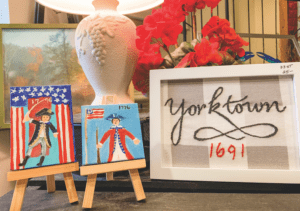
Stay: The former residence and gallery of well-known contemporary folk artist Nancy Thomas now serve as private cottages available to rent. Art lovers will appreciate looking for the many tributes to Thomas’ career featured throughout both cozy and eclectic accommodations.
Play: Hop on the Yorktown Trolley and head up the hill to Main Street to discover treasures at On the Hill Gallery and Gallery at York Hall, featuring the works of more than 300 Yorktown-area artists—paintings, pottery, jewelry, quilts, photographs, holiday ornaments, stained glass and more.
Eat: Dine al fresco next to the York River at Water Street Grille. Take your time and share seasonal craft cocktails and appetizers of local oysters, crab cakes and scallops casino, particularly on a Thursday night while listening to the sounds of the Rhythms on the Riverwalk Concert Series.
GIRLS’ WEEKEND
Event: Yorktown Wine Festival, Oct. 1
Stay: There is plenty of space to laugh, talk and reconnect over breakfast or in the lovely outdoor spaces at Marl Inn Bed & Breakfast. A variety of guest rooms and suites can host several friends.
Play: Stroll the mile-long pedestrian waterfront walkway and then linger as long as you’d like in Riverwalk Landing shops like Gangsta Dog, Viccellio Goldsmith or Auntie M’s American Cottage.
Eat: Relax and chat at the casual and welcoming Yorktown Pub. Large plates are perfect for sharing with friends, including the 1/2-pound burger and the steamed seafood sampler. Walk to Ben & Jerry’s Ice Cream in Riverwalk Landing for a sweet reward to end your evening.
FOOD ENTHUSIASTS
Events: Yorktown Market Days, September and October Saturdays (excluding Oct. 1); Yorktoberfest, Oct. 23
Stay: Enjoy a breakfast feast served by innkeeper Bill Cole at the York River Inn Bed & Breakfast. He prepares decadent dishes like glazed sausage cakes, spinach and artichoke pie and corn pudding.
Play: Work off your meals by renting bikes, kayaks or paddleboards from Patriot Tours & Provisions. Rentals are launched from the private beach at the Watermen’s Museum.
Eat: Journey beyond the Yorktown waterfront to The Edge District for innovative cuisine and gourmet tacos at Casa Pearl, locally roasted coffee flights at Column 15 or a double IPA at The Virginia Beer Co.
ROMANTIC GETAWAY
Event: Rhythms on the Riverwalk Concert Series, Thursdays in September and Oct. 6 and 13
Stay: Relax on your beachfront balcony at Yorktown Beach Hotel with a cup of coffee or glass of wine and enjoy the view as you toast the opportunity for a couple’s escape.
Play: Romance and sunsets go hand-in-hand, and being on the water aboard a Schooner Alliance sail enhances the allure.
Eat: Share a beautiful plate of fresh sashimi at Umi Sushi and then indulge in dessert at Carrot Tree Kitchens. Homemade cakes and pastries are impossible to pass up—and you shouldn’t.
HISTORY BUFFS
Event: Yorktown Day, Oct. 19; York County Vintage Market, Nov. 5
Stay: History aficionados will appreciate the story of The Hornsby House Inn. The colonial-style home was built in 1933 by John William “JW” Hornsby and has remained in the family for three generations.
Play: Immerse yourself in Yorktown’s world-class museums. Experience 18th-century living history at the American Revolution Museum at Yorktown through a Revolution-era farm and Continental Army encampment. Of course, history lovers can’t miss the Colonial National Historical Park, where they can ask questions during a tour of Yorktown Battlefield and watch a film about the Siege of Yorktown at the Visitor Center.
Eat: Mobjack Coffee Roasters and Petite Café offers coffees, espressos, sandwiches, sweets, beer and wine in the circa 1726 Cole Digges House on Main Street. The eatery also partners with Colonial National Historical Park on Stroll with a Historian history tours.
For more information about Yorktown weekends and to check out the complete events calendar, check out VisitYorktown.org.
2022 Lynchburg Dental Guide
Lynchburg’s Resource to Local Dental Care
Not sure where to go for your oral health or dental treatments? Look no further than the experts referenced in our Area Dental Guide. From braces for your kids to the dental professionals you want in your corner when there’s an issue, we have you covered.
“It’s Like Living in an Art Project”
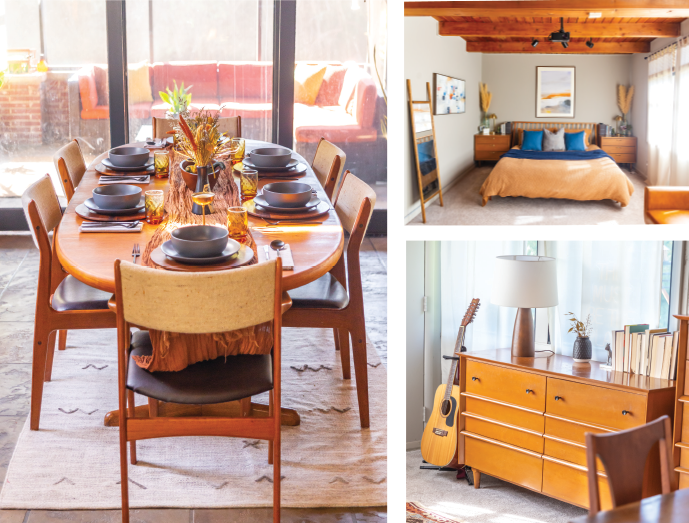
A Lynchburg Midcentury Time Capsule Meets Its Perfect Match
Is it possible that sometimes a house chooses its owners?
Much like a rare antique sitting boxed up for decades in an attic, or a valuable painting relegated to the back rack at a thrift store, it waits for just the right old soul who will lift it up with a sense of reverence and say, “There you are.” It seems an impossible idea given the recent real estate market, but when you hear the kismet story of Hannah Poucher and Grant Kittrell, it may lead you to wonder if maybe, just maybe, their house chose them.
Photos Courtesy of Daryl Calfee
The Discovery “We knew the second we looked through the windows that we wanted to live here forever,” Hannah, now 32, said of their love-at-first-home-sighting experience.
It was August 2019, and she and Grant, now 30, were making plans for a wedding and their future together, when something akin to Zillow lightning struck. A little listing with just five vague pictures popped up—a circa 1954 midcentury modern in the middle of Lynchburg. Within the hour, the couple found themselves peering through the windows, unable to believe their own eyes. It was meant for them, they knew it, but they needed to move fast.
“We weren’t pre-qualified, we had never looked at any houses before, we had to Google after we saw this place—’how to get a mortgage’—we didn’t know anything!” Hannah, a military recruiter for Liberty University, said. “But we knew if we didn’t jump at this, we wouldn’t get another shot at something like this in town.” A bidding war ensued, but the home seemed to intuitively know who it wanted as its next caretaker. The couple closed in November 2019 and made a defining decision in honor of their new-old home.
“We wanted to live in the space for at least a year before doing anything radical,” Hannah explained. “We wanted to understand what it was like to be here as people within a space where it was designed to work like this. So, we decided no big changes for the first year.”
An Intentional Interior It turns out, there was much the home wanted to teach them. Grant and Hannah took pleasure in learning about its history and thoughtful layout, taking note of each delightful detail, like how the abundant natural light shifted across the open-beamed ceiling throughout the day.
“We both, perhaps in different ways, came to this space with appreciation for art and design,” Grant, a writer, illustrator, and musician who works at Randolph College, said. “The midcentury modern style is very intentional and leans in the direction of sculptural, so there’s not a day that we don’t look around and say, ‘Hey look at that! Isn’t that really amazing?’ So, we are living in this space that we see as a piece of art, and really it is.”
Photos Courtesy of Daryl Calfee
Within that first learning year, they came to understand the unique reason for the way things were designed. Like the greater abundance of windows on one side of the house to allow for passive solar heat. Or the fact that the floors, which look like stone, are in fact stamped concrete designed to hold thermal mass, making what should be a cold underfooting somehow warm and earthy.
The biggest discovery, however, came in the form of a large manila folder filled with the home’s blueprints, original building materials, past pictures, and a booklet of original paint colors from The Frank Lloyd Wright Sierra Sunset Collection.
“When we found that folder, with the Frank Lloyd Wright paint palette, we realized that there was incredible intention behind it,” Hannah said. “So, for example, this color isn’t black, this is the Midnight color from that collection that is part of a larger palette. It was already here. We only painted the kitchen cabinets.”
Furnishings with Soul While their commitment not to change the home’s interior held strong after moving in, it did need some furnishings. Some true-to-the-era furnishings.
They dove in with both feet and hands.
“Pretty quickly, Hannah became a master of the Facebook Marketplace,” Grant laughed. “She would stay up late at night looking for furniture. So as soon as I got off work, we would take off and go to places we had never seen before, out in the countryside, and pick up an old piece of furniture that someone maybe didn’t really know what they had.”
The hunt for pieces soon evolved into restoration of those finds as needed. Grant and Hannah became quick students of the specific approach to refinishing midcentury pieces.
“We aren’t talking about just sanding and staining, you’re talking about burning through wood veneer if you mess it up and how things aren’t stained, they are toned and sealed and lacquered,” Hannah said.
Photos Courtesy of Daryl Calfee
“I think the more work we put into a piece, the more we favor it.”
Her current favorite piece? A hutch from Lane Furniture, whose factory was once headquartered in Altavista. They discovered the piece in Rustburg, and it is now situated proudly in the area that opens from the kitchen into the dining area.
“We got it on Facebook Marketplace and the seller’s mother had bought it originally from Lane. So it’s a Virginia piece and the time period is right,” she recalled.
What you won’t find a lot of on the home’s ever-evolving furniture front are many new items.
Not because they are purists, Hannah explained, but because of what’s available on Marketplace, what’s within their budget, and what they can restore back to life now and perhaps replace later.
“I can probably count on one hand the number of new things that are in this house,” she said. “And while sustainability might not be the first thing we think about, it’s definitely a driving force. I think in terms of a level of purism, that’s what we are working towards.
It feels like such a perfect space, and we want to honor it with things from that time period.”
Photos Courtesy of Daryl Calfee
An Apartment Evolution Of course, as with most self-imposed rules, there is almost always an exception. For Hannah and Grant’s “no changing the house for a year” rule, that exception came in the form of an efficiency apartment just across the home’s attached breezeway, where they cut their teeth on the basics of home renovation.
“We focused a lot of our initial energy there because it was a smaller space; we weren’t as overwhelmed and we figured we could learn in there and not have to live in it if we made any mistakes,” Hannah said.
While the essential layout existed when the couple bought it, the apartment needed some finishing work. They took to painting the kitchen cabinets the same green as the main home’s kitchen, updated the floors with a light luxury vinyl tile they laid themselves, and furnished the small bedroom, kitchen, and bath with interesting finds, such as a 1965 Sears Roebuck & Co. bar sourced in Roanoke and a white 1930s stove from Farmville. While not decade-specific to the home, Grant said, “when you bring something this old from the 30s, you’re bringing a long history into this space and the possibilities of whatever life it lived before.”
The renovations came with inherent lessons for the couple, and they reflect now that it better prepared them for future renovation jobs still ahead, like their dream of expanding the home’s main kitchen.
“We have learned to work with each other a little better and be patient with each other in different ways we didn’t know at that point,” Grant said. “Coming home each day and laying flooring every day…we learned a lot!”
From the Inside Out Much is to be made of the home’s interior, and for good reason, but the property’s grounds are stunning in their own right. In fact, it is the marriage of the two, one spilling by design into the other, that creates a zen-like cohesion with nature from nearly every vantage point.
Photos Courtesy of Daryl Calfee
“We both love and appreciate a lush, green space and this has a lot of bamboo, a big maple, and some really intentional plant life,” Hannah said. “So when you’re looking out these windows, the lines are blurred between outside and inside.
It feels like a really natural space and really a sacred space almost.”
The pair have worked diligently to make conscious updates to the home’s exterior, including retrimming the formerly gray windows to a crisp black, something akin to adding eyeliner to an already lovely face. They cut back layers of bamboo and, as a reward, have witnessed more wildlife at play, from a family of foxes to finches taking up residence in one of the many birdhouses Grant made to a shy resident doe the couple affectionately calls “Jean.”
Most warmer nights of the year, you will find Hannah and Grant on their back patio area, nestled in wicker egg chairs, beverage in hand, dreaming into the future about their vision for the space. Their ultimate hope is to continue to collaborate with their cherished home in order to share it with others—an ever-welcoming, one-of-a-kind retreat.
“Mixing the inside and outside is always a goal,” Grant said. “Having a nature trail on the property is a dream, or hosting yoga or meditation classes here, maybe along with some creative writing workshops.
I would also love to make this place more sustainable, perhaps with solar power.”
It is little wonder that whatever the pair chooses to do next will be with great planning and purpose for the home that somehow, some way, chose them. Three years into their adventure, they still wake every morning with a wide-eyed sense of awe for their surroundings.
“I think, ‘How is this even a possibility? How could this even possibly be our home?’” Hannah smiled. “There is a lingering sense of wonder and excitement every day that we are in this space.”
Photos Courtesy of Daryl Calfee
Follow Along Want to follow along with the home’s furnishing adventures and projects?
Check out Hannah and Grant’s Instagram page dedicated to the home @clerestorymod. “Clerestory” is the word for windows that are above normal ceiling height and project into the roofline, which their home boasts in abundance.
Have Paint, Will Travel
Raleigh artist, Chris Jones, finds beauty and inspiration in the Hill City
In the early 19th century, French painter Pierre-Henri de Valenciennes wrote a treatise entitled Reflections and Advice to a Student on Painting, Particularly on Landscape where he encouraged fellow artists to paint “en plein air”, or to paint landscapes while in the landscape. The act of immersing oneself in the elements, and painting the lines, light, and contrast exactly as they were rather than exactly as memory served, became the backbone of French landscape painting transforming from minor genre to primary art form as the 19th century progressed.
Today, artists around the globe still choose to paint en plein air—opting for mobile canvases and ever-changing environments as a way to keep their perspectives fresh and inspired. Chris Jones, a Raleigh-based artist, is one of them.
A renaissance man of sorts, Jones has always been a creator.
Chris Jones paints en plein air on Grace Street. Photo by Ashlee Glen.
“When I was 8 or 9 years old, there was a guy on TV named Jon Gnagy [host of the TV series You Are an Artist and Learn to Draw],” he explained. “He would draw something and show how a shadow might follow the contour of the land. It was all black and white TV back then, but he was drawing with charcoal so it didn’t matter. I ordered his book, which was on sale, and I devoured it. I drew everything in it and learned a lot about composition and perspective.”
Jones continued to pursue art through adolescence and into high school, when he became interested in photography, architecture, and design. After graduating high school, he began pursuing a degree in architecture and design from NC State University’s College of Design while supplying photography to local ad agencies.
“When I got to College, though, I realized it was design and art that I wanted, rather than architecture,” he remembered. “The closest art school was in Chapel Hill, so I took a semester there. It was a young program at the time, so I went on to look at Baltimore College of Art and California Institute of Art. Somewhere along the way, I got sidetracked a bit.”
At the time, Jones was a drummer in a band—a passion that started when he was six years old and still continues to this day.
“I ended up recording two albums with a band named Glass Moon at Electric Lady Studios and then toured for two years,” he said. “We had recorded in the West Village of New York, and I loved the city, so I ended up moving to New York after the tour was over. I left design school and decided to pursue photography full-time instead.”
Within six months in New York, Jones was getting work as a location photographer—and that work continued for the next 25 or so years.
“When I wasn’t traveling on assignment, I would hang out with artists and friends, and I would draw or paint on and off throughout those years. After my wife and I raised our children, we retired and moved to the west coast. I moved back to Raleigh in 2019, and when COVID hit, I put my camera down, picked up a paintbrush again, and started painting everyday. Now I have a stack of paintings that I don’t know what to do with,” he laughed.
Photo by Ashlee Glen
In a journey that may seem all too familiar to artists—one where passions are pursued and given the space to transform—Jones’s creative life has been a whimsical dance between music, photography, and painting. Each medium has offered a unique chance to view life in just a slightly different way.
“When COVID hit, there was this existential fear that we all had of, ‘What can I touch? Am I going to die? How many years do I have left to do what I’m doing?’” he explained. “I had already done photography and I had played drums all my life. I wanted to do painting and fine art. That was the third leg of my desires as a child, and COVID allowed me to explore it because I was at home.”
Now, Jones has been painting almost daily for over two years. He leverages his early love for architecture and design, and explores composition, light, shadows, and intensity of colors in architectural spaces in and around his home base of Raleigh.
Photo by Ashlee Glen
“Raleigh is a very happening place that’s growing very fast,” he said. “Part of my job as an artist is to document that. I like drawing and painting buildings. Because of the architectural influence I had as a kid, I love seeing how Raleigh is growing and trying to paint that.”
But Jones’s exploration of architectural beauty and growing cities doesn’t stop in Raleigh. Jones recently traveled to Lynchburg and found inspiration.
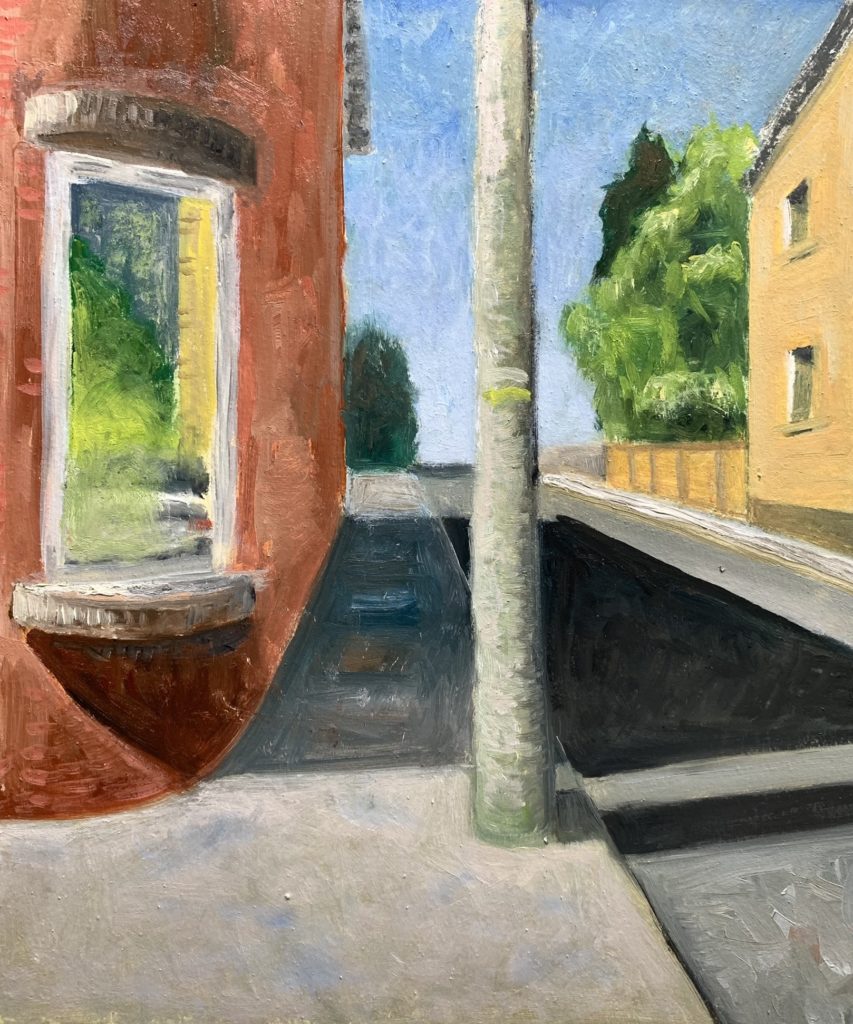
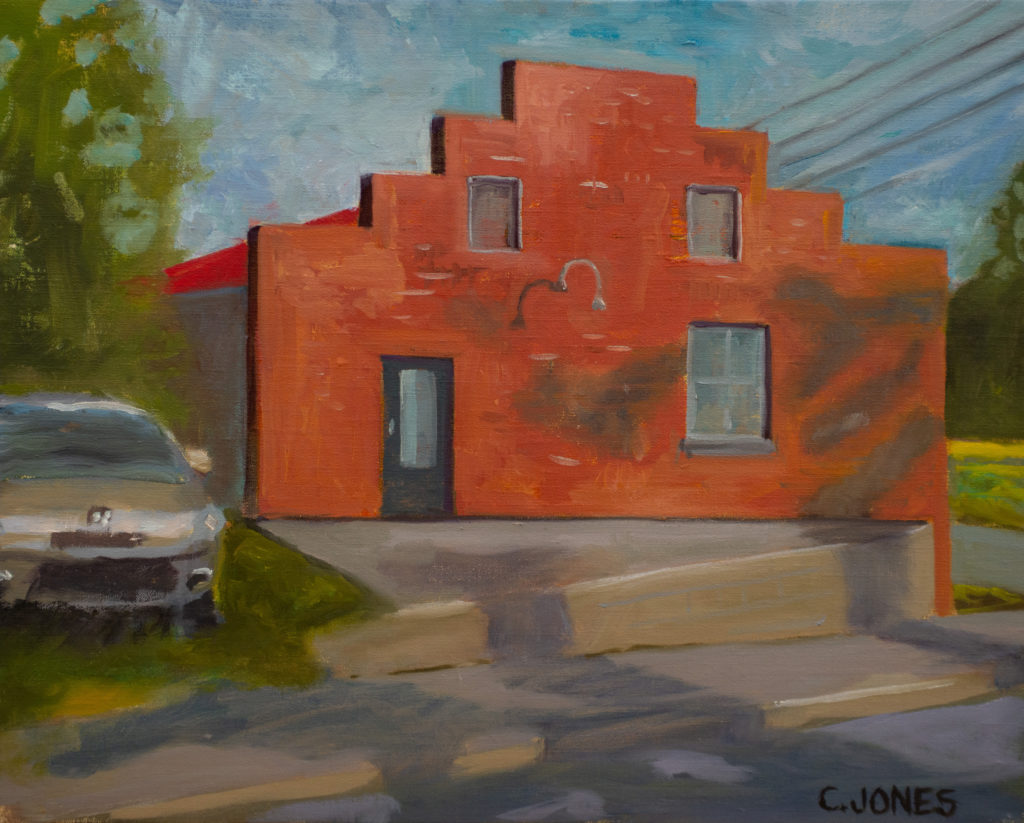
“When I drove to Lynchburg, I drove down Grace Street by mistake,” Jones explained. “As I drove down Grace Street, I immediately saw two scenes that begged to be painted—the first was the historic Fire Station No. 2 building and the second was a gorgeous brick building where you could see where the facade had been at one point. When I have that instant strike, it says to me, ‘Let’s see if I can paint it.’ The same happened on Church Street. I could have easily painted there for two weeks.”
Engine Company Number 2- 24×24 oil on panelChurch Street- 11×14 oil on paperOld Facade on Grove Street- 16×20 oil on panel
With his canvas and paint tools in tow, Jones stopped and painted the two Grace Street buildings en plein air.
“I was struck by [the Fire Station No. 2 building] because of the way the light hit it, plus it was beautifully designed in the first place,” Jones recounted. “I had this fantastic feeling of having been there in the day when it was being used, and seeing fire trucks come out of the door.”
Jones spent an afternoon getting the architectural lines and sunlight reflecting off the fire station just right before returning back home to Raleigh, but not before Lynchburg had a chance to leave an impression on him.
“Lynchburg is going through a renaissance of sorts, it seems,” he said. “I loved to see all of the hip looking youngsters walking around. If I didn’t love living in Raleigh, I’d be hard pressed not to want to move to Lynchburg.”
To see more of Chris Jones’s art, visit his portfolio at www.chrisjonespaints.com and find him on Instagram at @chrisjonespaints. He is currently accepting commissions, and his Lynchburg paintings are available for purchase.
A Beginner’s Guide to Vintage Furniture
Whether your home is a perfectly preserved period piece or an eclectic hodgepodge of eras, the right antique or vintage furniture can make a statement or pull a room together. But with estate sales, consignment shops, social media marketplaces, yard sales, and everything in between, where to begin with finding the right vintage furniture for your home?
Vintage vs. Antique First thing’s first: There is a difference, albeit slight, between vintage and antique furniture. By definition, a piece of furniture isn’t considered an antique until it is at least 100 years old. Anything else younger, but still at least 20 years old, is considered vintage. “Collectables” on the other hand, can be either vintage or antique.
Original antiques—furniture that is the first of its kind and style—tend to be rather pricey depending on where you find them. Reproductions of those pieces that pre-date the 1940s will look just as beautiful, will still have excellent craftsmanship, and can be very affordable.
Where to Search Finding vintage and antique furniture is a veritable treasure hunt full of excitement, unique finds, and, yes, some disappointment. Because you’re looking for a diamond in the rough—whether a particular style or something that is just right for your home—be prepared to go on a few furniture hunts before you find the right piece.
Estate sales, auctions, flea markets, antique stores, and social media or internet marketplaces are all perfect for finding the right vintage or antique piece for your home. The benefit of visiting a physical store, of course, is that you can inspect the piece yourself, take the appropriate measurements, and determine if the piece is really what you’re looking for.
What to Look For So how do you identify the real thing from a modern day look alike? Talk with the shopkeepers or sellers of the pieces and ask them questions about the piece you’re interested in. Store owners and workers especially are knowledgeable, not just about the type of furniture you’re looking for, but vintage and antique furniture in general. Ask them how to tell how old something is or what style something is made in.
If you find a piece that you genuinely love, inspect it for: Reasonable and practical signs of wear and usage. Think about what the piece was likely originally used for. For example, a vintage washstand will show stress signs from where the heavy wash basin sat day after day. These signs can indicate that the piece is authentic.
Dovetailing on drawer joints. As a general rule of thumb, the farther apart and larger the dovetails, the older a piece is. If no dovetail joints are present, the piece is likely not vintage or antique at all.
Cracks, broken pieces, chips, handles that have been replaced. These will either need to be areas that you will need to refinish or repair, or will make use of the piece less-than-ideal.
Proof of provenance. In other words, proof of provenance is the proof of origin, history, or previous ownership. Real silver pieces will contain hallmarks, or furniture may bear a label or stamp from the maker. Occasionally, an original shipping address or maker’s location will be etched onto the back of a piece of furniture. These ultimately will help you authenticate the piece you’re interested in.
Collecting vintage or antique furniture for your home will certainly take longer than shopping for a brand new piece at a furniture store, but the hunt is half the fun. Part history lesson, part treasure hunt, you’re in for an adventure as you seek out the perfect piece for your home.
Behind the Scenes September/October 2022
Taking art to the streets
Artist John Rose—one part of the duo behind Be Kind Gallery 101—took a break from creating art to showcase a more performative art style. Just like Rose uses the city’s landscapes to create stunning paintings, he uses the local architecture to perform incredible tricks on his BMX bike.
If you’re ever driving down Church Street and happen to see Rose on his bike, give him an encouraging wave!
See more on Be Kind Gallery on page 49. Photos by Ashlee Glen.
A Place for Growth
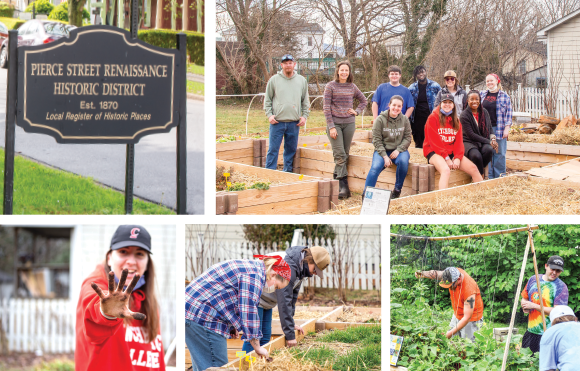
Take a walk down Pierce Street and you will find some pretty remarkable history. You may also find some gardeners and fresh produce.
At 1301-1303 Pierce St., the Pierce Street Community garden sits behind the old Calloway Store.
The garden is part of the Pierce Street Gateway, an organization that is seeking to preserve the history of Pierce Street and renew the community and neighborhood. The garden has become an integral part of the Pierce Street Renaissance District.
The two blocks of Pierce Street hold the homes and stories of many brilliant people. As the smallest of Lynchburg’s seven historic districts, it is recognized more for the people that resided there than its historic architecture.
At its start, an old Civil War hospital was run out of Pierce Street. The district was also the home of Anne Spencer, the renowned Harlem Renaissance Poet; her son Chauncey E. Spencer, a pioneer of the Tuskegee Airmen; and C.W. Seay, the first Black city council member and vice mayor of Lynchburg. There are so many others who left a mark not only on Lynchburg history, but on our nation as well.
Ghislaine Lewis, the director of Pierce Street Gateway and a founding member of the garden, knows that Pierce Street consisted of more than just the famous people.
“What you find on Pierce Street, if you look at housing records, is a lot of people who were educators and a lot of people who were seamstresses and businessmen and women who really helped to shape the African American community here in Lynchburg,” explained Lewis.
Photos Courtesy of Ghislaine Lewis
The Pierce Street Garden exists for the current residents of Pierce Street, while the Pierce Street Gateway exists to honor the residents of the past.
The idea for the garden began to take shape when Lewis spoke with Nina Salmon, a Pierce Street board member, about the gateway’s strategic plan. Salmon said they really wanted a garden.
Starting the garden became part of Lewis’ Lynchburg Leadership project. She was joined by six other members to form Team Big Hearts and, in 2021, the team established the garden behind the Calloway Store, one of the first Black-owned grocery stores in Lynchburg.
Currently, there are no grocery stores near Pierce Street, making it a food desert. This means that people do not have access to fresh, affordable produce—but with the garden they do.
“Food options are becoming really limited in the neighborhood. One of the big impediments when you’re talking about poverty is always access to food, particularly access to fresh food. It’s really important that people have access to fresh food,” Lewis said.
Before anything is planted, neighbors are asked what food they would like to see grown. Once grown, fresh produce is distributed to the neighbors’ houses every Saturday, and they can come into the garden at any time to get what they need.
On Saturday mornings, neighbors and volunteers—those who are charged with the ongoing garden maintenance—can be seen weeding and watering. Whitney Chauta, volunteer and head gardener, says there is a lot that goes into maintaining the garden.
“You have to decide what plants would do well in this setting, how much you should grow, making a schedule of when to start seeds and when you can move plants outside, and how to make the most of the space by doing some companion planting,” Chauta detailed.
According to Chauta, gardening is a very rewarding process, too.
“There’s a feeling of satisfaction when you work with your hands and can see the effects of that growing in front of you. Gardening is a never-ending learning experience.”
Eventually, Chauta would love for one of the neighbors to take over.
“I want it to be a true community garden. I want the people that live nearby to take charge of it and make it their own,” she said.
Both Lewis and Chauta expressed that one of the greatest pleasures of the garden is simply seeing the neighbors enjoy it and take part in it.
“I think the biggest joy is if you pop by on a Tuesday and you see someone getting something from the garden. Or if you come in on a Saturday morning and realize that there’s stuff that’s gone. That means somebody came. Somebody’s come in or a family’s come in and taken food. That’s been really important for us,” Lewis explained.
Chauta told a story of how she was in the garden and saw some strawberries that needed to be eaten before they went bad, so she offered them to a man passing by.
“His face lit up and he told me this story from when he was a little boy and he got into his aunt’s strawberry patch and ate all of them and how she wasn’t too happy about that. That’s the sort of thing I love—the history of a place, and the stories of a neighborhood that continue living on in the people still there. I think it’s a really positive place, in the way that it reminds people of good memories.”
Lewis conveyed that the goal of the garden and the Pierce Street Gateway is for the memories and history of the people of Pierce Street to continue to grow.
“We want to be able to create a hub to be able to tell the stories of Pierce Street—not just the stories of the famous people, but the stories of the ordinary people.”
To learn more about the Pierce Street Gateway, garden or make a donation visit www.piercest.org.
Photos Courtesy of Ghislaine Lewis
Continuing the Legacy of Education
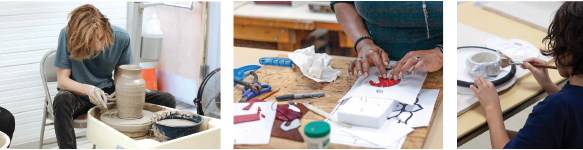
Carefully crafted pottery and vibrant stained-glass line the shelves and windows of the Jackson Heights Art Studio, a creative haven for many of Lynchburg’s passionate artists.
Opening officially as the Jackson Heights Art Studio in 2013, this unique neighborhood studio exists to carry out the legacy associated with the building’s long-standing history of devout education and community.
“It’s a really special thing to show up somewhere for the first time and know you are a part of something greater,” Sara Billings, a pottery instructor at the studio, said. “That is the reality we try to create and remind people of every time they walk through the doors.”
Formerly known as the Jackson Town Elementary School, the building was purchased from the Lynch family in 1826 by free African Americans. One hundred years later, in the midst of segregation, the men of the neighborhood built the two-room schoolhouse so the children in the community could attend school, according to Doug Washington, a museum volunteer who presented the “Jackson Town Tour.”
Although the school no longer educates and guides elementary grade students, it cultivates the same spirit of education through creativity for all ages and walks of life.
Currently, the art studio is open Tuesday, Wednesday, and Saturday at varying times for pottery classes, and on Thursday evenings for stained glass classes. With 10 potter’s wheels, an array of clay and glazes for creating hand-built wheel projects, and vibrant colored glass sheets for stained glass, the space naturally opens a new door of creative expression for many.
The art space sustains the legacy of shaping an intentional space to educate, learn, and grow by striving to make classes hands-on and supportive, no matter your experience level. Located at 720 Winston Ridge Road, the art space is now a part of the City of Lynchburg’s Parks and Recreation Department.
Photos Courtesy of Jackson Heights Art Studio
“We truly are a small part of a bigger picture with such support from the Parks and Recreation Department,” Brittany Helm, the Community Recreation Programmer for the studio, said. “We are striving to teach people a new craft. Whether they’ve been doing pottery and stained glass for years and years, there is still always something to be discovered.”
Helm was placed in the Community Recreation Programmer role as the studio grew to require more attention. The art space is now professionally managed with full financial support from the City of Lynchburg’s Parks and Recreation Department.
“It is so unique that the Lynchburg Parks and Rec. department funds this art studio,” Helm said. “It’s not often you see a department with so much responsibility tending to the community the way the City of Lynchburg does.”
In July, the studio closed its doors to participants for an entire month for the installation of entirely new floors. After its final facelift, there will be a grand re-opening on September 3 for the public.
“The renovations are important because we are always improving and expanding and seeking out ways we can improve the space for the sake of our students,” Billings said.
In addition to the aesthetic updates, the studio seeks to ensure that there is a place for everyone by providing participants with a financial assistance program.
“We really try to make our classes accessible. We don’t want finances to be something that holds anyone back from attending a class,” Billings said. “The financial program is how I was able to continue my journey with pottery; it was this very program that helped me start taking classes again while I was in college.”
Billings, one of the two highly skilled pottery instructors at the studio, juggles three businesses while also instructing at the art studio on Tuesday’s and Wednesday’s from 9 a.m. to 12 p.m.
For Billings, the pottery prevails as her “labor of love” and creating a piece is a “long and patient process,” she explained.
“Ideally, I get my students throwing, centering, and creating at least one piece in their first class with me,” Billings said. “The next week you come in, the clay will be in the ‘leather hard’ stage, where we are able to trim it. From there, it goes in for its first firing, then you glaze it, and fire it for a final time.”
Pottery and stained glass alike require patience and focus. Several students unanimously described the classes as “a form of therapy” and “their favorite form of self-expression.”
“Even if you get one piece out of an entire session, there is something so special about being able to engage with what’s in front of you and turn everything else off around you,” Helm said.
Pottery and stained glass, like any experience, has the ability to teach a lesson through simply trying and experimenting.
“Failing at pottery is a practice in and of itself,” Billings said.
“You learn to forgive yourself and realize at the end of the day, it’s really just mud. We want students to leave and realize, ‘I can do this again next week and do it even better.’”
To learn more about the Jackson Heights Art Studio and to sign up for an art class, visit the Parks and Rec website, www.lynchburgparksandrec.com. To keep up with upcoming events, programs, and activities, you can follow along on their Instagram, @jacksonheightsartstudio.