Lynchburg Living is recognizing and honoring the amazing, inspiring educators in our area with the Lynchburg Living Top Teachers Awards. Submit your entries for your favorite current and local teacher who, if chosen, will be honored in our upcoming March/April 2023 issue of Lynchburg Living magazine. Nominations begin October 1 on lynchburgliving.com.
Corrections
In our July/August story, Calling All Good Dogs, photo credit wasn’t appropriately given to Raspberry Hill Adult Daytime Center. Thank you so much to Raspberry Hill for hosting our photoshoot and for being such wonderful hosts to Cece and Joyce. Photos by Ashlee Glen.
In our July 2022 issue of Lynchburg Business, Central Virginia Family Physicians was listed as Gold in Best Health Insurance, when Weaver and Weaver should have been listed as Gold. Lynchburg Business regrets this error.
We Want to Hear from You! Send us an e-mail to megan@lynchburgmag.com. Correspondents must identify themselves; names may be withheld on request. Lynchburg Living may edit or condense.
The Maier Museum of Art at Randolph College
A Cold War Relic
Photos Courtesy of The Maier Museum of Art
Many Lynchburg residents are unaware of the Cold War relic humbly nestled on the campus of Randolph College. As one of Lynchburg’s staple art locations, the Maier Museum of Art’s history is as rich as its unique collection of original paintings and photographs.
In wake of the Nazi escalation of power, which pinnacled in 1938, Adolf Hitler confiscated thousands of European artworks, paving the way for a new kind of art—one that emphasized the Volksgemeinschaft (the racial community).
This menacing operation, titled Einsatzstab Reichsleiter Rosenberg, confiscated more than 20 percent of Europe’s art collections, making it the most detrimental heist of art in the world.
It robbed its own citizens and countless galleries and museums throughout Europe.
While some of these stolen treasures were eventually recovered following World War II, thousands were either lost or destroyed. Many items included works from Van Gogh, Michelangelo, and other celebrated, world-renowned artists.
But the conclusion of WWII ushered in another period of foreboding conflict—the Cold War, which stretched from 1947-1991. Fearful of the disastrous art robbery from the previous decade, the United States government knew it needed a backup plan for the nation’s art collection should the Cold War escalate and eventually manifest on U.S. soil.
The National Art Gallery in Washington D.C. devised a strategy to transport its valuable collection of art 150 miles Southwest, to Lynchburg, onto the campus of Randolph-Macon Woman’s College (R-MWC).
The college, founded in 1891, had built a strong reputation of art appreciation. Louise Jordan Smith, one of the first five resident professors at R-MWC, wanted students to be submerged in art, regardless of degree program. She taught Art and French and was the pioneer in building the college’s art program, even launching one of the first American Art History survey courses in 1913. Randolph’s annual exhibition of contemporary art, approaching its 111th uninterrupted show, was also Smith’s brainchild.
“She thought it was really important for all students to be surrounded by high-quality original artwork everywhere,” said Martha Johnson, who has served in various roles at the Maier Museum of Art since 2002. She now serves as director. “Where they ate, where they studied, where they socialized. It had to be a part of every aspect of their lives.”
The National Gallery board of trustees took notice—among other reasons—of the college’s powerful emphasis on the visual arts and authorized an emergency project to guarantee safety of its art collection should the Cold War turn dark. The National Gallery would transport its valuable collection of American art to R-MWC.
The confidential feat was dubbed “Project XYZ” (the “Y” referring to the college).
In 1951, the U.S. government funded a storage building between 6,000 and 7,000 square feet, with roughly 25,000 square feet of vertical space for sliding screens.
The fireproof structure, costing just under a quarter million dollars, was finished in the spring of 1952. Steel-reinforced concrete made up the building’s roof and floor; all aspects of the project were constructed in accordance with industry-standard codes for museum creation.
“There was a sense of urgency in getting this structure built quickly,” Johnson said.
Additional features included more than 60 rows of steel and aluminum sliding screens, a loading dock, and ample space for security.
The agreement would last for 25 years, and it was specified that R-MWC would have complete agency over the building unless the National Art Gallery needed it for its intended purpose. Given the confidential details surrounding the building, the college advertised it as space to house an outstanding collection of campus and American art.
A test evacuation drill occurred in 1962 to sample the abilities of the truck drivers and to ensure the trucks fit into the new building’s loading dock.
In March of 1976, the agreement was renewed for an additional 25 years.
The renewal included a $12,500 grant from the National Endowment of the Arts to fund renovations, which included additional gallery spaces, fresh paint, and other miscellaneous upkeep expenses.
Thankfully, America’s prized art collection never made its way to the college. Instead, the building now houses Randolph College’s astounding collection of paintings, photography, and more.
The museum welcomes thousands of guests every year. Prior to COVID-19 regulations, the museum brought in around 7,000 annual guests. The galleries are open to both students and members of the public.
The museum features five distinct galleries, each presented in chronological order. Upon entering, a portrait of Louis Jordan Smith greets visitors. Walking through the galleries, spectators can enjoy art pieces from the 19th, 20th, and 21st centuries. While two galleries are devoted to changing exhibitions, three remain relatively consistent, featuring the best from the permanent collection, such as pieces by Edward Hopper, Georgia O’Keeffe, Thomas Hart Benton, and a multitude of other artists throughout the centuries. The museum even shows a piece by Gilbert Stuart, who painted George Washington’s official portrait.
Randolph College’s Maier Museum of Art carries a rich collection of art and a fascinating history, even floor markings from the original sliders, but it also serves the Lynchburg community by boasting one of the greatest stories of art preservation.
“You have people who come in here and don’t care about art at all, but they love this story,” Johnson said. “There is a lot of history to try to live up to. We do our best to honor that. It’s a proud history to be a part of.”
The Maier Museum of Art is open Wednesday through Sunday 1-5 p.m. Admission is free. For additional information or to browse the current exhibitions online, visit maiermuseum.org, or call (434) 947-8136.
A Heart for Artists
Be Kind Gallery 101 Cultivates a Caring and Inclusive Community for Creatives
Viewed from different lenses, a single work of art can tell innumerable stories.
Art possesses a singular ability to speak to different people in different ways, and that is part of its power. That being said, there is also great power in an artist’s intent, in the often deeply personal message they seek to share. At Be Kind Gallery 101, both interpretation and intent are given space, thus creating an atmosphere where creativity, conversations, and connections thrive.
Be Kind Gallery 101 was founded by Stability X, an artist and veteran who sustained traumatic brain injuries after jumping out of airplanes during her service in the 82nd Airborne Division in North Carolina. When she decided to leave the military so she could better care for her daughter, X was met with little support.
“I sustained multiple traumatic brain injuries doing those jumps and decided, as a single mother, that I needed to stop so that I could have some cognitive abilities to take care of my daughter,” X said.
“She is, overall, top mission. I needed to do what was best at that time for my health and for my daughter’s safety. I did not get a positive reaction from my leadership when I made that decision. I could no longer perform human resources work, which had been my job for nine years, to the best of my abilities because traumatic brain injuries affect your executive functioning skills. I ended up getting disability compensation, but it wasn’t enough to take care of my daughter and me.”
X started a stationery notebook company to bring in some more income but discovered that the burnout resulting from being an entrepreneur with brain trauma made the situation untenable.
In addition to dealing with financial struggles due to lack of support, X was also dealing with isolation.
“When you’re in the military, you’re part of a team of soldiers,” she remarked.
“You are rarely isolated. When you’re a veteran out in the community, if you’re not with a company that has six or seven other employees in your immediate vicinity, you can feel immediately isolated… What I want people to understand about veterans, especially those recovering from injuries, is that it’s important to reach out. Talk to them, ask them about their journeys, and see how you can help introduce them to different resources and organizations.”
These experiences, paired with X’s long-standing love of and talent for art, led her to open Be Kind Gallery 101 in March. She currently invests her disability compensation into the gallery, and her ultimate goal is to attain 501(c)(3) status.
“I wanted people to know that I was trying,” she said of her decision to open the gallery. “I wanted to say, ‘This is how I’m trying. Come in and ask me questions, and let’s talk about it.
See how I’m still working.’ Veterans who are injured don’t get enough compensation nine times out of ten, and they still have to work. This is how I choose to work.”
X and her partner, John Rose, are both artists with unique styles. Rose likes to incorporate found objects that are often perceived as trash, such as empty beer cans, into his art, thus giving them new life. “I feel like I’m still discovering myself as an artist, and I feel like you always need to be open to evolving as an artist,” he noted. “It’s an ongoing process.”
X is a mixed-media artist. “Including pictures that are already made can give more of a story to a piece and inspire more conversation about a piece,” she said. “I enjoy doing the ‘unordinary’ when it comes to art. Often when you go into galleries—to this day—you’re just seeing paintings. I want the mixed-media niche to expand.”
Photos by Ashlee Glenn
In addition to showcasing a wide array of styles and mediums, Be Kind Gallery 101 invites artists of all skill levels to share and sell their work as space allows. “I want to bring awareness that this is a space that’s not going to say, ‘We’ll consider your work when we do another exhibition,’” X noted. “Bring in your work, and as long as we have the wall space, we will hang it up.”
Providing a safe and welcoming space for artists to share their stories through their work and for visitors to browse, talk, and shop is the gallery’s primary mission. Rose says that he “would like to help people find confidence in who they are as artists and as people,” and X hopes that coming to the gallery will provide people with a sense of refuge.
“Coming into this space is a break from what’s going on out there,” she remarked. “There is so much consumption and consumerism. You don’t have to buy anything when you come in here. You can just look and explore. I think we need more spaces like this where you don’t feel pressured. Giving that refuge is so rewarding to me, as is having people ask questions about the art.”
X can personally attest to the triple-fold power of creating, sharing, and talking to others about one’s own art. One of her pieces took 18 hours to create. “Every hour that I spent making it, I knew that it was helping me to get it all out and not keep it bottled up,” she said. “I want my art to get me in good trouble.” With its intentional and inclusive approach, Be Kind Gallery 101 is undoubtedly fostering invaluable connection and bringing much-needed awareness to talented local artists.
“I want people to know more artists the way that we know Beyoncé, Taylor Swift, and Justin Bieber,” said X. “We need to know painters and sculptors. Our experiences need to be shared and spoken about.”
Whether you choose to enter the gallery as a storyteller or an interpreter, you will likely empower others to share their stories. Together, our stories paint a beautiful picture—or perhaps, more accurately, create a dynamic and powerful mixed-media piece.
A 120-Year Legacy
The Academy Center of the Arts Continues to Hone their Mission
Photos Courtesy of The Academy Center of the Arts
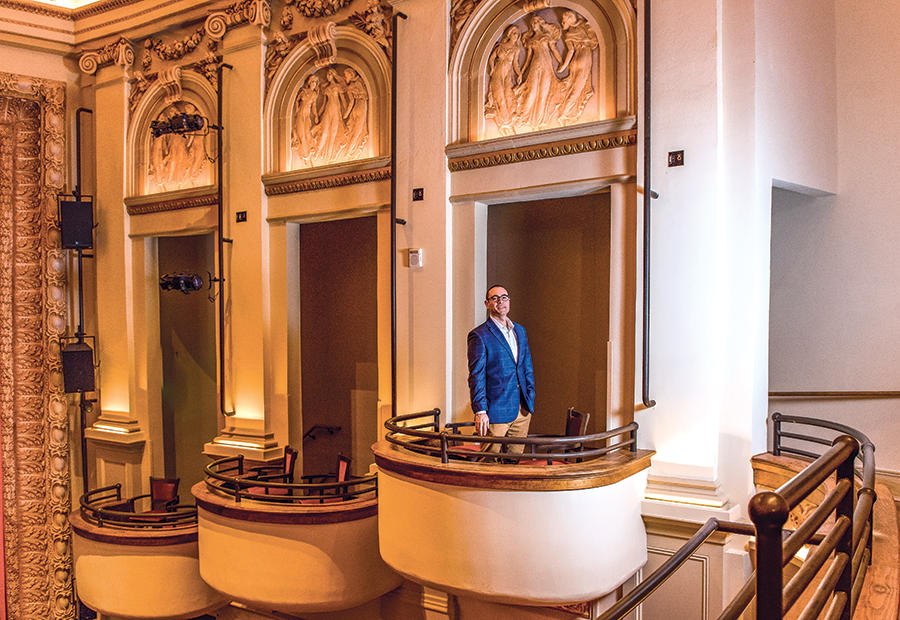
In its nearly 120-year history, the Academy Center of the Arts has seen highs and lows.
It was once a prominent, glamorous theater that brought in traveling shows, musicals, and performers.
At its lowest point, it was shuttered for six decades before restoration groups fought and fundraised for years to finally renovate the historic landmark back to its former glory.
Dr. Bill Kershner, volunteer archivist at the Academy, said there have been several stages in the life of the theater lasting longer than a century.
The golden age of the Academy began in 1905 and lasted until about 1915, he said.
The Academy opened in February of 1905 and had first and second class touring companies who would come to the Academy after their Broadway shows.
Photos Courtesy of The Academy Center of the Arts
“Lynchburg was an important stop because these touring companies didn’t want to travel without making any money every day. They didn’t want to play for, say, a week in Washington D.C. and then a week in Atlanta, and then lose a couple of days traveling. So they would book these things together,” Kershner said. “So Lynchburg was on that circuit. We had the same shows that everybody read about during this period.”
The Academy also offered cheaper events that were popular with different groups in the community.
“So the Academy always served several different parts of the community,” Kershner said. “It wasn’t just the wealthy folks.”
Aside from the touring companies, the Academy also held concerts and recitals, some of them by internationally famous acts. They even tried wrestling in 1914, and Kershner says he is still wrapping his head around how that was pulled off.
Parts of the Academy burned down on April 20, 1911, and the interior was destroyed. No one knows what caused the fire, but the best guess was it was caused by the furnace, Kershner said.
It was rebuilt and reopened in December of 1912 and the interior was even grander than the original—and it was that version that became the prototype for the restorations in 2015. The next period of the Academy brought in silent films, though the building wasn’t fitted for that type of venue until a third stage was built in 1928 for talking movies.
“For about two years, it does first run films and the Academy is once again on the forefront of entertainment in Lynchburg—but that only lasts a few years, because in 1930 the Paramount, designed as a movie theater, opens across the street, and after that they’re really a second-run theater,” he said.
Most people who remember the Academy from this time will remember viewing the serial films shown on Saturdays.
The theater showed some movies that were about a year or two old, ran serials, and held the occasional vaudeville show until it ultimately closed in 1958 and remained shut for 60 years until it reopened in 2018.
For the first 10 years of its closure, it fell into disrepair until the announcement that the 5th Street bridge would be built right through it in the late 1960s
A group of citizens rallied to secure a historical landmark status in 1969 and got the bridge rerouted, Kershner said, and although that group had hoped to restore it, raising money was difficult, so it continued to sit for another 15 years until the early 1980s when it was bought by Liberty University who had the idea to restore it.
That never happened though.
In the 1990s it was sold to the Friends of the Academy for the low price of about $10, Kershner said, and in 1996 it merged with the Fine Arts Center.
“That’s when the Fine Arts Center was torn down and they raised the money for the Warehouse Theater and the building next door, which became the art galleries,” he said.
It wasn’t for another 20 years when other spaces were being renewed downtown that people saw possibilities for the Academy to be a part of that renovation work. “People saw that downtown was coming back to life,” Kershner said.
Photos Courtesy of The Academy Center of the Arts
In 2015 they began seriously raising money and were successful, which was around the time that CEO Geoff Kershner—Bill Kershner’s son—took over.
“So that was pretty gratifying to us that it was while Geoff was executive director that it actually happened,” he said.
By December 2018, the historic theater was back open after a $30 million restoration project.
Nearly 50 years after community members were able to begin fundraising efforts for the Academy and save it from demolition, the beloved historic space was able to live on with the same mission it’s had all along of serving citizens from all backgrounds.
That inclusivity is an important piece of Chief Programming Officer Michelline Hall’s job, who said the mission of the new Academy is to have arts be accessible for all people in the community.
“A part of that is having camps and classes that people can attend and participate in and then another piece is providing financial support for people who can’t afford it,” she said.
New to the Academy that was not a part of its original function is the art galleries and educational classes that the community now has an opportunity to be a part of.
It recently has begun offering Academy in Motion, a mobile arts program that seeks to impact members of the Lynchburg community by providing arts access to groups and individuals with barriers that would otherwise prevent exposure to the arts on their physical campus.
Hall said the bus goes to the YMCA, adult day care centers, and schools to bring programming straight to participants.
She said it also has a partnership with the Virginia Cooperative Extension on an initiative called Plates and Paints, which is a food and nutrition program. The program works with people digitally to make a healthy plate of food in a way that is diverse in color just like a paint palette would be.
The Academy is also open for school field trips and offers students to take a class, see a performance or the art galleries, or learn the history of the building.
Photos Courtesy of The Academy Center of the Arts
“That’s the programmatic aspect of being intentional about how often we’re creating those moments where we’re able to tie in that educational and cultural component because a lot of these kids, just by expanding their horizons, you never know what they may decide they can do,” Hall said.
Hall said the Academy is going to invest in the best acts and artists that it can bring in, but wants to make sure that it’s bringing everyone to the table to enjoy it.
“I don’t know how many doors were opened just from people seeing something or experiencing something or hearing someone that inspired them and allowed them to go down a certain path,” Hall said. “I’m not anticipating that kids that come in here to all become amazing visual artists, but maybe they feel like they can do something else in their lives that they thought they wouldn’t be able to do.”
That’s a beautiful thing about the arts. The arts are cross-cultural, Hall said, and reach across all demographics.
“Good music touches everyone,” she said. “It doesn’t have a zip code, it doesn’t have a salary cap or limit. There are certain things about the arts that just unify all of us together.
And we’re trying to constantly be the catalyst for that.”
A Perfect Pairing
Dishing up exquisite portions of food and art, ElectricCoArt, Bistro & Market brings a big city vibe to the “World’s Best Little Town”
Tucked away from the heat of a typical Virginia summer day, and with an ice-cold carafe of water on the table in front of me, I sat with a passionate group of people who are on a mission to elevate Bedford’s art and food scene—all under one roof.
Surrounding our interview group is art—lots and lots (and lots) of art. From large, multi-colored abstracts to traditional pastoral landscapes to shelves displaying the most detail-oriented, whimsical sculptures I’ve ever seen. Almost every empty space in this historic, magnificent room is filled. It’s hard not to be inspired here.
“People walk in and say, ‘I feel like I’m in New York City or Downtown Philly.’ They will pick a city and fill it in. And that’s our goal,” said owner Wendy Witt.
ElectricCoArt, Bistro & Market Owner Wendy Witt and her partner, Bill Mauser. Photo by Ashlee Glen.
The vision for ElectricCo started forming when Witt, a real estate agent, had the Depot Street building listed for sale.
“We just started daydreaming about what this building could be,” she explained, adding that her partner, Bill Mauser, had been looking at vacant commercial spaces to put his blacksmith forge.
Once the couple made the move to buy the space, they had the end goal in mind—a maker’s market, art gallery, and restaurant. Naming the business was easy and was pulled straight from history—the ElectricCo building was constructed in 1895 as the original Bedford Electric Department and it functioned that way until 2000.
Photo by Ashlee Glen
Getting to their end goal, however, didn’t unfold quite like they thought it would and ended up happening in stages.
“We wanted to open up everything all at the same time, but we soon realized that wasn’t going to happen. The market was first and was the easiest,” Witt said.
In June 2021, their makers market opened to the public. It’s located on the lower level of the two-story building, with its own separate entrance, and features a little bit of everything—pottery, candles, jewelry, clothing, and more. Witt says local makers and artisans, who had been working at home during the pandemic, jumped at the chance to have a spot to showcase their goods.
Next came the art gallery, located upstairs. Witt and Mauser didn’t have much experience in this arena and weren’t sure how easy it would be to find artists who wanted to display their work in a new Bedford gallery. They were stunned by the initial feedback.
“It went so much easier than we expected.
As we started talking to artists, they told us, ‘oh my gosh, we are dying for a place to show’ or they were even looking for a second location to show,” she explained. “We got a lot of compliments from artists about how the place looks and feels.”
The front of the gallery is where visitors can peruse—and purchase if they choose—a wide variety of local and regional artwork, and artists swap out their pieces often so there is always something new to see. Keep walking to the rear part of the gallery, and you’ll find a larger, more comprehensive showing from a featured artist that typically stays on display for about six to eight weeks.
With the market and gallery underfoot, the restaurant seemed straightforward—a completion of their business model trifecta. It was going to be a relatively simple eatery, a limited kitchen offering some select sandwiches. But just like an artist who lets their imagination guide them on a canvas, the restaurant idea started taking a different direction when renovations began.
“We didn’t expect the demo of the building to open up the spaces as much as they did. The kitchen went from two small, dark rooms to a big open kitchen. We started knocking out walls, removing sheetrock, found windows that were hidden,” Witt said. “The whole vibe just changed.”
And the more the environment changed, the more their expectations for the restaurant expanded. Witt and Mauser’s limited kitchen concept had morphed into a full-service, fine dining experience.
Photo by Ashlee Glen
“Then, Chef Thomas and we came together, so it’s like it was all supposed to happen,” Mauser added.
The “cupid” in this serendipitous introduction, according to Witt, was the man who installed the restaurant’s kitchen equipment. One interview later and Chef Thomas Schmidt was hired to lead the way for ElectricCoBistro, which opened to the public in April.
Schmidt, a Blacksburg native who now lives in Lynchburg, graduated with honors from the Culinary Institute of America in New York. His resume includes the Sanderling Inn on the Outer Banks and the Willow Grove Inn in Orange, both of which are highly rated in the culinary world.
“After that, I broadened my foundation into some other things and then the opportunity to come back to fine dining arose with ElectricCo and I jumped on that and couldn’t be happier,” he said.
Creating a forward-thinking, upscale menu in a small town comes with its challenges—one of them being, you don’t want to scare people off.
“So it’s only about this much intimidating,” Mauser joked, holding up his thumb and forefinger.
Schmidt quickly jumped in to add, “You want it to be friendly, somewhat familiar. So people won’t go, ‘what is that?’ Our ingredients are all recognizable and everything is from scratch.”
There’s a lot of fusion-style cuisine. Schmidt has enjoyed pairing many well-known dishes with flavors inspired by Asia, France, or Germany. For example, one of their top selling appetizers is prosciutto risotto balls stuffed with mozzarella and topped with a Southwestern marinara and Mexican cheese. Schmidt’s recipe for ahi tuna with Asian slaw and sushi rice further highlights his love for international flavors.
Their chicken marsala is also a huge hit with customers, along with the bistro’s grilled salmon entrée.
“We have a few things on the menu that are standbys because they are so popular. Ultimately we will probably have a base menu, but we will always be switching things out,” Schmidt said.
The menu is dynamic, just like the art on the walls and Schmidt doesn’t have to work too hard to find inspiration for new dishes—he just looks around.
Photo by Ashlee Glen
“When the art is always changing, you want the food to change too,” Schmidt said. “You want it to be as special as the art.”
Those two elements, art and food, play delightfully off of each other here at ElectricCo—creating a special experience not only for locals but hopefully lots of out-of-towners as well.
“We want art lovers from New York to Atlanta to come up here to our area, from Roanoke to Lynchburg,” said Witt. “We want to create an art scene in this region and be part of that.”
Photos by Ashlee Glen
A Loving Space to Be
The Loving Co. combines community and coffee
Walking up the few steps and through the door to The Loving Co., adjacent to Riverviews Artspace, it immediately feels like stepping into the home of an old friend. Breathing out an audible exhale while looking around and taking in the soothing surroundings, I felt the sense of community right away. The walls are covered with artwork, every flat surface has something beautiful to peruse from various vendors such as handmade jewelry, plant-based bath and body care, keychains and stickers, mugs, and vintage clothing plus there is ample, comfortable seating just waiting to envelope you. Choose your tasty drink or snack from the large coffee bar where you’ll find a wide selection of teas and coffee drinks that differ from your traditional coffee shop. How about a salted honey latte or perhaps a mango milk tea?
The Lovings
The Loving Co. is a Black, women-owned business run proudly by four local Lynchburg ladies, the Lovings: matriarch Victoria and her three daughters Ceana, Taylor, and Ashley ranging in age from 22 to 36. Inspired by their love of conversation, they kept coffee as the conversational drink, added local small businesses within the shop, and made a space to host community events such as jazz nights and paint and sip; or you can rent the space for a shower, brunch, book club, business meeting, etc. Wednesday nights are open for business and known as Insomnia Nights at The Loving Co. where they have everything from music, movies, and games or customers can feel free just relax and read a book.
The Loving women were raised with an appreciation for art and they enjoy drawing, painting, photography, and writing. Taylor Loving shared, “At the Loving Co. we can show our love for art while supporting local artists as well. We know of other young artists that may not have the opportunity to showcase their talents. We decided to focus on women, people of color, and young artists to have this space to showcase or sell their works.”
At a Glance: The Loving Co. 901 Jefferson Street, Downtown Lynchburg (434) 485-8262 Find them on Facebook and Instagram
Sara Ernst Spreads Joy and Life Lessons from One Coast to the Next
Local artist Sara Ernst is a renaissance woman in every sense of the term. A photographer, published author, illustrator, and musician, Ernst has been creating in one way or another since she was 15 years old.
“Photography came first!” she said. “I started doing wedding photography when I was just 15 years old. Children and families have always been my passion, though, and I’ve been beyond blessed to be an award-winning children’s photographer here in the area for over 20 years! I’ve watched the newborns grow and graduate before my eyes and my lens…such a humbling experience. I’ve even had the honor of one of my photographs being in the 2020 May edition of British Vogue!”
Ernst’s love of children and families created a natural segue for her to hone her creativity even further and captivate an audience that she already enjoyed working with. Founding her business Wild Pickle Press, Ernst creates stories and songs that help the youngest readers navigate life.
“Adults can sometimes have a very linear way of looking at things…thinking of songs or books as simply ‘catchy’, ‘silly’, ‘boring’, etc.,” she said. “Children are eager to soak up whatever is provided to them, and new things tend to spark new interests.”
Ernst’s work breathes life into that curiosity—fostering a sense of awe for the natural world and answering the inevitable ‘whys’ that often come from children when they’re discovering something new.
“For example, when a child learns what an ootheca is through my music, they are so eager to tell me about one they found the next time they see me. They have even brought them to concerts to show me! Wondering what an ootheca is? Go listen to my song!” she laughed. “I have worked with children in some way, shape, or form since I was literally a child myself, so interacting with them comes very naturally to me. I also know that music is a powerful learning tool and children need as much positive music as we can give them. Knowing that I’m giving them something good through my words is rewarding.”
Ernst wrote her first book, Dragons Really Do Love Tea in 2017. With no intention to ever sell copies outside of the supportive friend or family member, Ernst found herself at local bookstore Givens Books, who expressed interest in selling it. Now, she has published four books, all of which are available at Givens and on Amazon.
“My fourth book is the one I consider the most crucial,” she explained. “It started with my song Shout No, which I wrote to help teach children as young as two what a tricky situation might look like—whether from a stranger, friend, or, sadly, family member. It helps teach them how they can react, what trust means, and the importance of listening to their feelings. I really wanted something for visual learners and early readers as well, though, so I created a book from the song called Shout NO! A Child’s Rhyme About Tricky People…And What To Do. This book is now in Germany, Japan, France, the United Kingdom, Canada, and across the United States.”
This fourth and important children’s book is being used in foster programs and is accessible via Little Free Libraries and school libraries. In 2021, it won both the Purple Dragonfly Book Award and The Story Monsters Approved Book Award, and is available to read for free on the Wild Pickle Press website. The song is also free to download via the website.
“I just want this crucial message spread to children,” Ernst furthered. “If hearing the song or reading the book saves a child from a potentially dangerous situation, it’s all worth it!”
“This book has armed my kids with knowledge and confidence,” one parent said.
Ernst’s work has received even more recognition in recent months—this time, for a jingle she wrote for the California Strawberries Commission.
From April to May of this year, the California Strawberries Commission opened a contest for artists across the country to submit a written and recorded 45-second jingle for the group to adopt for future marketing and outreach efforts.
“The contest was promoted on Instagram, and it happened to show up in my feed,” she explained. “When I read about the specific things the jingle needed for the entry, I immediately felt inspired, grabbed my ukulele, wrote the jingle in about an hour, and submitted it that day. I didn’t overthink it; I just wrote what I felt immediately about it. I genuinely had fun writing it and felt happy when I played it. Those were two things I knew couldn’t be changed even if I didn’t win!”
Out of countless submissions, Ernst’s melodic jingle was selected as the winner.
“Anytime someone sees something or hears something in my work that they love, it’s truly rewarding,” Ernst said. “Winning [the contest]meant that someone (really, a bunch of someones) other than myself found joy in it…and that’s a wonderful feeling! While I couldn’t say for certain exactly how or where California Strawberries will use the jingle, it is the first jingle to represent their company and they can use it however they see fit…whether it’s through television, radio, social media, in-person events, etc. If you hear it somewhere, let me know!”
Whether Ernst is writing books, helping kids navigate tricky situations with easy to memorize songs, or creating award-winning jingles, her message is always consistent: It’s about finding joy, feeling love, and having fun.
“I want kids to remember that no one has the right to try to make them do something that is wrong or makes them feel uncomfortable. That they are strong, brave, kind, and smart. That nature is a whole world of creatures and life just waiting for them to explore. That there is no one quite like them. And that feelings are like friends trying to tell them something for a reason.”
Parents and young readers looking to connect with Ernst can find her on her website, www.wildpicklepress.com, or on Facebook and Instagram @wildpicklepress.
The Magic of Art and Illusion
This summer, Ellee Evans, an artist who is from Lynchburg but currently living in Atlanta, set out to alter perception and bend reality. With paintbrush in-hand, she stood in the middle of Art Alley in downtown Lynchburg for four hours expertly mixing color and creating contrast. But rather than painting something stationary, Evans relied on a patient model to act as her canvas.
Artist Ellee Evans painting model Kiersten May
“I have a deep desire for making things magical just from illusion,” Evans explained. “I think it started from my scenic painting training my senior year of college. I learned how to make backdrops for plays look three dimensional and it inspired me to do the reverse with body paint. I want to turn the 3D image we see in life into a 2D illusion. It’s magical and so incredibly fulfilling once I step back and see the final product.”
Using Mehron, a water-based body paint, Evans was able to ensure that a thin layer of breathable, weightless paint could be applied to the skin and clothes to act as the base before applying contour and details. But before Evans ever puts brush to body, she first puts pen to paper.
“Prepping for a paint session starts with a drawing. I draw out a rough sketch using the dimension of the model, and then I play around with color palettes and designs,” she said. “Then, when I have a vision, I will share it with the client or friend that I am painting. I wash and cleanse all of my brushes and palettes, and then I pack up my back with all of my essentials and meet with the client to create the magic!”
For Evans, painting a person versus a canvas is about the connection and the process. Evans enjoys being able to talk to someone while she paints and allows herself to get inspired in the moment to add more details to her living painting while she works. But Evans also recognizes that there can be something deeper at play when you spend that much time working closely with another person.
“It’s body positivity,” she said. “I love making someone feel like a beautiful piece of artwork—even though every human already is one, we just often are hard on ourselves and don’t see it! I have a lot of self-image issues and whenever I paint myself, I feel so valuable and special and important. It means the world to me to be able to share that feeling with other humans.” Evans has been passionate and curious about this type of live, body art since she was a child. Her mom would read Purple, Green and Yellow by Robert Munsch to her, which recounts a story of a marker-obsessed girl who runs out of paper and begins drawing on herself instead.
“Throughout high school, I would use sharpies and eye liner to draw tattoos on myself,” Evans remembered. “Eventually, I started playing around with makeup and cosplays. I would want to buy a costume, but then something would just click in me, and I would just say, ‘I could just paint it on me, right?’ It all started trickling off into more and more creative ways to use paint and play with illusions.”
Although Evans moved away from Lynchburg a little over a year ago, she still enjoys returning for art projects or to see how much the city has changed.
“This last time coming back to Lynchburg, I found myself taking so many photos downtown,” she recounted. “The art scene has made a huge difference in the downtown atmosphere. It makes me feel welcome and appreciated as an artist. Like, ‘Hello, we welcome art here.’”
Evans plans to return to Lynchburg often, and is available for commissions via her website or on Instagram.




 Evans plans to return to Lynchburg often, and is available for commissions via