Window Opportunities

Today’s Top Window Treatment Trends

When it comes to the notion of form vs. function in your home, some items reside quite firmly in one camp or the other. For instance, indispensable and thoroughly unglamorous components like electrical panels, HVAC units, wires, and pipes tend to be intentionally kept out of sight—and out of mind, until emergencies occur—while many home decor items serve purely aesthetic purposes. Then there are the elements in your home that are centrally important from a functional standpoint but that also possess vast aesthetic potential. Among these dual-purpose elements are windows.

Windows serve myriad significant utilitarian purposes in a home: they let in natural light, offer passive climate control through ventilation and insulation, enable increased situational awareness, provide emergency exits, and even boost one’s mood and productivity. Despite these practical boons—or perhaps, in some cases, because of them—windows are often overlooked as conduits of style. Over time, window treatment trends have generally shifted from ornate and flashy aesthetics to markedly minimalist choices, but that minimalism is warming up in 2026. The stark whites, muted grays, and plain synthetic blinds that peaked during the 2010s and early 2020s are giving way to cozier and more expressive colors, textures, and general treatments. Read on for three of our favorite trending styles that will allow your windows to truly shine.

Roman Shades Featuring Soft Folds & Bolder Designs

Roman shades are fabric window coverings that feature horizontal folds and that can be raised and lowered through a variety of mechanisms: traditional cord locks, chain clutches, internal spring mechanisms, or automated motors. Although Roman shades have enjoyed steady popularity for decades due to their relative convenience and tidiness, the most preferred style of these shades is shifting from crisp, flat folds and low-saturation neutrals to soft, billowing folds and more striking color choices (and, in some instances, playful patterns). Incorporating Roman shades that stand out rather than blend in can create visual interest in and add dimension to an otherwise minimalist space or amp up the playful personality of a room intended to dazzle and entertain.

Bamboo blinds and sunlight streaming into the room through the windows, vintage decoration in a modern room

Bamboo Matchstick Rollup Shades

As interior design trends generally move away from stark minimalism towards a warmer and more luxurious minimalist approach, inspiration tends to derive from a more organic place—in terms of both hues and the actual materials used. Considering this shift, as well as a growing emphasis on sustainability on many fronts, it is not surprising that bamboo matchstick rollup shades are having a real moment. In addition to being eco-friendly, these shades are budget-friendly, lightweight, and easy to use. And although they make a pronounced earth-minded statement, they are neutral enough to suit a wide variety of spaces. There is also something beautiful about lovingly mimicking the splendor of sunlight beaming through the branches of a tree within the comfort of one’s home.

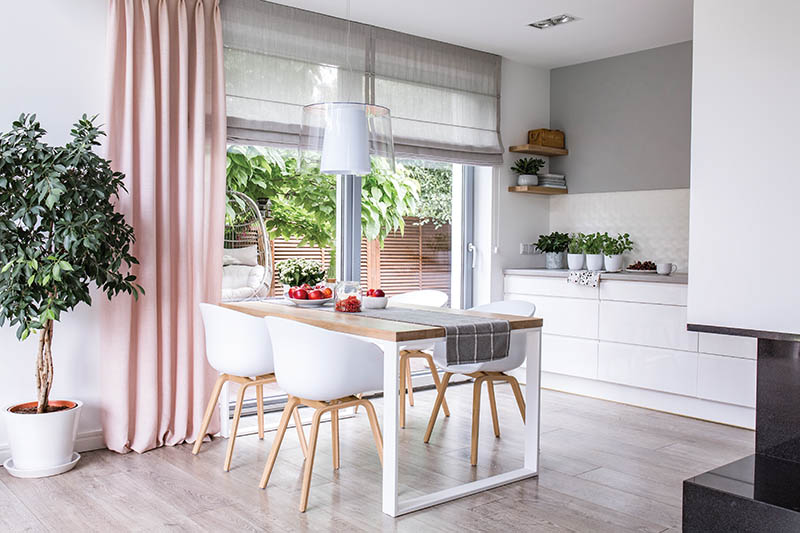
Gray roman shades and a pink curtain on big, glass windows in a modern kitchen and dining room interior with a wooden table and white chairs

Mixed-Texture Layered Window Treatments

To fully lean into the large-scale interior design trend of lived-in luxury, you will need to think outside the box—and blinds. Rather than opting for a single window treatment for each of your windows, consider mixing treatments (and textures) to create a unique and statement-making multi-layered aesthetic. Balance hard and soft by mixing wooden blinds with delicate fabric curtains, elevate roller shades with decorative side panels, or create drama and striking visual depth by layering two dissimilarly-textured (such as linen and velvet) curtains. No matter which combination(s) you choose, your intentional effort to express your personal style with a signature window treatment approach will undoubtedly make your windows, home, and outlook a little brighter.


From Bat Boy to the Wolf Den

Wolfbane Productions celebrates 20 years of immersive theater, unconventional ideas, and the Central Virginia audiences who helped make it all possible.

By: Charlotte Farley | Photos courtesy: Wolfbane Productions

Photo Above: Top: Ken Arpino, Executive Director (L); Dustin Williams, Artistic Director (R); BOTTOM: Christine Yepsen, Creative Director (L); Jeremy Craft, Chief of Operations (R). Photo by Deborah Ware Photography

When Chicago opens Wolfbane Productions’ 20th anniversary season in 2027, audience members won’t simply sit in rows and watch the action unfold from a safe distance. The Wolf Den will be reconfigured into an immersive, tableside setting, with a Broadway director and choreographer from New York helping bring the whole thing to life.

By the next production, the room may look completely different.

That flexibility is part of what makes a Wolfbane show a Wolfbane show.

The risers can come down. The seats can move. Music and atmosphere begin working on the audience before anyone delivers a line. Executive Director Ken Arpino says Wolfbane wants guests to leave the day behind for a few hours and step fully into the story. And that invitation extends to just about everyone.

At one performance, audience members arrived on four-wheelers.

That’s right: four-wheelers.

For Arpino, the story is proof that Wolfbane has managed to attract serious theater lovers without making newcomers feel they have to prove they know theater. Wolfbane began because people showed up—and grew because it created a kind of theater where nearly anyone could feel they belonged.

wolfbane productions

Wolfbane’s Grassroots Beginning

In 2007, a group of friends decided they wanted to put on Bat Boy: The Musical.

At the time, they were not thinking about indoor and outdoor venues, national attention, or a full season of professional productions. They just wanted to make a show. “It was truly a passion for art,” Arpino said. “It started with a bunch of friends who wanted to put on a show.”

The production went well, so they came back the following summer and staged another. Then they did it again. Little by little, the annual production became a tradition. The friends wanted to continue, but the audience’s response gave them a reason to believe the project could become something more.

Wolfbane did not begin with a major financial investment or a grand strategy. “It was truly grassroots,” Arpino said. People came, enjoyed what they saw and returned for the next production. That support became the catalyst for the company’s growth.

Once the founders began treating Wolfbane as a serious professional company, they heard plenty of reasons it would not work. People told them that a theater company based in Appomattox could never attract national attention.

“They were wrong,” Arpino said.

Building Something Bigger

Wolfbane’s growth has never been especially conventional. Take the Wolf PAC, the company’s outdoor venue in Appomattox. It exists because Wolfbane wanted to produce Evil Dead: The Musical, complete with its infamously messy splatter zone, and no one would let them do it in an existing venue. So they made their own.

The property belonged to the family of Dustin Williams, Wolfbane’s founding artistic director, and Wolfbane had the land rezoned. Its natural slope turned out to be ideal for an outdoor performance space. The story behind the venue says as much about Wolfbane as any production ever could. When the company wants to stage something, it tends to find a way. If the right kind of stage does not exist, Wolfbane may simply decide to build it.

That same instinct showed up again in a different form with the company’s annual Wolfswood Faire. Staff members noticed that some audience members were already arriving at shows in costume. Their response was immediate: This is awesome, and these people need another place to dress up, play along, and find others who love this stuff as much as they do.

Arpino describes Wolfbane’s event as part Renaissance Faire and part Comic Con. Guests choose between two tribes, compete in challenges throughout the day, and help decide which group will “rule the fair” the following year. “We’re all nerds,” Arpino said—and he means that proudly.

The event may be playful, but the idea behind it is central to Wolfbane’s work. People are encouraged to participate, express themselves, and become part of the experience.

That same spirit helps explain the company’s unusually varied audience. Wolfbane attracts seasoned theatergoers, first-time patrons, families, and visitors from Richmond and Washington, D.C. Some travel from cities with plenty of their own arts offerings because they trust Wolfbane to give them something worth the trip.

“I think what we’ve learned in the last 20 years is whether you’re a lifelong theater aficionado or you’ve never been before, people feel safe and comfortable with us,” Arpino said.

The company has also built trust through its adaptations. Arpino’s version of Wolfbane’s A Christmas Carol, for example, grew partly from his own upbringing outside Boston in a large Italian American family with a mother who loved Christmas movies. Dickens introduced Scrooge’s family, but Arpino wanted to explore those relationships further—particularly what Scrooge’s choices meant for his nephew Fred and the rest of the family around him. The production will return for its fifth year in 2027, and some patrons now come back annually.

Inside the Wolf Den

For Wolfbane’s first decade, the company’s mainstage work was primarily outdoors. In 2017, that changed with the opening of the original Wolf Den in downtown Appomattox. The 132-seat indoor space allowed Wolfbane to perform during the winter and experiment with becoming a year-round theater company. Arpino describes it as “dipping our toe in year-round theater.”

The experiment worked—perhaps a little too well. Audiences kept coming, and Wolfbane quickly outgrew the space. With help from Downtown Lynchburg Association’s Launch LYH program, the company found a larger home in downtown Lynchburg. Wolfbane moved into the new Wolf Den in late 2024.
The venue is, in Arpino’s words, “a big box,” but he means that as a compliment. The open space gives Wolfbane the freedom to design each production
from scratch. Risers can be taken down. Seating can be rearranged. One show may face the street wall, while the next may place the audience in a completely different part of the room.

“We try to build the atmosphere into the storytelling,” Arpino said.

The experience begins at the box office. Music sets the mood, staff members offer a friendly welcome, and the transition into the story starts before the show itself. Wolfbane is well aware that live theater is competing with screens, streaming services, and the temptation to stay home. Its answer is to create something people cannot experience on a phone or television: a room full of strangers reacting together.

“There’s nothing more unifying than feeling so human and feeling emotion with 200 other people,” Arpino said.

The move downtown has also connected Wolfbane more closely with Lynchburg’s restaurants, hotels, and shops. A theater date may also include dinner, drinks, shopping, or an overnight stay. Wolfbane hires more than 100 artists each year, attracts visitors, and contributes to spending throughout the surrounding area. Arpino believes that makes the company part of the local business community, not simply an optional cultural extra.

He is equally enthusiastic about the other arts organizations in the region. “There’s a reason they call it an arts community,” he said. “The stronger we are together, the better it is.”

Looking to the Next 20

Wolfbane’s 2027 season includes both new ambitions and a return to where the company began. The anniversary season opens with Chicago, followed by David Ives’ two-person play Venus in Fur. Wolfbane plans to limit seating for that production, creating an especially intimate atmosphere. Finding Neverland follows in June.

Then, 20 years after that first group of friends decided to put on a show, Wolfbane will remount Bat Boy: The Musical.

In the fall, the company will take The Legend of Sleepy Hollow outdoors. The title won Wolfbane’s audience-choice poll, which allows patrons to vote among productions the staff would already be excited to stage. The season will close with Wolfbane’s A Christmas Carol. Children’s camps, the Renaissance Faire and Wolfbane’s wine club will continue alongside the mainstage productions.

Arpino believes the first 20 years established what Wolfbane could accomplish. The next 20 will give the company an opportunity to take on larger titles, more ambitious productions, and work that draws even more attention to Lynchburg and Central Virginia.

Wolfbane is not short on ideas. Funding them is another matter. Wolfbane pays its artists, works with professional unions, and reinvests its resources into the company. Arpino sees the number of artists who return to work with Wolfbane as one of the strongest indications that the organization is healthy.

His long-term goal is to help make Lynchburg a national hub for the arts, a city where artists want to work and where audiences know they can find exceptional productions without traveling to New York. Still, when asked what he hopes people remember about Wolfbane’s first 20 years, Arpino gives a much simpler answer: “I hope we made people happy,” he said.

Maybe someone came to a show and laughed harder than they thought they would during a live performance, or maybe they shed a tear or two. Perhaps they walked back to the car and downloaded the soundtrack. Or maybe they just had one of the tunes stuck in their head for a week.

Honestly, that may be the best review any theater company could ask for.

Buy tickets, see schedules, and learn more at wolfbane.org.


Bridge to Community

Violins and More of Lynchburg Enriches Local Music Scene with Expertise and Emphasis on Connection

By: Jeremy Angione / Photos By: Ashlee Glen

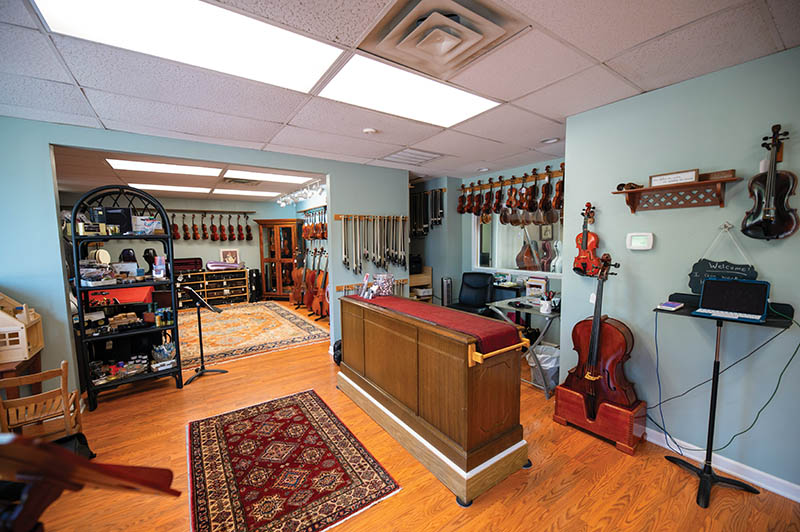
Tucked away into an unassuming storefront is Violins and More of Lynchburg, a local hidden gem that has been a haven for musicians all over Virginia. Owner Rachel Love says that her father, Allan Heer, took ownership of the store about 20 years ago.

After a stint in teaching, Love decided to join Heer as owner in 2019. Both father and daughter have a rich history in music. Love is a singer, choir director, and has been on the board of the Lynchburg Symphony for six years. Her father is an organist.

“My dad is very philanthropic and he loves music. One of the things that he loves to do is to go play piano for all of the concerts that the Lynchburg City Schools do,” Love said.

The storefront is small but tightly packed with stringed instruments, supplies to care for them, and everything in between.

Violins and More of Lynchburg

As you navigate further into the shop, the space opens up into a large common area with several branching rooms that serve unique purposes.

There are a few rooms that are dedicated to violin lessons taught by local teachers who rent the shop’s space. Violins and More has a directory of local teachers available for lessons on their website.

In another more spacious room is a workshop clad from floor to ceiling with the bodies of violins in various stages of repair. The workshop is home to Sam Howell, Violins and More’s resident luthier.

“A luthier is a woodworker who specializes in stringed instruments. Stringed instruments are made of very old, dry, thin pieces of exotic woods connected together under extreme tension,” Howell said.

According to Howell, luthiers are an “odd mix of artist and engineer.”

Violins and More of Lynchburg

While there are several schools that specialize in producing luthiers, Howell received his education through a collection of experiences including historical reproduction, custom millwork, furniture building, and his own musical acumen as a longtime cello player.

Howell considers his work to be more than just repair; he sees it as artistry. The look and feel of a violin is just as important to Howell as its primary function. The unique and delicate ingredients of lutherie, including the horsehair violin bow, all over Howell’s workshop make it apparent how much skill is required to do his work and why he is so sought after in Central Virginia.

“He [Howell] is one of the only luthiers in Central Virginia,” Love noted.

Love says that Howell’s luthier services currently have a three month waiting list. Violins and More supports the growing ecosystem of string players in the area.

All instruments are “rent to own,” which helps longtime students grow with their violin, from youth player to adult artist.

Violins and More of Lynchburg

“A lot of these kids, who are dynamite little players—their parents aren’t ready to invest in an expensive instrument for them, but they have a really nice instrument that they can rent from us,” Love said.

According to Love, as a child player physically grows, it becomes necessary to fit them for a bigger violin. In her time owning the shop, Love has seen many young players grow in skill and into a full-sized violin, which she cites as one of the most rewarding aspects of her work.

Violins and More is a proud supporter of the Lynchburg City Suzuki Strings Program. The program offers free Suzuki Violin lessons in Lynchburg City Schools.

“It’s an amazing program that not very many cities in Virginia have. This is putting Lynchburg on the map,” Love said.

Violins and More of Lynchburg

Violins and More helps to provide the students in the program with their instruments, making the shop a vital part of the life and growth of the program.
“This program is growing and growing.

We have the kids who come up through the City Schools playing violin, and then they have this amazing opportunity to play in a youth symphony,” Love stated.
While support for the Suzuki Strings program is a large part of Violins and More’s business, the shop also welcomes the musical community at large into the shop.

“Beginner’s Luck” is an ensemble program for adults who have some experience, but perhaps no grander ambition to play in a symphony or in other professional venues.

Violins and More of Lynchburg

On Tuesday evenings, Violins and More hosts a free Talent Night for kids and adults to come into the shop and play musical pieces of their choice.
“Those are some nice ways we reach out to the community,” Love said.

Ultimately, Violins and More keeps the artistry of string music alive by engaging with its community of players.

“If you do rock climbing, marathon running, or biking, you can find your group in Lynchburg. There is an incredibly large community of string players in Lynchburg, but if you don’t play, you wouldn’t really know it,” Love said. As an owner of a family-run business, Love recognizes the role of family in supporting the arts.

“I love the people who come through the door. I feel like I’m part of their family. I feel like I have a service that can really benefit them. Being in partnership with my dad has been an amazing season of life,” Love said.

Currently, Love says that her hope is to help the Suzuki Strings program expand into neighboring counties so that students who don’t have the opportunity to play can receive free string instruction in school.

To learn more about Violins and More, visit violinsandmoreoflynchburg.com.


2026 Lynchburg Dental Guide

Not sure where to go for your oral health or dental treatments in the Lynchburg area?

Look no further than the experts referenced in our Area Dental Guide. From braces for your kids to the dental professionals you want in your corner when there’s an issue, we have you covered.


Artist Profile: Stephen Kissel

Ace of Arts

Multitalented Artist and Art Educator Stephen Kissel Adds Distinct Character(s) to Local Art Scene

By: Jeremy Angione / Photos by: Ashlee Glen

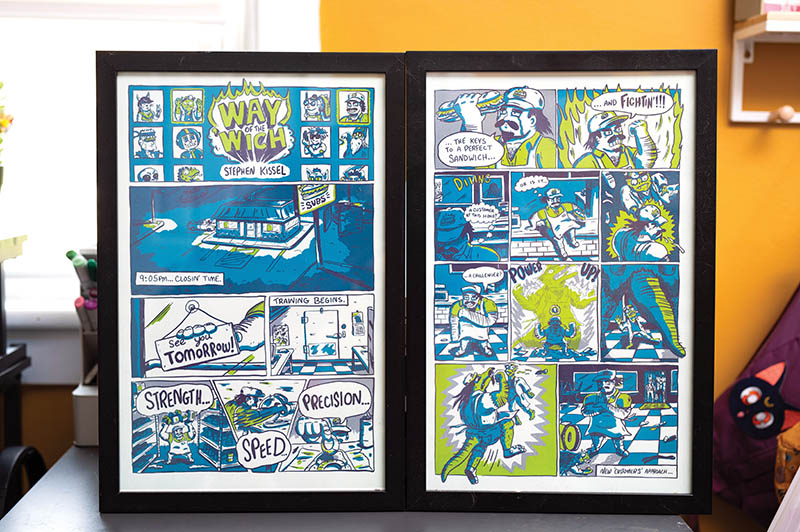
Aliens, robots, and monsters are now familiar downtown residents to anyone who has seen Stephen Kissel’s quirky sci-fi murals at the City Auditorium on Main Street.

Kissel is a lifelong cartoonist and illustrator. Although he grew up in New York, he spent much of his life in Virginia and managed to get deeply connected with the Central Virginia arts community.

“I’ve always felt like it was really welcoming here.

It’s just really easy to connect with people,” Kissel said.

Kissel says that he knew from a young age that he wanted to be an artist, just as soon as he realized it was an option for a career.

“It’s a part of my identity,” he asserted.

Despite possessing such a distinct illustration style, Kissel has found homes for each of his characters and creations in freelance work, comics, zines, and murals. Frequent guests of Super Rad Arcade Bar may notice a gang of cartoonish cryptids that he created as defacto mascots of the business.

©Stephen Kissel

Kissel considers his day job to be the many hats he wears at the Academy Center of the Arts, including his primary role as the director of outreach. His role supports Academy in Motion, a mobile art program that brings arts and education to community members—young and old—who would otherwise not have access to those resources.

“It’s fun to take the bus into communities that don’t have art programs. We found a lot of our needs are in Lynchburg, but also in the counties around us,” Kissel stated.

Kissel’s style is reminiscent of art styles that would’ve fit right in beside all your favorite newspaper comic strips. He even cites Garfield and Peanuts as early inspirations. “I’ve kind of unintentionally found a niche that people seem to know me for,” he said.

After seeing his artwork and meeting him, it becomes apparent that Kissel quite literally wears his artistic inspirations on his sleeves. His arms are covered in a patchwork of tattoos of his favorite cartoons, manga, niche pop culture references, and a bagel.

©Stephen Kissel

According to Kissel, Akira Toriyama, renowned author and artist of Dragon Ball, is a continuing source of inspiration for his work and the feelings he hopes to evoke in anyone seeing his art.

“I’ve always wanted my art to give people some joy,” Kissel said.

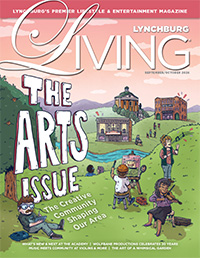
Cover illustrated by Steven Kessel

From murals to children’s books, Kissel has made his unique style as versatile as it can be. “I’ve gotten to do a lot of things that I’ve wanted,” he noted. He says that he’d like to venture into animation as a new medium for his art but that he isn’t sure he has the patience to be an animator.

Despite his work as an educator, freelance artist, and author, Kissel’s newest and perhaps most challenging role is as a new father. Kissel expressed that he hopes that he and his wife can share all the cartoons, movies, and media that they loved as kids with their child.

A huge thank you to Stephen Kissel for designing and illustrating this issue’s cover! To learn more about him and his work, visit stephenkissel.com.


Love at First Taste

Chemistry, Creativity, and Community Collide Deliciously at Love + Umami VA

By: Emily Mook | Photos By: Ashlee Glen

While visiting Japan in 2018, I became interested in the concept of umami, which is a Japanese word that translates literally to “essence of deliciousness” or “a pleasant savory taste.” Despite learning these translations and tasting authentic Japanese dishes that seemed to encapsulate the term, I still couldn’t fully distinguish umami from savory. Whether you are also familiar with the term but would struggle to produce its definition or are encountering it here for the first time, restaurateur and chemistry professor Amy Ngo has got you covered.

“I’m a chemist, so I’ll give you the scientific definition of umami first,” Ngo said. “Umami is recognized by receptors on your tongue that detect glutamate, a compound naturally found in ingredients like cooked meats, mushrooms, soy sauce, aged cheeses, tomatoes, and seaweed. Now for the foodie definition: Umami is that deep, savory richness that makes you stop after the first bite and say, ‘Wow!’ It’s the flavor that keeps you coming back for another bite and leaves you in the best kind of food coma.”

But Ngo and her husband, Kevin Jeon, who co-own new mobile pop-up food business Love + Umami VA, do more than define umami goodness—they consistently deliver it through their exciting, unique, and largely made-in-house menu of reimagined Asian comfort food offerings.

Love + Umami VA

Among those offerings are their signature customizable umami rice bowls, which customers can tailor to their tastes by choosing a protein, unlimited toppings, and a drizzle to add to a bed of delicious jasmine rice. With delectable and unique protein choices such as spicy mapo tofu with mushroom and tom yum pork chili, fresh toppings such as furikake, scallion, and cilantro, and flavorful finishers such as peach soy and spicy mayo drizzles, you can’t go wrong with any customization plan.

In addition to these standout loaded bowls—and a variety of distinctive sides and desserts, including Jeon’s favorite, their Ube + White Chocolate Sponge Cake—Love + Umami’s menu boasts an item that you’ve likely never encountered before: umami hot dogs. Originally intended to be a one-night-only special at Three Roads Brewing, the item was such a hit that it has since become a permanent fixture.

“You can choose between our Korean Bulgogi Philly Cheesesteak dog, piled high with sweet and savory marinade and melty cheese, or our Thai Tom Yum Pork Chili dog topped with a rich, tangy and slightly spicy pork chili inspired by the bold flavors of tom yum,” Ngo said. “Then comes the fun part: loading it up with your favorite garnishes, including Kevin’s mom’s homemade kimchi, which we grill to bring out its smoky, caramelized flavor.”

In addition to the chemistry and creativity that set their cuisine apart, Ngo and Jeon prioritize consistency and community—all while both working full-time jobs on opposite schedules.

Love + Umami VA

Although the couple just moved to Lynchburg last October and came up with the idea for their business in February, they have already cemented themselves as a staple with which many other businesses (both in and around Lynchburg) want to partner. Ngo also completed the Virginia Small Business Development Center – Lynchburg Region’s CO.STARTERS program to better understand all aspects of owning and running a mobile food business.

“CO.STARTERS has been really helpful in making me realize that running a food business is more than just cooking food and selling it,” she said. “There’s so much behind-the-scenes work and factors to consider when it comes to operations. I thought I would just get to cook and talk to customers all the time, but I do spend a good chunk of time filling out paperwork, making promo materials on Canva and grocery shopping, all while teaching chemistry full time at a local college. Also, the facilitators and my cohort this year have been so amazing and supportive since day one!”

Love + Umami VA

As Ngo and Jeon work tirelessly on a day-to-day basis both behind the scenes and on the front lines to grow their business, they also have specific goals for the future in mind—such as expanding their menu offerings and potentially opening a brick-and-mortar location—as well as a general goal of becoming a household name in the sphere of Central Virginia cuisine.

“Our goal is to become a household name in Lynchburg and throughout the surrounding region,” Jeon said. “If you’re within a two-hour drive, we want Love + Umami to be the first place that comes to mind when you’re craving bold, Asian-inspired food.”

No matter what shape the journey ahead takes, Ngo and Jeon are grateful for the community support they’ve received and encourage foodies near and far to follow along for the ride.

“Our social media really tells our story, so if you want to see what we’re cooking up and where we’ll be next, give us a follow!” Ngo said. “You can find us on Instagram at @love.umami.va and on Facebook at Love + Umami VA. We’d love to have you along for the journey!”


The Work of the Arts

Concerts may draw the crowds, but Executive Director Cyrus Pace says the Academy Center of the Arts’ greatest work happens beyond the stage.

By: Megan Williams | Photo Credits: Ashlee Glen, Deborah Ware Photography, and Academy Center of the Arts

In an age increasingly shaped by algorithms, artificial intelligence, and digital experiences, places where people gather to create something tangible—or simply experience something together—feel more valuable than ever. It’s in this nuanced time, when we find ourselves scrolling our social media and questioning what is or isn’t real, that the arts community stands like a beacon of creativity and perhaps even a bit of resistance. And the Academy Center of the Arts is thinking carefully about how to sustain those experiences.

“The work of the arts is to bridge the gap between what we believe can change lives through experience and what the market currently believes it can support,” explained Cyrus Pace, the Academy Center of the Arts’ new Executive Director. Pace joined the performing arts center in early 2026, following 15 years at the Jefferson Center in nearby Roanoke.

Academy Center of the Arts Executive Director, Cyrus Pace

Academy Center of the Arts Executive Director, Cyrus Pace (Photo by Ashlee Glen)

The Academy has had a long history in the Lynchburg community. First opened in 1905, the Academy (then called the Academy of Music) boasted clear sightlines and pristine acoustics—features that attracted touring acts from around the country. Today, the same can be said. The historic Academy theatre reopened in 2018, 60 years after its closure in 1958, to an extraordinary performance by legendary R&B and gospel singer, Mavis Staples. And the memorable acts have only continued. Since its reopening, locals and tourists alike have witnessed Old Crow Medicine Show, Ben Folds, Iam Tongi, The Temptations, The War and Treaty, and so many more. But Pace is quick to point out that concerts are only one piece of the Academy.

“It’s not unusual for a performing arts center like ours for the most visible thing to be the concert side of the business,” he said. “Everything from Old Crow Medicine Show or Amy Grant to touring versions of Broadway shows are more popular in every market, so they get more visibility.”

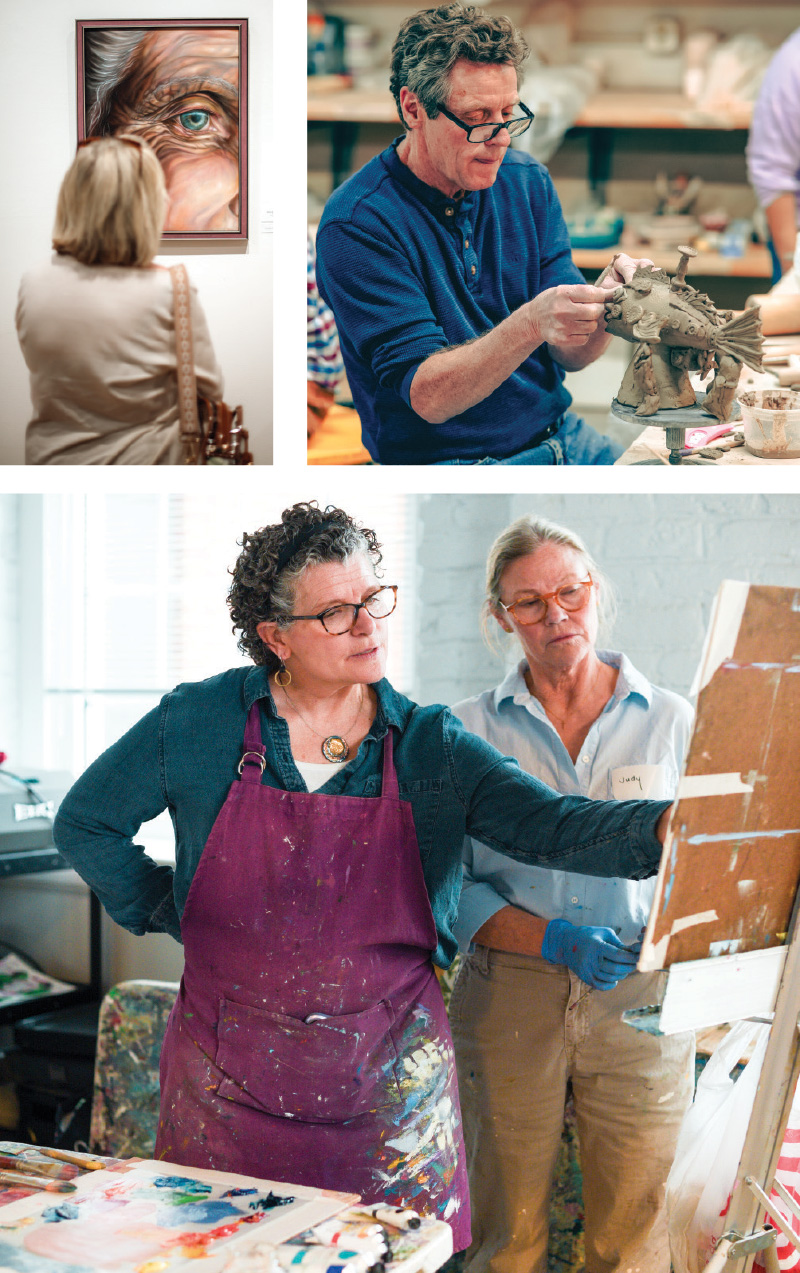
On any given day, whether the historic theatre is housing a live performance or not, artists and aspiring creatives move through the Academy’s doors. Some are learning pottery, painting, or drawing. Others are dropping off children for Academy Youth Theatre. Still others browse the rotating gallery beside the historic theatre. Beyond its downtown campus, the Academy is even extending its reach through Academy in Motion, a mobile arts initiative designed to bring creative opportunities to people who might otherwise never walk through its doors (meet the man behind the “Art Bus” on page 28).

But if you were to ask Pace, who is a lifelong jazz musician and arts leader, what it takes to sustain such a broad-reaching organization, the answer may be more pragmatic than poetic.

“All of the nonprofit arts sector exists under the tax code for education,” explained Pace, who approaches the arts with an economist’s appreciation. “I don’t see what we do as any different—it’s all about giving access to the community to experiences they wouldn’t otherwise attend.”

Ask Pace why access matters, and he will begin with budgets and strategic plans. But ask him about it again, and he will unequivocally tell you that it’s about the people.

Ask Pace why access matters, and he will begin with budgets and strategic plans. But ask him about it again, and he will unequivocally tell you that it’s about the people.

It’s an easy distinction to miss.

While audiences often associate the Academy with headline concerts and touring productions, Pace sees every facet of the organization—from performances to classes—as part of the same educational mission.

The goal isn’t simply entertainment, it’s creating opportunities for people to discover something they might not otherwise encounter.

Pace’s perspective is shaped by an unusual career path. Before leading nonprofit arts organizations, he earned a master’s degree in jazz performance from Manhattan School of Music and spent time working on Wall Street before eventually leaving New York, as he puts it, “to figure out how to make the world around [him] better.” Today, alongside leading the Academy, he teaches arts administration and nonprofit leadership at Virginia Tech—a combination that helps explain why he speaks about creativity and economics with equal fluency.

“The finance gig was really administrative,” he said. “I worked on the trade desk supporting traders and analysts. All of the work that I have done is ultimately administrative—you’re figuring out how to get the right information to the right people.”

When Pace left New York, he landed in arts education.

Ask Pace why access matters, and he will begin with budgets and strategic plans. But ask him about it again, and he will unequivocally tell you that it’s about the people.

“I had a really good band director in high school who gave me opportunities to play a lot of gigs early in life—I did my first gig when I was 15,” he recalled. “Secondly and equally important, the dad of a friend of mine was a jazz record and book collector. He found out that I liked music and started to gift me a treasure trove of records and CDs on the history of jazz and the important players. The inherent mentorship that happens when there are older people who care about things that are beautiful and want to make sure other people care about those things and that they stick around—it’s invaluable. Our job is to ensure people have that type of access to the arts.”

In his first few months in his role, Pace has approached the task of ensuring people have access to the arts with an artist’s precision and an analyst’s acumen. Rather than delving right into strategies that worked during his tenure at the Jefferson Center or relying on lessons taught in his arts leadership classes, Pace has paused—he’s assessed what is working today and what can be improved upon tomorrow.

“Right now, I’m getting responses to a board and staff survey and a survey is going out to the community to ask a pivotal question—what programs do you want?” he explained. “We want to be celebrated for serving the community and for reflecting their interests. And we want to be clear on the micro and macro realities of doing that—what the market tells us about supply and demand. For example, we may want to book an artist four times a year but the market may not support that four times a year.”

Pace says the Academy is planning a three-to-five-year strategic plan that will be flexible and adaptable.

“The organization is well-positioned in terms of asset structure and quality of its spaces to continue to increase and expand what we do well,” he said. “If I had to crystal ball anything, I would say the next few years will encompass improvement, expansion, and prioritization.”

Whether that growth comes through larger touring productions, expanded youth programming, additional visual arts offerings, or initiatives like Academy in Motion, Pace hopes the Academy will continue doing what it has done for generations: create opportunities for people to discover something that changes them.