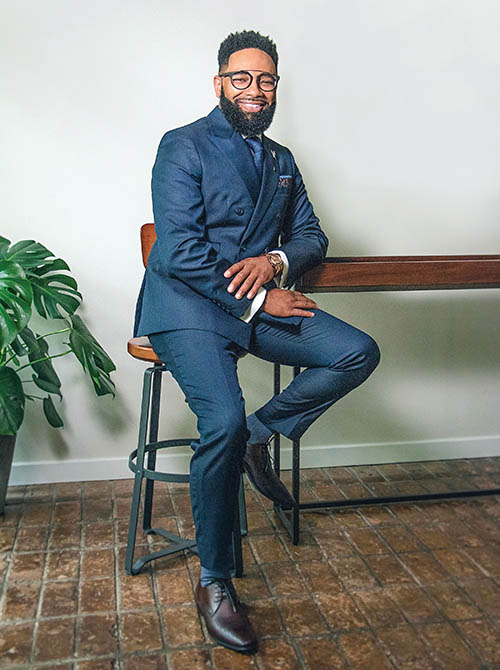
Artist Profile: Keith Thomas

The True Hill City Story of Keith Thomas From Church Showman to Media Success

By: Jeremy Angione  |  Photos Courtesy: Keith Thomas

The trajectory of success for Lynchburg local Keith Thomas is characterized by his willingness to learn, improvise, and teach. Before his various professional milestones, Thomas was profoundly shaped by the Lynchburg community and his upbringing in the church.

“You can’t be from Central Virginia and not be touched by religion in some way,” Thomas said. “I really appreciate how this community embraced a very youthful, naive, foolish Keith Thomas.”

At a young age, Thomas got his first taste of production thanks to Phil Spinner, a video producer for Lynchburg City Hall.

“He started a youth program way back then that taught knucklehead kids like me how to write, record, produce, shoot, and stage-manage productions,” Thomas said.

©Keith Thomas
Keith Thomas

From there, Thomas’ resume expanded exponentially. As an adult, he started working at a cable access station in Danville. Thomas then took a job at a NBC affiliate in Danville.

“That’s where things started to grow for me as a professional,” Thomas said.

Aside from television production, Thomas was and remains an avid musician. He attributes much of his passion and understanding of music to his early life in church.

“What I appreciated about the Black Gospel church experience was that it taught me how to hear,” Thomas said. 

The nuances of Gospel music afforded Thomas a universal understanding of the emotions that go into and that are conveyed by music. 

“It made me sensitive to the human condition,” he said. “It’s the same way I make my content today.”

Thomas’ music career started to blossom as he played gigs around Virginia, networking himself as a reliable “everyman” the whole way.

“I was starting to get connected with the ‘who’s-who’ of the music scene in Virginia,”
he recalled.

Although Thomas did not have a college degree at the time, he took marketing jobs at Radford University and Virginia Tech where he created their promotional material. Thomas says his work at those universities “raised his visibility.”

Despite his lack of technical know-how with certain tools on set, his wealth of experience in various media productions meant that he “understood the gear intuitively.” His various freelance jobs and willingness to fill any role on a set meant that Thomas was often at the top of the list for many producers looking for an experienced hand. An important opportunity presented itself when Thomas’ field producer fell sick while filming an episode of E! True Hollywood Stories about Missy Elliott.

On set filming HGTV's 
A Very Brady Renovation
On set filming HGTV’s A Very Brady Renovation

“If you don’t work as a crew, you don’t get paid. We wanted to get paid,” Thomas said.

He already had a connection with Missy Elliott’s mother which gave him the confidence to step up and produce the episode himself. The episode was so well produced that Thomas was offered a permanent field producing job.

In 2013, Thomas moved to Atlanta to produce several reality television shows including Say Yes to the Dress: Atlanta. Reality television gave Thomas a unique skill set in TV production.

“Couple that with my technical ability which most producers didn’t have, I sort of became a commodity. You could literally put me anywhere on a set and I could do it,” Thomas said.

After thoroughly establishing himself in the television industry, Thomas returned to Lynchburg two years ago. Needing a haircut, Thomas’ brother recommended a barber. Jordan Preston met Thomas, cut his hair, and the two discussed their careers and ambitions. 

Preston owned Music is Forever, a production studio on Jefferson Street in Downtown Lynchburg. Thomas came on board and helped to elevate the studio to grant artists more resources and a
wider appeal.

“We are a global organization, but we are locally minded,” Thomas said.

From his early church days, to his various production jobs, passion drives everything that Thomas produces.

“Whether it’s music, or whether it’s some visual thing that I create onscreen, my sole responsibility on this earth is to make you feel,” he said. “Feel what? It’s up to you.”


Artist Profile: Hanna Burnside

Legacy Keeper Artist Hannah Burnside Is Keeping a 700-Year-Old History Alive

PHOTOS BY ASHLEE GLEN

In August, tattoo artist Hannah Burnside woke up in Jerusalem. After long layovers, even longer flights, and hassles through airport security, she walked through the streets of the Christian Quarter and found herself in front of a solid metal door. On the door, no other markings were clear besides a phone number written in permanent marker.

“I called the number and this dude just rolled up in an old Harley,” Burnside, a Savannah native who has been living in Lynchburg since college, recounted. “His leather jacket had ‘Holy Land Bikers’’ on the back, which is a Christian biker club in Jerusalem.”

Stepping off of the bike was Wassim Razzouk, a 27th generation tattoo artist and the current owner of
Razzouk Tattoo.

PHOTOS BY ASHLEE GLEN

For the week following that phone call from the crowded streets of the Holy City, Burnside worked alongside the Razzouk family, learning their tattoo styles and, more importantly, the legacy that they represent.

“The Razzouk family immigrated from Egypt 700 years ago and followed a similar path to Jerusalem that folks take on pilgrimages to the Holy Land,” Burnside explained. “To commemorate their pilgrimage, people would get a tattoo of a particular saint or something that represented the pilgrimage. If they returned, say a year later, they would get the date tattooed underneath the original tattoo. So, some people would have dates stretching down their arm that marked their annual pilgrimages.”

Wooden carved stamps were used as stencils for the tattoos—stamps that are still used some 700 years later at Razzouk Tattoo.

PHOTOS BY ASHLEE GLEN

“There are some stamps at the shop that they believe are older than that,” Burnside said. “But they just can’t date them back that far.”

During her apprenticeship at Razzouk Tattoo, Burnside immersed herself into the culture and worked tirelessly alongside the Razzouk family as they helped people memorialize a significant journey.

“One day, we had a group of 20 or 30 Armenian pilgrims come by the shop and ask for cross tattoos to mark their journey,” she said. “It was really cool seeing all of these groups who have different takes on religion, but whether they were Christian, Jewish, or any other religion, Jerusalem marks the Holy Land for all of them. Knowing that they all didn’t believe the exact same thing, but still gathered for the same goal, was really beautiful.”

Despite the language barriers—folks travel from all over the world to get tattooed at Razzouk—Burnside noted that she still found such deep bonds with the people she was able to tattoo.

PHOTOS BY ASHLEE GLEN

“They have full trust in you even though you can’t understand each other,” she explained. “That’s a really powerful thing and a really amazing experience to have.”

That level of trust is something that Burnside has worked to cultivate since she began tattooing in 2020. A tattoo apprentice at Caspian Tattoo in Lynchburg, Burnside puts a big emphasis behind comfort and trust with the people she tattoos.

“I understand that a lot of people come into the shop with body image issues, or not loving a certain part of themselves and I just want our time together to be a time of complete ease and confidence,” she said.

PHOTOS BY ASHLEE GLEN

After returning home from her Razzouk Tattoo apprenticeship, Burnside is now an official Razzouk ambassador, which means she is in possession of some of the antique tattoo stamps and has expressed approval to tattoo those designs in Lynchburg. As one of only nine current ambassadors—all of whom are situated around the globe—this is an incredible privilege and honor.

“I even had the opportunity to design my own stamp before I left,” Burnside explained. “So now my stamp sits in the shop at Razzouk and they will tattoo my stamp for folks all over the world. And I can tattoo it here in Lynchburg, as well.”

Burnside shared a Ram Dass quote that she felt was particularly poignant in commemorating her journey to Jerusalem—her own pilgrimage in a way. “The quote is, ‘We are all walking each other home.’ I can’t think of a better way to describe what this experience has been like, or what these tattoos mean, than that.”


Artist Profile: Meg Davies Jan/Feb 2022

Visual Artist

Editor Shelley Basinger: Meg, have you always called Central Virginia home?
Meg Davies: I was born and raised in Lynchburg. I studied art at James Madison University and then lived back and forth between Hawaii and Uganda for several years before coming back home.

SB: When did you first become interested in art?
MD: Since childhood. I would fall asleep with crayons and markers in my bed and ask my mom “Can I draw now?” the minute I woke up. That passion for art has only gotten stronger each year and to be a professional artist is definitely living out my dream.

SB: What types of training have you received?
MD: I did receive formal training through the art program at James Madison University. But my grandmother, Pat Dougherty, is an artist and she always had room for me in her studio when I was growing up. She gave me a wonderful foundation early on and JMU helped me find direction.

SB: What inspires your art?
MD: It’s a broad answer, but life! Life is so full of places to find inspiration. I have a series of bug art, which all started by collecting cicada shells with my son.

SB: What are some of your favorite pieces you have created so far?
MD: My sketchbooks are by far my favorite works of art. However, being fairly private,
I rarely let people see them. As far as what’s out in the world, I’m most proud of work that opens people up to sharing their stories with me. The bug series did that. I quickly learned that countless people have a connection to bugs whether through nicknames, memories, or funny experiences.

SB: What types of challenges have you faced as an artist?
MD: Learning to be flexible enough to embrace change can be a challenge for me in life as well as art. When I find myself in a creative rut, it is usually because I need to change my technique for a while, the structure of my schedule, or how I let the outside world impact my art. Making changes, large or small, can open the floodgates of creativity.

SB: What are you currently working on?
MD: I am completing commissions and mapping out what I want 2022 to look like. It’ll start with another series of botanical work, which is represented with Liza Pruitt, an art representative in Richmond, and a fresh set of landscapes for Findings Art Store in the Boonsboro Shopping Center.

SB: What’s next for you?
MD: Experimenting with new techniques is something that excites me. I’ve worked the same style for years—which is great—but I’m eager to see how I can continue to grow through controlling less, playing more, and pushing my style in new directions.

SB: What advice do you have for future artists?
MD: Some of the best advice ever given to me was to simply draw, draw, draw. It is so relaxing and also provides endless inspiration for future work. Something I’ve also learned over time is to separate yourself from your artwork. Creatives put themselves out there on a continual basis, which of course comes with judgment and sometimes rejection. As much as our art is a part of us, it is freeing to realize that our worth isn’t wrapped up in the external validation. Lastly, meet with other artists on a regular basis to support each other. It’ll be good for your soul and for the art community as a whole.


STAY IN TOUCH
Follow Meg on Instagram, @meg_davies_design or visit her website, www.megdaviesdesign.com.


Artist Profile: Andrew Riscart July/August 2021

Intuitive Color Artist

Lynchburg Living Editor Shelley Basinger:
Andrew, the first thing we notice about your artwork is the use of color. Why do you enjoy using lots of bright hues?
Andrew Riscart: Because it’s so powerful. It leaves so much up for interpretation. It allows the viewer to take ownership from their own personal perspective.

SB: That’s why you describe yourself as an “intuitive” color artist.
AR: Right, I like to blend the real and recognizable with the abstract. I approach this by replicating recognizable characters and then manipulating color theory to interact with the viewer. I find this often requires some kind of response, but still leaves a lot up to interpretation. In short, I play with color theory while letting value do all of the work.

SB: When did you first become interested in art?
AR: When I was about five years old. I got mad that my neighbor’s cousin could draw so much better than me. I guess you could say I became determined. That’s when I really started to practice.

SB: What types of training have you received?
AR: My mother signed me up for a drawing class when I was 10. I later took a painting class at Central Virginia Community College with Kenny Weinfurtner. He showed me how to build a foundation. Over the past year, I’ve been picking things up along the way. Mostly through the internet; I study creatives that inspire me in various mediums like painting, music, poetry, and film.

SB: You’ve recently decided to make art a full-time career. How did that transition happen?
AR: It’s funny—I took a class under a very successful businessman. He kept on repeating the phrase: “What’s in your hand?” That’s where you start. If you want to be successful in business, start with what you have available to you right now. Another phrase he would say a lot is, “Your gift will make a way for you.” When I moved back to Virginia, I kept thinking back on this. The only thing I kept coming back to was painting. So, I started painting. I will ride this wave until it crashes, and then I’ll catch another one.

SB: The doors have certainly been opening for you! We are seeing a lot of your work around town.
AR: I have pieces hanging on Main Street in Dish, Starr Hill Brewery and the White Hart. I also have one inside Riverview Records, a new shop on Jefferson Street. I have some murals at the new Main Street Bar and Grill, and I’m also working on a piece for Crisp’s new beer garden. It’s expected to be open at the end of July.

SB: We heard about you from an Instagram post by Star Hill. How has social media influenced your artwork?
AR: Social media has opened a new avenue for artists, like myself, to create an audience. One we otherwise would not have been able to. It can be a powerful tool in this regard and in many others. However, social media can also be very dangerous. Unfortunately, it has become a substitute for one-on-one human connection. I’m beginning to see this can leave an emptiness in people. I believe fine art can bridge this gap between a sea of choices and what is actually physically tangible right in front of us. I continue to paint for this reason. I personally live for the one-on-one interaction painting affords me. I think this past year really put things into perspective for a lot of us. The greatest impacts are made one human interaction at a time. If we can love the person right in front of us and then they in turn love the person right in front of them, it creates a ripple effect.

SB: You’ve been getting a lot of requests for commissions. How is that going?
AR: I love doing commissions. They have been my bread and butter, if you will. However, I’m becoming more selective on what I choose. Mostly because I also need the commissions I do to fit a common vision with the style I’m evolving into.

SB: What’s next for you? Any future goals?
AR: I just want to be a part of the bigger picture.


Follow along
You can find Andrew on Instagram: @riscart


Artist Profile: Heather Sollers Baker May/June 2021

Lynchburg Living Editor Shelley Basinger: Heather, your cookies and other baked goods are certainly eye-catching! When did you first develop a passion for baking?

Heather Sollers: As a child, I used to love making recipes from my mom’s cookbooks and surprising my family. I started off with small snacks, then meals, and, eventually, baked goods. I also remember making chocolate chip cookies every year with my family at Christmastime and everyone sharing cookies they had made after Christmas Eve dinner. This is a tradition I continue with my own family. I have five kids ranging from ages 6 to 20, three girls and two boys.

SB: At what point did your baking turn into more of an artform?
HS: I first tried my hand at making more complicated, artistic cakes for my daughters’ joint birthday party back in 2005. I made a princess castle cake for my then four-year-old and a 3D baby sitting on a cloud for my then one-year-old. After my son was born in 2011, I made my first decorated sugar cookies—a flower cookie pop bouquet for the nurses.

SB: When did you officially start up your business, Creative Confections by Heather?
HS: I actually had a completely different job when we lived in New Jersey. I went to mortuary school and became a funeral director and only baked cakes and cookies on the side. In March of 2014, my husband was transferred and we moved to Lynchburg. Later that same month, I had my daughter and made cookies to thank the wonderful nurses at the Birth Center. A year later, I did the same when I had my son. The nurses quickly spread the word about my cookies and that’s when my business really started. In 2016, I created my LLC, got my business license, and became a state-inspected manufacturer.

heather sollers baker

SB: What types of techniques do you use?
HS: For the most part, I’m self-taught. While there are a number of ways to ice and decorate a cookie,
I use royal icing because it is easy to work with, dries hard, and is extremely versatile. With it, I am able to decorate with the wet-on-wet technique to create various designs, and when the icing is dry, I can layer it, airbrush it, do brush embroidery, hand paint, and use edible markers to add small details. I am always experimenting and learning new techniques.

SB: Do you have any favorites you’ve created?
HS: One of my favorites was a three-tier, ’80s-themed cake that I made for an E.C. Glass reunion a few years ago. I love everything ’80s!
My most memorable cookies would be the “Riverdale” cookies from 2017. They were my first to go viral, shared by Archie Comics and Seventeen Magazine, among others. That was pretty exciting!

SB: Likewise, what are some of the most unique requests you have received?
HS: Every year, usually for Halloween or Christmas, my husband’s cousin comes up with some crazy idea that she wants me to turn into a cookie. We’ve done everything from zombie snowmen to creepy dolls and scary nuns. But, I love the challenge!

SB: You’ve been baking for the Craddock Terry Hotel since 2016. How is that going?
HS: I started off making the red shoe cookies then quickly added many other items. Currently, I make all of the enhancements, custom orders, and the food items in their gift shop. I also bake custom items and treats for Shoemakers and Waterstone, and for the City of Newport News.

SB: What do you love the most about what you do?
HS: I love that I have a unique outlet for my creativity that also contributes to the memories of someone’s special day or event. I love the excitement my customers have when they are ordering and then when they see their cookies for the first time. I also feel very blessed to be a volunteer Sugar Angel for Icing Smiles. Through Icing Smiles, I am able to share my gift by providing dream cakes, celebration cakes, and cookies for families who are impacted by the critical illness of a child. Seeing the excited, appreciative smiles when a child receives their cake or cookies is something that I will always remember.


Artist Profile: Beatriz Gutierrez Mar/Apr 2021

Wood-Fired Pottery

Lynchburg Living Editor Shelley Basinger: Beatriz, you aren’t originally from the area—or even the country! Tell us a little bit about yourself.
Beatriz Gutierrez: I grew up on the island of Tenerife, Spain. My journey with clay began in Scotland at the age of 28 and continued when I moved to America to study at the Penland School of Craft in North Carolina in 2010.

SB: What other types of training have you received to improve your skill?
BG: I am grateful for the mentorship I have received from other potters since the beginning. Most recently, I have been studying wood firing with
Kevin Crowe at Tye River Pottery in Amherst County. We stopped last March when the COVID-19 pandemic began. He has a big kiln that requires 12 people and seven days to be fired. All the work is loaded into the kiln, but we are still waiting for when we can gather safely to fire.

SB: I’m sure you are looking forward to that day! Meanwhile, you spend a lot of time at your own studio in the Coleman Falls area of Bedford County.
BG: We have been building my studio for most of the past decade, using reclaimed materials collected over the years, including all of the bricks used in the construction of my kiln. That is one of the reasons why everything has happened very slowly. I have broadened my skills by being involved in every step of the process. I have worked mostly with my husband, Paul, with the occasional help of friends and neighbors.

wood fired pottery

SB: What is a typical day like for you at your studio?
BG: Depending on the weather and the time of the making cycle, I start my days with wood preparations: splitting and stacking. In addition to wood from my property, I purchase locally harvested wood from a logger down the road. The wood needs to be dried enough for the success of the firing—that is why it is stacked is so carefully. Inside the studio, you will find me clay mixing, reclaiming clay, mixing, maintaining my glazes and throwing. I mainly use a kick wheel to make my work and I harvest local clay to make my pieces.

SB: What types of challenges have you faced?
BG: Transitioning from mid-range temperature electric firing (how I used to make my pottery) to wood firing has been a difficult challenge. Over the past year, I have not had a lot of work available to sell because I am still working out the details of the kiln.
It could take me one to three months to produce enough work to fire my kiln and with the preheat,
it takes three days to fire.

SB: What are some of your favorite pieces you
have created so far?
BG: I love all of the shapes I am making. Tea pots are so much fun! Making the jars with the right curve is always a good challenge. Then, the lids
and the spouts and the handle. I love putting all of the parts together in a way that pleases my eye. When they end up working beautifully, it’s a great feeling of satisfaction.

SB: That transitions perfectly to my next question. What do you love so much about working with clay?
BG: Clay has memory—it records the process of making, shows the quality of the thoughts I had when working. When the clay is exposed to the flames of the fire in the kiln and vitrifies, all the conscious and unconscious choices in the making process are revealed. This is always a bit shocking. The power of pots relies on how ordinary and mundane they are. Objects we use every day on our tables.

SB: What’s next for you? What do you have planned in the coming year or in the future?
BG: There are so many pots I want to make this coming year: casserole dishes, planters, baking dishes. Each new form is an adventure.


Artist Profile: Jennifer Lipford Petticolas Jan/Feb 2021

Playwright and Performer

• JLP Productions, owner
• DC Black Theatre Festival, committee member

Lynchburg Living Editor Shelley Basinger: Jennifer, you have a very long history in the area’s theater community—particularly writing your own original plays. When did you first develop a love for the stage?
Jennifer Petticolas: I worked behind the scenes doing set design and building sets while attending Livingstone College
in Salisbury, North Carolina. When I declared my English major, my dean said, “Are you sure you don’t want to do theater?”

He saw something in me then that I didn’t see. But I chose English because I have always enjoyed writing and especially creative writing. That love started at Dunbar High School in Lynchburg, with Mrs. Jordan and Mr. Watson.

SB: Where did life take you with that English degree?
JP: After finishing college, I got a teaching job at a junior high school in Baltimore.

I had been teaching three or four years when the faculty wanted to do a play about the history of our country and incorporate some dance into it, so I volunteered to write it. That was the first play that I wrote, and it really piqued my interest.

SB: When did you return to Lynchburg? And did you get involved in theater right away?
JP: I came back to Lynchburg in 1976. I remember my oldest daughter was trying out to be in Annie and told me, “Mom, I want to be Annie.” I told her I didn’t know if they would cast her in that role, and she ended up being casted as one of the orphans. She said, “Well, if I can’t be Annie, I’m going to be the best dancing orphan up there.” I thought if she can do it, I can do it too! Later on, I was cast in For Colored Girls and started getting involved with the Fine Arts Center (now Academy Center of the Arts).

SB: Since then, you’ve written numerous plays that have gotten acclaim both locally and beyond. What are some of your favorites?
JP: One piece that I was most proud of focused on suicide awareness. A friend, Kim Kittrell, came to me and told me about how her daughter, a former E.C. Glass student, had committed suicide at college. She wanted to get the message out that there is help for people who are struggling with depression. I did an interview with Kim, which was a very difficult process. She talked about her daughter being a dancer and how her daughter always felt like every woman should have a little black dress. I titled the play that, Little Black Dress, to symbolize a sophisticated woman and also, depression. I also got help from the medical community to make sure we were giving out the right message. This play has been performed in Virginia, Maryland and D.C. The Campbell County Branch of the NAACP presented us with an award for the play.

Another favorite is Sunday’s Child, a play I wrote for Johnson Medical Center about the life of Dr. Robert Walter Johnson.

I did a lot of research for that one, including interviewing about 30 or 40 people on the telephone and visiting his grandson’s house in Maryland.

SB: You also have focused on black history through the years. Most recently, “People Died: The Struggle for African American Voting Rights” was shown at the Lynchburg Museum.
JP: That was a little different than a play, six short monologues highlighting six real-life individuals who died fighting for African American voting rights in the ’60s. After we did that Lynchburg City Council Member Sterling Wilder came to me and said, “That lit a fire under me.” It just feels good to know that you are making a difference, causing people to think differently. That has been my whole purpose.

SB: Could we see anything new from you in the coming year?
JP: Suga is a play I started working on a few years ago. It’s about a husband and wife—the husband has diabetes and high blood pressure—and how his health affects their sex life. I’ve thought about taking that off the shelf. When George Floyd was killed, I started working on a piece about Floyd and Emmett Till.

It feels like I’m always working on something!

SB: Finally, what advice do you have for aspiring playwrights?
JP: Just keep pushing. You have a story in you, I think we all have stories in us. Write those stories. If you need help, reach out.


Get in Touch:
Email Jennifer at jlp7139@yahoo.com
or send her a message on Facebook.