From Pierce Street to Point of Honor
A Theater Rooted in Place
By: Charlotte Farley / Photos Courtesy: Enstation Theatre Company
By the time I finally clicked on Endstation Theatre Company’s website, I felt that particular brand of guilt reserved for English majors like myself. After all, I’ve lived in this area for over twenty years. I’ve taught literature, worked with local arts agencies, and waxed poetic about “place.” And yet somehow I had missed that Lynchburg has had its own professional theater company for nearly two decades.
Sitting across from Producing Artistic Director Patrick Earl, though, my guilt turned into curiosity. Endstation isn’t trying to compete with touring blockbusters or turn out jukebox musicals. Instead, it’s doing something more rooted in this region and the people who call it home.
A Lynchburg Original
Endstation was incorporated in 2006, starting life as a small company at Sweet Briar College mounting original works, intimate Shakespeare, and adapted classics. From the beginning, its focus was to “advance the cultural history and landscape of this region,” language Earl calls “very poetic and awesome,” but also quite practical.
Underneath the lofty phrasing is a simple guiding principle he repeats to his company: serve the audience you actually have. For Endstation, that means the neighborhoods, histories, and unresolved stories of the greater Lynchburg area. “We are telling a people’s story,” he says, and he means “people” in the most local sense: the families who’ve walked Pierce Street for generations, the students bused in from area high schools, the patrons who might not see themselves on stage anywhere else.
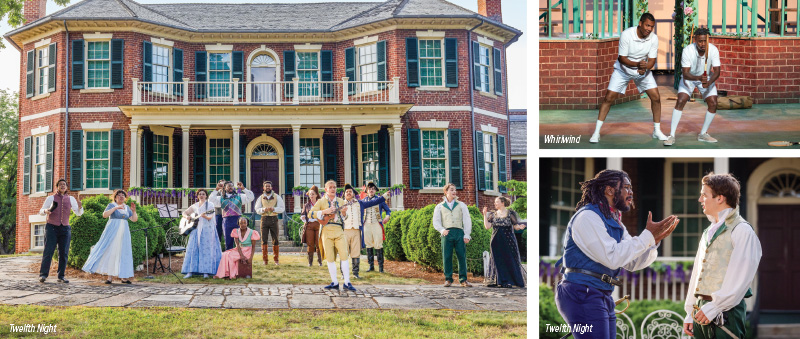
Over the years, the company has produced more than a dozen original plays, many commissioned or developed through its playwright pipeline. Whirlwind, for instance, explored the life of Dr. Robert Walter “Whirlwind” Johnson, the first Black physician permitted to practice at Lynchburg General Hospital and a tennis coach who mentored Arthur Ashe and Althea Gibson on a court in his side yard on Pierce Street.
That attention to place isn’t metaphorical: Endstation has staged performances inside historic homes, at Point of Honor, and even in the basin of a long-closed public pool while tracing the buried history of segregated swimming in Riverside Park. There’s something sacred about telling a story in the very space where it unfolded, as if proximity itself deepens the act of remembering.
Twenty Years of Evolution
Of course, no arts organization moves through twenty years unchanged. After its early seasons at Sweet Briar, Endstation experimented with larger productions and more commercially recognizable shows, the sort many regional companies rely on to stay solvent.
On July 1, 2024, Endstation officially came under the umbrella of Randolph College while retaining its own distinct nonprofit identity. As the college’s professional theater, it enjoys a stable home base, a campus full of students, and local connections.

Fringe, Fields, and Memories
The Central Virginia Fringe Festival—launched just last year—is another extension of that impulse. “We have so many talented folks, so many talented companies,” Earl says. “We need something to celebrate that. So we said, ‘You know what, let’s start a Fringe Festival.’”
The premise is simple but generous: Endstation provides a venue and modest tech support, and invites theater companies, community groups, and individual performers to show what they’ve been making. In its inaugural year, 14 companies (including Endstation) presented nearly 20 performances over the course of the week, spread across spaces at Randolph like Smith Hall Theater and another campus performance hall.
This summer’s festival will again run Saturday to Saturday in mid-June, opening with a concert and “Fringe Feast” and closing with the world premiere of Earl’s new play, Good Birth, alongside the launch of the summer Shakespeare production.
Beginning in fall 2026, Endstation will also take over the Old City Cemetery’s candlelit tour, partnering with staff to create a theatrical experience that weaves history, performance, and memory in one of Lynchburg’s most significant landmarks. If theater at its best is an act of collective remembering, there may be few settings more suited to that than a location where names are literally carved into stone.
Shakespeare on the Hill, Free for All
If you’ve never made it to Shakespeare at the Point, you’re not alone. But the series, now heading into its third summer, may be the clearest expression of Endstation’s commitment to accessibility.
What began as a small-scale experiment at Point of Honor has grown into a cornerstone of the season. Tickets for Endstation productions top out at $35 for special events (galas excluded), with many offerings around $15 (and less for students).Through the “Serving the Audience Initiative,” Endstation has made a portion of its outdoor Shakespeare performances free to the public in recent years, with a long-term goal of making the entire run free.
“We are working to make professional theater accessible to everyone,” Earl says. That includes scholarships for their Embark Youth Theatre Conservatory, where at least 15 of 40–50 spots each year are full or partial tuition scholarships, and Theater Day at Randolph, when high school students come to campus for workshops in technical theater, stage combat, and Shakespeare.
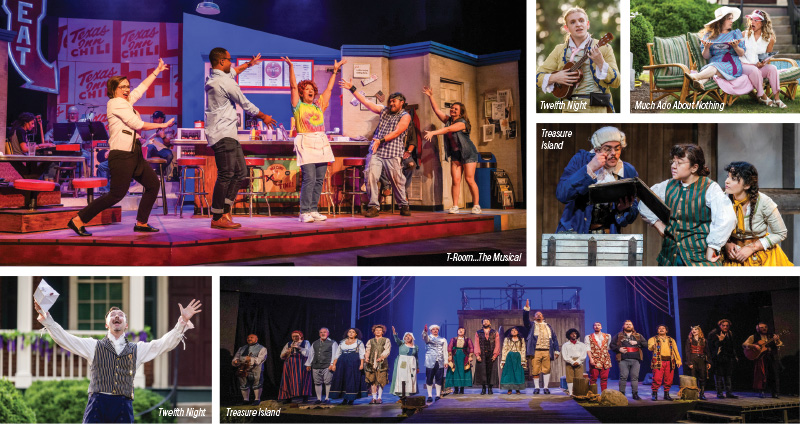
This summer’s production, The Merry Wives of Lynchburg, adapts The Merry Wives of Windsor, keeping the language largely intact while setting it here at home. It’s a playful nod to place that still takes the text seriously, much like the company itself.
What’s Next
“If I could choose, I’d want our legacy to be that we created essentially a staged history of our community, a dramatic, historical canon for the area,” he adds. “After being around 20 years and doing 14 original shows—that’s a lot for any theater company—and that doesn’t even account for the dozens of original plays from our Playwrights Initiative.
For Earl, the heart of Endstation’s work is empathy. “Theater is uniquely suited to helping audiences experience how someone else sees the world. That is, in its essence, what theater really is,” he says.
“I want Endstation to be the end station for theater. Every community deserves somewhere they can go and hear their story, and hear their story done well, and see live performance at the best possible level without having to drive to New York or to their nearest large city—at a high level, at a professional level, and a dependable level.”
As Endstation enters its third decade, it faces the same challenge every arts organization does: persuading people to show up in person. Earl is realistic about the competition. “Every platform, screen, and phone is rival for attention, but it’s something more than that,” he says. “People go into their phones trying to find happiness and humanity. But you know where it is: humanity is going to watch humans.”
That humanity lives here: on a hillside at Point of Honor as the sun goes down, in a darkened hall at Randolph, inside a reclaimed pool basin at Riverside Park.
It’s in the moment when a familiar street name, a long‑ignored plaque, or an old family story suddenly stands up, steps into the light, and, for a moment, seems to be speaking directly to you.