The Front Porch Effect
Why Outdoor Living Still Matters
There’s a particular kind of quiet that happens on a porch in the early morning. The house is awake enough to hum—coffee brewing, a door creaking open—but the day hasn’t fully arrived yet. You sit for a minute longer than you planned. You breathe. You watch light move across the yard. Nothing is urgent, and that’s the point.
Long before outdoor living became a category of furniture or a Pinterest board, porches, patios, and backyards were simply where life spilled out.
They were places to pause and places to gather, rooms without walls that asked very little of us beyond presence. In a world increasingly defined by speed
and screens, these spaces still matter—not because they’re trendy, but because they quietly hold together the rhythms of daily life.
A Room That Belongs to Everyone
The front porch, especially, has always been a kind of social contract. It’s private, but not too private. Public-facing, but gentle. A place where neighbors wave, conversations begin without ceremony, and time stretches just enough to allow connection.
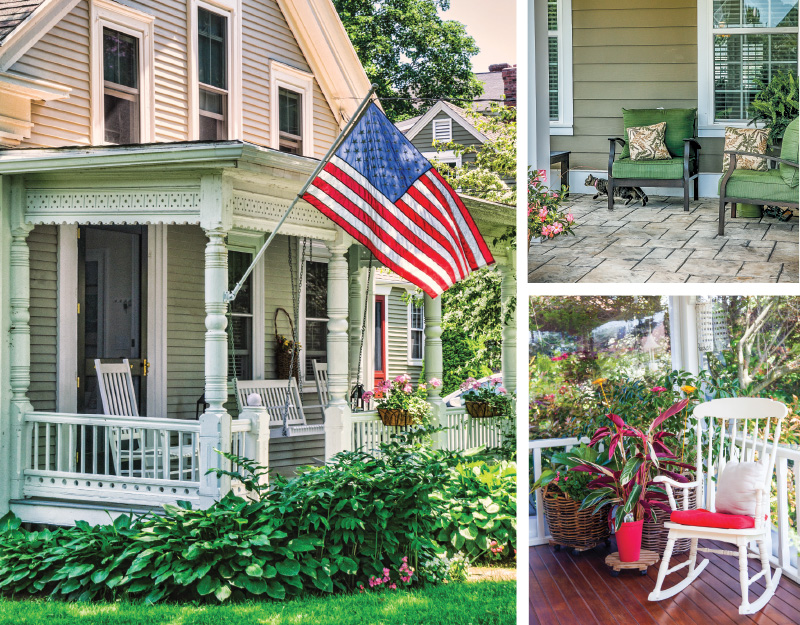
Historically, porches were designed for exactly this purpose. They cooled homes before air conditioning, yes—but they also cooled people. Rocking chairs encouraged lingering. Railings framed views of the street. Steps became seats for kids waiting on friends or adults swapping stories at dusk. Even now, a porch light left on in the evening still sends a quiet signal: you’re welcome here.
Patios and backyards carry that same spirit, just turned inward. Where the porch invites the neighborhood, the backyard gathers the household.
It’s where kids invent entire worlds with sticks and chalk, where dogs find their favorite patch of sun, where dinners stretch later than expected because the air feels kind.

The Rituals That Root Us
Outdoor living spaces endure because they become containers for ritual. Not the grand, ceremonial kind—but the everyday ones that anchor us.
Morning coffee tastes different outside. It’s slower, less transactional. You notice birdsong, the weather, the way your body wakes up when it’s not immediately pulled toward a screen. In the evening, a porch or patio becomes a soft landing place—a transition between the busyness of the day and the quiet of night. Conversations meander. Kids play until the light fades. You sit without agenda.
These rituals matter because they repeat. They mark time. They give shape to days that might otherwise blur together. In seasons of change—new jobs, new babies, new phases of life—these small, consistent moments offer a sense of continuity.
Rest That Isn’t Performative
So much of modern rest has become curated: wellness routines, productivity breaks, optimized self-care. Outdoor spaces offer something simpler. They allow rest without instruction.
You don’t have to do anything on a porch. You can scroll, sure—but you’re just as likely to put the phone down.
You can read half a page and stare off into the distance. You can sit with someone and talk about nothing in particular. This kind of rest isn’t about improvement; it’s about allowance.
There’s also something grounding about being partially exposed to the elements—feeling the breeze, adjusting to temperature, watching clouds roll in.
It reminds us that we’re part of something larger than our schedules and to-do lists. That awareness, subtle as it is, can be deeply calming.
Spaces That Grow With a Family
Outdoor living spaces evolve alongside the people who use them. A porch that once hosted late-night conversations might later hold a swing for a sleeping baby. A backyard that started as a blank slate becomes a patchwork of memories: the tree that held a tire swing, the corner where a garden finally took, the patio where birthdays were celebrated year after year.
For children especially, these spaces are formative. Outdoor play encourages creativity, independence, and a sense of belonging to a place. It’s where scraped knees happen—and where resilience quietly takes root. Long after toys are outgrown, the feeling of those spaces often remains.
Why It Still Matters
At its core, the front porch effect isn’t about architecture or square footage. It’s about permission. Permission to slow down. To be seen without being on display. To connect without scheduling. To rest without justification.
As communities grow more dispersed and lives become more digitally mediated, these spaces offer something increasingly rare: unstructured togetherness. They don’t demand productivity or performance. They simply hold space—for conversation, for quiet, for the ordinary moments that, over time, add up to a life.
You don’t need a sprawling wraparound porch or a magazine-worthy patio to experience it. A small stoop, a folding chair, a string of lights—sometimes that’s enough. What matters most is the intention to step outside, to linger, to let life happen just beyond the threshold of your door.
Because sometimes, the most meaningful moments aren’t planned at all. They’re the ones that happen when you sit down for a minute—and decide to stay.