A Home That Doesn’t Perform

In her 1924 Colonial Revival, Mia Mangold has created a space shaped by history, humor, and intention

By: Megan Williams | Photos By: Andria Fontenot

Life changes exponentially when you stop performing and stop caring who’s watching,” Mia Mangold said, standing in the dining room of her 1924 Colonial Revival home—a space layered with collected furniture, hand-upholstered pillows, and just enough evidence of daily life to make it clear no one here is trying to impress anyone.

Mangold laughed, almost as if to soften the weight of the statement. “It took me a long time to actually mean that,” she added.

It’s not a catchphrase she uses lightly. It’s an earned mantra—one shaped over decades of movement, reinvention, and saying yes to experiences that most people only daydream about, then learning when to stop performing altogether.

Mangold bought her Lynchburg home in 2019 after renovating a string of historic houses across the Hill City. The story of those homes—and the life she built around them—is literally displayed on the walls.
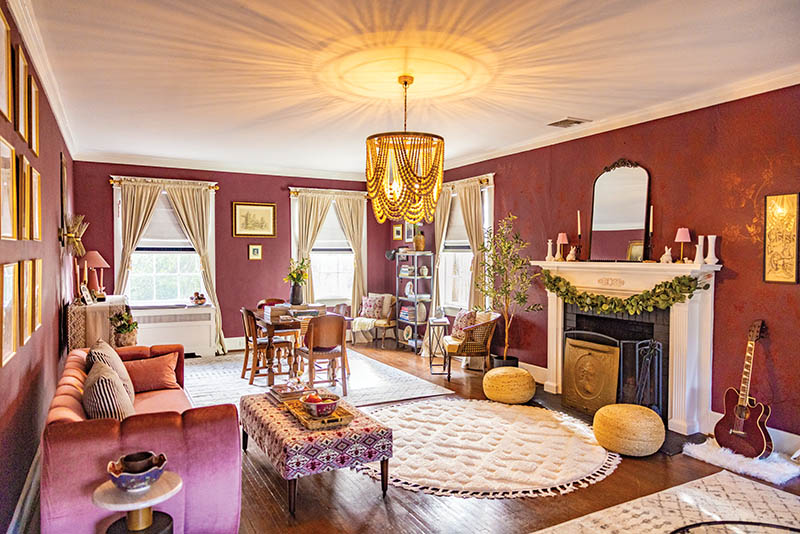
Decorative plates from Oxide Pottery line her living room built-ins, each illustrating a house she has owned, loved, and renovated in Lynchburg. She gestures toward them as if they’re old friends rather than milestones (though, to the outsider looking in, they are both).

“I’ve owned seven houses in Lynchburg, plus one in St. Pete [Florida], one in Austin [Texas], and one in New Jersey—so 10 total,” she said. “My first house in New Jersey was built around 1865, and it’s where Walt Whitman used to stay in the summer. There was a natural spring—I picture him sitting down there writing poetry.

It sounds cheesy, but as a kid I was an old soul, weird kid. New Jersey has so many old Victorians.”

To hear her describe her journey—from “old soul, weird kid” who grew up on the New Jersey–Philadelphia line to home renovator in Lynchburg—is to realize that Mangold’s life has never followed a straight line.

It’s shaped by an innate curiosity, a desire to see the world, and a penchant for never saying no to a good time.
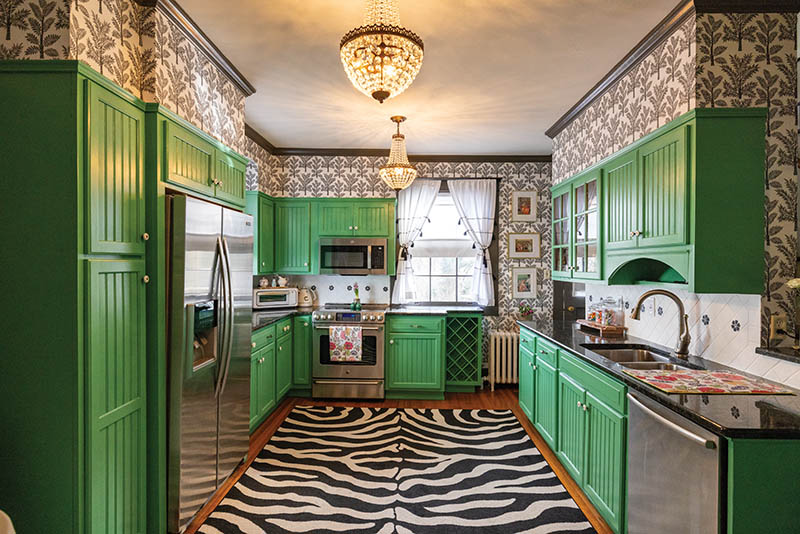
“I basically grew up in Philadelphia,” she said. “I lived 15 minutes away in New Jersey, near the Ben Franklin Bridge. Then I left for a while—lived in a car with my friends and went cross-country, ended up in San Francisco. I came back when I was 21 because my grandma got really sick. We thought she was going to pass, but she lived four more years and couldn’t be alone. I spent days with her; my mom slept there at night. I worked while getting my photography degree—I was a photo lab tech—and I worked at the Camden County Library in periodicals. I even worked at Staples, which was fun.”

By 24, Mangold had saved up enough money to buy her first home. It was then, staring down the beams of a 19th century Victorian, that her gumption grew even more.

“I didn’t have YouTube tutorials. I had old home and garden handyman books that taught me how to change a faucet or fix something,” she remembered, nodding to the corner bookshelf where her handyman books still reside. “My uncle worked at a lumber yard—he helped me with trim and molding.”

At the same time that she was teaching herself how to renovate her New Jersey home, she was also working at the historic Trocadero Theatre in Philadelphia’s Chinatown, where she worked until she turned 30. While she loved working as a concert promotor and then later a booking agent, the early load-ins and late-night shows eventually became too much. The housing market in New Jersey was booming and Mangold took a chance and sold her house.

“The housing market got high—when balloon loans were everywhere and rates were low—and I sold my house for three times what I paid,” she said. “Then I flew to Spain and didn’t come back for two years. I lived in Turkey, spent a lot of time in Greece, went to Australia, Asia… India for a while because it was affordable and I could stay longer. I was saving money because I knew I’d have to come back eventually and I wanted to buy another house.”

And she did.

After flying to Austin, Texas, for a wedding, Mangold planted roots once again—working at the legendary Red 7 venue, popular for hosting rock, punk, and metal shows. She also purchased a condo, which she sold a few years later for enough money to buy her first 5,000-square-foot home in Rivermont—with enough money left over for renovations.

“I saw a house online—I think it was on Madison—and I was like, ‘Where is this place?’ I thought: Is this magical fairyland? I could buy two old houses for what I could sell my one house for. So I made a list of 10 houses, found a local realtor, and she showed me all of them. I chose the Rivermont house—the big white house—it had an apartment in the back and had been a rooming house. It was fun to renovate. I was still tiptoeing into color because I was accommodating guests. I rented downstairs as an Airbnb. I didn’t want an all-white Airbnb with the same horse picture everyone has. I wanted it to feel interesting—bright, funky—something you don’t live in every day.”
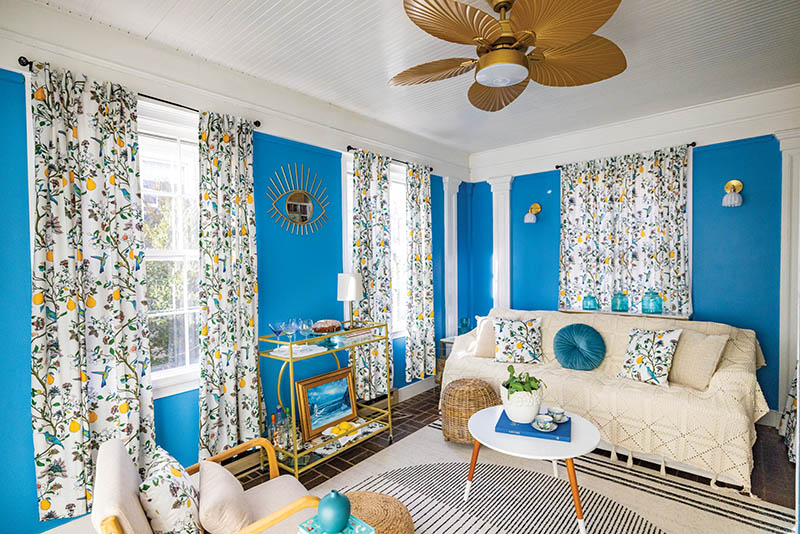
From there flowed a series of home purchases and renovations—some of which she held onto for a time as short-term rentals, and others she lived in or sold. All the while, Mangold was rolling up her sleeves, doing the work herself, and evolving her style even further.

“On Arlington [Street], I was taking out a vanity and the plumbing was corroded—it broke off and sprayed everywhere. I’m soaked, running into the basement, crawl space… water pouring everywhere—hardwood floors exposed,” she remembered, noting that the journey has been far from picture perfect, and that’s exactly how she’d prefer it. “Or when I moved here [to this house] the plumbing started leaking so I had to go in and fix it, patch the wall, put up a new ceiling… a week later, water’s dripping out of the vent. That stuff happens.”

Mangold doesn’t shy away from the uncomfortable. Rather, those messy moments are what make her story all the more interesting and all the more relatable. A small woman in stature, her lived experiences have made her a force of will and determination.
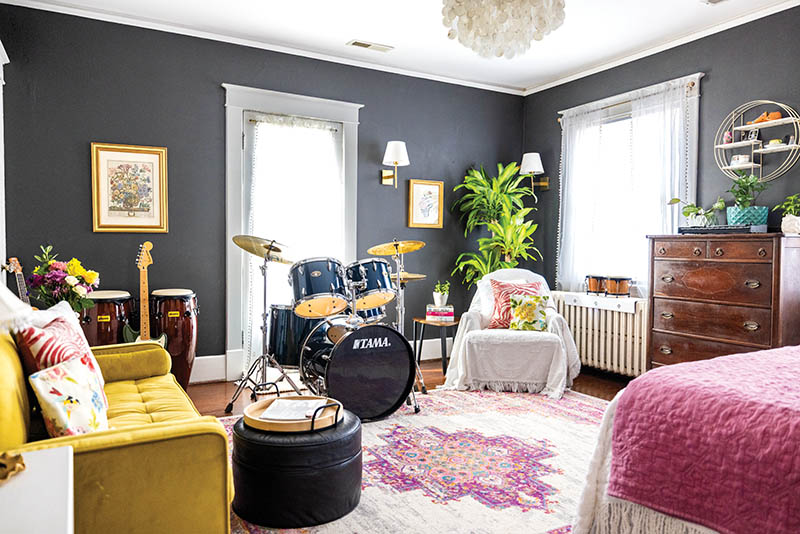
And it’s an interesting juxtaposition—the know-how to fix plumbing and patch the wall alongside of the person who can effortlessly style a room all while wearing vintage Doc Martens that have been meticulously preserved since the ‘80s.

Mangold’s life has never followed a straight line, and she has no interest in pretending it should have. The houses, the travel, the work—even the setbacks—have all been part of the same ongoing experiment: figuring out what feels honest, useful, and worth keeping.

In her Lynchburg home, there’s no performance—only layers of intention, curiosity, and care. It’s a place where old windows are left intact, mistakes are patched and repatched, and nothing is precious unless it’s personal.

For Mangold, that’s the point. Not perfection, not polish, just a life and a home that reflects exactly who she is, right now.


Bringing New Life into a Historic Home

Couple continues their 110-year old Tudor’s story—with a modern eclectic twist

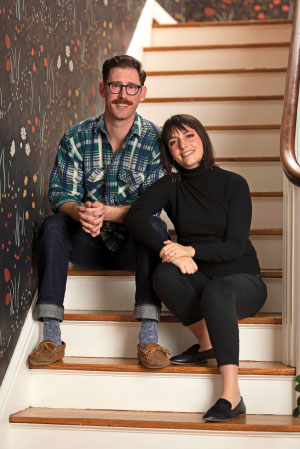
April marks one year since newlyweds Victoria Bartholomew and Jordan Reeves bought their Tudor on Rivermont Avenue. Bartholomew, a local REALTOR®, renovator and historic home lover, had been keeping her eye on the home for a while—25 years to be exact.

“I moved to Lynchburg when I was eight years old and the house we lived in was literally across the street,” she explained. “I looked at this house a lot when I was a little kid and I really liked it.”

The couple put in an offer on the 2,600-square-foot home without even seeing the inside yet, but it did not disappoint once they did—offering an abundance of natural light, unique woodwork and some untouched mid-century updates. It also helped that they knew the home’s architect was the famed Stanhope Johnson, who designed hundreds of houses and buildings in Lynchburg in the first half of the 20th century.

Victoria-Bartholomew-Jordan-Reeves

“All of the [Stanhope] houses are different. Stylistically, there are some similarities, there is a symmetrical look to his homes… but the details are all different,” Bartholomew said.

They were also drawn to the upkeep; although built in 1913, this home needed the least work of any other home they had considered. Most of the improvements they have made in the past year have been cosmetic—such as adding wallpaper, installing new light fixtures and reverting the fireplace’s original tile back to its former glory.

“We stripped years and years of paint off of the fireplace. It was peach. They painted the original tile peach,” Reeves laughed. “Which is extremely offensive if you like the original details of old houses.”

Reeves and Bartholomew not only like original details, they respect them—or, as I noticed as they excitedly showed me around their beloved home, they celebrate them.

“We think it’s those details that make the houses really unique and special,” Bartholomew explained.

historic-home

That doesn’t mean the couple holds back on infusing the old home with their own unique style. Bartholomew and Reeves have found they often agree on interior design choices, with Bartholomew describing her style as leaning towards “maximalist”—making the most out of her spaces—and modern eclectic.

“But we are not stuck on a certain style. I’m always a believer that if you paint the walls, you have good rugs and you have art… it’s a beautiful space,” she said.

“We also really like saturated colors.”

This is particularly evident in the home’s living room, where a mustard yellow couch from Interior Define contrasts gorgeously with rich blue-gray walls (Inchyra Blue by Farrow & Ball) and a red Persian rug.

The couch is actually the only “new” piece of furniture they have in the home. Everything else was purchased secondhand, such as estate sales or on Facebook Marketplace.

inside-historic-home

“There are stories to every single piece of furniture in this house, which is a lot of fun,” Bartholomew said. “There is definitely something warm and nice about giving something new life.”

One example is the living room’s mid-century storage unit, part of a set, which holds records and other collectibles. Bartholomew purchased the furniture locally from a man whose grandparents had brought it over from Denmark.

Behind the living room is what the couple has lovingly dubbed “the grandpa room”—partly because of its iconic wood panel walls that give off that “gentleman’s library” vibe. The room was added to the home during a major renovation in the ’50s and hasn’t been changed since; Reeves describes it as a perfect “slice” of mid-century style.

The grandpa room is also the place where the couple proudly displays items from their grandparents. Bright green chairs were a gift from Bartholomew’s step-grandparents and a flag from Reeves’ grandparents’ house hangs on the wall.

wood-panelling-revival

“My grandfather was an architect so we have some of his books in here and framed some of his plans,” Bartholomew added.

A powder room off the grandpa room was also a later renovation to the home and was a practical addition, serving as the only bathroom on the lower level. Of course, this couple was curious to see what the original space looked like.

“We found the original house plans and this used to be a pass through and there was a door leading in to the kitchen,” she said.

In the foyer, floor-to-ceiling black wallpaper (by Hygge & West) with an eye-catching metallic floral design is more proof of the couple’s willingness to take bold risks.

“We love it because it looks different depending on the light or the angle,” said Reeves.

There is minimal artwork in the foyer, so as not to cover up the wallpaper, which is a work of art itself, they explained. But they did allow one of Bartholomew’s large eccentric cat paintings—one of three cat-focused paintings downstairs. The foyer’s gorgeous crystal chandelier light fixture was not changed, since it was original to the home.

In the dining room, warm yellow walls (India Yellow by Farrow & Ball) are covered in colorful artwork Bartholomew has accumulated over the years. Throughout our tour, she pointed out piece after piece, many of them created by family members, including her grandfather and mother.

Some pieces of furniture can be considered works of art as well. Bartholomew bought the side chairs in the dining room on Facebook Marketplace from a missionary who had just returned to the area.

“The wooden part of the chair was handmade by a builder in Kenya when they were there. The man who bought them did the leatherwork,” Reeves explained.

Plants are another décor essential in this home—and they play the most prominent role in the dining room.

“It’s a jungle in here. I’m a sucker for living things!” Bartholomew laughed. The couple has five “elderly” cats and two dogs—a pit bull, Otis, and Great Dane, Ida, who nudged her way into the photo shoot numerous times.

A unique half-door leading to the kitchen helps keep the pets separated at times. The kitchen was renovated in 2007 and while the couple would love to update the style at some point, they don’t feel like it’s a “need” right now.

“It’s hard to justify going into a full kitchen reno, since it’s perfectly functional,” said Reeves.

They did update the lighting over the island; it coordinates with the dining room fixture found along the same sight line. Red Persian runners in the kitchen break up some of the light wood in the floor and cabinets.

Moving into year two in their beloved home, Bartholomew and Reeves plan to stay busy with more home projects, such as new wallpaper in their bathrooms that were also last updated in the ’50s. But the colorful tile is staying, they say.

“A lot of people will buy these homes, and you can get them very cheap, and they will pull out everything and replace it,” said Reeves.

But as is proof by their dedication to saving fireplace tile and preserving wood-paneled nooks, Bartholomew and Reeves see themselves almost as long-term visitors in their historic home, characters in its evolving story.

“You are not the forever owner of a house,” Bartholomew explained. “You are just a piece in its history.”


PHOTOS BY ASHLEE GLEN