Back to Basics
Helpful Hints for Your Home Kitchen
While many of us daydream about cooking elaborate, gourmet meals for in-home dinner parties, the reality is most of our time in the kitchen is typically spent preparing a quick bite for ourselves or our families in between meetings or soccer games.
We want it to be easy, painless, somewhat healthy and—of course—we want it to taste good. If you need a little pep talk to get you recharged or retrained in your home kitchen, we are here with loads of basic advice—tips to save you time, space, money (and maybe even a finger!).
Editor Shelley Basinger spent some time with Chef Stephanie Fees, owner of Scratch Pasta in the Lynchburg Community Market, to pick her brain on the do’s and don’ts of the kitchen. From culinary school to the Greenbrier to West Manor, she shares what she’s learned over the years. Then, we expanded our search for advice by getting insight from Chef Robert Patton at the Culinary Institute of Virginia.
Bon Appetit!

Chef Stephanie Fees, owner of Scratch Pasta.
Stephanie’s 3 Kitchen Truths
1. Always start with a sharp knife. “The first thing you learn in culinary school is how to sharpen your knife manually, using a sharpening stone. Because the saying goes—a sharp knife is a safe knife. The less you have to work to cut something, the less likely you are to cut yourself. If you don’t have a sharpening stone, just make sure yours is as sharp as possible. The test is always to cut through a tomato without having to press or push on the skin.”
2. Don’t be afraid of salt during the cooking process. “This is one of my big things, especially when it comes to your pasta water. People will add a couple of teaspoons, but you actually want tablespoons of salt in your water. Most of the salt is going to stay in the water. I also believe in salting your food as you cook versus adding it at the end. When you add salt to your finished dish, the food will just taste salty instead of flavorful.”
3. Beware of clever marketing tactics. “‘All natural’ on the label doesn’t mean it’s your personal idea of what all natural means. If you look up the FDA requirement for ‘all natural,’ it’s very broad. If you’re able to pay extra for meat, buy organic. There are legal guidelines for organic meats and vegetables, but you can put an ‘all natural’ label on just about anything. Another option is to buy from a local provider so you can ask them exactly where the meat came from and how the animal was raised. But don’t buy something just because of what it says on the label—unless it’s organic.
You are wasting money.”
 7 Kitchen Tricks and Tips
Don’t throw out the pasta water. “I try to use a spider or tongs when I pull out my pasta so I can preserve the water. You can add it to a sauce or toss it with some cheese to make a carbonara. You will get that little bit of thickening that you need.”
Use a microplane instead of a grater for parmesan cheese. “Parmesan cheese is a super dry cheese and doesn’t melt easily, so the smaller it is, the more quickly and evenly it will melt.”
Try a spoon instead of a knife when peeling fresh ginger. “When you use a knife, you lose a lot of the volume. Use a spoon to peel it back and just get the skin off.”
Bonus tip: “Since you usually only need a 1/2 a teaspoon for what you are making, chop up whatever you have and put it in the freezer.”
Two plastic lids can save you a lot of prep time. “While working at the Greenbrier after culinary school, I was cutting cherry tomatoes for salads one at a time. Someone in the kitchen showed me how to take two plastic lids, put the tomatoes between them, and cut eight of them at once. It was a game changer. This is also a great trick for moms who are cutting up grapes for their small children.”
Save the chicken bones. “I keep chicken bones in the freezer from when I buy a rotisserie chicken. Then, I will put them in a crockpot or instant pot overnight to make chicken stock. Just cover it with water or add carrots, onions, celery, garlic—whatever you want. The great thing is you can control the amount of salt, and the flavor is far superior to store-bought.”
 Use kitchen scissors instead of a pizza cutter.
“I didn’t have a pizza cutter one day and improvised. The scissors worked like a charm, if not better! I really don’t like single use items. So if you can take that one thing out of your jam packed drawer, I think that’s a huge plus. I’m all about having fewer things in your junk drawer.”
Be consistent with the type of salt you use. “Kosher salt is said to have a cleaner taste and is less salty than iodized salt by volume by about 30 percent. So you can salt your food more evenly without it being too salty. But whether you use kosher salt or iodized salt, you just have to be familiar with the salt that you use and how it makes things taste.”
5 of Her Favorite Things
Instant Pot: “I love mine so much and think everyone should have one. I use it just about every day and I can’t say that about many appliances that I have. These electric pressure cookers save your cooking time on everything and it turns out so well. Ribs, rice, chicken stock, yogurt—I’ve made everything in my instant pot.”
Cookbooks: “I think people get a lot of recipes from Pinterest these days then are disappointed by them. Just because there is a pretty photo doesn’t mean the recipe is all it’s cracked up to be. Find the right source material—blogs that you trust, cookbook authors that you trust. I use the internet for quick recipes, but my cookbooks are my go-to for complex dishes.”
Restaurant food containers: “I store all of my food in these plastic containers (you can buy them on Amazon) instead of Tupperware because they are stackable and really compact. And if you lose one, it’s only a couple of cents.”
Pre-peeled garlic: “In the produce section you can purchase garlic cloves that are already peeled and separated (not the chopped stuff in a jar). For me this is a huge time saver and then the leftover cloves stay fresh for a while in the fridge.”
Electric Egg Cooker: “This is one of the only single use items that I own. I can’t ever seem to get hardboiled eggs the way I want them and this does the job perfectly.”
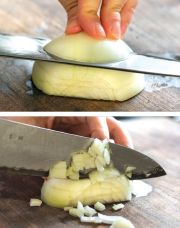 Onion Dicing 101
Do you need a refresher in cutting an onion? Stephanie believes there are technically two “right” methods—the “culinary school way” and then the “home kitchen way.” Both are perfectly acceptable. The only difference is your final product might not be as evenly diced.
Professional: Cut off the top of the onion first, trimming the root end but leaving it intact. Then, slice the onion down the middle and peel it. Cut the onion horizontally in layers to the root end. Then come back and cut back vertically in both directions before cutting off the root end. Those first horizontal cuts can be tough for people who aren’t as savvy with a knife or who are not using a sharp knife.
Home Kitchen: A very similar approach but in this case you cut off the top and root end of the onion first, then slice from side to side (so the onion would be in half moons if you separated the pieces), then turn and slice from top to bottom. The pieces won’t be as pretty as the “professional” way, but it’s a lot quicker!
10 Mistakes You Could Be Making In The Kitchen
By Angela Blue
Information from Chef Robert Patton, CEC, CCA, Campus Director for the Culinary Institute of Virginia. Overcooking your vegetables. Unless you are serving them to small children, the vegetables should still have a slight bite to them.
Cooking bacon on the stovetop. Instead, cook it in the oven in a glass baking dish. It saves a ton of mess and allows you to do other things on the range top.
Mistreating your fresh herbs. Trim the root ends a little bit, and then dunk them in a jar with water as you would a bouquet of fresh flowers. For cilantro and parsley, place a damp paper towel over the herbs and store in the refrigerator. For mint, rosemary, thyme, sage and hardier herbs, keep them in their vase out on the counter
at room temperature.
Refrigerating things that don’t like to be cold. Common sense might suggest that keeping things cool in the refrigerator is good for everything—but it’s not. Many items that are often refrigerated don’t need to be, and worse, some things behave badly in there. Potatoes and tomatoes, for example, suffer on the molecular level and lose much of their texture and flavor.
Overcrowding the pot or pan. This doesn’t allow the food to cook properly. Cook in smaller batches or invest in a larger pan. You’ll get a much better result.
Rinsing the noodles. Your pasta wants to wear its sauce like a nice jacket. When you rinse your pasta after cooking it, you are washing away the starch that makes the sauce stick to it. The result? Slippery pasta to which sauce won’t cling.
Not letting food rest. Food needs naps too!
When you take meats and baked dishes out of the oven, they need to sit for a few minutes before serving.
For meats, this prevents the juices from running away from the meat, and for baked dishes like casseroles and lasagna, it helps the liquids be reabsorbed into the food
so you’re not left with a big soupy, slippery mess.
Being afraid of the high heat. Sautéed vegetables, for instance, do better at a higher heat for a shorter period of time.
Tossing your vegetable scraps. Put fennel fronds, carrot ends and other vegetable scraps into a re-sealable plastic bag and keep in the freezer. When it’s full, make vegetable stock.
Not having fun! Don’t be afraid to get out of your comfort zone and experiment.
8 Unique Uses for Ordinary Kitchen Utensils
BY GRACE SILIPIGNI
Among the drawers overflowing with Tupperware containers, bakeware and other miscellaneous kitchen utensils, there are certain culinary devices that can be found in nearly every kitchen, each which can serve a variety of functions. From strainers turned into makeshift steamers to turkey basters serving as pancake makers, we’ve selected eight, common household utensils and offer suggestions on how they can better serve your baking and cooking needs.
Waffle Iron. Waffle irons are the jack of all trades. Not only do they prepare the beloved breakfast item, but can serve as a panini press or quesadilla maker as well. Other sweet treats such as cinnamon buns and brownies can be baked between the two griddles too.
Ice Cream Scoop. This household staple has several uses besides the simple function that its name conveys. Ice cream scoops also happen to measure the perfect amount of batter when preparing muffins, while also serving as the perfect tool for hollowing out the cavities of squash and pumpkins.
Strainer. While strainers are typically used after vegetables, noodles or other foods prepared in a pot of boiling water, we suggest combining the two utensils to create a makeshift steamer. Simply place your strainer, ideally one made from stainless steel, over a pot of boiling water and fill with broccoli, carrots, asparagus or your other favorite vegetable. Then place a lid over the strainer and allow it to steam for several minutes before removing it from the pot.
Tongs. Our alternative suggestion for tongs is somewhat counterintuitive to their purpose, but is certainly helpful. We suggest using the center of the tongs for juicing. Simply place a lime, lemon or other citrusy fruit between the arms and squeeze the open end of the tongs to juice the fruit. This trick is especially useful when preparing large pitchers of lemonade.
Turkey Baster. Turkey basters make their annual debut every Thanksgiving and then are stored away in a drawer for the remainder of the year. It so happens though that turkey basters serve as the perfect pancake maker. Fill the baster with your favorite buttermilk pancake batter and squeeze circles or other fun shapes onto a griddle.
Slotted Spoon. This trick is great for bakers and an easy way to get mess-free egg whites. Over a bowl, simply crack an egg into the slotted spoon to separate the yolk from the whites. Whichever portion of the egg you do not use, refrigerate in an airtight container and save for scrambled eggs or an omelet.
Roller Pin. If you aren’t making sugar cookie cut-outs or a homemade pie crust, the rolling pin may seem obsolete. This device actually serves a wide variety of functions for both cooking and baking. Use the pin as a meat tenderizer to flatten chicken or to crush up graham crackers and candy for baking.
Egg Slicer. This culinary gadget can slice much more than a hard-boiled egg. Try using it to dice up strawberries, avocados and soft cheese, as well as to mince garlic and ginger.
Stock Up Essentials For A Well-Equipped Pantry
Oils (vegetable or canola, extra virgin olive oil, toasted sesame oil): Keep a variety on hand for a little drizzle to finish a dish or to top a salad for added flavor and texture.
Vinegars (apple cider, red wine, rice wine): Each have a distinct flavor profile. A splash of vinegar does wonders to “brighten” up a dish’s
flavor and can be used to replace some of the salt.
Soy sauce: It’s an essential to add a depth of flavor, some umami mouthfeel and also a salty taste.
Worcestershire sauce: Most don’t know that it’s made from anchovies and also offers those umami flavors and a great savory saltiness to dishes.
Sriracha Hot Sauce: It offers a great heat and flavor without having too much vinegar flavor.
Local honey: A little bit of good quality honey instead of sugar not only adds sweetness but also depth of flavor.
Dijon mustard: This adds another layer of flavor, slight heat and also can be used to emulsify or bind a salad dressing together.
Sea salt: Have a nice sea salt on hand, not to use during cooking but to finish a dish and add a
great flavorful burst.
Canned beans (black, cannellini, navy, kidney or garbanzo): Having these on hand can give you a quick go-to meal.
A good quality stock or base: This will add that savory quality and can be handy in a pinch for a quick soup or sauce starter.
Canned tomatoes (paste, diced, sauce/puréed): These are a go-to for a quick sauce when tomatoes are out of peak season.

 Last year, “We Got the Beet” served approximately 400 participants. Most said afterward that they care more about eating healthy and have become more physically active. Of the children surveyed, nearly half said they now choose water over other beverages when thirsty (a ten percent increase from the start of the program) and 90 percent said they like trying new foods (up from 60 percent).