Growing Good

How Lynchburg Grows Is “Planting Seeds” to Feed and Impact our Community

by: Megan L. Horst | Photos Courtesy: Lynchburg grows

Lynchburg Grows has been serving the community for nearly 21 years. Their seven-acre urban farm offers meaningful job opportunities for individuals with disabilities, while also providing fresh, local produce to the community, restaurants, and organizations.

“Our mission is to work with the community to provide access to healthy food, and then also to provide purposeful jobs to people with disabilities,” said Shelley Blades, executive director of Lynchburg Grows. Currently, they have five paid farmers and two farm coaches who assist with harvesting and farm chores.

“Their coach is there to help answer any questions they may have, make sure everything is being done properly, and that they are doing their job safely,” Blades explained. Farm coaches also work with the farmers to ensure they meet their work and personal goals.

Recently, Lynchburg Grows was one of the ten recipients of the Kubota Hometown Proud Grant® and was awarded $25,000 in cash and $25,000 in Kubota equipment. The grant was awarded to nonprofits nationwide that are making a positive impact on their local communities.

“The work they do to feed the Lynchburg community resonated with the spirit of the Kubota Hometown Proud grant program,” said local dealer Zach Jones, general manager of Kubota of Lynchburg. “Their application made it very clear that they needed the grant resources to be able to increase the number of people they feed, teach, and empower in our community for years to come. At the heart of it all is dependable equipment that is needed to scale the project and to power real change for the goals of their operation.”
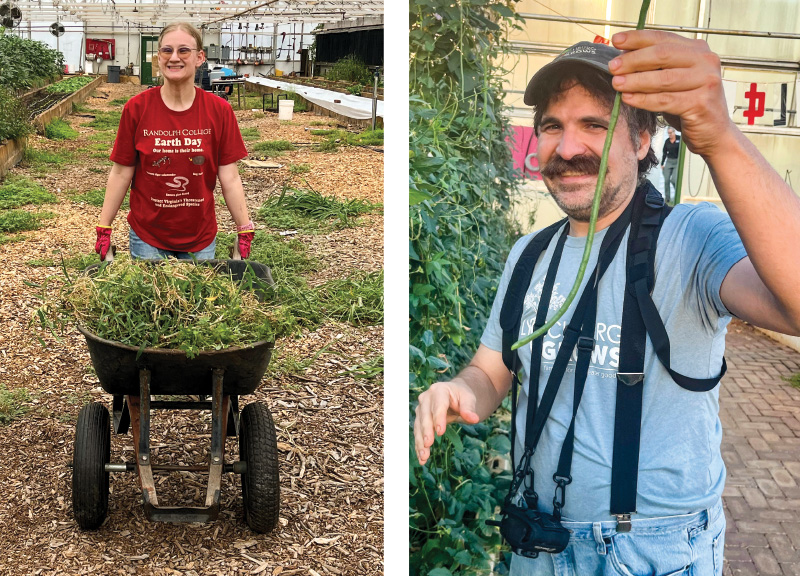
 

Blades expressed that they were pleasantly surprised and excited to have been chosen for the grant.

“It’s really great because we get some Kubota equipment, which will be very helpful,” Blades said. “That will help us in all aspects of the farm. It will help us post-harvest moving produce around, not having to carry 50 to 80 pounds of tomatoes from one greenhouse to another.” The grant funds will be used to expand their operation. They also expect the funds to increase their produce output by 25 percent, enhance nutrition education and provide additional vocational training opportunities for individuals with disabilities.

“We are looking forward to reaching our community in different ways and expanding,” Blades said.

Lynchburg Grows additionally provides opportunities for youth in the community to learn and have fun. A portion of the grant funds will be used to expand their education greenhouse, which is solely dedicated to learning, and used for classes, field trips, and camps.

“This will be a space for students to explore and learn and play without interfering with the day-to-day farm operations,” Blades said. They hope to include a “tasting kitchen” in the learning greenhouse, allowing them to transition from planting to harvesting to tasting all in one space. In the summer, Lynchburg Grows hosts a variety of day camps for kids. At the week-long camps, participants have the opportunity to work alongside farmers with disabilities and harvest produce.

“They learn about plant cycles and planting and growing,” Blades said.

“They learn about nutrition, they’ll cook the food that they are harvesting, and so they get some cooking lessons. They also help clean up, so they’re learning to work together as a team and then also they help us with our donations.” Lynchburg Grows donates to many local organizations, including Park View Community Mission, Miriam’s House, Lynchburg Daily Bread, Connecting Point, and others.

“They [campers] help pack donations up so they’re learning philanthropy and why it’s good to give back to your community,” Blades shared.
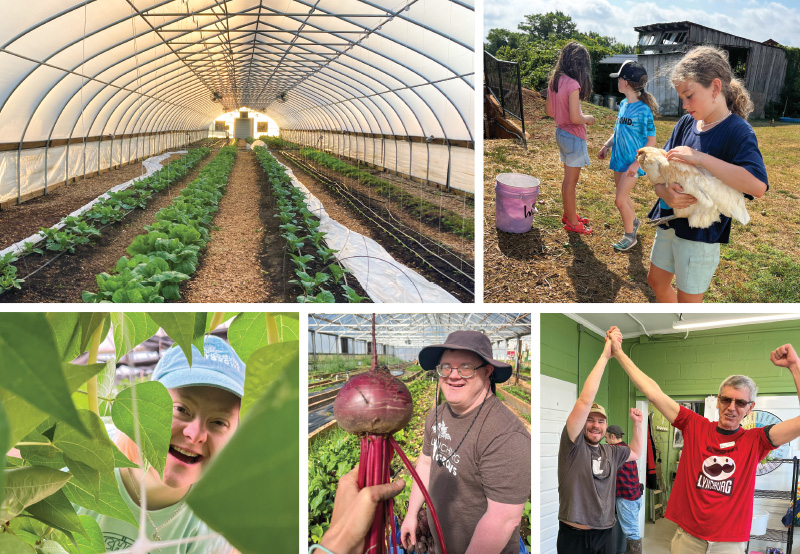
 

A wide variety of produce is grown on their farm, which changes depending on the season. Currently, they are growing a variety of root vegetables, including turnips, beets, carrots, radishes, and leafy greens, as well as eggplant, beans, herbs, tomatoes, cucumbers, cabbage, and more.

“We are lucky to be able to grow year-round,” Blades said. For members who join at the beginning of their growing season, in March, they can pick up their share on Wednesdays; however, their Farm Store is open to the public every Thursday from 9 a.m. through 1 p.m.

“We accept SNAP, which is great,” Blades said. They also participate in the Senior Farmers’ Market Nutrition Program, a government initiative designed to provide seniors with access to fresh produce.

“Lots of ways you can shop,” she said. Another way to support Lynchburg Grows is to volunteer at the farm. They are always looking for help with tasks around the farm.

“Not all of [the volunteer work] is really, really hard,” Blades said. “We can definitely modify it to each person’s abilities.”

Blades expressed that they are incredibly grateful to Kubota. The new equipment and funds will make a substantial impact on their operation.

“We are proud to have selected Lynchburg Grows for this opportunity,” Jones added. “And even more so to see what they’re able to accomplish with
our equipment.”


The Best Gardens of Virginia

MAKE PLANS TO VISIT THESE HORTICULTURE-FOCUSED DESTINATIONS IN 2022

It’s no secret that Virginia is a beautiful place to live, and every season brings out a new aspect of its beauty. Right now, while the air is cold and the trees are bare, we can appreciate that unhindered view of the Blue Ridge, maybe capped with a dusting of white. We can also plan for what we will do once the weather warms up again.

With that in mind, and to coordinate with our annual “Best Of Issue,” we have worked with some of Lynchburg Living’s most beloved contributors to curate a list of Virginia’s “best,” must-see gardens. Without further ado, here are our recommendations:

Charlottesville

Thomas Jefferson’s Gardens at Monticello
www.monticello.org/house-gardens/farms-gardens
Thomas Jefferson was an avid observer of nature, and a dedicated and methodical gardener. The gardens at Monticello served not only as a functional producer of food, but also as a lab for Jefferson’s experimentation with imported and exotic vegetables and botanicals. In fact, he documented his gardening experiments in his “Garden Kalendar,” which he wrote with a scientific exactitude, reflecting his passion for horticulture. Today, visitors can tour the lovingly restored flower gardens, the stunning 1,000-foot-long vegetable garden terrace, and the sprawling orchards maintained by the Thomas Jefferson Foundation. You will also have the opportunity to learn about 19th-century cultivation and the rich history of Virginia as a critical state in our nation’s development.
Recommended by Kaye Moomaw

Pavilion Gardens at University of Virginia
While you’re in town exploring Monticello, you’ll want to take a quick drive over to the University of Virginia, founded by—you guessed it—Thomas Jefferson. At UVA, TJ really flexed his truly inspired talent for landscaping. There are 10 unique pocket gardens spaced symmetrically along both sides of the famous “Lawn.” Many of the flowers and shrubs on display at UVA in Jefferson’s time were cultivated at Monticello and transplanted into the university gardens, which were traced and outlined by Jefferson’s own invention—serpentine brick walls. You’ll want to find a shady spot to sit with a cup of tea and a good book, because the small size and elegance of some of these spaces truly project a “secret garden” feel.
Recommended by Kaye Moomaw


Lexington

Boxerwood Gardens
boxerwood.org
The Boxerwood Education Association maintains over 15 acres of protected property, where they have identified and cultivated five unique ecosystems, all available for the inspiration and education of anyone with an interest in environmental preservation. The Pioneer Forest— complete with a “fairy forest” the kids are sure to love—is a great place to experience forest succession. The Wetlands is a habitat teeming with life, and is home to wonderful critters. As you transition into The Field, you can observe the different fauna that are attracted to this grassy, open space. The Hedgerow provides a transition between forest and field, and serves as a sort of highway for smaller critters and sun-loving trees and shrubs. Finally, the Established Woods is the picture of an old-growth, healthy and active forest full of large trees, and three distinct levels of growth: the upper, middle, and lower stories.
Recommended by Shannon Brennan


Nelson County

The Quarry Gardens at Schuyler
quarrygardensatschuyler.com
This one is a bit out of the way from our other suggestions, but well worth the trip because of its truly unique offerings. Once a very profitable soapstone quarry, the Quarry Gardens are spread out over two distinct geological formations, which foster a wide array of diverse ecosystems. In fact, maintained within these 40 acres is the largest concentration of Virginia native plants in the entire commonwealth. A large and winding trail system boasts 34 “galleries,” where you’ll find everything from pollinator gardens and vernal pools to wetlands, barrens and a fern gully.
Recommended by Shannon Brennan


Greater Lynchburg Region

Lynchburg Grows
www.lynchburggrows.org
Lynchburg Grows is a seven-acre, nonprofit urban garden that employs individuals with disabilities and provides fresh, organic produce for the community. Veggies are grown in greenhouses with all sorts of gardening techniques, including hydroponics. They also run a CSA, a farm store, and FreshRX, a super-inventive vegetable prescription program aimed at helping people with diet-related illnesses make healthy lifestyle changes.
Recommended by Susan Timmons

Anne Spencer House and Garden Museum
www.annespencermuseum.com
The Anne Spencer House and Garden Museum was home to late Harlem Renaissance poet Anne Spencer, who was an essential voice, both locally and nationally, for civil rights and equality. Her garden was a place of solitude and peace amid the very turbulent and racially segregated period of history in which she lived. The time she spent in reflection while tending to her garden inspired her writing; the house and gardens also played host to intellectuals, creatives, and African American travelers. The gardens have been restored with the help of Spencer’s direct descendants, as well as old photographs. Tours are available, which we highly recommend. Not only is this a beautiful, creative space, but it is also an invaluable piece of history.
Recommended by Susan Timmons and Ashleigh Meyer

Old City Cemetery
www.gravegarden.org
No local garden list would be complete without mentioning Old City Cemetery, with its peaceful rolling hills, sculptures, ponds, and, of course, Virginia’s largest public collection of heirloom roses. Yes, it’s also a cemetery, but it’s such a beautiful place. I personally think the cemetery adds an intriguing historical element to the whole experience, which you can learn about by visiting the gift shop/museum on the grounds—but if you’re just there for the flowers, you may not even notice the cemetery at all. Admission is free, so take advantage of a sunny winter afternoon and stop by.
Recommended by Susan Timmons and Ashleigh Meyer

Cloverlea at Claytor Nature Center
www.lynchburg.edu/academics/academic-and-community-centers/claytor-nature-center
Owned by Lynchburg College, Claytor Nature Center is a hidden gem located off Route 43 in Bedford County. The gardens enshroud a stunning 1780s farmhouse (Cloverlea) with breathtaking views of the Peaks of Otter. The grounds are free and open to the public, and feature meticulously trimmed boxwoods, a variety of flowers and shrubs, and one of Virginia’s largest white ash trees. I find it to be a truly calming and inspiring landscape. Also at Claytor Nature Center are multiple trails through forests and wetlands along Big Otter River. The Education and Research Center on site houses the Ramsey-Freer Herbarium, a collection of more than 63,000 dried and preserved plant specimens from all around the region.
Recommended by Ashleigh Meyer


Richmond

Lewis Ginter Botanical Gardens
www.lewisginter.org
This destination has more than a dozen themed gardens across 50 acres, complete with a really gorgeous glass-domed conservatory. A designated rose garden, an “Asian Valley” incorporating the stunning design features of Japanese gardens, and a fun and educational children’s garden are just a few of the reasons you need to visit the Lewis Ginter Botanical Gardens. In fact, you can even make a stop in the winter! Lewis Ginter is open year-round for guests and also offers membership options.
Recommended by Susan Timmons and Kaye Moomaw