Getting to Know Virginia’s Cantaloupes

Memories of a sweet summer job

Virginia loves melons. They grow wonderfully in our climate, and they make the perfect sweet addition to every picnic table. However, there is one melon that has brought Virginia some attention: the cantaloupe, a deceptive fruit with a blandly colored, rough netted rind and soft, juicy center.

There is a hidden beauty in these modest melons. They aren’t printed on tablecloths and sundresses or painted into Norman Rockwell’s idyllic picnic scenes. However, I would argue that they should be. After all, despite the cantaloupe’s quiet, non-ostentatious reputation, it is the most popular melon in America, consistently outselling the pompous watermelon.

But despite loving and growing up around cantaloupes, I can honestly say I didn’t fully appreciate them either until I spent a summer years ago deep in cantaloupe juice. That kind of intimacy with a melon? Well, let’s just say it changes things.

If you are traveling north on Route 43 in Bedford County towards the Peaks of Otter, you will spot a quaint little store resting in mountain shadows and encircled by crouching peach trees. The single ancient gas pump still works, and inside you’ll find the best pie in the Blue Ridge, among other wonderful treats.

At Mountain Fruit and Produce, where I worked that summer, we got cantaloupes by the box load. By the shopping cart load. By the truck load. And we sold it, too, hand over fist.

Restocking dry goods on the shelves involved battling the crates of cantaloupes that were left in the aisle for lack of better floorspace. We sold them whole, we sold them in slices, in ice-cream form, and in juice form.

People would wander up the mountain specifically in search of a good cantaloupe. They would tap their fingers against the rind, sniff the bottom where the vine was once connected, give it a good shake and inquire as to where each cantaloupe was grown until they settled on the perfect one—the cantaloupe of their dreams. Over the course of that one summer we probably sold a thousand cantaloupes. Suddenly, a large portion of my hourly wages was thanks to this one particular fruit.

That summer I sliced, diced, peeled, pulverized and blended hundreds of pounds of cantaloupe. I would arrive at the store in the morning and be ushered to a shopping cart straining under the weight of our most recent shipment. It was delivered to us from the orchards in beat up flatbed trucks loaded down with farm hands.

I learned even more tips and tricks on spotting the perfect cantaloupe: one that is nearly round, weighs about three pounds, gives just a little when you squeeze it, and makes a nice hollow knocking sound when tapped.

Unlike the watermelon, the cantaloupe is easy to work with. A sharp blade slices through the rind with little effort and the center of the fruit is so soft that if the knife wielder is not careful, he may lose control of the tool and cut himself, caught unaware when the blade falls rapidly through the meat. (Trust me.) Once halved, the delicious sun-colored fruit clings closely to the thin rind where a ring of light green brings the two together. The fruit is light, soft and sweet.

At the center of each half is a hollow cavity where around 400 little seeds are stored in a runny liquid, best removed by a metal stirring spoon. But as I learned at Mountain Fruit and Produce, you must be careful to not scrape away too much of the fruit. In the cantaloupe ice-cream business, every bit counts.

Long before becoming a beloved summer farmers market find, the cantaloupe wasn’t even grown in the U.S. It originated in Iran, India and Africa, around 5,000 years ago, where it grew naturally and was a staple food for the natives of each region. Europe’s first encounter with the cantaloupe, however, is quite an interesting tale.

There is much debate surrounding the truth of this story, but it is worth being told. Thirty miles north of Rome, there was a small papal village by the name of Cantalupo di Sabina. In this village rested the country estate of Pope Paul II, a very large, very demanding Pope who held his office from 1464 to 1471. During this time, an envoy of Armenians arrived from the East bearing gifts of melons, namely, the cantaloupe. Pope Paul had one taste and was mystified. He became obsessed with the cantaloupe, devoting garden space to the wandering vine and demanding that they be grown and harvested in the best possible conditions, ensuring the best possible outcome.

Paul was a pious man. (Maybe. It’s debatable.) But his desire for the melon was insatiable, and in July of 1471, at the age of 54, Pope Paul II suffered a heart attack and died. What brought on this heart attack? He suffered severe indigestion brought on after gorging himself on multiple cantaloupes hours before his death. Or so the story goes.

Fast forward several years and Christopher Columbus brought the cantaloupe with him on his maiden voyage to the New World in 1492. The fruit grew wonderfully in America’s fertile, loamy soil and thus the cantaloupe turned a new leaf, feeding settlers, natives, colonists and revolutionaries, to eventually find a soft landing place in every grocery store across the U.S.

Virginia has particularly loved and embraced the cantaloupe. In fact, in pre-pandemic years, we had a thriving festival dedicated to it. The Virginia Cantaloupe Festival began in 1981 in Halifax County, where it is suggested that the best of the best cantaloupes are grown. In past years, the festival limited ticket sales to “only 1,500” and they would always sell out.

With all of this information in mind, I hope the next time you discover that pale orange cube in your fruit cup you won’t dismiss it entirely. The cantaloupe is not meant to be plucked before its prime, crammed into a plastic cup alongside other, less worthy fruits and refrigerated for weeks on end. It is meant to be enjoyed fresh, in its boldest colors. Or better yet, as a dessert.

To this day, enjoying a spoonful of freshly made cantaloupe ice cream at Mountain Fruit and Produce brings back memories of that summer where I learned to respect this misunderstood melon.

How to Choose a Cantaloupe

Color—The outside should be a uniform pale, creamy yellow, with no green or white.
Webbing—The web-like texture covering the melon should be consistently rough ridges all the way around.
Stem—A ripe cantaloupe will fall on its own from the vine. The point where the stem was attached should be a little indented. If it is poking or bulging out, it could mean the farmer cut the melon too early.
Scent—The stronger the smell at the stem, the riper the melon.
Feel—Give it a good squeeze. If it’s hard, it’s not ripe. It should give a little in your hands. If it’s squishy, it’s overripe. That doesn’t mean it’s a goner! These are great for juicing.
Sound—Finally, give it a little knock. You should hear a low, solid thunk. A high-pitched sound could mean unripe.


Coming Clean

A local skin care formulator weighs in on one of the most popular buzz words in beauty marketing

A word that used to, back in the day, be associated with your daily house chores is now stamped on a wide range of skin care products—and statistics show lots of customers are sold on the idea of “clean” beauty.

According to the NPD Group, the natural skin care market has skyrocketed in recent years—growing 23 percent, about $1.6 billion, from 2017 to 2018 alone.

But what does “clean” really mean? Should this word drive a decision to purchase one product over another? We asked Karrye Flowers, founder and lead formulator for Oshun Organics, LLC in the Lynchburg Community Market, to help sort out the vocabulary.

Clean, defined (sort of)

First off, there is no set definition for what makes a product truly “clean.” The Food and Drug Administration does not regulate these product descriptions.

But Flowers says the general consensus in the skin care world is that “clean” means non-toxic.

“That’s also very subjective,” she explains, adding that they only use objective words to describe or market their plant-based products. “For example, we say our products are vegan. Vegan is a very specific word with a clear definition. Everything is derived from plants. We naturally scent and dye our products with essential oils or plant extracts.”

Don’t just read, research

She says with the rise of “clean” beauty products, customers are starting to take a closer look at that long ingredient list on the back of their face wash or eye cream. That’s a good thing, but with one caveat.

“People want things to be 100 percent natural, so they are looking for my ingredient list to only say things like ‘aloe vera’ and ‘coconut oil.’ But it’s very important to me that the products I offer are effective, as well as minimally processed. There is a balance,” Flowers said.

Meaning: You might need a stronger concentration of an ingredient, even a plant-based one, for it to work. For example, at first glance cetyl alcohol may look like an unrecognizable chemical. But it’s actually derived from palm oil, Flowers explained.

“You want to be able to trace an ingredient back to where it came from, even if it was lab created. You can’t make something from nothing,” she says.

Paraben propaganda?
Dermatologists are often critical of the natural skin care movement and the ingredients that have been red flagged through the years: such as sulfates, parabens, chemical sunscreens and others.

In an article published by JAMA Dermatology, “Natural Does Not Mean Safe—The Dirt on Clean Beauty Products,” two dermatologists wrote: “… many of the strongest voices in the clean beauty movement suggest avoiding ingredients owing to a theoretical risk of endocrine disruption and cancer, despite the fact that a causative relationship between these disease states and the concentration of these ingredients in cosmetic products has not been proven scientifically.”

They went on to say there is a safe use of preservatives such as parabens in order to prevent severe infections in users. Again, balance is key.

Flowers agrees that the research is limited, at best, about so many skin care ingredients, and says preservatives have their place, especially in skin care.

“You want to have some preservatives in anything you buy to prevent the growth of bacteria. Every time you put your hand in that jar of cream, you are taking bad microbia and putting it in there,” she says.

Getting practical

The only ingredients Flowers says she would try to avoid in skin care products are dyes.

“For many creams and lotions, you will find something like red 4 or yellow 2 at the end. They are so unnecessary and only make the product look good,” she explains. “They do nothing for you.”

Also, beware of greenwashing. Don’t buy a product solely because the creator claims it’s clean or more environmentally sound. Do your research.

Otherwise, if a “clean” product you swear by works for you, then by all means keep using it.

Just don’t get on a soapbox about it. It’s just a word after all.

Learn more about Oshun Organics, LLC at oshunorganics.com.


Business is Blooming

Gary’s Garden Center Returns After a Five-Year Break

When a private buyer inquired about purchasing Gary’s Garden Center, a family business spanning three generations, in 2016, owner Gary “Nelson” Garner Jr. hesitated.

He had not advertised to sell, so the offer took him by surprise. Plant material, and agriculture in general, had been a major hobby for as long as he could remember, a love he shared with his father and son, both co-owners.

“My first instinct was ‘no, I don’t want to sell’,” said Nelson, who first launched the center in 1979 with his father, Gary Garner Sr., as a mowing maintenance company.

That lawncare service business slowly evolved into a garden center, which sold a wide assortment of shrubs, trees, vegetables, flowers, and other itemized gardening goods, mulches, and soils. But in 2016, after assessing the value of the family business and considering the offer—as well as the fact that Gary III was away for college—the decision seemed clear.

“Everything was lined up, and it seemed like it was meant to be,” said Gary III, who was preoccupied at Gardner-Webb University and exploring other career options.

In 2016, after nearly four decades, the family sold their beloved garden center.

As years passed, and as rich planting seasons ebbed and flowed, old customers would constantly probe the three Garys—particularly Nelson—on when the garden center would blossom back to life. Throughout its history, Gary’s Garden Center had built strong bonds with members of the Lynchburg community—from homeowners to professional landscapers. The center was even voted Best Lawn and Garden Supply business by Lynchburg Living readers in 2011, 2013, 2015, and 2016.

“So many of our former customers were basically begging us to get back into it,” said Gary III, who is currently using his business administration degree at two businesses: the garden center and Baughman and Associates Insurance.

After a five-year hiatus, the three Garys decided to reopen the business. Nelson signed the lease, sought the proper permits, and reconnected with his supply haulers.

“It was all done very quickly,” said Nelson. “Once we knew we had the property leased, I started lining everything else up, and it all fell into shape very well. … For the most part, we got everything we needed to be opened the first of March. And it has gone very well. I’m very thankful to the public and to our old and new customers who have all come in and supported us.”

Gary’s Garden Center reopened March 1, 2021, on a two-acre lot nestled at the corner of Greenview Drive and Leesville Road. The center is complete with a large greenhouse, stocked with a wide collection of vegetables, flowers, and other seasonal products, and open outdoor spaces for trees, shrubs, and additional perennial items.

Lawn care products include premium grass seeds, mulches, and fertilizers by the bag. Additionally, they carry flower pots, small hand tools, animal repellants, and a basic lineup of chemical insecticides, fungicides, and miticides. The center carries a variety of hollies, nandinas, monkey grass, leyland cypress, and hydrangea. Items are sold by the pot size and start at $24.99.

Trees include maples, willow oaks, and other ornamentals. Vegetables vary from tomatoes, squash, cucumbers, peppers, eggplant, watermelon, cantaloupe, and more. Gary’s Garden Center is also home to one of the largest selection of herbs in the Lynchburg area.

While they strive to offer any and all products you could need for your lawn and garden, the family also loves meeting new customers and providing gardening and landscaping installation advice.

“That’s what sets us apart from the bigger stores,” said Gary III. “We know a lot of those little bits and pieces that help our customers be more successful.”

“It’s made us feel very good that our customers are confident and trusting in us to lead them and recommend the right direction for them,” Nelson added.

While Gary’s Garden Center operates through November and December, selling seasonal goods such as pumpkins, Christmas trees, and pansies, the center is closed January and February.

In the future, the Garys would love to expand their family business. Gary Sr., 86, has taken a behind-the-scenes role, writing content for the center’s monthly newsletter, which releases the first Thursday of every month.

“So many people just get enjoyment out of fixing a pot of flowers or having some kind of shrub or vegetable garden, even if they don’t have a lot of space,” said Gary III. “There are loads of studies about how plants improve peoples’ minds; even if they’re not digging in the ground, plants help filter the air.”

“Since we’ve opened back up, it’s made me realize I am a lot more appreciated in the business and industry,” Nelson added. “It has really humbled me. … We really appreciate the community and the area supporting us.”


The Reel Thing

Marsh Roots Seafood Company bridges the gap between the coast and Central VA with its just-off-the-boat selection

Photos by ASHLEE GLEN

When Oliver Russell left his family’s third-generation shipyard behind in early 2020 to move to Lynchburg, he knew parting with the life he knew along the Carolina coast would be tough.

But as the owner of the thriving Marsh Roots Seafood Company reflects 18 months later: “Sometimes you have to take a leap of faith.”

Getting Hooked on LYH
Oliver’s leap of faith to the Hill City was Claire Lockman, his girlfriend, who had already moved to the area to attend Liberty University College of Osteopathic Medicine. After ten years running the family shipyard and doing charter fishing in Morehead City, N.C., he made the “difficult decision” to relocate.

About six weeks into his new life, Oliver got the sign he needed for his next career: The couple couldn’t find any tuna steaks to make their traditional Valentine’s Day meal at home.

“Within a week, Oliver had formulated this plan to start the company,” Claire said. “He told me, ‘I’m going to the beach to get a load of seafood to sell at the market this Saturday.’”

“I called the market and they were so excited and said, ‘We have been looking for a seafood market for forever,’” Oliver added.

Oliver networked with some of the fisherman he knew near his hometown and made the drive down to pick up his first load. That first weekend, Oliver sold everything he had brought back: 100 pounds of shrimp and 20 pounds of tuna. He sold out the next weekend, too.

Then—the pandemic. The Lynchburg Community Market closed down, and Oliver was left wondering what was next for his brand new venture.

“This is where it turns into story about how great Lynchburg was. Oliver had lived in Lynchburg all of a month, was in business for one week, before we had to take everything online with maybe 100 followers. But people were asking, ‘How can we support you guys?’” Claire said.

“The community really rallied around what we were doing very heavily,” Oliver added.

Marsh Roots Seafood Company continued to gather faithful customers at the Lynchburg Community Market throughout the year and even added an outpost location in Forest, where they sell seafood in the parking lot of T.Y. Realty every Friday.

From the Dock to the Dinner Table
As CEO and founder of Marsh Roots, Oliver puts in a good amount of windshield time to make sure he is stocked for sales in Lynchburg and Forest.

“I drive down every Wednesday and go straight to the marina or to some fish houses I know, from friends and from being in the charting industry,” he said.

Which means customers can find out from Oliver exactly where their seafood came from—and when it was caught.

“I know most of the people I do business with on a first-name basis,” he said. “They will text me and say, ‘Hey I’m going fishing tomorrow. You want anything?’”

He says shrimp, scallops and soft shell crabs are the most popular items they sell to Central Virginia customers. They also have had a lot of success with their pre-made items, such as a shrimp dip, shrimp salad, and crab cakes.

“It’s really cool to share recipes that we would make at home,” he said. “It’s cool to mass produce them so everyone can enjoy.”

Seafood Stereotypes
Aside from simply selling fresh fish, Oliver is also passionate about educating this community about seafood—and addressing some misconceptions, including:

I stay away from seafood because it doesn’t have long shelf life.
Oliver says some customers think they have to eat seafood quickly, which may deter people who buy in bulk and meal plan for the week ahead.

“Ours is so fresh it will last three or four days in the fridge. If you come on Saturday you can still eat it Wednesday,” Oliver explained, adding that while fresh seafood is best, you can always freeze fish or shrimp to enjoy later if your plans change.

My favorite seafood is probably available whenever I want it.
“There is a modern westernized American mentality. ‘Let’s go to Sam’s Club and get a tomato in the middle of winter.’ Same thing with seafood. We are going to have fish available when they are available,” Oliver said.

Offerings will change throughout the year, so customers who want fresh seafood, not farmed, have to learn to eat what’s in season. This is a good thing because it leads to customers trying new things, instead of just sticking with their “favorite” fish.

According to Oliver, our current season (July/August) is the peak time for pretty much everything in the world of seafood—from tuna to mahi to Spanish Mackerel.

Seafood is intimidating; it’s hard to cook!
“We want to make eating seafood less of a scary thing for people who didn’t grow up around it, because it’s so good for you,” said Claire.

Oliver says seafood is actually “super easy” to cook: “Just throw it into the pan and add butter and spices.”

The “hard” part may be that seafood doesn’t need to cook for very long—meaning you can’t put it in a pan and forget about it. Most fish, scallops and shrimp only cook for a few minutes on each side, he explained.

Oliver loves being able to talk to customers one-on-one about how to prepare and cook their seafood. But what he treasures even more than those conversations are the follow-up reports from local home kitchens.

“People are sending us photos all of the time of what they are making,” Claire said. “It’s so neat to know we are making average weeknight meals so much better.”

Oliver and Claire share a couple of their favorite recipes for you to try HERE!


Get Reeled In
Follow Marsh Roots on Facebook and Instagram for updates or better yet, visit their website, marshrootsseafood.com, to sign up for their newsletter to be in-the-know about the latest offerings and deals.

Locations & Hours
Inside the Lynchburg Community Market
Tuesday, Wednesday: 8 a.m. – 2 p.m.
Thursday, Friday: 8 a.m. – 6 p.m.
Saturday: 7 a.m. – 2 p.m.

Forest Outpost at T.Y. Realty Parking Lot
Friday: 3 – 6 p.m.


Take a Hike

A Lynchburg family spends 2021 on the A.T.

On a whim several years ago, Josh Sutton and his wife, Cassie, decided to hop on a plane and travel to the Mount Everest basecamp.

“We had read a book that encourages people to take mini-retirements throughout their life,” Sutton explained. “Since I work in real estate and that leaves my schedule a little more flexible, we looked at flights and found it wasn’t too expensive to travel during the off-season.”

That adventure planted a seed that kept growing as the Suttons later became a family of three. Now, they are off trying to hike the entirety of the Appalachian Trail by the end of the summer.

Hiking the A.T. is no small feat. Spanning from Georgia to Maine, the approximately 2,000-mile trail takes even the most experienced hikers five to seven months to complete.

But what makes this adventure different is that the Suttons are bringing their 5-year-old son, Harvey, which would make him the youngest hiker to complete the A.T. if they finish.

And the Suttons are planning on it.

“Harvey is entering kindergarten in the fall, and we thought this was the perfect time to do something as a family,” Sutton said.

Hiking the Appalachian Trail has been a family goal for the last four years.

“We spent a lot of weekends training,” Sutton said. “At first, it would start out small by walking on the park trails with Harvey when he was really little and get him used to it. Then as he got older, we would try to go on a big hike every month.”

Alongside their years of training they also saved money. According to Sutton, the average hiker on the trail sets aside at least $1,000 a month. But you also must budget for expenses such as equipment, shoes, and transportation to hostels.

The Suttons started their trek in Georgia in January and were instantly met with snow and ice.

“It was pretty miserable at the beginning,” Sutton said. “I think in the early days we only saw the sun for about three days.”

At first, the trail was a ghost town. But now in the summer months, Sutton says they’ve seen a lot more hikers out and about.

“There’s all kinds of people out here,” he said. “There’s college students, retirees, couples, and people trying to do it solo. We’ve seen some of the same people as we move further up the trail. Most people can’t believe that we’re hiking with a five-year-old.”

But Harvey is taking it in stride.

“Some days I think he’s handling it better than me and my wife,” Sutton jokes. “He’s a champ. We play games with him like the ‘the floor is lava’ or freeze tag with other hikers. It keeps him motivated and focused.”

The family averages 13 miles a day on the trail and starts the day around 6 a.m. with a Cliff bar.

“We carry between [five to eight days] of supplies with us and restock every five days at hostels or in town,” Sutton said. “We carry tents, but on certain parts of the trail there are these three-walled pavilions you can stay in. Some of them have mice running around though and we try to avoid that. Most of the time we find a flat spot on the trail or near water where we set up for the night.”

Over the last several months, they’ve documented their journey through their YouTube channel and Instagram. Because of it, the Suttons have met up with some of their fans. They’ve also met others who simply want to support hikers on the A.T. through “trail magic.”

“It’s been great for Harvey to experience,” Sutton said. “Sometimes, you’ll find a cooler in the river with some extra sodas, or you’ll come off the trail and have people grilling up hot dogs and hamburgers for you.”

Sutton says that’s just what the trail community is all about.

“Everyone is always looking out for each other and paying it forward. It’s a really giving community. We’ve been in towns where people have offered us their cars to get supplies, which is funny because after 10 days without a shower, you’d think people would want to stay away.”

While the community aspect is something the family has enjoyed, another part is being able to unplug from their busy lives.

“When we first started, I was picking up my phone and starting to scroll through apps before I realized I didn’t have service,” Sutton said. “When we crossed through Lynchburg, I had to stop and check in on work and file taxes. It was overwhelming to get plugged in again after living in the woods. It makes you realize that maybe minimal living is the way to go.”

If all goes according to plan, (and so far so good) the Suttons will reach Maine by the end of the summer.

“No, we are not hiking all the way back,” Sutton jokes. “Our family is planning on meeting us at the top so we can celebrate with them and have some time with them to relax. Then we’ll rent a car and drive back to Lynchburg.”

Is this simply the first of many adventures for the family? Sutton says right now, they are simply trying to stay present in the moment.

“We want to finish this one first before we start planning again.”


FOLLOW ALONG
Find the Sutton family on Instagram
(@LiveSutton) or YouTube (Live Sutton).


Trail Tips

If you’re feeling inspired to hike the Appalachian Trail, we asked Josh what you may need to get started. Living in Central Virginia, you have a lot of access to great trails. But to become a serious hiker, there’s a lot to consider. Here are his top pieces of advice:

CERTAIN ITEMS ARE HEAVIER THAN YOU THINK—“If you invest in a high-quality sleeping bag, then that’s going to be about a third of your weight [in your backpack],” Sutton says, but added that a good tent and sleeping bag “are where you want to invest your money.”

DO YOUR RESEARCH ABOUT WHAT TO PACK. He suggests a water filter and clothes for all types of weather conditions—“It could start out really cold in the morning and then really hot by the end of the day,” he says. “You have to dress in a lot of layers and plan for rain or snow, depending on the season.”

YOU WILL NEED TO PLAN AHEAD AND TRAIN FOR YOUR HIKE. “When you’re hiking long distances, you’re going to consume more calories, so your diet is very different. You need to eat more dense food with a higher fat complex.”

TRAINING SHOULD INCLUDE CAMPING OFTEN AND IN VARYING LOCATIONS, SO YOU CAN ADJUST TO DIFFERENT TERRAINS AND TEMPERATURES—“That was something we would do very early on with Harvey,” Sutton says. “We’d get him used to sleeping outside and then in the cold or heat.”

GET USED TO SMELLING YOURSELF—“Everything is more enhanced on the trail and there are periods of time where you go without a shower,” Sutton says. “You adjust to more natural smells and then eventually, you can smell people who are just starting out, so you can smell soap before you see people. It’s a weird experience.”


The Reel Thing (Recipes)

Fresh Catch Summer Salad with Strawberries
Enjoy summertime on a plate with this refreshing, sweet, and delicious salad!

Ingredients:
Fish
1-2 pounds fileted fish
(our favorites are black bass, speckled trout, or any of the fresh catch from Marsh Roots Seafood)
1/4 cup olive oil
1 ounce Key West Blend Seasoning (available at Marsh Roots Seafood)
2 tablespoons butter
1 lemon slice
Pinch of salt and pepper

Salad
1 bag of spring mix
1 bag of arugula
1 pint strawberries, sliced
4 ounces goat cheese, crumbled
1 cup candied pecans, crushed (optional, can be found in stores)
Sunflower sprouts and your favorite microgreens (optional)

Dressing
2/3 cup olive oil
3 teaspoons lemon juice
1 tablespoon honey
1 tablespoon Dijon mustard
1 shallot finely diced
Salt and pepper as needed

Method:
Grab your favorite fish filet from your favorite local seafood market (Read: Marsh Roots Seafood Company). Rinse and pat dry—always make sure while patting dry to feel for bones along the spine of the filet and remove if necessary.

Once patted down, coat evenly with Key West seasoning and salt and pepper on both sides. Drizzle with olive oil. Slice butter and lemon. Add butter directly onto the filet and then add lemon slices. Wrap in foil and cook in the oven at 350º for 20-25 minutes or on the grill. You can also pan roast in a cast iron pan on the stove top with a little olive oil to avoid the filet sticking to the pan.

While the fish is cooking, make your dressing by adding the dressing ingredients to a bowl or mason jar. (We always do this in case there is any left over, then just cap and throw it in the fridge. Ready to pour on tomorrow’s salad!) Once added, whisk together well and add salt and pepper to taste. Set aside.

Assemble your salad with your bed of fresh greens, sliced strawberries, goat cheese, and crushed candied pecans. Add the fish filets and pour the dressing.


Cast Iron Seafood Pasta
This coastal twist on the traditional spaghetti night is easy and flavorful!

Ingredients:
Pantry
1 pound linguine or angel hair pasta

Seafood
1 pound shrimp peeled/deveined
Half pound, 10-20 ct. sea scallops
2 tablespoons butter
2 teaspoons minced garlic

Sun-Dried Tomato Pesto
8 ounces sun-dried tomatoes
4 garlic cloves
1/3 cup basil leaves
1/4 cup parsley
1/3 cup grated parmesan
1/4 cup pine nuts
Olive oil as needed
Salt and pepper as needed

Optional
Cherry tomatoes
Spinach
Basil or parsley for garnish

Method:
Bring 1-2 quarts of water to a boil and salt heavily. Add pasta. While the pasta is cooking make your homemade pesto by adding all the pesto ingredients to a food processor and blending. (If you decide to buy store-bought pesto, pour yourself a glass of wine!) Note: the ingredients should reach a smooth consistency from a slow addition of olive oil as they process, and once you see that fine grain you are good to stop blending. Set aside.

Bring your cast iron pan to low heat. Add butter and garlic, and allow butter to melt. Add shrimp and scallops, evenly spaced, wait about 2 minutes then flip each one to cook on the opposite side. Remember: Scallops should turn white and shrimp should turn pink when cooking. As you cook, make sure everything is getting a nice garlic-butter bath. If you are going to add cherry tomatoes now is the time, and allow them to begin softening.

Drain your pasta and set aside.

Once your shrimp and scallops have cooked for about 2-3 minutes on each side, add the pesto and allow to reach a simmer. If you are adding spinach, now is the time—let it begin to soften and wilt in the sauce. Add your pasta to the simmering seafood and pesto in your cast iron and coat thoroughly through the mixture. Leave on low for another 3-5 minutes covered or uncovered.

Serve with fresh basil and grated parmesan. Enjoy!


Best of Hall of Fame Winners July/Aug 2021

Earning a Best Of Lynchburg award should be celebrated. Earning this recognition year after year should be too!

To place in our Best Of Lynchburg Hall of Fame, a business, person or place needs to have won a gold level in a category the majority of years since VistaGraphics started conducting the contest in 2014.

Flip through to see who is the best of the best in the region!


Nominations/Voting for the 2022 Best Of Lynchburg Awards begins July 27, 2021.
Look for those winners in the January/February 2022 issue of Lynchburg Living!


Faces of Lynchburg July/August 2021


A Fresh Start

Area farmers markets emerge from the pandemic stronger than ever before

There’s something about a stroll through your local farmers market that turns grocery shopping from a rushed task into a meaningful experience—the simple wooden tables, rows of fresh products, and smiling faces of local makers and producers form a gathering spot that has been a mainstay in our area for generations, serving to not only nourish our bodies but also nurture a sense of community.

Even though farmers markets thrived better during 2020 than other businesses, because of their loyal followers and also being able to serve outdoors, they are just as enthusiastically celebrating the end of pandemic restrictions and are pulling out all the stops—from live music to night festivals. They are also seeing a wider range of customers and larger vendor base than ever before.

Dorothy McIntyre, market manager at the Forest Farmer’s Market, said she is seeing more vendors using the market as an avenue to showcase their creativities and as a way to introduce themselves into the community.

It’s no longer just a place for people to sell homemade muffins but also French-inspired pastries like macarons. Farmers markets are the incubator for these small businesses.

“You have the mom and pops that are coming in that are trying to create and bring something new and valuable to the area, but then you get these people that are relocating and are finding the farmers market and they feel like this is a good atmosphere to try out to see if this is something that would be interesting to the area,” she said.

Each week McIntyre says she sees more young people and a more diverse crowd come to the market to buy groceries and just to hang out at the park behind the Forest Library where the market is located.

“They’re asking questions about the food and how it’s been grown and where it’s been grown. Things like that are still happening,” she said. “It’s still very active in that people want to know where their food is coming from. I’ve been approached more this season by more African American or Haitian American potential vendors that have phenomenal products and are starting to see the market as not just the white person’s market.”

The Forest Farmer’s Market began in 2011 with 11 vendors. It now averages 38 to 42 vendors a week. By the end of September last year, total sales from all vendors were $500,000, McIntyre said.

“There’s been growth of the diversification to where it’s not just meat and produce and eggs, it’s spices, it’s pasta. The diversity of products has grown exponentially from 2011,” she said.

She said there are constantly new people coming in and experiencing local markets, whether it’s Lynchburg, Bedford or Forest, and they’re enjoying the atmosphere, the community and are supporting local businesses.

“They’re more mainstream now and it’s just part of people’s lifestyle now,” McIntyre said. “I know a couple people that their highlight for the week is coming to the market on Saturday because they know that they’ll get to see people, get good food, and they enjoy the people watching that you get to experience at a farmers market.”

The market has added new features on Saturday morning such as live music and offering booths for community programs and nonprofits to set up at.

“More of the community is seeing the market as a way to get their information out to the public,” she said. “There are tables and benches for people to come and the atmosphere is relaxed. People see friends, it’s pet-friendly, they’re getting their breakfast there and hanging out. They seem to want to be out in the public and enjoying the community space that a farmers market provides.”

Farmers markets also saw a big win from Virginia’s General Assembly this year when it deemed markets as essential in the event of a crisis, similar to how a grocery store is treated.

“If non-essentials are shut down, farmer’s markets can stay open and have a presence in the community,” McIntyre said.

Ricky Kowalewski, market manager of the Lynchburg Community Market, said this season, compared to last year, is already leaps and bounds better.

“I think last year this time [of year] we just moved everything back outside but we had barricades up,” he said. “We’ve still got all of our producers outside spaced out but we don’t have to control the traffic flow anymore.”

The market also recently just brought music back which is held every Saturday through the end of October.

He said he’s excited to have those typical Saturday mornings back that everyone knows and loves.

For example, Easy Does It Farm, one of the pork producers, will be out under the pavilion on Main Street at 7:30 a.m. cooking up sausages and setting out samples for customers meandering at the market.

“That really just kind of adds to the ambience of some of the market so we’re really excited,” he said. “We’re just really excited to be able to have a somewhat normal market experience and when you go to the Lynchburg Community Market on a Saturday morning, you’re ready to see a crowd about 7:30 once the sun comes up.”

The market is open Tuesday through Saturday but the weekday crowds are mostly lunch-driven and visited by tourists.

“We’ve got people from all over downtown that come and hang out at Ms. Barbs or they get something from the bakery,” he said. “Being open during the week is great. There’s not a whole lot of public markets around the country that are open five days a week. We were open during an ice storm a few months ago and the bakery had donuts ready to go. I think that just speaks a lot about Lynchburg as a whole.”

The market has started a Tuesday evening market for producers only and a Lynchburg Night Market, which will take place once a month the last Saturday of June, July, August and September and will host breweries, food trucks, vendors and live music.

Erika McFadden, market manager for the Bedford Farmers Market, which is held each Friday and second Saturday, said she was pleasantly surprised with the turnout from patrons over the last year during the pandemic.

“Our challenges were having to spread out vendors, and the masks and all that good stuff and do some additions that cost a little bit of money,” McFadden said. “But patron-wise, people in Bedford really showed up and supported the market, even though there was a pandemic in place. So our numbers weren’t hurting, we did a great job last year.”

The Bedford market is open from late April to October and is located at 220 W. Washington St. under a large pavilion.

McFadden said in past years the market sees between 17 to 21 vendors each week but this season she had 45 applications.

“We’ll have a really good turnout throughout the summer and it’s been nice to see more people want to come out and I think that’s what we’re seeing with the post-COVID vaccines as people are feeling a little bit safer,” she said. “More vendors feel like they can come out to the market so I’ve had a lot of phone calls from local producers and artisans.”

She thinks the people who show up to the market are looking to support local farms and to buy fresh produce.

“They buy their groceries here and that’s how they do their grocery shopping,” she said. “In June we have this huge influx of customers because that’s what they want, they want their fresh tomatoes, they want their fresh herbs and try different produce that’s coming through like eggplants and things like that.”

She said what makes Bedford so special is its family-friendly atmosphere where everyone can feel welcome.

“Everybody helps everybody else out,” she said. “We are one big family under the pavilion and people feel that. This is a great place to visit on a Friday or Saturday morning. It’s a nice place to be.”


Behind the Scenes July/Aug 2021

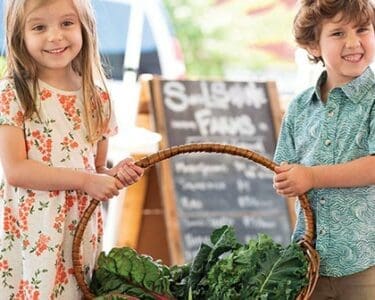
When looking ahead to each issue of Lynchburg Living, we are always planning our content with a big question in mind—what will the cover be? With a feature about farmers markets underway, Editor Shelley Basinger and Art Director Chris Meligonis were drawn to the idea of a bright, farmers market scene for the 2021 Summer Issue.

Chris envisioned having some kids be a part of the action and even suggested Shelley’s 4-year-old daughter, Camille, as being a good fit. Shelley decided to ask Camille’s best preschool friend, Lennox, to join.

On a sunny Saturday in May, Shelley and the kids met up with photographer Ashlee Glen at the Lynchburg Community Market. Brick Goldman, owner of Goldman Farm in Cullen, was such a good sport when asked to be a part of an “action shot.”

Best of all? Brick gave Camille and Lennox that carton of strawberries to enjoy.

Read the full story about local farmers markets starting on page 103!