A Home That Doesn’t Perform

In her 1924 Colonial Revival, Mia Mangold has created a space shaped by history, humor, and intention

By: Megan Williams | Photos By: Andria Fontenot

Life changes exponentially when you stop performing and stop caring who’s watching,” Mia Mangold said, standing in the dining room of her 1924 Colonial Revival home—a space layered with collected furniture, hand-upholstered pillows, and just enough evidence of daily life to make it clear no one here is trying to impress anyone.

Mangold laughed, almost as if to soften the weight of the statement. “It took me a long time to actually mean that,” she added.

It’s not a catchphrase she uses lightly. It’s an earned mantra—one shaped over decades of movement, reinvention, and saying yes to experiences that most people only daydream about, then learning when to stop performing altogether.

Mangold bought her Lynchburg home in 2019 after renovating a string of historic houses across the Hill City. The story of those homes—and the life she built around them—is literally displayed on the walls.
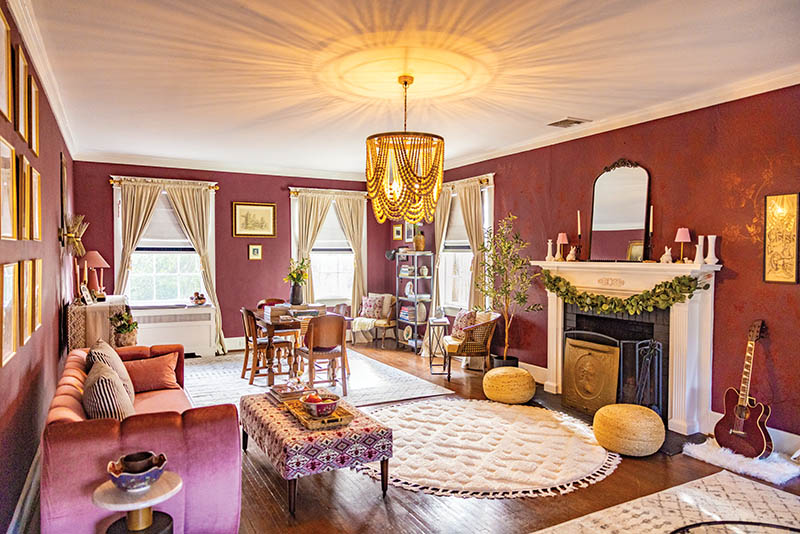
Decorative plates from Oxide Pottery line her living room built-ins, each illustrating a house she has owned, loved, and renovated in Lynchburg. She gestures toward them as if they’re old friends rather than milestones (though, to the outsider looking in, they are both).

“I’ve owned seven houses in Lynchburg, plus one in St. Pete [Florida], one in Austin [Texas], and one in New Jersey—so 10 total,” she said. “My first house in New Jersey was built around 1865, and it’s where Walt Whitman used to stay in the summer. There was a natural spring—I picture him sitting down there writing poetry.

It sounds cheesy, but as a kid I was an old soul, weird kid. New Jersey has so many old Victorians.”

To hear her describe her journey—from “old soul, weird kid” who grew up on the New Jersey–Philadelphia line to home renovator in Lynchburg—is to realize that Mangold’s life has never followed a straight line.

It’s shaped by an innate curiosity, a desire to see the world, and a penchant for never saying no to a good time.
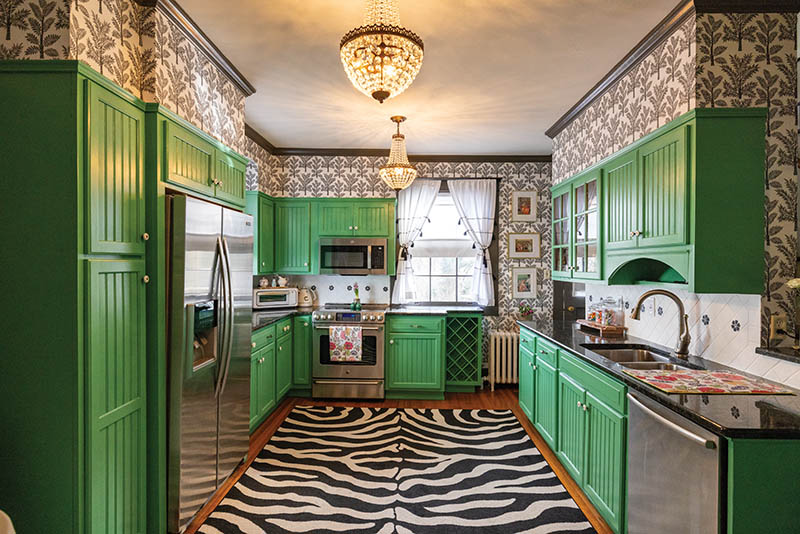
“I basically grew up in Philadelphia,” she said. “I lived 15 minutes away in New Jersey, near the Ben Franklin Bridge. Then I left for a while—lived in a car with my friends and went cross-country, ended up in San Francisco. I came back when I was 21 because my grandma got really sick. We thought she was going to pass, but she lived four more years and couldn’t be alone. I spent days with her; my mom slept there at night. I worked while getting my photography degree—I was a photo lab tech—and I worked at the Camden County Library in periodicals. I even worked at Staples, which was fun.”

By 24, Mangold had saved up enough money to buy her first home. It was then, staring down the beams of a 19th century Victorian, that her gumption grew even more.

“I didn’t have YouTube tutorials. I had old home and garden handyman books that taught me how to change a faucet or fix something,” she remembered, nodding to the corner bookshelf where her handyman books still reside. “My uncle worked at a lumber yard—he helped me with trim and molding.”

At the same time that she was teaching herself how to renovate her New Jersey home, she was also working at the historic Trocadero Theatre in Philadelphia’s Chinatown, where she worked until she turned 30. While she loved working as a concert promotor and then later a booking agent, the early load-ins and late-night shows eventually became too much. The housing market in New Jersey was booming and Mangold took a chance and sold her house.

“The housing market got high—when balloon loans were everywhere and rates were low—and I sold my house for three times what I paid,” she said. “Then I flew to Spain and didn’t come back for two years. I lived in Turkey, spent a lot of time in Greece, went to Australia, Asia… India for a while because it was affordable and I could stay longer. I was saving money because I knew I’d have to come back eventually and I wanted to buy another house.”

And she did.

After flying to Austin, Texas, for a wedding, Mangold planted roots once again—working at the legendary Red 7 venue, popular for hosting rock, punk, and metal shows. She also purchased a condo, which she sold a few years later for enough money to buy her first 5,000-square-foot home in Rivermont—with enough money left over for renovations.

“I saw a house online—I think it was on Madison—and I was like, ‘Where is this place?’ I thought: Is this magical fairyland? I could buy two old houses for what I could sell my one house for. So I made a list of 10 houses, found a local realtor, and she showed me all of them. I chose the Rivermont house—the big white house—it had an apartment in the back and had been a rooming house. It was fun to renovate. I was still tiptoeing into color because I was accommodating guests. I rented downstairs as an Airbnb. I didn’t want an all-white Airbnb with the same horse picture everyone has. I wanted it to feel interesting—bright, funky—something you don’t live in every day.”
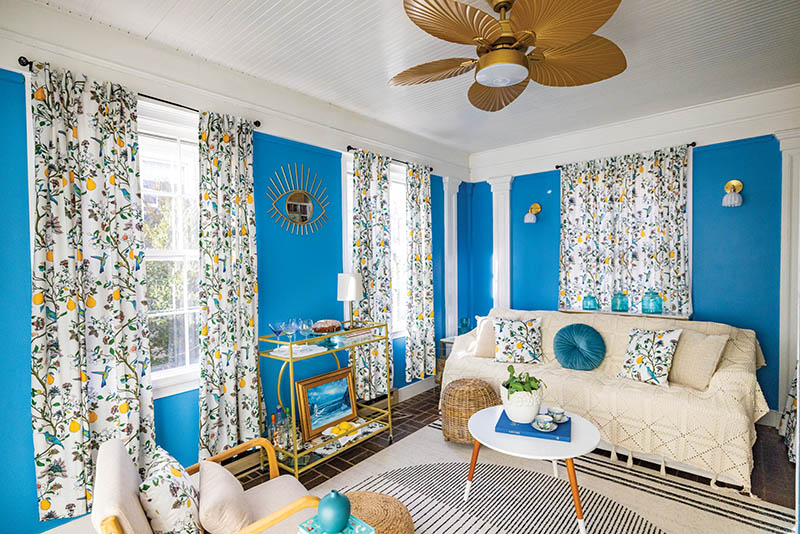
From there flowed a series of home purchases and renovations—some of which she held onto for a time as short-term rentals, and others she lived in or sold. All the while, Mangold was rolling up her sleeves, doing the work herself, and evolving her style even further.

“On Arlington [Street], I was taking out a vanity and the plumbing was corroded—it broke off and sprayed everywhere. I’m soaked, running into the basement, crawl space… water pouring everywhere—hardwood floors exposed,” she remembered, noting that the journey has been far from picture perfect, and that’s exactly how she’d prefer it. “Or when I moved here [to this house] the plumbing started leaking so I had to go in and fix it, patch the wall, put up a new ceiling… a week later, water’s dripping out of the vent. That stuff happens.”

Mangold doesn’t shy away from the uncomfortable. Rather, those messy moments are what make her story all the more interesting and all the more relatable. A small woman in stature, her lived experiences have made her a force of will and determination.
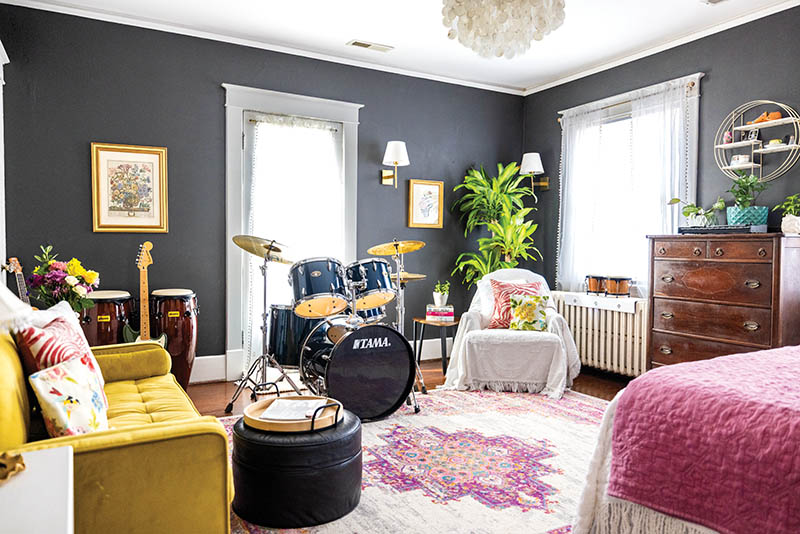
And it’s an interesting juxtaposition—the know-how to fix plumbing and patch the wall alongside of the person who can effortlessly style a room all while wearing vintage Doc Martens that have been meticulously preserved since the ‘80s.

Mangold’s life has never followed a straight line, and she has no interest in pretending it should have. The houses, the travel, the work—even the setbacks—have all been part of the same ongoing experiment: figuring out what feels honest, useful, and worth keeping.

In her Lynchburg home, there’s no performance—only layers of intention, curiosity, and care. It’s a place where old windows are left intact, mistakes are patched and repatched, and nothing is precious unless it’s personal.

For Mangold, that’s the point. Not perfection, not polish, just a life and a home that reflects exactly who she is, right now.


Rediscovering Jefferson’s Landscape

By: Ashleigh Meyer / Photos Courtesy: Poplar Forest

When we think about archaeology, most of us probably have a similar image come to mind: Sand swept deserts, long-buried pottery, delicate bones. At Thomas Jefferson’s Poplar Forest, archaeology is paramount to the preservation and restoration efforts of the property, but it often takes on an unexpected appearance.

Dr. Eric Proebsting has been a key part of the archaeological efforts at Poplar Forest since 2008. Much of his attention has focused on reconstructing Jefferson’s original landscape. Proebsting and a team of six other archaeologists slowly uncover layers of earth looking for evidence that they have reached the Jefferson-era. But they rarely uncover large artifacts. Instead, subtle clues in the soil tell them when they have hit their mark. Changes in soil color and density reveal long hidden planting sites. Plate fragments and other sundries once tossed out a kitchen window to the compost help to date the dig location.

Even the Jefferson layer itself reveals that the president tinkered with his design plan, making changes as the Virginia climate rejected his original vision or he didn’t like the way something looked.

In true Jeffersonian fashion, science and technology play a key role in rediscovering the original landscape. Phytoliths are trace minerals left over in decaying plant material that reveal important information about grass types, specifically if a grass preferred shade or sun. Through the study of these phytoliths, Proebsting’s team has been able to identify where clumps of trees were once planted. Pollen testing can give us clues about environmental changes and planting sites, and in the case of Poplar Forest, trace amounts of mulberry pollen were discovered in the archaeological layer, pointing to the species that had been planted there which was echoed in Jefferson’s own notes.

The property, once around 5,000 acres in size, was meticulously designed by Jefferson to serve as both a productive agricultural plantation, and as a retreat where he could clear his mind, collect his thoughts and enjoy intellectual pursuits. He was influenced heavily by the large, grandiose English gardens that he witnessed during his travels with John Adams, as well as contemporary landscape design. A shift had occurred by the end of the 18th century as designers turned from the rigid, symmetrical layouts that were popular previously and started creating spaces that reflected a more natural landscape. Observers can see Jefferson balancing these two ideals in his own plans for Poplar Forest.

A ten-acre square around the octagonal Retreat House was reserved for ornamental plantings where Jefferson explored his interest in landscape design. While Jefferson was the visionary, it was enslaved labor that brought it to life. Even while Jefferson was away at Monticello, traveling abroad, or otherwise absent, work on Poplar Forest continued in accordance with his design. The cobblestone carriage circle at the front of the retreat house was hand-dug and laboriously laid with stone, as revealed by the original road surface which had been excavated as part of the archaeological work on the property. Thanks to generous support from the Garden Club of Virginia, the original Jefferson-era road is protected under a new cobbled surface and a viewing box allows visitors to see underground, into the original cobbles.

While there is not an overabundance of source material to draw from, Jefferson did keep some notes on his landscape plans for Poplar Forest. We know that oval-shaped beds were placed on both sides of the north lawn of the retreat house, as well as directly in front of the home. During Proebsting’s excavation of the front lawn, archaeologists were able to identify the outline of the oval beds, as well as the remnants of planting holes where roses were once grown. Drawing on the gardening books known to be in Jefferson’s library, as well as what was planted at Monticello and accessible to the Poplar Forest plantation, antique roses were replanted in the oval beds and have now grown to be about the size that Jefferson likely would have seen during his lifetime.

Considerable work has been done to restore the double row of paper mulberry trees on the west side of the house, which would have provided shade to the porch as well as visual intrigue. Among other things, the particular species speaks to Jefferson’s interest in studying plantlife across the globe and bringing it home to test in the Virginia soil.

The clumps of trees near the front of the home have also been a large part of the archaeological restoration and reveal an intriguing fact about the third president. In 1812, Jefferson ordered four clumps of trees to be planted at the corners of the house. Species included black locust, tulip poplar, redbud, dogwood, and calycanthus shrubs, among others. The intention was for it to appear very natural, in keeping with the modern design ideas of his time. However, also in the same month it is noted that Jefferson borrowed a surveyors chain from a neighbor; a 66-foot length of chain used for mapping purposes. Despite his plan to make the tree clumps appear very natural, the trees are spaced at a precise 33-foot distance from one end to the other. He never could completely shake his love for symmetry, mathematics, and geometry.

His interest in Palladian symmetry served to create one of the largest and most noticeable geographic features on the property which remain clearly visible today. Two large mounds flank the east and west sides of the house, creating a sort-of visual frame and uniting the ornamental grounds with the built architecture. The dirt to create the mounds was removed from the south side of the house, where a large sunken lawn also creates visual intrigue. Archaeological investigation has suggested that the lawn was planted with geometric rows of shrubs and ornamental trees, while the mounds were adorned with willow trees and aspen to create an almost Greco-Roman oasis.

The digging of the rear lawn was carried out by enslaved laborers, with an enslaved man named Phill Hubbard leading the project. Hubbard had been born at Poplar Forest and often travelled back and forth from Monticello to work on various projects at both estates. Jefferson had inherited 11 enslaved individuals along with the property in 1773, and the number grew to just below 100, with the population ebbing and flowing over the course of his lifetime. In addition to bringing Jefferson’s ornamental vision to life, these enslaved individuals also labored in the agricultural fields. A project on the horizon for 2026 is the excavation of one of the quarters where enslaved people lived on the property, including their subsistence gardens, fence lines, and other archaeological data.

Restoring the landscape to its original grandeur is interesting and inspiring, and reveals a lot about Jefferson’s thought process and mind. However, Dr. Proebsting and the whole team at Poplar Forest is driven by more than a desire to create a beautiful landscape.

“It’s about people,” he said. “About all the people who lived here at Poplar Forest.”

His ultimate vision is to draw connections between modern day visitors and the folks who lived, worked and died on the grounds. With little written record of their day-to-day lives, archaeology is the looking glass that allows us to peer into the past and set our eyes on the actual evidence that remains of their lives and legacies, even if it is sometimes as quiet as a whisper, or as delicate as a change in the color of the earth.


2026 Lynchburg Best Of Party

Join us at the 2026 Lynchburg Living Best Of Party!

SEE EVENT RECAP HERE

When: January 31, 2026 | 6-9 p.m. Where: The Virginian Hotel

Come celebrate the winners of the 2025 Lynchburg Living Best Of Readers’ Choice Awards! This event is going to be extra special and extra fun! The event will feature live music to dance the night away, as well as delicious bites from local restaurants and cash bars. Plus, there will be a raffle off at the event with the raffle proceeds benefitting a local charity.

Each ticket includes:

  • Tastings from all restaurants
  • A drink ticket
  • Live entertainment: Local Call Band
  • General seating at a table

Tickets:  NO TICKETS WILL BE SOLD AT THE DOOR!

Participating Restaurants:

Entertainment:


Here’s How the World’s Longest Living Communities Eat—So Can You

“Blue Zone” diets explore how everyone can try to extend their life by making a few key food changes.

“Longevity diet” sounds like a trend, but what it really describes is a way of eating that feels almost old-fashioned: simple meals, cooked at home, shared often, and built from foods your great-grandparents would recognize.

As researchers look closely at communities where people remain active into their 80s and 90s, patterns emerge. They aren’t built on powders or promises. They’re built on beans simmering on a weekday stove, vegetables filling half the plate, olive oil glinting on a salad, and sweets saved for when they’re worth it. It’s less about chasing youth and more about giving your future self a better shot at feeling well.

In Central Virginia, the pieces are easy to find. A longevity-minded plate can come together from the farmers market, the produce aisle, or even your freezer: roasted broccoli beside brown rice, a ladle of lentil soup, a bowl of berries after dinner. The magic isn’t in any single ingredient. It’s in the steady, daily rhythm of choices that lower inflammation, steady blood sugar, and protect the heart and brain. Over time, those small advantages compound.

How to Eat a Blue Zone Diet

Protein is often the first question. Are we eating enough? Too much? The most durable longevity patterns hit a comfortable middle. They don’t fear protein; they simply choose it thoughtfully. Beans and lentils appear often, not as a penance but as comfort food—tucked into tacos, stirred into pasta, folded into soups. Eggs, yogurt, and modest portions of poultry or fish show up, too, usually as supporting players rather than headliners. For households avoiding fish, walnuts, chia, flax, and fortified products can help fill omega-3 gaps. The aim is to preserve muscle as we age without leaning on processed meats that add risk without much benefit.

Carbohydrates aren’t villains here, either. The difference between a grain that supports longevity and one that saps energy is mostly in the milling. Intact grains—oats, farro, barley, brown rice—bring fiber, minerals, and texture; highly refined flours bring speed but little staying power. In practice, that looks like pairing your carbs with something slow and satisfying: peanut butter on an apple, tahini over roasted sweet potatoes, a drizzle of olive oil and a handful of olives tossed through warm pasta and vegetables. You feel fuller, longer, and your blood sugar stays steadier between meals.

Woman enjoying a nutritious breakfast of fried eggs, salad, and cherry tomatoes with orange juice in her modern kitchen, focusing on a healthy start to the day

Simple Food Swaps For A Healthier Diet

Fat—so often maligned—plays a protective role when it comes from the right places. Extra-virgin olive oil is the backbone in most long-lived regions for good reason; its blend of monounsaturated fat and polyphenols supports heart health and helps the body absorb fat-soluble vitamins from all those vegetables. Nuts and seeds add crunch and calm, turning a simple salad into a meal and offering a bridge from lunch to dinner that doesn’t end in a 3 p.m. slump.

If there is a true hero of longevity eating, it’s fiber. Not the kind you buy in a tub, but the kind that grows: vegetables, fruits, legumes, and whole grains. Fiber feeds the gut microbiome—the trillions of microorganisms that help regulate inflammation, immunity, and even mood. When you give that ecosystem diverse, plant-rich meals, it returns the favor by producing compounds that protect the lining of the gut and the health of your arteries. It’s a quiet exchange you never see, but you feel it in stable energy and the ability to bounce back.

Fermented foods are another quiet helper. Cultures that age well often include yogurt, kefir, kimchi, sauerkraut, or miso in ordinary meals. You don’t need a fermentation crock on your counter; a spoonful beside dinner or a pour over granola is enough to diversify the beneficial bacteria in your gut. The point isn’t perfection. It’s frequency.

Lifestyle Changes to Extend Your Life

What about fasting? The most reasonable, sustainable approach is simpler than the trend stories suggest: finish dinner a little earlier, and allow your body a natural overnight fast—about 12 hours—most days. That gentle rhythm gives your metabolism time to reset without the stress of strict windows or skipped meals. It’s not appropriate for everyone, and it shouldn’t overshadow the basics: regular, unhurried meals with plenty of plants.

Alcohol sits in the “choose carefully” category. In long-lived places, it’s consumed modestly, usually with food, often in community. You won’t find nightly heavy pours in longevity research’s success stories. You will find tea, coffee, and lots of water—small rituals that mark the day and keep you hydrated.
Supplements? They’re the supporting cast at best.

A well-rounded longevity plate usually covers the bases, though a conversation with your clinician about vitamin D, vitamin B12 (especially if your diet is mostly plant-based), and algae-based omega-3s for non-fish eaters can be sensible. Be skeptical of “anti-aging” blends that promise sweeping results;
if something sounds like an elixir, it probably functions more like marketing.

Captured in a heartfelt moment, the man delights in his homemade salad while standing in the brightly lit kitchen. The comfortable blue sweater and elegant counter design highlight the joyful ease of his daily routine in a harmonious home environment.

Longevity Diets Are About…Well…The Long Run

Perhaps the greatest thing about a longevity diet is how well it pairs with an ordinary Tuesday.

You don’t need a chef’s kitchen or an afternoon free. You need a few staples you can reach for without thinking: a good olive oil, a jar of beans, a sturdy grain, frozen vegetables for nights when fresh isn’t in the cards, and a spice you love. Start meals by asking, “What’s the vegetable?” Then build around it. Roast a pan of whatever vegetables you have, toss with olive oil and herbs, and add protein to suit your household. Boil pasta and fold in white beans, cherry tomatoes, and spinach. Warm a pot of soup on Sunday and let it carry you through midweek.

And eat together when you can. The research on longevity always circles back to the table, not just what’s on it. Shared meals slow us down. They help us notice when we’re full. They anchor children’s routines and adults’ stress levels. In a culture tempted by speed, the decision to sit—truly sit—for dinner might be the most protective habit of all.

Longevity isn’t a cleanse, and it isn’t a finish line. It is, in the best sense, local: a way of stocking your pantry and shaping your week so that future you gets more mornings on the trail, more afternoons in the garden, more celebrations worth toasting. Start where you are. Choose the plant first. Drizzle the olive oil. Keep dessert special. Then repeat, quietly, in the background of a life that feels more energetic and clear. Years may be the headline, but day-to-day vitality is the real story—and that’s something you can taste.

RELATED CONTENT:

Healthy Restaurants in Lynchburg

Plant Based Eating Can Reduce Your Carbon Footprint


Maier Museum’s New Art Exhibition is a Celebration of Paint

Exploring Real, Tangible Art in an Age of Algorithms

By: Charlotte Farley | Photos By: Ashlee Glen

I don’t know about you, but I’ve been craving a return to a more analog kind of life, gravitating toward something that I can touch and hear without needing screens and Internet service. For my birthday, my husband gave me a stereo system complete with a turntable and CD player. When I finally listened to music through those killer speakers after years of streaming on Pandora or Spotify, the sound startled me in the best way possible. It was rich. It was bold. It was beautiful. That small shift back to analog made me feel what I’d been missing, which is exactly the energy behind the Maier Museum’s new exhibition Audacity: The 114th Annual Exhibition of Contemporary American Painting.

For more than a century, this annual exhibition has showcased contemporary American art in all its shifts and reinventions, and this year’s focus on painting feels both timely and strikingly fresh. This show is indeed a vivid display of what it means to have the audacity to create something purely from one’s own hands, with one’s own imagination and heart. In other words, how dare we be human.

The History of Maier Museum’s Annual Art Exhibition

The Maier’s annual exhibition series began in 1911, when Randolph-Macon Woman’s College committed to bringing the strongest contemporary American art to its students each year. For decades, that meant painting. The show functioned as a cultural gateway that introduced both the college community and Lynchburg at large to the best work emerging in the medium.

For the first half-century, the annual exhibition centered almost entirely on painting, but in the decades since, it has expanded to reflect the growing range of media explored by contemporary American artists. This year marks the first time in nearly thirty years that the exhibit returns to painting alone, echoing its earliest roots.

“It felt like time to revisit painting,” said Martha Johnson, director of the Maier Museum.

Maier’s annual exhibition

The Spirit Behind the Art Exhibition

Johnson explained that the spirit behind Audacity grows out of the moment we’re living in. Conversations about AI—its speed, its opacity, its uncanny output—have become impossible to ignore, and so much of the imagery we encounter now is generated instantly by software. In that landscape, returning to painting feels purposeful.

“We’re all feeling some uncertainty about where AI is going—or has already gone,” she said. “It isn’t something that’s ‘coming’; it’s blown past us, and that can feel very untethering.”

For Johnson, this exhibition is “a kind of answer to what’s happening. It’s a reaffirmation, a fearless reaffirmation, of the medium of painting.” And even as the show responds to all that technological drift, she hopes its effect is simple and human. “I want visitors to be delighted.”

Meet the Artists Behind Audacity: The 114th Annual Exhibition of Contemporary American Painting

The exhibition brings together four large-scale painters (Sally Egbert, Julia Jo, Sue McNally, and Walter Price) whose canvases radiate gesture and presence, inviting visitors into the physical presence of work shaped directly by human hands. Each selection embraces that physicality. One navigates gigantic, state-by-state landscapes after time spent outdoors. Another literally tosses paint onto canvas.

“Whether you’re using a brush, tossing paint like softballs, or pouring it the way Sally [Egbert] does,” Martha said, “there’s such physical pleasure in the act itself. What painting is, for all of these artists, is the pure joy of painting—the tactility, the sensuousness, the sheer joy of a pure color.”

The Experience of Maier Museum

The Maier Museum is intentionally welcoming. Admission is always free and there are various community programs, talks, and even camps for kids and other programs for high school students. Johnson wants a visit to the Maier to feel as normal as a stop at the library or a walk in the park.

“The default for a lot of people is thinking they don’t know enough to come here, or that it’s going to be expensive,” she said. “There’s no test at the end. We’re not trying to stump anyone. We just want people to come in and spend time with the art.”

Staff members aim to offer visitors a “hook”—just enough context about process or history to spark curiosity—without flattening a painting into a lecture.
For many regulars, the museum’s permanent collection has become something of a community of familiar faces. Visitors return to particular works like old friends within the richly colored galleries.

Maier Museum’s Hours and Exhibition Details

Above all, this exhibition extends an invitation: slow down, step close, and let color work on you. As Johnson puts it, “I would love for people to have had a joyful experience—to feel that painting is still a vital force—and to have set their anxieties aside for a moment and get lost in the art.”

Audacity reminds us that standing in front of paintings can be as surprising and alive as hearing music on real speakers again. It turns up the volume on what it means to be human. And painting, it turns out, still has plenty left to say.

ON VIEW:
October 19, 2025 – March 8, 2026
More Information: maiermuseum.org
Hours: Wed–Sun, 1–5 p.m.

RELATED CONTENT:

The Cold War History of the Maier Museum

Inside the Lynchburg Art Club and Gallery


A Q&A On The Virginia 250 Celebrations

Photo courtesy: VA250 Commission

The Virginia American Revolution 250 Commission is bringing the spirit of the American Revolution to cities all throughout Virginia, with an ambitious goal of visiting every middle school in Virginia.

A hands-on, interactive, and immersive “museum on wheels,” the VA250 Mobile Museum Experience titled Out of Many, One is housed in a quad-expandable tractor trailer that is traveling throughout Virginia and beyond. Guests visiting this unique traveling museum will embark on a journey through pivotal moments of our fight for freedom while learning about the Revolution’s key figures as well as the often-overlooked stories of the Indigenous Virginians, free and enslaved African Americans, and others whose efforts secured American independence.

Here, learners of all ages experience the Mobile Museum during its visit to the Danville Museum of Fine Arts and History in May 2025.

Carly Fiorina, National Honorary Chair of the Virginia American Revolution 250 Commission

Carly Fiorina, National Honorary Chair of the Virginia American Revolution 250 Commission

“America Was Made in Virginia”

Carly Fiorina, National Honorary Chair of the Virginia American Revolution 250 Commission, shares why the Commonwealth’s story—and its citizens—are central to understanding who we are as a nation and who we aspire to be.

Q&A with Carly Fiorina, National Honorary Chair –Virginia American Revolution 250 Commission (VA250)

As the nation approaches its 250th anniversary in 2026, Virginia is preparing to take center stage. The Virginia American Revolution 250 Commission—known as VA250—is leading the Commonwealth’s commemoration of the Semiquincentennial, a nationwide reflection on America’s founding, growth, and ongoing story. Through statewide programs, local events, and educational initiatives, VA250 invites Virginians to explore how “America was made in Virginia”—and what that means today.

VA250’s theme is “America was made in Virginia.” What does that phrase mean to you personally, and why do you think it’s an important message for Virginians today?

To me, “America was made in Virginia” is a reminder that this Commonwealth was the testing ground for so many of the ideas that still define us as a nation. The promise and the problems of America showed up here first. Early experiments in representative government, but also the grave injustices of slavery and displacement. Saying “America was made in Virginia” isn’t a slogan, it’s a responsibility. It means Virginians have a special opportunity—and obligation—to understand our history honestly, take pride in our progress, learn from our failures, and carry those lessons forward. If we do that well, we help the entire country remember who we are and what we’re capable of.

Virginia played a defining role in our nation’s founding—from early democracy in Jamestown to leadership in independence. How do you see those stories continuing to shape America’s identity?

Our national identity has always been rooted in ideas, not bloodlines or borders. Many of those ideas were debated, refined, and fought over here in Virginia. The notion that government derives its just powers from the consent of the governed, that people have inherent rights, that power must be restrained—those aren’t abstract concepts. They emerged from real people, on real soil, making real choices. When we remember that, we stop treating our system as something automatic or guaranteed. We see it instead as an inheritance that must be renewed. Virginia’s founding stories remind us that America is a work in progress, shaped by character and courage, one generation at a time.

As National Honorary Chair, what aspects of Virginia’s history do you most hope people rediscover through VA250 events?

I hope people rediscover the full story. Not just the familiar names and dates, but the countless men and women—well-known and unknown—whose grit, faith, ingenuity, and sacrifice moved history forward. I want Virginians to see how enslaved people, Native communities, women, immigrants, soldiers, and citizens all played essential roles. I also want us to reconnect with the idea that ordinary people, close to the problems, have always been essential to the solutions. When people see themselves in the story—not just as spectators of history, but as heirs to it—they’re more likely to engage, to serve, and to lead in their own communities.

The Semiquincentennial is both a celebration and a reflection. What do you hope Americans take away from this milestone?

I hope Americans come away with a renewed sense of gratitude and responsibility. Gratitude that we live in the only nation in history founded on ideas about human dignity and self-government—and responsibility to live up to those ideas. A 250th anniversary is not about nostalgia; it’s about perspective. We see how far we’ve come, how much we’ve overcome, and also where we’ve fallen short. Holding pride and pain together is hard work, but it’s what mature nations do. If we can do that together, we’ll emerge from 2026 with a stronger sense of who we are and what we owe to one another as citizens.

As a former Fortune 50 CEO and Virginia resident, how do you see leadership—past and present—playing a role in our state’s story?

Leadership is always about more than titles. In Virginia’s story and in my own experience, the most important leaders are often the ones closest to the problem who choose to act with courage and integrity. Our history is filled with famous leaders, but it’s also filled with teachers, pastors, entrepreneurs, parents, and community organizers who saw a need and stepped forward. Good leadership always holds freedom and responsibility together, rights and duties together. When leaders—whether in business, government, or the community—remember that their job is to serve, to listen, and to leave things better than they found them, they carry on the best of Virginia’s legacy.

If you could choose one takeaway for every Virginian to remember about our nation’s 250th anniversary, what would it be?

I would want every Virginian to remember that our history is not just something to admire or critique from a distance—it is something we inherit and continue. We are the stewards of a remarkable experiment in self-government, born in large part here in Virginia. That experiment has endured through wars, crises, injustices, and profound change because generation after generation chose to work toward a more perfect union. The question for each of us is simple: knowing this history, what will I do—right where I am—to strengthen my community, serve my neighbors, and live up to the ideals that made America possible in the first place? 


Inside Endura Wellness, A Boutique Wellness Clinic in Lynchburg

A nurse practitioner started Endura Wellness after personal medical struggles and now serves the community with personalized healthcare

By: Megan L. Horst | Photos By: Ashlee Glen

Brittany Brown, a nurse practitioner and owner of Endura Wellness, started her practice after experiencing health issues and frustrations with the traditional healthcare system.

“I had been medically gaslighted so many times,” Brown said. After multiple miscarriages and visiting numerous doctors who never discovered the root cause of her struggles, Brown finally found someone who would listen to her and look for the underlying cause of her health issues. Her personal struggle with her health led her to open Endura Wellness and instilled in her an even greater passion for helping people.

Left to Right: Brittany Brown, Owner, Nurse Practitioner; Daria Ray, Receptionist; Megan Ringi, Registered Nurse

Left to Right: Brittany Brown, Owner, Nurse Practitioner; Daria Ray, Receptionist; Megan Ringi, Registered Nurse

“If I can take my pain and make it a purpose and help others, then that’s what I’m going to do,” Brown said.

At Endura Wellness, they strive to offer personalized healthcare that finds and treats the root cause, rather than simply masking symptoms. In the months that they have been open, they have grown significantly, and she predicts an expansion in the future.

“It’s been a blessing,” Brown said, “As a human being, I was obviously very fearful in going into business by myself, but the good Lord—He literally has led us the entire way. So we are very very blessed, that’s for sure.”

The practice offers a variety of services, including bio-identical hormone replacement therapy, a weight loss program, IV therapy, and ozone therapy. Brown explained that she treats a lot of autoimmune disorders, and her practice is the only one in Lynchburg that offers high-dose IV vitamin C and ozone.

“We have a lot of patients who use [IV therapy] in combination with chemotherapy and radiation for cancer treatment or autoimmune disorders,” she said.
Ozone therapy is more commonly used in Europe. In the United States, it is considered to be a more controversial treatment.

“We use it for many different modalities, but ultimately what it does is help boost the immune system,” Brown said.

She has found ozone therapy helpful in supporting patients with autoimmune disorders, respiratory disorders, and other chronic conditions.

“Ultimately, what it’s doing is boosting white blood cells in order for your body to start fighting against whatever is going on,” she said.

The treatment typically takes about an hour and a half. The process involves using the patient’s own blood, which is infused with O3, an extra oxygen molecule. The blood is then slowly infused back under UV therapy.

“It’s not for everybody…there are safeguards behind it,” Brown said. “But it’s one of those things where the population that gets it and needs it, [finds] it very, very helpful to them.”

One of her passions is helping men and women balance their hormones, as she understands firsthand how hormone imbalances can affect overall health and daily life. Although when you think of hormone imbalances, it is more common to think of women’s struggles, she explained that men suffer from hormone imbalances as well. Men’s hormonal imbalances are often overlooked.

“A lot of times [men] present with severe fatigue or anxiety,” Brown said. “As their testosterone starts to drop, it puts them in grave danger of prostate cancer, dementia, and all of the above.” Hormone-related issues are becoming more of a problem, and Brown said she is seeing more hormone imbalances than ever before.

“And that’s probably multi-factorial,” she explained. “It can be environmental, obviously, a lot of things that we put on our hair and our skin have neurotoxins in them or endocrine toxins.”

Brown said that everyone will eventually go through hormone decline with age, but recently, they are seeing a trend of younger people having issues.

“We’re seeing men at the age of 35 declining at least one percent if not more per year,” Brown said. “Women, we’re seeing in their earlier 30s now instead of pre-menopause, which is thought to be in the 40s.” She explained that genetics can also play a role in hormone function.

Her method uses a combination of science-driven care and a more holistic approach.

“I try to take a very integrative approach as much as possible,” she said. Looking in-depth at thyroid, gut function, and quality sleep are just a few of the things she considers when looking at someone’s overall health.

She believes one aspect of her practice that sets Endura Wellness apart from others is that she personally takes time with every patient and listens to their story.

“When you come see me, especially for the first time, you get a whole hour with me,” Brown said. “I like to dive into your history and ask questions.
I want you to bring questions. With that is education. You cannot advocate for yourself if you don’t know what is going on in your own body. So, my job is to teach you that.”

She looks at her patients as part of her family and wants to be accessible to them. They have designed their practice to be welcoming and family oriented, creating an atmosphere that feels safe and open to everyone.

“My goal is to help everybody,” Brown said. “As many people as I possibly can.”

RELATED CONTENT:

Vie Wellness Club is Redefining Movement

FrostFire is Not Your Average Spa


2026 Top Lawyers: The List

Summary. To create the list, the Lynchburg Living contracted DataJoe Research to facilitate an online peer-voting process and Internet research process. DataJoe Research is a software and research company specializing in data collection and verification, and conducts various nominations across the United States on behalf of publishers. To create the list, DataJoe Research facilitated an online peer-voting process. We paired this with an Internet research process to identify success characteristics. DataJoe checked and confirmed that each published winner had, at time of review, a current, active license status with the appropriate state regulatory board. If we were not able to find evidence of a lawyer’s current, active registration with the state regulatory board, that lawyer was excluded from the list. In addition, we checked available public sources to identify lawyers disciplined for an infraction by the state regulatory board. These entities were excluded from the list. Finally, DataJoe presented the tallied result to Lynchburg Living for its final review and adjustments.

Final note. We recognize that there are many good lawyers who are not shown in this representative list. This is only a sampling of the huge array of talented professionals within the region. Inclusion in the list is based on the opinions of responding lawyers in the region. We take time and energy to ensure fair voting, although we understand that the results of this survey nomination and Internet research campaign are not an objective metric. We certainly do not discount the fact that many, many good and effective lawyers may not appear on the list.

Disclaimers. DataJoe uses best practices and exercises great care in assembling content for this list. DataJoe does not warrant that the data contained within the list are complete or accurate. DataJoe does not assume, and hereby disclaims, any liability to any person for any loss or damage caused by errors or omissions herein whether such errors or omissions result from negligence, accident, or any other cause. All rights reserved. No commercial use of the information in this list may be made without written permission from DataJoe.

Questions? For research/methodology questions, contact the research team at surveys@datajoe.com.


Here’s How to Spend a Perfect Winter Day in Appomattox, VA

If you’re looking for a winter escape that has a little bit of everything and is just a short drive from Lynchburg, Appomattox is a fantastic choice. This small town offers one of the most charming and unexpectedly cozy winter getaways in Central Virginia.

By: Abby Price

I grew up here before moving to Lynchburg, and I can personally vouch for its small-town feel, quiet historic streets, welcoming community, and fun things to do in the winter. It’s the kind of place where you can slow down, learn something new, and truly savor the season.

How to Reach Appomattox from Lynchburg

Appomattox is easy to get to from Lynchburg; it’s just a 30-minute drive southeast on U.S. Route 460. It’s a scenic drive through rolling countryside that feels especially peaceful in winter.

Start Your Morning with Coffee and Antique Shopping

Start your winter morning with a stop at Baine’s Books & Coffee, where the scent of freshly brewed coffee and warm pastries instantly sets the tone for a cheerful day ahead.

I’ve been browsing the shelves here since I was a small child, and it’s still my favorite place in town to order a coffee and wander through the aisles in search of my next good read.

It’s the perfect spot to settle in with a pastry and a book as you ease into a cold winter morning.

Once you’re warmed up, I recommend wandering over to Yesterday’s Bazaar; it’s the perfect place to look for antiques downtown. This homey store is perfect for escaping the cold while browsing for vintage decor, collectible finds, or that perfect, unique souvenir to commemorate your time in Appomattox.

Spend Midday Immersed in Appomattox’s Historic Past

Plan to spend your late morning and early afternoon exploring The American Civil War Museum, followed by the Appomattox Court House National Historical Park, where winter turns the historic village into a peaceful retreat. With fewer visitors this time of year, it often feels like you have the entire place to yourself.

I recommend starting at The American Civil War Museum so you can stay warm inside while diving into the stories, artifacts, and context that shaped the end of the Civil War.

It’s a rich introduction to the events that unfolded here—and it also gives the day a little time to warm up before you head outdoors to walk the actual grounds where some of our nation’s most pivotal moments occurred.

Enjoy a Cozy Lunch in Town

When you need a bite to eat, head to Taco Wagon for flavorful Mexican food. Known for their friendly service, tasty salsas, al pastor tacos, and hearty fajitas,
it’s hard to go wrong with anything on the menu. It’s the perfect spot for a quick lunch before heading back out to explore more of what Appomattox has to offer.

Spend the Afternoon Wandering Around Holliday Lake State Park

If you’re anything like me in the winter, you enjoy finding a balance—staying warm inside, but still getting outside long enough to enjoy the crisp air without freezing.

After you’ve warmed up with lunch, head over to the beautiful Holliday Lake State Park for a refreshing walk.

If you’re in the mood for a longer adventure, the Lakeshore Trail circles the entire lake and stretches about 6.5 miles, typically taking around two and a half hours to complete. If you prefer something shorter, the Dogwood Loop is less than half a mile and can be finished in about 20 minutes.

End Your Day with a Relaxing Dinner

End your evening with dinner at Carmine’s Pizzeria, where you’ll find classic New York-style pizzas and delicious cannolis. It’s the perfect way to unwind after a day spent exploring historic sites, browsing antique shops, and taking in the town’s charm.

While traditional pepperoni and cheese pizzas are always a hit from Carmine’s, the buffalo chicken pizza is a must-try for anyone looking to add a little extra kick to their meal.

Where to Stay Overnight

If you’re looking for an overnight stay with character, I recommend The Babcock House. With six bedrooms and one suite, it offers just the right amount of rooms so it feels lively without ever feeling too crowded. The breakfast here is also exceptional.

For a more traditional hotel experience, the Appomattox Inn and Suites is an excellent choice, offering plenty of rooms and a convenient location.

Even More to Explore in Appomattox If You Have Extra Time

If you have a little extra time in your schedule or you’re spending the weekend in Appomattox, consider adding Clover Hill Village to your itinerary. This historic village, created by the Appomattox County Historical Society, features several buildings that offer visitors a glimpse into the past.

Highlights include the Civil War Winter Quarters, built to show what Confederate soldiers used during the winter months, Wesley Chapel, one of the oldest churches in the county, and Hamilton’s Blacksmith Shop, where metalwork once took place.

The area is made up of original structures that were relocated, along with carefully replicated buildings based on old photographs. Altogether, it offers locals and visitors a look at Appomattox’s rich history and what life was like in the 1800s and early 1900s.

RELATED CONTENT:

White Bard Vintage is a Timeless Treasure Hunt

Up for an Adventure in Culpeper


2026 Best Of Readers’ Choice Awards Winners

The Lynchburg Living Best Of Awards are the result of an online voting contest on lynchburgliving.com, held from August-September 2025.

Voting took place for the entire duration of the contest with write-in nominations accepted for the first few weeks. Readers could vote one time per email address in as many or as few categories that they preferred. The winners listed inside this section are the ones that received the most votes.