

Forte Chamber Music Captivates Audiences with Intricate and Intimate Performances
By: Olivia Carter | Photos courtesy: Forte Chamber Music
For a taste of some of the world’s finest chamber musicians, Lynchburg audiences don’t necessarily have to travel to New York City, Washington, D.C., or another major metropolitan area. They can simply take a seat in a small Lynchburg venue.

That is the idea behind Forte Chamber Music, a volunteer-run organization that for more than two decades has quietly brought internationally acclaimed musicians to the Hill City—often musicians whose resumes would be equally at home on the stages of Carnegie Hall or other prestigious concert halls around the world.
Since its founding in 2004, Forte has built its reputation around giving local audiences the opportunity to hear exceptional chamber music in an intimate setting, often just a few feet from the performers.
Dudley Marks, president of Forte, said that intimacy is one of the organization’s greatest strengths.
“You really get to see what these people have had to put into their careers as far as practice and where they’ve been and the schools that they’ve been to,” Dudley said.
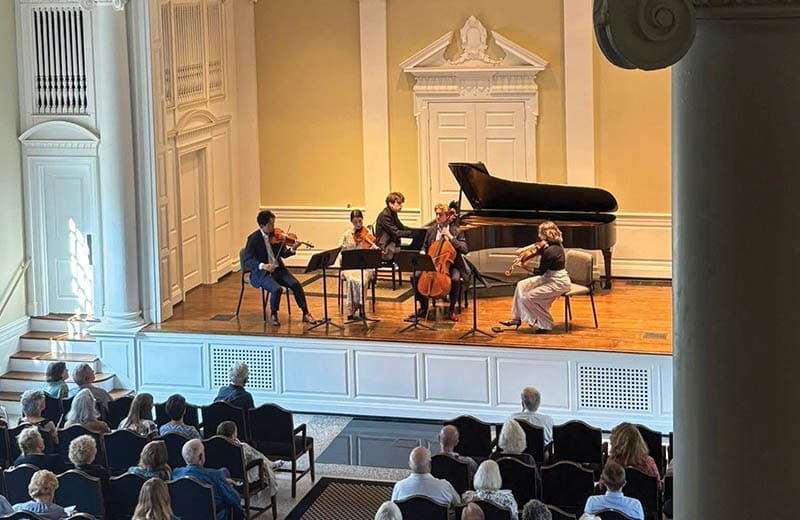
Viano Quartet with Albert Cano Smit (piano) perform at Wimberly Recital Hall at Randolph College. Photo by Farah Marks.
Chamber music itself is designed for that kind of close interaction. Unlike a large symphony orchestra, a chamber ensemble typically consists of a small group of musicians, each with an individual part. That might mean a string quartet, piano trio, cello, and piano or another combination of instruments.
Forte began as a small group of people, some connected to the Lynchburg Symphony Orchestra, who saw an opportunity to bring chamber musicians to the city without the expense associated with presenting a full orchestra.
The organization also benefited from the support of Minnie and Bernard Lane, longtime classical music enthusiasts who helped introduce Forte to pianist Gustavo Romero, a young musician they had supported financially. Romero was among the early artists brought to Lynchburg.
Over the years, the list of performers has grown considerably—and so has the caliber of talent. Dudley estimates that about 90 percent of the artists Forte has presented have won major fellowships or international competitions.
The organization has hosted musicians who have performed at Lincoln Center, Carnegie Hall, and other major venues, as well as artists associated with elite music institutions such as the Curtis Institute of Music, the Juilliard School, and the Colburn School. Some have been winners or medalists in major international competitions, including the Banff International String Quartet Competition, the Tchaikovsky Competition, and the Queen Elisabeth Competition.
Farah Marks, who is also involved with Forte, said the organization offers something different even within a city already fortunate to have a strong arts community.
“Lynchburg is fortunate to have a very rich arts culture,” she said. “We have opera. We have the symphony. We have all kinds of arts organizations. But what we bring is, I think, an opportunity for people to experience artists who are at the very top of their careers and craft.”

Shmuel Ashkenasi (violin) and Katharina Kang Litton (viola) perform with chamber orchestra at The Academy. Photo by Rick O’Neil.
That opportunity is particularly striking because Forte’s concerts are intentionally small. The organization typically draws about 120 people to a performance and has no desire to turn its concerts into massive events. Farah said 200 attendees would be about the maximum the organization would want because chamber music is meant to be intimate.
“There have been a couple of chamber groups down at the Academy and we’ve been to some at the Paramount in Charlottesville. But really, you don’t get the same experience if you’re in a big hall of 1,000 people or more,” she said.
In a smaller space, the audience can watch musicians communicate with one another in real time, exchanging glances, responding to subtle cues, and playing as a unified group.
“When you’re four feet from a cellist who’s just really into his part and really giving a great performance, or any musician like that and you see the give and take between the players and how they’re playing as one unit…it’s really thrilling,” Farah said.
Dudley compares the experience to watching a sporting event in person rather than on television. “You can watch the Indy 500 on television and it’s not the same thing as being at the racetrack,” he said.
The closeness also allows audiences to see something they might not notice from the back of a concert hall: the physical and emotional work behind an extraordinary performance.
Dudley remembers watching violinist Will Hagen perform in Lynchburg. Hagen, the highest-finishing American violinist in the Queen Elisabeth Competition since 1980, is an internationally acclaimed musician who has performed with major orchestras around the world. After one performance, Dudley noticed that Hagen’s suit was soaked with perspiration.
“People don’t realize the physical effort involved,” Dudley said. “To see these people up close, you realize what they’re putting into it.”
Forte performers frequently remain after concerts to talk with audience members, answer questions, and, in some cases, join small groups for dinner. At a recent event at a private home, for example, pianist Albert Cano Smit performed for about 65 guests and then stayed for another 30 minutes to speak with them.

David Ehrlich (violin), Richard Young (viola), and Shmuel Ashkenasi (violin), perform with Callisto Quartet members Eva Kennedy (viola) and Hannah Moses (cello) at the Maier Museum of Art at Randolph College. Photo by Farah Marks.
That accessibility is part of what Forte hopes will make classical music feel less intimidating. The organization also works to expand access for younger audiences. Students from kindergarten through graduate school can attend Forte concerts for free, and the group has developed outreach programs with area schools.
“We’ve formed a nice relationship with a young woman who heads up some of the gifted programming in Campbell County, and so we’ve been going out to those schools to do outreach,” Farah said. “That’s part of what I mean by the accessibility of it, just making it easier for students and others to be able to experience this kind of music.”
Musicians participating in those programs don’t just perform; they talk with students, answer questions, and introduce them to instruments and music they may never have encountered before.
For an organization with such an ambitious artistic mission, Forte operates on a surprisingly small scale. It has no paid staff and relies on individual donations, grants, and ticket sales. A volunteer board handles everything from selecting artists and arranging venues to marketing, publicity, and housing performers.
Even the process of choosing a season is personal. Forte looks for artists who have demonstrated exceptional achievement through competitions and fellowships, particularly younger musicians who are beginning their professional careers. The organization also tries to create variety, balancing string quartets with pianists, trios, clarinetists, and other combinations.

Ivan Zenaty, Czech violinist, at the Academy Center of the Arts. Photo by Rick O’Neil.
The organization brings performers who have spent years competing on international stages, practicing thousands of hours and establishing careers among the elite of their field, and places them in an intimate Lynchburg room where an audience member might sit just a few feet away.
The Markses believe that a live performance offers a chance to put everything else aside for a while. “When you come to one of these intimate chamber music concerts, you leave the world behind,” Dudley said. “It’s like it’s a respite from the world as it is.”
Farah added that the performances connect audiences directly with music that has survived generations. “It’s almost like studying the classics,” she said.
Some Forte musicians even perform on instruments dating back centuries, including Stradivarius and Guarneri violins. The result is an unusual meeting of past and present: centuries-old compositions, historic instruments, and musicians at the peak of their careers, all brought together in a small Lynchburg venue.
Audiences don’t have to travel to Carnegie Hall to experience that singular magic. For a few hours, Carnegie Hall can come to Lynchburg.
To learn more about Forte Chamber Music, visit fortechambermusic.com.


