One Idea, Many Doors

How Traber Ranch’s growing collection of concepts is reshaping downtown Lynchburg—one space, one experience at a time.

By: Olivia Carter  |  Photos By: Ashlee Glen

A string of new businesses is unfolding along Main Street in downtown Lynchburg.

Owner Melanie Traber has a growing portfolio of concepts under the Traber Ranch umbrella. What started as a simple idea—a small store and coffee shop—has quickly expanded into a network of distinct but interconnected spaces: Trading Post by Traber Ranch, The Vault, TBR Bistro, Lonestar Market and Café, and the Boiler Room.

Although it may sound ambitious, Traber said that this wasn’t part of some grand master plan. “Just one thing after another is kind of how it happened.”

She saw a gap downtown at the start. “There were no stores to go to,” she said. “You have to go to Madison Heights or out Wards Road just to get something simple.”

That inconvenience planted the seed for what would become the Trading Post, a hybrid retail shop and coffee space designed to serve both practical needs and create a reason for people to linger downtown.

The building itself helped shape what came next.

“We saw the back space of it, which is absolutely beautiful, and thought, well, if we were in this, we could do the store, a coffee shop, and maybe rent out the back for weddings,” Traber said.

But like many of Traber’s ventures, the concept evolved organically.

A basement space, initially little more than a cleaned-out shell, transformed after a suggestion from her son.

“He said, ‘What if we put pool tables in that downstairs area and had that as a bar?’” she said.

That idea eventually grew into what regulars now refer to as the “speakeasy,” adding an entertainment layer to the Trading Post and laying the groundwork for a broader vision.

As the Trading Post gained traction, another opportunity emerged—one that would expand the concept beyond retail and into nightlife. Behind the original building, Traber and her team introduced a music hall complete with a stage and professional sound system, driven in part by a personal motivation.

“My husband loves live music, so we ended up deciding to build a stage and have live music events,” she said.

The result is a space that blends casual Western-inspired charm with live entertainment, creating a layered experience that invites visitors to move between spaces rather than stay in just one.

That “movement” between concepts has become a defining thread across all Traber Ranch businesses. “They’re all individuals,” Traber explained, “but they’re all so close to each other so people do like to go from one thing to another.”

Just down the road, another historic building presented a new opportunity at 1030 Main Street.

“It’s absolutely beautiful, an old bank, and the ceilings are just incredible,” Traber said.

Rather than replicate the Trading Post’s casual feel, this new business, called The Vault, leans into a more elevated nightlife experience while still maintaining the accessibility that defines Traber’s approach.

“We could rent it out on the weekends and probably do even better,” she admitted. “But we really want people to have some place to go and to get to enjoy some of these buildings.”

Inside, the space is intentionally varied. Different rooms offer distinct aesthetics, from teal-walled lounges to more dramatic bar settings, giving guests multiple atmospheres within a single venue.

Beneath The Vault is another concept: TBR Bistro, located in the former Bull Branch restaurant space.

“I think the most excitement comes from people who used to go to Bull Branch,” Traber said.

To honor that legacy, the team has incorporated subtle nods to the former restaurant, including menu inspirations and design elements. “We put a bull head up to kind of pay homage to that,” she added.

As the Traber Ranch footprint expanded, so did the practical realities of running multiple businesses, including leftover equipment from earlier ventures. Instead of letting it go to waste,
Traber saw yet another opportunity.

“We were looking at all this equipment, and it’s like, what are we going to do with all this? We could just open another coffee shop and store,” she said.

That decision led to Lonestar Market and Café, located in the former Market on Main space. Building on the Trading Post model, it offers a larger footprint, a full kitchen, and expanded grab-and-go options like casseroles and prepared meals.

The concept blends convenience with the brand’s signature Western aesthetic, while also reinforcing Traber’s original mission of making downtown more functional for everyday life.

Located beneath Lonestar is TR Boiler Room Steakhouse. Originally envisioned as a traditional full-service restaurant, the space has been reimagined as something more experiential. Instead of daily service, the Boiler Room will focus on curated events such as chef-inspired dinners, wine and bourbon pairings, and private gatherings. “We really focus on the entertainment side of things,” Traber said.

Plans also include chef’s table experiences, holiday events, and themed evenings on what Traber describes as one of downtown’s most overlooked features, including a newly renovated patio. “We’re going to do bourbon and cigar nights and wine and cheese nights,” she said.

It’s a shift that reflects a broader trend across all Traber Ranch ventures: turning dining into an experience rather than just a meal.

While the businesses are planted in downtown Lynchburg, their identity traces across the river to Amherst, where Traber Ranch spans 500 acres. There, the family raises full-blood Wagyu cattle, which translates directly to the dining concepts.

“We have a place where, if we wanted to sell our Wagyu beef, we could,” Traber said.

Despite the momentum, growth hasn’t come without challenges. From extended road construction that once reduced business by 90 percent to ongoing infrastructure issues like parking and trash services, Traber says operating downtown requires persistence. Still, she believes in the potential and necessity of creating more for the community.

In the future, Traber sees her collection of spaces not just as standalone venues, but as a connected experience. Plans are already underway for events that span multiple locations such as an “adult prom” that moves guests from dinner to drinks to dancing across the different concepts. But for now, she hopes to slow down for a bit.

“I hope that there’s a little bit of relaxation,” Traber said with a laugh.  


2026 Lynchburg Restaurant Week

Experience Lynchburg Restaurant Week
June 13-20, 2026!

Get ready to indulge in the culinary delights of Lynchburg during this year’s Lynchburg Restaurant Week, brought to you by Lynchburg Living magazine. From June 13 to June 20, nearly thirty of our city’s best restaurants will open their doors, offering specially crafted three-course menus that showcase the local flavors and talent that make our food scene so exceptional. Whether you’re revisiting old favorites or trying something new, this is the perfect opportunity to savor the hard work and creativity of our local chefs.

From innovative appetizers to mouthwatering entrees and decadent desserts, Lynchburg Restaurant Week invites you to enjoy delicious meals, all while supporting our community’s vibrant restaurant culture.

And don’t forget—if one of our participating restaurants leaves you wowed, you can cast your vote at lynchburgrestaurantweek.com!

The winning restaurant will receive well-deserved recognition and exciting prizes. We hope you’ll join us in celebrating the flavors that make Lynchburg unique.


Welcome Hill City FC

Soccer has deep roots in the Hill City, and this spring, those roots will bring forth new life when a local United Soccer League 2 (USL2) team debuts at City Stadium. 

By: Carrie Dungan / Photos By: Ashlee Glen

Hill City FC, a semi-professional soccer team, is the culmination of one local player’s dream to give back. 

Growing up in Lynchburg, Anthony Catalano first picked up soccer as a preschooler playing with the YMCA.

Those early days ignited a lifelong passion for the beautiful game. Catalano would go on to cultivate his skills on teams at Lynchburg United (now Central Virginia United), Holy Cross Catholic School, and E.C. Glass High School, before becoming a captain of the Division I soccer team at Elon University and a professional player with the Charleston Battery and Richmond United. 

Once his playing career was over, Catalano wanted to find a way to pour back into the sport that changed his life. He knew personally the difference professional and semi-professional leagues could make in a young player’s career, from exposure to higher levels of play to establishing community. 

So, in 2020, he founded the semi-pro team Apotheos FC in Atlanta, where he currently lives with his wife and three young children. 

default

“I felt like this was just a great way for me to contribute to the passion that I have and the game that gave me so much,” Catalano said. “I think it just builds so many relationships and connections from the players that you play with to the coaches that you’re coached by, and it’s just a network that opens up so many opportunities for players.”

During that time, Catalano’s love and commitment to his hometown remained strong as he and his family continued to invest in Lynchburg’s revitalization.

“I think it has everything that you could want, from a great place to raise a family to the outdoor access, to living in Central Virginia and being so closely connected to pretty much anything that you need to get to and experience,” he said. “I think it’s just a great community.” 

After finding success with Apotheos FC, and with soccer projected for its biggest growth period in U.S. history through the FIFA World Cup this summer, Catalano knew the time was right to introduce a USL2 team to his hometown. 

As a young player, he didn’t have a high-level soccer team to root for in Lynchburg, and Catalano wanted to provide that opportunity for the next generation. He partnered with Michael Hitchcock, an experienced soccer executive and owner/co-owner of nearly two dozen soccer clubs, to establish a new Lynchburg team that would serve as a source of community pride and inspire young athletes by providing a pathway to a semi-professional team. 

Like Catalano, Tyler Beck spent many of his days as a young player on Lynchburg soccer fields, including City Stadium. The current Liberty University goalkeeper always had dreams of playing professionally but never imagined it could start in his own town. 

“I knew it had the potential, but I just didn’t know that anybody could see Lynchburg for what it could be,” Beck said. “I think that the fact that somebody spotted that Lynchburg’s a perfect place for a USL2—it’s awesome.

It makes me happy because this is a really cool city.”

Earlier this year, Beck became Hill City FC’s first signed player—a milestone he will never forget. He said the honor gives him additional motivation in the team’s inaugural season as he plays on the same field where he stopped shots as a high schooler. 

“It’s exciting to know that this season has more of a weight on it in a sense that we’ve got something to prove,” Beck said. “We want to put ourselves on the map and let everybody know Lynchburg’s here and we’re not messing around.”

Beck is a cornerstone of Coach Lucas Paulini’s lineup, which consists of players from colleges and universities across the country. Paulini, who also serves as an assistant coach with Virginia Commonwealth University’s men’s team, echoed Catalano’s desire for Hill City FC players to serve as ambassadors. He said he is cultivating a team culture that focuses on commitment to the community and serving as a role model for younger players. 

“Although winning is very important, I don’t think anybody’s going to remember 10 years down the road how the team did, how many games they won, but they’re going to remember the way the team made them feel,” Paulini said.

Paulini and Catalano said one of the biggest advantages of having a USL2 team in Lynchburg is the exposure to higher-level opportunities for both the city and the players. USL recently introduced promotion and relegation, meaning teams can move up to a higher division. Many USL2 players are also drafted into Major League Soccer.

Lynchburg is now home to Virginia’s highest level of soccer competition south of Richmond with the addition of this new team. When Hill City FC players take to the turf in May, they’ll join a bustling local soccer scene of youth and college teams and another semi-pro club, creating a ladder in Lynchburg that can launch players to professional soccer careers.

Hill City FC can serve as the catalyst for those players to elevate their game.  

Opportunities with Hill City FC aren’t restricted to just players and coaches. Catalano said a crucial piece of the club lies in the support team, ranging from social media to branding and game day production. The club will remain active throughout the year, engaging with the community at events and working with interns from local colleges and universities to create the best possible environment for the next season, giving these interns invaluable experience working with a professional sports organization. 

Since its inception, the team has prioritized community engagement with locals voting to pick the team’s name, logo, mascot, and mascot’s name.

The club has also prioritized partnerships with local organizations and companies such as Collaborative Health Partners. Hill City FC creates a “shared experience” for locals from all ages and backgrounds to rally around, according to Lauren Bennett, vice president of culture and communications with Collaborative Health Partners.

“Whether it’s families attending matches, kids seeing local athletes compete at a high level, or community partners coming together to support a common goal, it builds a sense of pride and connection that extends beyond the field,” she said. “It gives Lynchburg something to celebrate together, and that kind of collective energy is incredibly powerful.”

Catalano said fans can expect an exciting game day environment, with pre-game tailgates and local vendors including Taco Jesus and Three Roads Brewing available inside the stadium. Some fans have already created a “12th man” supporter group called the River Watch to cheer on the city’s newest team. 

Beck said when he steps back onto that familiar field in May, he is looking forward to playing for something
bigger than himself as the team works together to connect both players and locals to the club. 

“I’m expecting it to be jumping,” he shared with a smile. 

Catalano concurred, reflecting on the roots he established as a high school player at City Stadium and the “electric” atmosphere he’s anticipating for home games there this season. 

What he’s looking forward to the most? That’s easy, he said. 

“The first goal that we capture, and seeing the stadium just light up,” Catalano said. “I think that’s going to be the moment.”  


Destination Sweet Briar 

Summa Cum Surprising!

By: Marisa A. Marsey / Photos Courtesy: Sweet Briar College / Photo Above Courtesy: Cole Pillow and Susan Sietz

Psst. Want the name of Central Virginia’s most appealing getaway you’ve never heard of? Sweet Briar College (SBC). OK, so you probably have heard of the esteemed women’s liberal arts and sciences college in Amherst County, hugging the base of the Blue Ridge Mountains, but bet you didn’t know that it should be on your “must-visit” list. Even if you’re not looking to matriculate.

Sweet Briar is in a sweet spot between Charlottesville and Lynchburg, and its on-campus Elston Inn—an inviting, 38-room, pet-friendly boutique hotel decorated with a light Early American touch—makes an excellent launching pad for touring the area’s rich history and natural splendor. But if
you’re into food and wine, you don’t necessarily have to venture beyond its rolling verdant hills.

That’s because sprawled across 2,840 acres, SBC grows its own vegetables, makes its own honey, and begets award-winning wines. As you drive along U.S. Route 29, you’ll espy sloping rows of cabernet franc and cabernet sauvignon vines. That’s the campus’s lower vineyard. There’s also an upper vineyard planted with chardonnay and merlot.

The focus on agriculture and sustainability at the 125-year-old college has mushroomed since devoted alumnae swooped in to save their alma mater from closure through a successful legal challenge and generous donations in 2015.

“We have an incredible campus landscape that has long been integrated with our curriculum, and with the addition of the 26,000-square-foot greenhouse, 20-hive apiary, and nearly 18 acres of grapes, we have enhanced the hands-on experiential learning opportunities for our students,”
said Dr. Lisa Powell, vice president of academic affairs and dean of the college.

In the vineyards, the syllabus covers everything from pruning and estimating yields to determining when grapes are ready to be picked. The wine is then made in a custom crush facility near Charlottesville founded by Michael Shaps, a leader in Virginia’s wine industry, where students help work the bottling line.

Apparently, someone’s been doing their homework. Sweet Briar College Farm’s debut independent vintage from the 2023 harvest shone at the Virginia Governor’s Cup competition in 2025. “Earned the Rosé,” a dry, merlot-based rosé named for the school’s tradition of bestowing a rose along with a diploma at graduation per its motto, “She who earns the rose may bear it,” captured gold, while “Leading the Way Chardonnay” and “Meadow Merlot” took home silver medals.

Over at the greenhouse, which features both soil and hydroponic growing spaces, an automated environmental control system, and pink grow lights (for an effect that upholds the school’s colors: pink and green), any of the college’s 400 students taking Ag Op (Agricultural Operations) courses get their own plot and the autonomy to cultivate whatever they choose.

The result is brilliantly colored, crinkly rainbow chard as gargantuan as if sprouted from magic beans, candy-sweet cherry tomatoes, plump eggplants, brisk lettuces like romaine, red gem, and Batavia, peppers spanning the alphabet from bell and habanero to shishito, cucumbers, a plethora of fragrant herbs, and more.

The bounty is sold to local restaurants, caterers, a retirement facility, a private school, and a distributor, and fills C.S.A. (Community Supported Agriculture) baskets for the community. The lion’s share (make that the Vixen’s share, since SBC’s mascot is a female fox) supplies Prothro, the airy student dining hall. If you stay at the Elston Inn (which serves complimentary continental breakfast including apple cake and SBC honey), you’re welcome to dine there, to savor the hyperlocal fruits of their labor, er, learning.

For a postprandial, apply yourself to 20 miles of trails that meander past two lakes and a boathouse, stables, a butterfly research garden, and a wildflower meadow. Stroll amidst the stunning Georgian Revival buildings, one of the largest collections of Ralph Adams Cram architecture in the nation.

“It’s really an all-season destination,” shared Brian Stanley, director of hospitality for the Elston Inn and its adjoining conference center which border a sanctuary of white oaks hundreds of years old. He catalogs the many campus events open to the public throughout the year such as a Van Der Meer adult tennis clinic, Richmond Symphony performances, equestrian competitions, and gourmet tastings.

Elston Inn guests are welcome to use the Fitness & Athletic Center (yes, there’s a men’s locker room—though you may prefer showering back in your room as it’s stocked with hair and skincare products showcasing SBC honey). Later, sink into a plush chair with a good book at Daisy’s Café, a cozy corner for specialty coffees, light lunches, and snacks.

There’s no whiff of institution here, especially at The Book Shop. It sells textbooks, certainly, but with fabulous fashions, home, and gift items, so much dripping in pink and green, this store deserves a Pulitzer. A Lilly Pulitzer.

If you can pull yourself away, visit Ankida Ridge, Lovingston, and Rebec, all celebrated wineries nearby, or venture into the quaint town of Amherst. Ruffles, Lace & Grace Boutique offers lovely women’s apparel, while Old Soul Vintage and Warehouse Antiques entice with shabby-chic and eclectic treasures.

You’ll find SBC wines at The Briar Patch, where three generations take pride in scratch-made American comfort food. Bonfire, known for its Southern-rooted, wood-fired cuisine, features the college’s wines, too. Chef-owner Brandon Castro Pruett established his locavore bona fides at the Biltmore, and sources SBC’s produce as well as beef from Tucker Family Farms, 5 miles away.

You might just run into Bill and Claudia Tucker there (such are the charms of small towns). They were named “Commercial Producers of the Year” in 2000 by the Beef Improvement Federation, and Bill will passionately describe how he calculates the marbling differential among his multiple breeds (though you might need a Ph.D. to comprehend his formula; just nod and savor that luscious burger).

Back at school, check out the Sweet Briar Museum and art galleries (by appointment) whose collections contain medieval manuscripts, 20th-century femmage (feminist collage), and works on paper by Rembrandt, Picasso, and Goya. Thankfully, there’s a full-service post office on campus, too; you’ll want to send postcards to all your friends saying, “Wish you were here!”  

134 Chapel Road, Sweet Briar, VA, 24595. 434-381-6100.
sbc.edu


Minding Midtown

Penny Lane Properties Focuses Revitalization Efforts on Fort Avenue

By: Emily Mook / Photos Courtesy: Daryl Calfee / Photo Above: Palmera House Photo by Ashlee Glen

Daryl Calfee holds—and has historically held—an impressive number of professional titles, but his self-appointed moniker “Big Believer in Lynchburg” may very well be his most prominent, enduring, and inspiring designation.

You do not need to converse with Calfee for long to become aware of his steadfast passion for and action-backed investment in the Lynchburg community, but you will undoubtedly want to keep the conversation going to see what he has planned next in his ongoing efforts to improve and enrich life in the Hill City.

As the owner of Penny Lane Properties, a Class A Commercial and Residential Construction and Development firm that he (along with his first wife, Johanna, who passed away in 2023 after a courageous battle with cancer) established in 2009, Calfee has spearheaded adaptive reuse projects that now house some of Lynchburg’s most beloved commercial spaces: Casa Nueva Events, Palmera House, Taco Jesús, Golf Park Coffee Co., Farm Basket, Bentley’s on Bedford, Mission Thrift on Bedford Avenue, Marsh Roots Seafood Company, Truss Restaurant, Scratch Pasta Co., Bacon St. Bagels, Teachable Moments Preschool, Benaiah Prints Co., and Super Rad Arcade Bar, among others.

Over time, Calfee and the Penny Lane team—which currently includes COO John Rerick, Jesús Ochoa on project management, Brittany Sydnor on interior design, Brandon Sydnor on budget and finance, and Billy Hansen on commercial real estate—have shifted from an initial focus on rebuilding and restoring residential properties to a focus on commercial projects that more directly impact the community as a whole.

“We started out mostly doing residential flips, and that moved into commercial spaces,” Calfee remarked. “Our first project was a commercial space downtown in 2009, but after that, we couldn’t find anything else downtown, so we ended up doing a couple of residential projects next. Then, we moved on from those back into commercial because I wanted to hold on to everything that we did. I know that fixing and flipping are cool and show-worthy, but for long-term redevelopment and the betterment of our city, I wanted to do bigger projects that we could hold on to.”

When it comes to choosing commercial projects, Penny Lane seeks out spaces that have storied pasts and the potential to tell new—and often very different—stories in the future.

“We love doing the projects that nobody else wants to do,” noted Calfee. “When things have character, patina, and age to them, they create a different nature in your community than new construction does—not that there’s anything wrong with building new construction commercial, because we all need that for development—but old buildings just have so much character of their own, and we love bringing that back to life.”

As indicated by the aforementioned list of the firm’s commercial projects, Penny Lane has effectively breathed new life into Bedford Avenue. Having gained valuable insights from that work, the firm is now focusing its revitalization efforts on a bustling but largely underutilized area in Lynchburg: Fort Avenue.

“Fort Avenue was an untapped space,” Calfee said. “You’ve got a high traffic count and a key location in the middle of the city, but the truth is that it’s been underutilized and forgotten for so long. I had the opportunity to buy five buildings in a row from an old friend, and we were about to finish up Bedford Avenue. Looking at what we learned from Bedford Avenue, we said, ‘If we had acquired all of our Bedford Avenue properties at one time and redeveloped them as we went there, we would have paid less and we would have seen the benefit of increasing the property values around us—which, instead, we just had to pay for.’ I think that what we learned from Bedford Avenue is what we want to take to Fort Avenue.”

After buying those five buildings, Calfee—along with his wife, Erica Kerns-Calfee—discovered a former dry cleaner’s building on Fort Avenue and transformed it into event venue Casa Nueva, which opened last year. They subsequently bought the Bee Line garage building from Kevin Jones, owner and president of Bee Line Transport, Inc., and they plan to bolt Casa Nueva and the garage together and build up on the garage.

“We’re planning to add some rooftop terraces,” Calfee added. “If you can imagine, it’s the Fourth of July at the Hillcats Stadium and there’s a semi-pro soccer game happening over there—it’d be a cool spot to be in to watch fireworks.”

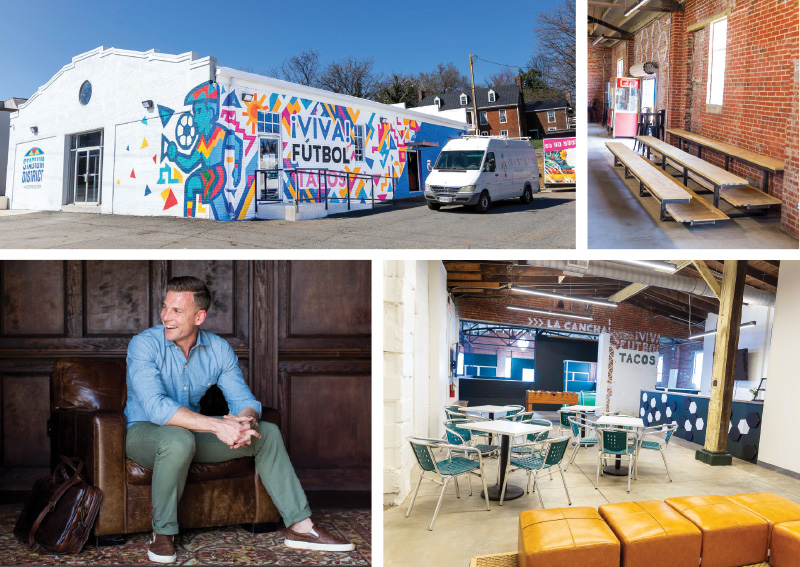
Penny Lane’s work at the other five Fort Avenue buildings has kickstarted with an exciting dual development that marries a fan-favorite sport (soccer) with a fan-favorite cuisine (Mexican): Stadium District Indoor Soccer and a second Taco Jesús location, both of which launched in March.

The project has been one of the most involved that Penny Lane has taken on yet—the Taco Jesús building did not have a roof—but Calfee said that it has also been one of the most rewarding projects yet.

“These buildings, every day, once you rebuild them, move into a state of decay if you’re not constantly maintaining them,” he remarked.

“As people age and end their careers, and as their financial resources change, they just don’t have the ability to maintain these buildings in the same way. That creates opportunities for guys like me to come along and say, ‘Hey, I can look at this with new eyes, and we can put something different in here.’ That place has been auto parts for the last 70 years or more. What we saw was something completely different, and I think that’s part of the ‘American Dream’ story. Not only are these old buildings getting new life, but there’s also this idea that there are people who might have been marginalized before who now have the opportunity to chase down that ‘American Dream’ by being part of these kinds of projects.”

Depending on how the venture goes, Calfee noted that an expansion into the building next door is possible and could allow for the addition of more fields and bigger fields. Redevelopment is also currently ongoing at the former site of The Carpet Shop, and Penny Lane is adding a new building and an infill lot in the middle of the two buildings for a mixed-use commercial, residential, and office space. The firm also recently completed work on the Humbles Building on Fifth Street.

With so many irons in the fire—Calfee is also the director of marketing at Hurt & Proffitt and a father of three children, among other roles—one may wonder how he does it all. While that question seems unanswerable, Calfee credits Kerns-Calfee, his friends and colleagues from both of his occupations, and others for their own tireless work and for their unwavering support of his endeavors.

“For me to have been carrying so much for so long, then for Johanna to pass, then for me to be a single dad, and then to find love and a partner in Erica—that’s an important part of my journey,” he said. “Having friends locally is a big part of my journey, too. When you think about the subcontractors and partners that we have in redevelopment, we’ve got some really great friends who do great work. We couldn’t do what we do without them. And then you think about finances; we couldn’t do what we do without folks like Luke Towles at Pinnacle [Financial Partners], Sherri Sackett at Select [Bank], H.B. Hunter at First Bank [and Trust], and Brent Jenkins at Freedom First [Credit Union].”

No matter what the future holds for Calfee in his many ventures, one thing is for certain: his love for and commitment to the Lynchburg community are for life.

“Being part of our city and improving our city are the most rewarding things about what I do,” he stated. “I love Lynchburg. Yes, my primary residence is across the county line, but that doesn’t change the fact that my entire portfolio of properties is in Lynchburg because I love it! We want to be here. We’re not outsiders—we don’t come in from somewhere else, make our money, and move out. In fact, we’re the opposite: We’ve invested all of our own money into these properties in order to make Lynchburg a better place to be. We’re just big believers in Lynchburg.”  

This article was originally published in the April/May 2026 issue of Lynchburg Business magazine.


Artist Profile: Alexandra Milhous

Perfecting Pottery: Local artist creates masterpieces, builds community in Lynchburg

By: Christian Shields | Photos By: Ashlee Glen

Through her love for pottery and people, Lynchburg artist Alexandra Milhous creates incredible ceramic pieces and educates others how to do the same.

Milhous began her pottery journey years ago as a student at Virginia Tech, where she took a couple ceramics classes while studying interior and industrial design.

After moving back to Lynchburg, she continued to study the medium and eventually purchased a kiln and other pottery equipment. Since then, she has opened a pottery studio, Firebrick Pottery, on Main Street, and has continued to improve her craft. She creates various mugs, vases, bowls, pots, and more.

“What I first fell in love with about pottery is the creative options are endless,” she said. “I could spend the next 20 to 30 years of my life exploring one technique in pottery and still not fully explore everything that is possible with that one technique.”

As a new potter, Milhous often found herself following a rigid structure with calculated stylistic decisions. Now, she takes a much more organic approach to her craft, comparing her fluid style changes to the adaptability of an octopus.

Alexandra Milhous

“I don’t want to fall into manufacturing the same thing over and over again, where you lose that handmade feel,” she said. “What I love about pottery, or anything else handmade, is as you use it, you are creating a connection with the artist who made it.”

As a result of these rapid style changes, Milhous hopes to never completely duplicate a single piece. In doing so, she allows each piece to remain unique and special.

“If you buy a store-bought manufactured bowl, your hands are probably the first human hands that have touched that bowl taking it out of the packaging.

There’s no uniqueness and not a lot of thought or care put into the making of it. It’s just a bowl. When you buy a bowl from a potter, especially a local potter in your community, they put thought and time into the bowl. They express themselves through it,” she said, joking that drinking from a handmade mug was equivalent to “drinking a page of someone’s diary.”

Through teaching weekly workshops at Firebrick, Milhous hopes to share her passion for pottery with others, helping them realize the incredible mental and physical benefits of crafting with clay.

“I’ve found a lot of joy in watching other people go through the same discovery process that I went through when first learning pottery. The magic of it. You are literally playing in mud and then you make something cool out of mud. Then you fire it, and it turns into permanent glossy ceramic. It’s a magical feeling the first time you can see a piece you made come out of the kiln and unless that piece gets smashed, it’s going to outlive you.”

Milhous currently sells her own products at Firebrick, but also sometimes advertises through her @ampotteryart and @firebrickpottery Instagram accounts.


Meet the Spring Regulars

Birds You’ll See This Spring

s winter loosens its grip and daylight stretches a little longer each evening, Central Virginia’s soundscape begins to change. The hush of cold months gives way to birdsong—clear whistles, chatter from the hedgerow, and rhythmic tapping from nearby trees. March and April are prime months for spotting familiar feathered neighbors as they establish territories, build nests, and feed hungry mates and hatchlings.

Whether you’re watching from a kitchen window, strolling a neighborhood trail, or working in the yard, these are the spring regulars you’re most likely to see—and hear—this time of year. Here’s how to recognize them, where they tend to gather, and what brings them back season after season.

Eastern Bluebird (photo above)

Habitat: Open yards, fence lines, meadows
Behavior: Nesting, insect hunting, gentle warbling
What attracts them: Nest boxes, open grassy areas, mealworms

Few birds signal spring quite like the Eastern bluebird. Males arrive early, often in late winter, flashing their brilliant blue backs as they perch on fence posts or low branches. Bluebirds favor open spaces where they can swoop down to catch insects emerging from warming soil.

By March, pairs begin nesting—often in cavities or birdhouses placed at the edge of lawns or fields.

Unlike many backyard birds, bluebirds aren’t frequent feeder visitors, but a well-placed nest box and a supply of mealworms can make your yard irresistible.

Robin bird sitting on a branch

American Robin

Habitat: Lawns, parks, wooded edges
Behavior: Ground foraging, dawn singing
What attracts them: Soft soil, fruiting trees, open lawns

Robins are often among the first birds people notice in spring, thanks to their bold orange chests and early-morning songs. They’re most active on the ground, cocking their heads as they listen for earthworms beneath the soil.

In March and April, robins are busy feeding and scouting nesting sites in trees and shrubs. While they’ll visit feeders occasionally, they’re more interested in berry-producing plants like holly and serviceberry—and freshly turned garden beds where worms are easy pickings.

Male Northern Cardinal (Cardinalis) - Isolated on white background

Northern Cardinal

Habitat: Shrubs, gardens, wooded neighborhoods
Behavior: Singing, pair bonding, territorial displays
What attracts them: Dense shrubs, sunflower seeds

Year-round residents, cardinals become especially noticeable in early spring. Males sing persistently from treetops, announcing territory and courting mates. Their bright red plumage stands out against still-bare branches, making them easy to spot.

Cardinals prefer thick vegetation for nesting and cover, so layered landscaping with shrubs and small trees is ideal. They’re also reliable feeder birds, favoring sunflower seeds scattered on a platform or tray feeder.

Carolina Chickadee

Habitat: Wooded areas, mature yards
Behavior: Constant movement, cavity nesting
What attracts them: Trees, suet, sunflower seeds

Small but endlessly energetic, Carolina chickadees flit through branches in tight-knit pairs, calling their distinctive “chick-a-dee-dee-dee.” In early spring, they begin inspecting cavities—both natural holes and nest boxes—for nesting.

Chickadees are among the friendliest backyard birds, often returning repeatedly to feeders stocked with sunflower seeds or suet. Leaving dead trees or snags (when safe) can also provide valuable nesting sites.

Red Winged Black Bird - Isolated Perched - Green Background

Red-winged Blackbird

Habitat: Creeks, wetlands, ponds, open fields
Behavior: Territorial singing, flocking
What attracts them: Wetland vegetation, open water edges

If you live near water, you’ll likely hear red-winged blackbirds before you see them. Males perch atop cattails or fence posts, flashing their red-and-yellow shoulder patches while delivering a distinctive, buzzy call.

These birds are among the first migrants to return in late winter and early spring. They favor marshy areas and field edges, especially near creeks and retention ponds. While they may visit feeders occasionally, natural wetland habitat is their biggest draw.

Woodpeckers: Downy & Red-bellied

Habitat: Wooded yards, tree-lined neighborhoods
Behavior: Drumming, insect foraging, cavity nesting
What attracts them: Mature trees, suet feeders, dead wood

Woodpeckers bring a different rhythm to spring—literally. Their drumming echoes through neighborhoods as they establish territories and communicate with potential mates.

The downy woodpecker, the smallest in North America, is a frequent backyard visitor, often spotted clinging to tree trunks or suet feeders. The larger red-bellied woodpecker is equally common, known for its rolling call and bold presence.

Both species benefit from mature trees and standing dead wood, which harbor insects and provide nesting opportunities. Suet feeders placed near tree trunks are a reliable way to draw them closer.

Creating a Spring-Friendly Yard

You don’t need acres of land to enjoy spring birdlife. Simple choices—planting native shrubs, leaving seed heads through winter, offering fresh water, and avoiding pesticides—can transform even a modest yard into a seasonal haven.

March and April are a time of renewal, not just for plants but for the birds that depend on them. As you step outside this spring, pause and listen. Chances are, one of these familiar voices is already welcoming the season back.


The Front Porch Effect

Why Outdoor Living Still Matters

There’s a particular kind of quiet that happens on a porch in the early morning. The house is awake enough to hum—coffee brewing, a door creaking open—but the day hasn’t fully arrived yet. You sit for a minute longer than you planned. You breathe. You watch light move across the yard. Nothing is urgent, and that’s the point.

Long before outdoor living became a category of furniture or a Pinterest board, porches, patios, and backyards were simply where life spilled out.

They were places to pause and places to gather, rooms without walls that asked very little of us beyond presence. In a world increasingly defined by speed
and screens, these spaces still matter—not because they’re trendy, but because they quietly hold together the rhythms of daily life.

A Room That Belongs to Everyone

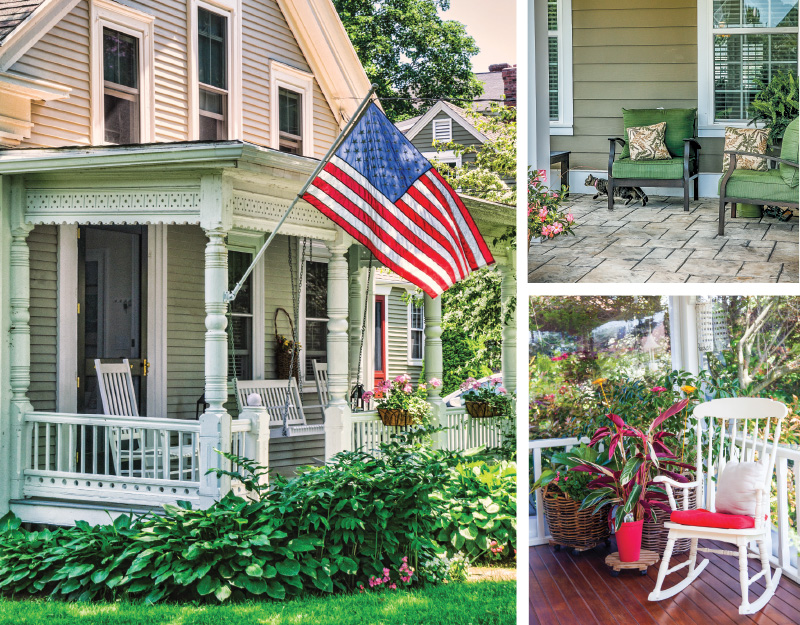
The front porch, especially, has always been a kind of social contract. It’s private, but not too private. Public-facing, but gentle. A place where neighbors wave, conversations begin without ceremony, and time stretches just enough to allow connection.

Historically, porches were designed for exactly this purpose. They cooled homes before air conditioning, yes—but they also cooled people. Rocking chairs encouraged lingering. Railings framed views of the street. Steps became seats for kids waiting on friends or adults swapping stories at dusk. Even now, a porch light left on in the evening still sends a quiet signal: you’re welcome here.

Patios and backyards carry that same spirit, just turned inward. Where the porch invites the neighborhood, the backyard gathers the household.

It’s where kids invent entire worlds with sticks and chalk, where dogs find their favorite patch of sun, where dinners stretch later than expected because the air feels kind.

porches

The Rituals That Root Us

Outdoor living spaces endure because they become containers for ritual. Not the grand, ceremonial kind—but the everyday ones that anchor us.

Morning coffee tastes different outside. It’s slower, less transactional. You notice birdsong, the weather, the way your body wakes up when it’s not immediately pulled toward a screen. In the evening, a porch or patio becomes a soft landing place—a transition between the busyness of the day and the quiet of night. Conversations meander. Kids play until the light fades. You sit without agenda.

These rituals matter because they repeat. They mark time. They give shape to days that might otherwise blur together. In seasons of change—new jobs, new babies, new phases of life—these small, consistent moments offer a sense of continuity.

Rest That Isn’t Performative

So much of modern rest has become curated: wellness routines, productivity breaks, optimized self-care. Outdoor spaces offer something simpler. They allow rest without instruction.

You don’t have to do anything on a porch. You can scroll, sure—but you’re just as likely to put the phone down.

You can read half a page and stare off into the distance. You can sit with someone and talk about nothing in particular. This kind of rest isn’t about improvement; it’s about allowance.

There’s also something grounding about being partially exposed to the elements—feeling the breeze, adjusting to temperature, watching clouds roll in.

It reminds us that we’re part of something larger than our schedules and to-do lists. That awareness, subtle as it is, can be deeply calming.

Spaces That Grow With a Family

Outdoor living spaces evolve alongside the people who use them. A porch that once hosted late-night conversations might later hold a swing for a sleeping baby. A backyard that started as a blank slate becomes a patchwork of memories: the tree that held a tire swing, the corner where a garden finally took, the patio where birthdays were celebrated year after year.

For children especially, these spaces are formative. Outdoor play encourages creativity, independence, and a sense of belonging to a place. It’s where scraped knees happen—and where resilience quietly takes root. Long after toys are outgrown, the feeling of those spaces often remains.

Why It Still Matters

At its core, the front porch effect isn’t about architecture or square footage. It’s about permission. Permission to slow down. To be seen without being on display. To connect without scheduling. To rest without justification.

As communities grow more dispersed and lives become more digitally mediated, these spaces offer something increasingly rare: unstructured togetherness. They don’t demand productivity or performance. They simply hold space—for conversation, for quiet, for the ordinary moments that, over time, add up to a life.

You don’t need a sprawling wraparound porch or a magazine-worthy patio to experience it. A small stoop, a folding chair, a string of lights—sometimes that’s enough. What matters most is the intention to step outside, to linger, to let life happen just beyond the threshold of your door.

Because sometimes, the most meaningful moments aren’t planned at all. They’re the ones that happen when you sit down for a minute—and decide to stay.


Rich in Arts

The Richmond Scene Needs to Be Seen

By: Butch Maier

Virginia Repertory Theatre actor McLean Fletcher has worked in the arts around the world but always comes back to Richmond. “I think it’s beautiful,” said Fletcher, who also is a filmmaker and a painter. “The walkability, the drivability, the climate, the tree-lined streets.

“I feel like Richmond is an oasis for me. I have an artistic community that challenges me in a positive way. “It’s big enough to find work but small enough that you can be heard.” No matter your voice.

“It’s diverse and bigger than I think people think—broader,” Virginia Rep artistic director Rick Hammerly said. “There is everything. There is so much music.

A lot of live music, which is amazing. Actual art—painting, photography—it’s everywhere. And I think the theater scene here is really dynamic.

“D.C. has grown into a behemoth, in terms of theater. But here, there are a smaller number, but what I like is the diversity that there is. While we [Virginia Rep] are the largest theater in town, there is another theater that specializes in new plays, there’s another theater which is the gay theater, there is another that does Shakespeare.

“You have all these niches so that if you’re a Richmonder, all of your theater needs are met.”

VIRGINIA REPERTORY THEATRE

Virginia Rep, a regional professional theater headquartered in downtown Richmond, staged Deathtrap (see page 96) in December and January at the Hanover Tavern.

Deathtrap actor Nathan Whitmer and his wife, actor Emelie Faith Thompson, moved to Richmond from Northern Virginia to upsize their home as well as to “hop on the elevator as it’s on its way up” while the Richmond arts scene reaches greater heights.

“We chose this community because we knew that we could come in and keep doing the art we wanted to do and hopefully grow with this community,” Whitmer said. “There’s a bunch of driven artists here—not just in the theater but in the visual arts. We have done a lot of film projects down here over the last eight years, whether it’s commercials or short narratives, so we’ve been down to Richmond a lot, and we’ve really enjoyed getting to know the arts scene down here. We want to help to grow that.”

Upcoming Virginia Rep shows include:
• Primary Trust, March 5-29, at Theatre Gym in the November Theatre complex
• The Cottage, March 27-April 26, at Hanover Tavern
• The Musical Adventures of Flat Stanley, April 11-May 3, part of the Jessie Bogese Family Series at the November Theatre
Website: va-rep.org

RICHMOND SHAKESPEARE

Fletcher will portray Lady Macbeth in Richmond Shakepeare’s March 27-April 18 run of Macbeth at Dominion Energy Center’s Gottwald Playhouse.
Website: richmondshakespeare.org

THE BYRD THEATRE (photo above)

I had never been to the Byrd.

I have longed to have one of my movies shown in that sensational cinema location, but I have yet to make something grand enough that makes it Byrd-worthy.

In the meantime, a few hundred other audience members and I gathered to see someone else’s Byrd-worthy pic: Steven Spielberg’s Jurassic Park…a movie I had neglected to see in a theater the first time around.

I know, I know. Why? I was a college graduate when it premiered in 1993. I was “too cool” to go see a dinosaur movie. I admit my mistake. Sure, I had watched it dozens of times in the past three decades, and it was impressive every time I saw it on TV, but at the Byrd in January, it was magnificent.
The creatures were enormous.

The action was incredible. And the laughs! Every joke played. What a wonderful time was had by all. Well, except for those who were eaten.
Website: byrdtheatre.org

VIRGINIA MUSEUM OF FINE ARTS

The Virginia Museum of Fine Arts bills itself as a world-class art museum with hometown hospitality.

Case in point: The VMFA displayed a collection of more than 50,000 works of art from almost every major world culture, welcomed indie filmmakers for the James River Short Films Showcase, and hosted an elegant private wedding reception—all in one weekend.

The top prizes in the short film competition went to Richmond’s Jeremy Drummond for Monument, the Texas duo Adam Dietrich and Elliott Gilbert for J.J., Richmond’s Nathan Conrad Piskator for Computer Blue, and D.C.’s Justin Lamb for Work From Home.
Websites: vmfa.museum, jamesriverfilm.org


Virginia Rep Takes a Stab at an Old Story, Gives Deathtrap New Life

By: Butch Maier / Photo above courtesy of Sutten Photography

Deathtrap, Ira Levin’s comedy-thriller play in two acts, was first staged in 1978. In January, the almost-a-half-century-old story felt new again. Plot twists drew gasps during a Saturday matinee performance of a Virginia Repertory Theatre production at Hanover Tavern, just north of Richmond. “Hanover is, honestly, one of the most charming little theaters I have ever sat in,” Virginia Rep artistic director Rick Hammerly said. “It’s only 150 seats, but you’re almost on the stage, so it’s very intimate, which is lovely.”

The sold-out crowd was as snug as a bug in a rug—or as a body on stage wrapped in a rug.

The brick production design matched the actual theater structure, adding to the atmosphere of audience members feeling like flies on a wall—with the show generating positive buzz during the intermission.

“There’s something about it that’s a little bit foolproof if you just do the script and put it up there, it’s gonna work,” said Virginia Rep actor Nathan Whitmer, who portrayed famous-but-struggling playwright Sidney Bruhl.

In Deathtrap, Sidney invites his student, Clifford Anderson (Axle Burtness), to his home to discuss Clifford’s new script, which Sidney recognizes as a potential hit. Sidney’s plans scare his wife, Myra Bruhl (McLean Fletcher), who tries to convince the two men to work together. Psychic neighbor Helga ten Dorp (Donna Marie Miller) also sees to it that she has plenty funny to say about the men’s interaction.

As Whitmer’s Sidney intensely shared his thoughts and plots aloud with a sharp tongue, Fletcher’s Myra deftly traversed a verbal tightrope between curtailing her husband’s evil intentions and enticing Burtness’s not-so-innocent Clifford to do a deal.

My favorite moment: Fletcher’s hilarious, never-ending yowl when a certain deed was done. Director Sidney Lumet’s movie Deathtrap, starring Michael Caine, Christopher Reeve, and Dyan Cannon, premiered in 1982—also the first year my family got HBO. It played over and over. Multiple times a day. I watched it again and again.

So, I had looked forward to seeing how the play, directed at the Hanover by Paul Takacs, would play on a stage. Many in the audience were seeing the story play out anywhere for the first time.

“What’s tricky in this day in age is what is theater being looked at to do right now?” Hammerly said. “We’re dealing with economic hardships—I mean, the country is. We’re dealing with a lot of stress. Do people want to be challenged? Or do they need to escape and be entertained? And trying to ride that line.

“This is a show that you can escape for two hours, and you’re on the edge of your seat because it turns and twists so much. So, I wanted to do something that would do that—that would allow people to escape, to live in a different world for a while.”

The Deathtrap world was one room that kept attendees on edge with 20-plus weapons hanging on the center-stage wall, waiting to be grabbed at any time. The actors deftly handled numerous props throughout, and every time one held a weapon, attendees anticipated a sharp plot point.

“Theater is constantly trying to bring in a new audience, and by that, I mean a younger audience,” Hammerly said. “Theater audiences tend to be a little older, and what happens when they’re no longer going to the theater? We need that next generation constantly to be stepping up. So, you can do some old chestnuts, and I think it’s going to turn off some of the younger folks.

“With a show like this, because of the themes of greed and murder—the fact that it’s a thriller, and it also has some comic stuff, it’s really engaging that I think all ages can really respond to it.” Audience members of all ages responded enthusiastically…and shortly thereafter quizzically, wondering if there was a twist they missed. They engaged in a debate about whether one actor played two characters, since a person was missing at curtain call. (The answer: No. Someone was on the mend.)

If you missed Deathtrap, I encourage you to head over to the Hanover or the November Theatre for another Virginia Rep play.

Maybe you will discover a show—either new or new to you—that will pull the rug out from under you.

For more on the Virginia Repertory Theatre season, go to va-rep.org/2025-2026.