

How Virginia’s revolutionary thinkers helped shape a nation—and left their mark on Central Virginia
Before there was a United States, there was an idea.
The belief that people possessed inherent rights.

That governments derived their authority from the consent of the governed. That liberty was not a privilege granted by a king, but a natural condition of humankind.
These principles, which would become the foundation of the Declaration of Independence and later the Constitution, did not emerge from Philadelphia alone. They were debated, refined, and championed by a remarkable group of Virginia thinkers whose influence helped shape the course of a nation.
As America prepares to commemorate its 250th anniversary in 2026, Virginia’s role in the birth of those ideals remains impossible to overlook. And while Lynchburg itself would not be incorporated until 1786—ten years after the Declaration of Independence—the region bears the imprint of the people and ideas that transformed a collection of colonies into a republic.
Among the most influential was Thomas Jefferson.
Born in Albemarle County and educated in Williamsburg, Jefferson drew heavily from Enlightenment philosophers when drafting the Declaration of Independence in 1776. His famous assertion that “all men are created equal” and possess “unalienable Rights” distilled a growing belief that legitimate government existed to protect individual liberty rather than preserve inherited power.
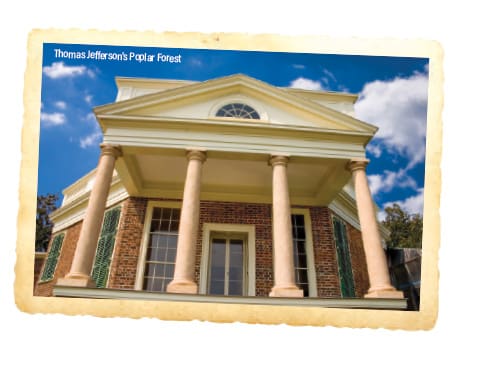
Today, visitors can explore Jefferson’s connection to the region at Poplar Forest, his retreat home in Bedford County. Though constructed after the Revolution, the villa reflects the intellectual curiosity and classical ideals that defined Jefferson’s worldview. The property offers a tangible connection to one of America’s most influential political philosophers and provides insight into the man whose words helped articulate the nation’s founding principles.
Jefferson was not alone in shaping revolutionary thought.
Nearly a month before the Declaration of Independence was adopted, George Mason authored the Virginia Declaration of Rights. Ratified in June 1776, the document asserted that all people possessed inherent rights, including freedom of the press, religious liberty, and protections against government overreach. Historians widely regard Mason’s work as a direct influence on Jefferson’s Declaration and, later, the U.S. Bill of Rights.
If Jefferson gave eloquent voice to the Revolution’s ideals, Patrick Henry supplied its fire.
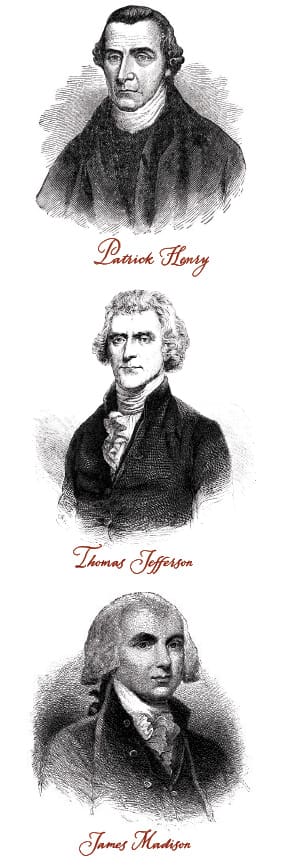
A gifted orator and fierce advocate for independence, Henry became one of the most recognizable figures of the Revolutionary era through his impassioned speeches against British rule. His declaration, “Give me liberty, or give me death!” remains among the most famous lines in American history.
Henry’s legacy is preserved at Red Hill, his final home and burial site in Charlotte County, less than an hour from Lynchburg. Overlooking the Staunton River, the property serves as a reminder that the fight for independence was not merely waged in distant capitals but was deeply rooted in the communities and landscapes of Virginia.
Another Virginian would help ensure that the ideals of the Revolution endured beyond independence.
Often called the “Father of the Constitution,” James Madison spent much of his life wrestling with a difficult question: How could a government protect liberty without becoming a threat to liberty itself?
Madison’s contributions to the Constitution and the Federalist Papers helped establish a framework of checks and balances that continues to shape American government today. His later advocacy for the Bill of Rights ensured that many of the freedoms first articulated by Mason and Jefferson became protected under federal law.
Taken together, these men represented more than a collection of prominent Virginians. They were participants in a broader intellectual movement inspired by Enlightenment thinkers who emphasized reason, individual rights, and self-government. Their ideas helped transform colonial grievances into a coherent philosophy—one that continues to influence democratic societies around the world.
For Lynchburg and Central Virginia, these stories are not distant history.
The roads, rivers, and communities that surround the city formed part of the landscape where revolutionary ideas took root and spread. The region’s proximity to sites such as Poplar Forest and Red Hill offers residents and visitors an opportunity to explore the people behind the principles that shaped the nation.
As Virginia commemorates the semiquincentennial, it is worth remembering that the American Revolution was not solely a military conflict. It was also a revolution of ideas.
Those ideas were debated in Virginia homes, written into Virginia documents, and championed by Virginia voices. They would eventually find expression in the Declaration of Independence and become the foundation of a new nation.
Two hundred and fifty years later, their influence remains all around us—not only in the historic sites that preserve their stories, but in the enduring belief that liberty, equality, and self-government are ideals worth pursuing.
Find Event Information and More at VA250.org
America’s 250th in Appomattox
July 3, 2026 – 8 p.m.
Celebrate America’s 250th anniversary with a spectacular event on Friday, July 3rd from 8:00 pm to 10:30 pm at Appomattox County High School, featuring a breathtaking 300-drone light show that will paint the sky with patriotic imagery including waving American flags, soaring eagles, and the stars and stripes in stunning aerial choreography, followed by a dazzling fireworks display that will light up the night in a brilliant tribute to our nation’s enduring spirit of freedom and unity.
Independence Day Celebration at Poplar Forest
July 4, 2026 – 10 a.m.
Thomas Jefferson held July 4th as “the only birthday I ever commemorate…” Bring your family and friends out to Poplar Forest, his Bedford County retreat, to celebrate the 250th anniversary of the adoption of the Declaration of Independence in historic style. Enjoy colonial-style entertainment, demonstrations by colonial artisans and craftspeople, archaeological displays, old-fashioned children’s activities, a reading of the Declaration of Independence at 1:30 p.m. and more. Tickets are $15/person ages 16+, under 16 are free. House Tours available for a reduced rate of $10 ages 18+, $7/ages 6-17, and free under 6.
Appomattox Liberty Golf Classic
July 10, 2026 – 8 a.m.
Experience Appomattox is proud to present the inaugural Appomattox Liberty Golf Classic: Where History Meets the Fairway. Join them for this premier event celebrating America’s 250th Anniversary in one of the nation’s most historic communities. Experience a unique 18-hole golf tournament at Falling River Golf Club alongside a continental breakfast to kick off the day. A ceremonial presentation of the colors by historical reenactors will take place as well as immersive historical elements and reenactments along the course.
Colonial Era Liberty Ball
July 11, 2026 – 6 p.m.
You’re invited to step back in time—Colonial Ball style. Visit Appomattox County for a lively 1776-themed ball celebrating the birth of our nation. Whether you’re eager to join in the dancing or prefer to relax and enjoy the atmosphere, there’s something for everyone. Colonial attire is welcome and will be admired but is not required—come as you are and enjoy the sights, sounds, tastes, and trivia of yesteryear.
Pamplin Train Depot – 115 Main Street, Pamplin, Virginia


