
Needle Ninja adds color and tactile arts to downtown Lynchburg
By: Olivia Carter | Photos By: Ashlee Glen
When customers step through the doors of Needle Ninja, they are immediately welcomed by color.

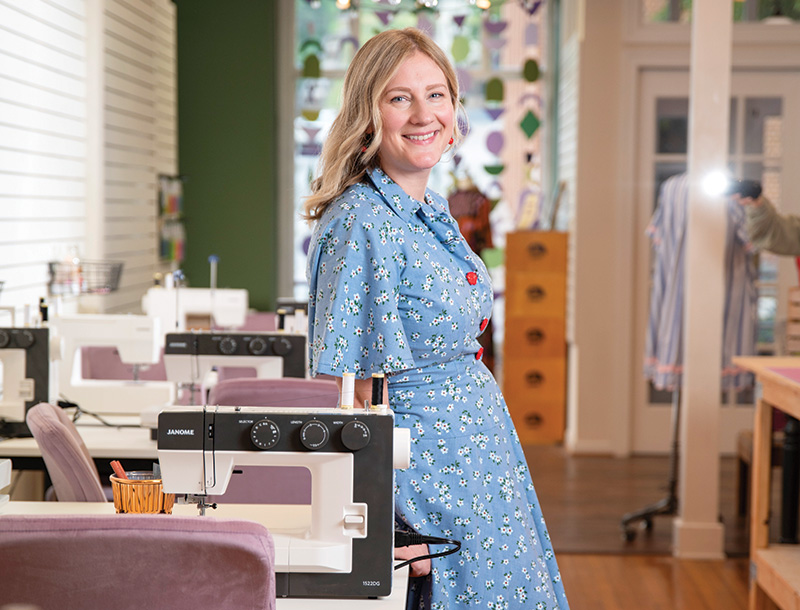
The entryway, painted in alternating lavender and lilac stripes, is intentionally playful and is the first clue that this is not a traditional fabric store. Inside, sunlight pours through tall windows onto tables filled with vintage buttons sold by the ounce, bolts of linen and denim, sewing machines waiting for their next makers, and carefully curated cross-stitch kits featuring literary icons such as Jane Eyre, Mary Poppins, and Anne of Green Gables.
It’s a space owner Lynne Forth says people often describe the same way: “happy, light-filled, airy.”
That atmosphere is exactly what Forth hoped to create when she opened Needle Ninja in downtown Lynchburg—a place where creativity feels approachable and sewing feels less like a niche hobby and more like an invitation.

“I’ve always had entrepreneurial goals and dreamed of having my own shop,” Forth said. “This really combines a few different passions and loves for me.”
For Forth, sewing is much more than a business model. It’s a language.
This began about 15 years ago, when she took her first sewing class while earning a degree in fashion merchandising. Though she had grown up watching her mother sew, she wasn’t sure at first whether the craft was for her.
That changed after making a simple pillowcase.
“I just thought, ‘Oh my gosh, I made a pillowcase with my own two hands, with just some thread and some fabric. This is incredible,’” she said. “And it just kind of took off from there.”
Her passion deepened while working at Liberty University, where she designed and created costumes for theater productions. There, she learned that fabric could tell stories before an actor ever spoke a line.
“I fell in love with color theory and what color can convey on stage,” she said. “What can I tell the audience without using words just by using fabric or shape or pattern?”
That fascination eventually shaped her graduate work in strategic communication, where she studied how clothing communicates identity and emotion. It also helped define the mission behind Needle Ninja: not just selling fabric, but teaching people how to make something meaningful.
“As a way of showing other people, this is something you can do, something you can be passionate about, use to make an income, or use to empower yourself,” Forth said. “If you are sewing something and it turns out well and you’re proud of it, it’s a beautiful way to gain confidence.”

Needle Ninja arrives at a time when handmade skills are experiencing renewed interest. In an age dominated by online shopping and fast fashion, Forth believes many people are craving something slower and more tactile.
“People want to make something with their own two hands,” she said. “They want to do something in person. They’re tired of trying to look things up on YouTube and not having someone next to them who can say, ‘That’s right, but if you do it this way, it’ll be even better.’”
She believes people are looking for even more than just sewing. They’re looking
for connection.
“People are craving community,” Forth said. “A lot of arts can feel isolating because you’re often doing them alone. Here, you get the creative world and community together.”
Some of the vintage fabrics displayed throughout the store belonged to Forth’s late grandmother, an avid collector and sewer.
“The fact that we’re getting to use that again is really, really special,” she said. “It kind of makes it so that she’s all over the store with us.”
Her mother’s influence is even more visible.
Forth describes her mother as both a lifelong maker and one of her biggest inspirations. A master of Norwegian Hardanger embroidery, or Hardangersøm, her mother now spends part of the year in Lynchburg helping teach at Needle Ninja.
“She’s one of my best friends,” Forth said. “To be able to do this with her, to give her a space where she can teach people and meet people, is just so special.”
That family legacy helps explain why Needle Ninja feels less like a store and more like a gathering place. Customers wander in for different reasons. Some are experienced sewists thrilled to have a dedicated downtown creative space. Others are complete beginners who saw the shop’s bright windows and simply got curious.
“We’ve had people walk in and say, ‘I saw the word needle and wondered what that meant,’” Forth said with a laugh. “And then we get people who say, ‘My grandmother sewed all our clothes growing up, and I’d love to carry that on for my children.’”
Needle Ninja is built for both groups.
Its large communal cutting table, a feature many home sewists don’t have space for, invites customers to spread out and work. Rows of sewing machines sit ready for classes and open studio sessions. The goal, Forth says, is not just to teach people to sew, but to create a place where they want to stay.
That mission also has an environmental edge. Forth is outspoken about the waste generated by fast fashion and hopes sewing can offer an alternative.
“There’s this steady pipeline of cheaply made garments that’s taking up landfills,” she said. “For me, it’s not always about making something cheaper than buying it. It’s about having something unique to you.”
That uniqueness, she believes, especially resonates with younger generations.
“Gen Z and millennials are looking for something personalized,” she said. “What’s more personalized than making your own clothes?”
Forth’s ambitions extend beyond retail. She hopes to launch a sponsorship program that would allow local middle school, high school, and college-age students to take sewing classes for free, funded by businesses and community donors.
“I would love to see local companies and philanthropists invest in kids who want to learn this skill,” she said. “It could become a career, a side hustle, or just something that gives them confidence and purpose.”
She also envisions future summer camps, after-school programs, and an expanded roster of instructors so students can learn a wider range of textile arts.
“My goal is not to always be the one teaching every class,” she said. “I’m always learning, myself. There’s always someone who knows something different, and I want our students to benefit from that.”
For now, though, Forth is focused on what’s directly in front of her, opening the doors each day and watching people discover, sometimes for the first time, the joy of making something by hand.