
Preserving a Hidden Language of Freedom
By: Shannon Kelly | Photos By: Ashlee Glen
At 99 years old, Edith Younger Edmunds is still stitching—and with every thread, she’s weaving a deeper connection to her heritage. What began as a childhood pastime has evolved into a late-in-life mission: bringing the story of the Underground Railroad to life, one quilt pattern at a time.

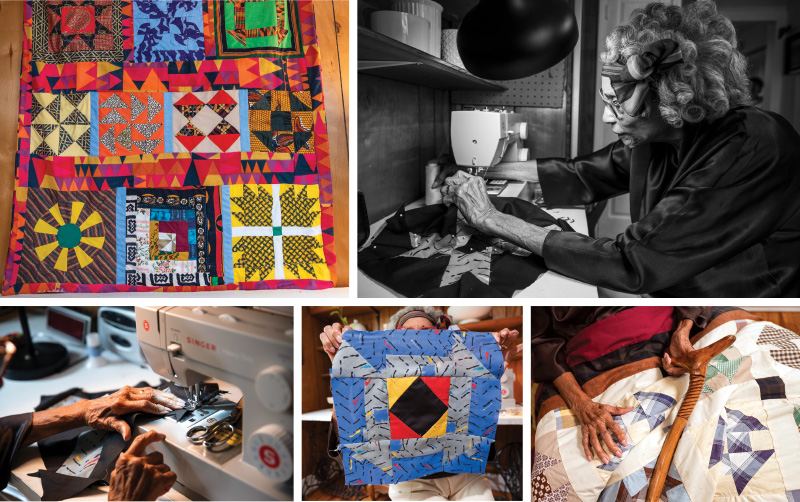
Edmunds has been quilting since she was seven, but it wasn’t until her 80s that she discovered a powerful intersection between her lifelong craft and the coded patterns once believed to guide enslaved people to freedom.
Though the historicity of the quilt code is disputed, it is nonetheless a fascinating story, and the distinct patterns are a rich part of art history.
As children, Edmunds and her twin sister—two out of the family’s twelve children—used scraps from their mother’s sewing projects to create patterns, which they sewed onto magazine pages. The result was a quilt, which the girls’ father proudly showed off any chance he got.
“He called it a spread. ‘Go get that spread so I can show it to my friend.’ He said, ‘This is what my girls did, my twins did, seven years old.’ He was so proud of us doing that,” Edmunds said.
When she got older, Edmunds got paid to do alterations and saved some money to buy her first sewing machine, which had a treadle. Later, she bought a motor to modify it.
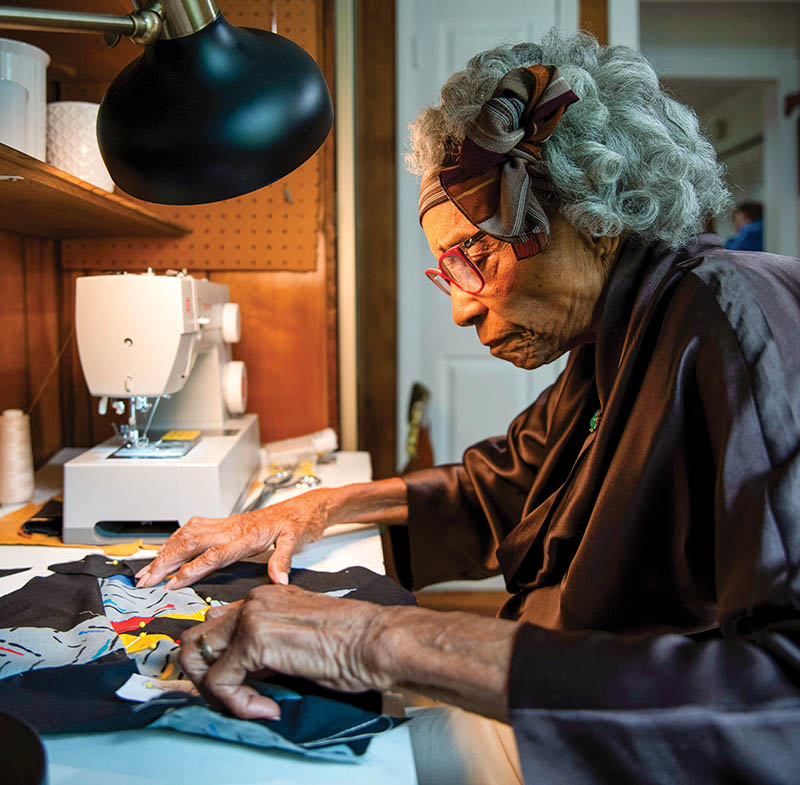
“I put that motor on myself, and that made me be able to sew a little faster, and I could get things done quicker,” she remembered.
Edmunds was a stay-at-home mom after she started her family, but once her daughter, Amy, started school at Sinai Elementary, Edmunds got a job as a teacher’s aid there—but she never stopped sewing. She went on to work in the fabrics department for Belk’s, where she spent 18 years of her career.
“I crocheted, I did needlework, I did embroidery. All of this was a part of my…I call it my career of sewing,” she said.
Edmunds passion for sewing and, in particular quilting, pivoted and grew when she learned about how textiles were said to be used in the Underground Railroad.
“I guess it probably was about 15 years ago, may not have been that long. I was reading a little magazine called Guidepost, and in that little book, it had a picture of the Underground Railroad in it… I ordered the pattern of the Underground Railroad, and I made the first hanger, and it turned out so pretty,” she said.
From there, Edmunds tackled more patterns and learned about their symbolism as she went. She read books on the history of the Underground Railroad, and when the movie Harriet came out, she and her daughter both loved it; Harriet Tubman’s story spurred Edmunds’ interest in the Underground Railroad.
In 1860, around the time of the Civil War, Virginia had the largest enslaved population of all the Confederate states. Four generations of the Edmunds family have come from Halifax County. According to the 1860 census, enslaved people made up the majority of the county’s population. Nelson Edmunds, Amy’s great-great-grandfather, was born on the Red Field plantation there.
He would have been five or six years old at the time of emancipation, Amy—who researches her family’s genealogy—said.
While none of her ancestors ever escaped —at least not to the Edmunds’ knowledge—Edmunds was nevertheless fascinated by the inventive ways abolitionists, allies, and escapees operated the famous covert network. The story of the quilt code is one where messages were hidden in plain sight, under the guise of commonplace household items that would seem totally innocuous to individuals who weren’t in the know.
These quilt patterns were fascinating and also challenging for Edmunds to undertake.
The Crooked Path, for example, is tricky to achieve due to the cut of the pattern.
“That means that… you can’t walk straight,” Edmunds said. “They walk zigzag, so if somebody is trying to catch up with them, they can’t follow their crooked road.”
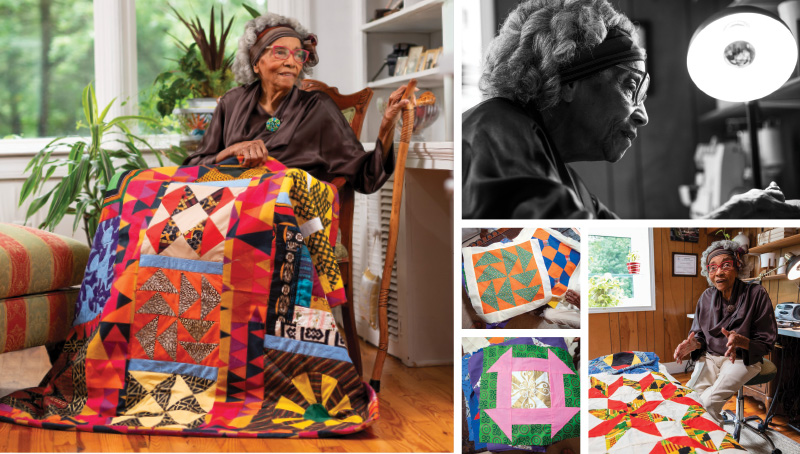
Whether taking a crooked path or a straight one, passengers on the Underground Railroad could identify allies by a “shoofly” pattern, made with four triangles around a center square.
“The shoofly is a person who would secretly help the enslaved. By that, I mean…this secret person would hide the enslaved in caves, or a church, or graveyard. He would do that, risking his own life,” Edmunds explained. “He would give them clothes to clean themselves up so they could go downtown and pass as free. They would be dressed in clean clothes, because when you’ve been walking to escape, your clothes get dirty.
So, this shoofly, he would help them.”
The bear paw pattern is characterized by four squares in the center, with outer edges that look like a bear’s paw.
“That bear paw, it tells the enslaved to follow the bear. It would go to where food and water were,” Edmunds said.
The flying geese; the bow tie, or hourglass; Jacob’s Ladder; nine-patch; the North Star; all these patterns are associated with the tradition of a quilt code.
Pattern recognition was the key to reading these symbols, Amy said: any colors could be used, but the colors themselves did not hold meaning.
“To look at the bear claw, somebody may have made it using blue and red. Somebody else may have made it using all black, but they would have had to have been able to focus on that design, to recognize it, no matter what the color or how incremental the seamstress had made the different parts, but to still be able to see that overall design,” she said.
These patterns could theoretically be combined to form messages, as well.
“That’s part of the intrigue in creating these images. It’s like, how many messages can I combine? Or, what if I wanted to try to create a message that has multiple meanings? And you can do that. You can imagine that, but I also have such an appreciation for the eye that the guide must have had, to be able to see the design so clearly, in spite of it being different every time,” Amy said.
Quilting takes a lot of time, and a lot of materials. Enslaved women who endeavored to make any of these patterns likely had extremely limited resources. Amy added: “There was no JoAnn’s Fabric.”
“From our perspective, it was difficult for us to imagine them making a full-sized quilt with a repeating pattern of the same square. It occurred to us that it is possible that they may have made something similar to a string quilt, and then just attached almost like an applique, one of these patterns,” she said. “If you knew what you were looking for, you would recognize it.”
Perhaps due to limited textile resources, the patterns were sometimes etched in dirt or marked elsewhere in another fashion.
Travelling the Underground Railroad was treacherous for anyone involved.
Out of the numbers of enslaved people who fled, relatively few made it all the way to freedom, Amy said.
Edmunds has been on a mission to educate others about the Underground Railroad, and the story of the quilt code, sharing her interest in the general history of the system, but also her perspective as a seamstress.
She has visited schools where she showed children how mathematics and art collide when it comes to quilting, hoping to inspire them, and demonstrate how the subjects they learn in the classroom apply to real life. The wagon wheel pattern is a prime example.
“The wagon wheels have a lot of different angles to be cut, and put together,” Edmunds said. “I told them, I said, ‘Now, all these pieces are not the same. You’ve got a rectangle, you’ve got a triangle, you’ve got a square.’ I said, ‘You’ve got to know how to measure to get those angles just right. If you don’t, your pattern’s not going to come out right.’”
Edmunds has done a variety of other engagements where she educates communities about the Underground Railroad and the quilt code. She brings samples of her work along, displaying them for audiences to examine as she delivers an informational presentation. She has participated in television interviews, a segment with NPR, and worked with various news outlets.
At 99 years old, quilting and educating remain Edmunds’ passions. She has no plans to slow down. She brings textile projects with her even on car rides. Looping is one of her more recent practices, in addition to embroidery, crochet, and quilting.
“I just like staying busy,” she said.